

The exchange has been doing it [ethics training] for years but it never changes the traders’ behavior because there are rules and then there are rules.…Society has rules and then there are legal rules but traders are their own society and have their own rules and those are the ones you follow on the floor (trader interview).
At a time when business scandals are commonplace, regulators often turn to formal financial sanctions to punish wrongdoing. For instance, in 2016 the US Securities Exchange Commission (2016) assigned financial sanctions totaling $4 billion. Yet, employee deviance persists despite elaborate, and costly, formal sanctioning systems. To understand the persistence of illegal conduct, Smith, Simpson, and Huang (Reference Smith, Simpson and Huang2007) designed a study of managers using vignettes of corporate crime and found that expectancies involving informal social sanctions such as loss of respect from family, friends, and business associates played an important role in the effectiveness of the formal legal sanctions. Importantly, in their study of managers, informal social sanctions supported the formal legal sanctions. What happens when the informal sanctioning system is at odds with the formal sanctioning system?
This question is particularly important for organizations that adopt formal sanctioning systems to curtail unethical workplace behavior because an informal sanctioning system that promotes unethical behavior may render the formal sanctioning system ineffective. Little empirical research, however, captures how informal sanctioning systems (e.g., praising, scolding) influence organizational deviance in the workplace, especially when informal sanctions compete with strong formal sanctioning systems (e.g., financially rewarding, demoting). Scholars who study collective corruption, however, theorize that informal sanctioning systems promote corruption through informal influence that entails manipulating employees’ sense of pride, fear, embarrassment, and moral disengagement (Ashforth & Anand, Reference Ashforth and Anand2003; Moore, Reference Moore2008; Smith-Crowe & Warren, Reference Smith-Crowe and Warren2014). Using a unique research setting where the interplay of informal and formal sanctioning systems and deviance are observable, I conducted an ethnographic study of exchange deviance among traders in six trading crowds on two financial exchanges. The purpose of this study is to understand how informal sanctioning systems compete with formal sanctioning systems to influence organizational deviance, which in this context constitutes deviance from the exchange’s rules regarding trader behavior on the floor of the financial exchange (referred to as “exchange deviance”).
The financial exchanges, as a means to combat traders’ informal sanctioning system, not only banned specific trader behaviors that violated exchange rules (e.g., trading without stating a market), but also banned the informal sanctions used by the traders (e.g., ostracism, harassment, physical threats) to reinforce traders’ informal norms because the informal norms clashed with the exchange rules. Essentially, the financial exchange prohibited the sanctioning tactics that the traders used to enforce their own informal norms by categorizing these tactics as violations of the exchange rules (i.e., exchange deviance). The exchanges’ approach was largely effective in deterring informal trader sanctions that took the form of physical fighting. However, informal trader sanctions that included ostracism and social rejection (which both exchanges regarded as the smallest of minor rule violations according to the fine schedule) evaded the formal sanctioning system because they were difficult for the exchanges to detect and unlikely to be reported by observers. Yet these seemingly minor sanctions were interpersonally hurtful and hindered trading performance. Since trading performance determined a trader’s pay, the traders could affect each other’s compensation through minor informal social sanctions (ostracism and social rejection) which might entail discouraging or even excluding one from participation in a trade. Thus, despite elaborate rules with corresponding sanctions for infractions as well as organizational representatives who monitored behavior, the financial exchange did not detect certain types of informal trader sanctions which allowed the informal trading norms and exchange deviance to persist.
This study contributes to the behavioral ethics literature in three ways. First, I find evidence that explains how a system of competing sanctions can emerge. My findings suggest that the shared work value—equity—is enacted differently by individuals within the same organization. More specifically I document a conceptualization of equity from the traders’ perspective, which is grounded in contributions to the trading crowd over time, and from the financial exchange’s perspective, which entails equal access to every trade without regard for seniority or reciprocity. This difference explains how organizational members who embrace the same values but enact them differently can develop competing sanctioning systems. Second, I identify different strategies within each of the competing sanctioning systems and demonstrate how the interplay between these strategies can be manipulated and exploited to promote a desired behavior. The financial exchange’s formal sanctioning system banned informal traders’ sanctions in order to reduce exchange deviance. The traders, however, could evade the formal sanctioning system through informal social sanctions involving ostracism and social rejection, which were difficult to detect yet interpersonally and financially damaging. Third, building on the existence of interplay between sanctioning strategies, my findings establish an important linkage between sanctions themselves. When traders’ informal sanctions sabotaged the performance of other traders, trading firms imposed sanctions related to compensation. I assert that this linkage strengthened the influence of the trader’s informal sanctioning system. This pattern conflicts with the current depiction of sanctions as isolated events, which is commonly found in the predominant deterrence and social learning theories (Hollinger & Clark, Reference Hollinger and Clark1982, Reference Hollinger and Clark1983; Smith et al., Reference Smith, Simpson and Huang2007; Smith-Crowe & Warren, Reference Smith-Crowe and Warren2014; Tenbrunsel & Messick, Reference Tenbrunsel and Messick1999; Warren, Reference Warren, Mannix, Neale and Tenbrunsel2006; Warren, Gaspar, & Laufer, Reference Warren, Gaspar and Laufer2014). My research points to the coupling of sanctions in ways that allow informal sanctions to harness formal sanctions to reinforce informal norms, which run counter to the formal rules of the exchange.
In the next section, I discuss the current state of research on sanctioning systems and highlight gaps in knowledge which are addressed in this study. After reviewing the literature, I introduce the research method, present study findings, and follow with a discussion that links this study’s findings to the broader literature on sanctions, and discuss implications for research and practice.
COMPETING SANCTIONING SYSTEMS AT WORK
Organizational sanctioning systems are thought to play an important role in curtailing workplace deviance, which is characterized by behavioral departures from the informal norms or formal rules of a group or organization (Warren, Reference Warren2003). The focus of this study is exchange deviance that constitutes behavioral departures from the exchange’s rules. Sanctioning systems entail several components including the sanction type, sanction severity, and detection processes, which then affect the likelihood that the sanction will follow from deviance. In this section, I start by considering what constitutes a sanction and the ways that past research contributes to our understanding of how sanctions, which vary on different dimensions, deter or promote deviance.
Sanctions Characteristics
Sanctions are often referred to as rewards, inducements, reinforcements, incentives, penalties, fines, and punishments (Ashforth & Anand, Reference Ashforth and Anand2003; Hollinger & Clark, Reference Hollinger and Clark1982, Reference Hollinger and Clark1983; Mulder, Reference Mulder and DeCremer2009; Nelissen & Mulder, Reference Nelissen and Mulder2013; Smith et al., Reference Smith, Simpson and Huang2007; Smith-Crowe & Warren, Reference Smith-Crowe and Warren2014). Sanctions motivate individuals to act in accordance with norms or rules by either incentivizing individuals to display desired behaviors through rewards or deterring them from exhibiting undesirable behaviors through punishments (Hollinger & Clark, Reference Hollinger and Clark1983; Smith et al., Reference Smith, Simpson and Huang2007; Warren, Reference Warren, Mannix, Neale and Tenbrunsel2006). Because workplaces involve a complex array of sanctions, scholars strive to identify which sanctions are most effective in promoting conformity to organizational rules by examining the attributes of sanctions, including the sanction type (social versus financial), source (informal versus formal), certainty, severity, as well as the strength of the overall sanctioning system (Bowles & Polanía-Reyes, 2012; Hollinger & Clark, 1982, 1983; Nelissen & Mulder, Reference Nelissen and Mulder2013; Smith et al., Reference Smith, Simpson and Huang2007; Tenbrunsel & Messick, Reference Tenbrunsel and Messick1999; Warren, Reference Warren, Mannix, Neale and Tenbrunsel2006). As I will discuss, past research provides insight into important attributes of sanctions and monitoring. These fine-grained analyses, however, present unanswered questions about features of sanctioning systems as they unfold in a work context, especially when they compete for influence.
Informal versus Formal Sanctions
The power of informal sanctions is deftly documented in the work of Barker (Reference Barker1993) who describes the emergence of a rigid informal system—one that surpassed that of the formal organization—within self-managing teams. Barker’s (Reference Barker1993) findings help us understand the strong informal sanctions found in classic research on factory workers, which provides rich accounts of conflicts between the sanctions of managers and coworkers. For example, Roy’s (Reference Roy1953) study of factory quota systems reveals a competing set of sanctions that motivated factory workers. Management’s positive financial sanctions, which promoted worker productivity, conflicted with the workgroup’s system of negative sanctions where “aiming too high would have brought extreme criticism and possibly severe penalties from the group” (Roy, Reference Roy1953: 513). Similarly, Roethlisberger and Dickson (Reference Roethlisberger and Dickson1961) documented the use of “binging,” hitting a coworker hard in the arm, to punish fast workers who produced too much output. Roy’s (Reference Roy1953) and Roethlisberger and Dickson’s (Reference Roethlisberger and Dickson1961) pioneering works captured the tension between competing informal and formal sanctions but stopped short of describing the processes or mechanisms that determine when informal sanctioning systems undermine formal sanctioning systems.
The desire to understand the interplay between informal and formal systems continues today with systematic quantitative research aimed at revealing differences in relative power. In one of the most comprehensive studies on employee deviance and sanctions, Hollinger and Clark (Reference Hollinger and Clark1982) surveyed over nine thousand employees across three industries on workplace sanctions and found that informal coworker sanctions (e.g., “discourage,” “avoid the person”) affected self-reported deviance more than the formal sanctions of managers (e.g., “reprimand,” “fire”). The authors assert that “the reaction of one’s fellow workers, not management, seems to be the more influential in establishing normative limits on the acceptable range of workplace behaviors” (Hollinger & Clark, Reference Hollinger and Clark1982: 342). As mentioned earlier, Smith and colleagues (Reference Smith, Simpson and Huang2007) also found informal sanctions played an important role in deterring deviance in a vignette study on corporate crime with managers. While both studies provide important insights into the effects of sanctions on deviance, both the informal and formal sanctions discouraged the same behavior: employee deviance. Unfortunately, these studies do not capture what happens when informal sanctions promote workplace deviance and formal sanctions discourage it, which is an important dynamic for organizations struggling with workplace deviance.
Social versus Financial Sanctions
The classic factory settings often pit financial sanctions against social sanctions and subsequent empirical research has attempted to determine if the type of sanction matters. In a causal test of social and financial sanctions on compliance, Nelissen and Mulder (Reference Nelissen and Mulder2013) used a public goods game to test the effects of a social sanction (expressing disapproval) and a financial sanction (imposing a fine) on norm compliance after the sanction was removed. They found that once the sanction was removed, social sanctions were more effective than financial sanctions in reinforcing norms. The authors suggest these findings are particularly important for environments, such as workplaces, where monitoring is imperfect and sanctions may not follow after every infraction (Nelissen & Mulder, Reference Nelissen and Mulder2013). While this study demonstrated the difference between the effectiveness of social sanctions over financial sanctions, the sanctions reinforced the same, not opposing, behaviors. The findings are valuable but leave unanswered questions about the relative effectiveness of social sanctions when, for instance, social sanctions promote deviance and financial sanctions discourage it, which was the dynamic experienced on the factory floors (Roethlisberger & Dickson, Reference Roethlisberger and Dickson1961; Roy, Reference Roy1953).
Weak versus Severe Sanctions
In addition to studying the type and formality of the sanction, scholars theorize about the importance of sanction severity on compliance, and several empirical studies point to sanction severity as a predictor of deviance (Hollinger & Clark, Reference Hollinger and Clark1982, Reference Hollinger and Clark1982; Mulder, Verboon, & De Cremer, Reference Mulder, Verboon and De Cremer2009; Verboon & van Dijke, Reference Verboon and van Dijke2011). Hollinger and Clark (Reference Hollinger and Clark1983) found perceived severity of organizational sanctions related to employee theft. Similarly, Verboon and van Dijke (Reference Verboon and van Dijke2011), using a field study on tax compliance and a laboratory study on plagiarism, found severe sanctions promote compliance when the study participants perceive the authority associated with the sanctioning system as fair. The difficulty faced by researchers studying sanction severity is that in the workplace, severity is most accurately measured relative to other sanctions and a sanction’s severity is difficult to capture outside of the context. For example, it is difficult to determine the strength of a positive reward for meeting a production quota independent of the other sanctions at play in the workplace, such as the scorn of a coworker for producing too much. Currently, the literature is missing a comparative analysis of informal and formal sanctioning systems as they unfold simultaneously. Another important determinant of sanction effectiveness in a work context is the detection process; if deviance is not detected then sanctions, even severe ones, are not likely to occur.
Detection of Deviance
Logic suggests sanctions require detection and a lack of detection causes the highest levels of deviance. Tenbrunsel and Messick (Reference Tenbrunsel and Messick1999), however, found that weak sanctioning systems, operationalized as low monitoring, promoted more defection than a condition with no sanctioning system (no monitoring) in a series of laboratory studies. Importantly, study participants in the weak sanctioning condition were more likely to possess a “business” decision frame while those who faced no sanctions were more likely to possess an “ethics” decision frame. The authors theorize that defection was higher in the weak sanctioning system because the sanctions signaled a “business” decision frame, and because of the weak sanctioning condition defectors thought they were unlikely to get caught (Tenbrunsel & Messick, Reference Tenbrunsel and Messick1999). Such studies provide important insights into the ways in which monitoring of deviance can induce specific mindsets that then affect willingness to break rules. They also lead to questions regarding the influence of monitoring in a work context where multiple sanctioning systems influence workers and the organization is not the only source of detection, such as when workers are able to report deviance too.
Taken together, these studies demonstrate that various sanction attributes affect sanction effectiveness in reinforcing desired rules or norms. Past research suggests informal sanctions are more influential than formal sanctions; social sanctions are more effective than financial sanctions when monitoring is spotty; and weak monitoring is worse than no monitoring when predicting the likelihood of defection in a social dilemma. By isolating various aspects of the sanctioning systems, past studies advance our understanding of how sanction attributes influence behavior. These studies fall short, however, in explaining how sanctions that vary along multiple dimensions interact in a workplace, especially when they reinforce opposing behaviors. Here I use an observational study in a work setting where sanctions and deviance are observable to analyze how informal and formal sanctioning systems interact to influence deviance when they are reinforcing opposing behaviors. I begin by describing the work context of this study and the values endorsed by the traders and the exchange. I then follow with a comparison of the informal and formal sanctioning systems observed on the exchange floor with the purpose of examining the interplay between systems. I end with a discussion of when the informal sanctioning system undermined the formal sanction and how these findings inform current research.
RESEARCH METHOD
Research Setting
I conducted an observational study of traders who worked on two financial exchanges that traded the same assets.Footnote 1 The term “exchange” refers to the membership organization that governs trading as well as the physical location where the market makers, brokers, clerks, floor officials, and exchange employees meet to trade.
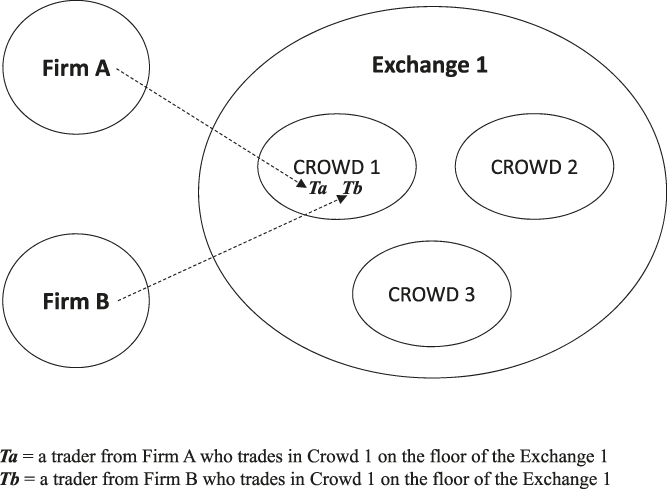
The designated area where trading occurs usually involves some form of physical structure that signifies that the area is dedicated to trading specific assets. This area may be referred to as the “desk,” “post,” “pit,” or “crowd” for a particular asset. Stable groups assemble around trading areas based upon the assets being traded. For this study, the location and the group that formed at the location will be referred to as the crowd. Traders, who are employed by different firms, buy and sell the same asset in the same crowd every day. Figure 1 demonstrates the way trading firms relate to trading crowds on a financial exchange.
Diagram Of Trading Crowds, Firms, and the Financial Exchange

I chose this population because past research and descriptions in the popular press suggested there was observable conflict between norms and the related sanctions (Abolafia, Reference Abolafia1996; Baker, Reference Baker, Adler and Adler1984). Furthermore, traders are regularly observed while they conduct their work and I surmised they would be less likely to change their behavior due to an observational study. Crowds are stationed close together such that traders located in one crowd can often view the behavior of traders in several other crowds on the exchange floor and exchange floor officials who walk around the floor also observe traders to monitor their behavior. The public can also view trader behavior from public observation booths at any time during the day. On some exchanges, television networks place correspondents on the floor of the financial exchange to report daily financial news while standing in front of trading crowds. Exchanges also regularly invite guests from the financial industry and the media as well as politicians and celebrities to tour the floor. Thus, traders are frequently observed while they work.
The traders in this study convene in their crowds and, as part of their agreement to stand in the trading crowd, “make markets,” which means they must be willing at all times to give a buy and sell price for a particular asset. This market is offered without the knowledge of whether or not the requestor wants to buy or sell, and importantly, the trader must be willing to follow through with a transaction at the stated market. Traders yell out their markets in an auction format, and the trade is supposedly awarded to the first and loudest trader with the best price. Rules exist regarding the nature of making markets but ultimately the traders are obligated, while standing in their crowds, to make a two-sided market: a price at which the trader will buy the asset (a bid) and sell the asset (an offer). If the market conditions are volatile and unfavorable the trader may state an unfavorable spread but declining to make a market or remaining silent is unacceptable according to exchange rules. Traders carefully state their markets because the individual requesting a market may demand a transaction and the trader must make a trade at the given market (either buy or sell).
Because traders who work for the same firm typically do not trade in the same crowd, traders usually spend more time with crowd members than with anyone from their own firm during the day. All day crowd members stand side-by-side, with very little space between them, watching electronic screens for movements in financial conditions, which guide their trading choices and the calculation of their markets.
Participant Observation
I gained access to two financial exchanges through two trading firms. These firms, with approval from the exchanges, provided me with access to the trading floor as well as access to their offices. After spending several days walking around each trading floor and examining reports on trading crowd activity, I chose 6 crowds with a total of 194 traders for this study because they 1) provided a range of crowd sizes (from 6 to 53 traders); 2) displayed a range of assets; 3) were well-established (in existence for more than 3 years); and 4) exhibited variance in trading activity (i.e., experienced slow trading days and active trading days), which allowed me to see how sanctions occurred across trading conditions.
During my time on the trading floors, I spent an average of three days per week on-site observing the traders in their crowds over a nine-month period. In addition, I observed 3 trading firms outside of the exchanges for 47 hours over a period of 9 months as well. My firm observations included new trader training sessions and daily meetings before the opening and after the close of the market. When on the exchange floor, I wore a trading jacket and badge, and all traders in the crowds I observed were told that I was an academic researcher studying trader behavior. This introduction prompted many traders to tell stories about their own behavior as well as that of others. They also shared their trading philosophy and critiques of the trading environment and appropriate crowd behavior. Traders chose to share their more unusual experiences (e.g., arguments, physical altercations, behavior under tough financial conditions). When trades were announced or conflicts arose, traders quickly turned away and ignored my presence. While I was on the exchange floor, I took notes throughout the day in my notebook or handheld device and typed field notes at night. All names were recorded as pseudonyms.
It is important to note that my study only captures observable conduct violations (intimidation, harassment, physical or verbal abuse, etc.) that the exchanges label as “minor” violations. A large percentage of the exchange monitoring is focused upon trading violations that involve fraud or illegal trading that are difficult for an observer in a trading crowd to detect. For instance, if a trader engaged in front-running, money laundering, insider trading, or otherwise falsifying trading circumstances, I could not obtain such information so those violations fell outside the scope of my study.
Documents and Interviews
The exchanges have their own constitutions, training sessions, and exams for traders. All traders receive a constitution containing the rules and regulations that apply to trading on that exchange and must attend training sessions as well as pass the exchange’s exam. I was not able to gain access to a training session as they were for members only, but I received copies of training books and materials and asked traders who attended exchange training to describe the activities and lessons involved in each day of training. These traders described similar experiences in which instructors, some employees from the exchange and some contractors with exchange experience, read through the materials presented in the books, and when appropriate, provided contextualized examples.
In order to understand the exchanges’ position on matters regarding trading and sanctions, I consulted (a) training materials provided to all traders (69-page binder for Exchange 1; 190-page binder plus 35-page supplement for Exchange 2), (b) the exchange constitutions, which outlined the rules and penalties for violations (336 pages for Exchange 1, 880 pages for Exchange 2), (c) intermittent 1-page notices issued on matters pertaining to trader behavior (as opposed to those regarding changes in technology and other technical matters related to trading), and (d) weekly newsletters sent to exchange members on topics of interest to traders such as the trading seat prices, membership applications and leases, changes to back office procedures, and recent disciplinary decisions (ranged from 5-10 pages). While the exchanges in my sample had different materials, they were both regulated by the same bodies and therefore their materials possessed the same general messages regarding trader behaviors and expectations regarding the process of trading. The bulk of the literature focused on the proper statement of markets, rules of the open outcry system, position limits, reporting of positions, trading under special circumstances, and the prohibition of collusion, intimidation, and harassment.
When observing the trading firms, I received daily trading reports and firm memos that served as information on the key indicators of performance for the trading firms. I also observed and received materials used for 12 training sessions across 3 firms. The training sessions varied in length from 60 to 90 minutes and were conducted after the close of the market. Two of the trading firms that I observed used mock trading sessions to train new traders. Observing the firms’ mock trading sessions provided an opportunity to view how firms encouraged traders to conduct themselves on the exchange floor. Through my interviews, I learned many firms use mock trading to teach new traders how to make markets in crowds.
During my observations in the trading firm offices and on the exchanges, I repeatedly spoke with informants who fell into the following categories: 40 traders, 6 brokers, 17 clerks, and 12 firm managers. With the exception of two formal interviews conducted after the completion of the observational study, the interviews were informal and unstructured but generally focused on trader behavioral norms and sanctions that typically follow from norm violations. The interviews occurred during the workday, in the course of my observations. Fourteen of the 40 traders and 4 clerks were also my contact people for particular crowds and were interviewed as frequently as 23 times.
Analytic Approach
I employed an analytical approach that entailed coding my data for categories, identifying meaningful connections between categories, and then linking these relationships to the existing literature (Corbin & Strauss, Reference Corbin and Strauss2008; Glaser & Strauss, Reference Glaser and Strauss1967). To start, I coded my observational notes, interview data, and documents for the occurrence of informal and formal sanctions as well as for forms of deviant behavior. I developed grounded categories of informal and formal sanctions through open coding by following the methods of Glaser and Strauss (Reference Glaser and Strauss1967). Each week I reviewed my field notes and adjusted categories of sanctions to reflect the emergence of new categories. I kept notes of instances when sanctions clashed and when a specific norm was expressed. I identified three categories of informal sanctioning (physical aggression, social rejection, ostracism) and formal sanctioning (fines, suspension, and revocation of trading rights).
Like open coding, axial coding is a method of coding qualitative data according to main dimensions or categories (e.g., informal sanction, exchange deviance), but axial coding also entails identifying relationships between the categories. The categories may be linked in numerous ways including sequentially (e.g., exchange sanctions follow from exchange deviance) or one category may be a constraint of another (e.g., exchange sanctions follow from exchange deviance only when a floor official is present or an observer reports exchange deviance). Axial coding builds upon the initial identification of meaningful concepts in a dataset (open coding) and further entails identifying patterns or relationships between the categories such that theory emerges from the relationships identified. Following the method of axial coding, I examined consequences and conditions surrounding exchange deviance and the corresponding sanctions. When I found a description of an informal or formal sanctioning event in my observational notes, I delved into the causes of the informal or formal sanction and the perceived deviance. This allowed me to identify the consequences and contextual conditions associated with deviance and types of sanctions. After multiple passes through the data, a patterned relationship of deviance and sanctions emerged.
Next, I analyzed the informal sanctioning system on the exchange floor alongside the corresponding formal sanctioning system with a focus on the values underpinning the two competing sanctioning systems, the type of sanctions employed by the exchanges and the traders, and differences in detection of violations, which ultimately affected the occurrence of sanctions.
WHEN INFORMAL SANCTIONING SYSTEMS UNDERMINE FORMAL SANCTIONING SYSTEMS
To start, I focused on different conceptualizations of equity by the traders and the exchanges, which served as the basis for the existence of two competing sanctioning systems (informal versus formal).
Equity on the Trading Floor
In the business ethics literature, equity captures broad-based concerns for fairness and justice and is often studied as a foundational concept of ethical judgment (Cropanzano & Stein, Reference Cropanzano and Stein2009; Reidenbach & Robin, Reference Reidenbach and Robin1990). Variation may exist, however, in perceptions of what a just or fair work practice entails, such as what constitutes a fair wage or a just sanction. On the trading floor, the exchange and the traders possessed different views of equity in trading, which then led to sanctioning systems that reinforced different behaviors.
Exchange’s Interpretation of Equity
According to the exchange’s rules, equity entailed a distribution of trades according to the best, fastest market heard in a trading crowd. It also entailed equal opportunities to trading. Exchange 1’s rule book explained that the exchange rules and fine schedule were “designed to promote just and equitable principles of trade, to prevent fraudulent and manipulative acts, and, in general, to protect investors and the public interest.” The financial exchange rules upheld that the trade went to the best, fastest market as indicated in statements such as these: “If two or more bids … represent the best price, priority shall be afforded to such bids in the sequence in which they are made.” In order to combat attempts by traders to use different trade distributions, many of the formal sanctions addressed informal sanctions that traders used to manipulate trade distributions. For example, Exchange 2 explicitly stated, “Practices involving harassment, threats, intimidation, collusion, refusals to deal, or retaliation that have the intended purpose or effect of discouraging a member or other market participant from acting, or seeking to act, competitively are prohibited.” Due to the importance of physical position within a trading crowd, attempts to prevent a trader from standing in available physical locations were also banned. Essentially, any behavior (beyond competitive market making) that prevented or discouraged a trader from trading was prohibited. In effect, a trader may be intimidated by a trade or a crowd due to the competitiveness of the trading but not due to social dynamics that discourage participation.
Traders’ Interpretation of Equity
In contrast, equity from the traders’ perspective involved a sense of “paying your dues” by spending a certain number of years trading the asset or assisting the crowd in filling public (and oftentimes undesirable) trades. To understand the traders’ interpretation of workplace norms, it is important to consider the work setting of a trader. A large part of the day, and sometimes the week, is spent waiting for trades. Depending upon the financial cycle and announcements, trading activity can be agonizingly slow. Traders who had stood in the crowd every day, all month, or for many years felt they deserved a portion of a trade when an opportunity arose. These traders felt particularly deserving of trades compared to traders who recently joined the crowd or those traders who infrequently “showed up.” For the traders, equity entailed seniority, which reflected some appreciation for performance over time (which included consideration for how long a trader had been actively trading an asset). Equity also reflected reciprocity, which entailed making markets under poor market conditions for the benefit of the crowd, the exchange, or both.
Reciprocity was most often demonstrated by a trader accepting bad trades for the sake of the crowd and/or the exchange. This dynamic was displayed in an interaction that occurred when a broker announced a good trade that was especially beneficial to those who participated in an undesirable trade for the public earlier in the day. Ron, a trader, said, “If [asset] trades again, me, Lee, and Ann should get to do the order because we were the only ones who were willing to buy them earlier.” Thus, reciprocity entailed trading for the benefit of the crowd and/or the exchange, even if it did not benefit the specific trader, but with the expectation that the trader would later receive benefits associated with their act.
The seniority norm was most evident when newcomers tried to join trading crowds. Some crowds held the expectation that newcomers should not trade freely without exhibiting some deference to, and respect for, the existing crowd members. This respect was shown by accepting a distribution of trades that favored senior traders and allowing senior traders to stand in the most desirable physical positions. Many of the interactions I observed revealed a tacit seniority norm, which was explicitly referenced when educating newcomers. In one instance, a senior trader named John explicitly told Glenn, a new trader who attempted to trade, “You need to show respect to the more senior guys. No one wants you here and I’m speaking for a lot of people.”
Newcomer behavior that did not favor seniority could be construed as a form of stealing. Max, a trader with a long history with the exchange, explained this rationale. He and I stood side-by-side and observed an altercation in a different crowd between Sam and Fred. Fred, a new trader in Sam’s crowd, attempted to participate in a trade. Sam became angry, yelled at Fred, and threatened to fight Fred outside. Max analyzed the interaction for me in the following manner:
Would you mind if someone stole money out of your purse? Would you let me take money out of your purse? That’s what happened—Fred stole from Sam. Would you care if someone broke into your house and stole food from your refrigerator? Now you wouldn’t mind if they were your friends. This guy is new to the crowd, doesn’t bother to become friends with Sam, and steals from him (trader interview).
Max’s belief that Fred is stealing because he is new to the crowd and has not established social ties with the other members conflicted with the exchange rule that the trader with the best, fastest market receives the trade regardless of tenure or social ties.
Comparison of Equity Interpretations
While the traders and the exchanges differed in their interpretation of equity, the conceptualization of equity advanced by each exchange is based upon a societal agreement. More specifically, the financial exchange is given the right to provide a specialized function within society, which carries many privileges, but, in return, the exchange must meet certain requirements reflected in the exchange’s constitution. The traders’ obligation to make markets in a specific manner aligns with the financial exchange’s agreement with the broader society. By trading according to the informal norms of seniority and reciprocity, the traders risked not fulfilling their obligations embedded in the social contract between the financial exchange and the broader society.
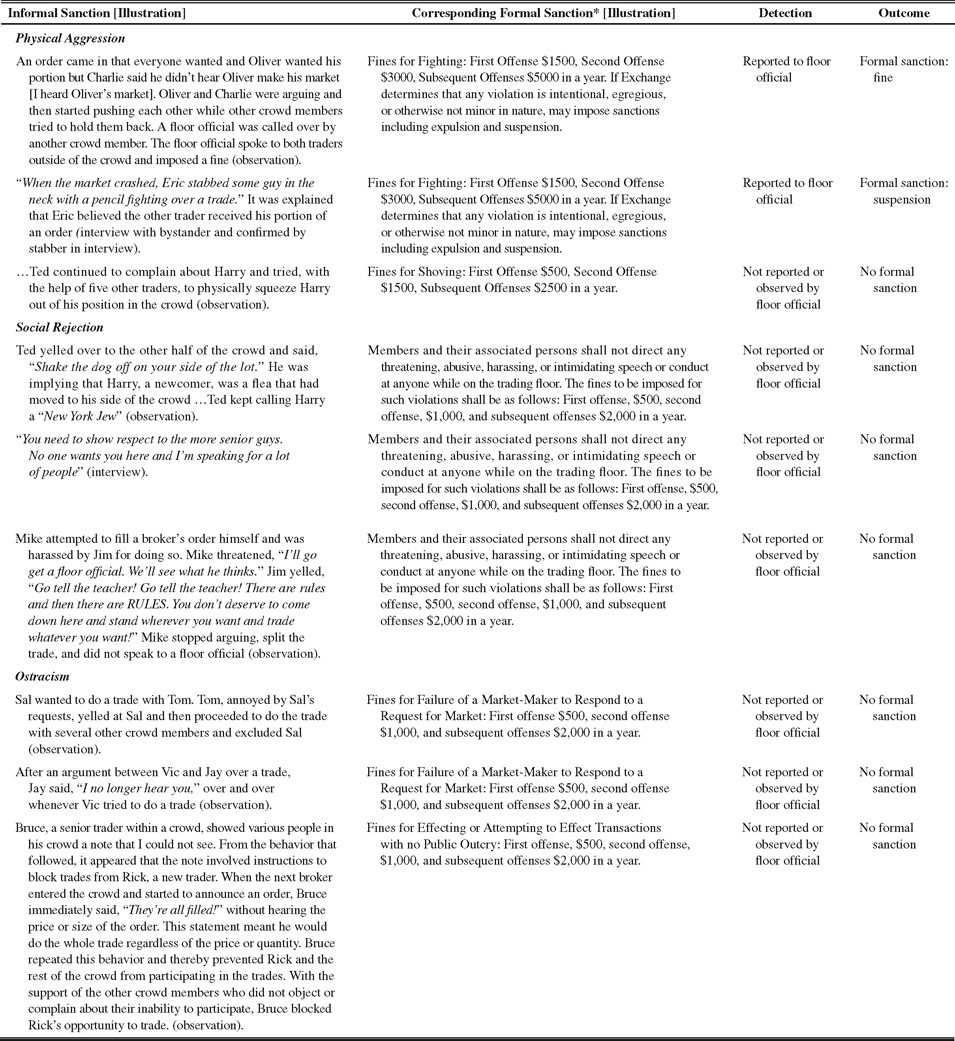
The conflict in perceptions of what constituted equity while trading on the floor of financial exchanges set the foundation for conflicting informal and formal sanctioning systems. In the next section, I examine conditions under which the formal sanctions failed to combat the informal sanctions on the trading floor. To start, I introduce Table 1, which provides illustrations of informal sanctions, the corresponding formal sanctions, detection, and the outcomes of the sanctioning events. Last, I theorize on how informal sanctions that entailed social rejection and ostracism sabotaged trader performance and thereby manipulated secondary sanctions tied to trading firm compensation.
Interplay of Informal and Formal Sanctioning Systems

* Formal sanctions are excerpts from the financial exchange constitutions.
Competing Sanctioning Systems
As mentioned earlier, sanctions may vary on several dimensions, from informal to formal, social to financial, and weak to severe. On the exchange floor, traders encountered sanctions that varied on all of these dimensions. Table 1 contains illustrations of the types of informal sanctions commonly encountered in the trading crowds as well as the corresponding formal sanctions meant to punish the informal sanctions. Neither list of informal sanctions nor formal sanctions is exhaustive but they demonstrate the interplay between informal and formal sanctioning systems.
Financial Exchange’s Formal Sanctions
To promote adherence to the exchanges’ rules, each exchange possessed an elaborate formal sanctioning system. Although sanctions fell into three categories (fines, suspensions, and revocation of trading rights), fines were most common. For fines, the exchanges used a sliding schedule that increased with the number of violations. For example, a $500 fine for a first offense preceded a $1000 fine for a second offense. By assigning particular fine amounts to different behaviors, the exchange conveyed important information regarding the severity of the violation and subsequent sanction. For example, the first offense of harassment received a relatively low fine ($500) while fighting received one of the highest fines ($1500). More severe violations were cause for temporary or permanent loss of trading rights on an exchange.
Traders’ Informal Sanctions
In contrast to the exchange, the traders’ sanctions were predominantly social and centered on enforcing the traders’ perception of equity (which was oriented towards reciprocity and seniority). I describe three types of informal trader sanctions (physical aggression, social rejection, ostracism) and each was considered a formal violation and possessed a corresponding formal sanction.
Physical Aggression
Traders used physical aggression to sanction other traders for not following the traders’ conceptualization of equity norms. Physical aggression included shoving, physical fighting, and threats to physically fight. Differences in fines indicate that the exchanges considered physical aggression a severe act of exchange deviance and worthy of a heftier fine than verbal aggression. Depending upon the degree of the offense, an exchange had the ability to assign more severe sanctions beyond the fine schedule. During my nine-month observation period, three acts of physical aggression superseded the fine schedule and received a formal sanction of suspension.
Physical aggression often took place after an argument over trades or physical positions in the trading crowds (because certain physical positions provided advantages in viewing screens or hearing broker orders). In one of the most competitive crowds, Ben, a seasoned trader, told me the senior traders would throw hot coffee on more junior traders who stood in their positions. Because the traders stood side-by-side, shoving was a common occurrence. Physical space constraints seemed to promote physical aggression. In the following example, several crowd members worked together to squeeze a newcomer out of a desired spot within the trading crowd:
Ted yelled over to the other half of the crowd and said, “Shake the dog off on your side of the lot.” He was implying that Harry, a newcomer, was a flea that had moved to his side of the crowd. Ted continued to complain about Harry and tried, with the help of five other traders, to physically squeeze Harry out of his position in the crowd. Ted kept calling Harry a “New York Jew” (observation).
In addition to demonstrating the way in which traders used physical aggression to encourage respect for seniority, this illustration also demonstrates verbal attacks, a form of social rejection that occurred alongside the physical aggression and is discussed next.
Social Rejection
Social rejection includes behaviors that are meant to verbally convey disapproval through harassment, intimidation, and bullying (O’Reilly, Robinson, Berdahl, & Banki, Reference O’Reilly, Robinson, Berdahl and Banki2014; Williams, Reference Williams2007). On the trading floor, I observed weekly, sometimes daily, acts of social rejection meant to reinforce trader equity norms of seniority or reciprocity. These social sanctions involved explicit declarations of disapproval or a desire for the trader to leave the crowd.
If traders did not help with a certain number of bad trades or avoided trading on volatile days, they could suffer social rejection from another trader. For example, a trader, Hal, was noticeably absent on a stressful day with a lot of volatility. Upon his return, a senior trader, Gus, yelled “Dirty!” every time Hal traded. Gus explained to me that Hal had skipped work due to the turbulent financial conditions and did not deserve trades during the calmer financial conditions.
In the following illustration, the traders threatened to sabotage future trading if the system of seniority was not upheld:
Jen’s market was first, best, and audible so she requested the whole trade. Members of the crowd disputed her right to do so. She said, “I was first and would like to do all 25.” She said it louder. This angered Ed, another trader in the crowd. Ed started screaming, “You are so out of line.” Jen said, “You just did 50 by yourself and Dave did 40 without splitting the orders. I’d like to do this myself.” Ed started jumping up and down and screaming, “fucking nasty girl,” which caused everyone to laugh. Jen explained that other traders were allowed to do the whole trade, but he ignored her. Victor joined Ed and called Jen “a fucking nasty girl.” Then Keith, and finally Tom, joined Ed in yelling at Jen. Ed started screaming loudly, “You want to play hardball—that’s fine with me—I’m better that way!” Jen stopped protesting and split the trade (observation).
In this particular case, Jen was competitively trading and desired the whole trade but was punished through the use of abusive language including harassment and intimidation. These informal social sanctions violate the exchange rules and were supposed to be punished by exchange fines but none followed.
Ostracism
Unlike social rejection, which entails declarations of disapproval, ostracism entails ignoring or excluding individuals (O’Reilly et al., Reference O’Reilly, Robinson, Berdahl and Banki2014; Williams, Reference Williams2007). Given the interdependent nature of trading, ostracism was an effective sanction in this work context. One afternoon, after an argument between Vic and Jay over a trade, Jay said, “I no longer hear you” over and over whenever Vic tried to do a trade, thus blocking Vic from trading.
The act of blocking future trading opportunities appeared in many crowds in a variety of forms. The following account demonstrates how traders worked together to block trades through a form of ostracism whereby a senior trader, through coordination with other traders, excluded a new trader from trades:
Bruce, a senior trader within a crowd, showed various people in his crowd a note that I could not see. From the behavior that followed, it appeared that the note involved instructions to block trades from Rick, a new trader. When the next broker entered the crowd and started to announce an order, Bruce immediately said, “They’re all filled!” without hearing the price or size of the order. This statement meant he would do the whole trade regardless of the price or quantity. Bruce repeated this behavior and thereby prevented Rick and the rest of the crowd from participating in the trades. The other crowd members did not object or complain about their inability to participate (observation).
Thus, the crowd’s ability to hinder future trading was a real and motivating concern among traders. In this instance, the informal sanction of a trader not only creates feelings of ostracism, which is hurtful, but the sanction could also elicit a secondary sanction from Rick’s trading firm for poor trading, which I will discuss later in this section.
Financial Sanctions versus Social Sanctions
In this work setting, the distinctions between financial and social sanctions may be somewhat blurred because some social sanctions may have financial repercussions and vice versa. For the purpose of identifying patterns across sanctioning systems, I proceed with an understanding that the exchanges relied primarily on financial sanctions while the traders relied primarily on social sanctions, but will address relationships between the two types of sanctions later in the analyses.
Large differences exist in the personal content of the sanctions delivered by the traders versus those delivered by the exchanges. The exchange sanctions were mainly financial and contained no personally damaging content. While a trader may find an exchange’s sanction, such as losing the right to trade, upsetting, few would view such a sanction as a malicious attack on the trader’s character. In contrast, the sanctions used by the crowd members tended to be degrading, abusive, and sometimes physically threatening. They often included insults regarding ethnicity, gender, and religion.
Informal sanctions also frequently included ostracism while the exchange sanctions only entailed ostracism under extreme conditions (suspension, revocation of trading rights). During my nine months of observation, an exchange sanction involving suspension only occurred once in six crowds, and during interviews I was told of two other exchange suspensions during my observational period.
Even though the exchange’s fine schedules did not treat abusive language or ostracism as harshly as physical fighting, the impact on the traders may have been the same. Ostracism in the workplace has recently gained attention because of its powerful effects on individual well-being and employment outcomes (O’Reilly et al., Reference O’Reilly, Robinson, Berdahl and Banki2014; Williams, Reference Williams2007). Research suggests that ostracism is neurologically similar to physical pain (Eisenberger, Lieberman, & Williams, Reference Eisenberger, Lieberman and Williams2003; Nelissen & Mulder, Reference Nelissen and Mulder2013) and more damaging, in terms of work outcomes, than harassment (O’Reilly et al., Reference O’Reilly, Robinson, Berdahl and Banki2014). In the next section, I discuss how the damaging nature of these violations combined with their ability to escape detection by the formal sanctioning system establishes an exploitive opportunity for the informal sanctioning system.
Differences in types of sanctions is particularly important given the previously mentioned findings of Nelissen and Mulder (Reference Nelissen and Mulder2013), who found in a laboratory study that when sanctions were removed, compliance with norms in the social sanction condition lasted longer than the financial sanction condition. If we assume that both the exchanges and traders possessed equal abilities in monitoring (i.e., detect and miss the same number of deviant acts), the exchanges’ reliance on financial sanctions put them at a disadvantage because, as Nelissen and Mulder’s (Reference Nelissen and Mulder2013) study suggests, financial sanctions are less effective than social sanctions in encouraging compliance under conditions of imperfect monitoring. As I explain in the next section, the exchanges’ monitoring abilities for minor violations were significantly weaker than those of the traders, which only reduced the effectiveness of the formal sanctions.
Approaches to Monitoring
To enforce their rules, the financial exchanges used floor officials to monitor the activities of the traders on the exchange floor. Floor officials wore special jackets and badges and were directly responsible for monitoring the visibly detectable misconduct on the trading floor. Off the trading floor, the exchanges monitored other forms of exchange deviance (e.g., front-running, insider trading, money laundering), which fell outside the set of observable behaviors included in this study.
To understand the exchange monitoring system, consider the following argument between Paul and Stan over trading. Paul screamed, “Get off my back you big pussy” at Stan. Stan yelled back, “I’d punch you in the face if that floor official wasn’t standing there.” Here a trader said he was refraining from imposing an informal sanction (a punch) due to the presence of a floor official who could impose a formal sanction (a fine or, worse, a suspension). Thus, the mere suggestion of a formal exchange sanction was enough to modify, even stop, an informal trader sanction.
To further clarify the interplay between a potential informal trader sanction and a potential formal exchange sanction, consider the following illustration in which Ken modifies the severity of his informal sanction to reflect the recent formal sanctions he received and to avoid a further formal sanction for fighting:
Ken, the crowd’s biggest bully, wanted part of Dennis’s trade so he yelled at Dennis. Even though Ken is known for his physical aggression, the conflict stopped at verbal abuse and did not escalate to physical threats. Another trader standing alongside me in the crowd explained that Ken had reached the exchange limit for physical fights and his next infraction would cause him to lose his right to trade on the floor: “One more strike and he’s gone” (observation).
This excerpt demonstrates how the mere threat of a severe formal sanction (revoking the right to trade) prevented the occurrence of a severe informal sanction (physical fighting).
This pattern is important because it demonstrates how the expectation of a formal sanction affects the occurrence of informal sanctions. In this section, I analyze the exchanges’ and traders’ respective monitoring abilities as a means to understanding when formal sanctions followed from informal sanctions.
Comparison of Monitoring Abilities
Important differences existed in the monitoring abilities of the traders and the exchanges. As mentioned earlier, the traders stood side-by-side all day, every day, and most other crowd members could observe their work behaviors. In contrast, exchange officials walked the floors of the exchanges but could not watch every trader every minute of the market hours. Exchange sanctions only followed from exchange deviance when a trader reported it or a floor official observed the deviant act. As one trader explained, “These guys [floor officials] are not refs at a sporting event calling every violation. They’re more like police officers.”
Like police officers, floor officials noticed physical aggression more so than insults. Much like the arrival of the police, detection was hampered when the floor officials approached because the traders would stop engaging in exchange deviance. The following interaction between two fighting traders illustrates how a floor official’s presence affected exchange deviance.
A fight broke out between Ben and Jeff. An order came in that everyone wanted and Ben wanted his fair share but Jeff didn’t hear Ben make his market. Ben and Jeff were fighting and swinging at each other. A floor official was called over and they stopped just prior to his arrival (observation).
Since exchange deviance was not always observed directly by exchange officials, the exchanges, like many organizations, relied upon observer reports (traders, brokers, clerks, etc.). In a situation such as this, the exchange relied upon other traders to provide information on what occurred. The exchange attempted to prevent the withholding of information by punishing those who did not provide information at the request of a floor official. On Exchange 2, failure to abide by a floor official’s request for information carried a fine of $1000 for the first offense, $2500 for the second offense, and $5000 for subsequent offenses.
Furthermore, by assigning dollar values to exchange violations, the exchanges communicated which behaviors were more problematic or severe, which could influence reporting tendency. A trader may be less likely to report intimidation than a physical fight because they assume that intimidation is of little concern to the exchange. In such cases, the trader may threaten to report the informal sanction but not follow through with a floor official.
Thus, the type of formal sanction assigned to the traders was important for not only conveying the severity of exchange deviance but also appeared to affect the likelihood that the deviant behavior would be reported by observers. In my study, exchange deviance was only reported for more severe infractions (those with higher fines according to the fine schedule). The system of threats could act as a deterrent, but threatening to get the floor official is not the same as actually reporting exchange deviance to the floor official. A floor official judges whether or not the behavior actually violates the exchange rules (not a trader’s recollection of them) and potentially warrants a formal sanction. For sanctions that involved sliding scales, the lack of reporting prevented the escalation of the fine amount or in some cases, the loss of the right to trade.
The three types of informal sanctioning (physical aggression, social rejection, ostracism) varied greatly in their ability to be detected, and this contributed to the difference in the amount of formal sanctioning that followed from informal sanctioning. A floor official was less able to detect a trader pretending not to hear another’s market versus physically pushing another trader out of a position. Furthermore, some informal sanctions involved a single act of punishment or reward while others entailed patterns of behavior that occurred over time. In terms of detection, it is easier for an observer to detect an initial sanction that involves a single act of verbal or physical abuse versus a pattern of behavior in which the repetition of the behavior designates it as harassment or intimidation. Even behavior that appeared to be competitive trading—a behavior desired by an exchange—could be used to sanction another trader. When traders in a crowd coordinated their trades (e.g., taking turns yelling “take ‘em” before the broker even announced the trade) with the sole purpose of blocking the access of other traders, such trading actually constituted cooperation, a violation of exchange rules. To an observer who only saw one or two trades, an act of blocking may simply appear to be competitive trading but it could constitute intimidation for the newcomer. From the standpoint of detecting deviance, it was more difficult to detect subtle informal sanctions that stemmed from repetition of what could be an acceptable act (e.g., competitive trading) versus behavior that was inherently deviant for a workplace (e.g., physical violence).
In short, exchange detection of exchange deviance depended upon the observations of the floor officials or reporting by traders. In my data, I find the traders reported more-severely-fined exchange deviance to the exchange but did not report less-severely-fined deviance, even though acts of ostracism and social rejection could be personally damaging. In the next section, I discuss how traders employed these informal sanctions to elicit secondary sanctions from trading firms that are financially damaging.
Secondary Sanctions that Strengthen Informal Sanctions
While trading firms were not present on the floor of the exchanges, the trading firms monitored traders through work outcomes such as balances in trading accounts. During the time of this study, I found trading firms were struggling to remain profitable as trading shifted towards electronic markets, so they were particularly concerned about trader performance. Sal explained, “Firm X traders were losing so much money, the managers just fired a bunch of them [the traders].” With the future of trading unknown, an emphasis was placed on trader profitability and therefore trading firms linked many of their firm sanctions to trader profitability. As one upstairs manager of a trading firm explained, “You’re only as good as the balance in your trading account.” This message rang true with every visit to the firms. When I left the exchange floor with Susan, she told me, “I dread seeing Chris [her trading firm manager].” When I asked why, she said, “I had a really bad day. I lost a lot of money.” Her performance review was approaching and one bad trading day made her concerned about her review.
I found the main form of sanctioning by trading firms entailed increasing compensation for profitable traders and decreasing compensation for unprofitable traders. Based upon trading performance, the firms would alter the trader’s “deal” (their split between base and contingent pay) by either reducing the base pay and increasing the contingent pay or reducing the contingent pay and increasing the base pay. During this time period, good traders on average kept 50 percent of their trading profits while some received as much as 90 percent of their trading profits.
Good trading performance could also cause further firm sanctions, such as moving a trader to a crowd with more trading volume and better market spreads (i.e., more opportunities to make profit), or poor trading performance could lead a trader to be moved to an undesirable crowd with low trading volume and small market spreads (i.e., fewer opportunities to make profit). Early in my study, I noticed Joe was standing in a new crowd so I asked Amy, Joe’s colleague, if he quit. She explained, “Our best trader left the firm so they moved Joe to X.” She explained it was a form of promotion. On the second exchange, I walked over to observe a crowd and Carl was missing. Later in the day, I asked another trader from Carl’s firm what happened. He said upper management moved him to a different crowd. He added, “That’s the last place they move you before they fire you.” This sanction would inevitably affect a trader’s pay.
At least once a week, I observed traders manipulating trading firm sanctions by sabotaging trades in the crowds which then gave the traders the ability to indirectly affect access to resources, namely compensation and employment from the trading firms. Because the traders worked on the floor of the financial exchange and outside the trading firm offices, the trading firms possessed little ability to monitor trader behavior on the trading floor. Instead, the trading firms relied upon signals of trader behavior that usually came in the form of trading activity and formal sanctions from the exchange. While I do not have data linking specific informal trader sanctions to a firm sanction, my observations within the trading firms demonstrate what firms can do in response to informal trader sanctions and these data are indicative of the types of secondary sanctions traders can experience from their trading firms. Informal sanctions that entailed sabotaging trades could subsequently elicit financial sanctions from the trading firms. The exchanges’ formal sanctions involving suspensions and revocation of trading rights also had the potential to cause secondary sanctions from firms. Importantly, secondary sanctions, previously unexplored in the literature, emerged from the extensive patterns of interplay between sanctioning systems in this study.
In total, my analyses of the informal and formal sanctioning systems on the financial exchange indicate that the conflict in informal and formal sanctioning systems was grounded in different interpretations of equity when trading, and that informal sanctioning systems undermined formal sanctioning systems when informal social sanctions, such as ostracism and social rejection, evaded detection by the exchange.
DISCUSSION AND CONCLUSION
Understanding when informal sanctioning systems will undermine formal sanctioning systems is critical for the ethical functioning of organizations. In this study, I examined the interplay of formal and informal sanctioning systems with the goal of understanding how they compete to influence organizational deviance. Several important differences between sanctioning systems surfaced during my analyses and new patterns of interplay arose demonstrating a linkage between systems. First, the competing sanctioning systems both valued equity but were grounded in different enactments of equity in trading. Second, the exchanges, as a means to fighting the informal system, not only banned specific trader behaviors (e.g., trading without open outcry), they also banned the informal trader sanctions (e.g., harassment, physical aggression) used by the traders to reinforce their informal norms. Third, the formal sanctioning system underestimated the severity of ostracism and social rejection, which were hurtful yet difficult to detect. Last, the study findings revealed linkages between the sanctions themselves, which added to the impact of the ostracism and social rejection.
If organizations hope to reinforce ethical behavior through formal sanctioning systems, it is important to understand how or when these sanctions might fail, and, in this section, I consider how attributes of both formal and informal sanctions affect the efficacy of a formal sanctioning system. In particular, I integrate my findings with past research to consider how the nature and severity of sanctions may not only signal moral concern but also affect the likelihood that a violation will be reported by observers. I also discuss the importance of accurately gauging sanction severity, which entails understanding if informal sanctions are linked to organizational resources, opportunities, or rewards.
Sanction Type as a Signal of Moral Concern
The use of financial sanctions to combat social sanctions is commonly found throughout regulation and law. Yet, several researchers have suggested and provided empirical evidence that financial sanctioning promotes a business mindset and thereby discourages actors from considering morally relevant attributes of a situation, such as ethical norms or moral rules (Bowles & Polanía-Reyes, Reference Bowles and Polanía-Reyes2012; Moore, Reference Moore2008; Nelissen & Mulder, Reference Nelissen and Mulder2013; Tenbrunsel & Messick, Reference Tenbrunsel and Messick1999). To convey this logic, many cite the study on the introduction of a fine for rule breaking (late pickup of children from daycare) (Gneezy & Rustichini, Reference Gneezy and Rustichini2000). Unexpectedly, the introduction of the fine caused more, not fewer, parents to pick up their children late. Many assert that the introduction of the fine caused the parents to think they could simply pay for the inconvenience that they caused the teachers (Gneezy & Rustichini, Reference Gneezy and Rustichini2000; Mulder, Reference Mulder and DeCremer2009).
Relating this research to the financial exchanges, the use of fines as the main sanction for exchange deviance may have provided the traders with the sense that they could simply pay for violating the formal exchange rules. More specifically, fines for physical aggression, social rejection, and ostracism could ignite a business decision frame and diminish awareness of the moral implications associated with such conduct.
Similarly, financial sanctions are also thought to promote moral disengagement, a cognitive process that diminishes the self-regulatory systems that would normally prevent individuals from engaging in behavior that they consider unethical (Bowles & Polanía-Reyes, Reference Bowles and Polanía-Reyes2012; Moore, Reference Moore2008). Bowles and Polanía-Reyes (Reference Bowles and Polanía-Reyes2012), in a review of empirical studies using economic incentives, theorize that economic incentives promote moral disengagement. When moral disengagement occurs, individuals downplay or block the morally relevant aspects of an ethical dilemma through mechanisms such as moral justification, euphemistic labeling, and distortion of consequences (Moore, Reference Moore2008). Applying Bowles and Polanía-Reyes’ (Reference Bowles and Polanía-Reyes2012) logic, which conceptualized economic incentives as both financial rewards and punishment, the exchanges’ use of fines to punish exchange deviance may have triggered moral disengagement in traders.
While I did not measure the psychological processes of the traders, trader behavior relative to the fine schedule suggests that it was not simply the financial (versus social) nature of the fines that caused the informal sanctioning system to undermine the formal sanctioning systems. More specifically, certain fines, such as those related to fighting, appeared to deter exchange deviance. In the next section, I consider how the severity of the sanctions may have played an important role in circumstances where the informal system undermined the formal system.
Sanction Severity as a Signal of Moral Concern
In addition to the type of sanction, sanction severity is thought to ignite moral concerns, which affects the sanction’s effectiveness. More specifically, Mulder (Reference Mulder and DeCremer2009) asserts that severe sanctions signal retribution and convey punitive purpose associated with moral concerns. Conversely, weak sanctions convey a compensatory purpose (e.g., simply paying for damage incurred by the violation) and do not elicit the same moral concerns. Following Mulder’s (Reference Mulder and DeCremer2009) logic, the severe informal sanctions used by the traders likely conveyed retributive purposes and thereby moral concerns. Conversely, the formal exchange sanctions at the lower levels of the sliding scale likely convey compensatory purposes. According to Mulder’s (Reference Mulder and DeCremer2009) theory, only the higher levels of the sliding scale signaled retribution and moral concerns even though they occurred infrequently. In alignment with Mulder’s (Reference Mulder and DeCremer2009) theory, the findings of this study suggest the exchange’s strategy for sanctioning informal sanctions was more effective for behaviors that the exchange deemed more severe (as communicated via the fine schedule). For example, fighting was punishable by one of the highest financial sanctions (fines) for exchange conduct violations, which appeared to deter fighting. This finding lends support to the theory that severe sanctions, possibly by raising moral concerns, deter deviance and that the financial nature of the sanction, in and of itself, does not simply operate like a “price” to pay for violating the exchange rules.
Past research, however, does not address the importance of properly gauging the severity of sanctions. In this work setting, the two sanctioning systems (trader, exchange) differed in their rating of severity; while abusive language was one of the lowest fined exchange violations, this study’s evidence suggests it could be interpersonally hurtful and therefore effective at reinforcing informal trader norms of equity, which favored seniority and reciprocity.
Moral concerns related to deviance are not only communicated by sanction severity, but possibly by the exchanges’ labeling of the conduct itself. Specifically, the exchanges’ labeling of trader conduct violations as “minor” could have contributed to the disparity in perceptions of severity. Arguably, the violations contained in this study were appropriately regarded as minor rule violations when compared to the magnitude of potential violations, such as widescale fraud, that the exchanges were attempting to prevent. Nevertheless, the language used to communicate the nature of the violations may have affected moral concern relative to exchange deviance, thereby giving the informal sanctioning system an advantage in terms of influence.
Another important feature of this study is that it captures the complexity of an actual workplace where social versus financial sanctions simultaneously compete to influence behavior. In this work setting, more severe financial sanctions (e.g., fines for fighting) from the exchange appear to influence trader behavior more than weaker financial sanctions (e.g., fines for abusive language). In contrast, the subtler social sanctioning from the traders (“I no longer hear you”) is not clearly less effective than more unrestrained social sanctioning (screaming insults), largely because of the connection between the subtler social sanctions and secondary sanctions from trading firms. When these two systems are juxtaposed, it appears that informal social sanctioning will overcome formal financial sanctioning in situations where the formal financial sanctions are weak (i.e., when both sanctioning systems employ their weakest sanctions). While Nelissen and Mulder (Reference Nelissen and Mulder2013) found social sanctions were “stickier” than financial sanctions in situations of spotty monitoring, in this setting, informal sanctions are both social and entail better monitoring, so it is difficult to discern if the social nature of the sanction or the better monitoring is affecting the sanction effectiveness. More research is needed to tease apart the role of severity and monitoring in determining the effectiveness of financial and social sanctioning.
In summary, if an organization underestimates the severity of an informal sanction such as worker harassment or ostracism, the organization may miss an opportunity to communicate moral concerns, and the workers’ behavior is more likely to shift in the direction of the more severe, informal sanctions. In the next section, I will discuss how this shift in moral concerns may subsequently affect willingness to report organizational infractions, an important component of organizational detection of deviance.
Detection Difficulties of Social Sanctioning
This work setting serves as a conservative test of organizational sanctioning systems because the formal sanctioning system explicitly states rules, violations, and the corresponding sanctions. Furthermore, individuals were assigned the role of floor official and canvassed the work areas monitoring behavior. In contrast, a typical business organization may explicitly state its rules but is unlikely to list a corresponding schedule of formal sanctions nor to assign an individual the role of canvassing work areas to monitor organizational deviance. Furthermore, the ability of fellow organization members to observe organizational deviance such as harassment or ostracism is hampered when work is conducted in closed offices. Thus, a typical office setting hinders detection by coworkers (witnesses) and subsequently reduces the likelihood that behavior will be reported. In comparison to a typical business organization, financial exchanges possess strong sanctioning systems. Yet, deviance from formal exchange rules still occurred, which suggests detection is a critical component of a sanctioning system.
When informal sanctions such as harassment and ostracism are difficult for the organization to observe, the organization must depend upon observer reporting. In this study, threats of reporting exchange deviance, rather than actual reporting, were a common means for informally adjudicating wrongdoing without the involvement of the formal organization. Similar to the financial exchange, coworkers in corporations are often closest to wrongdoing and best able to report organizational deviance, but research suggests they refrain from doing so (Treviño & Victor, Reference Treviño and Victor1992; Treviño & Weaver, Reference Treviño and Weaver2001; Warren et al., Reference Warren, Gaspar and Laufer2014). Longitudinal surveys of US employees indicate that while most indicators of an ethical culture within US organizations continue to improve, employee reporting of misconduct does not (Ethics Resource Center, 2014). A separate study using a global sample of employees found that after reporting misconduct, employees experienced high rates of retaliation which included “the silent treatment, verbal harassment, demotions, undesirable assignments, or even violence” (Ethics Research Center, 2016: 8). Interestingly, these retaliatory behaviors correspond to the informal sanctions employed by traders, which suggests that the patterns found on the financial exchanges mirror struggles faced across organizations. As Treviño and Weaver (Reference Treviño and Weaver2001) found, perceptions of organizational justice, especially as it relates to follow-through with ethical problems, relates positively to willingness to report ethical problems. If the organization is unable to detect misconduct, however, it will not be able to demonstrate follow-through.
Thus, the lack of observer reporting is a difficultly suffered across organizations and a serious threat to sanctioning systems. Because monitoring of social sanctions is difficult and observers are hesitant to report organizational deviance, the organization could manipulate other aspects of the sanctioning system with hopes of promoting reporting by observers. As previously mentioned, past research suggests that sanction severity is an important deterrent of deviance (Hollinger & Clark, Reference Hollinger and Clark1983; Mulder et al., Reference Mulder, Verboon and De Cremer2009; Verboon & van Dijke, Reference Verboon and van Dijke2011) and that severity conveys moral concerns (Mulder, Reference Mulder and DeCremer2009). By increasing the sanction severity associated with wrongdoing, the organization may signal moral concerns, deter individuals from engaging in deviance and encourage reporting by observers. For example, fighting, which carried a fine three times higher than the fines for harassment and ostracism, was infrequently observed by floor officials but reported by observers to the exchange. While the nature of the study prevents causal claims, such patterns suggest a relationship between sanction severity and willingness to report in this setting. Given the difficulty of detection faced by many business organizations, future research should examine the optimal level of sanction severity with respect to encouraging willingness to report.
Importantly, sanctions should not be too severe, because they may be disregarded as unjust, and past research suggests procedural fairness also plays an important role in the effectiveness of a sanctioning system (Mulder et al., Reference Mulder, Verboon and De Cremer2009; Verboon & van Dijke, Reference Verboon and van Dijke2011). Using a field study on tax compliance and a laboratory study on plagiarism, Verboon and van Dijke (Reference Verboon and van Dijke2011) found that severe sanctions promote compliance when study participants perceive the authority associated with the sanctioning system as fair. As discussed earlier, the traders in this study encountered competing perceptions of equity at work, and the traders may have found the informal trader sanctions to be fairer and therefore more influential than those of the exchange, which then affected reporting behavior.
Due to limited resources, some may argue that the exchanges needed to focus attention on the larger, more egregious forms of exchange deviance. Theories such as Broken Windows Theory, however, suggest that the key to stopping larger infractions is to focus on the smaller ones (Kelling & Coles, Reference Kelling and Coles1998). While the theory is usually applied to community crime, it suggests that the prevalence of unsanctioned, small infractions signals a lack of formal control and thereby promotes the rise of larger, more problematic forms of deviance. On the financial exchange, the lack of formal sanctions after smaller infractions, such as abusive language, may have signaled weak formal control to those who considered engaging in larger violations.
In the next section, I consider how the interplay of sanctioning systems, more so than the features of specific sanctions and detection, further affected deviance from the exchange rules.
Sanction Linkages That Alter Severity
Importantly, sanction-based theories of behavior such as social learning, social control, and deterrence theories conceptualize sanctions as independent, unrelated events (Hollinger & Clark, Reference Hollinger and Clark1982, Reference Hollinger and Clark1983; Nelissen & Mulder, Reference Nelissen and Mulder2013; Smith et al., Reference Smith, Simpson and Huang2007; Tenbrunsel & Messick, Reference Tenbrunsel and Messick1999; Treviño & Weaver, Reference Treviño and Weaver2001). These theories predict that more severe and more frequent sanctions will overpower those that are less severe and less frequent (Hollinger & Clark, Reference Hollinger and Clark1982, Reference Hollinger and Clark1983). In contrast to past theories, the findings of this study indicate that sanctions are often dependent, related events and as a result, informal sanctions need not simply be more severe than other sanctions to influence individuals. Rather, an informal sanction’s effect can be amplified if it is linked to secondary sanctions that are regarded as important or severe. If trading performance in the trading crowd was not linked to trading firm sanctions (e.g., compensation), informal trader sanctions that entailed sabotaging trading would lose some effectiveness in reinforcing trading crowd norms. To understand the value of this insight relative to existing research, consider the substantial research on worker deviance that highlights the influence of informal sanctions of peers (Hollinger & Clark, Reference Hollinger and Clark1982). As mentioned previously, Hollinger and Clark’s (1982) past research indicated that informal sanctions were more influential than formal sanctions, but this finding may be in part because informal sanctions (e.g., “avoid the person”) are linked to powerful secondary sanctions related to work performance. Given the findings of this study, the influence of informal coworker sanctions may not be due entirely to the informal sanctions’ inherent severity or frequency but rather the secondary sanctions, especially those related to compensation.
For the behavioral ethics literature, this study demonstrates how sanctioning systems in work settings vary; they are not simply weak or strong. Rather, the same sanctioning system may effectively detect and punish some violations while missing others, and those violations that are missed may be more severe than the organization realizes. Research in the area of behavioral ethics should focus on which behaviors slip through the formal monitoring systems of organizations and how the organization may address these deficiencies. In particular, organizations should consider the use of social versus financial sanctions as well as sanction severity when designing their sanctioning systems, and consider how the choice of sanction may alert organizational members to moral concerns.
Limitations
More research is needed to understand how the structure of the work relative to the organization affects the dynamic between informal and formal sanctions. This study was conducted in an environment where employees spend more time outside their firm’s offices and their work is conducted in groups. While some employees such as external auditors, lawyers, and consultants work outside the offices of their employing firm and in groups, many others do not. It is difficult to say how much working outside the firm offices affects the relationship between informal and formal sanctions.
I was only able to observe a subset of instances when the formal sanctioning failed to combat the informal sanctioning. Other, more severe, exchange violations which were far more damaging to the public, such as large-scale fraud, may have been detected and properly sanctioned by the exchange during this time period. I also did not focus on situations when the informal sanctions aligned with the formal sanctions. Many forms of exchange deviance were also opposed by the trading crowd members.
In addition to distance between employer and employee, this study involved two separate organizations, the firm and the exchange, which governed the work of traders and possessed the authority to impose sanctions. This is not representative of a typical work arrangement and the degree to which this affected the interplay of informal and formal sanctions is unknown. Many types of work, however, are governed by regulatory or professional organizations, and to the extent that the exchange represents a regulatory or professional organization, the findings of this study are relevant.
Conclusion
Formal sanctioning systems curtail unethical behavior, but their effectiveness may be hampered by informal workplace sanctions that reinforce unethical behavior. By studying sanctions over time, I identified important relationships between types and sources of sanctions and theorize about the conditions that lead informal sanctioning systems to undermine formal systems. Despite elaborate rules with corresponding sanctions for infractions and organizational representatives who monitored behavior, the financial exchanges did not detect certain informal social sanctions that were both personally and financially damaging and, in such situations, informal sanctions effectively reinforced informal norms which entailed exchange deviance. This study suggests that perhaps the undetected, seemingly minor, social sanctions between employees may be causing the persistence of organizational deviance in certain workplaces. This study also raises concerns about formal financial sanctioning, especially that which is not viewed as severe. Many formal sanctions (e.g., US Securities Exchange Commission, US Organizational Sentencing Guidelines) rely heavily upon financial fines to punish corporate wrongdoing. If these fines are not regarded as severe or minimize moral concerns by inducing a business decision frame, then they are unlikely to be as effective as informal social sanctioning that is regarded as severe or linked to secondary sanctions.
ACKNOWLEDGEMENTS
I am indebted to numerous people who guided me through the many stages of this research project. I am particularly grateful for the support of Ted Baker, Beth Bechky, Tom Dunfee, Etty Jehn, Bill Laufer, Lisa Lewin, Alan Strudler, and Ann Tenbrunsel. The article benefited greatly from Juliane Reinecke’s editorial guidance and the encouraging, detailed feedback from three anonymous reviewers.