Implications
Supervision of sheep grazing on mountain pastures is challenging as fencing is not practical in these areas. The Nofence system is a virtual fencing system aiming to restrict the movement of sheep without the use of physical boundaries, using sound and electrical shocks instead if the sheep crosses a virtual border. In the present study, we tested the Nofence system in groups of sheep with lambs to evaluate its function, a learning procedure and its impact on sheep welfare. The results indicate that virtual fences are not enough to keep sheep in the intended area and animal welfare cannot yet be ensured while using this system.
Introduction
Rangeland grazing systems provide an important feed source and have a high animal welfare potential due to a high degree of freedom and the possibility for the grazing animals to fulfil their natural behavioural needs. However, the areas are large and fencing is costly. The challenges with fencing in relation to rangeland pastures is one reason to develop alternative technical systems, such as virtual fences, to control grazing animals. A virtual fence was defined by Umstatter as ‘a structure serving as an enclosure, a barrier, or a boundary without a physical barrier’ (Reference Umstatter2011). Existing virtual fencing prototypes usually consist of a collar mounted to the neck of the animal. If the animal crosses the virtual border, the collar gives an aversive stimulus. As with physical fences, the aversive stimulus usually is in the form of a weak electric shock (e.g. Lee et al., Reference Lee, Henshall, Wark, Crossman, Reed, Brewer, O’Grady and Fisher2007; Jouven et al., Reference Jouven, Leroy, Ickowicz and Lapeyronie2012; Brunberg et al., Reference Brunberg, Bøe and Sørheim2016). In most systems, the electric shock is preceded by a warning signal of some kind, most commonly a sound cue. In that way, the animal is supposed to learn to turn when hearing the sound signal to avoid the shock.
In Norway, the legal framework regarding using electric devices for animals are rather strict. Virtual fences have mainly been commercially available for dogs and these are not legally allowed in Norway. Moreover, any new technical devices must be tested and documented regarding functionality and possible effects on animal welfare before taken into use. Most previous studies on virtual fencing used only one single virtual border (Tiedemann et al., Reference Tiedemann, Quigley, White, Lauritzen and McInnis1999; Jouven et al., Reference Jouven, Leroy, Ickowicz and Lapeyronie2012; Brunberg et al., Reference Brunberg, Bøe and Sørheim2016) and others a border surrounding a specific attraction (Lee et al., Reference Lee, Prayaga, Reed and Henshall2009), such as feed or another sheep. Cattle is the most investigated species when it comes to virtual fencing, usually tested individually or in very small groups (e.g. Bishop-Hurley et al., Reference Bishop-Hurley, Swain, Anderson, Sikka, Crossman and Corke2007; Lee et al., Reference Lee, Prayaga, Reed and Henshall2009; Umstatter et al., Reference Umstatter, Brocklehurst, Ross and Haskell2013).
In an earlier study, Brunberg et al. (Reference Brunberg, Bøe and Sørheim2016) tested the virtual fencing system Nofence on small groups of sheep, with a special focus on possible effects on sheep welfare and behaviour. Several concerns and challenges regarding both the function of the system and effects on sheep welfare were reported. Only one-third of the sheep learned to avoid the electric shock by turning on the sound signal. Moreover, it seemed like the sheep relatively quickly learned and avoided the position of the virtual border, but when the virtual border was moved to a new location they quickly crossed the border. It was concluded that the system must be tested on ewes with lambs in larger groups in order to ensure that it can be used in a commercial setting. In addition, a safe and efficient learning protocol must be developed to safeguard animal welfare.
The main aim with the Nofence experiments was to evaluate the function of Nofence in relation to animal welfare before any possible commercial use. This included development and testing of different training protocols and assessment of how ewes in different group constellations learned the system. The present study was to repeat the experiment described in Brunberg et al. (Reference Brunberg, Bøe and Sørheim2016) with ewes and lambs and without the pre-selection of ewes that was used in the earlier experiment. Further, the second aim was to introduce two or more virtual borders testing a new learning protocol more suitable for commercial use.
Material and methods
Two experiments were performed May to June 2013 on a commercial sheep farm in Norway. The experimental procedure was approved by Norwegian authorities. The behavioural reactions of the sheep were continuously evaluated and measures were taken to minimize stress.
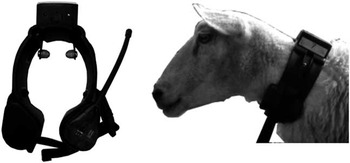
Collars provided by Nofence AS (Figure 1) were used in both experiments. The collars had an inbuilt Global Positioning System (GPS) and two electrodes directed to the neck of the sheep (see also Brunberg et al., Reference Brunberg, Bøe and Sørheim2016). To ensure contact with the skin, all ewes were shaved around the neck before the experiments. The virtual border was pre-programmed manually. When a sheep crossed a virtual border, a sound signal with increasing frequency (2 to 4.2 kHz) was given. If the sheep turned back into the allowed zone, the sound signal stopped. However, if the sheep stayed outside the assigned area, the sound signal continued for 4 s. After this, a weak electric shock (4 kV, 0.1 J, 0.2 s) was elicited. If the sheep continued to stay outside the assigned area after the shock, the procedure with sound and shock was repeated for a maximum of four times with a short (up to 5 min) break between each repetition. After these four repetitions, the system was deactivated until the sheep returned to the allowed zone again. The sheep could receive a maximum of five shocks each day. After this, the system was deactivated until the next day. Hence, if a collar was deactivated and the ewe still remained in the experimental enclosure, the sheep had the possibility to cross the virtual border without receiving sound signals or electric shocks.
A picture of the Nofence collar on a sheep. Photo: Oscar H. Berntsen.

Experiment 1: testing the Nofence system in small groups of ewes with lambs
Animals
Nine ewes, either Spæl sheep (S, n=5) or Norwegian White Sheep (NWS, n=4), aged 1 to 6 years and not previously exposed to virtual borders were included in the experiment. The ewes, with their 16 lambs (1 to 3 lambs/ewe) were divided into three groups (A, B and C) stratified by breed. Each ewe was individually marked with spray colour on the back.
Experimental procedure
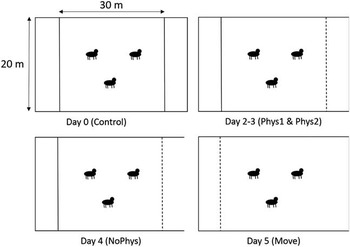
During 5 consecutive days at ~1000 h, each group was moved from the barn to one out of three rectangular enclosures with pasture, each measuring 20×30 m. The perimeters of the enclosure were fenced with electric netting fences. See Figure 2 for a drawing of the enclosure. The experiment lasted for 2 h/day, after which the sheep were brought back into the barn.
Experimental setup in Experiment 1 in which ewes with lambs were tested in an enclosure with one Nofence border. On Days 2 to 3 there was a physical fence outside the Nofence border. This physical fence was then removed on Day 4. On Day 5, the virtual border was moved to the other end of the enclosure. The solid black lines represent physical fences and the dotted lines virtual border.

The different treatments were performed corresponding to Brunberg et al. (Reference Brunberg, Bøe and Sørheim2016). The ewes were habituated to the enclosure on day 0. On Day 1 (Phys1), one of the short sides of the rectangular enclosure was replaced by a Nofence border with a physical fence ~7 m apart from the border, outside the enclosure. This was repeated on Day 2 (Phys2). On Day 3 (NF), the physical fence outside the virtual border was removed. On Day 4 (Move), the virtual border was moved to the other short side of the rectangular enclosure, 7 m inside the physical fence (see Figure 2). However, due to technical problems with all of the collars on Day 1, we had to postpone the introduction of the virtual border and there were hence two habituation days. Moreover, there were further technical problems with the collars in Group C and we had to postpone the trials for Group C one more day. The ‘Move’ treatment for Group C was instead performed in the afternoon after the ‘Nophys’ treatment.
Observations and data analysis
One observer was positioned at each enclosure to record ewe behaviour. The observers recorded the position of each ewe (in allowed zone or in exclusion zone) every second minute for 2 h (instantaneous sampling), starting when the ewes were introduced to the enclosure. On three occasions, the sheep ran out of sight from the observers. One attempt was made to chase them back into the allowed area. If they immediately escaped once again, they were moved into the barn not to disturb the animals at the other enclosures. All remaining observations for the escaped group were then recorded as being in the exclusion zone.
When possible, the observers also continuously noted if the ewes went over the virtual border, any extreme reaction to sounds and electrical shocks (i.e. did not react at all or panicked and ran out of control) and if anything unexpected happened with the technical equipment. Moreover, the number of shocks were recorded by each collar, sent via Global System for Mobile (GSM) to a server and communicated to a web page. In some cases, there were problems with the technical registration of the number of shocks. Hence, a combination of the information stored in the collar, on the website and recorded by the observer was used in the statistical analysis.
Any differences in the number of received shocks between the different days were analysed with SAS software (version 9.3; SAS institute Inc., Cary, NC, USA) using the MIXED procedure and assuming a Poisson distribution. The model used group and sheep nested within group as random effects and day as fixed effect.
Experiment 2: testing several virtual borders and a new learning protocol in larger groups of ewes
Animals
In total, 32 naïve ewes aged 1 to 6 years were used. They were either of the Spæl breed (N=18) or NWS (N=12). In all, 18 of the ewes had 1 to 3 lambs (in total 39 lambs). The ewes were divided into four groups (A, B, C and D) with eight ewes in each group and individually marked with spray colour on their backs. Each group had a mix of breeds of different ages (mean age was between 1.1 and 3.9 years). For practical reasons, the number of lambs differed between the groups, with Group A having 16 lambs, Group B 17 lambs, Group C five lambs and Group D only one lamb. However, each group went through the same experimental procedure and was corrected for in the analysis.
Experimental procedure
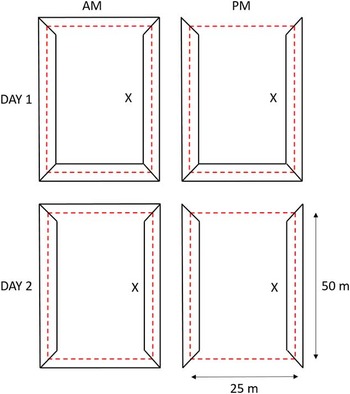
The evening before the start of the trial, each group was placed in a rectangular enclosure with pasture bordered by Nofence virtual borders, measuring 50×25 m. Before the actual trial started, the animals were separated from the virtual border with a physical fence placed inside the border. There was also a physical fence outside the virtual border. There were water and shelter available in each of the enclosures. The ewes and lambs were exposed to the following treatments (Figure 3):
-
Day 1: For 3 h in the morning, a virtual border was introduced (i.e. the physical fence inside the virtual border was removed) 7 m inside of the outer physical fence in one of the short sides of the rectangular enclosure. For 3 h in the afternoon, the physical fence outside the virtual border was removed.
-
Day 2: For 3 h in the morning, two virtual borders were introduced 7 m inside of the outer the physical fence on both the short sides of the rectangular enclosure. For 3 h in the afternoon the physical fences outside the two virtual borders were removed.
Experimental setup in Experiment 2 on Days 1 to 2 (one or two virtual borders, respectively) and AM and PM (with and without a physical fence outside the border). The solid black lines represents physical fences, the red dotted lines represents virtual borders, and the X indicates where shelter and water were located.

2 h after each session started, any ewes and lambs that had crossed the virtual border and were outside the allowed area were brought back into the enclosure.
On Days 3 and 4, the procedure was supposed to be repeated with three and four virtual borders, respectively. However, as we had to restrict the number of electrical shocks due to welfare reasons, the learning criterion for each group to continue to Day 3 was that at least 50% of the group members with functioning collars should have received less than five shocks on Day 2. In all of the four groups, the majority of the ewes received the maximum numbers of shocks on Day 2. Hence, the experiment was stopped after 2 days for all four groups.
Observations and data analysis
Every third minute, an observer at the enclosure recorded if each individual was in the allowed enclosure or outside the Nofence border in the exclusion zone. The number of sound signals and electrical shocks each collar gave was recorded automatically by the collar and also transferred to a web page via GSM. The effect of day (1 and 2) on the number of administrated electric shocks were analysed using a model with day as fixed effect and group and ewe nested within group as random effect assuming a Poisson distribution (MIXED procedure, SAS version 9.3).
Results
Experiment 1: testing virtual borders in small groups of ewes with lambs
As described in the ‘Material and methods’ section, we had several problems with non-functional collars. At 15 occasions, the observer reported that two of the ewes in Group A received sound signals or shocks when they were well inside the allowed area in the opposite end of the pasture from the virtual border. The cause was probably inaccurate GPS signals. At 11 occasions, the observers noted that the ewes, mainly in Group A, crossed the virtual border but no sound/correction was given, even when the ewes had been grazing outside the virtual borders for some minutes.
The ewes received an average of 10.9±2.0 (range 6 to 20) electrical shocks during the 4-day experimental period. Number of electrical shocks received was 2.6±0.7 on Day 1, 2.4±0.8 on Day 2, increased to 4.4±0.6 on Day 3 and was reduced to 1.5±0.7 on Day 4 (F=3.93, P<0.05).
On 12 occasions, the observers noted that four of the nine ewes received electrical shocks either without any reaction at all (six occasions) or a very mild reaction (six occasions).
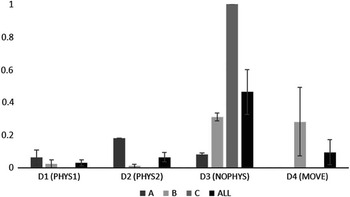
As shown in Figure 4, the ewes spent on average 3% of their time outside the virtual border on Day 1, 6% on Day 2, 46% on Day 3 when the physical fence was removed and 9% on Day 4 when the virtual border was moved. Group C escaped immediately on Day 3. They were chased back into the enclosure once, but ran out immediately again.
Mean proportion of recorded observations outside the Nofence border for each individual sheep in the different groups (A, B and C) and the different days. Day 1 with a physical fence (D1, Phys1), Day 2 with a physical fence (D2, Phys2), Day 3 without a physical fence (D3, Nophys) and Day 4 when the border was moved (D4, Move).

Experiment 2: testing several Nofence borders and a new learning protocol in a larger group
Unfortunately there were problems with non-functional collars in three of the four groups. On Day 1, 28 of the 32 collars functioned correctly and on Day 2, 26 of the 32 collars functioned correctly. Whenever possible, we tried to change broken collars after Day 1, but this was not always possible. For practical reasons, also the ewes without functioning collars remained in the enclosure both days. They are not included in the analysis of the number of shocks. However, as the behaviour of these ewes probably affected the rest of the group and as this is a possible scenario in a real situation, the proportion of time they spent outside the virtual border is reported.
In Group A, one ewe received more than five shocks on Day 2 as her collar did not stop giving shocks after the five shocks as intended. The last shocks were received at the very end of the day and the collar was removed immediately.
Number of electrical shocks
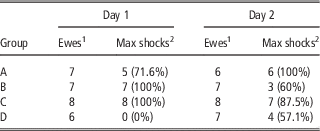
The mean number of electrical shocks received per ewe was not reduced from Day 1 (4.1±0.3) to Day 2 (4.7±0.3) (F=0.68; P=0.42). Out of the 28 ewes with functioning collars on Day 1, 20 (71%) received the maximum number of five electrical shocks (Table 1). The corresponding numbers on Day 2 was 20 ewes out of 26 (77%). This means that most of the ewes crossed the border one or several times.
Number of sheep with functioning Nofence collars in each group in Experiment 2 and the number and proportion that received all five electric shocks on Day 1 (one virtual border introduced) and Day 2 (two virtual borders introduced)

1 Number of ewes with functioning collars in the group.
2 Number of ewes that received the maximum number of five shocks.
Location
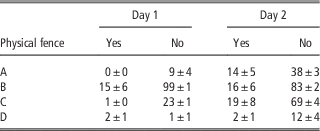
The individual ewes spent between 0% and 52% of the observation period in the exclusion zone with a physical fence outside the virtual border and between 0% and 89% without the physical fence. On average, the ewes spent 4% in the exclusion zone in the morning of Day 1 (with physical fence) and 33% in the afternoon (without physical fence). On Day 2, the corresponding numbers were 12% and 50%, respectively. The variation between the groups was, however, large (Table 2).
Percentage of time (mean±SE) that all sheep spent in the exclusion zone on Day 1 (one virtual border) and Day 2 (two virtual borders), with and without physical fence outside the virtual Nofence border

Discussion
Experiment 1: testing the Nofence system on ewes with lambs
The ewes in the present experiment received almost 11 electric shocks/ewe during the experimental period and they spent 3% to 6% of the observations in the exclusion zone on the first 2 days and nearly 50% when the physical fence was moved. These numbers are much higher than the 1.9 shocks/ewe and no observations in the exclusion zone reported in Brunberg et al. (Reference Brunberg, Bøe and Sørheim2016). The main reason for this difference is probably that the ewes participating in the previous study (with no lambs present), went through a pre-selection process in which we selected ewes that learned to associate the sound with the electrical shock (i.e. turned when being exposed to the sound cue) in only three repetitions. The ewes participating in the present study were randomly selected. We noted that during one or several occasions, four of the nine ewes did not react at all, or showed a very mild reaction, to the electric shocks. The electrodes were clearly in contact with the skin, so lack of contact was not an explanation for this. This difference in sensitivity to the electrical shock was also experienced by Brunberg et al. (Reference Brunberg, Bøe and Sørheim2016), in which three ewes were excluded due to lack of reaction, whereas others showed severe reactions. Hence, it seems that both the pre-selection and quickly removing individuals showing no reaction to the shock, is of highest importance for the functionality of the Nofence system.
Although systematic observations were not performed, it did not appear that the lambs were the reason for the ewes to cross the virtual border.
Experiment 2: testing several Nofence borders and a new learning protocol
It has earlier been discussed that efficient and secure learning is necessary for a virtual fencing system to function and to reduce stress (Tiedemann et al., Reference Tiedemann, Quigley, White, Lauritzen and McInnis1999; Bishop-Hurley et al., Reference Bishop-Hurley, Swain, Anderson, Sikka, Crossman and Corke2007). The Nofence system is supposed to function in a commercial setting in large herds. Therefore, the criteria for a learning procedure must be that it should be possible to perform in a group and that the sheep should be able to learn it without too much involvement of the farmer. In the present study, we aimed at teaching small groups of sheep to respond correctly to the Nofence system in 4 days and with a maximum of four electric shocks per day. There are certainly several other options for a learning protocol, which may be tested. In a commercial setting, larger group sizes are probably used. The electric fence functions as a visual cue, as opposed to a virtual fence using, for example, an auditory cue. Both systems rely on the animals associating the positive punishment with the cue (Bishop-Hurley et al., Reference Bishop-Hurley, Swain, Anderson, Sikka, Crossman and Corke2007).
Only one of the groups reached our criterion on Day 1 and none on Day 2. Hence, the experiment ended after Day 2 and only two Nofence borders were tested at the same time. As the sheep received an equal amount of shocks on Day 1 compared with Day 2, we could see no improvement between days. This was also reflected in the amount of time the ewes spent in the exclusion zone; on average 18% on Day 1 and 30% Day 2.
In earlier performed studies on virtual fences, it has been suggested that the herd instinct can be an advantage as the flock may follow individuals that stop/turn by the virtual border and hence the whole group stay within the allowed area. It has even been suggested that it may be possible to have collars on only a few lead animals (Tiedemann et al., Reference Tiedemann, Quigley, White, Lauritzen and McInnis1999; Anderson, Reference Anderson2007; Jouven et al., Reference Jouven, Leroy, Ickowicz and Lapeyronie2012). This was investigated by Jouven et al. (Reference Jouven, Leroy, Ickowicz and Lapeyronie2012), who tested sheep in groups of 32 ewes in which different proportions were trained and wore collars. The remaining animals in each group were naïve and did not wear collars. It was shown that in mixed groups, the naïve ewes crossed the border and a few trained ewes followed and the frequency of trained ewes that received audio cue/shocks increased with the percentage of naïve ewes in the groups. As a number of the ewes in the present Experiment 2 received the maximum number of shocks during the morning, we had a situation in which only a few of the ewes received shocks when crossing the border in the afternoon. This situation lead to that we, unintentionally, tested the function of the Nofence system when only a few of the ewes wore functioning collars. The strong herd instinct seemed to be an obstacle for the function of the Nofence system, if one sheep crossed the border and ignored the sound/shock, there was a large risk that others followed. This was also shown for cattle by Tiedemann et al. (Reference Tiedemann, Quigley, White, Lauritzen and McInnis1999).
The technical issues may of course have influenced the results of the experiments. The sheep with collars that did not give any sound signals or shocks, naturally, had no chance to learn the system. As described in the previous paragraph, these sheep may also have attracted their peers with functioning collars to cross the border. That some sheep received sound signals and shocks inconsistently when they crossed the border, probably also affected the learning. This inconsistency also made it difficult for the animals to learn the location of the border, even if this is not the aim with the Nofence system. Moreover, the learning protocol was developed with the intention that the physical fence would help the sheep to learn to turn in order to avoid the shock. With a non-functioning collar, this first step of the learning procedure may be missed out. However, although the technical issues of course affected the sheep that wore those collars, also the sheep wearing collars that worked perfectly had severe problems with learning or respecting the virtual border. Thus, the technical issues surely affected the outcome, but was not the most important factor.
We could distinguish three different causes for an animal to cross the border:
-
∙ Sheep that did not experience the shock as painful (indicated by no reaction to the shock).
-
∙ Sheep that did not learn to associate the sound signal with the shock.
-
∙ Sheep that crossed the border due to attractions outside (i.e. other sheep or feed).
All of the above causes are of course problems regarding the function of the Nofence system, the latter two are also potential welfare problems. Individuals that do not learn to associate the sound signal with the shock will not be able to foresee or control the stimuli, leading to a stressful situation. Some of the animals learned quickly how to actively avoid the shock. However, we saw examples when other ewes went over the border and remaining ewes stood on the allowed side hesitating for a few minutes before crossing, obviously stressed by the situation. In other situations, all sheep crossed the border at the same time.
Conclusion
Taking into account the results from Brunberg et al. (Reference Brunberg, Bøe and Sørheim2016) and the results presented in this paper, we believe that it will be very challenging to use the Nofence system in large groups of ewes in commercial settings. In the experiment we were not able to develop a sufficient learning protocol, and a high number of electrical shocks imply that animal welfare were at risk. Moreover, the Nofence virtual borders were insufficient in keeping the sheep within the intended area and there were large technical issues with the system. Hence, we strongly recommend not to continue testing sheep with the Nofence system.
Acknowledgements
The project was funded by The Regional Research Fund mid Norway/Norwegian Research Council, County Council in Møre & Romsdal and The Agricultural Department in Møre & Romsdal. The authors appreciate the collaboration with Oscar Hovde Berntsen and other co-workers at Nofence AS. The animal owner is thanked for collaboration around the animals. The authors are also grateful for technical help from Nina Lie, Hanne Dahlen and statistical help from Torfinn Torp (Bioforsk).