Introduction
Studies of higher education policy and practice in Asian countries have been growing in volume over the past 10 years (Jung & Horta, Reference JUNG and HORTA2015). Knowledge of the educational practices of these countries presents scholars and researchers in the rest of the world with possibilities for collaboration, professional growth and the formulation of important research questions. This article reports on work measuring pre-service teachers’ self-perceptions of their creative identity in Singapore and the United States, as measured previously in England (Randles & Smith, Reference RANDLES and SMITH2012), Finland (Randles & Muhonen, Reference RANDLES and MUHONEN2015) and Australia (Randles & Ballantyne, Reference RANDLES and BALLANTYNE2018). Results of this line of work suggest that the occupational identities of pre-service music teachers (PSMT) where creativity is concerned are different in various parts of the world as a result of culturally specific socialization factors. An exploration of this phenomenon in Asia had yet to be conducted.
Background
Who a teacher is and will become is in many ways a product of their occupational identity. Identities influence preconceptions about what it is to be a music teacher and are related to what PSMT value. Their identities guide their thoughts and actions, and arguably inform all of what they will do as a teacher. It is for this reason that research into the occupational identities of PSMT is necessary if we are to better understand our students, and therefore help them become the best teachers they can be.
Research conducted by Isbell (Reference ISBELL2008) investigated the socialization and occupational identity of undergraduate music teachers. Isbell’s work draws upon that of L’Roy (Reference L’ROY1983), Roberts (Reference ROBERTS1991) and Woodford (Reference WOODFORD and Colwell2002), suggesting that music teachers arrive at the profession with a perception of what it means to be a music teacher based on their primary and secondary socialization. Their assumptions, what they identify with and particular aspects of occupational roles are essentially a product of how they have been socialized. As a result, the literature suggests that music teachers are often socialized to think of themselves foremost as musicians or performers and to a lesser extent, teachers. Isbell suggests that the present line of research is necessary as a means of establishing how identity develops in order to address both orientations. The work of Beijaard, Meijer and Verloop (Reference BEIJAARD, MEIJER and VERLOOP2004) who discuss their understanding of the term professional identity also supports the development of the present line of work. They argue that teachers have ‘sub-identities’ which may ‘conflict or align with each other’ (Reference BEIJAARD, MEIJER and VERLOOP2004, p. 113).
Recent work in the area of PSMTs’ identity formation suggests that identity is a fluid construct (Draves, Reference DRAVES2014). Ballantyne, Kerchner and Arostegui (Reference BALLANTYNE, KERCHNER and AROSTEGUI2012) note that PSMT’s identities are dynamic, and that PSMT education programs have a crucial role to play in ensuring that identity development can bolster early-career music teachers’ forays into the workforce. That being the case, what is being done to nurture the identities of teachers to be fluid, flexible and embracing of new curricular models? What is being done to nurture PSMT’s identities as creative musicians – particularly where composition, improvisation and popular music performance are involved?
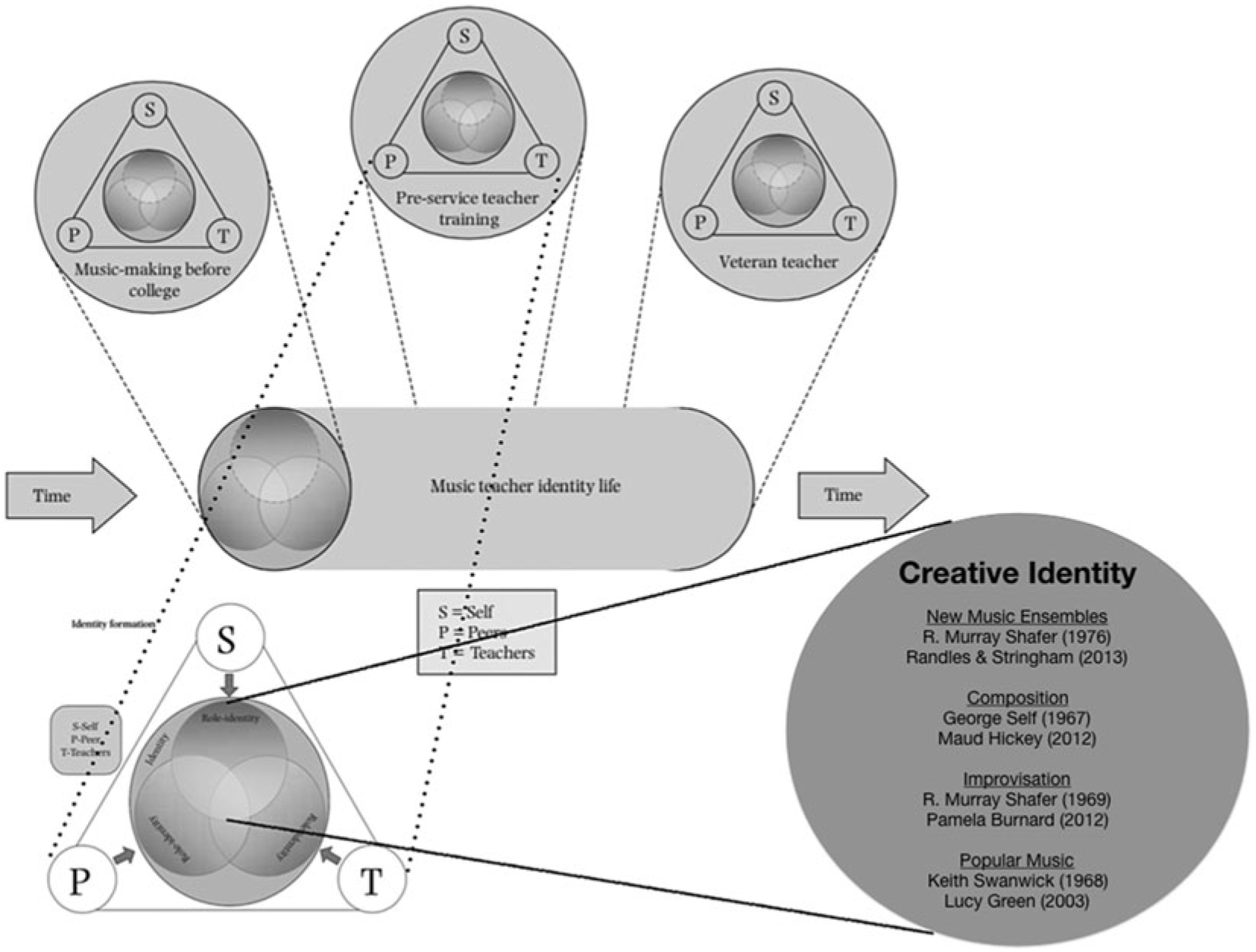
The primary purpose of music teacher education is to prepare pre-service teachers to be effective teachers in the classrooms of the future. If we are concerned with preparing teachers for an uncertain future, one where the profession is likely to look increasingly different as the influence of technology becomes increasingly more ubiquitous (Mark, Reference MARK and Randles2015; Reimer, Reference REIMER and Randles2015; Thibeault, Reference THIBEAULT and Randles2015; Tobias, Reference TOBIAS and Randles2015), what are we doing to prepare students for that future? As argued by Randles and Smith (Reference RANDLES and SMITH2012), Randles and Muhonen (Reference RANDLES and MUHONEN2015) and Randles and Ballantyne (Reference RANDLES and BALLANTYNE2018), developing teacher identity and, in particular, ‘creative identity’ are areas of crucial concern to those preparing music teachers for their occupation. Music teachers who have experience as composers, improvisers and arrangers of popular music covers and original songs are more likely to be able to develop those same types of skills in the music students of the future. These experiences nurture what Randles calls creative identity (Reference RANDLES2010), something that all musicians and musician/teachers possess in varying degrees over the duration of their lives (see Figure 1).
Theoretical model to creative identity measure development.

Creativity and identity have been considered together outside of the music education area recently in general education (Greenwood, Reference GREENWOOD2009), and social psychology (Jackson et. al., Reference JACKSON, SULLIVAN, HARNISH and HODGE1996). Researchers in general creativity describe a new construct, one they term ‘creative personal identity’ to help describe creativity as a social phenomenon within the workplace (Jaussi Randel and Dionne, Reference JAUSSI, RANDEL and DIONNE2007, p. 247). Creative identity has also been examined in the areas of art (Welkener, Reference WELKENER2000), advertising and music history. While defined differently in these diverse studies from different fields, these are examples of the pairing of these two concepts in the related literature.
This study represents one of the few examples of a continuation of a line of research that quantitatively examines the pairing of self-perceptions of identity, creativity and PSMT education. Pre-service music teaching has been a widely studied area of the music education literature recently, in the area of occupational identity (Isbell, Reference ISBELL2008), teaching experience (Schmidt, Reference SCHMIDT2010), concerns of teachers entering the field (Thompson, Reference THOMPSON2007) and perceptions of fieldwork experiences in a special needs classroom (Hourigan, Reference HOURIGAN2009). At the moment a handbook for pre-service music teaching in North America is being written (Conway et al., in press). The present study is in some ways an extension of the work of Isbell (Reference ISBELL2008), within the theoretical framework of symbolic interactionism, and it extends the work done by Randles and Smith (Reference RANDLES and SMITH2012) in England, Randles and Muhonen (Reference RANDLES and MUHONEN2015) in Finland and Randles and Ballantyne in Australia (Reference RANDLES and BALLANTYNE2016). Findings are relevant to teacher educators who would aspire to nurture PSMT who will be more likely to be successful in developing the creativity of their future students.
The present study, like the three previous studies in this line of research, is an exploration of the possibility that (1) creativity can be examined in terms of identity, a construct influenced by psychological and sociological factors, and (2) creativity as a function of identity can be measured empirically. Randles and Smith (Reference RANDLES and SMITH2012) used the Creative Identity Measure to assess the self-perceptions of PSMT in England (n = 52) and in the United States (n = 159), and discovered that PSMT in England ‘feel comfortable teaching music composition’ and perceive that they can ‘compose their own music’ to a greater extent than PSMT in the United States. Randles and Smith (Reference RANDLES and SMITH2012) suggested that PSMT educators in the United States examine the curriculum of the English system for clues as to how they introduce composition and the teaching of composition in both music students’ primary and secondary school music experiences.
Continuing this line of research, Randles and Muhonen (Reference RANDLES and MUHONEN2015) used the Creative Identity in Music (CIM) with United States (n = 159) and Finland (n = 118) PSMT to measure self-perceptions of creative identity. The purpose of that study was not only to use the CIM with those student populations and to view the results through a comparative lens, but to examine how the CIM as a tool could be further divided into sub-scales for comparative purposes. It was discovered that while both populations of PSMT were willing to allow for creativity in the classroom, as measured by CIM Sub-Scale number 3, Finland PSMT indicated a stronger degree of creative music-making self-efficacy (p < 0.0001), valued the areas of creative identity as measured by CIM to a significantly greater extent (p < 0.0001) and valued the use of popular music listening/performing within the learning environment to a significantly greater extent (p < 0.0001) than US PSMT. The researchers, again, pointed the reader to the curricula in Finland, where substantial time is given for allowing students to think and work creatively with sound, such as when they compose, improvise or perform the popular music of their choice.
The most recently published study in this line of research compared PSMT perceptions of their own creativity in the United States (n = 219) and Australia (n = 79) (Randles & Ballantyne, Reference RANDLES and BALLANTYNE2018). Like in the Randles and Muhonen (Reference RANDLES and MUHONEN2015) study, the Randles and Ballantyne (Reference RANDLES and BALLANTYNE2018) study used the measure and the three sub-scales for comparative purposes. It was discovered, similar to findings in Finland, that while both populations of PSMT were willing to allow for creativity in the classroom, as measured by CIM Sub-Scale number 3, Australia PSMT indicated a stronger degree of creative music-making self-efficacy (p < 0.0001), valued the areas of creative identity as measured by CIM to a significantly greater extent (p < 0.0001) and valued the use of popular music listening/performing within the learning environment to a significantly greater extent (p < 0.0001) than US PSMT. The researchers, again, pointed the reader to the curricula in Australia, where substantial time is given for allowing students to think and work creatively with sound, such as when they compose, improvise or perform the popular music of their choice.
The primary aims of this study were to utilize the CIM with US and Singapore PSMTs to assess and compare their levels of perceived creative identity, and to examine through factor analysis how the sub-scales of the CIM with this population compare to previous research (Randles & Ballantyne, Reference RANDLES and BALLANTYNE2018). With that in mind, the research questions were as follows: (1) In what ways do PSMTs in the United States and Singapore differ with regard to their perceptions of their own creative identities as indicated by the individual items of the CIM? (2) In what ways do PSMTs in the United States and Singapore differ with regard to the sub-scales of CIM? (3) How does the CIM as a measure used in this research compare to that of prior research?
This research is guided by the theoretical framework (see Figure 1) proposed by Randles and Smith (Reference RANDLES and SMITH2012). It draws heavily on work in the area of occupational identities, building on the work of Isbell (Reference ISBELL2008) and Austin, Isbell and Russell (Reference AUSTIN, ISBELL and RUSSELL2012). It is situated squarely within a concept of creative musicianship that is inclusive of composition, improvisation, new music ensembles (ensembles made up of musicians who compose music for the ensemble) and popular music. The researchers acknowledge that creative musicianship can be defined much more broadly to include a host of other related abilities. Future work could and perhaps should include these areas. However, this line of research has operationalized creative musicianship to these particular areas of creativity.
This research begins with the understanding that occupational identities encompass the norms and values that are associated with a given profession. This study is an investigation of the creative identities of PSMT as a subset of their occupational identities. The development of the measure from the work of Randles and Smith (Reference RANDLES and SMITH2012) is described in more detail in Randles and Ballantyne (Reference RANDLES and BALLANTYNE2018), and briefly in the section that follows.
Method
Creative identity measure
A 20-item questionnaire was administered to pre-service teachers enrolled in music teacher education programs within the United States and Singapore. Randles and Smith (Reference RANDLES and SMITH2012), Randles and Muhonen (Reference RANDLES and MUHONEN2015), and Randles and Ballantyne (Reference RANDLES and BALLANTYNE2018) utilized Isbell’s (Reference ISBELL2008) questionnaire, and adapted it to explore the creative identities of PSMTs. Isbell’s 5-point, ‘Rate the importance of’ Likert scale, as well as his six-point, ‘Indicate the extent to which you agree or disagree with the following statement’, Likert scale have been employed, with responses ranging from strongly disagree to strongly agree.
The theoretical framework of occupational identities including various role identities that can include what the researchers have called creative identity is what guided the development of the measure. Figure 1 shows models developed by Randles (Reference RANDLES2010), and more specifically models of how the work of music educators from over the past 40 years have influenced the development of the measure components: composition (Hickey, Reference HICKEY2012), improvisation (Burnard, Reference BURNARD2012); Schafer, Reference SCHAFER1969), new music ensembles (ensembles who perform music that they themselves have composed or arranged) (Randles & Stringham, Reference RANDLES and STRINGHAM2013; Schafer, Reference SCHAFER1976) and popular music (Green, Reference GREEN2003; Swanwick, Reference SWANWICK1968).
The items address both PSMT’s perceptions of their own creativity and their value of composition, improvisation, new music ensembles and popular music in the context of the music classroom. Pedagogical creativity is not measured by the CIM. Therefore, results of CIM should not be used to predict real-world effectiveness or pedagogical creativeness of the teacher. The measure was devised to get at self-perceptions of personal musical creativity and beliefs about musical creativity areas as conceptualized in Figure 1.
The researchers acknowledge here the issue of comparing PSMTs from different cultures using the same measure. It is possible, and in some ways probable, that the items of the CIM might not be internalized in exactly the same way by the PSMT’s in these very different settings. Following this line of critique, any significant findings could be attributed to different understandings of what the items mean rather than differences in the constructs that the items purport to measure. With this critical orientation in mind, the researchers proceeded to assess both populations with the same measure.
Participant population
Nine universities selected from across the United States and one university in Singapore agreed to take part in the study. Participation by students at the various universities was voluntary. Research board approval was obtained for both researcher institutions. A statement regarding ethics by way of the research board was attached to each invitation to be a part of the study.
For the US data, surveys were sent via an e-mail attachment to the PSMT from each of the institutions. Students were asked to take the online survey, which could be accessed by following a link within the e-mail. About 174 total surveys were returned out of 698 total e-mails sent from the United States, for a return rate of 25%. For the Singapore data, the coauthor obtained permission to solicit participants through their course lecturers. He spoke to the potential participants at the end of their classes and handed out consent forms and questionnaires to those who volunteered to participate. All Singapore participants who agreed to participate duly completed the questionnaires. A total of 274 surveys from both countries were returned, making factor analysis possible.
PSMT in the United States
In the United States, PSMT take coursework for a degree in music education. The degree typically takes 4 years to complete. Upon finishing coursework, there is generally a one-semester or two-semester internship called student teaching where each PSMT goes to a school every day and teaches alongside a teacher and then eventually takes over some or all of the teaching duties of his or her supervising teacher. A certification test is usually given by each state in the senior year of studies, before the internship, that allows a PSMT to obtain a job teaching in the schools. The PSMT who responded to this questionnaire come from all regions of the United States and therefore represent a good sample of the entire country. No graduate or postgraduate students were surveyed.
PSMT in Singapore
In Singapore, PSMTs fall into two broad categories: those who receive their music teacher education as part of their undergraduate and diploma programs, and those who complete their degrees first before enrolling in the Postgraduate Diploma in Education (PGDE) program. Both groups of PSMTs were surveyed in this study. Like their US counterparts, PSMTs in Singapore undergo student teaching; they go to schools and learn from their mentors with additional advice from their teacher education institution’s supervisors.
Analysis procedures utilized
The computer software SPSS was used to calculate all of the data. Analysis of variance was used on each item to determine difference between each country’s PSMT, similar to the way that t-tests were used to determine difference by Randles and Smith (Reference RANDLES and SMITH2012). Factor analysis with Varimax rotation was then performed to identify potential sub-scales. Varimax was chosen as it maximizes the sum of the variances of the squared loadings while preserving orthogonality – it leaves the sub-space invariant, allowing for the researchers to better sort the factors for research purposes. Pearson correlations were used to calculate the internal consistency of sub-scale items. MANOVA was used to calculate differences between the two countries with regard to total creative identity, and Univariate F-tests were used to calculate differences with regard to each sub-scale between the two countries.
Results
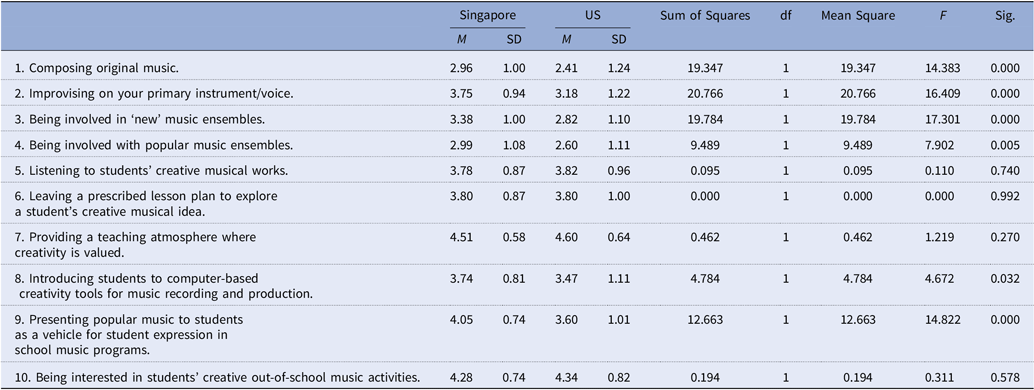
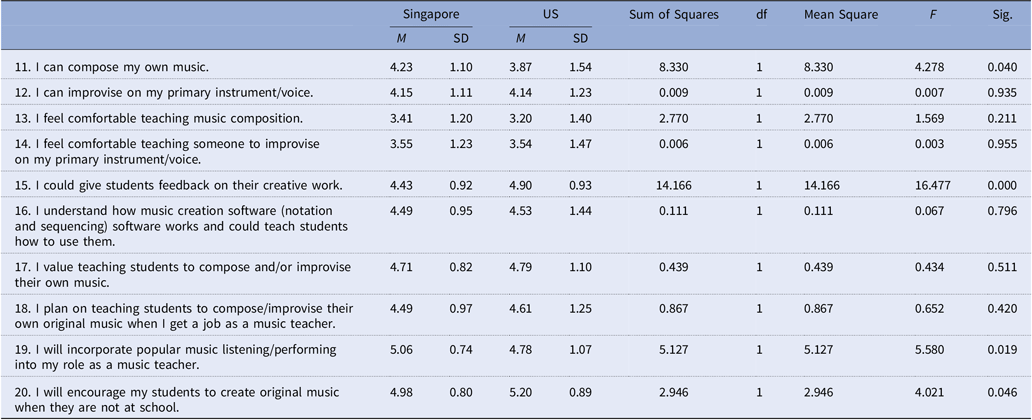
Respondents rated 10 items regarding their perceptions of the importance of various aspects of the music teachers’ experience (see Table 1 for individual items and descriptive statistics). Respondents rated the extent to which they had felt each item was important from ‘1’ = not important to ‘5’ = extremely important. Mean scores for the Singapore PSMT tend to be higher than mean scores for US PSMT, for all items except ‘Listening to students’ creative musical works’, ‘Providing a teaching atmosphere where creativity is valued’, and ‘Being interested in students’ creative out-of-school music activities’. Similarly, in the second part of the CIM, students rated 10 items according to the extent to which they agreed or disagreed with each statement (see Table 2 for individual items and descriptive statistics).
Descriptive Statistics and Analysis of Variance for Items of Creative Identity in Music (CIM) Part 1 ‘Rate the Importance of:’

Note: Rating scale 1–5; 1 = Not Important, 2 = Somewhat Important, 3 = Moderately Important, Very Important, and 5 = Extremely Important.
Descriptive Statistics and Analysis of Variance for Items of Creative Identity (CIM) Part 2 ‘Indicate the Extent to Which You Agree or Disagree with the Following Statements’

Note: Rating scale 1–6; 1 = Strongly Disagree, 2 = Disagree, 3 = Somewhat Disagree, 4 = Somewhat Agree, 5 = Agree, 6 = Strongly Agree.
Respondents rated the extent to which they had felt each item was important from ‘1’ = strongly disagree to ‘5’ = strongly agree. The Singapore PSMT mean scores were higher than the US PSMT mean scores for all statements except ‘I could give students feedback on their creative work’, ‘I understand how music creation software (notation and sequencing) software works and could teach students how to use them’, ‘I value teaching students to compose and/or improvise their own music’, ‘I plan on teaching students to compose/improvise their own original music when I get a job as a music teacher’, and ‘I will encourage my students to create original music when they are not at school’.
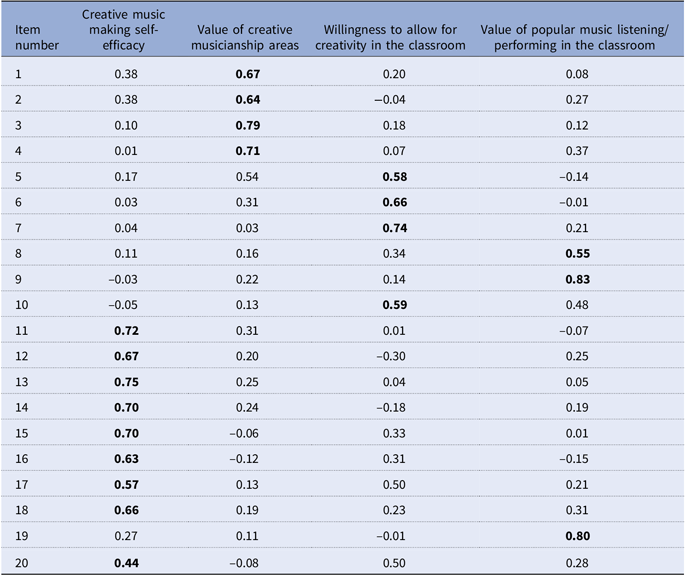
As described earlier, the items follow the theoretical framework developed in prior research (Randles, Reference RANDLES2010; Randles & Smith, Reference RANDLES and SMITH2012). Confirmatory factor analysis revealed that the four sub-scales as reported here in detail match the results of prior research (Randles & Ballantyne, Reference RANDLES and BALLANTYNE2018; Randles & Muhonen, Reference RANDLES and MUHONEN2015) and confirm the theoretical framework developed in prior research. The results of specific research questions are now presented in order.
Research Question 1 – In what ways do PSMTs in the United States and Singapore differ with regard to their perceptions of their own creative identities as indicated by the individual items of the CIM?
Results of analysis of variance of individual line items of the self-perceptions of PSMT as measured by the CIM indicate that the following items were significant at the p < 0.001 level, favoring the Singapore PSMT:
‘Rate the importance of:’
Composing original music
Improvising on your primary instrument/voice
Being involved in ‘new’ music ensembles
Presenting popular music to students as a vehicle for student expression in school music programs
‘Indicate the extent to which you agree or disagree with the following statements:’
I can compose my own music
I could give students feedback on their creative work
I will present popular music performance/listening into my role as a music teacher
Means and standard deviations are displayed in Tables 1 and 2. ‘Being involved with popular music ensembles’ approaches the designated level of significance (p < 0.005). ‘Introducing students to computer-based creativity tools for music recording and production’ also approaches the set level of significance (p < 0.032).
Research Question 2 – In what ways do PSMTs in the United States and Singapore differ with regard to the sub-scales of CIM?
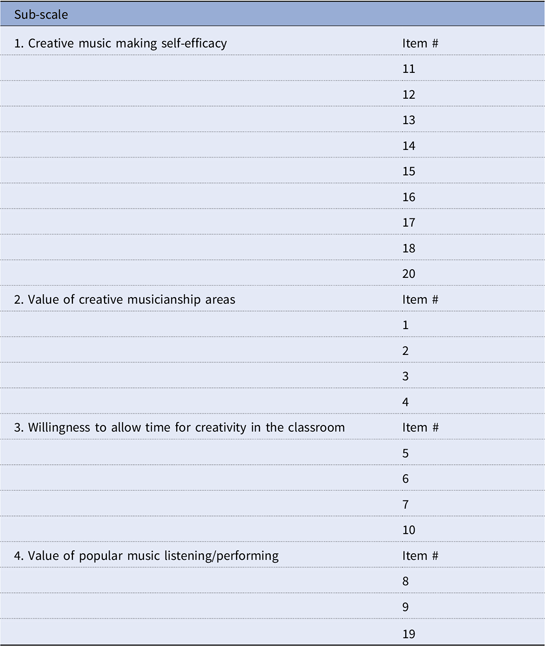
Through exploratory factor analysis, four latent variables were uncovered, in congruence with prior research (Randles & Ballantyne, Reference RANDLES and BALLANTYNE2018; Randles & Muhonen, Reference RANDLES and MUHONEN2015). The researchers have given these variables the following names: (1) ‘creative music-making self-efficacy,’ (2) ‘value of creative musicianship areas,’ (3) ‘willingness to allow for creativity in the classroom’ and (4) ‘value of popular music listening/performing in the classroom’ (see Tables 3 and 4). Table 3 shows how the measure items were loaded. Table 4 shows how the items were grouped according to each sub-scale.
Factor Loadings for Exploratory Factor Analysis of CIM (Creative Identity in Music) with Varimax Rotation for Both the US and Singaporean Pre-service Populations Combined

Note: N = 274. Items are highlighted to indicate how each item loaded to form the four factors. Eigenvalues = 6.513 for Factor 1, 2.462 for Factor 2, 1.879 for Factor 3 and 1.510 for Factor 4. Factors 1, 2, 3 and 4 accounted for 33%, 12%, 9% and 8% of the variance respectively. Interfactor correlations are 0.31 (Factors 1 & 2), 0.47* (Factors 1 & 3), 0.44 (Factors 1 & 4), 0.27 (Factors 2 & 3), 0.10 (Factors 2 & 4) and 0.18 (Factors 3 & 4) *p < 0.01.
Item Groupings According to Sub-Scale

Note. Sample subject n = 274.
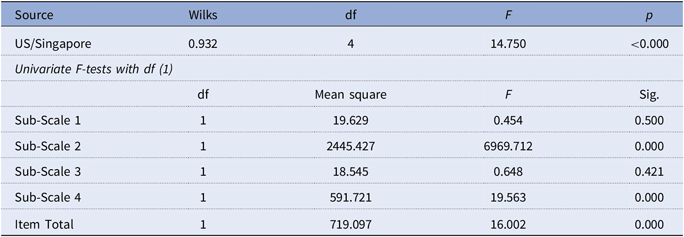
Difference between the US and Singapore PSMT self-perceptions of creative identity was calculated using MANOVA. A significant difference was found between the two populations favoring the Singapore PSMT (p < 0.0001). Univariate F-tests were performed to calculate difference among the sub-scales of CIM for both Singapore and US PSMT. Significant differences were found favoring the Singapore PSMT populations with regard to the following sub-scales: ‘value of creative musicianship areas’ (p < 0.0001), and ‘value of popular music listening/performing’ (p < 0.027). A measure of the CIM item total was also significantly different (p < 0.0001). The two populations were not significantly different with regard to ‘Creative music-making self-efficacy’ (p < 0.0001) or ‘Willingness to allow time for creativity in the classroom’ (Sub-Scale #3) (Table 5).
MANOVA Results of Sub-Scale Comparison of US and Singapore Pre-service Teachers

Note: Significance was set at p < 0.05.
Research Question 3 – How does the CIM as a measure used in this research compare to that of prior research?
CIM was used by Randles and Muhonen (Reference RANDLES and MUHONEN2015) and Randles and Ballantyne (Reference RANDLES and BALLANTYNE2018) in their research, taking a similar factor analytical approach. They uncovered similar latent variables that form the sub-scales of CIM in the present study. Sub-Scale number 1 in the present study contains nine items (11, 12, 13, 14, 15, 16, 17, 18 and 20), similar to the Randles and Ballantyne (Reference RANDLES and BALLANTYNE2018) study while Sub-Scale 1 in the Randles and Muhonen’s (Reference RANDLES and MUHONEN2015) study contains six items (11, 12, 13, 14, 15 and 16). Sub-Scale 2 in the present study contains all items as the Randles and Muhonen (Reference RANDLES and MUHONEN2015) and Randles and Ballantyne (Reference RANDLES and BALLANTYNE2018) study except item 5 (1, 2, 3, 4). Sub-Scale 3 in the present study contains four items (5, 6, 7 and 10), more like the Randles and Ballantyne (Reference RANDLES and BALLANTYNE2018) study than the Randles and Muhonen (Reference RANDLES and MUHONEN2015) study. Sub-Scale 4 in the present study contains three items (8, 9 and 19), similar to the Randles and Ballantyne (Reference RANDLES and BALLANTYNE2018) study. Randles and Muhonen (Reference RANDLES and MUHONEN2015) provide correlation matrices for Sub-Scales 1–4. The correlation matrices for the present study were so similar, and space is so limited in this case, that tables displaying relationships among sub-scale items were omitted.
Discussion
General
On the whole, the individual item scores of the Singapore participants appeared higher than those of their US counterparts. These findings stand in contrast to a line of Singapore-US cross-cultural research in music education which found no significant differences among instrumental students’ achievement goal orientations toward band (Miksza, Tan and Dye, Reference MIKSZA, TAN and DYE2016; Tan & Miksza, Reference TAN and MIKSZA2018), and little differences among general music teachers’ pedagogical creativity (Abramo & Tan, Reference ABRAMO and TAN2017). Given that Asians are in general less likely to indicate extreme scores in Likert-type scales (Chen, Lee and Stevenson, Reference CHEN, LEE and STEVENSON1995), the higher scores reported in this study suggest some possible avenues for fruitful comparisons in music teacher education between the two countries.
While Singapore, like the United States, offers traditional large ensembles (specifically, band and choir) as curricular offerings in its music teacher education programs, PSMTs could also choose to enroll in self-directed popular music ensembles and non-Western ensembles such as the Gamelan. The opportunity for PSMTs to participate in popular music ensembles might have contributed to an overall greater willingness to incorporate popular music and improvisation in their teaching. Composition is also offered as an elective in the undergraduate music education program.
It was revealed through the analyses of the results of CIM sub-scales 2 and 4 that US PSMTs value the creative musicianship areas and the use of popular music in the music classroom to a lesser extent when it comes to connecting those skills to their occupational identity (Isbell, Reference ISBELL2008) as do their Singapore counterparts. If PSMT educators wish to counteract this difference, then real steps to include pathways of musicianship that include improvisation, composition and authentic popular music performance along with recording arts must be a part of the collective plan (Randles, Reference RANDLES, Conway, Pellegrino, Stanley and Westin press).
With more colleges and universities partnering with the non-profit sector to offer modern band teacher training, this difference seems to be moving towards being lessened. Modern band is the name being given to the school music offering in the North America where students perform the music of their choosing, utilizing contemporary instrumentation and modern methods of performance. Teacher education programs that seek to develop the creative identities of their students throughout the program will continue to be the most valuable tool at lessening this gap. Both authors see great value in nurturing 21st-century musicianship skills that are inclusive of how creative identity has been defined in this research strand.
Recommendations for practice
Progressive methods courses
To complement traditional music teacher education offerings such as instrumental, choral and orchestral methods courses, music education in the United States would be wise to nurture and grow methods courses for preparing students to teach classes that do not yet exist. These types of courses could consist, at the foundational level, of deep creative thinking around the particularities of the problems and possibilities inherent with music in the schools. This could accompany the nurturing of musical skills in a wide array of musical areas not typically explored in higher education music: digital music production, multimodal composition and nonlinear composition (Maschine, Abelton, etc.).
At the heart of these new methods courses could be the idea that the best school music offerings have yet to be discovered. Inquisitive thinkers as future music teachers could choose to take paths in their classrooms where bringing out what is best in the students that is somehow already there is the primary mode of operation. What is to come could be more important than what has come before. What has come before is important. That is not being disputed here. The uncertainty and contention from our perspective as researchers interested in creativity and the future of widespread curricula in music education in the United States is the place for innovative practice that ventures from the norm. There need to be places where future music teachers learn how to create new classes that have never before existed.
Creative performance chamber ensembles
In addition to offering methods courses, program leaders in music education in the United States can offer lab settings where students are encouraged to form their own autonomous bands that both perform music that blurs the lines between classical and popular music and music-from-notation-only and play-by-ear. Music in the world is complex, genre-fluid, diverse and increasingly more interesting all of the time. Growing a presence for creative performance chamber ensembles would augment the present system, perhaps paving the way for a more interesting future for all of music education.
Students can be encouraged to compose their own music in those creative performance chamber ensembles, and to dig into the wells of popular music for inspiration. The dichotomy of high and low music, art and popular, needs to be broken down in the United States (Shusterman, Reference SHUSTERMAN2000). Decades of music that is rich with meaning in the lives of human beings the world over has been glossed over and belittled on the merits of a misunderstanding of value, merit and worth. Students in creative performance chamber ensemble may start with popular music and explore the depths of meaning and meaning-making free from judgment and scrutiny. The underlying goals for students are to have fun by way of expanding his or her skillset in music making that includes a strong component of creativity.
In conclusion
This study, as is true of previous studies in this strand, is a reflection of researchers/educators/scholars working to understand what appear to be systemic differences in music education programs across the world where creative identity is concerned. Some favor creative music making activity, and consequently the creative identity that goes hand-in-hand with it, more than others. In this case, US PSMTs indicated a lesser creative identity than their counterparts in England, Finland, Australia and Singapore. These findings do not suggest that PSMTs in the United States are less able to be creative or cannot be creative in conjunction with the formation of their occupational identity. Rather, it seems to mean that because of how they were socialized by the existing school programs and university teacher preparation programs (Ballantyne, Kerchner, & Arostegui, Reference BALLANTYNE, KERCHNER and AROSTEGUI2012), they are less likely to put their creative identity (less than teachers in the other countries researched) to work in their future jobs as music teachers.
It cannot be said enough here that differences in creative identities among PSMT in different parts of the world must be attributable in some way to differences in the ways that they are being socialized to be creative and therefore think about the value of those particular ways of being creative with music (in the ways that we have measured). Changing the ways that both younger students of music in the schools and PSMTs are socialized can have an impact on the sources of these differences.
Further research to better understand what is occurring in these other countries in their teacher education programs seems warranted. Researchers/scholars/educators interested in exploring how change might be implemented in the United States could benefit from visiting the programs at every level in some of these other countries. The researchers hope that these and other collaborations can be a result of this line of research, and that more of what can be beneficial for each country can be uncovered and shared. This would surely be a positive benefit of such cross-cultural research.