This research began with a focus on the development of world-class universities in China. Several major funding programmes have invested millions of RMB in the country's leading universities. While international comparisons are difficult, the differences between five leading Chinese universities and similar institutions in Europe, the United States and other Asian nations demonstrate the progress China has made as well as the challenges it still faces. Are the top Chinese universities more competitive now after more than a decade of special funding?
Context
This research is grounded in the larger discussion of globalization and higher education.Footnote 1 Globalization is generally defined as worldwide integration with an emphasis on market-style competition between nations.Footnote 2 Johnstone draws a distinction between internationalization and globalization. Internationalization means activities within universities' control, such as the exchange of students, scholars, ideas and activities that celebrate national and regional cultures. He defines globalization as supranational: diminishing national cultures, or at least those cultures that cannot withstand pressures of modernism, liberal democracy and the hegemony of the English language.Footnote 3
In an increasingly networked global economy,Footnote 4 knowledge is positioned as the foundation of economic, social and political power,Footnote 5 and thus nations are increasingly dependent upon brainpower.Footnote 6 This means universities play a key role in creating new knowledge for economic growth and in educating people who have the intellectual breadth and critical thinking skills to innovate and lead.Footnote 7
In the past, colleges and universities competed nationally; today many of them compete globally. As a result, universities become disembedded from the national contextFootnote 8 and governments have less control over individual institutions.Footnote 9 The role universities play in a global context becomes more important than their role at a national level.Footnote 10 At the same time, universities themselves have less sovereignty over their own activities because of the influence of global forces.Footnote 11
The world-class university phenomenon is an outgrowth of international competition among research-intensive universities. As Altbach states, “No one knows what a world-class university is, and no one has figured out how to get one.”Footnote 12 The creation of international university rankings, especially the Shanghai Jiaotong University listings,Footnote 13 has led to what some observers consider an academic arms raceFootnote 14 since rankings create a zero–sum game of prestige. Many of these rankings valorize research in the sciences and thus create a single model of excellence.Footnote 15 Rauhvargars cautions that policymakers are “tempted to judge all higher education in the world by the standards that rankings use to detect the top research universities, rather than applying one of the core principles of quality assurance – the ‘fitness for purpose’ principle.”Footnote 16 Globalization subjects all higher education institutions to the pressure of an unequal global knowledge system dominated by the wealthy universities, and imposes the norms and values of those institutions upon all.Footnote 17
Methodology
This project compares 21 research-intensive universities, taking the institution as the unit of analysis:
China
• Beijing University (BJU)
• Qinghua University (QHU)
• Sichuan University (SCU)
• Tianjin University (TJU)
• Beijing Normal University (BNU)
Japan
• Tokyo University (TOK)
• Kyoto University (KYO)
• Tohoku University (THK)
Australia
• Australian National University (ANU)
• University of Sydney (SYD)
Hong Kong
• Chinese University of Hong Kong (CUHK)
• Hong Kong University (HKU)
Other Asia
• National Taiwan University (NTS)
• National University of Singapore (NUS)
• Korea University (KOR)
Europe
• University of Oxford (OXF)
• Swiss Federal Institute of Technology Zurich (ETH)
• Pierre and Marie Curie University (Paris 06)
United States of America
• Massachusetts Institute of Technology (MIT)
• University of California, Berkeley (UCB)
• University of Michigan, Ann Arbor (UM)
Institutional statistics were gathered on enrolments, staffing, budgets, research expenditures, rankings and publications in 2003 and 2007. Sources include university websites, relevant government resources, the ISI Web of Knowledge and personal interviews at Chinese universities.
The years 2003 and 2007 were chosen because of the timing of the 985 Project, a huge supplemental funding stream for an elite group of 39 Chinese universities with the potential to achieve international distinction. The first phase of the project (1999–2003) provided a total grant of 14.2 billion yuan (US$1.7 billion). This report focuses primarily on the second phase of the project (2004–2008), which granted 19.1 billion yuan (US$2.3 billion) in support.
Wealth
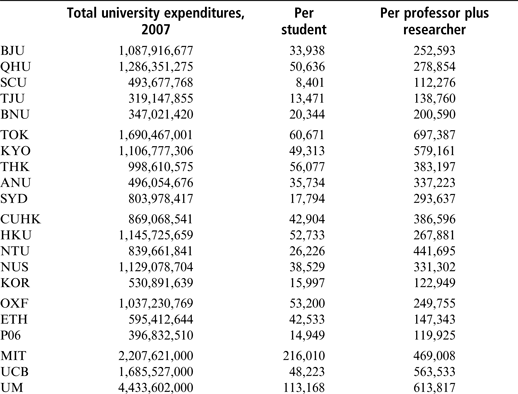
While money alone does not make a university internationally competitive, it certainly helps. This research takes university expenditures and normalizes them to US dollars using the World Bank's Purchasing Power Parity (PPP) methodology.Footnote 18 Then, given the size differences among the 21 universities, it compares expenditures on a per student basis and on a professor plus researcher basis; because universities organize their teaching and research staff in different ways, this project adds the two academic categories to make the statistics comparable (see Table 1).
University Expenditures per Student and per Professor Plus Researcher in US$ Using PPP, 2007

Sources:
University websites (see Appendix); Ministry of Education of China 2007; personal communication with author.
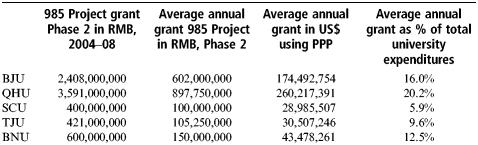
It is not surprising that the American universities are relatively wealthy, but it is startling to see that Tokyo exceeds, and Kyoto approaches, Berkeley and Michigan in total expenditures per professor plus researcher. Another surprise is the relative affluence of Qinghua and Beijing universities, both of which ranked higher than all three of the European institutions. These two Chinese universities increased total expenditure between 2003 and 2007 by 76 per cent for Beijing and a remarkable 82 per cent for Qinghua (see Figure 1). While the increases include all sources of revenue, a significant factor for the five Chinese universities is the 985 Project. As Table 2 suggests, the amount of money going to top universities is staggering, even by Western standards, demonstrating the impressive commitment of the Chinese government to its higher education.
Percentage Change in University Expenditures, 2003–2007
Average Annual Grant from 985 Project as a Percentage of Total University Expenditures, 2007
Research Expenditures
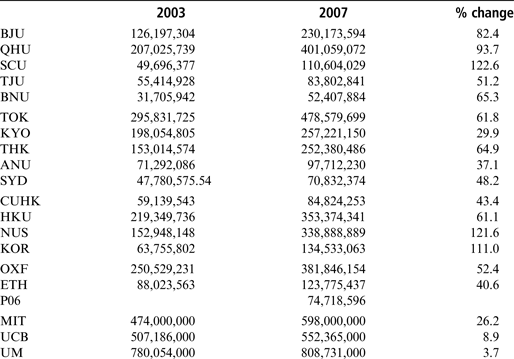
While global competitiveness can be measured in many ways, the prevailing standard is research output and impact. As Table 3 shows, all of the universities in this study increased their research expenditures between 2003 and 2007, in some cases by more than 120 per cent. Comparisons of research expenditures between high and low institutions reveal some interesting patterns. For example, Michigan (the university with the highest research expenditure in 2003) outpaced Beijing Normal (the university with the lowest research expenditure) by 24 times. However, in 2007, this difference had been reduced to 16 times higher, suggesting that Beijing Normal increased its commitment to research at a faster rate than Michigan. Similarly, MIT's research expenditure in 2003 was 2.3 times more than that of Qinghua; in 2007, the difference was 1.5. A comparison between Tokyo and Beijing shows a 2003 difference of 2.3 times, while the gap narrows to 2.0 times in 2007. In other words, Chinese universities are investing heavily in research.
Research Expenditures in US$ Using PPP, 2003 and 2007
Sources:
University websites (see Appendix); Ministry of Education of China 2003; 2007; personal communication with author.
When controlling for size, the differences among the 21 universities are striking. As Table 4 shows, Sichuan and Korea more than doubled their research expenditures per professor plus researcher between 2003 and 2007 (albeit from a small base). Four other universities increased the same statistic by more than 50 per cent. In 2007, Tokyo spent more on research per capita than Michigan, and Qinghua's expenditure was nearing that of Kyoto and Singapore universities. Interestingly, both MIT and Michigan's research expenditures per professor plus researcher decreased. One possible reason is a 15 per cent increase in the number of professors and researchers at MIT and a 43 per cent increase at Michigan between 2003 and 2007. The decline in research expenditures per capita may also reflect a slowdown in US government research support during this period.
Research Expenditures per Professor Plus Researcher in US$ Using PPP, 2003 and 2007
Sources:
University websites (see Appendix); Ministry of Education of China 2003; 2007; personal communication with author.
Research intensity can be estimated by looking at the proportion of the total university budget devoted to research. According to Figure 2 most universities outside the United States show an increase between 2003 and 2007.
Research Expenditures as a Percentage of Total University Expenditures in US$ Using PPP, 2003 and 2007
Publications
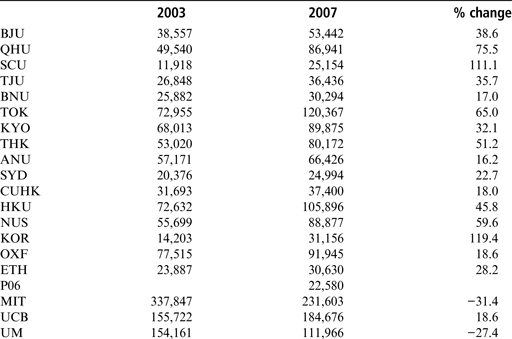
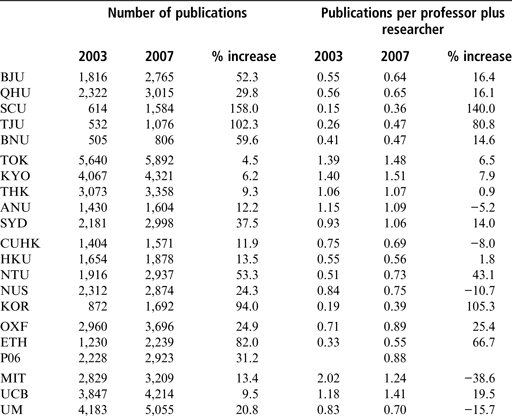
A second way to estimate research intensity is to look at publications in highly regarded journals. I use the total number of journal articles listed in the ISI Web of Knowledge as an indicator of good quality research. As Table 5 shows, all 21 universities increased the number of publications by faculty and researchers between 2003 and 2007, with a doubling of publications at both Sichuan and Tianjin; Korea was not far behind with a 94 per cent increase. A more useful comparison controls for institutional size by dividing the number of journal articles by the number of professors plus researchers in the relevant years. As the right hand columns of Table 5 reveal, Tokyo and Kyoto lead in this measure in 2007, but the Chinese universities do not compare as well, despite increases in the total number of publications. Since much research was done in separate institutes until recently, the comparatively low statistics are not surprising.
Publications, and Publications per Professor Plus Researcher, 2003 and 2007
Source:
ISI Web of Knowledge.
Note:
Number of publications equals the total of journal articles in the Science Citation Index Expanded, Social Science Citation Index, and Arts and Humanities Index.
Interestingly, five institutions saw a decline in publications per capita, but these five universities were all among the top eight in the percentage increase in professors plus researchers. In other words, the number of academic staff increased much faster between 2003 and 2007 than the number of publications. However, in general all of the 21 universities are increasingly oriented towards publications.
Frequently Cited Researchers
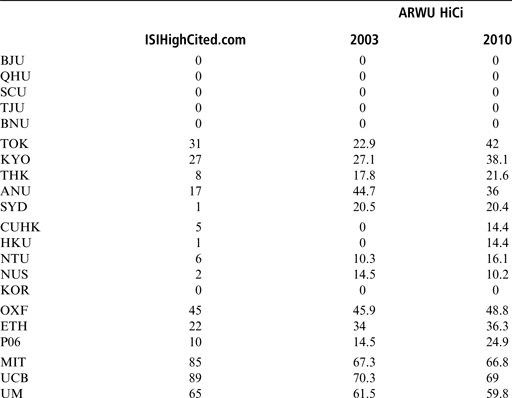
However, number of publications is not always matched by reputation. A third way to evaluate research intensity is to examine the number of frequently cited researchers. The first column in Table 6 shows the number of individuals at each institution who are frequently referenced by other scholars. American universities have the largest number of frequently cited researchers, while Korea and the Chinese universities have no frequently cited scholars. Similar evidence comes from the Shanghai Jiao Tong rankings, with no Chinese or Korean scholars frequently cited. The possibility of a “halo effect” must be considered, in which scholars prefer to cite people at the most prestigious institutions thereby giving the advantage to well-known Western scholars. However, the absence of frequently cited researchers in Chinese universities suggests that investments made today may not show results for many years to come.
Highly Cited Researchers
Source:
ISI Web of Knowledge; 2010 Academic Ranking of World Universities.
Notes:
ISI highly cited researchers is the number of scholars frequently cited in journals listed in Science Citation Index, Social Science Citation Index, and Arts and Humanities Citation Index. ARWU HiCi ranking is based on the relationship between the top-rated institution (Harvard University in the case of HiCi) and other institutions' scores, displayed as a percentage of the top-rated institution's number of frequently cited researchers.
Value for R&D Investment
One measure of effectiveness can be found by comparing research expenditures with the total number of articles published in the various indices – in other words, are funders getting their money's worth? Since publication lags behind investment by a number of years, this study looks at 2007 research expenditures divided by the number of articles published in 2010 (Figure 3). Admittedly, this is a crude measure but it shows significant differences among the 21 universities. Technology-oriented universities such as Qinghua, MIT and Tianjin spend more per article than do other universities but the differences cannot be attributed only to technological demands; Paris 06, also a science-oriented university, spends seven times less per article than MIT.
2007 Research Expenditures per 2010 Article in US$ Using PPP
Equally startling is the comparison between European and Chinese universities: both Qinghua and Tianjin spend more per article than Oxford, ETH and Paris 06. However, it is not clear which way the causation runs. It could be that Chinese institutions may still be in the start-up phase of big research while European universities have been conducting such research for many decades. Alternatively, Chinese universities could be spending more of their money on long-term fundamental research rather than short-term projects, although the policy emphasis on economic development suggests a priority on applied research instead. Finally, it may be that Chinese universities may be spending more money simply because they have more money.
Conclusion
With world-class stature as a stated policy goal, China's top universities are following the lead of European and North American universities by shifting their frame of reference from national to international ranking.Footnote 19 Global competitiveness requires more than achieving high rankings, but the development of international league tables has provided new ammunition in the battle for worldwide excellence.Footnote 20
Thoughtful scholars have observed that rankings can influence institutions to change their behaviour in response to being evaluated. Espeland and Cauder note that rankings encourage schools to mimic what the rankings measure, with institutional responses including redistribution of resources, redefinition of work and “gaming the system.”Footnote 21 Hazelkorn reports that, of the 151 university faculty and administrators she surveyed, only three individuals reported no action in response to rankings.Footnote 22 Deem, Mok and Lucas call for careful reflection on the extent to which “good practices” from Europe and North America can be successfully integrated into non-Western systems. Will competition in a system based on science-oriented universities in the West lead to a new dependency culture reinforced by American-dominated hegemony?Footnote 23
Marginson notes that most of the ranking systems emphasize quantity of publications as a proxy for academic quality. In questioning the effects of global comparisons, he muses about the implications for intellectual creativity:
One danger is that an emphasis on maximizing the volume of high quality work, so as to augment the position in citation metrics and rankings, may drive a higher proportion of inquiry down more predictable and less risky intellectual pathways. Perhaps scholars and researchers are more likely than before to work to the academic opinion market and less likely to overturn received wisdom.Footnote 24
China has prioritized the development of innovative universitiesFootnote 25 but if Marginson is correct, its “fervent embrace”Footnote 26 of rankings and Western definitions of excellence may be at odds with its vision of an innovative society. The heavy investment in a small number of leading universities could widen the gap between elite research universities and mass teaching institutions, with uncertain implications for social and national solidarity and development.Footnote 27 Ross and Lou reinforce this point with their plea for greater balance between the potentially empowering trends of global communications and the concrete challenges faced by local communities.Footnote 28
All the universities in this project, and the Chinese universities in particular, demonstrate an increasing emphasis upon research and publications. Yet, even with major commitments, most of the 21 universities do not have resources commensurate with their international ambitions. Hazelkorn reports that the fiscal demands of operating a world-class university are estimated at US$1.5 to 2 billion per year,Footnote 29 a level achieved in 2007 only by Tokyo and the three American universities.
These financial statistics bear out the intellectual differences between Beijing and Qinghua on the one hand, and Sichuan, Tianjin and Beijing Normal on the other. The overall budgets for the first two institutions are much larger than the other three. Research expenditures per professor plus researcher are significantly higher at Beijing and Qinghua compared with the others and their publications mirror that financial investment. Therefore, global standing may not be a realistic target for all members of the 985 Project. It might make more strategic sense for some Chinese universities to identify a few fields in which they can excel rather than striving for university-wide global recognition.
Chinese investment in its leading universities is not buying top-quality research as defined by citation indices. None of the Chinese universities has a professor whose published research is highly cited by other scholars. Intellectual snobbery may play a role, but the magnitude of the difference is marked, suggesting that the current pressure in Chinese universities to produce a high volume of publications may be a misguided priority. Perhaps fewer, but higher quality, articles would be a more suitable goal.
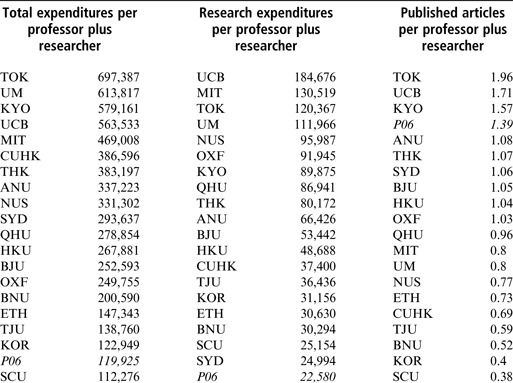
The research outlined here also suggests that factors other than money are important for maintaining competitiveness in the global higher education marketplace, as demonstrated by the high scholarly productivity of Paris 06, despite its low funding levels. As Table 7 shows, Paris 06 ranks at or near the bottom in university expenditures and research expenditures per professor plus researcher, yet is fourth in published articles per capita. A possible explanation for this phenomenon comes from Salmi, who states that there are three conditions necessary for the development of world-class universities: concentration of talent, abundant resources and appropriate governance.Footnote 30 The top Chinese universities, along with the others in this study, meet the first standard of talented professors and students. Beijing and Qinghua also have abundant resources. The difference comes in the third category, by which Salmi means the overall regulatory framework, the competitive environment and the degree of academic and managerial autonomy that universities enjoy.
Universities in Rank Order, for Total University Expenditures, Research Expenditures and Published Articles per Professor Plus Researcher, 2007
Sources:
University websites (see Appendix); Ministry of Education of China 2007; ISI Web of Knowledge; personal communication with the author.
Altbach and Salmi note that although Chinese universities have benefited from greater autonomy, continuing tight political control in the country could hamper the full development of leading universities in the medium term. They note three areas of tension. The first comes from the dual governance structure of Chinese universities in which the president shares authority with the Communist Party secretary, with the potential to undermine the president's ability to lead the institution in an autonomous fashion.Footnote 31 Mohrman, Wang and Li observe that greater autonomy has been accompanied by greater accountability through a high-stakes quality assurance system; universities are subject to a powerful form of steering at a distance.Footnote 32 Similarly, Mok observes that decentralization does not necessarily mean greater authority and decision-making power. In fact, the new governance strategies may create a more activist state rather than diminish state capacity.Footnote 33 The changing nature of government–university relations has resulted in some greater procedural autonomy for institutions, but has led to a narrowing of substantive autonomy.Footnote 34
Academic freedom is the second area of tension identified by Altbach and Salmi, especially in sensitive areas of the humanities and social sciences.Footnote 35 In this respect, India has a powerful advantage over China, according to Levin, because professors have the freedom to pursue their intellectual interests wherever they may lead – a freedom that is an indispensible feature of any great university.Footnote 36
Altbach and Salmi's third area of tension is pressure from local authorities on admissions for local students, a particular problem in places such as Shanghai where local governments have made substantial investments in their universities.Footnote 37 Thus, even the best Chinese universities do not meet all three of Salmi's standards for world-class universities.
Qinghua University is arguably the most successful Chinese university in terms of finances and status, yet its very success may hamper its quest for world-class status. Yang and Welch believe that Qinghua's uneven development between the social sciences on the one hand, and the natural and technological sciences on the other, may affect its international standing in the long term. The imbalance is historical in part, but is also a result of strategic decisions to link university development with national policy priorities.Footnote 38 This close partnership with government leads to two dilemmas. The first is academic autonomy. Yang and Welch ask, “How much does the intertwining of academia and officialdom … allow Tsinghua to maintain the independence critical to university development?”Footnote 39 The second dilemma stems from Qinghua's emphasis on applied rather than basic research, since basic research is considered by many to be the foundation for long-term innovation. As an institution known especially for its expertise in engineering, this is a particular issue for Qinghua.Footnote 40
Are Chinese universities globally competitive? Xu Zhihong, former president of Beijing University, has stated that China does not have “world-first-class universities at the present time.”Footnote 41 But, he might have added “not yet.” China's investment in its leading universities is impressive, and the desire to meet global standards for academic excellence may well lead to greater academic freedom. The quality of Chinese universities, Beijing and Qinghua in particular, should make them increasingly competitive in the years ahead.
Appendix
Website Sources Used in Tables
Beijing Normal University. “History of BNU: a chronological review,” http://www.bnu.edu.cn/bnueng/AboutBNU/historyofbnu.html.
ISI Web of Knowledge. Science Citation Index, Social Science Citation Index, and Arts and Humanities Citation Index, http://isiwebofknowledge.com/. Accessed 28 March 2011.
Massachusetts Institute of Technology. Common data set 2003–2004, http://web.mit.edu/ir/cds/2004/i.html. Accessed 12 May 2011.
Massachusetts Institute of Technology. Common data set 2007–2008, http://web.mit.edu/ir/cds/2008/i.html. Accessed 12 May 2011.
Massachusetts Institute of Technology. Financial reports for 2003 and 2007, http://web.mit.edu/annual reports/. Accessed 12 May 2011.
Ministry of Education of China. 2003; 2007. Common data set of higher education institutions. Information provided to the author.
National Center for Education Statistics, US Department of Education Institute of Education Sciences. “Integrated postsecondary education data set,” http://nces.ed.gov/ipedspas/. Accessed 15 January 2011.
Peking University. “General information,” http://english.pku.edu.cn/AboutPKU/. Accessed 27 February 2011.
Sichuan University. “About SCU,” http://www.scu.edu.cn/en/H6401index_1.htm. Accessed 28 February 2011.
Swiss Federal Institute of Technology [ETH]. “About us,” http://www.ethz.ch/about/index_EN. Accessed 17 April 2011.
Swiss Federal Institute of Technology [ETH]. Annual reports for 2003 and 2007, http://www.ethz.ch/about/publications/annualreports/index_EN. Accessed 17 April 2011.
Tianjin University. “About TU,” http://www.tju.edu.cn/english/AboutTU/Welcome/. Accessed 4 March 2011.
Tsinghua University. “Introduction to Tsinghua University,” http://www.tsinghua.edu.cn/eng/about.jsp?boadid=32&bid2=3201&pageno=1. Accessed 3 March 2011.
University of California Berkeley. Common data set 2003–2004, http://cds.berkeley.edu/. Accessed 4 April 2011.
University of California Berkeley. Common data set 2007–2008, http://cds.berkeley.edu/. Accessed 4 April 2011.
University of California Berkeley. Financial reports for 2003 and 2007, http://controller.berkeley.edu/FINRPTS/FinancialStatements.htm. Accessed 4 April 2011.
University of Michigan. Common data set 2003–2004, http://sitemaker.umich.edu/obpinfo/files/umaa_cds2004.pdf. Accessed 8 April 2011.
University of Michigan. Common data set 2007–2008, http://sitemaker.umich.edu/obpinfo/files/umaa_cds2008.pdf. Accessed 8 April 2011.
University of Michigan. Financial reports for 2003 and 2007, http://www.finops.umich.edu/reporting/annualreports. Accessed 8 April 2011.
University of Oxford. Financial statements for 2003 and 2007, http://www.ox.ac.uk/about_the_university/facts_and_figures/financial_statements.html. Accessed 7 February 2011.
University of Oxford. “Student statistics, 2003 and 2007,” http://www.ox.ac.uk/about_the_university/facts_and_figures/index.html#astudent_life. Accessed 7 February 2011.
University of Paris 06 – Pierre and Marie Curie. Information provided to the author.