Introduction
San Sebastián Bay, situated on the Atlantic coast in the northeast of the Isla Grande de Tierra del Fuego (Figure 1), is a clear example of an area of conflict between conservation managers and hydrocarbon companies operating in a protected area (BirdLife International 2024).
The bay is part of the current Tierra del Fuego Atlantic Coast Reserve, which extends 220 km (140 miles) along the Fuegian coast. This area serves as a refuge for migratory shorebirds and copious aquatic life (López Gappa and Sueiro Reference López Gappa and Sueiro2007; Morrison and Ross Reference Morrison and Ross1989; Niles et al. Reference Niles, Sitters, Dey, Atkinson, Baker, Bennett, Carmona, Clark, Clark and Espoz2008). Among the long-distance migratory shorebirds that visit the area in summer to eat in the intertidal are the white-rumped sandpipers (Calidris fuscicollis), the redknots (Calidris canutus), and the Hudsonian Godwits (Limosa haemastica). They feed mainly on small invertebrates such as polychaetes, crustaceans, insects, and molluscs, especially bivalves like clams (Hernández et al. Reference Hernández, Bala and Musmeci2008). Also, more than 20 species of cetaceans use the waters of the Atlantic coast of Tierra del Fuego, either for reproduction or feeding in tidal zones, with both whales and sperm whales migrating through these waters in spring (Goodall et al. Reference Goodall, Dellabianca, Boy, Benegas, Pimper and Riccialdelli2008; Pimper et al. Reference Pimper, Goodall, Gibbons, Sobral, Lockyer and Praderi2008). Due to its ecological significance, this site was designated as a Ramsar site in 1995 and later became a provincial nature reserve in 1998 (Law 415/98) currently being the southernmost site in the world both on the Ramsar list and in the Western Hemisphere Shorebird Reserve Network (BirdLife International 2024).
Furthermore, and contrary to the conservation objectives of the reserve, the area is vulnerable to the impact of oil and gas extraction, both from onshore and offshore deposits. It has been the subject of major hydrocarbon spills, including a notable incident in September 2019, where a 50-m-long spill occurred due to poor handling and equipment failures during oil extraction (Di Paola Reference Di Paola2023).
In this context, there is still little information about the coastal productive systems, and even less known, about the biotic interactions among their components. However, a pioneering work conducted by López Gappa and Sueiro (Reference López Gappa and Sueiro2007) in San Sebastián Bay provided basic information on the shallow (6–31 m depth) benthic communities of this area.In this work, 113 taxa of macrobenthic invertebrates from 12 animal phyla were identified. These taxa exhibit affinities to the faunas from other localities of Tierra del Fuego, the Magellan Strait, the southern Chilean fjords or even other subantarctic islands of the Scotia Arc. These authors also mention that on the beach they frequently observed shells of two mactrid bivalves, Darina solenoides and Mactra fuegiensis, which were ‘perforated by circular boreholes made by naticid gastropods, (…)’ (p. 685). This observation caused the interest in conducting this study focused on the transported mollusc assemblage along the coast of this bay. In this sense, it is widely known that taphonomic studies focused on mollusc assemblages can provide relevant information about adjacent living communities (e.g., Fürsich and Flessa Reference Fürsich and Flessa1987; Kidwell Reference Kidwell2002a, Reference Kidwell2002b). In this regard, it is important to highlight that the intertidal environment of the bay, which spans several kilometres (approximately 7–10 km) is very difficult to access for collecting biological data (see comments by López Gappa and Sueiro Reference López Gappa and Sueiro2007). This difficulty is due to the sedimentological characteristics with a predominance of soft substrates, combined with large tidal amplitudes and low slope. This means that for now there is no precise information about the benthic communities in this sector. Conducting taphonomic studies is essential for understanding the processes and agents that influence how well assemblages reflect the original faunal communities (Beherensmeyer Reference Beherensmeyer2021). So, knowing the taphonomy of the mollusc assemblages becomes increasingly significant. Therefore, the main objective of this work is to enhance our understanding of biotic interactions in the tidal flats of this bay, with a particular focus on drilling and crushing predation from a taphonomic perspective.
Shell assemblages as ecological proxy of benthic communities
The shell assemblages deposited on modern beaches are remnants of living organisms that were subject to environmental post-mortem agents and processes. Therefore, they can provide information about the interactions between an organism and its environment during life and processes such as bioerosion, encrustation, disarticulation, predation, transportation, and diagenetic alteration (Claassen Reference Claassen1998; Cummins et al. Reference Cummins, Powell, Stanton and Staff1986; Kidwell and Behrensmeyer Reference Kidwell and Behrensmeyer1988; Parsons and Brett Reference Parsons, Brett and Donovan1991).
It is important to highlight that these assemblages reflect the average variability resulting from the cumulative effects of different populations or biocenoses. Despite the presence of taphonomic biases, they preserve the ecological fidelity (i.e., species composition, relative abundance, clues to biotic interactions) of the communities from which the shells originated (Archuby et al. Reference Archuby, Adami, Martinelli, Gordillo and Boretto2015; Fürsich and Flessa Reference Fürsich and Flessa1987; Kidwell Reference Kidwell2001, Reference Kidwell2002a, Reference Kidwell2002b; Kidwell Reference Kidwell2013; Tomašových and Kidwell Reference Tomašových and Kidwell2009).
Drilling predation by gastropods
These assemblages of dead shells also offer an opportunity to study drilling predation. This is a particular type of predator–prey interaction mainly caused by certain gastropods. These predators make holes in the shells of their prey, making this phenomenon a significant area of interest for both biology and paleontology, particularly in the contexts of ecology and evolutionary ecology (Kelley and Hansen Reference Kelley, Hansen, Kelley, Kowalewski and Hansen2003; Vermeij Reference Vermeij1987).
It is well established that two different groups of gastropods are the main responsible for making drill holes on shelled taxa: on the one hand, the naticids, which include species that predominate in soft substrate environments and feed preferentially on infaunal organisms, and on the other hand, the muricids that are associated with firm substrates and mainly feed on epifaunal species, but also semi-infaunal ones (Gordillo Reference Gordillo, Johnston and Haggart1998; Kabat Reference Kabat1990; Kowalewski Reference Kowalewski2004; Martinelli et al. Reference Martinelli, Gordillo and Archuby2013). To make the holes, these snails employ a combination of mechanical processes using the radula and chemical processes through specific glands, the so-called accessory boring organ or ABO (Carriker Reference Carriker1981; Carriker and Gruber Reference Carriker and Gruber1999). There are certain physiological and anatomical differences between the two groups of snails (such as the position of the ABO and different glands and their secretions), which result in different holes that can often be used as a diagnosis to identify the predator, especially when the holes are incomplete (Carriker Reference Carriker1981; Vermeij et al. Reference Vermeij, Dudley and Zipser1989).
Shell crushing predation by crabs
Under natural conditions, this type of interaction has been studied mainly from repaired marks (non-lethal damage) found on the prey shells (Alexander and Dietl Reference Alexander, Dietl, Kelley, Kowalewski and Hansen2003; Kowalewski and Flessa Kwand Marcot Reference Kowalewski and Flessa Kwand Marcot1997; Stafford et al. Reference Stafford, Tyler and Leighton2015b; Vermeij Reference Vermeij1982, Reference Vermeij1987). Additionally, other works base their interpretations on the analysis of the breaks (lethal damage) because certain types of shell damage are more commonly associated with predation rather than taphonomic processes. For example, in coastal marine environments, crabs (phylum Crustacea) are the main invertebrates that produce breaks in shells using three basic methods of subjugation that include crushing, peeling and pounding (Vermeij Reference Vermeij1987). These mechanisms generate different types of breakage, some of which can be identifiable and linked to predatory action (Stafford and Leighton Reference Stafford and Leighton2011; Stafford et al. Reference Stafford, Dietl, Gingras and Leighton2015a, Reference Stafford, Tyler and Leighton2015b), serving to estimate this interaction and make comparisons between different species and/or places.
Materials and methods
Study area and sampling
San Sebastián Bay is located on the Atlantic coast to the northeast of the Isla Grande de Tierra del Fuego (53° 10ʹ S; 68° 30ʹ W, Figure 1). It lies approximately 20 km south of the mouth of the Strait of Magellan. The bay has a semicircular shape and measures about 55 km in a North–South direction and approximately 40 km from East to West. The tidal regime is semi-diurnal with a maximum amplitude of 10.23 m and an average amplitude of 6.57 m (Naval Hydrography Service, consultation 11/18/24). Water temperature ranges from 5°C (winter) to 11°C (summer) and salinity from 30 to 34 PSU. The intertidal zone has a width of 7–10 km, depending on the area. The depths recorded in the middle zone of the bay range between 9 and 13 m, being maximum (around 48 m) in the proximity of the El Páramo Peninsula at its northern end (López Gappa and Sueiro Reference López Gappa and Sueiro2007).
Location map. (A) Location of Tierra del Fuego (in black and marked with a circle) at the southern tip of South America. (B) Northeastern sector of Tierra del Fuego showing the location of San Sebastián Bay. (C) Coastal scheme showing different physiographic sectors (A–F; according to Vilas et al. Reference Vilas, Arche, Ferrero and Isla2000) and (D) Satellite image of San Sebastián Bay (from Google Earth Pro) showing the sampling site (black star). (E–I). Different views of the studied site. Photos taken during the fieldwork.

The internal part of the bay shows a progressive evolution from pure tidal plain in the north to gravel beaches and cliffed coast in the south, where sedimentation is absent allowing for the distinction of different subenvironments: gravel beaches of Peninsula del Páramo (A), muddy tidal plain (B), cheniers plain (C), beaches with sandy and muddy tidal flats (D), cliffed coast (E), and a beach–barrier–‘lagoon’ complex (F) (Vilas et al. Reference Vilas, Arche, Ferrero and Isla2000; Figure 1C).
The material analysed here was collected in December 2017. Shells were collected by hand from 20 quadrants of 1.0 m2 located near the mouth of the San Martín River (Figure 1D). This river has a low-flow runoff and a gentle slope toward the Atlantic (Iturraspe and Urciuolo Reference Iturraspe and Urciuolo2000).
Taphonomic bias and ecological cues
To estimate the taphonomic biases and the representativeness of the mollusc assemblage, we considered some factors including the ratio between right and left valves, the size distribution of the most abundant species and the abrasion of the sampled collection (see Dodd and Stanton Reference Dodd and Stanton1981; Frey and Henderson Reference Frey and Henderson1987; Fürsich and Flessa Reference Fürsich and Flessa1987; Kidwell and Bosence Reference Kidwell, Bosence, Allison and Briggs1991; among many others). These factors were compared using chi-squared test in the R program (version 4.3.3).
For the identification of mollusc species, different works were consulted, including Segade and Pastorino (Reference Segade and Pastorino2008); Aldea et al. (Reference Aldea, Rosenfeld and Cárdenas2011); Rosenfeld et al. (Reference Rosenfeld, Maranbio and Aldea2016) and Pastorino and Simone (Reference Pastorino and Simone2021), and updated taxonomic names were obtained from WoRMS (2024). To estimate the relative abundance of the different taxa in the mollusc assemblage, we categorized them as follows: very frequent (more than 50 specimens), frequent (between 50 and 20), common (between 19 and 10), infrequent (between 9 and 3), or rare (less than 3). Life mode for each species was reconstructed from our own observations of most of these species or congeners in other natural environments or under laboratory conditions, and by comparison with related species in bibliographic references (e.g., Stanley Reference Stanley1970)
Drilling predation on bivalve shells
The parameters used to evaluate predation caused by drilling gastropods were predation intensity, size selectivity, and site selectivity. These proxies are considered and applied in numerous published works (e.g., Anderson et al. Reference Anderson, Geary, Nehm and Allmon1991; Dietl and Alexander Reference Dietl and Alexander1995; Hansen and Kelley Reference Hansen and Kelley1995; Gordillo and Amuchástegui Reference Gordillo and Amuchástegui1998; Sawyer and Zuschin Reference Sawyer and Zuschin2010; among many others). The predation intensity for each species was estimated by calculating the frequency of predation, determined by the ratio of the number of drilled specimens or valves to the total number of specimens or valves of that species. To determine the number of bivalve specimens with disarticulated valves, the left and right valves were counted separately before applying a numerical equation (n = left + right/2).
Specimens with complete drill holes were considered cases of successful predation, while those with incomplete drill holes represented failed attempts by the predator, that is, unsuccessful predation. For articulated specimens that featured multiple drill holes, we distinguished between specimens with only incomplete drill holes (which represent failed predation) and those that contain at least one complete drill hole (representing successful cases of predation).
Size–frequency distribution was used to describe the preference (or not) for a particular size. For each species, according to its size (length in mm), five class intervals were considered. In D. solenoides, the intervals were as follows: I (15 ≤ 25), II (25 ≤ 35), III (35 ≤ 45), IV (45 ≤ 55), and V (55 ≤ 65). In M. fuegiensis the intervals were as follows: I (10 ≤ 20), II (20 ≤ 30), III (30 ≤ 40), IV (40 ≤ 50), and V (50 ≤ 60).
In order to assess site selectivity on these two bivalve prey, we analysed the positions of the drill holes on the shell surface. In the case of D. solenoides, the shell was arbitrarily divided in three zones, from the anterior to the posterior sector of the valve (sensu Gordillo et al. Reference Gordillo, Malvé, Morán and Boretto2020; zones I–III; Figure 2A). In M. fuegiensis the shell surface was arbitrarily divided into nine sectors (sensu Kelley Reference Kelley1988; zones I–IX), as shown in Figure 2B. Then, the number of drill holes per sector was counted for each bivalve species.
Arbitrary subdivision of the valve surface of two prey species into sectors. (A–A’) D. solenoides. (B–B’) M. fuegiensis. Explanations in the text.

The identification of potential drilling predators was mainly based on the morphology of the holes produced by naticids and muricids, that was described in different works (e.g., Aitken and Risk Reference Aitken and Risk1988; Carriker and Yochelson Reference Carriker and Yochelson1968; Guerrero Alba and Reyment Reference Guerrero Alba and Reyment1988; Kabat Reference Kabat1990; Tull and Bohning-Gaese Reference Tull and Bohning-Gaese1993).
Finally, to evaluate if there is a relationship between the size of the predators and their prey, we analysed the correlation between the size of the prey (length in mm) and the size (diameter in mm) of the drill holes. The size of the drill holes serves as an indirect measure of predator size (Harper et al. Reference Harper, Robison and Lee2011; Tull and Bohning-Gaese Reference Tull and Bohning-Gaese1993).
From a taphonomic perspective, this study assumes that shells with drill holes are in a similar condition to shells without drill holes (see Kelley Reference Kelley, Wisshak and Tapanila2008).
Crushing predation on gastropod shells
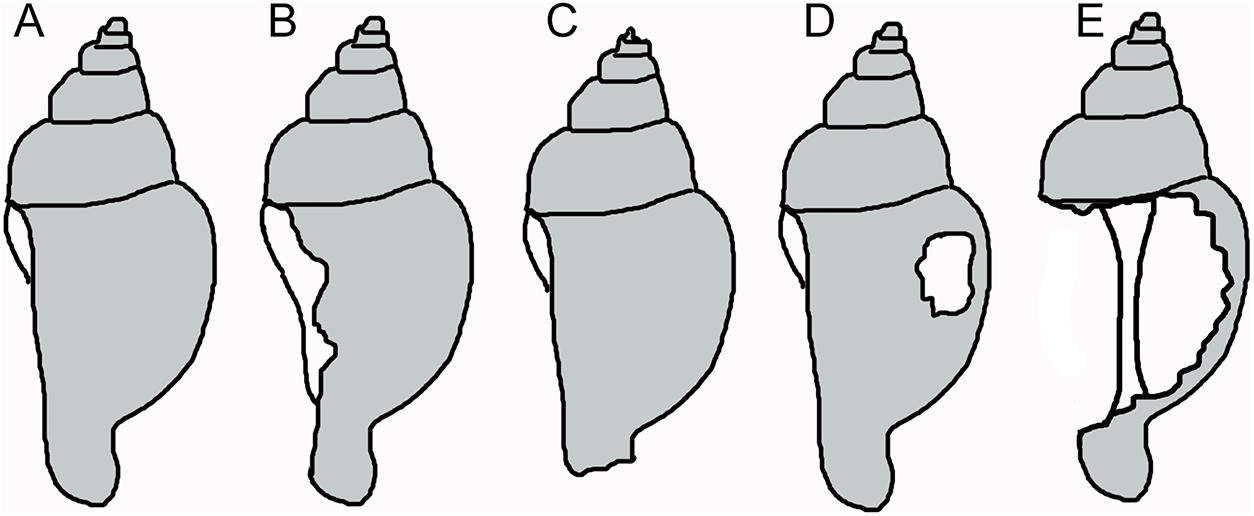
Predation behaviour and damage produced by potential predators (i.e., crabs) on gastropod shells was inferred by the shell conditions observed in the three most abundant species: the naticid Falsilunatia limbata and the muricids Trophon geversianus and Xymenopsis muriciformis. For this, several previous works (Edgell and Rochette Reference Edgell and Rochette2009; Gordillo and Archuby Reference Gordillo and Archuby2014; Stafford and Leighton Reference Stafford and Leighton2011) were taken as reference. The shell condition was discriminated according to five categories (Figure 3): Intact shells (A), Shells with damage to shell aperture margin (B), Shells with spire/apex and/or columella/siphonal channel (in muricids) damage (C), Shells with a hole in body whorl (D). We distinguish two subcategories based on the size of the break: up to 5 mm (a) and larger than 5 mm (b), and Shells with a major damage in last whorl, with exposed columella (E).
Different types of damage on gastropod shells. See the explanation of the five categories (A–E) in the text.

Finally, we also analysed specimens showing repair marks, corresponding to non-lethal damage (Alexander and Dietl Reference Alexander, Dietl, Kelley, Kowalewski and Hansen2003).
Results
Taphonomic bias and ecological cues
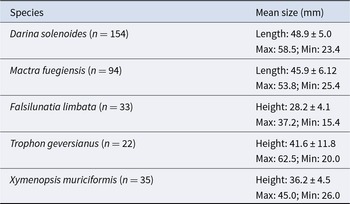
We identified 14 species from the mollusc shell assemblage: 4 bivalves and 10 gastropods (Table 1). Five species constitute 95% of the sampled set according to their relative abundance. They are the mactrids D. solenoides and M. fuegiensis which were very frequent, and the naticid F. limbata and the muricids X. muriciformis and T. geversianus which were frequent (Table 2). These five species were represented by a wide size range covering small to large sizes, which is relevant to evaluate taphonomic bias and ecological fidelity. In terms of taphonomic bias of the mollusc assemblage, the ratio between right and left shells was 0.94 in D. solenoides (Χ 2 = 0.275; p = 0.6) and 0.97 in M. fuegiensis (Χ 2 = 0.089; p = 0.76) showed no significant differences.
Taxonomic composition of the shell assemblage collected from the beach, near the mouth of the San Martín River indicating their relative abundance (RA) and life mode

The sampling site is shown in Figure 1.
1 Turritella sp. (two fossil broken specimens). Relative abundance: C, common; F, frequent; I, infrequent; VF, very frequent; R, rare. Life mode: Ep, epifauna; In, infauna; Semi-In, semi-infauna; Byss, bivalve fixed by the byssus; Burr, burrowing bivalve; Mob, mobile gastropod.
Number of specimens measured and size distribution of the species involved in the predator–prey interactions analysed in this work

Regarding the remaining nine species recovered in the mollusc assemblage, two other gastropods, Buccinastrum paytense and Pachycymbiola ferussacii, were common species and the remaining seven species were infrequent or rare, with one or two/three specimens in each case. Additionally, the collected material included two broken fossil specimens of Turritella sp. probably coming from the Middle/Early Miocene Carmen Sylva Formation (sensu Codignotto and Malumian Reference Codignotto and Malumian1981), located near the site.
Infaunal and semi-infaunal species dominated according to their life mode, while epifaunals show low proportion. Almost all species (except the mytilids) exhibit mobility that allows them either to move across the sediment or bury themselves within it.
Drilling predation on bivalves
Size distribution and intensity of drilling
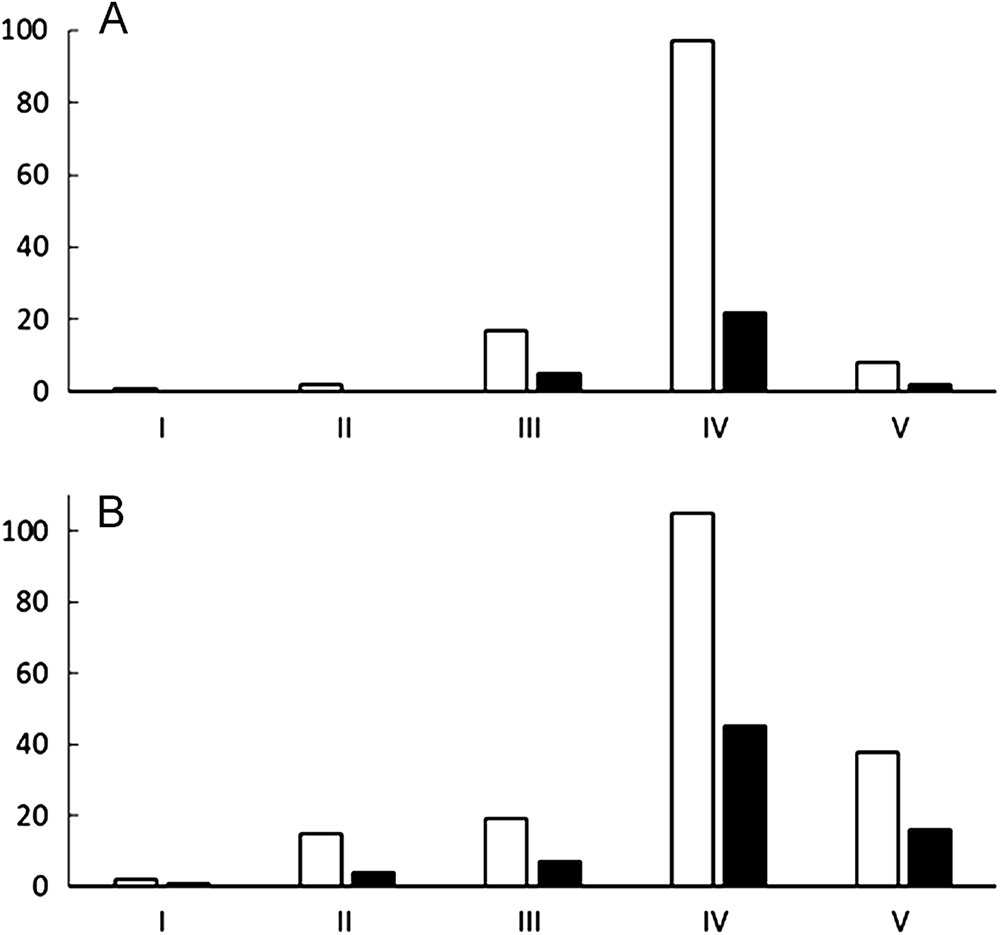
In D. solenoides (Table 3; Figure 4A), the most preyed upon size corresponds to specimens between 45 and 55 mm in length (Χ 2 = 12.035; p = 1), which coincides with the most abundant size of the group. The 18.8% of the articulated valves showed drilling, and this percentage was similar (18%) when also considering the disarticulated single elements, applying the correction mentioned in the methodology. In M. fuegiensis (Table 4, Figure 4B), the most preyed upon size corresponds to specimens between 40 and 50 mm in length (Χ 2 = 46.264; p = 1), which also coincides with the most abundant size of the group. In this species, the 23.8% of the articulated valves showed drilling, and this percentage was slightly higher (27.5%) when including single shells.
Size frequency distributions of drilled and undrilled articulated specimens and single shells of Darina solenoides (A) and Mactra fuegiensis (B). articulated specimens and single shells with drill holes in black and undrilled articulated specimens and single shells without drill holes in white.

Darina solenoides. Different elements (articulated and non-articulated valves; shells with drill holes and without drill holes) and size distribution according to length (in mm)

Mactra fuegiensis. Different elements (articulated and non-articulated valves; shells with drill holes and without drill holes) and size distribution according to length (in mm)

Complete, incomplete, and multiple drill holes
The shells with signs of drilling predation analysed in this study include specimens with a single or more drill holes, which can be complete or incomplete as shown in Figure 5. The majority of them presented complete drill holes (Table 5). Among them, two morphological types can be recognized: on the one hand, tapered holes (Figure 5A, C, and G – G1′) and, by the other, nearly cylindrical holes (Figure 5D), which coincide with the holes produced, respectively, by naticids and muricids. In addition, the presence of incomplete drill holes, although relatively low, allowed us to observe specimens with a flat bottom (Figure 5F) or with a central hump (Figure 5B, E, and G – G2′), on both bivalve prey, which also has implications as a diagnostic element to differentiate naticids from muricids. Finally, shells with multiple drill holes were relatively more abundant in M. fuegiensis (28%) than in D. solenoides (10%).
Shells with drill holes. (A–B). Darina solenoides. (C–G). Mactra fuegiensis. (A′–G′). Different kind of drill holes in both bivalve prey. Scales: 10 mm. Explanations in the text.

Distribution of drill holes in articulated specimens and disarticulated shells of two prey bivalves

Data pooled from all individuals and shells collected.
1 Only one failed/not successful case (specimen with two incomplete drill holes).
In relation to the size of the holes (external diameter), in D. solenoides an average value of 31.4 ± 6.2 mm (n = 18; Max: 40.0; Min: 17.0) was obtained, while in M. fuegiensis the external hole diameter was smaller, with a mean value of 23.6 ± 0.7 mm (n = 32; Max: 40.0; Min: 14).
Then, when discriminating the shells with drill holes according to the types (Table 5), the success/failure relationship of the predatory action was obtained, resulting in a probability of failure of 0.2 for D. solenoides, while a lower value of 0.12 was obtained for M. fuegiensis.
Site selectivity and distribution of drill holes
In D. solenoides, the drill holes are concentrated in the central area of the valve (zone II, 85.3%; Χ 2 = 2.4769; p = 1), while in M. fuegiensis there is a clear preference for the umbonal region (zone II, 64.3%; Χ 2 = 59.33; p = 0.977) and, in a second place, the middle central area (zone V, 20.2%), without significant variations between the right and left valves (Figure 6).
The positions of drill holes made by drilling gastropods on the two bivalve prey. Data pooled from all individuals. (A–A′) Darina solenoides. (B–B′). Mactra fuegiensis. Black and grey circles represent, respectively, complete and incomplete drill holes.

In both species, there was no correlation between the size of the prey and the inner diameter of the drill hole: r 2 = 0.009; y = −0.09x + 27.4 in D. solenoides and r 2 = 0.31; y = −0.46x + 38.3 in M. fuegiensis.
Crushing predation on gastropod shells
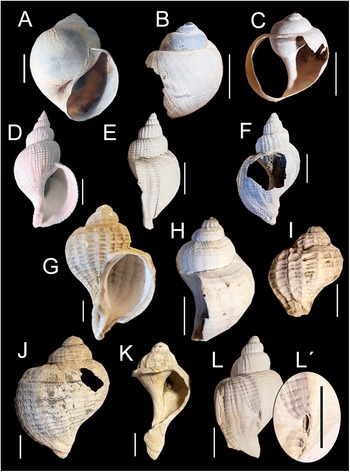
Table 6 and Figure 7 show the breakage pattern recorded in the specimens of the three gastropod species analysed and according to the different categories described in the methodology. The two species of muricids have marks on their shells that are interpreted as caused by crabs. In the naticids, however, the majority (73.5%) do not exhibit signs of attack by durophages. In the muricids, in the case of T. geversianus, 81.8% perceive some type of breakage, while in X. muriciformis, the percentage is lower (61.8%). In T. geversianus, the highest proportion (38.8%) corresponds to specimens that have an exposed columella (category E), while in X. muriciformis another pattern predominates (category D) with specimens that present a break on the last body whorl and on the edge of the aperture (61.9% of the non-intact shells).
The types of damage recorded in three gastropod species studied. (A–C) Falsilunatia limbata: (A) Intact shell. (B) Shell with damage in the aperture. (C) Shell with a hole in the last whorl. (D–F) Xymenopsis muriciformis. (D) Intact shell. (E) Shell with damage in the aperture. (F) Shell with a hole in the last whorl. (G–K) Trophon geversianus. (G) Intact shell. (H) Shell with damage in the aperture. (I) Shell with damage in the apex and the siphonal channel. (J) Shell with a hole in the last whorl. (K) Shell with exposure of the internal columella. (L) Shell of X. muriciformis with damage in the aperture and in the last whorl, showing repair signs. (L′) Repair area of L in detail. Scales: 10 mm.

Damage recorded in gastropod shells

Specimens grouped in five categories (A–E) according to different kind of breaks.
Explanation of the lettered categories in the text. See also Figure 3. In parentheses, the two subcategories (a + b) within category D are provided.
Summary of morphological and ecological characteristics of the two prey bivalves

Finally, in relation to non-lethal damage, some muricid specimens, three specimens (13.6%) of T. geversianus and one specimen of X. muriciformis (2.9%), show disruptions in the growth lines and surface ornament (Figure 7L) assumed as repaired scars.
Discussion
Taphonomic biases and ecological fidelity
This work, carried out on the analysis of a molluscan assemblage recovered from the beach of San Sebastián Bay, provides novel ecological information, mainly drilling predation and shell-breaking predation in the intertidal benthic community of this bay.
This type of study, although it does not replace obtaining first-hand data from living organisms, is valuable due to the difficulties in carrying out biological sampling in the intertidal (López Gappa and Sueiro Reference López Gappa and Sueiro2007). However, they also offer an alternative way for the study or periodic monitoring of living communities, avoiding the collection of living individuals, often unnecessary, depending on the scientific purposes.
Regarding taphonomic biases, the fact that in disarticulated bivalves the obtained values indicate a near match between the number of left and right single shells, which constitutes evidence that supports low transport (Frey and Henderson Reference Frey and Henderson1987). If we add to this the wide range of sizes of the main five species analysed (Table 2), which represent the majority of the mollusc assemblage considered and the absence of signs of abrasion of the different species (i.e., not polished surfaces and rounded edges; Parsons and Brett Reference Parsons, Brett and Donovan1991), this interpretation of low taphonomic biases is strengthened, suggesting and indicating that the sample studied is representative of the intertidal durophagous benthic community that inhabits this sector of the San Sebastián bay.
In relation to the life mode, in the material considered there is a great predominance of infaunal species and little presence of epifaunal ones, which is consistent with an intertidal environment dominated by soft substrate that includes ‘patches’ of hard substrates (i.e., gravels; Vilas et al. Reference Vilas, Arche, Ferrero and Isla2000) more suitable for epifaunal species. Besides, the accumulation of clam shells on the bottoms can also form substrate for the settlement of species more linked to a hard base layer, such as muricid gastropods, also present in the studied assemblage, and other benthic organisms such as crabs. In this regard, for the subtidal of the San Sebastián bay, below 6 m depth, López Gappa and Sueiro (Reference López Gappa and Sueiro2007) also mention that concentrations of empty Mulinia shells provide a substrate for epifaunal species. In that study these authors also highlight that living clams were rare in these subtidal habitats, but might be abundant at low intertidal levels of this bay, a very difficult zone for biological sampling.
In order to improve the understanding of life habit and drilling predation on the two bivalve prey (which together represent 73% of the relative abundance), a comparison between the morphological and ecological characteristics of D. solenoides and M. fuegiensis was made, which showed great differences in the shape and hardness of their shells (Table 7). In D. solenoides, elongated and fragile shells is understood as adaptations to its mode of life as infauna within fine substrates, and globose, subcircular, and strong shells of M. fuegiensis are in accordance to a species capable of living in different substrates (from soft to hard) and with difficulties for complete burial, being able to rest on the sediment or be semi-infaunal (see Stanley Reference Stanley1970).
Drilling predation on bivalves
An aspect of interest regarding drilling predation is to understand if the intensity of predation follows a latitudinal pattern or is temperature-dependent, that was considered at a regional scale in previous works (Gordillo and Bayer Reference Gordillo and Bayer2024; Martinelli et al. Reference Martinelli, Gordillo and Archuby2013). Our results showed that the average drilling predation for San Sebastián bay at 5–11°C was 25.1%, a relative high value for cold-temperate waters, particularly when compared to similar average values, but registered in warm temperate to temperate waters in other parts of the world. For example, in a similar setting of tidal flats in Chapidur, India (27–30°C), Pahari et al. (Reference Pahari, Mondal, Bardhan, Sarkar, Saha and Buragohain2016) obtained an average value of 25.7% and in the Adriatic Sea (22–28°C), the mean value for shallow waters (intertidal-subtidal) obtained by Sawyer and Zuschin (Reference Sawyer and Zuschin2010) was 20.6%. Therefore, our results reinforce previous regional work that drilling predation does not indicate a latitudinal/thermodependent trend, and other regional or local factors would be responsible for the greater or lesser intensity of drilling predation.
When analysing, separately, the incidence of predation for each species, it was high in both taxa, being higher in M. fuegiensis (23.8%) than in D. solenoides (18%). In this regard, data for both species previously obtained for other sites in Patagonia yield similar results. A study in northern Patagonia carried out by Gordillo et al. (Reference Gordillo, Malvé, Morán and Boretto2020) in naticid predation on D. solenoides from the tidal flats in the Pozo Salado site in Golfo San Matías gave an average value of drilling predation of 22%. In that work, the highest incidence of predation on D. solenoides took place within the most abundant size range, with was smaller (20–30 mm length) than in San Sebastián Bay (45–55 mm, this work), but in both cases, no selectivity was found for a particular size of prey. Then, regarding M. fuegiensis, in other work by Gordillo and Bayer (Reference Gordillo and Bayer2024) that covered a wide area of the Argentine sea in Patagonia, at depths between 27 and 135 m, an average value of 22.3% was obtained for this species.
Regarding the identity of the predators, and mainly taking into account the morphologies of the drill holes produced by naticids and muricids, and described in different works (Aitken and Risk Reference Aitken and Risk1988; Carriker and Yochelson Reference Carriker and Yochelson1968; Guerrero Alba and Reyment Reference Guerrero Alba and Reyment1988; Tull and Bohning-Gaese Reference Tull and Bohning-Gaese1993), it is interpreted that tapered holes are produced by naticids and nearly cylindrical holes by muricids. In addition, among the incomplete drill holes, those with flat bottoms are thought to be caused by muricids and those with a central hump by naticids, also following previous work (Aitken and Risk Reference Aitken and Risk1988; Carriker and Yochelson Reference Carriker and Yochelson1968; Kabat Reference Kabat1990). According to these morphologies, both species would be eaten by naticids, and M. fuegiensis would be also commonly eaten by muricids, giving higher values of drilling frequencies, and also a higher incidence of multiple drill holes. This is also supported by the mode of life of both bivalves (Table 7), which makes their interaction with the two groups of predators be different in each case.
When considering selectivity by zone, in D. solenoides there is a greater concentration of drill holes in the mid-central zone, which was similar to the site selectivity pattern observed in a previous work (Gordillo et al. Reference Gordillo, Malvé, Morán and Boretto2020) in Pozo Salado, northern Patagonia, and made by other naticid (Notocochlis isabelleana) preying on D. solenoides. These non-random distribution patterns would be caused by the relative position that the naticid predator adopts with respect to its prey, on which it secretes mucus and wraps around with its foot (Carriker Reference Carriker1981), also influenced by the morphological characteristics of the shell of the potential prey that may present defensive adaptations (e.g., size, thickness, shape, ornamentation; Ansell and Morton Reference Ansell, Morton, Morton and Dudgeon1983).
In M. fuegiensis, there was also a non-random distribution, with a greater concentration of holes in the central sector of the umbonal zone, followed by the mid-central zone. This case is more complex to interpret since it would involve two predators, and based on the incomplete drill holes, both of them record failed attempts in these two areas. Anyway, the muricids can attack their prey when it is in a vertical, semi-buried position, with the umbonal sector protruding above the sediment. Furthermore, if the bivalve is lying on one of its valves, the predatory snail can rest on the prey through its foot, preferring the central middle sector to print the hole. A similar pattern, with greater preference for the umbonal sector, followed by the central sector, was observed in the coastal sector of Bahía Bustamante (Chubut) in Patagonia (Gordillo and Archuby Reference Gordillo and Archuby2014), in the venerid Ameghinomya antiqua, also capable of living as a semi-infaunal, which would be caused by the muricid T. geversianus.
Likewise, naticids could have similar behaviour to muricids with M. fuegiensis, whose shell is very different from D. solenoides, probably requiring another manipulation strategy. In this regard, naticids can also search and capture their prey on the surface of the sediment (Gordillo et al. Reference Gordillo, Malvé, Morán and Boretto2020; Pahari et al. Reference Pahari, Mondal, Bardhan, Sarkar, Saha and Buragohain2016; Savazzi and Reyment Reference Savazzi and Reyment1989), which would increase competitiveness with muricids, as suggested by Kabat (Reference Kabat1990).
In relation to the rate of failure of drilling predators in both prey species, it was low but was slightly greater in D. solenoides (0.2) than in M. fuegiensis (0.12). It means that although M. fuegiensis receives the most lethal attacks, it is also the one with more failed attempts than D. solenoides. Beyond these minor differences between both bivalves prey, these low values of failed attacks indicate that the drilling predators are efficient and almost always successful.
Damage by crushing predation on gastropods
Most of the shells of the naticid F. limbata show no signs of breakage caused by crabs. However, a percentage of ca. 15% presents the condition of incipient breakage of the opening edge, which could have produced during their predatory activity consuming bivalves as has been documented in some laboratory works (Stafford and Leighton Reference Stafford and Leighton2011).
However, in the case of muricids, the results would indicate marks attributable to predation by crabs, with a higher incidence in T. geversianus than in X. muriciformis.
Furthermore, the differences in the breakage condition between both species suggest that the predators could be different species, or with a certain plasticity to resolve the mode of attack according to the characteristics of their prey. It is known that these organisms use different methods to access soft tissues, which includes chipping, smashing, or peeling of the apertural lip (Stafford et al. Reference Stafford, Tyler and Leighton2015b; Vermeij Reference Vermeij1987).
Regarding the species of decapod crabs that live in San Sebastián Bay (López Gappa and Sueiro Reference López Gappa and Sueiro2007) and that could be potential predators of molluscs, including gastropods, at least three decapods can be considered: Peltarion spinosulum, Eurypodius latreillei, and Munida subrugosa. For the Beagle Channel, south of Tierra del Fuego, Comoglio (Reference Comoglio1994) determined that Peltarion spinosulum and Eurypodius latreillei (both Brachyura) feed on bivalve molluscs and gastropods, 23% and 10%, respectively; and for the subantarctic region, Gorny (Reference Gorny1999) also mentions that the shrimp Munida subrugosa (Anomura) includes bivalves (Lasaea sp.) and gastropods (Trochita pileus) in its diet.
In any case, the data obtained are still very limited to draw conclusions about the species involved and the patterns followed, for which further research must be carried out. For now, the fact that these shells show breaks, but without signs of abrasion due to waves, also reinforces the interpretation of damage caused by predators. Although more precise, as a measure of predation evaluation, it is highlighted that a minor proportion of specimens of both muricid species showed signs of repair in the aperture and last whorl, that would represent non-lethal damage from a previous attack, such as that of the specimen of X. muriciformis illustrated in Figure 7. In both muricids, the repairs took place on specimens that belong to the largest sizes, greater than the class interval that shows the highest concentration of breaks, so the size could be a refuge or escape from predation, which should be corroborated from a larger set of shells.
In addition, among other potential predators of the species studied in San Sebastián bay, some works mention the volutids, such as Odontocymbiola magellanica. This snail eats naticids and muricids, among other gastropods, which narcotizes and consumes alive (Bigatti Reference Bigatti2005). It is also important to mention shorebirds that have a preference for bivalves with thin shells, such as D. solenoides, which they eat whole, and their shells are broken internally, resulting in small fragments that are regurgitated in the pellets, or eliminated through faeces (Cadeé 1994, 1995; Ferrari et al. Reference Ferrari, Lizarralde, Pittaluga and Albrieu2015; Hernández et al. Reference Hernández, DAmico and Bala2004, Reference Hernández, Bala and Musmeci2008; Lizarralde and Pittaluga Reference Lizarralde and Pittaluga2011). This does not imply that there cannot be specimens damaged by birds and exhibiting other types of breakage. For example, Cadeé (1995) in the Northern Hemisphere noted that Mytilus shells dropped by Herring gulls result in shells with breaks but held together by the ligament. Regarding gastropods, Cadeé (1994) mentions the presence of small specimens of Hydrobia (smaller than 4 mm) – whole, broken, or fragments – in the faecal material of the wading bird Calidris. Also Alexander and Dietl (Reference Alexander, Dietl, Kelley, Kowalewski and Hansen2003) pointed out that shorebirds can also drill irregular holes in the shells of snails living on sandbanks, beaches, and intertidal flats. However, these are still isolated examples, and more systematic studies are still needed to strengthen these observations.
Finally, it should be clear that these results and their interpretation represent an approximation to quantify part of the trophic interactions in the studied environment and the values obtained may be biased (underestimated or overestimated) by potential predators that do not damage shells or engulf or destroy shells completely (see Kowalewski Reference Kowalewski, Kowalewski and Kelley2002), or even by taphonomic biases (see Roy et al. Reference Roy, Miller and La Barbera1994; Zuschin and Stanton Reference Zuschin and Stanton2001). However, this type of analysis is a direct method for determining the evolution and ecological impact of predation on benthic communities, and is useful in monitoring and management plans for environmental degradation.
Concluding remarks
This study presents novel information on different types of predation marks on mollusc shells recovered from San Sebastián Bay, located in the subantarctic region, strengthening the previous information available for South America, which is still very scarce and limited. Despite the taphonomic biases, the molluscan assemblage analysed suggests ecological reliability, respect for the living benthic community mainly in the intertidal of the bay.
The average intensity of predation by drilling was high in both bivalves prey (18.8% in D. solenoides and 27.4% in M. fuegiensis) and the potential predators involved were one naticid (F. limbata) and two muricids (T. geversianus and X. muriciformis). Differences and variations between species would be linked to local factors, where both the way of life of the prey and the characteristics of their shells, as well as the predators, acquire relevance, which causes differences between predators of each species, and in site selectivity.
Furthermore, among gastropods, particularly in muricid shells, breakage and repair marks were recognized that were interpreted as produced by crushing predation by crabs.
Finally, it is highlighted that it is necessary to reinforce studies in the region, in order to recognize trends in interactions within benthic communities, particularly in a context of climate change, with threats from invasive species (e.g., European green crab), among other existing problems, already mentioned.
Acknowledgements
We are grateful to the staff of the Dirección Provincial de Patrimonio Cultural and the Dirección General de Áreas Protegidas y Biodiversidad, the institutions of the province of Tierra del Fuego, Antártida e Islas del Atlántico Sur, which provided the authorization to carry out the fieldwork and sampling; to Daniel Fernández and Carlos A. Ferrer of the Centro Austral de Investigaciones Científicas (CADIC) for the collaboration in logistical support for fieldwork; to Daniel Aureliano (CADIC) for the assistance during the fieldwork and sampling; and to the editor Nathan King and both reviewers, Elizabeth M. Harper and John Huntley, for their insightful comments and suggestions that greatly improved the manuscript.
Author contributions
S.G.: Conceptualisation; fieldwork and data collection; methodology; writing – original draft of the manuscript, preparation of tables and figures. S.G. and M.S.B.: analysis of the data and interpretation of the results; writing – review and editing. Both authors have read and agreed to the published version of the manuscript.
Funding
This study was carried out with financial support from the Consejo Nacional de Investigaciones Científicas y Técnicas (PIP CONICET 114-200801-00260) to S.G.
Competing interests
The authors declare that they have no conflict of interest.