Prologue: The Ossian Phenomenon
Between 1760 and 1773, the Scottish littérateur James Macpherson published a unique collection of poems attributed to the legendary poet Ossian. By 1780, Macpherson's Ossian poems had found an audience outside Britain through translations in German, French and Italian.Footnote 1 Ostensibly the work of an ancient bard, the last surviving member of a once-great Celtic tribe, they presented keen nostalgia for an unreachable past. While their apparent subject is an epic centred on the hero Fingal, the poems’ emotional heart lies in their sense of civilizational decline, their emotionality, their depiction of nature and their awareness of the supernatural. Strong warriors who weep over their slain enemies in a sentimental fashion rub shoulders with ghosts, omens and Ossian's own awareness of that he is the last to bear witness to the forgotten heroes of the past. Macpherson's version of Ossian can therefore be analysed in terms of eighteenth-century sensibility, gothic horror and the emergence of romanticism.Footnote 2
The poems were written in a unique prose style that Macpherson claimed was the result of a direct English translation of Scots Gaelic, but which owes more than a little to the King James Bible and the Greco-Roman classics.Footnote 3 Although Macpherson conducted ethnographic research in the Scottish Highlands, the poems’ authenticity was questionable from the very beginning, as critics such as Dr Samuel Johnson accused Macpherson of passing his own original work off as a translation from antiquity.Footnote 4 Most modern scholars agree that large parts of the published poems appear to be Macpherson's own invention, although he did draw on existing Celtic folklore.Footnote 5 However, beyond these facts, there is little consensus about ‘the nature of the deception practiced by Macpherson, and indeed the degree of his personal culpability’.Footnote 6 To this day scholars remain divided between those who take Macpherson's Ossian seriously as a significant cultural phenomenon, and those who dismiss it as a simple fraud that deserves exposure and dissection.Footnote 7
The Ossian poems cut across cultural fault lines, demonstrating to excited readers across Europe that ancient ‘barbarian’ cultures had also created epic literature on par with the Iliad (this was the reason that Macpherson's supporters regularly compared Ossian to Homer). Macpherson's mythical version of Ossian thus became a kind of European ‘noble savage’ and an emblem of the high culture of those who were seemingly ‘barbaric’.Footnote 8 Although the Ossian poems are based on stories common in Scottish and Irish lore,Footnote 9 the popularity of Macpherson's version meant that Ossian came to be closely associated with Scotland in the European imagination. The intellectuals of practically every European nation read and were influenced by Macpherson's poems, and found ways to appropriate them for their own (often nationalist) ends.Footnote 10 Ossian inspired artists in all genres during the eighteenth and nineteenth centuries. Musicians such as Le Sueur, Schubert, Felix Mendelssohn, Gade, Brahms and Bizet all wrote music directly invoking Ossian, while countless other musicians who wrote ‘Scottish’ music probably had Ossian in mind as a subtext.
Werther as an Ossianic Opera
When considering Massenet's opera Werther (completed by 1887, premiered in 1892) in relation to other musical works inspired by Ossian, scholars usually treat it as an afterthought, even though it is one of the few works in the modern repertory to set Ossianic lyrics. There are several reasons for this situation. In contrast with other examples of nineteenth-century Ossianic music (such as Mendelssohn's ‘Hebrides’ Overture), only a brief excerpt of the opera engages overtly with Ossian: a short air (‘Pourquoi me réveiller’) from Act III in which Werther reads a poem to Charlotte. Further, this excerpt seems to exist within quotation marks, set off from the rest of the opera by its difference in style from the rest of the surrounding music. Massenet set it as a German lied, a choice acknowledged in the published title of the excerpt (‘Le Lied d'Ossian’).
Several scholars have written at length about Werther in general and the Ossian-reading scene in particular, but without finding more than a passing connection between ‘Pourquoi me réveiller’ and the large corpus of Ossianic music from the nineteenth century. This tenuousness is partly because of the diversity of musical styles used to depict Ossianic texts, and partly because relatively few of these works have stayed in the modern concert repertoire. Three recent discussions are noteworthy: Steven Huebner argues that Massenet's reference to the lied attempts to depict the domestic context of a private poetry reading in Germany. Jason D'Aoust explores the creative reinterpretation of Macpherson's Ossian through the lens of intertextual vocality. Christopher Smith, in an essay on the large body of Ossianic music, describes ‘Pourquoi me réveiller’ as essentially disconnected from other Ossianic settings, ‘even with its use of the harp’, an instrument commonly used in nineteenth-century Ossianic music.Footnote 11
The current essay explores an alternate view. This interpretation, like Massenet's own account of Werther's genesis, uses Ossian as a key for understanding the opera, and consequently attempts to read the work backwards from this moment. Drawing connections between Werther and other nineteenth-century treatments of Ossianic topics in music, I identify a musical strategy – the presence or absence of the harp – that unifies the depiction of Werther as a character throughout the opera, suggesting that his dramatic arc reflects some key elements of Macpherson's Ossian as filtered through a distinctly fin de siècle aesthetic. The lied reference, I argue, is part of this broader strategy, and it intersects with the contemporary French reception of German lieder to hint at Werther's sentimentality and emotional fragility. The resulting analysis is grounded in early critical reactions to the opera and suggests ways of hearing the influence of both Schumann and Schubert in Werther.
Macpherson's Ossian in Goethe and Massenet
Goethe's novella Die Leiden des jungen Werthers, the source text for Massenet's opera, provides the starting point for this discussion.Footnote 12 When writing his memoirs many years after the opera's premiere, Massenet claimed that Werther's Ossian reading was the catalyst for the composition of the entire opera:
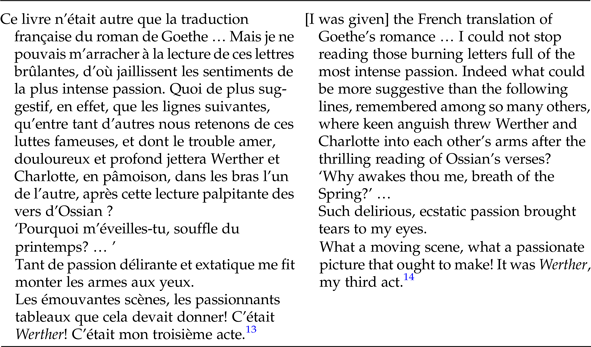
One must admit at the outset that this origin story may not be entirely true: Massenet's memoirs, written towards the end of his life, contain slips of memory and errors of omission. Werther's genesis, in particular, is a tangle of contradictions, as it involved three librettists (Edouard Blau, Paul Milliet and Georges Hartmann).Footnote 15 Although no corroborating evidence for this story has emerged, this account is meaningful as a kind of personal myth-making: it suggests the importance that the Ossian reading had acquired for Massenet later in his life and perhaps had always held.
In both Goethe's novel and Massenet's opera,Footnote 16 the Ossian reading is the moment at which Werther's and Charlotte's suppressed attraction comes closest to consummation, despite Charlotte's loyalty to her husband, Albert. Werther reads a lengthy extract from ‘The Songs of Selma’, translated by Goethe for the novel, which focuses on two lovers who face a tragic destiny. The key passage, which appears in both the novel and the opera, is the following excerpt from ‘Berrathon’:
The flower hangs its heavy head, waving, at times, to the gale. Why dost thou awake me, O gale, it seems to say, I am covered with the drops of heaven? The time of my fading is near, and the blast that shall scatter my leaves. Tomorrow shall the traveller come, he that saw me in my beauty shall come; his eyes will search the field, but they will not find me? – So shall they search in vain, for the voice of Cona, after it has failed in the field. The hunter shall come forth in the morning, and the voice of my harp shall not be heard.Footnote 17
The poem's power is such that both Werther and Charlotte are overcome with sentiment – to quote from Goethe: ‘Both of them were fearfully agitated. They could sense their own wretchedness in the fates of the noble heroes; they sensed it together, and shed tears in harmony’.Footnote 18 After trying to continue the reading, Werther attempts to kiss Charlotte; she flees from him, shutting herself up in her room. The next day, Werther, in despair, mortally wounds himself with a pistol.
The Ossian reading thus induces the climax of the tragedy and provides an emotional impetus toward action – allowing Werther and Charlotte to overcome social expectations of proper behaviour through their kiss. These events occur partly because of Werther's personal identification with Ossian, which Goethe makes clear through two devices at this point in the novel.Footnote 19 One is that Werther has translated Ossian's poems himself, so that only Werther's words enable others to hear Ossian. The other is that the last poem that Werther reads to Charlotte, the one that removes all barriers to his pursuit of Charlotte and hastens his own suicide, is ‘Berrathon’, which Macpherson labelled as the last song Ossian sang before his death.Footnote 20
The function of the Ossian quotation differs in Goethe and Massenet. In the novel, as opposed to the opera, Ossian is merely one of several poets that Werther reads (the others include Klopstock and Homer), part of his literary diet as an eighteenth-century ‘man of feeling’ ‘whose feelings are too exquisite for the acquisitiveness, vulgarity, and selfishness of the world’.Footnote 21 Ossian is an important part of Werther's intellectual world, but as his consuming passion for Charlotte spirals into depression, his poetic references shift heavily toward the poems of Ossian and the exclusion of other authors, signalling his melancholy and nostalgia.Footnote 22 The letter of October 12 (Book 2) opens:
Ossian has ousted Homer from my heart. What a world that exalted soul leads me into! … And then to find him, that grey-haired bard, wandering on the vast heath, seeking the places his forefathers knew, and then, ah! finding their tombstones.Footnote 23
His overindulgence in the bard's gloomy tales of decay and ruin (symbolized at the end of the novel by Werther's lengthy reading from the ‘Songs of Selma’) leads directly to events that cause his death. Goethe himself, despite his own early passion for Ossian, seems to have viewed Werther's excessive fondness for the bard as a sign of weakness, later saying, ‘No one remarked that while Werther is in his senses he talks about Homer, and only after he grows mad, is in love with Ossian’.Footnote 24 Ossian thus becomes a symbol of emotional imbalance by the end of the novel.
In the opera, however, Ossian becomes the chief representative of Werther's poetic side, probably because of time constraints (the five-page Ossian reading is cut to a mere eight lines of poetry, so that ‘Pourquoi me réveiller’, a loose translation of ‘Berrathon’, is the only setting of Ossianic poetry in the opera). Perhaps Ossian was also emphasized in the opera because of the French history of appropriating Ossian as a Celtic – and therefore Gaulic – figure.Footnote 25 Certainly Ossian was more relatable to French audiences than Klopstock, the only other poet whose verse is specifically invoked in the novel and opera. The chief Klopstock reference in the novel centres on Die Frühlingsfeier, a hymn which attributes the wonders of nature to a divine creator.Footnote 26 As Steven Huebner has noted, Massenet set the only Klopstock reference in the opera as a parody of eighteenth-century German sentimentality; two minor characters repeat the poet's name to the same two notes.Footnote 27
By side-lining Klopstock, the libretto alters Werther's relationship with Christianity and allows Ossianic elements to take on a greater role. Goethe's Werther knew Klopstock's Die Frühlingsfeier well enough to be moved to tears simply at the memory of the poem.Footnote 28 Massenet's Werther, on the other hand, is practically a nature-worshiper: in his first air, ‘Ô nature’, he apostrophizes Nature herself as ‘pleine de grâce’ (‘full of grace’ – a traditional appellation given to the Virgin Mary), and as the ‘Mère éternellement jeune’ (the ever-young mother). Werther's love of nature is similar to Rousseau's (a comparison Massenet himself made), although he seems to lack Rousseau's firmly deist beliefs.Footnote 29 Instead, he alternates between nature-worship and some kind of Christian belief, and rarely links the beauties of nature to divine creation.
The religious elements in the opera are linked to Werther's ultimately fatal immersion in Ossianic poetry. This is most apparent in the air ‘Lorsque l'enfant’, in which he describes himself as the prodigal son returning home to God the Father, and as Nature's son who wishes to come home. In both cases, suicide is his method of travel; it should be no surprise that the Ossian reading is the catalyst for his suicide. The fusion of these elements matches the French reinterpretation of Ossian from a religious and specifically Christian perspective, which dates back to the turn of the nineteenth century.Footnote 30 At the same time, Werther's willingness to rationalize suicide – a sin in the eyes of the church – suggests the degree to which his Ossianism has warped his religiosity.
Linking Werther's religious outbursts to his naïve Ossianism brings him in line with a major thread of Massenet's dramatic oeuvre. In the 1880s, the composer had a penchant for setting libretti about deluded figures (many of them religious) who are unable to live up to their avowed moral standards: Hérodiade (1882) proposed that John the Baptist and Salome had a romantic relationship; Manon (1884) features a scene in which a courtesan seduces a cleric in a church; Thaïs (1894) is about a monk who interprets his sexual dreams about a courtesan as a sign that he should save her soul. Unlike these other works, Werther is not overtly erotic, nor is the main character so thoroughly embedded in a religious context; still Werther's conflation of Ossianic and Christian beliefs and eventual suicide constitutes a similar case of moral weakness.
Massenet's opera contains an interpretation of Ossian somewhat removed from Macpherson's vision and from Goethe's use of Macpherson in his novel. Despite the centrality of the Ossian reading to the structure of the opera, there is little to suggest that the composer or his librettists had any great familiarity with Ossianic myths outside of their work on Werther.Footnote 31 Ossianic scholar Dafydd Moore describes the typical ingredients of Macpherson's Ossian as follows (numbers have been inserted for clarity):
[1] the watery ghosts who are paradoxically both closer to the living and yet more physically ephemeral than perhaps any in literature; [2] the evocation of mountain, moor, and heath; [3] the mysterious alignment of scenery, atmosphere and lyric mood; [4] the definite, yet strangely anonymous characters …; [5] a dead beauty and [6] the bloody, terrible and obscure wars of Fingal.Footnote 32
The lengthy excerpts from Ossian in Goethe's novel include all these features. In the opera, on the other hand, the ‘noble heroes’ over whom Werther and Charlotte wept do not appear at all. Absent its mythology and the supernatural, Ossianic poetry is distilled to natural metaphors, references to the harp and a rhapsodic or melancholy tone. Werther's Ossianic obsession with nature is thus conflated with Werther's nature-worship described above.
Moore's third trait is the one feature of Macpherson's Ossian that consistently recurs throughout the opera, including passages in which sunshine corresponds to joy (‘Ô Nature’), moonlight to falling in love (the instrumental ‘Clair de lune’ from Act I), grey skies to depression (the letter scene from Act III: ‘Je vous écrit de ma petite chambre’) and a storm to emotional distress (Prelude to Act IV). At the same time, Werther's bond with the poems intensifies: he explicitly says that the Ossianic poems represent his own soul, a line invented by the librettists for the opera: in the novel, he silently picks up the poems before reading them.Footnote 33 Further, ‘Pourquoi me réveiller’, the translated version of ‘Berrathon’ that he sings, is in the first person, unlike the original. It is hardly coincidental that the reading of ‘Ossian's last song’ is literally Werther's last sizeable air in the opera.
Werther's Harp
Despite various articles on individual composers’ reactions to Ossianic poetry, identifying a broader ‘Ossianic’ musical style in the mid-to-late nineteenth century is difficult, as composers’ attempts to re-create the unusual qualities of Ossianic poetry in their music took a number of forms. R. Larry Todd finds it difficult to separate Mendelssohn's Ossianic music from his compositions inspired by Scottish topics; he sees Mendelssohn's Ossianic compositions as exercises in exoticism. John Daverio has highlighted the overlap between what he termed ‘Ossianic’, ‘Celtic’ and ‘Nordic’ musical styles in the music of Robert Schumann and his contemporaries, suggesting that all three concepts could fuse in complex ways. Paul F. Moulton's attempt to identify an overarching Ossianic style is little more than a list of musical devices which some composers occasionally used in reaction to Ossian. Perhaps the most comprehensive attempt to describe a musical style associated with Ossian is Sarah Clemmens Waltz's description of a ‘Northern Style’, which provides a cluster of musical devices – including key choices, tempo directions, textures, melodic styles and specific procedures such as horn fifths in the minor – that were often used together by German-speaking composers working before 1850.Footnote 34
One of the few unifying features in orchestral music inspired by Ossian is the use of the harp, inspired by the bard's frequent references to the instrument.Footnote 35 The harp features prominently in the early Ossianic operas of Jean-François Le Sueur (1804) – which employs a consort of eight – and Étienne-Nicholas Méhul (1806), in Neils Gade's overture Nachklänge von Ossian (1840) and in Johannes Brahms's Gesang aus Fingal (1859–60). The harp even appears in works which participate in the Ossianic topos without explicitly claiming identification with it, such as Max Bruch's Schottishe fantasie (1880).Footnote 36
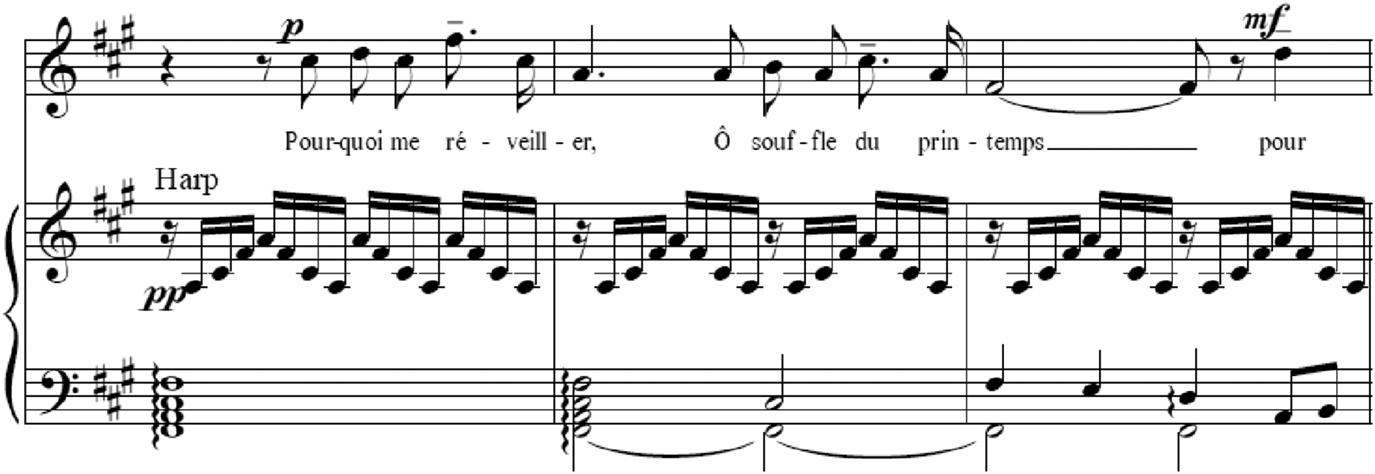
‘Pourquoi me réveiller’ follows these earlier precedents by featuring a prominent harp accompaniment, which provides a constant stream of rippling arpeggios. One might easily understand the harp as a coloristic effect designed to summon up Ossianic associations; René Brancour, an early Massenet biographer, describes ‘la harpe de Erin’, perhaps associating it with Irish Ossianic traditions.Footnote 37 Similarly, Jean-Christophe Branger views the harp's presence here as a homage to convention, although it is unclear whether the convention in question is Ossianic or merely as an accompaniment to a poetic recitation.Footnote 38
But a broader view of Massenet's compositional strategies in the opera suggests that the harp is more than a generic invocation of Ossian. Ossian is mentioned only once in the opera, yet the harp appears throughout the whole work. A survey of the whole score shows that the harp is almost exclusively associated with Werther's presence on stage or the reprise of motives associated with him. It supports his first air (‘Ô nature’) and his duet with Charlotte in the moonlight, reprises of the moonlight music (Acts II (r.h. 116) and IV (r.h. 245 + 4)), and even appears in the scene in which Charlotte reads Werther's letters aloud (r.h. 146).Footnote 39 There are only two real exceptions: the harp briefly supports Albert in Act I (r.h. 47), although it is not prominently used; it also joins in an orchestral tutti at the end of Act II (beginning at r.h. 139).
Reading backwards from an Ossianic interpretation of ‘Pourquoi me réveiller’, I argue that Massenet highlighted the Ossianic elements of Werther's character through the persistent use of the harp throughout the opera. Throughout the opera, the harp represents a constellation of dramatically significant ideas, allowing listeners to track Werther's Ossianic narrative.
The first Ossianic topic highlighted by the harp is nature. Werther's character arc is framed by a pair of tenor airs whose texts are concerned with nature and whose music Massenet set to a prominent harp accompaniment (‘Ô nature’ and ‘Pourquoi me réveiller’). The recitative that introduces Werther's entrance air (‘Ô nature’) makes the harp's significance quite plain:

The reference here is to the Aeolian harp, an instrument which was much in vogue in the eighteenth and nineteenth centuries. It was common to place such harps in windows so that the breeze would make the strings vibrate: thus it ‘was played, not by man, but by the breath of Nature herself’Footnote 41. The harp is therefore a logical symbol of Werther's love for and sense of unity with nature.
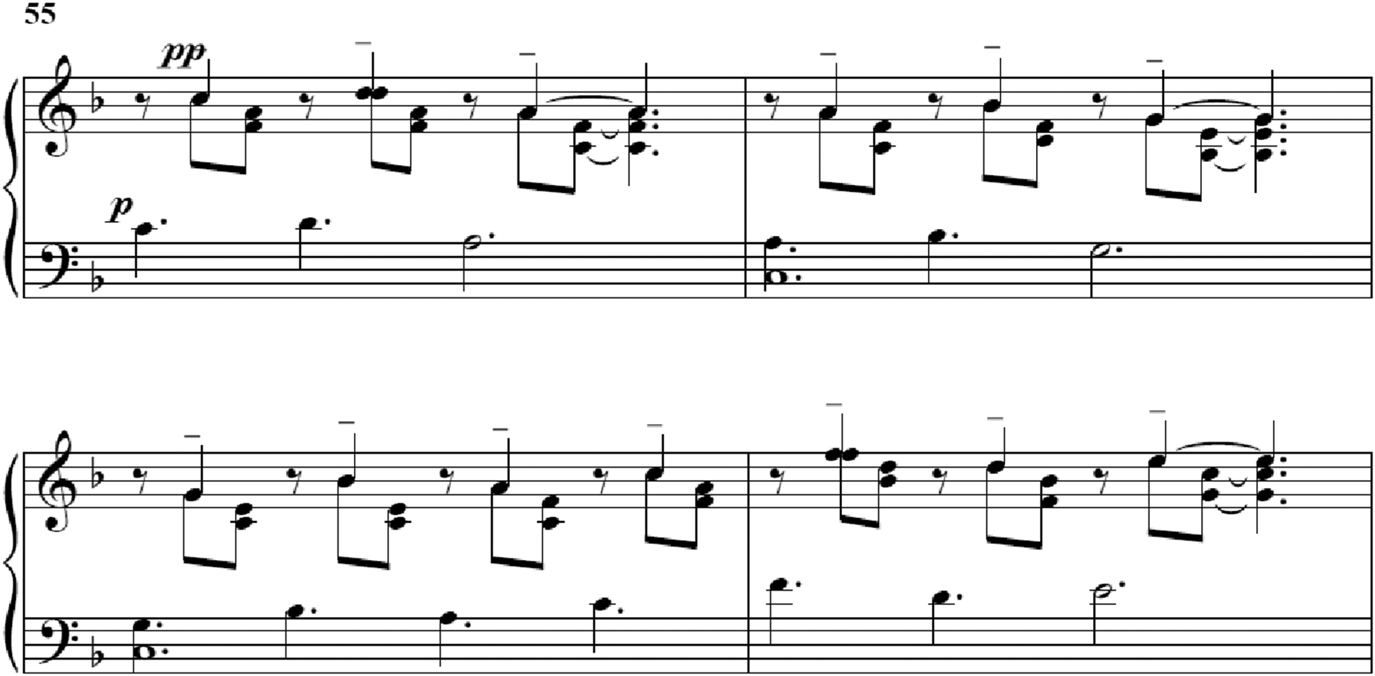
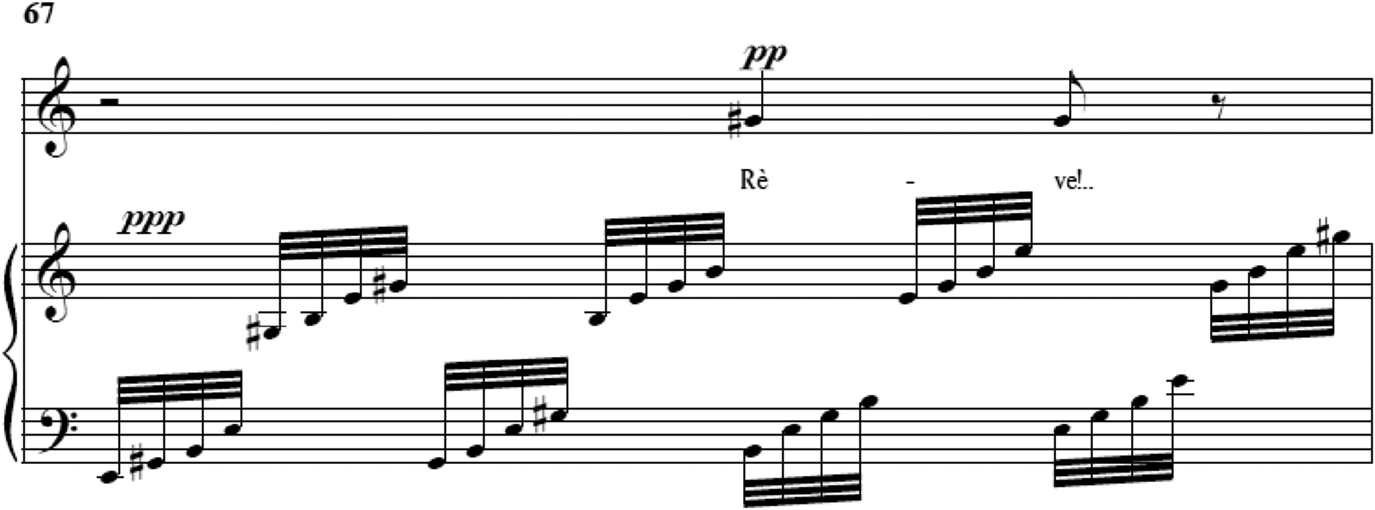
Soon the harp becomes associated with Werther's love for Charlotte. It reappears when Werther watches Charlotte with her many siblings, suggesting its significance has been transferred to her (r.h. 39). As in the novel, she is a virginal ‘mother’ to the orphaned children:Footnote 42 she is the ‘Mère, éternellement jeune, adorable et pure’ of Werther's earlier air, brought to life. The harp's two dramatic associations – nature and Charlotte – combine when Werther takes a walk in the moonlight with Charlotte, connecting it to yet another nineteenth-century convention related to the harp – the nocturne in compound time (see Ex. 2).Footnote 43 The transfer of the harp's significance from representing nature to representing Charlotte culminates just before Werther's declaration of love, in a burst of demisemiquaver runs (see Ex. 3).
The harp accompaniment in ‘Pourquoi me réveiller’, Act III (r.h. 190 + 5). Massenet, Werther: drame lyrique en quatre actes et cinq tableux d'après Goethe, partition piano et chant (Paris: Heugel, c. 1894), 176.

The moonlight music, Act I (r.h. 55). Massenet, Werther: drame lyrique en quatre actes et cinq tableux d'après Goethe, partition piano et chant (Paris: Heugel, c. 1894), 62.

Werther declares his love for Charlotte to the accompaniment of the harp, Act I (r.h. 67). Massenet, Werther: drame lyrique en quatre actes et cinq tableux d'après Goethe, partition piano et chant (Paris: Heugel, c. 1894), 72.

As the opera progresses, the harp's presence and absence marks the stages of Werther's emotional journey. In Act II, in which his pursuit of Charlotte has been frustrated by her marriage to Albert, the harp is relatively silent, except for a reprise of the moonlight music (r.h. 116 + 2–r.h. 118 + 2). It is completely absent from ‘J'aurais sur ma poitrine’, the air in which Werther refuses to accept Charlotte's lack of interest (‘C'est moi … qu'elle pouvait aimer!’). Werther's music returns to the pastoral style in his last air of Act II, ‘Lorsque l'enfant’ – the introduction opens with sustained tones on the flute – but the harp is barely present here. There is a good reason: this air is essentially an apology for suicide, with the argument being that a son (Werther) has every right to go home (to Nature). The harp appears only in the central section, as Werther repeats the words ‘ton fils’ (r.h. 132). The harmony is unstable and modulating, and the mood created by the harp is unable to sustain itself: Werther's inability to maintain a pastoral mood suggests his inner torment.
If Act II represents Werther's separation from nature, Act III represents his final attempt to restore the balance. The harp reappears in Charlotte's letter scene, as she reads his letter describing the grey December sky (r.h. 146). When Werther finally reads Ossian to Charlotte, reciting the words that he himself has translated, the harp gains one more function: accompaniment to poetic recitation, of the type found in many nineteenth-century operas such as Il trovatore and Tannhäuser. Its link to Werther's emotional state is confirmed again as it reappears after Werther and Charlotte kiss and ceases abruptly when Charlotte rejects Werther's advances. The harp remains silent as Werther reprises the melody of ‘Ô nature’ (‘Prends le deuil, ô nature’) to express his resolve to kill himself: the music alternates rapidly between major and minor, unable to maintain the stability of mood that Werther seeks to attain.
By Act IV, having shot himself and accepted his fate (in true Ossianic fashion), Werther is back in harmony with nature, and his music is heavily dominated by the harp. The Act is split into two scenes: the first is an instrumental prelude; the second, an extended duet with Charlotte, who has rushed to his bedside as he lies dying. Much of scene 1 (r.h. 226–r.h. 232 + 2) is dominated by a lyrical, falling theme set in regular four-bar phrases. This features a prominent harp accompaniment and recalls Werther's earlier music in the opera. This theme is later linked directly to Werther, as it underpins his first utterance in Act IV, scene 2 (r.h. 239 + 2). The harp goes silent in the scene shortly after the tam-tam (r.h. 232) and wind machine (r.h. 233) make audible the storm invoked in the Ossian reading. The harp also returns for a final reprise of the moonlight music from Act I, shortly after Charlotte confesses her love for Werther (r.h. 245 + 4). It also supports the Christmas carol that Werther deliriously imagines is a sign of divine forgiveness for his suicide (perhaps it is supposed to reflect angelic music?) (r.h. 255 + 2), and of course, it underpins his final request to be buried by the linden trees (r.h. 259 + 2).
It is tempting to hear the storm music at the opening of Act IV, scene 1 (r.h. 220) as reflecting Werther's suicide attempt: the harp is certainly silent here. The staging of this scene – rather like a tableau vivant without any actors – makes clear that the storm occurs only in the mind. The stage directions call for a curtain showing night falling over the town of Wetzlar, the windows lighting up, snow falling, while bells ring in the distance. Yet this tranquil picture contrasts with the music (r.h. 220–225), which suggests a storm through its irregular rhythms, bursts of monotone semiquavers and screeching wind instruments.
However, the surrounding scenes suggest that the storm represents Charlotte's inner trauma, not Werther's. She rushes off-stage to prevent Werther's suicide at the end of Act III, and Act IV, scene 2 opens with her arrival in Werther's apartments, too late to save him. Acts III and IV are played without a break, so that she is the last character seen before the storm music starts and the first character seen on stage when it resumes. The opening of Act IV, scene 2, alternates Charlotte's storm music – reflecting her horror at finding Werther lying bloody in his apartment (r.h. 237, r.h. 242 + 4) – with themes derived from Werther's own harp-based music (r.h. 239 + 2).
Massenet's use of the harp in the opera thus invokes several pre-existing cultural associations with the instrument – nature, moonlight, heavenly music, poetic recitation and Ossian – and combines them. It is a sign of Massenet's subtlety as a composer that several of these meanings can apply to ‘Pourquoi me réveiller’ at once. For the poem, as Werther reads it, is a tragic pastoral in an Ossianic vein, one which warns of a coming storm and the inevitability of death. It is also a melodramatic poetic recitation with harp accompaniment of the type so beloved in the nineteenth century – so that one early French critic heard echoes of ‘Oh! Ma lyre immortelle’ from Gounod's Sapho in this scene.Footnote 44
The harp, therefore, is not a decorative element in ‘Pourquoi me réveiller’, but an essential part of the opera's dramatic structure. The harp represents Werther's Ossianic aesthetic and provides an audible link between the chief stages of his sorrows. One can profitably analyse Werther, not simply as someone who simply reads a little Ossianic poetry accompanied by the customary harp, but also as a character whose dramatic arc reflects some of the major themes of Ossianic myth: love of nature, loss of innocence, melancholic nostalgia and the correspondence between nature and characters’ emotional lives. Thus this seemingly generic reference to Ossian is actually part of a coherent musical strategy that depicts Werther's fall from grace.
The Lied and its Sources in a French Context
In this context, the connection between Massenet's portrait of Werther and German lieder is now even more striking. Just like Ossian's harp, the lied reference seems a generic choice for an operatic depiction of German people reading poetry aloud. But the lied reference is also the highlight of Werther's character arc, the point at which he gives fullest expression to the Ossianic topos which haunts Massenet's depiction of him. As will be shown below, Massenet's use of the lied matches the contemporary French reception of German lieder. Thus it is likely that the lied appears here because the genre was likely to raise specific associations among educated listeners, associations which lend new resonance to the opera. The lied, therefore, can function as both as a topical reference and perhaps as an invocation of specific German lieder.
By the time that Massenet was writing Werther in the mid-1880s, German lieder, especially those of Schubert, had been circulating in Paris for many years. The singer Adolphe Nourrit had introduced Schubert's songs to the Paris salons in the mid-1830s, possibly at the suggestion of Franz Liszt. After Nourrit's early death, other singers such as François Wartel, Jean-Antoine-Juste Géraldy and Pauline Viardot popularized Schubert's songs in French translations. Starting in the 1830s, French publishers began to issue Schubert lieder, often in French translation; by 1845, over 300 Schubert songs were available.Footnote 45 In 1841, Richard Wagner wrote of the Parisian taste for ‘sentimental ballads and romances … Think of Franz Schubert's songs, and the vogue they enjoy here!’Footnote 46 Between the 1850s, when Massenet started attending the Conservatoire in Paris, and the 1870s, when Massenet achieved his first great successes with Marie Magdalene and Le Roi de Lahore, even Schubert's chamber works came to be ‘standard repertory’ in France.Footnote 47 The same period also saw an increased number of performances of Schumann's lieder by singers such as Viardot.Footnote 48
While there is no evidence that Massenet himself intended to take any specific lied as a model for this scene, several contemporary critics attempted to locate one, suggesting songs by either Schumann or Schubert as role models. These are plausible enough, as Massenet knew both composers’ music.Footnote 49 This allows exploration of two possible interpretations of ‘Pourquoi me réveiller’ focused on connecting it to a specific lied, before addressing the role of the lied within French culture.
Relatively few French critics discussed Werther's lied in any detail at the Paris premiere, as they were distracted by the question of whether Wagner's influence could be detected in the opera as a whole.Footnote 50 There was great resistance to acknowledging any kind of German influence on the opera's music; among French critics, Camille Bellaigue and Paul Dukas were among the few to sidestep nationalist perspectives.Footnote 51 Both acknowledged Robert Schumann's influence on the opera as a whole, as did Giuseppe Depanis in Italy. Bellaigue went so far as to argue that ‘Pourquoi me réveiller’ was modelled on Schumann's ‘In der Fremde’.Footnote 52 Depanis noted that the Ossian reading resembled a well-known Schubert song, although he did not specify which one he had in mind.Footnote 53
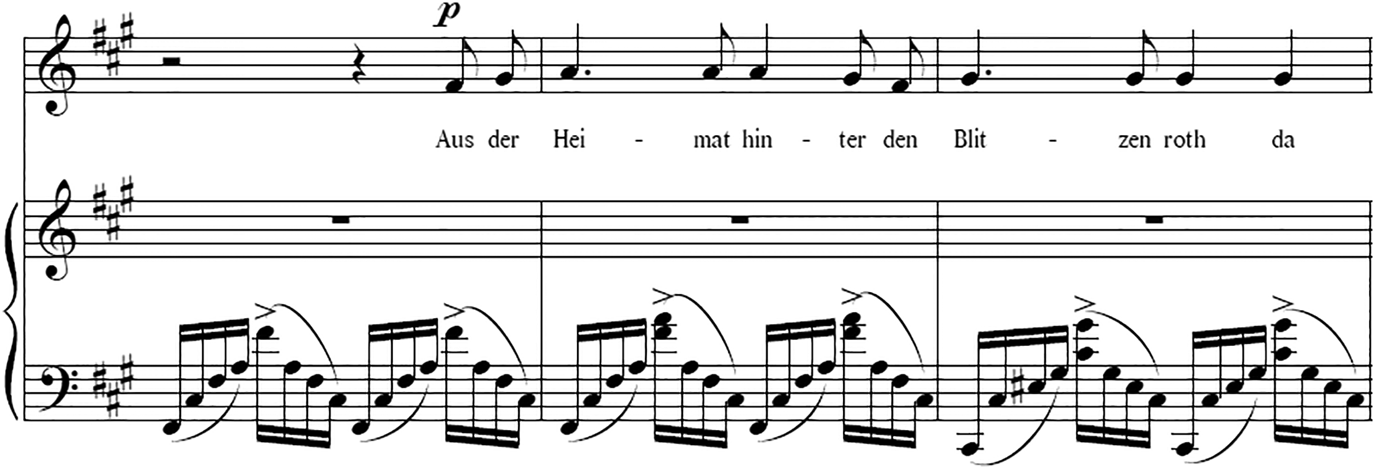
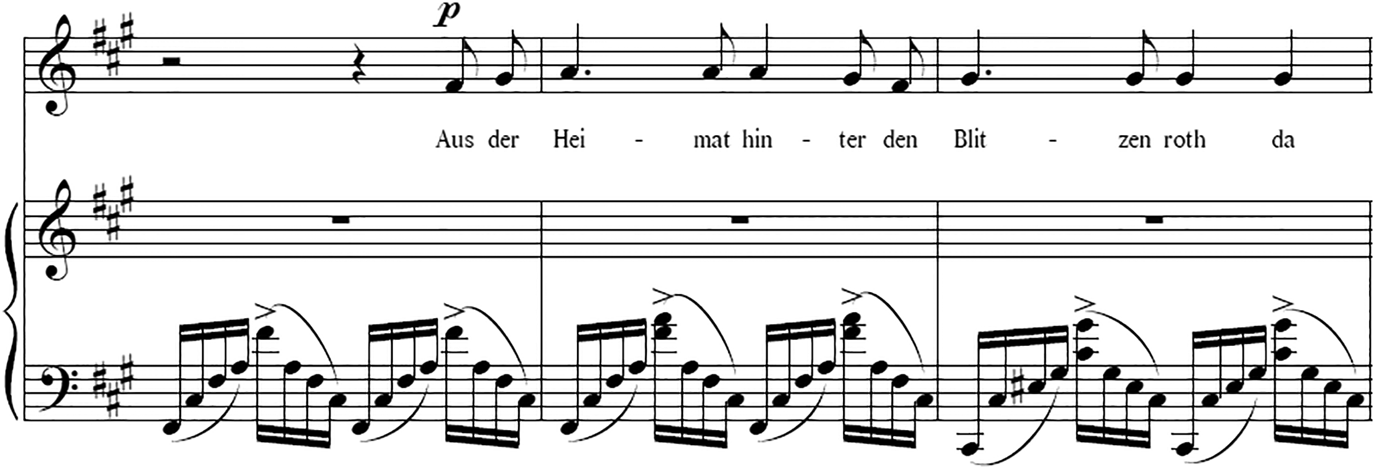
As Bellaigue notes, ‘In der Fremde’ and ‘Pourquoi me réveiller’ share a number of features: they are both in F-sharp minor, and both feature a regular semiquaver accompanying pattern (see Ex. 4). More recently, Steven Huebner has also commented on these features.Footnote 54 Bellaigue does not explore the treatment of tonality in detail, but there are further similarities between the two songs: both tonicize B minor, and both develop the tension between F-sharp minor and its parallel major. For Bellaigue, the dramatic significance of this lied lies in a past conversation with Georges Bizet, in which the dead composer, a mutual acquaintance of both Massenet and Bellaigue, spoke of ‘In der Fremde’ as embodying ‘a yearning for death’.Footnote 55 ‘Pourquoi me réveiller’, in this reading, represents Werther's awareness – and perhaps his acceptance of – his impending fate.
The opening of Robert Schumann's ‘In der Fremde’, bars 1–3. Schumann, Liederkreis, op. 39. In Robert Schumann's Werke, herausgegeben von Clara Schumann, Serie XIII (Leipzig: Breitkopf & Härtel, 1885), 2.
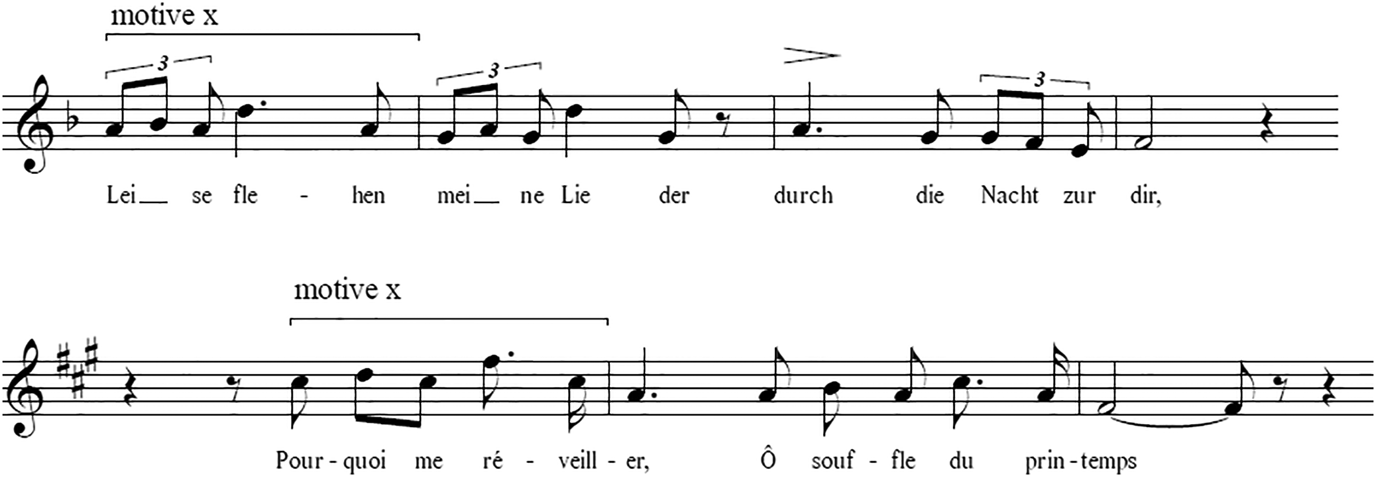
Depanis's vague reference to a Schubert song that resembles ‘Pourquoi me réveiller’ might well refer to ‘Ständchen’, D. 957 no. 4. The opening motive of Werther's air contains the same ÞÞ5–Þ6–ÞÞ5–Þ8–Þ5 melodic pattern as in ‘Ständchen’ (labelled ‘motive x’ in Ex. 5), and has a similar rhythmic pattern which places the highest pitch on a dotted note. Similarly, this motive also recurs throughout the air at the start of phrases. The melodic significance of motive x in the opera is underlined by Massenet's later uses of it in various forms (to accompany Werther's death scene, for example). If ‘Ständchen’ is the point of reference here, then it resonates with Ossian in a different way: it invokes a serenade sung by a lover to a beloved whose response remains ambiguous. Ludwig Rellstab's text explicitly addresses the process of singing and the impact of song on the listener, paralleling the recitation of poetry in the Ossian reading. ‘Ständchen’ thus represents rather accurately Werther's conflicted feelings toward Charlotte, combining his love for her with moonlight and nature, while acknowledging their need for secrecy. The poem is also a request – the reader does not know if the beloved will indeed answer the call. And indeed, Charlotte's reaction to ‘Pourquoi me réveiller’ is ambiguous enough that Werther will misread it, with tragic consequences.
Comparing the melodies of Schubert, ‘Ständchen’ (bars 5–8), above; and Massenet, ‘Pourquoi me réveiller’ (Act III, r.h. 190 + 5), below. Massenet, Werther: drame lyrique en quatre actes et cinq tableux d'après Goethe, partition piano et chant (Paris: Heugel, c. 1894), 176; Schubert, ‘Ständchen’ from Schwanengesang (Vienna: Tobias Haslinger, n.d.), 28.

These examples suggest that Massenet may well have been intentionally referring to one or both of these lieder in this scene. If one were to speculate further, the Schubert connection seems more plausible based on what is known about Massenet's biography and musical tastes. As noted above, Schubert's songs were well known in Paris during Massenet's lifetime; the renowned littérateur Théophile Gautier had even once called Massenet ‘the child of Franz Schubert’.Footnote 56 Massenet seems to have revered Schubert, to the point that he turned down an opportunity to create an opera titled La fille du Roi des Aulnes (The Daughter of the Elf-King) with Gautier, which would presumably have taken place in the world of Schubert's ‘Der Erlkönig’. As the composer wrote many years later, ‘the recollection of Schubert frightened me off [the subject]’.Footnote 57 Only in 1891, after completing Werther, did Massenet overcome his apparent fear of competing with Schubert, when he arranged ‘Am Meer’ (D. 957 no. 12) for horn and orchestra.Footnote 58 There is also a pleasing bit of biographical context here: Schubert's lied was marketed posthumously as part of a collection titled the ‘Schwanengesang’ (swansong). If we hear the ‘Ständchen’ reference, then Werther is quoting Schubert's swansong while singing Ossian's last hymn and his own last air in the opera. As Steven Huebner has shown, Massenet created similar musical puns at other points in Werther.Footnote 59
Certainly the lied reference has potential for creating a deeper level of meaning than has been previously supposed. Huebner, for example, argues that Massenet's reference to the lied represents a kind of musical topic – domestic music making – which works well as a broad gesture but which has little dramatic meaning.Footnote 60 Bellaigue, on the other hand, finds significance in the invocation of Schumann's lieder – not from their generic qualities, but from their emotional resonance:
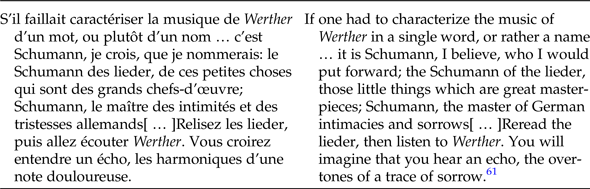
In other words, because Bellaigue sees Schumann as providing an accurate representation of German emotional life, his music is an apt source for Massenet's depiction of a German subject. In the same vein, several critics (including Eduard Hanslick) expressed surprise that Schumann had never attempted to write any music based on Werther.Footnote 62
The use of lied style in Werther also intersects with French attitudes toward German lieder. Contemporary French authors saw the lied as a uniquely German expression of unmediated emotion. Mme Audley's biography of Schubert (1871) describes song as ‘expression naturelle d'un sentiment de l’âme’ (the natural expression of a sentiment in the soul) and praises the lied as the most versatile form of song, ‘propre à exprimer les sentiments multiples/de l’âme, les plus tendres comme les plus violents’ (proper for expressing the soul's many sentiments, from the most tender to the most violent).Footnote 63 Similarly, Marcillac's survey of contemporary music (1875, reprinted 1881) suggests that the lied represented a specific type of poetic character (melancholic and lyrical) for French music critics and historians in the late nineteenth century:
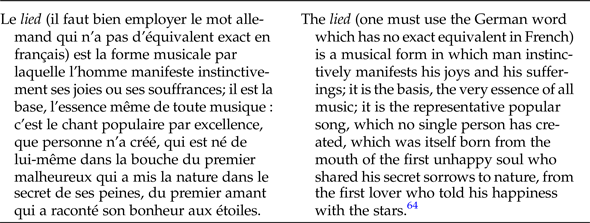
Similarly, the lied could provoke overpowering emotions. The lied makes a striking appearance in Huysmans's novel À rebours (1884), a detailed study of the refined sensibilities of Des Esseintes, a decadent aesthete who walls himself off from the world. The author tells us:
Certain of Schumann's parts for the cello had left him actually gasping and choking, in the grip of hysteria; but it was above all Schubert's Lieder that uplifted and carried him away, leaving afterwards as prostrated as though from a great outpouring of nervous energy, during an extreme mystical experience. Schubert's penetrating music thrilled him to the marrow, forcing a multitude of forgotten griefs and ancient discontents to surface in a heart astonished at containing so much confused misery and ill-defined pain. This desolate music, this lament coming from the furthermost depths of the soul, both terrified and enchanted him. Never had he been able to hum ‘Des Mädchens Klage’ to himself without tears of nervous agitation filling his eyes, for there was in that mournful song something more than grief, there was something wrenching that tore at his heart-strings, something that evoked a dying love-affair set in a forlorn landscape.Footnote 65
Massenet's use of the lied matches these sources, all of which were published before he completed Werther. Even Marcillac's reference to the lied as depicting suffering (souffrances) echoes the common title of Goethe's Werther in French (Les souffrances de jeune Werther). More specifically, Marcillac ties the lied to the expression of human emotions in relation to nature, and to an explicitly confessional tone – which complements Werther's characterization in the opera. (Such overtones linger in autobiographical interpretations of Schumann's song output.)Footnote 66 Massenet's use of lied-like music to depict an emotional outpouring that makes frequent references to nature seems like a textbook imitation of Marcillac's description of the lied. Similarly, Werther's statement that Ossian's songs represent his soul (a statement with no source in Goethe, as noted above) is striking given Audley's description of the lied as a direct expression of the soul. Just as Des Esseintes associates the lied with the memory of past sorrows, so too does Werther's performance of lied-like music release suppressed emotions. Huysmans's portrait of what a lied can do to an overly sensitive listener mirrors the events in the opera: Werther recites his translation of Ossian, and overpowering emotions take hold of both the performer and the listener. Massenet's use of the lied in Werther therefore reflects contemporary French discourses about the lied's uses and emotional power, and resonates with French attitudes toward German music, culture and ethnic identity.
The role of the lied in Huysmans's novel suggests connections between Massenet's conception of Werther and the decadent aesthetics of the fin de siècle. As noted above, Goethe conceived Werther as a man of feeling, who is ready to burst into tears over the memory of a poem, who spontaneously kisses children because his heart too full to do otherwise.Footnote 67 Werther's emotional behaviour took on a different meaning in Massenet's late nineteenth-century context, however. Werther's hysterical, tragic, Ossianic sensibility seemed distinctly unmanly, an unflattering demonstration of weakness that led critics to describe the character as feminized, childish, androgynous (one critic even called him ‘Cherubin tragique’) and psychologically unstable.Footnote 68 The critics were clearly unnerved by Werther's overwrought sensibility and his readiness to vent and wallow in his emotions.
Werther's reception as a feminized or androgynous man in the late nineteenth century runs parallel to that of Schubert. In Massenet's own lifetime, French and German authors increasingly described Schubert's music as feminine or androgynous, as Scott Messing has shown in his exhaustive study of Schubert's European reception. The example of Robert Schumann, who described the ‘Mädchencharakter’ of Schubert's music in an widely read article, was influential here, as were the host of fictionalized accounts which stressed Schubert's inability to consummate a heterosexual relationship.Footnote 69 Although Massenet might not have intentionally invoked Schubert in the ‘Pourquoi me réveiller’, the potential symbolism of such a gesture is too much of a coincidence to ignore, and helps explain why critics such as Depanis were ready to hear specific references to Schubert's lieder in Werther.
Conclusion
As stated above, previous scholarly discussions of ‘Pourquoi me réveiller’ have drawn attention to its use of generic style markers – the ‘Ossianic’ harp and the German lied style for a domestic poetry reading. Because Massenet's stylistic choices recall earlier models, there is certainly a temptation to see these as simple examples of local colour or generic scene-setting. As I hope to have shown, however, they are much more than that. As seen above, the lied was associated with the expression of sincere and deeply felt emotion in France, which made it ideal for the heady rhetoric of an Ossianic poem. But that also made it the perfect vehicle for an emotionally fragile male character such as Werther or Des Esseintes. When Werther sings his lied, he momentarily takes on the role of the bard, imagining a similarity between his own personal life and the end of a great civilization: it is self-pitying but utterly sincere, a fin de siècle version of an Ossianic surrender to sorrow.
Placing this air in the context of other Ossianic music, through its use of the harp, allows us to develop a musical understanding of Werther as an Ossianic, bardic character – a view which resonates with Goethe's novel and its extravagant descriptions of nature (many of which had to be cut in the opera). Exploring the models for the lied connection lets us hear the reference to the lied as both musically and dramatically significant, not simply as a clever piece of scene painting. Both the harp and the lied thus provide keys to understanding Werther's character arc throughout the opera, allowing us to hear Werther as a fin de siècle reinterpretation of the Ossianic aesthetic.