Introduction
In psychiatric nosology death ideation (thinking about/wishing for one's own death, thinking that one would be better off dead) (Van Orden et al., Reference Van Orden, Simning, Conwell, Skoog and Waern2013) is associated with depression and suicidality. In the Diagnostic and Statistical Manual of Mental Disorders Fifth Edition (DSM-5), recurrent thoughts of death over a 2-week period are one of the diagnostic criteria of major depressive disorder (American Psychiatric Association, 2013), while in the World Health Organization's Composite International Diagnostic Interview (CIDI – version 3.0), information on death ideation is similarly collected during the assessment of depression (Kessler and Ustun, Reference Kessler and Ustun2004). DSM-5 also links death ideation with suicidal behaviour as thoughts of death, suicidal ideation, planning and attempting suicide all fall within the same depression diagnostic criterion (A9) (American Psychiatric Association, 2013). This linkage has also been seen in other classification models such as Paykel's assessment of ‘suicidal feelings’ where feeling life is not worth living and wishing oneself dead are conjoined with items on suicidal ideation and suicide attempts (Paykel et al., Reference Paykel, Myers, Lindenthal and Tanner1974). Indeed, it has been suggested that thoughts of death, as expressed by the feeling that life is worthless, and death wishes may fall along a suicidality continuum where they precede more overt manifestations of suicidal behaviour, i.e. suicidal ideation, plans, attempts and completed suicide (O'Connell et al., Reference O'Connell, Chin, Cunningham and Lawlor2004), with death ideation sometimes being referred to as passive suicidal ideation (Van Orden et al., Reference Van Orden, Simning, Conwell, Skoog and Waern2013).
In the context of this close association between thoughts of death, depression and suicidal behaviour, death ideation has been operationalised in differing ways in research studies (e.g. in terms of whether individuals felt life was not worth living, wished for death, had thoughts of death/self-harm) (Paykel et al., Reference Paykel, Myers, Lindenthal and Tanner1974; Scocco and De Leo, Reference Scocco and De Leo2002; Fanous et al., Reference Fanous, Prescott and Kendler2004). Despite this, until now, there have been few studies (Bogers et al., Reference Bogers, Zuidersma, Boshuisen, Comijs and Oude Voshaar2013) that have focused on what can be regarded as more general thoughts of death (GTOD) that do not express a specific wish to die or place a value on life/one's own life. This may be an important omission for several reasons. First, research has shown that not only do people have death-related thoughts across the life course (Chopik, Reference Chopik2017), but that GTOD may be prevalent in some subpopulations such as older individuals. A previous study reported, for instance, that in a general population sample aged 55 and above, 27.3% of those surveyed had current thoughts of death (Cohen et al., Reference Cohen, Colemon, Yaffee and Casimir2008), possibly due to their own ageing (and thus closer mortality), and more frequent encounters with death (friends/relatives) (Kalish and Reynolds, Reference Kalish and Reynolds1977). Second, both quantitative and qualitative research has shown that even when death ideation is expressed, e.g. as a wish to die, it is not always linked to depressive disorder/symptoms (Rurup et al., Reference Rurup, Deeg, Poppelaars, Kerkhof and Onwuteaka-Philipsen2011a, Reference Rurup, Pasman, Goedhart, Deeg, Kerkhof and Onwuteaka-Philipsen2011b). Rather, it can develop for a variety of reasons such as in connection with the perception that the quality of one's life is poor due to ageing/ill health (Rurup et al., Reference Rurup, Pasman, Goedhart, Deeg, Kerkhof and Onwuteaka-Philipsen2011b). Third, it is possible that GTOD might be important for health outcomes other than depression/suicide. An earlier study reported that, irrespective of current mental state, elderly women who felt that life was not worth living had a higher 3-year mortality rate than women without such feelings. As these deaths were from natural causes, it was hypothesised that this may have signified a ‘giving up–given up complex’ (Skoog et al., Reference Skoog, Aevarsson, Beskow, Larsson, Palsson, Waern, Landahl and Ostling1996). In addition, a recent study from the Netherlands found that among some older individuals (aged >70) who were free from psychiatric and life-threatening disease, there was nevertheless a feeling that ‘life [was] completed and no longer worth living’ (Van Wijngaarden et al., Reference Van Wijngaarden, Leget and Goossensen2015). As other research has shown that subjective nearness to death (a feeling that death is near) is also associated with an increased mortality risk across time in old age (Kotter-Grühn et al., Reference Kotter-Grühn, Grühn and Smith2010), it is possible that death ideation, as manifest in more general, non-specific death thoughts might be an important marker for future health outcomes.
The current study will examine the association between GTOD and mortality in older Japanese adults. This may be an ideal setting to examine this association. Not only does the Japanese population comprise the highest percentage of older adults in the world (in 2009, 23% of the population were aged 65 and above) (Muramatsu and Akiyama, Reference Muramatsu and Akiyama2011), but other research has indicated that thoughts of death are common among the Japanese elderly (Ono et al., Reference Ono, Tanaka, Oyama, Toyokawa, Koizumi, Shinohe, Satoh, Nishizuka, Kominato, Nakamura and Yoshimura2001). Thus, this study had three specific aims: (1) to determine if GTOD were associated with an increased risk for mortality in older Japanese adults; (2) to examine if GTOD were differently associated with different causes of death in this population; and (3) to explore whether the GTOD–mortality association varied by sample characteristics. Based on the limited previous research to date, it was hypothesised that GTOD would be associated with an increased risk for mortality in older Japanese adults.
Methods
Study participants
This study used data from the Komo-Ise cohort in Gunma prefecture, in the Kanto region of Japan (Iwasaki et al., Reference Iwasaki, Otani, Ohta, Yosiaki, Kuroiwa and Suzuki2002a, Reference Iwasaki, Otani, Sunaga, Miyazaki, Xiao, Wang, Yosiaki and Suzuki2002b). The cohort was established in 1993 when questionnaires were sent to all residents aged 40–69 in Isesaki city (N = 7755) and Komochi village (N = 4875). In the first wave of the survey, basic information was obtained on demographic, lifestyle and health-related factors. The survey response rate was 91.6%. In 2000, a follow-up survey was undertaken where more detailed information was obtained on physical and psychological health, as well as on topics such as parenting and care giving. In this wave 2 survey, 9650 respondents participated (an 88.5% response rate) (Wang et al., Reference Wang, Iwasaki, Otani, Hayashi, Miyazaki, Xiao, Yosiaki, Suzuki, Koyama and Sakamaki2005). Of these respondents, 9533 were still resident in the study area on 1 January 2000, which constituted the beginning of the observation period for the current study. The mean age of the respondents was 61.7 years with the age range stretching from 47 to 77 years at wave 2. Information on deaths and migratory activity of the cohort members in the period until 31 December 2008 (the end of the study observation period) was obtained from the municipal resident registration file, Jumin Kihon Daicho. Attempts were made to contact those respondents who had left the study area by mail. Those who could not be contacted/did not respond were excluded from the study.
Measures
Predictor variable
General thoughts of death
GTOD were measured in wave 2 (2000) with an item that was taken from the depression measure used in the Alameda County Study that was based on DSM-IV symptom criteria for major depressive episode (Roberts et al., Reference Roberts, Kaplan, Shema and Strawbridge2000). Respondents were asked ‘During the last 2 weeks have you had any of the following problems or feelings nearly every day?’ and then presented with a list of health/behaviour outcomes that included, ‘Thought about death more than usual, either your own, someone else's or death in general?’ with yes and no answer options. This item corresponds closely with an item that is found in the depression module of the World Health Organization's World Mental Health Composite International Diagnostic Interview (WHO WMH-CIDI) (https://www.hcp.med.harvard.edu/wmhcidi/).
Control variables
Demographic, lifestyle and health variables
Information was collected on sex, age (47–59, 60–69, ⩾70), location (urban/rural), educational level (high (college and higher), less than high) and marital status (married, never married (single), not married (separated/divorced/widowed)). Social support was assessed with three questions that enquired if the respondents had someone to confide in, to take them to the doctor if it was necessary, or who could prepare meals for them if they were unable to. There were five answer options ranging from ‘all of the time’ (scored 1) to ‘none of the time’ (scored 5). The answers were summed to create a score ranging from 3 to 15 with higher scores indicating a lower level of social support. This variable was then dichotomised into high (3–6) and low (7–15) social support. For smoking status, respondents were categorised as either current, former (had quit) or never smokers. Information was also collected on the presence of five self-reported chronic diseases/disorders in the previous 12 months: cancer, heart disease (trouble), diabetes, stroke, depression.
Mortality data
Among those who provided baseline information about GTOD in 2000, there were 672 deaths in the follow-up period until 31 December 2008. These were classified in accordance with the International Classification of Diseases 10th Revision (ICD-10). Death certificates, Shibo-Kohyo, were accessed at the local public health centre and used to obtain information on the cause of death. All-cause mortality and deaths from external (V01-Y98) and non-external causes were investigated. The analyses were further refined so that neoplasms (C00-D48), circulatory (cardiovascular) (I00-I99) and respiratory deaths (J00-J99) could also be examined separately. Only 19 (2.8%) of the 672 deaths were not assigned ICD-10 codes. These undetermined deaths were included in the all-cause mortality analysis but excluded from the analyses that focused on specific forms of death. Ethical approval for the study was obtained from the Ethics Committee at the Graduate School of Medicine at Gunma University, Maebashi, Japan. Informed consent was assumed with the voluntary return of the postal questionnaire.
Statistical analyses
To determine the association between GTOD and all-cause and cause-specific mortality in the period from 1 January 2000 to 31 December 2008, we used Cox proportional hazards regression analysis. Those participants who had migrated out of the study area during the follow-up period (N = 42) were censored on the last date they were confirmed to be alive. Participants who were alive at the end of the follow-up period were censored on the date of follow-up. The multivariable models adjusted for potential confounding factors using data collected in the 1993 (demographic factors) and 2000 surveys. Specifically, model 1 adjusted for demographic factors (age, sex, area of residence, marital status, education and social support). In addition to those factors in model 1, model 2 also incorporated chronic diseases (cancer, heart disease, diabetes and stroke). Model 3 additionally included smoking status. Model 4 also adjusted for depression in addition to those variables that were adjusted for in the first three models. All models included only those participants who had full information for all of the variables. An analysis was also performed which was stratified by demographic characteristics to determine if these were important for the association between GTOD and all-cause mortality. In this analysis, all the variables used in model 4 in the previous analysis were controlled for (excepting the variables used for stratification in each stratified model). In addition, we also performed a further analysis to check the association between GTOD and mortality among subjects with missing data who were removed from the final multivariable model. To evaluate the proportional hazards assumption, Schoenfeld's tests were performed. Results are in the form of hazard ratios (HR) with 95% confidence intervals (CI). R version 3.0.3. (R Project for Statistical Computing, Vienna, Austria) was used to perform the analyses.
Results
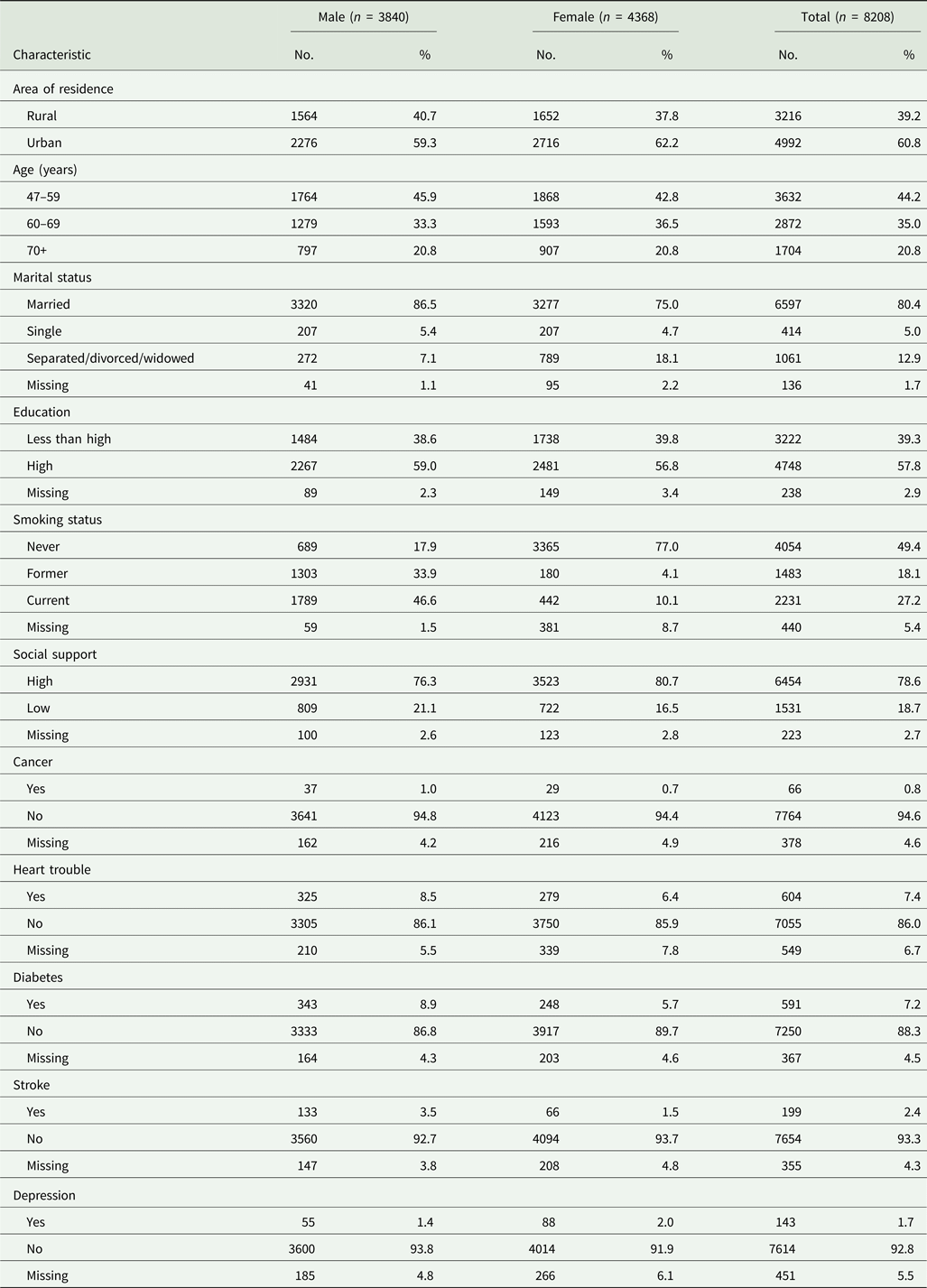
In total, 8208 participants (men 3840, women 4368) were included in the study. GTOD were reported by 5.4% of the participants with the prevalence being higher among women (6.6%), than men (4.0%). Details of the study participants are presented in Table 1. The mean age (s.d.) of the participants was 61.3 years (8.2) with the largest number being in the 47–59 age group (44.2%). The majority of the participants were married (80.4%) and had received a high education (57.8%), while almost 80% of them reported having a high level of social support.
Participant characteristics

The association between GTOD and mortality is presented in Table 2. During the 9 years of follow-up, there were 672 deaths. In model 1 that adjusted for demographic characteristics, GTOD were associated with a significantly increased risk for all-cause mortality (HR 1.79, 95% CI 1.35–2.38), non-external deaths (HR 1.74, 95% CI 1.29–2.34), neoplasms (HR 1.87, 95% CI 1.22–2.86) and cardiovascular mortality (HR 1.72, 95% CI 1.01–2.91). Adjusting for the presence of chronic disease at baseline in model 2 resulted in the association with cardiovascular mortality becoming non-significant (HR 1.51, 95% CI 0.86–2.64). Further adjustment for baseline smoking (model 3) and depression (model 4) altered the results comparatively little, so that in the final model, GTOD were associated with significantly higher HRs for all-cause mortality (HR 1.66), non-external mortality (HR 1.62) and neoplasms (HR 2.09). GTOD were not associated with respiratory and external causes of death in any of the models. The full results for each outcome (i.e. the results for all of the variables in each analysis) are presented in the supplementary material (Appendices 1–6).
Association between general thoughts of death (GTOD) and all-cause and cause-specific mortality among members of the Komo-Ise cohort

Model 1 adjusted for age, sex, area of residence, marital status, education and social support.
Model 2 adjusted for chronic diseases (cancer, heart disease, diabetes and stroke) in the past 12 months in addition to variables in model 1.
Model 3 adjusted for smoking (never, quit or current) in addition to variables in model 2.
Model 4 adjusted for depression in the past 12 months in addition to variables in model 3.
For n = 19 causes of deaths were unknown.
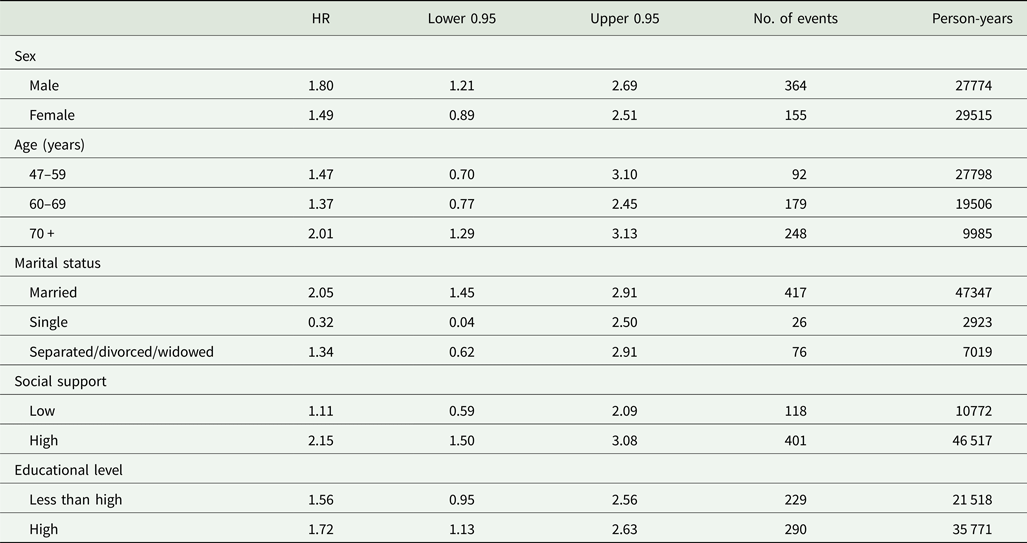
In an analysis that was stratified by the demographic characteristics of the cohort participants, there were some noticeable differences between groups (Table 3). Thus, while men who had GTOD were significantly more likely to die than men who did not (HR 1.80), there was no difference in all-cause mortality for women. In terms of age, only the oldest death ideators (⩾70) had a significantly increased HR for all-cause mortality (HR 2.01). Being married (HR 2.05), having a high level of social support (HR 2.15) and having a high education (HR 1.72) were all associated with significantly higher mortality hazard rates.
Association between general thoughts of death (GTOD) and all-cause mortality in an analysis stratified by sample characteristics

Finally, an additional analysis restricted to subjects with missing data did not show evidence of an association between GTOD and mortality (data not shown).
Discussion
This study used data from a community-based cohort of over 8000 older Japanese residents to examine the prospective association between GTOD and mortality. A Cox proportional hazards regression analysis showed that across a follow-up period of 9 years, GTOD were associated with a significantly increased risk for all-cause, non-external and cancer mortality after controlling for demographic, lifestyle and health-related variables. A stratified analysis also showed that the association was elevated in specific subsections of the population, i.e. men, those who were oldest, married, had a high education and more social support.
In the current study, 5.4% of the participants had GTOD in the previous 2 weeks. Although comparisons between studies are complicated by the different ways death ideation has been operationalised and variations in the length of the reporting period, this figure is lower than those in several previous studies. For instance, the prevalence was over five times higher in individuals aged 55 and above in an earlier US study (Cohen et al., Reference Cohen, Colemon, Yaffee and Casimir2008), while the current figure is less than half of that reported (11.7%) in a previous study among Germans aged 18–65 (average age 42) that used the CIDI (Brunner et al., Reference Brunner, Bronisch, Pfister, Jacobi, Höfler and Wittchen2006) and by Japanese participants aged ⩾65 in Aomori prefecture (11.2%) that also used that diagnostic instrument, although in that study, the figure was only 3.1% for those with thoughts of death lasting 2 weeks or longer (Ono et al., Reference Ono, Tanaka, Oyama, Toyokawa, Koizumi, Shinohe, Satoh, Nishizuka, Kominato, Nakamura and Yoshimura2001). As previous research has indicated that death ideation (wishes) can vary greatly across older populations (Mellqvist Fässberg et al., Reference Mellqvist Fässberg, Östling, Braam, Bäckman, Copeland, Fichter, Kivelä, Lawlor, Lobo, Magnússon, Prince, Reischies, Turrina, Wilson, Skoog and Waern2014), it is possible that these differences may simply be due to different reporting periods. Nonetheless, as it has also been suggested that death anxiety may be comparatively high among the Japanese (Becker, Reference Becker1999), we cannot discount the possibility that the current figure may also reflect some degree of under-reporting/non-responding. In particular, as 13% of respondents did not answer the GTOD question in the 2000 survey, it suggests that some caution should be exercised when interpreting these results.
The finding that GTOD are associated with mortality after adjusting for a range of baseline control variables builds on and extends several earlier studies which have linked suicidal ideation and death ideation (life is not worth living) to all-cause and cause-specific mortality (Skoog et al., Reference Skoog, Aevarsson, Beskow, Larsson, Palsson, Waern, Landahl and Ostling1996; Khang et al., Reference Khang, Kim and Cho2010; Shiner et al., Reference Shiner, Riblet, Westgate, Young-Xu and Watts2016) by showing that more general, non-specific death thoughts are associated with subsequent mortality. It is uncertain what underlies this association although several mechanisms might be important. For instance, the ‘terror management health model’ theory has posited that conscious thoughts of mortality (mortality salience) produce anxiety which acts as a motivation to remove the death-related cognitions from consciousness. This can result in health-enhancing behaviours, but also, health-threatening behaviours as a result of maladaptive threat-avoidance responses, such as the attempt to escape from self-awareness by engaging in risky health behaviours (Goldenberg and Arndt, Reference Goldenberg and Arndt2008). Support for this latter supposition has come from field research which has linked death primes to increased alcohol consumption (Ein-Dor et al., Reference Ein-Dor, Hirschberger, Perry, Levin, Cohen, Horesh and Rothschild2014) and the finding that death reminders result in those with stronger smoking cravings smoking at a higher intensity (Arndt et al., Reference Arndt, Vail, Cox, Goldenberg, Piasecki and Gibbons2013). Indeed, as earlier research from Japan has also shown that a fear of death is linked to worse health habits in men but not women (Hioki and Tanaka, Reference Hioki and Tanaka2004), this might help explain the significant association we observed between GTOD and mortality in men but not women in the current study, although it should be noted that smoking seemed to have little effect on the GTOD–mortality association when adjusted for in the analysis.
Purpose in life might also account for the link between GTOD and future mortality. Specifically, it has been hypothesised that a perceived lack of life meaning may be one of the factors that gives rise to death thoughts (Hayes et al., Reference Hayes, Schimel, Faucher and Williams2008), while research has shown that purpose in life is negatively associated with death fears/avoidance (Ardelt, Reference Ardelt2003) and may also prevent thoughts of death turning into death fears (Routledge and Juhl, Reference Routledge and Juhl2010). In turn, a greater purpose in life has been linked to a reduced risk for all-cause mortality among older adults (Boyle et al., Reference Boyle, Barnes, Buchman and Bennett2009). Importantly, a sense that life is worth living/purpose in life (ikigai in Japanese) has also been associated with reduced mortality among older Japanese adults (Sone et al., Reference Sone, Nakaya, Ohmori, Shimazu, Higashiguchi, Kakizaki, Kikuchi, Kuriyama and Tsuji2008). It is possible that having a purpose in life might result in reduced mortality via different mechanisms. For example, there is some evidence that older individuals with a higher purpose in life are more likely to use preventive health care services (Kim et al., Reference Kim, Strecher and Ryff2014).
It is noteworthy that GTOD were associated with some forms of mortality but not others. Although one can only speculate on what underlies the difference across outcomes, one explanation might be related to the fact that some of the analyses may possibly have been underpowered to detect associations. Specifically, the number of deaths for some of the outcomes was small (i.e. for external and respiratory deaths). An important task for future research will be to examine these associations using data from larger samples/longer cohorts. It is also possible, however, that other factors were involved. For cardiovascular deaths, for instance, an initial statistically significant association in model 1 was attenuated when controlling for baseline cardiovascular disease and stroke, which had a very strong association with subsequent mortality (shown in the supplementary material, Appendix 5). This suggests that psychological factors might have been less important for this cause of death in this particular sample. Support for this supposition comes from the fact that the association with depression was non-significant in the final model even though an additional analysis showed that baseline heart disease was significantly associated with baseline depression (p < 0.01 (Fisher's exact test)), while an earlier meta-analysis found that depression was linked to an increased risk for mortality in patients with coronary heart disease (Barth et al., Reference Barth, Schumacher and Herrmann-Lingen2004).
Stratified analyses similarly showed that GTOD were associated with an increased risk for mortality in some groups but not others. Regarding age, the association was only observed among those who were aged 70 and above. This might be linked to an age-related decline in health and viewing death as a viable alternative to further decline (Gesser et al., Reference Gesser, Wong and Reker1987–88) together with a desire to avoid becoming a burden on others and the stresses that can arise from dependency-induced filial co-residence, which has previously been discussed in the context of elderly suicide in Japan (Traphagan, Reference Traphagan2004). In addition, older age is associated with a lower sense of control (Mirowsky, Reference Mirowsky1997), which is also a risk factor for premature mortality (Infurna et al., Reference Infurna, Gerstorf, Ram, Schupp and Wagner2011). The finding that GTOD were associated with an increased mortality risk in those who were married and who had greater social support was unexpected given that previous research has shown that both marriage and higher social support protect against mortality in the elderly (Manzoli et al., Reference Manzoli, Villari, Pirone and Boccia2007; Mazzella et al., Reference Mazzella, Cacciatore, Galizia, Della-Morte, Rossetti, Abbruzzese, Langellotto, Avolio, Gargiulo, Ferrara, Rengo and Abete2010). Although it is unclear what underlies this finding, it can be speculated that GTOD in those with a comparative social advantage might be indicative of poorer social relations and that these might also be important for mortality. In particular, earlier research has shown that quality rather than size of social support is important for health (Vandervoort, Reference Vandervoort1999), while better marital quality has also been associated with a reduced mortality risk (Robles et al., Reference Robles, Slatcher, Trombello and McGinn2014). It is also possible, however, that these unexpected results might be due to other potential confounding variables that were not included in the analysis, although an additional analysis which included functional limitations showed that the results for social support remained the same.
The strengths of this study include the use of a large sample with a good survey response rate and a long follow-up period. The study also has several limitations. As mentioned previously, due to the potentially sensitive nature of this topic, it is possible that GTOD were under-reported in this study. Medical conditions were self-reported and we were not able to verify these reports against other information sources such as medical records. This might have resulted in misreporting as an earlier study found that although most self-reported physical illnesses are reported accurately, older adults may report some conditions inaccurately (Kriegsman et al., Reference Kriegsman, Penninx, van Eijk, Boeke and Deeg1996). In addition, despite the long follow-up period, there were relatively few deaths which meant that it was only possible to examine broad cause of death groups. As indicated above, it is also possible that important variables were missing from the analysis. An earlier study that examined factors associated with thoughts of death/self-harm in young/middle-age adults identified a number of correlates such as stressful life events (Fanous et al., Reference Fanous, Prescott and Kendler2004) that have also been associated with an increased mortality risk (Rosengren et al., Reference Rosengren, Orth-Gomér, Wedel and Wilhelmsen1993). Finally, as we did not collect information on death wishes or suicidal ideation, it was not possible to examine if there was an overlap between general and more specific thoughts of death. Future studies should examine both to determine their association, whether/how it varies across time and the implications this has for mortality in older individuals.
In conclusion, this study has shown that after adjusting for a number of control variables, GTOD without an expressed wish to die/life value judgement are associated with premature mortality in older adults. Given this association, an important task for future research will be to determine the specific object of these GTOD and the factors associated with them using both quantitative and qualitative methods. It will also be important to determine whether screening for GTOD in patients/older individuals is of clinical relevance as well as assess the feasibility of interventions to address death-related cognitions in individuals in the absence of depression.
Supplementary material
The supplementary material for this article can be found at https://doi.org/10.1017/S2045796018000434.
Acknowledgements
The authors would like to thank Professor Shosuke Suzuki of the International Eco Health Research Group and all the people who have participated in and contributed to the Komo-Ise cohort study.
Financial support
AS's work was supported by the International Eco Health Research Group (Komo-Ise research grant). AK's work was supported by the Miguel Servet contract financed by the CP13/00150 and PI15/00862 projects, integrated into the National R + D + I and funded by the ISCIII – General Branch Evaluation and Promotion of Health Research – and the European Regional Development Fund (ERDF-FEDER). YI was supported by the Nippon Foundation International Fellowship program (http://intl-fellow.jp/). These organisations had no role in the study design, collection, analysis and interpretation; in the writing of the manuscript; and in the decision to submit the paper for publication.
Conflict of interest
None.
Ethical standard
The authors assert that all procedures contributing to this work comply with the ethical standards of the relevant national and international committees on human experimentation and with the Helsinki Declaration of 1975, as revised in 2008.
Availability of data and materials
The authors received permission to access the data used in this study. However, as they are not the custodians of the data they are not able to make the data publicly available.