Compulsive checking has a lifetime prevalence of approximately 1.8% (Ruscio, Stein, Chiu, & Kessler, Reference Ruscio, Stein, Chiu and Kessler2010) and is one of the most common compulsions experienced by individuals with obsessive–compulsive disorder (OCD; e.g., Hermans, Martens, De Cort, Pieters, & Eelen, Reference Hermans, Martens, De Cort, Pieters and Eelen2003; Ruscio et al., Reference Ruscio, Stein, Chiu and Kessler2010). Common rituals include checking whether a stove is properly turned off or whether doors are properly locked (Abramowitz & Nelson, Reference Abramowitz, Nelson, Antony, Purdon and Summerfeldt2007). One area of research examining possible mechanisms involved in the development and maintenance of OCD checking pertains to memory processes.
Individuals with OCD checking often experience high levels of doubt in the veracity of their memories (Exner, Martin, & Rief, Reference Exner, Martin and Rief2009). It has been proposed that this doubt is a response to deficits in memory functioning (Ecker & Engelkamp, Reference Ecker and Engelkamp1995; Jaafari et al., Reference Jaafari, Frasca, Rigalleau, Rachid, Gil, Olié and Vibert2011; Sher, Frost, Kushner, Crews, & Alexander, Reference Sher, Frost, Kushner, Crews and Alexander1989; Tallis, Pratt, & Jamani, Reference Tallis, Pratt and Jamani1999). As such, repetitive checking may be an attempt to compensate for these deficits (Sher et al., Reference Sher, Frost, Kushner, Crews and Alexander1989). However, while some researchers have found evidence for memory deficits in OCD checkers (Ecker & Engelkamp, Reference Ecker and Engelkamp1995), other researchers have found OCD checkers to have comparable memory performance to controls in a variety of domains (e.g., Macdonald, Antony, Macleod, & Richter (Reference Macdonald, Antony, Macleod and Richter1997).
An alternative explanation for the doubt about completed actions often experienced by OCD checkers is diminished memory confidence in the absence of any objective memory deficit (Tekcan, Topçuoğlu, & Kaya, Reference Tekcan, Topçuoğlu and Kaya2007). A number of researchers have found OCD generally, and OCD checking in particular, to be characterised by low memory confidence in the absence of poorer accuracy (Cougle, Salkovskis, & Wahl, Reference Cougle, Salkovskis and Wahl2007; Macdonald et al., Reference Macdonald, Antony, Macleod and Richter1997; Nedeljkovic & Kyrios, Reference Nedeljkovic and Kyrios2007; Nedeljkovic, Moulding, Kyrios, & Doron, Reference Nedeljkovic, Moulding, Kyrios and Doron2009).
Van den Hout and Kindt (Reference van den Hout and Kindt2003a) suggest low memory confidence among OCD checkers may result from, as well as contribute to, checking behaviour. As such, while the aim of checking appears to be to reduce doubt, repeated checking may in fact increase memory uncertainty, and therefore function as a self-perpetuating mechanism (van den Hout & Kindt, Reference van den Hout and Kindt2003b). Van den Hout and Kindt, (Reference van den Hout and Kindt2003a) conducted a series of studies with non-clinical samples to further explore this, using an interactive computer program referred to as the ‘3D Checking Task’ or ‘Stovetop Task’. This program was developed to simulate OCD checking. The task involves two stimuli, a six-burner gas stove and a row of six light bulbs, that are manipulated using the computer mouse. Their first study using this task employed 39 undergraduate participants. While no differences in memory accuracy were found between the two conditions, those who repeatedly checked the stove (the checking relevant stimulus), experienced a significant decrease in confidence in the accuracy of the memory, memory vividness and memory detail for the last stove check compared to those who repeatedly checked the lights (the checking irrelevant control stimuli).
Van den Hout and Kindt (Reference van den Hout and Kindt2003b) propose that increased familiarity of a stimulus results in perceptual processing being increasingly inhibited, and replaced by top-down conceptual processing. As a result, the clarity of one's visual memory of checking the stimulus decreases. This in turn results in reduced confidence in the accuracy of one's memory, seemingly without affecting accuracy itself (van den Hout & Kindt, Reference van den Hout and Kindt2003b). This suggests that the more patients check, the less confident they become in their memory for previous checks. This likely precipitates further checking in a counterproductive attempt to regain memory clarity and confidence, giving rise to a self-perpetuating mechanism.
Radomsky, Gilchrist, and Dussault (Reference Radomsky, Gilchrist and Dussault2006) extended van den Hout and Kindt's (Reference van den Hout and Kindt2003a) research using the same procedure, but with a real stove and sink in place of the virtual stove and lights. Consistent with the findings of van den Hout and Kindt (Reference van den Hout and Kindt2003b), a significant decrease in memory confidence, vividness and detail for the stove occurred for those who repeatedly checked this stimulus, but not for those who repeatedly checked the sink (Radomsky et al., Reference Radomsky, Gilchrist and Dussault2006). In contrast to van den Hout and Kindt (Reference van den Hout and Kindt2003b), however, a small but significant decrease in memory accuracy was seen in the stove but not the sink condition (Radomsky et al., Reference Radomsky, Gilchrist and Dussault2006). Radomsky et al. (Reference Radomsky, Gilchrist and Dussault2006) suggest this inconsistency may be due to the higher perceived responsibility for possible harm presumed to be induced by their more ecologically valid paradigm.
The Stovetop Task has also been used with a clinical OCD sample (Boschen & Vuksanovic, Reference Boschen and Vuksanovic2007). Boschen and Vuksanovic (Reference Boschen and Vuksanovic2007) had 15 individuals with OCD (all of whom reported significant checking concerns) and 40 non-clinical undergraduate participants complete this task. The procedure was identical to that employed by van den Hout and Kindt (Reference van den Hout and Kindt2003b), except that all participants completed a trial with both the stove and lights at pre and post-test, but completed all repeated checking with the stove. The effect of repeated checking on memory confidence was replicated. While the OCD group were found to have lower memory confidence overall, the decline in confidence did not differ significantly between the OCD and non-OCD groups (Boschen & Vuksanovic, Reference Boschen and Vuksanovic2007).
While several studies have found support for the memory confidence effect for repetitive checking behaviour, some findings suggest that checking may not be necessary and instead, the act of repeatedly viewing, using, or being exposed to stimuli, can also result in reduced memory confidence for that stimulus. For example, Tolin et al. (Reference Tolin, Abramowitz, Brigidi, Amir, Street and Foa2001) examined memory confidence in relation to stimuli presented repeatedly and found a decline in memory confidence with repeated exposure to particular stimuli for individuals with OCD for objects they had rated as ‘unsafe’. In contrast, van den Hout and Kindt (Reference van den Hout and Kindt2003b) found this decline in non-OCD individuals with non-ideographically selected stimuli. These studies differ in the way in which they attempt to simulate repeated checking. While Tolin et al. (Reference Tolin, Abramowitz, Brigidi, Amir, Street and Foa2001) simply had participants repeatedly view the stimuli, van den Hout and Kindt (Reference van den Hout and Kindt2003b) had participants also return to the stimuli to check they were properly turned off.
Similar to Tolin et al. (Reference Tolin, Abramowitz, Brigidi, Amir, Street and Foa2001), Hermans et al. (Reference Hermans, Engelen, Grouwels, Joos, Lemmens and Pieters2008) also investigated the effect of repeating certain actions (e.g., turning a stove on and off) on cognitive confidence. Importantly, although Hermans et al. (Reference Hermans, Engelen, Grouwels, Joos, Lemmens and Pieters2008) refer to this as ‘checking’, participants were required to carry out the actions without subsequently making sure they had been carried out properly. Repetition was found to significantly decrease confidence in perception, but not memory. The authors attribute this failure to replicate the memory confidence effect to the limited number of trials (five, in contrast to 20 used by van den Hout and Kindt (Reference van den Hout and Kindt2003b). However, the absence of a ‘checking step’ is also a key difference between this paradigm and that of van den Hout and Kindt (Reference van den Hout and Kindt2003b) and may account for the discrepancy in findings.
Moreover, while the explanation of this effect in terms of shift in processing style suggests other kinds of repeated action will have an equivalent cognitive impact to repeated checking, this theoretical implication has not been tested. If the effect occurs with other kinds of repeated use of particular objects, this would suggest a reduction in memory confidence for highly familiar objects may occur prior to the onset of repeated checking. This may predispose susceptible individuals to later development of checking compulsions in relation to those objects. The present study thus aims to further investigate the memory confidence effect for repeated checking and will also examine whether repeated use of, that is, repeated exposure to, an object is sufficient to induce the effect.
Van den Hout and Kindt (Reference van den Hout and Kindt2003a) argue that the deleterious effect of repeated checking on memory confidence contributes to the failure of the behaviour to terminate after one or even a few checks, and therefore functions as a maintaining factor. Thus far, no studies have examined whether the memory confidence effect persists after a hiatus in checking. It is therefore uncertain from the literature so far whether the effect may increase an individual's vulnerability to commencing subsequent checking episodes. The present study will endeavour to address this gap in the literature by examining whether confidence is restored, remains low, or declines further when the stimulus is re-encountered following a delay in repeated checking or repeated use.
Van den Hout and Kindt (Reference van den Hout and Kindt2003b) suggest repeated checking represents a counterproductive attempt to enrich memory and thereby increase memory confidence. At the same time, it has been suggested that while perseverative checking is intended to reduce the anxiety brought about by obsessions, checking may be an ineffective neutralisation strategy (Rachman, Reference Rachman, Silva and Menzies2003; Roper, Rachman, & Hodgson, Reference Roper, Rachman and Hodgson1973). It has not, however, been examined whether these findings are related, as previous studies examining the impact of repeated checking on memory processes (e.g., van den Hout & Kindt Reference van den Hout and Kindt2003a, Reference van den Hout and Kindt2003b, Reference van den Hout and Kindt2004), have not assessed state anxiety. If repeated checking exacerbates, rather than alleviates memory uncertainty, it may also have a counterproductive impact on anxiety levels. The present study investigated this.
Consistent with the findings of van den Hout and Kindt (Reference van den Hout and Kindt2003b) and others, it was hypothesised that there would be no significant change in memory accuracy between pre-test and post-test irrespective of condition (exposure or checking) or stimulus type (stove or lights). In line with previous research on the effects of repeated checking (Boschen & Vuksanovic, Reference Boschen and Vuksanovic2007; Tolin et al., Reference Tolin, Abramowitz, Brigidi, Amir, Street and Foa2001; van den Hout & Kindt, Reference van den Hout and Kindt2003a, Reference van den Hout and Kindt2003b, Reference van den Hout and Kindt2004), significant decreases from pre-test to post-test in memory vividness, detail and confidence were expected for the stove stimulus compared to the light stimulus. Additionally, since van den Hout and Kindt (Reference van den Hout and Kindt2003a) propose that decreases in these memory processes are the consequence of increased stimulus familiarity, no significant difference in the decrease in memory vividness, detail and confidence between the exposure and checking conditions was expected.
On the basis of previous theory and research on the ineffectiveness of checking as a neutralising strategy (e.g. Rachman, Reference Rachman, Silva and Menzies2003), and consistent with the decrease in memory confidence and clarity found to occur with repeated checking (van den Hout & Kindt, Reference van den Hout and Kindt2003b), a significant increase in state anxiety was expected across pre, mid and post-test for both the exposure and checking conditions. It was expected that when the stove was reencountered following a delay in repeated checking or repeated use, confidence would not be restored to pre-test levels, but would not deteriorate further. As such it was predicted that memory confidence would be significantly lower at follow-up than at pre-test for this stimulus, but not significantly different between post-test and follow-up, and this would be the same for the checking and exposure conditions.
Method
Design
The present study employed a 2 (condition: checking, exposure) × 2 (stimulus type: stove and lights) × 2 (time point: pre, post) mixed design, with repeated measures on the second and third independent variables (IVs). In addition, checking symptoms were included as a continuous IV. The dependent variables (DVs) were memory accuracy, confidence, vividness and detail. For a subset of participants, a 2 (condition: checking, exposure) × 2 (stimulus type: stove, lights) × 3 (time: pre, post, follow-up) design was employed, with repeated measures on the second and third IVs. The DV was memory confidence. To examine changes in state anxiety across time points, a 2 (condition: checking, exposure) × 3 (time point: pre, mid, post) mixed design was employed, with repeated measures on the second IV. The DV was the Subjective Units of Distress Scale rating.
Participants
Participants were undergraduate students enrolled in first-year psychology who participated in exchange for course credit. Participants were randomly allocated to either the checking or the exposure condition using Research Randomiser (http://www.randomizer.org/form.htm). A total of 127 participants were tested; however, 10 participants (5 from each condition) were excluded due to failure to complete the Memory Questionnaire at one or more time points, and one (from the exposure condition) due to failure to complete the Stovetop Task itself. A further three participants (two from the checking and one from the exposure condition) were excluded due to failure to complete the STAI. The final sample thus consisted of 113 participants (32 male), 56 of whom were in the exposure condition (19 male) and 57 (13 male) in the checking condition. Participants were aged between 18 and 47 years (M = 19.70, SD = 4.40).
Materials
The Stovetop Task (van den Hout & Kindt, Reference van den Hout and Kindt2003b)
The Stovetop Task is an interactive 3D computer program designed to simulate OCD checking behaviours. The task involves two stimulus types, a six-burner gas stove, and a row of six light-bulbs, which are manipulated using the mouse. When the user turns a particular stove knob to the right, flames appear at the corresponding gas-ring. Turning the knob back to its original position causes the flames to disappear. Similarly, the lights can be manipulated using sliders presented below the stimuli. The task was modified from its original form to include an exposure condition in which the checking step was omitted (see ‘Procedure’ for details).
Reading comprehension filler task (Doctorow, Reference Doctorow1976; Mengestu, Reference Mengestu2008)
This task consisted of two brief (200–300 word) passages taken from fictional works, and comprehension questions pertaining to each (seven for the first passage and nine for the second). Passages were presented one at a time, with the relevant questions presented beneath.
Measures
Obsessive Compulsive Inventory – Revised (OCI-R; Foa et al., Reference Foa, Huppert, Leiberg, Langner, Kichic, Hajcak and Salkovskis2002)
The OCI-R is an 18-item self-report questionnaire. Participants rate, on a 5-point Likert scale, the level of distress experienced in association with a variety of OCD symptoms. Items represent six subscales: checking, washing, ordering, obsessing, hoarding and neutralising. The OCI-R has been shown to have high internal validity in both clinical (Foa et al., Reference Foa, Huppert, Leiberg, Langner, Kichic, Hajcak and Salkovskis2002) and non-clinical (Hajcak, Huppert, Simons, & Foa, Reference Hajcak, Huppert, Simons and Foa2004) samples. Hajcak et al. (Reference Hajcak, Huppert, Simons and Foa2004) also found the scale to have good to excellent convergent and divergent validity.
State Trait Anxiety Inventory (STAI; Spielberger, Reference Spielberger1983)
The STAI is a 40-item self-report measure of the presence and severity of current anxiety symptoms, and general propensity toward anxiety (Spielberger, Reference Spielberger1983). Participants are asked to rate, on a 4-point scale, their current anxiety (20 items) and general anxiety (20 items). Previous studies have found the internal consistency of the measure to be high, ranging from 0.86 to 0.95 (Spielberger, Reference Spielberger1983).
Subjective Units of Distress Scale (SUDS)
Participants rate their current level of anxiety on a scale ranging from 0–10. The SUDS has been found to have adequate convergent and discriminant validity, including convergence with the STAI-S and divergence from the STAI-T (Kim, Bae, & Park, Reference Kim, Bae and Park2008).
Memory and Meta-memory Questionnaire (Constans, Foa, Franklin, & Mathews, Reference Constans, Foa, Franklin and Mathews1995; van den Hout & Kindt, Reference van den Hout and Kindt2003b)
These task-related questions pertained to memory accuracy, confidence, clarity, and standards. The assessment of memory accuracy presented participants with an image of either the stove or lights, below which were boxes corresponding schematically to each light-bulb/gas-ring. Participants were asked to indicate, by checking the relevant box, which three gas-rings/lights they used in the last trial. All other items asked participants to respond on a Visual Analogue Scale (VAS) from 0 to 100 (0 = not . . . at all and 100 = extremely. . .), using a slider. Items assessed memory confidence (‘How confident are you that your answer to the previous [memory accuracy] question was correct?’), vividness and detail (‘How vivid/detailed is your recollection of stove/lights you viewed in the last trial?’).
Procedure
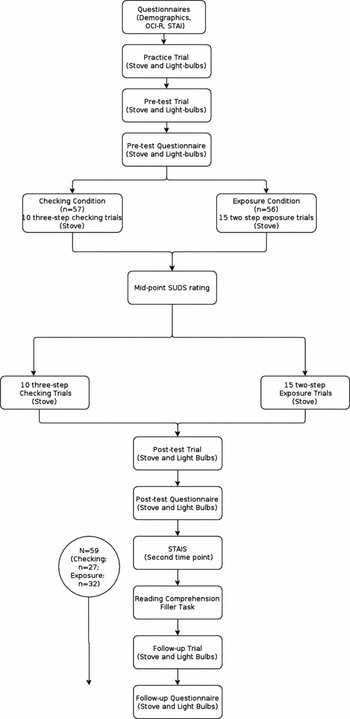
The study was approved by the University's Human Research Ethics Committee. Participants were tested in small groups (maximum of 10) in sessions of approximately 60 minutes duration. All testing was conducted by the first author. Questionnaires and the Stovetop Task were completed on Dell desktop PCs with 15- inch monitors. Screen resolution was 1280 × 1024 pixels. An overview of the procedure is presented in Figure 1.
Overview of procedure.

After giving informed consent, participants were seated at non-adjacent computers. Participants first completed the questionnaires in the following order: Demographics, STAIS-S, STAI-T, and OCI-R. All questionnaires were completed on computer using Limesurvey, a web-based survey administration tool. Participants were then directed, via instructions on the computer screen, to begin the Stovetop Task. All instructions for this task were presented in written form on the screen. After reading the initial instructions, participants completed a practice trial with both the stove and the lights, in which they were asked to turn on and off each of the six gas-rings and light-bulbs. The pre-test trial was then completed. All participants were first shown, for 4 seconds, a schematic diagram of the stove, showing in orange those gas-rings they were to turn on. Following this, participants in the checking condition were instructed to turn on, turn off and then check the stove, while participants in the exposure condition were instructed to turn the stove on and then off. This was also completed with the lights. The order in which the stove and lights were presented was counterbalanced.
Having completed one trial with each of the stove and lights, participants completed the Memory and Meta-memory Questionnaire for both stimuli, followed by the SUDS. The order in which the questions for each stimulus were presented was counterbalanced, to avoid potential recency effects. Participants then returned to the Stovetop Task. Those in the checking condition completed 20 trials as described above. Participants in the exposure condition turned the stove on and off 30 rather than 20 times, to ensure the number of times the stimulus was viewed was the same in each condition. After 10 trials in the checking condition, and 15 in the exposure condition (the mid-point), participants again completed the SUDS. The post-test questionnaire was completed after 20 and 30 trials respectively, and the order of the questions pertaining to the stove and to the lights was again counterbalanced. SUDS ratings again followed.
With the last 59 participants (16 male) assessed, a follow-up trial was also completed, after a delay in which participants did not use or check the stove. After submitting the post-test questionnaire, participants again completed the STAI-S, and were then presented with a reading-comprehension task, on Limesurvey. Participants read two short passages of fictional prose, and answered comprehension questions for each. This task took approximately 8 minutes. Participants then completed a final trial identical to the pre- and post-test trials with both the stove and the lights, followed by the items assessing memory accuracy and confidence. Stimuli and questions pertaining to each were again counterbalanced.
Results
Preliminary Tests of Group Equivalence
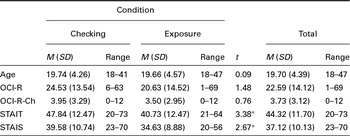
There were no significant differences between groups in age (p = .93), or gender (χ2 = 1.72, p = .19). An independent samples t test revealed no significant differences between conditions in OCD symptoms, t(111) = 1.48, p = .14, or checking symptoms, t(111) = 0.76, p = .45. However, significant pre-test differences between conditions were found on baseline state anxiety, t(111) = 2.67 p = .01 and trait anxiety, t(111) = 3.38, p = .001, with participants in the checking condition scoring higher on both than those in the exposure condition. To determine whether it might be necessary to control for these in the main analyses, a set of correlations between these variables and the DVs were conducted. Baseline state anxiety and trait anxiety were significantly correlated with most DVs. These variables were therefore included as covariates in all main analyses.
Demographic information, means and standard deviations for the initial questionnaires, and results of independent samples t tests are presented in Table 1.
Descriptive Statistics and Results of Independent Samples t Tests for Age, OCI-R, OCI-R-Ch, STAIT and STAIS by Condition

Note: M = Mean; SD = Standard Deviation; OCI-R = Obsessive Compulsive Inventory Revised; OCI-R-Ch = Checking subscale of the Obsessive Compulsive Inventory – Revised; STAIT = State Trait Anxiety Inventory (Trait version); STAIS = State Trait Anxiety Inventory (State version); *Significant at p < .05.
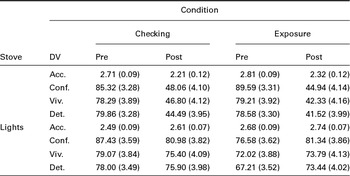
The groups were also compared for any differences in pre-test memory accuracy, confidence, vividness and detail for the stove and lights. No significant differences were found. Covariate-adjusted means and standard errors for all DVs at pre and post-test across conditions and stimuli are presented in Table 2.
Covariate-Adjusted Means and Standard Errors for Dependent Measures Across Pre- and Post-Test for Stove and Light Stimuli

Note: Acc. = Accuracy; Conf. = Confidence; Viv. = Vividness; Det. = Detail.
Reliability for all scales, and for the checking subscale of the OCI-R, was high. For the OCI-R, Cronbach's alpha for the total scale was .92, and for the checking subscale was .84. For the STAI-T and STAI-S alphas were .93 and .92 respectively.
Main Analyses
To examine the impact of repeated trials, a series of 2 × (2) × (2) mixed ANCOVAs were conducted with stimulus type (stove vs. lights) and time point (pre vs. post) as the repeated measures IVs and condition (checking vs. exposure) as the between subjects IV. Checking symptoms, baseline state anxiety and trait anxiety, were included as covariates. The DVs were memory accuracy, confidence, vividness and detail.
Impact of Repeated Trials on Memory Accuracy
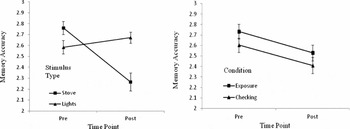
The main effect of stimulus type was not significant, F(1, 108) = 3.66, p = .06. However, as can be seen in Figure 2, after controlling for baseline state anxiety, trait anxiety and checking symptoms, a significant decrease in memory accuracy occurred from pre to post-test, F(1, 108) = 8.69, p = .004, partial η2 = .074, which was significantly greater for the stove than for the lights, F(1, 108) = 25.34, p < .001, partial η2 = .19. Consistent with expectation, no significant difference between conditions in the decrease in accuracy between pre and post-test was found, F(1, 108) = 0.02, p = .89, as displayed in Figure 2.
Memory accuracy across pre- and post-test for the stove, lights and checking and exposure conditions.

Impact of Repeated Trials on Memory Confidence, Vividness and Detail
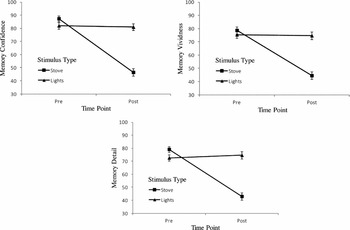
Averaged across conditions and time points, and accounting for the covariates, confidence was significantly lower for the stove than for the lights, F(1, 108) = 42.55, p < .001, partial η2 = .28. This was also the case for vividness, F(1, 108) = 36.32, p < .001, partial η2 = .25, and detail, F(1, 108) = 38.12, p < .001, partial η2 = .26. Significant decreases in confidence, F(1, 108) = 67.82, p < .001, partial η2 = .39, vividness, F(1, 108) = 49.38, p < .001, partial η2 = .31, and detail, F(1, 108) = 57.00, p < .001, partial η2 = .35, from pre- to post-test were observed, and these decreases were significantly more pronounced for the stove than the lights, F(1, 108) = 109.15, p < .001, partial η2 = .50; F(1, 108) = 63.64, p < .001, partial η2 = .37; F(1, 108) = 98.26, p < .001, partial η2 = .48 for confidence, vividness and detail respectively). This is presented in Figure 3.
Memory confidence, vividness and detail across pre- and post-test for the stove and lights.

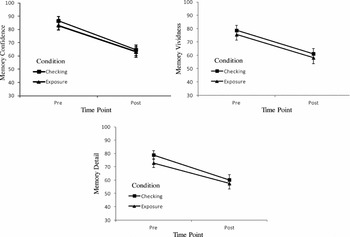
For memory confidence, a significant three-way interaction between stimulus type, time point and condition was observed (F(1, 108) = 5.31, p = .023, partial η2 = .05), such that the difference between stimuli in the confidence decrease from pre-test to post-test was significantly greater in the exposure than in the checking condition. The main effect of condition was non-significant for confidence (F(1, 108) = 0.44, p = .51) vividness (F(1, 108) = 0.58, p = .45), and detail (F(1, 108) = 1.32, p = .25). Further, no significant interaction between time point and condition was found for memory confidence (F(1, 108) = 0.13, p = .72), vividness (F(1, 108) = 0.00, p = .99) or detail (F(1, 108) = 0.49, p = .49), as presented in Figure 4.
Memory confidence, vividness and detail across pre- and post-test for the checking and exposure conditions.

Impact of Repeated Trials on State Anxiety
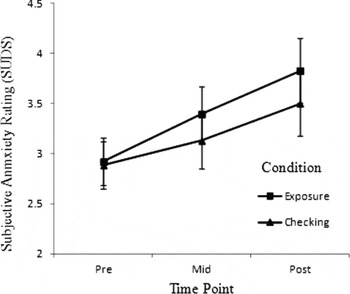
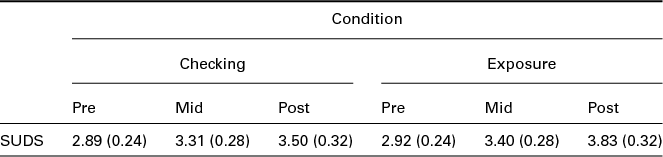
A 2 × (3) × (2) mixed ANCOVA was employed with stimulus type (stove vs. lights) and time point (pre vs. mid vs. post) as the repeated measures IVs and condition (checking vs. exposure) as the between subjects IV. The DV was SUDS rating. This was supplemented by a 2 × (2) × (2) mixed ANCOVA with stimulus type (stove vs. lights) and time point (pre vs. post) as repeated measures IVs, condition (checking vs. exposure) as the between subjects IV, and STAI-S score as the DV. Consistent with prediction, a significant linear increase in SUDS ratings from pre- to post-test, F(1, 108) = 13.19, p < .001, partial η2 = .11, was found, as shown in Figure 5. Also consistent with prediction, the increase in anxiety from pre-test to post-test did not differ significantly according to condition, F(1, 108) = 0.44, p = .509. Additionally, a significant increase in STAI-S scores from pre to post-test, MD = 4.69, F(1, 54) = 19.13, p < .001 partial η2 = .26, was found.
SUDS ratings across pre- and post-test for the checking and exposure conditions.

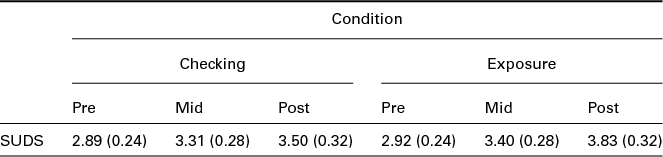
Covariate-adjusted means and standard errors for SUDS ratings are presented in Table 3.
Covariate-Adjusted Means and Standard Errors for SUDS Ratings Across Pre-, Mid- and Post-Test.
Impact of Checking Hiatus on Memory Confidence
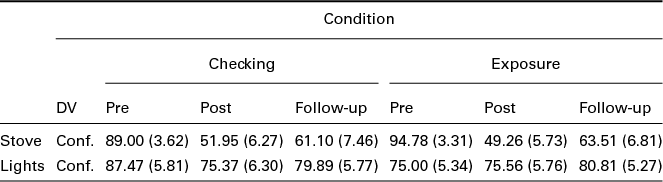
Two mixed ANCOVAS were used, with stimulus type (stove vs. lights) and time point (pre vs. post vs. follow-up) as the repeated measures IVs and condition (checking vs. exposure) as the between subjects IV. The DV was memory confidence. Checking symptoms, baseline state anxiety and trait anxiety were again included as covariates.
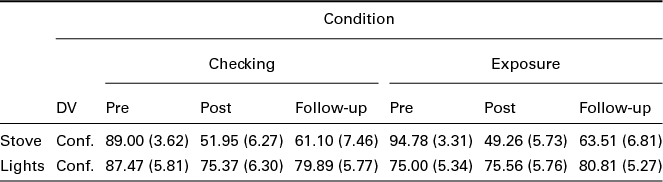
As planned contrasts addressing this hypothesis were not orthogonal, the Family-Wise Type I error rate was controlled using the Bonferroni correction, adjusting the significance level to p = .025. Covariate-adjusted means and standard errors for the follow-up analyses are presented in Table 4.
Covariate-Adjusted Means and Standard Errors for Memory Confidence Across Pre-Test, Post-Test and Follow-Up — Stove and Lights
Note: Conf. = Confidence.
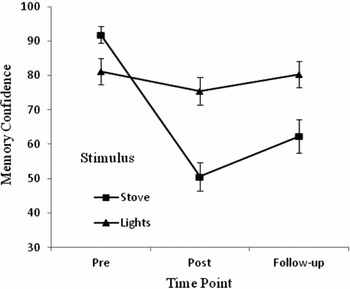
The main effect of stimulus type was significant; confidence was significantly lower for the stove than for the lights, F(1, 54) = 13.34, p = .001, partial η2 = .20. Consistent with prediction, memory confidence was significantly lower at follow-up than at pre-test, F(1, 54) = 19.21, p < .001, partial η2 = .26, but was not significantly different between follow-up and post-test, F(1, 54) = 4.77, p = .033. As expected, a significant interaction between time point and stimulus type occurred, such that the reduced confidence at follow-up as compared to pre-test was significantly greater for the stove than the lights, F(1, 54) = 18.83, p > .001, partial η2 = .26, as can be seen from Figure 6. The difference in confidence between pre-test and follow-up and post-test and follow-up was not predicted to differ significantly between conditions. This was supported, F(1, 54) = 0.46, p = .502 and F(1, 54) = 0.13, p = .721 respectively.
Memory confidence across pre-test, post-test and follow-up for the stove and lights.

Discussion
Overview
The present study investigated whether repeated checking leads to reduced memory vividness, detail and confidence. In some studies examining this effect, checking has been operationalised in a way that does not entail participants reviewing the stimulus to ensure its status (Hermans, Martens, De Cort, Pieters, & Eelen, Reference Hermans, Martens, De Cort, Pieters and Eelen2003; Tolin et al., Reference Tolin, Abramowitz, Brigidi, Amir, Street and Foa2001). The findings from those studies have been less consistent than those in which a specific checking step was included. The present study sought to address this inconsistency, and examined whether repeated exposure to a stimulus has the same effect on memory processes as repeated checking of this stimulus. The present study also examined changes in state anxiety with experimentally-induced repeated exposure or repeated checking. Finally, this study examined whether the effects of perseveration persist after a hiatus in stimulus checking or stimulus exposure.
Memory Accuracy
Contrary to expectations, a significant decrease in memory accuracy from pre- to post-test was found. This occurred to a significantly greater degree for the stove stimulus than the light stimulus, suggesting this decrease was a result of repeated checking or repeated exposure. This result is inconsistent with the findings of Tolin et al. (Reference Tolin, Abramowitz, Brigidi, Amir, Street and Foa2001), van den Hout and Kindt (Reference van den Hout and Kindt2003a), Coles, Radomsky, and Horng (Reference Coles, Radomsky and Horng2006) and others, but is consistent with findings reported by Boschen and Vuksanovic (Reference Boschen and Vuksanovic2007), Radomsky et al. (Reference Radomsky, Gilchrist and Dussault2006) and Radomsky and Alcolado (Reference Radomsky and Alcolado2010). Radomsky et al. (Reference Radomsky, Gilchrist and Dussault2006) suggest a decrease in accuracy may occur when more ecologically valid stimuli are employed; that is, a real rather than virtual stove. However, this effect occurred in the present study despite use of the computer-animated Stovetop paradigm. The absence of any significant decrease in memory accuracy in a number of previous studies (e.g., van den Hout & Kindt, Reference van den Hout and Kindt2003a) may have been due to a lack of sufficient power to detect this effect, given the much larger sample size of the current study.
The finding that memory accuracy does decrease with repetition suggests that, although OCD checkers appear not to experience general memory deficits (Macdonald et al., Reference Macdonald, Antony, Macleod and Richter1997), they may experience lower memory accuracy specific to repeatedly checked stimuli or to stimuli they are repeatedly exposed to. This supports evidence suggesting repeated checking may function as a self-perpetuating mechanism. It is unclear from the results of the present study whether this effect occurs by the same mechanism proposed to explain reduced memory confidence and clarity, that is, a shift in processing style, or is consequent of another process, for instance, proactive interference, as suggested by Tallis (Reference Tallis1993).
Memory Confidence, Vividness and Detail
Significant overall declines in confidence, vividness, and detail from pre-test to post-test were found, and these were significantly greater for the stimuli repeatedly checked or used than for the control stimuli. These findings are thus consistent with those of previous research demonstrating that repeated checking leads to reduced memory confidence and memory clarity. The finding of a decrease in memory confidence, vividness and detail when participants repeatedly used the stimulus or repeatedly checked it supports van den Hout and Kindt's (Reference van den Hout and Kindt2003b) suggestion that these effects are the result of increased familiarity with the stimulus, and not due to any uncertainty-inducing effect of being repeatedly required to ensure that the stove was off. The divergence of this finding from those of Tolin et al. (Reference Tolin, Abramowitz, Brigidi, Amir, Street and Foa2001) and Hermans et al. (Reference Hermans, Engelen, Grouwels, Joos, Lemmens and Pieters2008) may be explained by their use of fewer trials, and potentially also their use of actions completed with non-virtual stimuli, which are likely to be less homogenous and thus more distinctive than actions completed using a computer program.
This finding also suggests that low confidence specific to frequently used objects may begin to develop before repeated checking behaviour occurs. For some individuals, this may increase vulnerability to later repeated checking in a stimulus-specific manner. This does not, however, mean that a vulnerability to compulsive checking is likely to occur with any frequently-used object. Other factors, such as degree of perceived threat associated with the stimulus may play an instrumental role in determining whether or not a particular item is the subject of repeated checking.
A significant three-way interaction between stimulus type, time point and condition indicated that the greater decline in confidence for the experimental than for the control stimulus was more marked in the exposure than the checking condition. Although individuals in both conditions viewed the stimulus the same number of times, the number of new combinations of gas-burners manipulated was greater in the exposure condition. This may explain this result. This suggests that the number of new combinations encoded, rather than the number of manipulations of the stimulus, may be important in determining the extent of the effects. Alternatively, since the steps completed by those in the exposure condition were less varied, greater decline in attentional resources allocated to the task may have occurred for these participants, leading to lower confidence in memory. Future research exploring this is required.
State Anxiety
As predicted, a significant increase in state anxiety was found across pre-, mid- and post-test assessments for both conditions. Since participants were required to attempt to accurately recall which burners they had used or checked, it is suggested that reduced memory confidence and clarity may have resulted in increased anxiety as the task proceeded. That is, participants may have experienced the increased distrust in their memory as distressing. Compulsive checking is theorised to be in part an attempt to achieve memory certainty (Rachman, Reference Rachman2002; van den Hout & Kindt, Reference van den Hout and Kindt2003b). The fact that compulsive checking appears to counterproductively reduce memory certainty may account for the finding that the compulsion does not always serve its intended function of reducing the anxiety brought about by obsessions (Roper et al., Reference Roper, Rachman and Hodgson1973).
A number of researchers have questioned the aetiological role of anxiety in OCD (e.g., Hoehn-Saric, McLeod, & Hipsley, Reference Hoehn-Saric, McLeod and Hipsley1995). The findings of the present study appear to be consistent with the notion that OCD checking may not always follow the pattern of temporary anxiety reduction characteristic of other anxiety disorders (Beech, Reference Beech1974; Rachman, Reference Rachman1976). This finding requires replication in a clinical sample. For clinical compulsive checkers, factors other than decreased memory confidence are likely to be involved in the perpetuation of the compulsion. For instance, for these individuals the stimuli involved in checking represent a greater threat, and thus checking may serve to alleviate anxiety, even as it brings about increased uncertainty.
The present research does not allow clear conclusions to be drawn with regard to any causal effect of reduced memory confidence and clarity on anxiety. It is possible that other aspects of the experimental situation may have had an impact on participants’ anxiety levels. As participants were tested in small groups and the tasks were self-timed, some participants may have become anxious about their progress relative to others. While this potential issue was largely addressed by seating participants apart, thus making it difficult to monitor each other's progress, it remains a possible explanation for the findings.
Alternatively, participants may simply have found the repetitive nature of the task, and the uncertainty about when it would end, agitating. A similar response to this type of task was observed by Radomsky et al. (Reference Radomsky, Gilchrist and Dussault2006). Further, it is possible that the observed increase in state anxiety reflects the threat-relevant nature of the stimuli that participants repeatedly viewed. It is notable that both the overall OCI-R and checking subscale scores of the sample were higher than those generally found in non-clinical populations. The mean score for the total scale (22.59) was above the cut-off of 21, which the authors of the scale recommended as optimal for detecting clinical OCD (Foa et al., Reference Foa, Huppert, Leiberg, Langner, Kichic, Hajcak and Salkovskis2002). Both this overall mean and that of the checking subscale (3.73) were higher than those found in other undergraduate samples (Hajcak et al., Reference Hajcak, Huppert, Simons and Foa2004; Roberts & Wilson, Reference Roberts and Wilson2008). The Stovetop Task may thus have been experienced as more anxiety-provoking in the present sample than would generally be expected among undergraduate participants.
Effects of Checking/Exposure after a Delay
As expected, after a delay in checking or use of the stove, memory confidence remained lower than at pre-test, but was not significantly different to memory confidence at post-test assessment. The difference in confidence between pre-test and follow-up was anticipated to be significantly greater for the stove than the lights. These predictions were supported, suggesting that the detrimental effect of repeated checking persists even after a period in which other activities are performed. The central implication of the memory confidence effect is that reduced confidence is likely to be crucial in causing instances of checking to become perseverative. However, studies on the effects of repeated checking so far have been limited in their ability to draw conclusions about the effect of reduced memory confidence on behaviour the next time a particular object is encountered. The finding unique to the present study that memory confidence remains at a reduced level after a delay indicates that the effects of previous checking on confidence may also influence the commencement of new checking episodes. The persistence of reduced memory confidence did not differ significantly between the checking and exposure conditions, suggesting that the effects on confidence of familiarity through repeated use may also generalise to subsequent encounters with the relevant stimulus.
The delay period used in this study was relatively short, and it remains to be established whether low memory confidence persists after a longer delay. It is important to note that confidence did begin to increase between post-test and follow-up, and the difference between these time points approached significance. This suggests confidence may be restored to initial levels after an adequate delay. Just as researchers have explored the threshold at which the negative impact of repeated checking on confidence becomes apparent (Coles et al., Reference Coles, Radomsky and Horng2006), future research should expand on the findings of the present study by examining the temporal boundaries for the persistence of this effect. Establishing these boundaries may be of relevance to the delivery of Exposure and Response Prevention (ERP), since although ERP is highly effective for the majority of individuals (Lindsay, Crino, & Andrews, Reference Lindsay, Crino and Andrews1997), understanding how long an individual may need to refrain from compulsive checking for memory confidence to be restored may assist in enhancing effectiveness for the minority for whom this treatment is not currently successful.
Clinical Implications
The findings of the present study support the use of psycho-education in which the client with OCD checking learns about the counterproductive effects of repeated checking as a way of challenging positive beliefs about compulsive checking being helpful or beneficial. The recently developed treatment for OCD checkers called Danger Ideation Reduction Therapy (Vaccaro, Jones, Menzies, & Clare, Reference Vaccaro, Jones, Menzies and Clare2010), includes a component referred to as ‘the double-checking experiments’ based on the findings of van den Hout and Kindt (Reference van den Hout and Kindt2003b) and others. In this component clients are encouraged to relate evidence from the van den Hout and Kindt (Reference van den Hout and Kindt2003a, Reference van den Hout and Kindt2004) research for the counterproductive effects of perseverative checking to their own checking behaviours (Vaccaro et al., Reference Vaccaro, Jones, Menzies and Clare2010). Information on these effects thus forms a strong foundation for challenging the client's beliefs about checking as a viable strategy for reducing obsessional doubt, and ultimately for motivating behavioural change (Vaccaro et al., Reference Vaccaro, Jones, Menzies and Clare2010).
While Danger Ideation Reduction Therapy for OCD checkers has been shown in an initial pilot study of three cases to be very effective, (Vaccaro et al. (Reference Vaccaro, Jones, Menzies and Clare2010), it should be noted that it is a comprehensive treatment package with six components, and the specific contribution of the double-checking experiments component to the reduction of OCD checking behaviours was not determined. Radomsky, Shafran, Coughtrey, and Rachman (Reference Radomsky, Shafran, Coughtrey and Rachman2010) suggest behavioural experiments in which OCD checking patients are encouraged to compare the effects of one check to the effects of a greater number may be useful. Psycho-education and behavioural experiments demonstrating the counterproductive effects of repeated checking are likely to be valuable strategies for encouraging patients to challenge these beliefs. Presenting patients with experimental evidence that memory distrust is a to-be-expected result of perseveration may also assist in normalising their experiences of uncertainty, thereby addressing unhelpful negative meta-cognitive beliefs about these experiences (e.g., ‘Being uncertain means I am not in control’; van den Hout & Kindt, Reference van den Hout and Kindt2004). Further, the results of the present study suggest that uncertainty as a result of increased familiarity is not specific to repeated checking. This supports the premise that some degree of memory uncertainty is unavoidable, and that addressing how patients respond to this uncertainty is likely to be important in effective treatment.
The current findings demonstrated that repeated stimulus use as well as repeated stimulus checking has a deleterious impact on memory confidence and clarity. As such, they provide evidence suggesting that decreased perceptual processing may be responsible for these effects (van den Hout & Kindt, Reference van den Hout and Kindt2003a, Reference van den Hout and Kindt2003b, Reference van den Hout and Kindt2004). Thus, we agree with Boschen, Wilson, and Farrell, (Reference Boschen, Wilson and Farrell2011) that interventions based on knowledge of this mechanism may be useful. Strategies preventing the shift from perceptual to conceptual processing, such as the use of distinctive stimuli or imagery during checking, appear to be effective in attenuating its impact on memory distrust, potentially thereby reducing the need for further checking (Boschen et al., Reference Boschen, Wilson and Farrell2011; Tallis, Reference Tallis1993).
Strengths and Limitations of the Present Study
The present study employed a larger sample than previous research using the Stovetop Task, thereby affording greater ability to detect effects such as the decline in memory accuracy. The present study also controlled for trait and baseline state anxiety and checking symptoms. This enabled the likely influence of these variables on the DVs to be accounted for. This study also included a novel and important investigation of the temporal persistence of the memory confidence effect and thus of the extent to which it generalises to new encounters with the stimulus. Therefore, there were a number of important strengths to this study.
However, some limitations need to be noted. Despite the relevance of the stimuli to common checking concerns, the virtual nature of the Stovetop paradigm nonetheless limits its ecological validity. Additionally, this study did not assess the role of cognitive variables such as threat, responsibility and intolerance to uncertainty that may have an important influence on the effects of interest (Boschen & Vuksanovic, Reference Boschen and Vuksanovic2007; Radomsky, Rachman, & Hammond, Reference Radomsky and Alcolado2001). An additional potential methodological limitation concerns the nature of the checking and exposure conditions. It is possible that, despite not being instructed to do so, some participants in the exposure condition engaged in some form of checking, for instance, spent time remanipulating the stove knobs before moving on to the next trial. Future research could include an exposure condition in which the program does not allow such remanipulation. It is also important to note that the external validity of ‘repeated use’ in this study was limited, since the stove was used numerous times in close succession, rendering this operationalisation qualitatively dissimilar to day-to-day repeated use. Future research should further investigate the relative contributions of repeated checking and repeated use utilising a more externally valid protocol.
Consistent with the research conducted by Boschen and Vuksanovic (Reference Boschen and Vuksanovic2007), stimulus type was included in the present study as a within subject variable. Although this design maximised efficiency in terms of sample size, the lights did not serve as a control for the impact of perseveration on state anxiety, since all participants either repeatedly checked or repeatedly used the stove. Thus, as noted above, the present study does not offer causal conclusions with regard to this effect. Future research should examine changes in state anxiety during the Stovetop Task using an alternative control. In addition, future studies could include a manipulation of memory confidence, for instance using false feedback (Jennings, Nedeljkovic, & Moulding, Reference Jennings, Nedeljkovic and Moulding2011), to establish whether reduced confidence may have a causal impact on anxiety in the manner tentatively proposed by the current study.
Conclusion
In conclusion, the findings of the current study make an important contribution to the literature exploring memory processes involved in the development and maintenance of OCD checking. Our findings replicated those of previous research showing that repeatedly checking leads to reduced memory confidence, vividness and detail and demonstrated that these effects do not pertain to any specific property of repeated checking, but in fact occur to an equal degree with repeated stimulus use. The present research indicated that repeated checking may also fail to effectively serve its intended anxiolytic function, compounding its counterproductive nature. Finally, this study revealed that reduced memory confidence as a result of repeated checking, or repeated use, persists after a delay but shows a trend toward recovery. Further research is required to establish how long after perseveration has terminated its meta memorial impact remains.
Acknowledgements
The authors would like to thank Professor Marcel van den Hout and Mr Theo van Aerts for allowing us to use their ‘Three-Dimensional Checking Task’ software. Thanks also to Dr Mark Boschen for providing English language instructions for the task and Associate Professor Lynne Harris for her helpful comments on this manuscript.