

I. Introduction
The Better Regulation agenda is set up to ensure evidence-based policymaking. To this end the 2021 Better Regulation Guidelines note that Better Regulation “[…] is a way of working that allows political decisions to be prepared in an open and transparent manner, informed by the best available evidence, including via the comprehensive involvement of stakeholders.”Footnote 1 As such, the requirement for regulatory impact assessments (IAs) has become part of the legislative process.Footnote 2 In principle, since 2005 no legislative proposal can be submitted without a regulatory IA,Footnote 3 and since 2016 a positive advice by the RSB is a requirement in order to be able to proceed with the legislative proposal.Footnote 4 The introduction of public consultations as a contribution to evidence-based policymaking and to facilitate decision making also served as a strengthening of the legitimacy of the legislative process.Footnote 5
IAs are subject to Regulatory Scrutiny Board (RSB) opinions, which have consistently been critical.Footnote 6 Among the frequent criticisms has been the lack of evidence to support policy choices, lack of clarity on whether new legislation is in fact needed, or whether the proposed policy option would lead to improvement.Footnote 7 Additionally, Alemanno notes that an increasing number of proposals are not accompanied by regulatory IAs.Footnote 8 And Garben notes that the feedback gathered from public consultations is assessed behind closed doors with no apparent transparency of how such input affected further decision-making.Footnote 9 Furthermore, whilst a positive decision of the RSB is a requirement, it can be pushed aside by the “head of the Better Regulation Office,” as is shown in the case of CS3D.Footnote 10
These criticisms are particularly evident in the case of the two directives that are central to this paper: the Corporate Sustainability Reporting Directive (CSRD) and the Corporate Sustainability Due Diligence Directive (CS3D). The CSRD is a further iteration of the Non-Financial Reporting Directive (NFRD) and introduces more detailed reporting requirements for companies on a wide variety of sustainability related aspects, but also includes a requirement to publish a climate-plan to bring the business in line with net-zero. The CS3D introduces, amongst others, a value chain-related due diligence requirement for companies. The CS3D essentially complements the reporting requirements for CSRD in the sense that it not only provides further information for disclosure, but also requires companies to undertake action when it identifies issues in the value chain, such as human rights violations committed as part of the company’s value chain.
Of these two directives, CS3D proved particularly contentious as it was unable to secure a positive RSB opinion.Footnote 11 Whilst NGOs sought even more stringent legislation with a view to accountability, companies worried about regulatory burden and the impact on competitiveness, and sought a “light touch” to the proposed regulatory responsibilities. The Commission argued that the proposals would level the playing field and foster competitiveness and pushed through, but failed to account for the feedback gathered in consultations and feedback rounds as is shown in the analysis below. Yet not two years later, with CSRD and with CS3D not even (fully) implemented yet, the (potential) regulatory burden and costs associated with these proposals were deemed to be so strenuous that it was argued that it affected the competitiveness of European companies.
With the introduction of Omnibus I, the Commission reversed on the argumentation used in CSRD and CS3D, citing urgency and competitiveness concerns to set aside the regular legislative process such as the execution of public consultation and feedback, the performance of an IA and consequent RSB opinion. This despite the fact that Omnibus I introduced quite substantial changes. For example, amongst the proposed amendments are delayed implementation for certain stakeholders, as well as simplification of reporting and the exclusion of a significant portion of the originally scoped stakeholders.Footnote 12 This raises the question of how the input gathered during the consultations was considered, if shortly after the introduction of this legislation it apparently proved wrong.
This paper seeks to provide insight into the feedback given during the legislative process, both from the perspective of the main stakeholders and from the gatekeeper of the Better Regulation agenda, the Regulatory Scrutiny Board (RSB). This article contributes to the debate on the future and relevance of Better Regulation by advocating for a reinvigoration of the Better Regulation process with a clear emphasis on evidence-based policymaking. In this context, greater transparency in the motivation behind policy choices is suggested, in order to safeguard the continued legitimacy of European lawmaking.
II. Research question
Citing competitiveness and urgency, the Commission built a case for the need for the Omnibus I proposal whilst bypassing procedural steps typically associated with the presentation of a new proposal. The steps the Commission referred to specifically related to the execution of IAs, gathering feedback of stakeholders and the subsequent assessment by the RSB. This argument suggests that current circumstances could not reasonably have been foreseen. Specifically, the competitiveness issues said to be related to CSRD and CS3D were new.
The assumption underlying this paper is that some of the stakeholder feedback for CSRD and CS3D raised the issues used by the Commission to provide a basis for Omnibus I early on in the respective legislative processes. The further assumption is that during the respective legislative processes, the stakeholder feedback would have received acknowledgment and an explanation of how this feedback found its way into CSRD and CS3D through IAs. By not performing IAs, and by not addressing the earlier feedback from CSRD and CS3D, the legitimacy of both the CSRD/CS3D process and Omnibus I may be called into question.
The main question this paper therefore asks is: does feedback gathered for CSRD and CS3D support or undermine the urgency argument used by the Commission and does this affect the legitimacy of Omnibus I? In order to answer this question, the paper analyses the feedback from the legislative procedures of CSRD and CS3D, examining whether the stakeholder concerns show a trend over time and whether the concerns raised by the RSB are reflected in the argumentation used to justify the Omnibus I.
III. Theoretical framework
The principle of legitimacy is the idea that institutions not only have power, but also have the authority to exercise that power and have their decisions accepted by those affected, regardless of whether they agree.Footnote 13 Among the approaches to legislative legitimacy, two are of particular interest to this paper. The first is input legitimacy, where legitimacy is derived from representation. Addressees of legislation feel adequately represented and heard and thus accept legitimacy of legislation.Footnote 14 The second is output legitimacy, where addressees of legislation consider the outcome (legislation) to serve common interests.Footnote 15 However, both these approaches overlook what happens between the input and output (procedure). Transparency of procedure allows insight into decision-making, and for addressees of legislation to value procedural fairness of the outcome. This is known as throughput legitimacy. Throughput legitimacy is the question of how, and on what basis, decision-making took place that led to legislation and does it meet the requirements of efficacy, accountability, transparency, inclusiveness and openness.Footnote 16
IAs have been presented as a conduit to allow evidence-based policymaking. Footnote 17 Evidence-based relates to the gathering of empirical information that supports assumptions and allows for informed decision-making.Footnote 18 In this context, IAs are suggested to provide a foundation and evidential underpinning for the considerations leading to the choice of policy options.Footnote 19 However, within the context of Better Regulation, it is unclear how evidence should be defined, who delivers it and what its status is. For instance, stakeholder input (consultations) is presented as evidence, yet stakeholder input may lack objective criteria as they typically tend to represent specific stakeholder interests. Rather, this approach may be viewed to provide input legitimacy rather than serve as actual evidence, as this input may be used to provide a basis for decisions that have essentially already been taken.Footnote 20 Similarly, suggesting that the choice for a specific policy-outcome is linked to evidence in the IA implies a claim to output legitimacy, despite the opaque nature of such evidence making this hard to verify.Footnote 21
Both input and output in IAs are arguably only part of the equation when it comes to evidence-based policymaking. Great input does not automatically result in great output, and vice versa. If the process fails to explain how input was used, evidence has been gathered and appreciated, and thus how the output then becomes the logical result, then throughput legitimacy is compromised.Footnote 22 The middle part, i.e., the assessment and qualification of gathered information and evidence, provides a basis for the output and ties input and output together. Without this, input and output could arguably be considered disconnected – like two silos rather than a single structure.Footnote 23
As noted above, evidence-based policymaking relies on information and evidence. Consultations are considered to be one of those sources for IAs. The current approach to consultations in European legislative procedures was introduced as part of Better Regulation. The Commission stated as its ambition to create a consultation process that would counteract bias by promoting openness, transparency, participation and involvement of – inter alia – civil society.Footnote 24 There are various types of consultation practices, including online consultations, stakeholder conferences and restricted fora.Footnote 25 The online consultations are arguably most accessible, as they are typically open to all those interested, whereas the criteria for participation in stakeholder conferences and restricted fora are more opaque, limiting participation to those invited, thereby reducing inclusiveness. However, these consultations have been noted to be perceived as form over substance, predominantly serving to provide input legitimacy.Footnote 26 In this context Bunea and Thomson argue that due to the large and diverse nature of open consultations, the results may be used as bargaining chips by the Commission, using the outcome as legitimisation for choices made.Footnote 27 However, how or if this information is in fact used is rarely explained, suggesting a failure on transparency.
Meanwhile, Binderkrantz et al. note that, particularly in the context of public consultations, most information gathered comes from the stakeholders or sectors that are affected by the proposed legislation.Footnote 28 The Commission presents this as inclusive, yet in practice it may not be. How stakeholders are valued is arguably dependent on the legislative objective of the Commission, and consequently so is who gets heard.Footnote 29
With the opacity of how IAs use gathered information towards the output of the choice of a policy option, and similar opacity in the use and qualification of gathered consultation input, the process of evidence-based policymaking may be perceived as a black box. With the throughput link between input and output missing, a basis may be created for calling into question the legitimacy of the resulting legislation.
IV. Methodology and analytical framework
Through document analysis of consultation input, IAs, and Regulatory Scrutiny Board (RSB) opinions, the procedures surrounding CSRD, CS3D and Omnibus are reconstructed and evaluated. As such, this article analyses what input has been provided as part of the pre-legislative and legislative consultations and how this input was accounted for in the IAs of CSRD and CS3D as well as what arrangements were put in place vis-à-vis evaluation. Whilst Omnibus I is more than just CSRD and CS3D, this legislation is the one that has generated most participation and feedback, and it is mentioned as being an important source vis-à-vis regulatory burden and competitiveness impact.Footnote 30 This is why this paper will focus on this legislation exclusively.
This has been done by compiling all relevant feedback documents for the inception IAs and proposal feedback assessments for CSRD and CS3D and extracting all stakeholder data and concerns for each document. Subsequently, the output for each feedback package has been analysed in order to identify most recurring concerns per stakeholder group, as well as an analysis of which issues most clearly hold opposing views between stakeholders. In addition, the relevant IAs and RSB opinions were analysed to review the appreciation of stakeholder feedback and the consequent criticism vis-à-vis substance and process of the relevant legislative process by the RSB.Footnote 31
Next, an analysis of the assumptions for Omnibus (through the report on “The Future of European Competitiveness,” also known as the “Draghi report,”Footnote 32 and Omnibus documentation) was performed, in particular which steps and substantive motivation were used to skip procedural steps and requirements as set out by the Better Regulation Guidelines. The analysis involves the review of the feedback and consultation outputs of CSRD and CS3D per stakeholder group, the result of which are compared to the considerations by the Commission to introduce Omnibus I and its urgency motivation.
V. Analysis
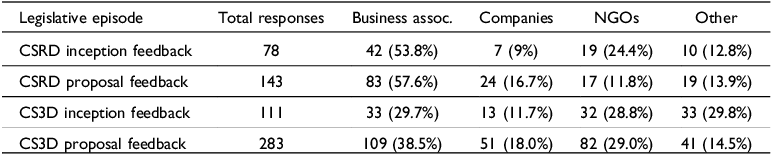
Table 1 shows stakeholder participation throughout the feedback procedures for CSRD and CS3D, with a further specification per main stakeholder group for these procedures. What becomes clear from this table is that the combination of business association and companies are generally the most dominant participants in these feedback procedures, with NGOs following closely, albeit to a varying degree across the legislative episodes. The “Other” category includes public authorities, academic and research institutions, trade unions and individual citizens.
The analysis below examines what concerns these stakeholder groups raised across the respective feedback procedures, and the extent to which those concerns were subsequently acknowledged and addressed in the IAs and policy choices that followed. The concern categories used in Tables 2–5 are derived from the feedback data by the author and are not Commission-defined labels.
Feedback procedure response rate.

Table 1. Long description
A table comparing stakeholder responses during legislative episodes. The table has four rows and five columns. Column headers are Legislative episode, Total responses, Business assoc., Companies, NGOs, and Other. Row labels are CSRD inception feedback, CSRD proposal feedback, CS3D inception feedback, and CS3D proposal feedback. Row 1: CSRD inception feedback, 78, 42 (53.8 percent), 7 (9 percent), 19 (24.4 percent), 10 (12.8 percent). Row 2: CSRD proposal feedback, 143, 83 (57.6 percent), 24 (16.7 percent), 17 (11.8 percent), 19 (13.9 percent). Row 3: CS3D inception feedback, 111, 33 (29.7 percent), 13 (11.7 percent), 32 (28.8 percent), 33 (29.8 percent). Row 4: CS3D proposal feedback, 283, 109 (38.5 percent), 51 (18.0 percent), 82 (29.0 percent), 41 (14.5 percent).
1. CSRD
a. Analysis of inception impact assessment and public consultation
The feedback and consultation approach for CSRD is part of the consultation strategy on the review of the NFRD.Footnote 33 The commitment by the European Commission to review the NFRD was part of the European Green Deal.Footnote 34 In the Green Deal, it was argued that companies were generally too focussed on short-term (financial) benefits. At the same time they provided too little information to, e.g., investors on sustainability data, such as climate and environmental impact data, to allow investors to assess the impact of a company.Footnote 35 To initiate this review, an inception impact assessment was published.Footnote 36
The inception IA provided a first outline of identified problems, amongst them were insufficient availability of non-financial sustainability information and the costs companies incurred in reporting this information. It was argued that these problems were the result of regulatory and market failures.Footnote 37 The inception IA provided an overview of policy options that could be considered, including an assessment of these policy options.Footnote 38 The inception IA noted – inter alia – that the initiative to revise the NFRD had the potential to increase costs for companies due to more detailed reporting, as well as a potential increase of burden on SMEs. Simultaneously, it noted that the initiative had the potential of levelling the playing field, e.g., by standardising reporting.Footnote 39 It is notable that the evidence for these assumptions was not available, as the supporting studies had yet to be conducted.Footnote 40
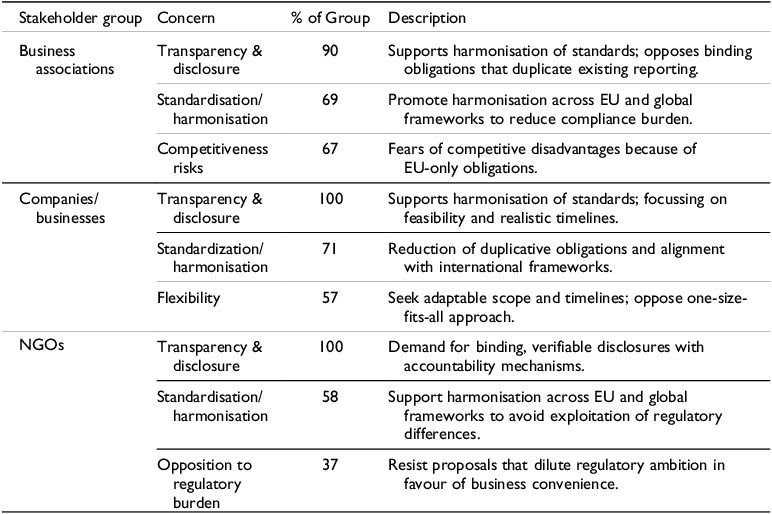
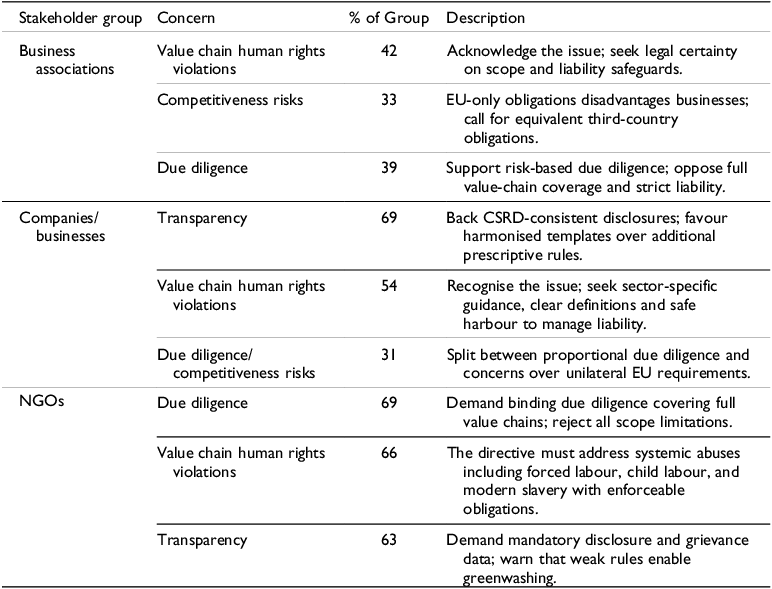
The inception IA was accompanied with an opportunity for public feedback. The main concerns raised are set out in Table 2. The “Concerns” are a short and general case-specific description of the concern, whereas the “Description” provides a more specific description thereof for that relevant stakeholder group.
Top concerns by stakeholder group CSRD inception impact assessment.

Table 2. Long description
A table comparing concerns of stakeholder groups regarding CSRD inception impact assessment. The table has four rows and five columns. Column headers are Stakeholder group, Concern, % of Group, and Description. Row labels include Business associations, Companies/businesses, and NGOs. Row 1: Stakeholder group, Business associations; Concern, Transparency & disclosure; % of Group, 90 percent; Description, Supports harmonisation of standards; opposes binding obligations that duplicate existing reporting. Row 2: Concern, Standardisation/harmonisation; % of Group, 69 percent; Description, Promote harmonisation across EU and global frameworks to reduce compliance burden. Row 3: Concern, Competitiveness risks; % of Group, 67 percent; Description, Fears of competitive disadvantages because of EU-only obligations. Row 4: Stakeholder group, Companies/businesses; Concern, Transparency & disclosure; % of Group, 100 percent; Description, Supports harmonisation of standards; focussing on feasibility and realistic timelines. Row 5: Concern, Standardization/harmonisation; % of Group, 71 percent; Description, Reduction of duplicative obligations and alignment with international frameworks. Row 6: Concern, Flexibility; % of Group, 57 percent; Description, Seek adaptable scope and timelines; oppose one-size-fits-all approach. Row 7: Stakeholder group, NGOs; Concern, Transparency & disclosure; % of Group, 100 percent; Description, Demand for binding, verifiable disclosures with accountability mechanisms. Row 8: Concern, Standardisation/harmonisation; % of Group, 58 percent; Description, Support harmonisation across EU and global frameworks to avoid exploitation of regulatory differences. Row 9: Concern, Opposition to regulatory burden; % of Group, 37 percent; Description, Resist proposals that dilute regulatory ambition in favour of business convenience.
Whilst the inception IA consultation window was still open, the public consultation was launched, which produced 588 responses. The consultation focussed, e.g., on the scope and quality of disclosures, simplification or standardisation, materiality and assurance.Footnote 41 The consultation allowed participants to provide additional background information, but what was done with this information is unclear.Footnote 42
The public consultation showed strong support by NGOs for mandatory reporting and standards for all companies (regardless of size) and the introduction of double materiality,Footnote 43 whereas business associations and companies favoured a limited scope vis-à-vis applicable companies and advocated flexibility in reporting, building on existing standards and frameworks.Footnote 44 The feedback from public consultation was consistent with the concerns raised by stakeholders on the feedback to the inception IA.
b. Impact assessment and proposal feedback
The CSRD IA contained no substantive reference to the results of the inception IA feedback and public consultation, nor did it explain whether or how these results impacted, e.g., the choice of policy options.Footnote 45 The IA did contain Annex 2, which outlined the results of the inception IA feedback and public consultation, which provided a short explanation of how this information was used for the legislative proposal, but did not explain if or how the input was weighed vis-à-vis the considered policy options.Footnote 46 This is despite the fact that, according to the Better Regulation Guidelines, stakeholder views are a source of evidence that inform the conclusions, and notably where differences between the conclusions of the IA and stakeholder views require explanation.Footnote 47 Consequently, the process fails to meet the transparency and accountability criteria of throughput legitimacy, with consultation being present but no explanation how it connects to the policy choice. The process essentially remains a black box.Footnote 48
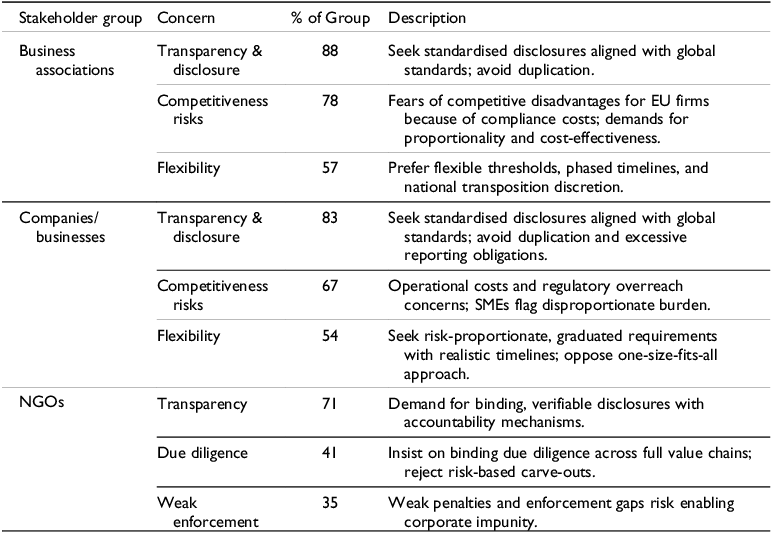
The feedback round that accompanies IAs is essentially a public consultation on the legislative proposal. Arguably, it provides insight into the perception of stakeholders how much of their comments provided in the previous feedback and consultation rounds have been addressed to their satisfaction. As such, it can be argued that if stakeholders are consistent in their feedback, this may be an indication that their input has not been fully addressed. The main concerns raised by the stakeholders are set out in Table 3. The analysis shows that most of the business associations and companies did not necessarily object to the proposed legislation, but concerns about the execution of the proposed legislation and its possible impact persisted. The concerns vis-à-vis transparency and competitiveness compared to the inception feedback results increased substantially. Considering the persistence of concerns in the proposal feedback, it can be asserted that the concerns raised in the inception IA feedback and public consultation were not addressed as stakeholders may have expected. As the regulatory IA did not address these concerns, it is unclear how, if at all, this feedback was taken into account for the choice of policy options.
Top concerns by stakeholder group CSRD impact assessment.

Table 3. Long description
A table comparing the top concerns of different stakeholder groups regarding the CSRD impact assessment. The table has four columns: Stakeholder group, Concern, % of Group, and Description. It has three rows for each stakeholder group: Business associations, Companies/businesses, and NGOs. Row 1: Stakeholder group, Concern, % of Group, Description. Row 2: Business associations, Transparency & disclosure, 88.0, Seek standardized disclosures aligned with global standards; avoid duplication. Row 3: Business associations, Competitiveness risks, 78.3, Fears of competitive disadvantages for EU firms because of compliance costs; demands for proportionality and cost-effectiveness. Row 4: Business associations, Flexibility, 56.6, Prefer flexible thresholds, phased timelines, and national transposition discretion. Row 5: Companies/businesses, Transparency & disclosure, 83.3, Seek standardized disclosures aligned with global standards; avoid duplication and excessive reporting obligations. Row 6: Companies/businesses, Competitiveness risks, 66.7, Operational costs and regulatory overreach concerns; SMEs flag disproportionate burden. Row 7: Companies/businesses, Flexibility, 54.2, Seek risk-proportionate, graduated requirements with realistic timelines; oppose one-size-fits-all approach. Row 8: NGOs, Transparency, 70.6, Demand for binding, verifiable disclosures with accountability mechanisms. Row 9: NGOs, Due diligence, 41.2, Insist on binding due diligence across full value chains; reject risk-based carve-outs. Row 10: NGOs, Weak enforcement, 35.3, Weak penalties and enforcement gaps risk enabling corporate impunity.
c. CSRD RSB opinionFootnote 49
The role of the RSB is that of quality assurance of – inter alia – draft IA.Footnote 50 Draft IAs must be presented for review according to the Better Regulation Guidelines. In principle comments of the RSB must be addressed as part of the procedure, although resubmittal is not mandatory.Footnote 51 However, if an opinion is negative, the proposal cannot proceed unless the vice-president of Better Regulation decides that it shall proceed regardless.Footnote 52
In the case of the CSRD IA, the RSB provided a “positive with reservations” advice, meaning that the positive advice is conditional on the expectation that certain amendments relating to the more substantive observations will be made. Among the observations made was the fact that the IA insufficiently explained and evidenced the assessment that user (primarily investors and financial market participants) information needs had (significantly) increased.Footnote 53 This observation has to be seen in connection with the process from the beginning of the legislative process. As early as the inception IA, it was asserted that regulatory and market failures allowed for a situation where insufficient information was reported for, e.g., investment firms to make well-informed decisions. The RSB notes that the subsequent policy options are based on this assertion, which it considers is not sufficiently substantiated by supporting evidence. In addition to this it is observed by the RSB that it is unclear how the proposal relates to other, existing, legislation (e.g., the Sustainable Finance Disclosure Regulation and the EU Taxonomy Regulation). The RSB assumed these items would be addressed further along in the legislative process. Yet whether, and if so, how these concerns are addressed is not something that will be subjected to further scrutiny by the RSB, and does not become clear from the legislative process.Footnote 54
2. CS3D
a. Analysis of inception impact assessment and public consultation
The CS3D legislative process started with the inception IA. The CS3D was situated within the Commission’s sustainability agenda, as complementary to CSRD.Footnote 55 The problem driver was the assertion that companies are driven by short-term (financial) incentives at the expense of sustainable outcomes, which were considered to be market failures requiring regulatory adjustment.Footnote 56 The objective was to embed sustainability in corporate governance so as to create legal certainty and a level playing field for companies to identify, assess and mitigate adverse impacts in their value chains.Footnote 57 The inception IA relied on two studies, which are argued to show that stakeholders would see certain economic benefits associated with the introduction of mandatory due diligence whilst associated costs would be deemed limited, although the studies themselves present a more nuanced picture on costs.Footnote 58
The main concerns raised are set out in Table 4. Compared to the CSRD feedback, business associations and companies became much more concerned with the possible competitiveness implications CS3D could have, as well as the liability risks they associated with the potential of greater transparency. In this context, NGOs raised similar concerns, but with opposite considerations. Their concern was rather to ensure maximum transparency with maximum accountability.
Top concerns by stakeholder group CS3D inception impact assessment.

Table 4. Long description
A table comparing concerns of different stakeholder groups. The table has four columns: Stakeholder group, Concern, % of Group, and Description. It has three rows for each stakeholder group: Business associations, Companies/businesses, and NGOs. Row 1: Stakeholder group, Concern, % of Group, Description. Row 2: Business associations, Value chain human rights violations, 42 percent, Acknowledge the issue; seek legal certainty on scope and liability safeguards. Row 3: Business associations, Competitiveness risks, 33 percent, EU-only obligations disadvantages businesses; call for equivalent third-country obligations. Row 4: Business associations, Due diligence, 39 percent, Support risk-based due diligence; oppose full value-chain coverage and strict liability. Row 5: Companies/businesses, Transparency, 69 percent, Back CSRD-consistent disclosures; favour harmonised templates over additional prescriptive rules. Row 6: Companies/businesses, Value chain human rights violations, 54 percent, Recognise the issue; seek sector-specific guidance, clear definitions and safe harbour to manage liability. Row 7: Companies/businesses, Due diligence/competitiveness risks, 31 percent, Split between proportional due diligence and concerns over unilateral EU requirements. Row 8: NGOs, Due diligence, 69 percent, Demand binding due diligence covering full value chains; reject all scope limitations. Row 9: NGOs, Value chain human rights violations, 66 percent, The directive must address systemic abuses including forced labour, child labour, and modern slavery with enforceable obligations. Row 10: NGOs, Transparency, 63 percent, Demand mandatory disclosure and grievance data; warn that weak rules enable greenwashing.
The total number of responses for the CS3D public consultation was 473,461, however a large part of these responses was driven by campaigns (efforts led by, e.g., NGOs collecting signatures on pre-filled questionnaires).Footnote 59 The total response count was largely attributed to NGO campaign submissions, which was condensed to NGO-specific feedback, thus bringing the response rate back to 855 responses.Footnote 60 Despite a comparable questionnaire to the CSRD public consultation and far more respondents (855 vs 588), the summary report was significantly less detailed. It is unclear why there is such a discrepancy in level of detail or transparency. The majority of companies and business associations raised concerns on the potential increase of administrative burden and the considered associated competitive disadvantage.Footnote 61 With respect to due diligence, the summary noted that 48.1% prefers the most ambitious due diligence approach, but from the specification follows that this is not the preferred approach by the majority of business associations or companies.Footnote 62 As with the CSRD public consultation, this consultation also referenced the receipt of 149 position papers.Footnote 63 As with CSRD, it is unclear if, and if so how, these position papers have impacted the results listed or the legislative process in general.
b. CS3D proposal feedback and regulatory impact analysis
The IA re-iterated that sustainability needed reinforcement in corporate governance and management systems, and that companies were deemed insufficiently able to address adverse sustainability effects without legislation.Footnote 64 It was argued that short-term incentives for companies were driving these problems. The short-term objectives of companies were driven by being overly focused on shareholder interest rather than public interest, constituting market failure.Footnote 65 It was argued by the Commission that this legislation would bring further legal certainty for companies, and effectively levelling the playing field, as the proposed legislation would even out the reporting and due diligence obligations amongst parties.Footnote 66
Annex 2 to the IA contains an outline of the outcomes of the feedback and consultation rounds. In this context it was noted that civil society had a different take on what should be done and how the impacts should be appreciated, than companies and business associations which are advocating for legal certainty and the extent to which (and on which) due diligence should be applied, in line with the analysis above.Footnote 67 It is notable that the various stakeholder groups appear consistent in the concerns they voiced, but that the European Commission gives little if any appreciation of these concerns, and does not explain how these concerns were addressed in the regulatory IA. As such, the IA itself however does not provide explanation to what extent the (differing) viewpoints noted in Annex 2 were taken into account in the considerations for the selected policy option.Footnote 68 As with CSRD, from a throughput legitimacy perspective there is a transparency and accountability failure as the Commission acknowledges the divergence of stakeholder views, and is careful to ensure inclusiveness of these stakeholders, but provides no account of how those views were assessed in reaching the chosen policy option.
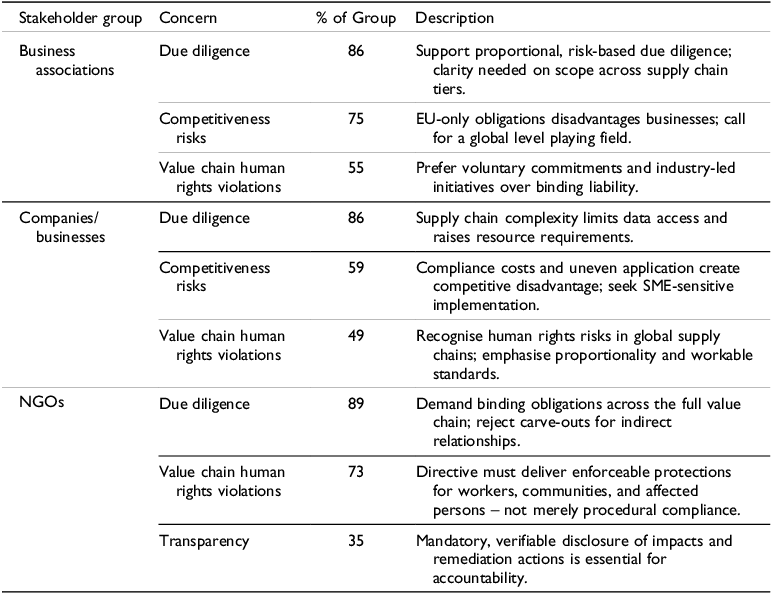
The main concerns raised are set out in Table 5. Table 5 highlights a sharp rise in concerns voiced by business associations and companies vis-à-vis due diligence (citing complexity and costs) and a further push for concerns relating to the impact on competitiveness. The increase in these concerns, accompanied by the increase in stakeholder responses, implies that the legislative proposal had all but addressed these concerns. A similar argument can be made for the concerns voiced by NGOs, showing an increased push for a more rigorous approach.
Top concerns by stakeholder group CS3D impact assessment.

Table 5. Long description
A table comparing the main concerns raised by different stakeholder groups regarding due diligence, competitiveness risks, and human rights violations. The table has four columns: Stakeholder group, Concern, % of Group, and Description. It also has three rows of stakeholder groups: Business associations, Companies/businesses, and NGOs. Row 1: Stakeholder group, Business associations. Row 1: Concern, Due diligence. Row 1: % of Group, 86.2. Row 1: Description, Support proportional, risk-based due diligence; clarity needed on scope across supply chain tiers. Row 2: Concern, Competitiveness risks. Row 2: % of Group, 75.2. Row 2: Description, EU-only obligations disadvantages businesses; call for a global level playing field. Row 3: Concern, Value chain human rights violations. Row 3: % of Group, 55.0. Row 3: Description, Prefer voluntary commitments and industry-led initiatives over binding liability. Row 4: Stakeholder group, Companies/businesses. Row 4: Concern, Due diligence. Row 4: % of Group, 86.3. Row 4: Description, Supply chain complexity limits data access and raises resource requirements. Row 5: Concern, Competitiveness risks. Row 5: % of Group, 58.8. Row 5: Description, Compliance costs and uneven application create competitive disadvantage; seek SME-sensitive implementation. Row 6: Concern, Value chain human rights violations. Row 6: % of Group, 49.0. Row 6: Description, Recognise human rights risks in global supply chains; emphasise proportionality and workable standards. Row 7: Stakeholder group, NGOs. Row 7: Concern, Due diligence. Row 7: % of Group, 89.0. Row 7: Description, Demand binding obligations across the full value chain; reject carve-outs for indirect relationships. Row 8: Concern, Value chain human rights violations. Row 8: % of Group, 73.2. Row 8: Description, Directive must deliver enforceable protections for workers, communities, and affected persons - not merely procedural compliance. Row 9: Concern, Transparency. Row 9: % of Group, 35.4. Row 9: Description, Mandatory, verifiable disclosure of impacts and remediation actions is essential for accountability.
c. CS3D RSB opinion
The RSB issued two consecutive negative opinions.Footnote 69 It cited, amongst others, continued shortcomings in the problem description used as well as insufficient supporting evidence for the motivation used. Furthermore, the RSB noted that the policy options used were too limited and the impacts assessed were not “sufficiently complete, balanced and [assessed in a] neutral way. Uncertainty related to the realisation of benefits is not sufficiently reflected.”Footnote 70 The Commission chose not to provide a new IA, but rather provided a response and an outline of changes to the proposal, noting that the RSB opinions were quality assessment, rather than an appraisal of the legislative proposal.Footnote 71
Whilst this is true in principle, this approach fails to acknowledge the fact that the quality assessment relates to the quality of the process leading up to legislation.Footnote 72 The comments of the RSB vis-à-vis the quality of the problem description and policy options presented (including supporting evidence) suggest that the motivation to continue with legislation may lack verifiable criteria. Note in this context the argument of the vice-president responsible for “better regulation” to continue despite the negative opinions, citing “political importance, the urgency for action, and to address the risk of increasing fragmentation of the single market.”Footnote 73 This decision by the vice-president is not accompanied by substantiation, which compounds the original transparency failure with an accountability failure. The urgency argument is a political argument that is used in lieu of evidence. As such, what exactly the referenced “urgency for action” entails, and how the risk of “increased fragmentation” is evidenced, remains unclear.
VI. Omnibus
1. Draghi report, the Budapest declaration and the Omnibus proposal
The Commission report on “The Future of European Competitiveness” (the “Draghi report”)Footnote 74 suggested that the burden and compliance costs created by CSRD and CS3D were such that they affected competitiveness.Footnote 75 The report raised the complexity and regulatory burden of – inter alia – CSRD and CS3D,Footnote 76 and recommended amongst others further simplification. However, it did not suggest the urgent re-opening up the existing legislation, at least not without proper substantiation.Footnote 77 The report also called for better checks and balances, to ensure no overlap in regulation and unnecessary regulation.Footnote 78 Additionally, the report recommended a 25% reduction in reporting obligations – an initiative originally launched by the Commission in 2023 with limited results to dateFootnote 79 – together with a competitiveness test for all new proposals measuring cumulative compliance costs and administrative burden.Footnote 80 These recommendations were reinforced by the Budapest Declaration, in which EU Heads of State and Government called on the Commission to drastically reduce regulatory and reporting burdens and to make concrete proposals to that effect in the first half of 2025.Footnote 81
In the subsequent Omnibus I proposal, the Commission argued that the geopolitical changes that occurred since 2023 that had caused trade-related tension as well as a change in approach of some jurisdictions to corporate sustainability reporting and due diligence had caused the Commission to reassess the relevant legislation in the context of EU competitiveness.Footnote 82 The Commission noted that “issue of competitiveness is of critical urgency,” which is why it was held that the proposal(s) presented do not allow for an IA, which derogation was granted in accordance with the Better Regulation Guidelines.Footnote 83 The staff working document (SWD) that accompanied the proposal noted, amongst others, that companies were struggling with the lack of level playing field outside the EU.Footnote 84
As a basis for the proposed amendments, the Commission refers to the feedback that was gathered on administrative burden,Footnote 85 which was part of the Call for Evidence on the Rationalisation of reporting requirements.Footnote 86 This 2023 call for evidence was an explicit part of the endeavour of the Commission to reduce administrative burden by 25%.Footnote 87 An analysis of the feedback gathered shows that 62% of the respondents were business associations or companies and 12% of the responses were from public authorities (such as, e.g., supervisory authorities), but less than 9% were NGOs. Interestingly, many of the concerns raised in this consultation were fairly similar to those that were raised in the CSRD and CS3D feedback. Among all feedback gathered, almost 76% of stakeholders raised the issue of competitiveness and costs associated with regulatory burden. Yet aspects like transparency were also among the top concerns, raised by some 43% of stakeholders, and using argumentation much like that seen in CSRD and CS3D, pleading for more cost-effective options with more standardised reporting. The most contentious aspects were – again – the approaches to, e.g., due diligence (business associations and companies pleading for flexibility and NGOs pleading for rigour) and enforcement (light versus strict). In a sense, this feedback was further confirmation of the issues already raised in CSRD and CS3D. It also further confirmed the existing contradictions between stakeholders, specifically between NGOs and business associations and companies. In this feedback, however, NGOs were much less represented than was the case for CSRD and CS3D, calling into question the representativeness of the feedback.Footnote 88
In the context of the Omnibus I process, the Commission refers to round tables that have taken place between the Commission and various stakeholders, which were essentially restricted fora serving as a form of consultation.Footnote 89 Yet who had partaken, how these parties were selected, as well as what the distribution of comments were, remains unclear. The comments raised on this process, as presented by the Commission, show overlap with the concerns historically raised by business association and companies in CSRD and CS3D, but there is little reference to the concerns raised by NGOs.Footnote 90 The representation of NGOs in this process consequently appears limited, which seems to be in line with the Competitiveness agenda, as noted by Avril, suggesting an imbalance of representation of stakeholders in the Omnibus I process.Footnote 91 From a throughput legitimacy perspective, the Omnibus I consultation process fails on inclusiveness, transparency and accountability, as neither the selection criteria for the round tables nor how the gathered input has been used is disclosed.Footnote 92
2. Analysis of Omnibus argumentation
In CSRD and CS3D it was argued that these proposals would ensure level playing field and offer a competitive advantage.Footnote 93 The argumentation used by the Commission in the Omnibus proposal is similar, but the Commission now considered that CSRD and CS3D hampered competitiveness. The Omnibus I argument was directly contradictory to the argumentation used in CSRD and CS3D, without explanation as to how this conclusion was reached. In the framework’s terms, this is the black-box pathology in its most acute form: the input (stakeholder competitiveness concerns, raised consistently since the CSRD inception IA) and the output (Omnibus I’s competitiveness rationale) are present, but the throughput (the account of how that earlier input was assessed, why it was not acted upon at the time, and why it now justifies opposite action) are entirely absent. This is simultaneously a transparency failure and an accountability failure.
In fact, the Omnibus proposal essentially all but ignored arguments used to substantiate CSRD and CS3D on why those proposals were deemed necessary and proportionate.Footnote 94 The initial “selling points” for CSRD and CS3D, such as their contribution to the level playing field or in fact provided competitive advantage, were not only ignored in Omnibus, but implicitly held as incorrect in Omnibus I. For instance, one of the key arguments for CSRD was that enhanced transparency would help users of that information, such as investors, assess sustainability-related risks and improve the allocation of financial resources.Footnote 95 Similar reversals are evident across other stated CSRD and CS3D objectives, including the reduction of systemic risks and the improvement of non-financial risk data, none of which are substantively addressed in the Omnibus I argumentation.
Additionally, it is argued that the changes do not impact the Green Deal, at least not on the long run.Footnote 96 However there is no IA to verify or substantiate this assumption. And as there is no IA, there is no RSB opinion and no evaluation of the evidence base. But more importantly, there is no explanation as to how these assumptions came to be or how they compared to the opposite argumentation that was used in relation to CSRD and CS3D.
Similarly, the push to continue on with CS3D, despite two negative opinions by the RSB on the IA, citing urgency and a risk for fragmentation without substantive supporting evidence, was not mentioned in preparation of Omnibus I.Footnote 97 This is despite the fact that similar argumentation was used for Omnibus I. In both cases, there is no definition or policy basis to test the urgency argument against, as was acknowledged by the Commission following the investigation of the European Ombudsman and its urging of the Commission to define “urgent.”Footnote 98 The Commission recognised these issues and agreed to revise internal rules.Footnote 99
Finally, from the Omnibus Q&A, as well as the Draghi report and the Budapest declaration, a clear shift is noticeable, specifically towards the interests of companies and businesses and to the apparent detriment of civil society.Footnote 100 The considerations that led to this decision were not addressed. Since the weighing of interests for Omnibus I is overtly business oriented, it raises the uneasy question whether, despite the assurances by the Commission, the Green Deal still stands as firmly as suggested.
VII. Long-term effects
The intended reduction in administrative burden for the companies that are subject to the proposed legislation may ease burden on the aforementioned, but the intended simplifications may also create new uncertainties and have unintended consequences. For example, financial institutions may no longer rely on the informational basis for their portfolio reporting that the original CSRD and CS3D provided.Footnote 101 Similarly, the move back towards self-regulated reporting may affect the reliance for users on this data,Footnote 102 and the potential reduction in accountability may put the focus back on short-term return maximisation.Footnote 103 It is argued that the changes brought on by Omnibus I do not in fact bring the simplification that it purports to do and consequently may not necessarily lead to less administrative burden.Footnote 104 Removing the transition plan requirement may save short-term costs, but risks conflicting with other legal obligations and leaves investors and supervisors uncertain as to companies’ long-term preparedness.Footnote 105 There is also debate on whether the exclusion of SMEs from CSRD and CS3D could result in them losing access to funding, considering that even though Omnibus causes a scaling down of legislative obligations, the need for that information from market parties, like financial institutions, may remain nonetheless.Footnote 106
A more problematic consequence may however be the fact that Omnibus I, relying on the argument of urgency and as noted above, provides very limited evidence-based policymaking.Footnote 107 The evidence gathered throughout the CSRD and CS3D procedures, whilst as noted above applied selectively and generally found insufficient by the RSB, has been ignored whilst opposite arguments have been made based on even less evidence. This is a departure from the principles of the Better Regulation Guidelines, and arguably a departure from evidence-based policymaking, at least in the case of the Omnibus I proposal.
In this context, the lack of evidence-based substantiation poses a fundamental question on the position of the Better Regulation Guidelines. Principally, the Better Regulation Guidelines do not prohibit this approach, in the sense that they are internal instructions that guide and facilitate the objective of better regulation, but how this objective is achieved is not set in stone.Footnote 108 Yet, this approach seems contradictory, as the RSB holds the power to prohibit a proposal from going through.Footnote 109 The vice-president responsible for Better Regulation may allow the proposal to go through despite the dual negative opinion, but on what basis or considerations this may be the case does not appear to be subject to any specific conditions, at least not according to the Better Regulation Guidelines or its Toolbox.Footnote 110 As could be seen in the case of CS3D, the argumentation to continue may be quite concise, and subsequently contradicted. From a perspective of keeping in line with the principles of Better Regulation as well as accountability, the absence of a substantive motivation in case of deviation raises questions about arbitrariness, proportionality and the perception of legitimacy.
The consequence of the current process on Omnibus I may be that the impression of civil society is that the business interests currently prevail over any other, without due explanation. This may be enhanced by the fact that NGOs (and others) have participated in all of the feedback processes to partake in their democratic rights, yet these rights are not honoured in this process, and there is no explanation as to what considerations were applied to ignore the original feedback given in both CSRD and CS3D. Furthermore, the absence of an open feedback procedure in the Omnibus I process may raise the question among stakeholders what, if anything, the use of participating in these feedback processes in fact is. A consequence may be that participation in these processes may decline, leading to potential further erosion of perceived legitimacy of legislation among stakeholders.Footnote 111 Some of the responses by NGO-coalitions, academics and the Ombudsman suggest that these risks are not imaginary, but are actually manifesting already.Footnote 112 In fact, more than 362 civil society organisations issued a joint statement urging Parliament and Council to reject the proposed amendments.Footnote 113
VIII. Conclusion
The review of stakeholder feedback for CSRD and CS3D shows consistency in concerns raised by stakeholder groups over time, with business associations and companies raising concerns on proportionality and competitiveness and NGOs consistently pushing for more granular due diligence frameworks. The analysis further shows that these concerns were not only consistent, but that they increased in frequency throughout the procedures. Yet the IAs that were subsequently prepared for CSRD and CS3D provided no substantive feedback on how the concerns raised in the feedback procedures were addressed.
The fact that these concerns not only remained, but increased in intensity, should arguably have resulted in a substantive response. This makes the lack of substantiation of choices made in light of such feedback problematic from a legitimacy perspective. A legislator that does not address the concerns raised in feedback, even if it is just to outline why the legislator went ahead with the legislation in its current form despite such feedback, may lose support and credibility. The transparency and accountability criteria were not met, and the RSB’s evidence-base critiques – including a dual negative opinion for CS3D – were overridden on urgency grounds without substantive justification. This further strains the perceived legitimacy of the choices made.
As a result, the competitiveness argument the Commission relies on for its argued urgency is in fact undermined by the findings on the feedback given throughout the legislative procedures of CSRD and CS3D. This selectivity is notable: where feedback supported the proposed legislation, it was noted in detail, whereas critical feedback received no comparable treatment. This selectivity suggests reasoning backwards from an intended outcome.Footnote 114 Consequently, this also meant that it was unclear whether the proposal could count on support among the various stakeholders (not just companies), but perhaps more importantly, the evidence-based policymaking required, through IAs and evaluations, was omitted. This compounded the already existing legitimacy issues present from the CSRD and CS3D procedures. In this case, the opaque consultation process and its composition constitute an inclusiveness failure. And the transparency and accountability criteria fail on the absence of how the earlier CSRD/CS3D feedback – which had raised the same competitiveness concerns – was reassessed. The result is the black-box failure Schmidt and Wood identify as the core throughput pathology: input and output are both present, but the reasoning connecting them is absent, and in Omnibus I demonstrably contradictory.
A fundamental issue in this context is what exactly is meant by urgency. As noted, the argument used by the Commission was the geopolitical situation that had manifested. Yet during the CS3D legislative procedure the urgency argument was in fact used to push for CS3D despite the negative RSB opinion. This arbitrary use of “urgency” arguably implies that the Commission, by arguing “urgent circumstances,” can and has circumvented legislative procedures intended to ensure fact- and evidence-based policymaking. Such arbitrary application of “urgency” fundamentally affects the perception of legitimate legislation. After all, if the Commission can avoid evidence-based legislative procedures and consultation by arguing an undefined concept of “urgency,” that moreover lacks a basis in policy, it can arguably avoid critical stakeholders and simply push through the desired legislation.
I would argue that using an “urgency” argument must be based on evidence-based criteria set out in policy. These criteria may be linked to, e.g., deteriorating geo-political circumstances or catastrophes, none of which were foreseen but more crucially are expected to have a material impact on the European Union, which again should be on objective evidence-based criteria as part of an IA. In case of Omnibus I, the Commission claimed there was no time for an IA. This may be resolved by allowing more concise, more specific IA, focused on the evidence-base and policy considerations. However, invoking such a situation should be approved by the European Parliament. This should arguably also imply an “urgency-procedure” to be created for putting these situations to the European Parliament, so as to ensure urgency would be maintained throughout the process. Moreover, to ensure continued legitimacy, stakeholder consultations and IAs should always be part of the process, whether in shortened form or shorter timelines, and the input following this process must be part of the policy option considerations. This will allow not only throughput legitimacy throughout the process, but will also provide a basis for evaluation further down the line. The placement of this process, at present, should arguably be in the Interinstitutional Agreement on Better Law-Making,Footnote 115 which would further solidify the role the European Parliament should play in such situations.
Supplementary material
The supplementary material for this article can be found at https://doi.org/10.1017/err.2026.10131
Acknowledgments
The views, thoughts and opinions expressed in the text belong solely to the author.
Competing interests
The author declares none.
AI-use disclosure
Anthropic Claude (Sonnet 4.6 and Opus 4.6, via claude.ai) was used for: (1) data extraction and cross-validation of stakeholder feedback documents (see Methodology); (2) literature identification, including locating academic and institutional sources; (3) structural and editorial feedback, including suggestions for bridging text connecting the theoretical framework to the analysis; and (4) drafting the abstract. All suggested formulations were rewritten by the author. All sources were read and verified by the author. All analysis, argumentation and substantive text is the author’s own.


 Open access

