Introduction
Indigenous cattle are the predominant breeds kept in Tanzania. These indigenous cattle are grouped into distinct breeds/strains such as the humped Tanganyika Shorthorn Zebu (TSZ), Ankole, Tarime and Fipa cattle. These breeds/strains play multiple roles with respect to production environments and farming systems of the country, particularly in the agropastoral and pastoral production systems. Their contribution to household food security and income as well as their socio-cultural roles are well known (Bwire, Mkonyi and Masao, Reference Bwire, Mkonyi and Masao2005).
The Fipa cattle form an important strain kept in the Fipa plateau of Rukwa region in the southwestern highlands of Tanzania. They are also kept in the northeastern part of Zambia where they are named differently. They contribute significantly to the livelihood of the Fipa communities in which crop production is the principal occupation. The Fipa cattle population is estimated at about 269 890 heads (URT, 2010). The animals are said to be well adapted to the local environmental conditions and can survive well in various agro-ecological zones (AEZs) of Rukwa region (Mwakilembe et al., Reference Mwakilembe, Mbwile, Sendalo, Msanga, Murro, Mwambene and Temu2007; URT, 2010). According to Rege and Tawah (Reference Rege and Tawah1999), the Fipa cattle strain is a derivative of Sanga and Small East African Zebu (SEAZ). Similar to other indigenous cattle, the Fipa cattle are considered to have developed through artificial selection in challenging environments in order to suit the socio-economic characteristics and needs of the Fipa community. According to Mwambene et al. (Reference Mwambene, Katule and Chenyambuga2012), the Fipa cattle are the major source of draught power, manure and household income in Rukwa region. They also provide genetic resource materials for research and development in the country.
In Rukwa region, the Fipa cattle are preferred to other indigenous cattle strains because of their perceived draught capability, relatively large size, tasty meat and saleability (Mwambene, Katule and Chenyambuga, in press). They also provide a wide range of other products such as horns, skins and milk, as well as have various cultural functions (dowry, rituals and income) (URT, 2010). The Fipa cattle are also renowned for adaptive traits that enable them to be resilient to seasonal environmental stresses. They subsist on natural pastures, utilize crop residues and have positive environmental effects by being fully integrated into the nutrients recycling for sustainable agriculture (Mwambene, Katule and Chenyambuga, in press). Despite the immigration of other indigenous cattle, particularly Tarime and Ankole in some parts of Rukwa region, Fipa cattle still constitute the majority (>90 percent) of the cattle in the Fipa plateau AEZ where they are preferred to other indigenous cattle (URT, 2010).
Normally, the breeding strategies followed by livestock keepers are as diverse as the agro-environments in which they operate. Their breeding goals are often comprehensive (Köhler-Rollefson, Reference Köhler-Rollefson2000; Bebe et al., Reference Bebe, Udo, Rowlands and Thorpe2003; Roessler et al., Reference Roessler, Drucker, Scarpa, Markemann, Lemke, Thuy and Valle2008) and are mainly driven by the underlying production systems, trait preferences, socio-economic and cultural circumstances (Wollny, Reference Wollny2003; Ouma, Abdulai and Drucker, Reference Ouma, Abdulai and Drucker2007). In order, therefore, to design a viable and sustainable breeding plan, farmers’ preferences for the different traits need to be investigated and incorporated in the plan (Ngowi, Chenyambuga and Gwakisa, Reference Ngowi, Chenyambuga and Gwakisa2008). Investigations of this nature are aimed at determining special qualities of a breed/strain with the ultimate goal of optimizing the utilization of the breed/strain in their natural production systems (Schwartz, Reference Schwartz, Schwarz and Dioli1992; Ouma, Abdulai and Drucker, Reference Ouma, Abdulai and Drucker2007). To date, there is scanty information on the unique qualities of the various cattle strains constituting the indigenous cattle population of Tanzania.
In Rukwa region, the human population is also increasing. This situation has led to the gradual decrease in the grazing rangelands. This, in turn, is threatening the long-term existence of the Fipa cattle population despite their apparent ecological and economic importance to the livelihoods of the Fipa community. Consequently, the identity of Fipa cattle population is likely to disappear before being properly documented owing to admixing and interbreeding with other indigenous cattle. Information on desirable traits, traditional breeding practices, productive and reproductive performance is lacking. The present study was therefore, undertaken to determine Fipa cattle unique qualities, adaptive traits, traditional breeding practices and productive performance under their natural environment as a preliminary step towards the development of a sustainable conservation and improvement strategy of the strain.
Materials and methods
Study area
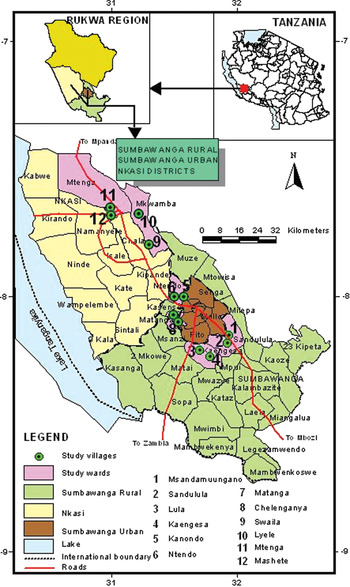
This study was conducted in three districts (Sumbawanga rural, Sumbawanga urban and Nkasi) of Rukwa region, in the southwestern highlands of Tanzania (Figure 1). Geographical location, altitude, AEZs, landscape, production systems, soil types, natural vegetation, farming systems, socio-economic activities and climatic conditions of the study area are described in detail in Mwambene et al. (Reference Mwambene, Katule and Chenyambuga2012).
Map of Tanzania showing the study districts, wards and villages.

Research design
A cross-sectional research approach was used in this study. To obtain desired data, purposive sampling was used to select six wards (two wards per district) and two villages were randomly selected per ward for the study. In each village, 10 households were randomly selected to make a sample size of 120 households, as described in Mwambene et al. (Reference Mwambene, Katule and Chenyambuga2012).
Data collection
A structured questionnaire was used to collect basic data on special attributes, adaptive traits, productive performance and breeding practices of the Fipa cattle, as well as data on preferences of Fipa cattle owners on certain attributes of the strain. Information gathered on the farmers’ preferences of various traits of the Fipa cattle strain included body size, body conformation, body colours, disease and heat/drought tolerance, draught ability, meat taste, milk production, temperament and fertility. The information collected for adaptive qualities included ability to forage, resilience to environmental changes, draught ability and ability to walk for a long distance. Traditional breeding strategies commonly practiced by the Fipa community were also investigated. Information on productive attributes included age at first calving, calving interval, longevity, number of calves in a cow's lifetime, lactation length and daily milk yield at peak and end of lactation. All quantitative data depended on the farmer's memory as they usually did not keep any records. In case of milk yield, a 1 litre jug that was commonly used for measuring out local liquor was used for yield estimations. Data were collected during the onset of the dry season, in the months of June to August in 2010.
Data analysis
Qualitative data from the field survey were coded and analysed using the Statistical Package for Social Sciences (SPSS, 2008) computer software in order to generate frequencies and percentages. The chi-square tests for independence were run to compare proportions of respondents from different districts with respect to particular responses and variables studied. Quantitative data were also analysed using SPSS in order to generate and compare means between districts.
Results
Perceptions of farmers on the trait qualities of Fipa cattle
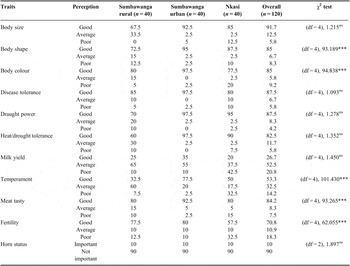
Table 1 shows the perceived evaluation by farmers on various traits of Fipa cattle. The body size, body shape, body colour, draught power, disease and drought tolerance, carcass quality and fertility of Fipa cattle were perceived to be good by most of the respondents, while milk yield and temperament were considered ‘average’ in the Sumbawanga rural district, but not in Nkasi district. The presence or absence of horns was not considered to be an important trait by most of the farmers. The levels of perceptions among the farmers on the trait qualities of the Fipa cattle were almost similar between the study districts, except for body shape, fertility, meat tasty, temperament and body colour.
Proportions (%) of farmers with different perceptions on various Fipa cattle attributes.

Note: N = number of respondents; ***very highly significant (P < 0.001), nsnot significant (P > 0.05).
Fipa cattle traits preferred by Farmers
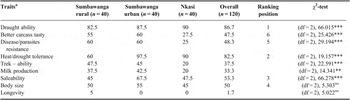
Draught ability, saleability, body size, tolerance to diseases/parasites/drought and tasty meat were the most valued attributes by the farmers. On the other hand, milk yield and longevity were not regarded as important attributes (Table 2). The levels of preference among the respondents on the various traits of the Fipa cattle were different between the study districts, except for body size and longevity. A considerable proportion (53.3 percent) of farmers valued the temperament of Fipa cattle to be good, more in Sumbawanga urban (77.5 percent) than in Sumbawanga rural district (32.5 percent).
Proportion (%) of respondents indicating preference levels for various traits of Fipa cattle.

Note: aData were based on multiple responses; N = number of respondents; ***very highly significant (P < 0.001); **highly significant (P < 0.01); nsnot significant (P > 0.05).
Breeding management strategies of Fipa cattle
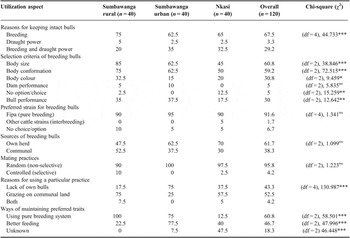
Table 3 shows different approaches pertaining to breeding practices that are employed by the Fipa cattle farmers. Most (67.5 percent) of the farmers reported that they kept intact bulls for mating purpose, while a few (29.2 percent) of them kept intact bulls both for breeding and draught purposes. A considerable proportion (61.7 percent) of the farmers had their own breeding bulls. The remaining (38.3 percent) farmers depended on the other farmers’ bulls for mating their cows particularly in the communal grazing areas. There were more farmers keeping their own breeding bulls in Nkasi (70 percent) and Sumbawanga urban (62.5 percent) districts than in Sumbawanga rural district (47.5 percent). Selection of breeding bulls was reported to be not practised at all. About 60.8 percent of the farmers indicated that if they had to select a bull for breeding, they would base the selection on body size, while 59.2 percent said they would go for body conformation, 30.8 percent for body colour and 30 percent would go for the bull's own performance with respect to growth rate.
Proportion (%) of respondents falling in indicated categories pertaining to utilization of Fipa bulls.

Note: N = number of respondents; ***very highly significant at P < 0.001; **highly significant at P < 0.01; *significant at P < 0.05; nsnot significant at P > 0.05; data on selection of breeding bulls and ways of maintaining preferred attributes were based on multiple responses.
The majority (91.6 percent) of the respondents preferred pure breeding using Fipa bulls for mating. Random (uncontrolled) mating was common in most (95.8 percent) of the Fipa cattle herds. This situation was attributed partly to lack of own breeding bulls (43.3 percent) for some of the households and partly (52.5 percent) because of the communal grazing and watering practices. Interbreeding with other cattle strains was not common in almost all the study districts. The proportions of respondents on the reasons given for keeping breeding bulls and selection criteria for breeding bulls were different between districts, whereas they were similar for bull strain preference, sources of breeding bulls and mating practices.
Table 3 shows also the farmers’ responses with respect to ways of sustaining the preferred traits in Fipa cattle. The preferred traits of Fipa cattle were reported to be retained mainly through pure breeding system (60.8 percent), much more in Sumbawanga urban (100 percent) and Sumbawanga rural (75 percent) than in Nkasi district (12.5 percent). Better feeding was also mentioned to be the way of sustaining the preferred traits by some (46.7 percent) of the farmers, largely in Sumbawanga urban district (77.5 percent). On the other hand, a few (18.3 percent) farmers were not aware of the means for achieving the desirable traits of the Fipa cattle, particularly in Nkasi district (47.5 percent). The difference of proportions of respondents on the strategies reported to be used for maintenance of preferred traits between the study districts was highly statistically significant.
Castration of Fipa bulls
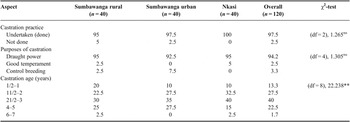
Table 4 summarizes the purposes and ages of castration of the Fipa bulls. The majority (97.5 percent) of respondents reported to castrate their bulls at different ages, mainly (94.2 percent) for attaining better draught animals with good temperament. The purposes for castration of bulls were almost similar across the study districts. Bulls were castrated at varied ages, mostly at the age of 2–4 years.
Proportion (%) of respondents falling in indicated categories pertaining to castration of Fipa male cattle.

Note: N = number of respondents; **highly significant (P < 0.01); nsnot significant (P > 0.05).
Culling of animals
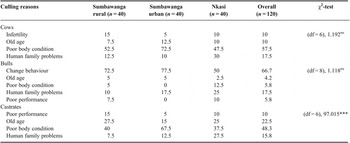
The results further reveal that the decision to retain or dispose of an animal was based mainly on the animal's body condition for cows and castrates, and on changing behaviour (bad temperament or straying) for bulls. Other reasons for culling cows, bulls and castrates are indicated in Table 5. Unlike the castrates, the reasons for culling bulls and cows were almost similar across the study districts.
Proportion (%) of respondents indicating different reasons for culling bulls, cows and castrates.

Note: N = number of respondents; ***very highly significant (P < 0.001); nsnot significant (P > 0.05).
Entry and exit channels of Fipa cattle
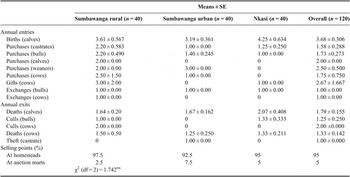
Many farmers reported that they acquired different categories of animals through purchases, births, gifts and exchanges, in that order of significance. On the other hand, different categories of cattle exited from farmers’ herds mainly through culling, deaths and theft. Most (95 percent) of the respondents sold their animals that were culled to private customers at household levels, while very few (5 percent) of them sold at the livestock auction marts. Based on the overall mean of annual births and deaths of calves reported in the study areas, the annual mortality rate for calves was estimated at 1.79/3.68 = 48.6 percent (Table 6).
Means of annual entries and exits of Fipa cattle per household in the last 12 months.

Note: N = number of respondents, SE = standard error of the mean; means along the rows without superscripts are not significant (P > 0.05); nsnot significant (P > 0.05).
Productive performance of Fipa cattle
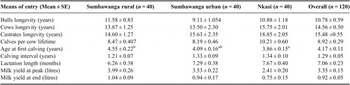
The estimated productive and reproductive performances of Fipa cattle are summarized in Table 7. The overall average age at first calving and calving intervals were about 50 and 15 months, respectively. The Fipa cattle from Nkasi district had significantly (P < 0.05) lower age at first calving than that of the other districts. The average longevity was 10.78 ± 0.59, 14.56 ± 0.50 and 15.5 ± 48 years for bulls, cows and castrates, respectively. The castrates and cows lived relatively longer than bulls. The average lifetime number of calves per cow was 9 and the lactation length was 7.1 months. The average number of calves was relatively larger in Nkasi than in the other districts while the lactation length was relatively shorter in Sumbawanga rural than in the other districts. The results further revealed that the average estimated milk yield at the peak and the end of lactation were 3.35 ± 0.15 and 0.92 ± 0.05 litres, respectively. The average milk yield per day was relatively lower in Nkasi than in the other districts.
Productive and reproductive attributes of Fipa cattle.

Note: N = number of respondents; SE = standard error of mean. Means along the rows without superscripts are not significantly different at P > 0.05.
Discussion
Perceptions of farmers on the trait qualities of Fipa cattle
The favourable impression the farmers had on the Fipa cattle with regard to body size, body conformation, draught power and meat taste implies that the strain is essential to the livelihoods of the Fipa communities. These attributes, coupled with the perceived adaptive traits such as tolerance to diseases, drought/heat, natural pastures and feed shortages, show the suitability of the strain to the Fipa community. The adaptive traits reported for Fipa cattle may also enable the strain to cope with the current global climate change coupled with nutrition fluctuations and shrinkage of grazing rangelands that are now experienced in Rukwa region because of increase in human population and expansion of cropping activities. These findings are consistent with those reported by Mwacharo and Drucker (Reference Mwacharo and Drucker2005) for SEAZ of southeastern Kenya and by Sungael (Reference Sungael2005) for Iringa red cattle in Tanzania.
Fipa cattle traits preferred by farmers
The present study has also revealed that most farmers prefer Fipa cattle to other breeds mainly because of better draught ability, heat/drought tolerance, saleability and large body size. These observations are similar to those reported by Chenyambuga et al. (Reference Chenyambuga, Ngowi, Gwakisa and Mbaga2008) for Tarime cattle, Oumam, Abdulai and Drucker (Reference Oumam, Abdulai and Drucker2005) for SEAZ cattle and Oseni and Bebe (Reference Oseni and Bebe2010) for pastoral communities of Kenya. Milk yield and temperament traits were considered to be average. The temperament of Fipa cattle, particularly for cows and bulls, was reported to be average perhaps because some of these animals were not used to be handled during milking or traction. Milking was reported to be not done by some of the households because of lack of traditions of milk drinking. These findings are inconsistent with those observed by Chenyambuga et al. (Reference Chenyambuga, Ngowi, Gwakisa and Mbaga2008) on Tarime cattle and Sungael (Reference Sungael2005) on Iringa red cattle where all the animals were docile and could be easily handled even by women during milking and draught activities.
Breeding management practices of Fipa cattle
The most common breeding system reported in the three districts surveyed was pure breeding. Pure breeding was mostly preferred to cross-breeding/interbreeding system in order to maintain the genetic purity of the Fipa cattle. Interbreeding of Fipa cattle with other indigenous cattle was reported to be very rare perhaps because of low number of them in the Fipa plateau unlike in other AEZs of Rukwa region (Mwambene et al., Reference Mwambene, Katule and Chenyambuga2012). The mating system that was commonly in use was natural random. In communal grazing areas, herds of cattle from different households and areas were grazed together. As a result, only some (61.7 percent) farmers kept their own breeding bulls while a considerable proportion (38.3 percent) of them depended on bulls from the communal grazing areas. Dependence on bulls from the communal grazing areas was reported to be preferred as it was cheaper to farmers than keeping their own breeding bulls in addition to draught bulls which would have been castrated ones. Random mating in communal areas might also be advantageous for maintenance of genetic diversity of Fipa cattle as it minimizes an occurrence of inbreeding effects particularly in the households with small herd sizes.
It was, however, reported by the farmers that mostly mediocre, immature or stunted bulls of unknown history were left for breeding in the communal grazing land, while the strong and fast-growing bulls were castrated for draught activities, particularly in Sumbawanga rural and urban districts. This implies that systematic selective breeding was lacking in the Fipa community. In the long run, this tendency might have a serious genetic effect and thus, threaten the long-term existence of the strain. This habit might be attributed to the lack of awareness of the majority of farmers of the importance of selection and keeping superior bulls for breeding, and valuing traction (cropping) activities rather than the development of the Fipa strain. This scenario is quite different from that which has been reported for Kurya (Chenyambuga et al., Reference Chenyambuga, Ngowi, Gwakisa and Mbaga2008), Sukuma (Msalale, Reference Msalale2007) and Kamba (Mwacharo and Drucker, Reference Mwacharo and Drucker2005) communities where superior bulls were selected for breeding in every household and inferior bulls castrated for draught purposes. However, farmers indicated that if they have to make a choice of a superior bull for breeding, the emphasis would be mainly on physical features such as body size, body conformation, body colours and fertility. Black, red and a mixture of these colours with white were reported to be the most preferred coat colour patterns of the breeding bulls among the Fipa cattle herds. On the other hand, white colour alone was not preferred in the whole study area because it was believed to be associated with high tick infestations. The white colour was further reported to affect the salvage price of a bull unlike the bulls with other colours at the local markets. A similar observation has been reported for farmers keeping SEAZ in Makueni Kenya (Mwacharo and Rege, Reference Mwacharo and Rege2002) and for Iringa red cattle in Iringa region (Sungael, Reference Sungael2005).
The majority of farmers reported to castrate their bulls in order to attain better draught animals with good temperament. Castration was carried out when the bulls attained an age between 2 and 3 years. The reasons given by farmers for late castration of their cattle were that animals at 2–4 years of age and above would develop more muscle and eventually offer more traction power and higher meat yield than if the animals were castrated at a young age. Thus, castration of cattle at 2 or more years enabled farmers to balance between good working ability and high salvage value at the time of their disposal. These observations are also similar to those reported by McDonald (Reference McDonald1989) and Sungael (Reference Sungael2005) for other cattle breeds on different castration ages of intact bulls.
In general, from Rukwa region statistics, the population of Fipa cattle is over 0.26 m, indicating that this strain of cattle is still in large numbers. What puts the population at risk of genetic erosion is the breeding management practiced where the mating system is random without proper selection of breeding bulls. Furthermore, there are lots of other types of TSZ strains that are being introduced in the region particularly in some AEZs of Nkasi and Sumbawanga rural districts. Given these situations the risk status of Fipa cattle can be classified as need to monitor the breeding practices and control of cattle movements.
Entry and exit channels of Fipa cattle
Most of the acquisitions of Fipa cattle reported by farmers were through purchases, births, gifts and exchanges. The main channels of exit were culling (sales), deaths and theft. Female cattle were rarely disposed of, mainly because of old age, poor body condition and infertility, while breeding bulls were culled because of showing bad behaviours (fierce or straying) as they got old. This is a common phenomenon in traditional livestock-keeping communities who value the role of cows in raising calf crops for herds’ growth. These findings are consistent with those reported by Mwacharo and Drucker (Reference Mwacharo and Drucker2005) in the southeast of Kenya and Ishag and Ahmed (Reference Ishag and Ahmed2011) in Sudan where female cattle and female camels, respectively, were maintained in the herds up to the end of their reproductive life in order to ensure an adequate year-round supply of milk and growth of the herd size.
The majority of the farmers reported to be reluctant to dispose of their animals through sales, unless the animals were very old, poor in body condition or had a bad temperament. The high status of the Fipa cattle as a draught animal rather than commercial one may be the reason for this. The reluctance to dispose of cattle could also be attributed to the lack of formal livestock markets. According to Mwakilembe et al. (Reference Mwakilembe, Mbwile, Sendalo, Msanga, Murro, Mwambene and Temu2007) the absence of effective marketing channels in the tropics is a major constraint to increasing cattle sales and off-takes. Informal market normally leads to exploitation of farmers by middlemen through lowering cattle prices. Furthermore, the Fipa cattle farmers might still be regarding livestock farming as a means of minimizing risks in the case of crop failures, as well as a capital reserve in the case of emergencies rather than considering it as a readily available source of cash income and food security (Franzen et al., Reference Franzen, Reule, Richter, Peters and Gall1996).
The mortality rate of calves calculated from the reported number of calf births to deaths annually across the study area was observed to be very high. Many deaths were associated with tick-borne diseases, particularly East Coast fever. The practice of allowing calves to accompany their dams for grazing and during night at a young stage can be among the factors accounted for high calf mortality rate (Mwambene et al., Reference Mwambene, Katule and Chenyambuga2012). This finding is similar to that reported by Rwambo et al. (Reference Rwambo, Grootenhuis, Demartini and Mkumbo1998) on calf mortality rates in the agropastoral production system in Ngorongoro conservation area and Maeda-Machang'u et al. (Reference Maeda-Machang'u, Mutayoba, Laswai, Mwaseba, Kimambo, Lazaro and Matovelo2000) for other agropastoral communities in Tanzania.
Production performance of Fipa cattle
Females and castrates had greater longevity than males. Because of this, they play valued roles in producing replacement stocks for herd growth and providing draught services to the households, respectively. This finding is consistent with the herd life of most African domestic cattle (Mukasa-Mugerwa Reference Mukasa-Mugerwa1989; Mwacharo and Rege, Reference Mwacharo and Rege2002). The advanced culling ages of castrate and female animals suggest the ability of the animals to survive the tropical prevalent diseases/parasites, feed and climate fluctuations. This is an indication of their good adaptive qualities (Ouma, Abdulai and Drucker, Reference Ouma, Abdulai and Drucker2007). The long reproductive life reported by farmers indicates the Fipa cattle to possess longevity trait. This trait can thus be tapped in the case of selection of animals for economic attributes that are well expressed at later stages. On the other hand, entire males were disposed of earlier since as they got old, they became fierce and sometimes strayed away from their herds chasing other cows on heat. This tendency forced many farmers to cull breeding bulls earlier to avoid risks of injury and permanent loss.
The average age at first calving of the Fipa cattle was about 4 years. This age was much longer compared with that of exotic breeds of around 2–3 years. Poor inherent genetic potential and absence of selection for high growth rate and early maturity as well as nutritional stress throughout the growth period could be the causes of this late age of attaining sexual maturity and hence advanced age at first calving. Similar observations have been reported by Payne and Wilson (Reference Payne and Wilson1999) on the factors affecting delays of onset of sexual maturity, infertility and subfertility of cattle in the tropics. In this study, it was observed that the average age at fist calving of Nkasi cows was significantly less than that of Sumbawanga rural and urban districts. Early attainment of age at first calving for the animals from Nkasi district could be attributed to ready availability of enough feed all year-round in the district. There were more grazing rangelands with low stocking density, low human population and minimal cropping activities in Nkasi district than in the other districts (Mwambene et al., Reference Mwambene, Katule and Chenyambuga2012). Generally, the average age at first calving observed in the present study is almost similar to those reported for TSZ cattle (Mpiri, Reference Mpiri1994), Africander, Ankole, Boran and Malawi zebu (Mukasa-Mugerwa, Reference Mukasa-Mugerwa1989) and SEAZ of Kenya (Mwacharo and Rege, Reference Mwacharo and Rege2002). However, it is lower than the age at first calving which have been reported for Tarime zebu (Chenyambuga et al., Reference Chenyambuga, Ngowi, Gwakisa and Mbaga2008) and Iringa red cattle (Sungael, Reference Sungael2005).
The average calving interval of Fipa cattle (1.3 years) was considered to be good as it was within the range of some African shorthorn cattle (Mpiri, Reference Mpiri1994). Normally, estimates of calving interval in zebu cattle range from 1.01 to 2.22 years and most are therefore, unsatisfactory (Mukasa-Mugerwa, Reference Mukasa-Mugerwa1989). The good calving interval observed in Fipa cattle might have been influenced by low milk yield, which facilitates early return to oestrous and conception (Sungael, Reference Sungael2005). Normally, the short calving interval is useful in case of the rate of genetic progress and reproductive efficiency of any breed/strain.
However, the number of calves born during the life time of a Fipa cow is slightly smaller than that reported in the survey for Tarime cattle (Chenyambuga et al., Reference Chenyambuga, Ngowi, Gwakisa and Mbaga2008) but larger than that reported for Kenana cattle (Saeed et al., Reference Saeed, Ward, Light, Durkin and Wilson1987). The lactation length of 7.1 months reported in this study is slightly lower than that reported for SEAZ (Mwacharo and Rege, Reference Mwacharo and Rege2002), but compares well with that of Ankole cattle in pastoral areas of Uganda (Kugonza et al., Reference Kugonza, Nabasirye, Mpairwe, Hanotte and Okeyo2011) and TSZ (Mpiri, Reference Mpiri1994; Sungael, Reference Sungael2005). The average milk yield estimated in this study is similar to the values reported by Mwacharo and Rege (Reference Mwacharo and Rege2002) for SEAZ (1–3.1 litre/day), but is slightly higher than that of Iringa red (0.7–2.34 litres/day) (Sungael, Reference Sungael2005) and Tarime cattle (1.9 litres/day) (Chenyambuga et al., Reference Chenyambuga, Ngowi, Gwakisa and Mbaga2008). Generally, the low lactation performance observed in the Fipa cattle reflects their low genetic potential for milk production, although other factors such as poor and fluctuating nutrition, breeding and other management practices may also contribute to the observed low milk yields. The yields of milk observed in this study might also have been underestimated as the milking was done once a day. Similarly, farmers did not take into account the milk that was consumed by the calf. Nevertheless, the observed variation of milk yields and lactation length between and within Fipa cattle subpopulations may suggest the influence of differences in availability of feed resources and management practices among the districts (Mwambene et al., Reference Mwambene, Katule and Chenyambuga2012). These variations might also suggest the existence of inherent genetic differences in milk production potential among individual animals in the population. Inherent genetic variations can also be used as a resource for choosing better animals on the basis of milk yields and lactation length. Consequently, as some Fipa farmers do neither milk their animals nor keep records, selection of Fipa individuals based on an optimum index of lactation yield and length as recommended by many scholars (Rege et al., Reference Rege, Kahi, Okomo-Adhiambo, Mwacharo and Hannotte2001) may not be practical.
Conclusion and recommendations
Based on the findings of this study it is concluded that:
1. The Fipa community considers adaptive traits (disease resistance, heat/drought/nutrition tolerance) and productive traits (draught ability, body size, fertility, meat taste and saleability) as essential attributes of Fipa cattle.
2. The Fipa cattle farmers prefer pure breeding to cross-breeding/interbreeding in order to maintain the genetic purity of the strain.
3. Random (non-selective) mating is commonly practised among the Fipa cattle herds owing to shortage of breeding bulls in some households, and also because of the grazing of animals in communal land.
4. The variation in the performance levels of Fipa cattle within and between districts is an indication of differences in feed availability, management practices or inherent individual animal differences. The inherent animal differences can be tapped for improvement through selection.
In order to improve the Fipa herd productivity, a sustainable conservation and improvement strategy that incorporates farmer preferences of the important, adaptive and productive traits of the strain is needed.
Acknowledgements
This study was supported by research grants from the National Agricultural Sector Development Programme (ASDP) in Tanzania. We are grateful for its financial support. The authors thank all the farmers who willingly provided all necessary information and unrestricted access to their farms as well as the extension staff in the three districts who contributed positively to the study.
Statement of interest: The authors strongly declare that there are no any conflicts of interest.