Introduction
Reticulitermes grassei Clément is a subterranean termite native to the Iberian Peninsula and southwest France (Clément et al., Reference Clément, Bagnères, Uva, Wilfert, Quintana, Reinhard and Dronnet2001). This species occupies the northern, western and southern areas of Spain (Kutnik et al., Reference Kutnik, Uva, Brinkworth and Bagnères2004). R. grassei colonizes natural and manmade environments where it is a major pest of wooden urban infrastructure (Gaju et al., Reference Gaju, Notario, Mora, Alcaide, Moreno, Molero and Bach2002; Alcaide, Reference Alcaide2010). For this reason, most studies on R. grassei have been devoted to exploring methods of managing it in urban environments (Getty et al., Reference Getty, Solek, Sbragia, Haverty, Lewis, Lee and Robinson2005; Rojas et al., Reference Rojas, Morales-Ramos, Lockwwod, Etheridge, Carroll, Coker and Knight2008; Gaju et al., Reference Gaju, Moyano, Alcaide, Patiño, Diz, Nunes, Bach and Molero2010).
Termites are an important element of forest ecosystems because they contribute to natural recycling by eating wood and soil. Decaying wood provides more nutritional benefits to subterranean termites than fresh wood due to the higher availability of nutrients such as nitrogen (Pinzon et al., Reference Pinzon, Houseman and Starbuck2006). Knowledge of the natural foraging ecology of subterranean termites in the family Rhinotermitidae is relatively scarce because their nests are difficult to locate and delimiting their foraging area is complicated (Waller, Reference Waller1988). However, some information is available on the seasonal feeding behaviour of the genus Reticulitermes (Su & Scheffrahn, Reference Su and Scheffrahn1994; Haagsma & Rust, Reference Haagsma and Rust1995; Haverty et al., Reference Haverty, Getty, Copren and Lewis1999) including R. grassei. This species has never been considered a pest in Iberian forests but notably its feeding activities create lesions in cork oak (Quercus suber L.) (Gallardo et al., Reference Gallardo, Cárdenas and Gaju2010), and its nests and foraging areas are associated with cork oaks (Cárdenas et al., Reference Cárdenas, Moyano, Gallardo and Hidalgo2012). Consequently, it could be hypothesized that the wood of cork oak, or the cork itself, may be more suitable as food for R. grassei than the other vegetal species. In general, it is accepted that the process of termite recruitment to a particular food source may be influenced by the properties of wood (Price, Reference Price1984). Specifically, the hardness of the wood are among the main factors influencing the consumption of wood by termites (Peralta et al., Reference Peralta, Menezes, Carvalho and Aguiar-Menezes2004), but additional factors such as moisture content and the presence of toxins or fungi may also be involved (Smythe et al., Reference Smythe, Carter and Baxter1971; Carter & Smythe, Reference Carter and Smythe1974; Nagnan & Clément, Reference Nagnan and Clément1990). Understanding food selection by termites requires knowledge of their feeding pattern as well as their detection and attraction behaviour to different food stimuli (Suoja et al., Reference Suoja, Lewis, Wood and Wilson1999).
The scant information on the feeding preferences of subterranean termites in nature indicates that most of these organisms are generalist consumers (Haverty & Nutting, Reference Haverty and Nutting1975; Lai et al., Reference Lai, Tamashiro, Yates, Su, Fujii and Ebesu1983), but species with a diet restricted to a few food sources also exist (Waller, Reference Waller1988).
Studies on feeding preference of some Reticulitermes species (Reticulitermes flavipes Kollar and Reticulitermes virginicus Banks) indicate a clear preference for a particular wood species (southern pines and sugar maple; Smythe & Carter, Reference Smythe and Carter1970). R. grassei is particularly known to have a strong preference for poplar wood (Populus sp.) in comparison with other types of industrial wood (Gaju et al., Reference Gaju, Notario and Bach1996) suggesting that this species could have a selective feeding preference.
This research aimed to study the suitability of the wood of the main oak species growing in Mediterranean forests (Q. suber, Quercus ilex L. and Quercus faginea Lam.) as well as cork (the bark of the cork oak) as a food resource for R. grassei in order to determine whether a preference for wood of cork oak explains the lesions observed on this plant species. Food preference was investigated by analysing the relationships over time between termite survival and food consumption.
Materials and methods
Sampling area
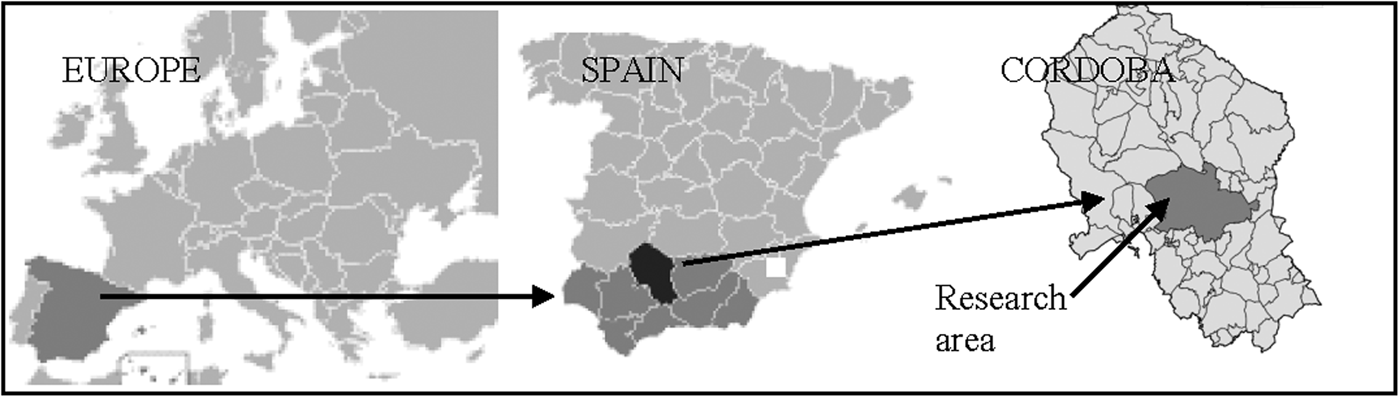
Termites were collected from Los Baldíos (Sierra Morena mountains, southern Iberian Peninsula; fig. 1), where cork oaks showing galleries made by R. grassei had been previously observed (Gallardo et al., Reference Gallardo, Cárdenas and Gaju2010). In this area there is a Mediterranean mixed forest dominated by Q. ilex, Q. suber and Q. faginea, and also has Pinus pinea L. and Olea europaea var. sylvestris Brot. (Cárdenas et al., Reference Cárdenas, Moyano, Gallardo and Hidalgo2012). The scrubland in the area is diverse and mostly represented by Genista spp., Cistus salviifolius L. and Daphne gnidium L.
Location of the research area (source Gallardo et al., Reference Gallardo, Cárdenas and Gaju2010).

The area sits on the Thermo-Mediterranean and Meso-Mediterranean belts, with broad transitional zones between them (Cárdenas & Bach, Reference Cárdenas and Bach1989). The soils are mainly acidic, with Paleozoic metamorphic rocks, which include quartzite, slate and semi-acidic, intrusive types. The climate is typically Mediterranean with winter rainfall ranging 500–800 mm year, an average annual temperature of 17 °C, relatively warm summers (average 24 °C) and winters with an average temperature ranging between 6 and 10 °C (Gallardo et al., Reference Gallardo, Cárdenas and Gaju2010).
Fieldwork
Workers of R. grassei were collected from the field between 10 and 14 April 2015, and were found by lifting fallen wood and course woody debris. The termites were transported to the laboratory along with the wood in which they were found.
Laboratory work
To determine the feeding preference of R. grassei to the multiple Mediterranean oak species and to the bark of cork oak (cork), we conducted choice and non-choice experiments lasting for 15, 30, and 45 days. The specimens selected for the experiments were workers of at least the third stage (Chouvenc et al., Reference Chouvenc, Bardunias, Li, Elliot and Su2011). In the non-choice experiments, termites were offered one of the following food types: Q. suber (cork oak), Q. ilex (holm oak), Q. faginea (gall oak), cork, and the soft wood (P. pinea), which was considered to be the control because the wood of pine results the best food for laboratory studies with subterranean termites (Smythe & Carter, Reference Smythe and Carter1970; Perkins, Reference Perkins2012; EN 118, 2013). The choice feeding experiment used all the same food types listed above, supplied simultaneously in the same container.
For each individual trial of the non-choice feeding experiment, eight sapwood blocks (approximately 2 × 2 × 1 cm3 in volume) of each food type were supplied (Q. suber, Q. ilex, Q. faginea, cork and P. pinea). Ten individual trials of each food type were performed.
In the individual trials of the choice feeding experiment, ten sapwood blocks of different plant species (two pieces of cork oak, holm oak, gall oak, and pine) and of cork (two pieces) were provided as food. Ten individual trials of this experimental design were also performed.
Small metal tags of different shapes were used to identify the wood species in this experiment. For each trial, 150 workers of the same colony were placed into a container and reared under controlled conditions: a rearing chamber in permanent darkness at a constant temperature of 26 ± 1 °C and 80 ± 5% relative humidity. In total, 180 rearing containers measuring 18 × 15 × 7 cm3 were used. Following the methods of Gallardo et al. (Reference Gallardo, Cárdenas and Murillo2016) and EN 118 (2013), each container was provided with 60 g of sand, moistened in a proportion of one volume of distilled water to four volumes of sand.
The food types were collected from the same area as the termites and were kiln-dried at 60 °C for 48 h to determine dry weight. This procedure is commonly used to study the wood preferences of termites (Su & La Fage, Reference Su and La Fage1984a; Grace & Yamamoto, Reference Grace and Yamamoto1994; Morales-Ramos & Rojas, Reference Morales-Ramos and Rojas2001; EN 118, 2013) because this temperature preserves the properties of the wood (Kačík et al., Reference Kačík, Veľková, Šmíra, Nasswettrová, Kačíková and Reinprecht2012) and also has the benefit of sterilization (http://www.usgr.com/soil-sterilization).
After each exposure time (15, 30, and 45 days), the pieces of wood were removed, kiln-dried again, and weighed to quantify consumption, and the number of surviving termites were counted to calculate survival.
Data analysis
The following parameters were considered:
Survival = percentage of live workers found for each treatment at the end of each experiment.
Consumption = difference between value of initial dry weight of food and value of final dry weight of food in each trial.
Consumption rate = wood weight consumed/surviving termite biomass (Su & La Fage, Reference Su and La Fage1984b).
Termite biomass was quantified by individually weighing (with a precision balance) 100 randomly selected workers from the total specimens caught in the field, resulting in an average weight of workers of 0.002 ± 0.0001 g.
An analysis of variance (one-way ANOVA) was used to test for differences in mean survival among food types and different exposure times. The assumptions of normality and homoscedasticity were checked with a Shapiro–Wilk test and a Levene test, respectively (Zar, Reference Zar1999). If the data did not satisfy the normality and homoscedasticity criteria, the non-parametric Kruskal–Wallis test was applied instead. In addition, to discern differences in survival vs. exposure times and vs. food types, the post-hoc Tukey–Kramer test or box plots were performed for the ANOVA or the Kruskal–Wallis test, respectively.
The relationship between exposure time and the mean number of surviving termites for each treatment was examined using Pearson's correlation. Because the distribution of termite survival during the study period (15, 30, or 45 days) was not known, a logarithmic transformation of the y-axis data was used to obtain a linear regression equation for use as a predictive model.
Because mortality may significantly influence the consumption rate (Su & La Fage, Reference Su and La Fage1984b), this parameter was only analysed for the experiments in which the statistical comparison of survival resulted in no significant differences among treatments.
The one-way ANOVA test was also applied to assess differences in total consumption in the non-choice experiments after 15 days; and the differences in total consumption in the choice feeding experiment were tested by the χ2 test. Because the number of surviving termites varied among treatments, differences in consumption rate were also examined using again one-way ANOVA as statistical procedure. The Pearson's correlation was also applied to assess the relationship between wood density and consumption after 15 days of exposure to each non-choice feeding experiment. Information about wood density was provided by Gutiérrez & Plaza (Reference Gutiérrez and Plaza1967).
The statistical tests were performed using SPSS (SPSS 20.0, 2011).
Results
Survival
Survival versus food type
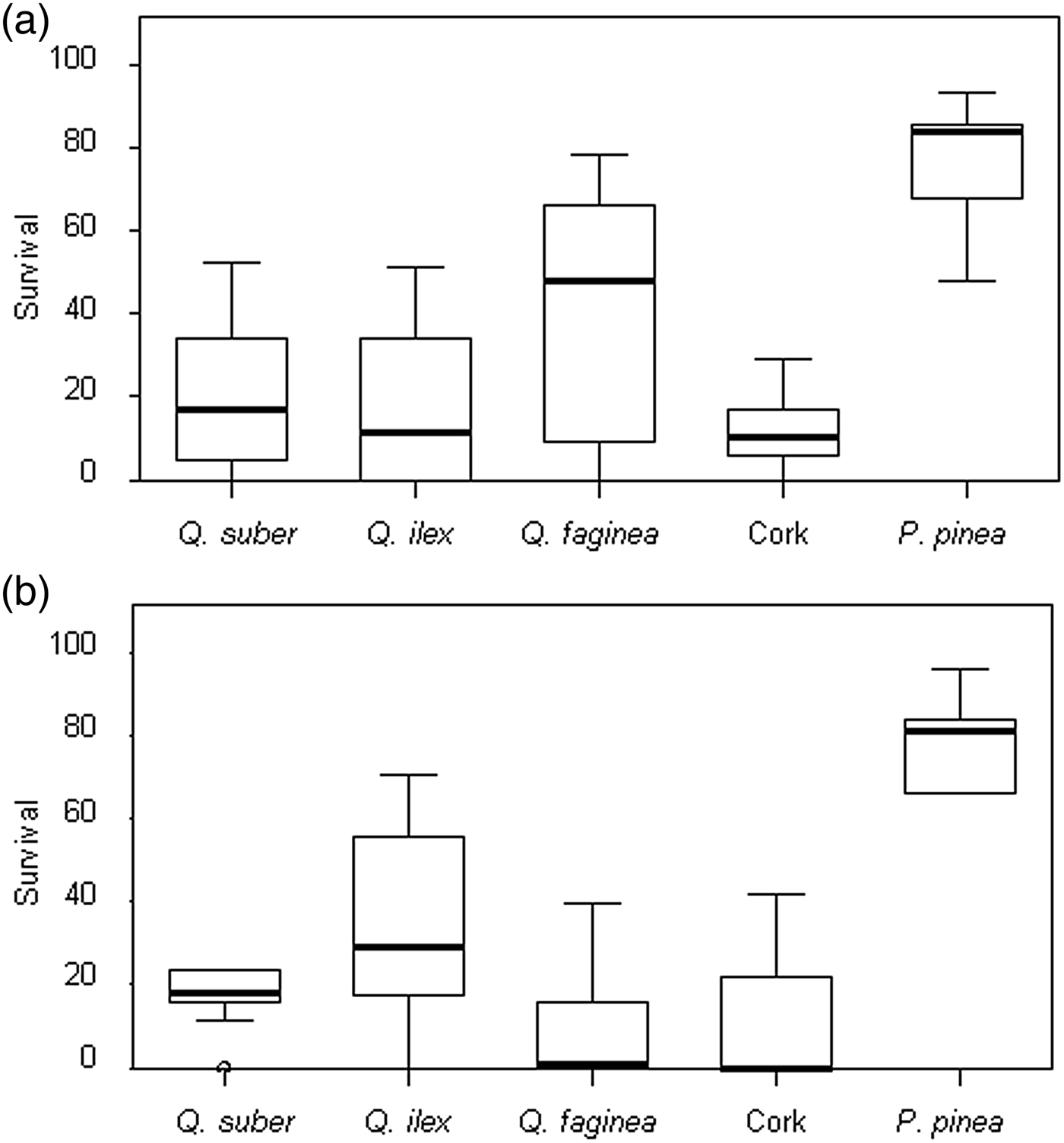
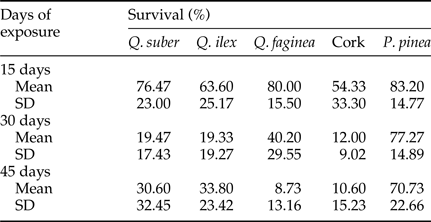
After 15 days there were no differences in termite survival among treatments (Q. suber, Q. ilex, Q. faginea, cork and P. pinea; P = 0.116, χ2 = 7.41) (table 1). However, after 30 and 45 days there were significant differences among food sources (P = 0, χ2 = 24.37; P = 0, χ2 = 25.43, respectively). After 30 days the greatest survival was recorded with P. pinea, followed by Q. faginea. Survival in Q. suber, Q. ilex and cork did not surpass 20% (fig. 2a). After 45 days, the greatest survival was recorded again in P. pinea, but the lowest rates corresponded to Q. faginea and cork (fig. 2b).
Termite survival in non-choice feeding experiment for the five food types: (A) after 30 days of exposure, (B) after 45 days of exposure. Vertical bars indicate the minimum and maximum data values. The line in the box indicates the median value of the data. The upper and lower edges of the box indicate the 75th and 25th percentiles, respectively.

Mean survival (%) and Standard Deviation (SD) of the ten individual trials of each non-choice feeding treatment (Q. suber, Q. ilex, Q. faginea, Cork, and P. pinea) after 15, 30, and 45 days of exposure.

Analysis of survival versus exposure time
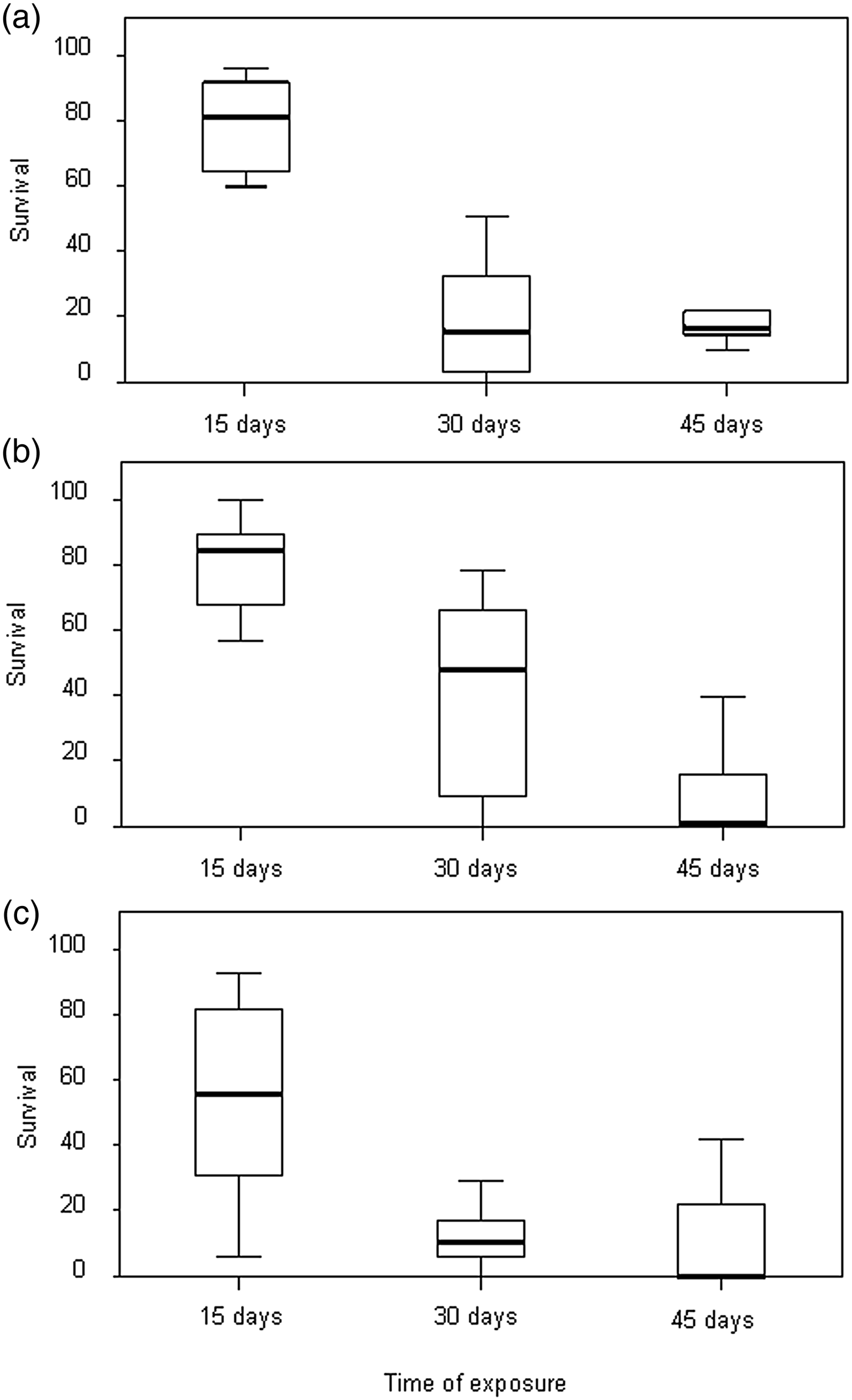
Termite survival decreased significantly among the three experimental timeframes in each non-choice treatment, except for the P. pinea treatment in which high survival was observed in all three times of exposure (tables 1 and 2). Termite survival decreased drastically after 15 days in the Q. suber, and cork treatments (fig. 3a, c) and remained at low levels until the end the study. Survival decreased more progressively over time in the Q. faginea treatment (fig. 3b).
Termite survival in non-choice feeding experiment after 15, 30, and 45 days of exposure in: (A) Q. suber. (B) Q. faginea. (C) Cork. Vertical bars indicate the minimum and maximum data values. The line in the box indicates the median value of the data. The upper and lower edges of the box indicate the 75th and 25th percentiles, respectively.

Comparison of mean survival among the three experimental durations (15, 30, and 45 days) for each non-choice feeding treatment (Q. suber, Q. ilex, Q. faginea, Cork and P. pinea).

F: values of one-way ANOVA test; χ2: values of non-parametric Kruskal–Wallis test; P: probability, asterisk (*) indicates significance for α = 0.05.
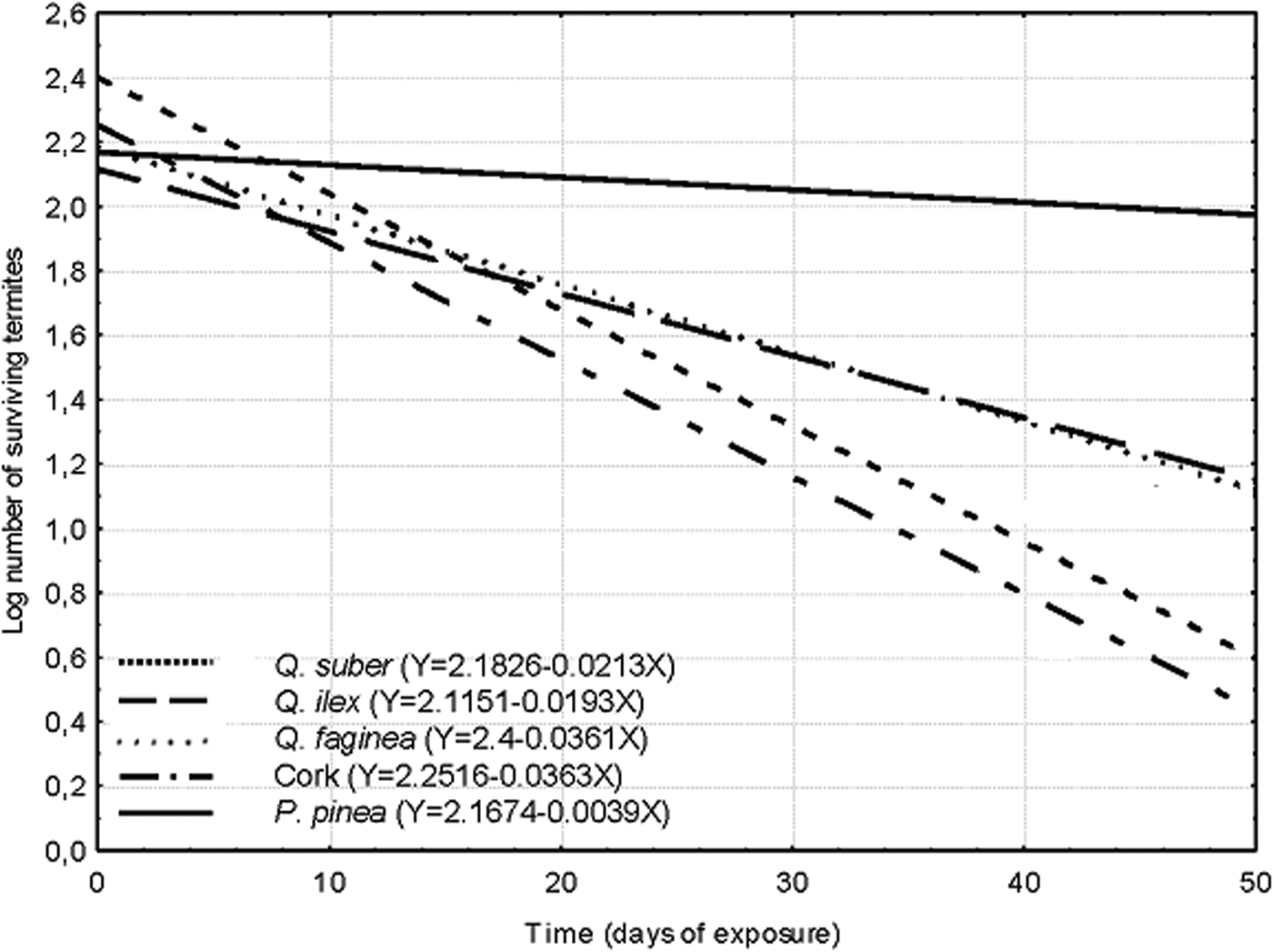
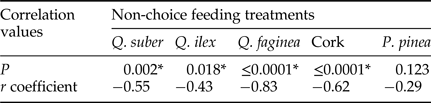
The values of the correlation coefficient between the survival for each type of food and days of exposure are displayed in table 3. Pearson's coefficient was significant and negative for all the treatments except for P. pinea (P = 0.123, R = −0.288). The respective linear equations provided the predictive model of the course of survival within each treatment over time (fig. 4). The regression lines with the highest slopes correspond to cork and Q. faginea. In these treatments, 100% mortality would occur after 45–50 days. Conversely and as expected, the lowest slope was observed in P. pinea in which termites would remain alive for more than 155 days. The regression lines for Q. suber and Q. ilex run quite parallel and the last surviving termites would not surpass 55 days.
Linear regressions between log-transformed mean number of surviving termites of each non-choice-feeding treatments (Q. suber, Q. ilex, Q. faginea, Cork, and P. pinea) and time of exposure (15, 30, and 45 days).

Pearson's correlation coefficient (r) and probability values between the survival of each non-choice feeding treatments (Q. suber, Q. ilex, Q. faginea, Cork and P. pinea) and the time of exposure.

F: values of one-way ANOVA test; χ2: values of non-parametric Kruskal–Wallis test; P: probability, asterisk (*) indicates significance for α = 0.05.
Consumption
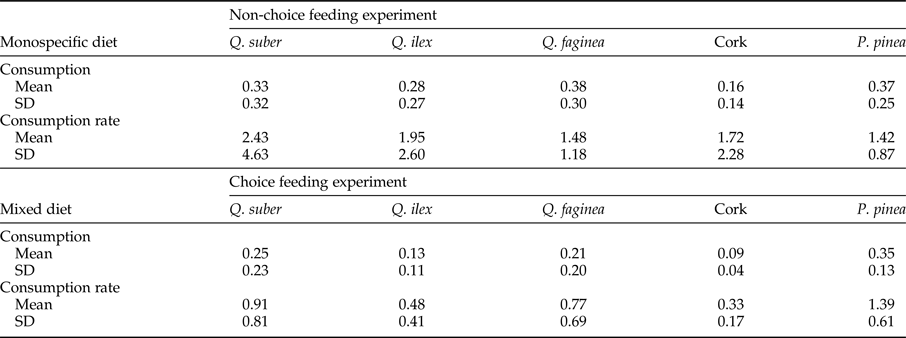
No significant differences were found for consumption among the food types in the non-choice feeding experiment (P = 0.329, F = 1.19) and in the choice feeding (P = 0.998, χ2 = 0.11) (table 4). Likewise, when consumption rates in the non-choice and choice feeding experiments were compared, no significant differences were found (P = 0.916, F = 0.24; P = 0.927, χ2 = 0.884, respectively).
Mean and Standard Deviation (SD) of the consumption (in grams) and consumption rate of the ten individual trials of each non-choice feeding treatments (monospecific diet with Q. suber, Q. ilex, Q. faginea, Cork and P. pinea) and of those of choice feeding treatment (mixed diet) for 15 days of exposure.

There was no relationship between consumption after 15 days and wood density (P = 0.223, R = 0.18).
Discussion
The survival analysis indicated that an increase in rearing time was associated with a significant decrease in survival, regardless of the type of food, except when pine is supplied. High mortality is typical of this type of bioassay after some weeks of exposure (Grace et al., Reference Grace, Wood and Frankie1989; Grace & Yamamoto, Reference Grace and Yamamoto1994; Arinana et al., Reference Arinana, Tsunoda, Herliyana and Hadi2012) due to the loss of vigour that may be related to age, disease or other intrinsic factors associated with the experimental treatment (Su & La Fage, Reference Su and La Fage1984a). In spite of this, a high survival rate was recorded in the control throughout the three times, which validates the experimental design and the affinity of R. grassei for soft wood such as P. pinea. This finding is in accordance with other species of subterranean termites (e.g. Heterotermes longiceps Snyder, Coptotermes gestroi Wasmann and Nasutitermes jaraguae Holmgren) preferring softwoods (Peralta et al., Reference Peralta, Menezes, Carvalho and Aguiar-Menezes2004).
All types of food supplied in the non-choice feeding experiment were palatable to the termites and there were no statistically significant differences among the consumption of different food types in both non-choice and choice feeding experiments. These findings are in accordance with the existence of Quercus species classified as ‘poorly or not at all resistant’ to be eaten by subterranean termites (Reyes et al., Reference Reyes, Viveros and Pérez1995).
Similar results were obtained when we compared rate of consumption instead of total consumption in non-choice feeding experiment. However, in the choice–feeding experiment, the consumption rate was higher in pine, which is also in agreement with the preference for soft wood usually attributed to Reticulitermes species (Haverty, Reference Haverty1979).
The selective feeding behaviour shown by certain subterranean termites is hypothesized to be primarily a result of the emission by the plants of volatile substances, usually detectable from a distance (Reinhard et al., Reference Reinhard, Hertel and Kaib1997) that could attract or repel these insects (Scheffrahn, Reference Scheffrahn1991). Volatile compounds emitted include isoprenes and terpenes (Kesselmeier & Staudt, Reference Kesselmeier and Staudt1999), which perform several functions for the plants, including defence against pathogens and herbivores (Martín et al., Reference Martín, Gershenzon and Bohlmann2003; Dudareva et al., Reference Dudareva, Pichersky and Gershenzon2004; Sánchez-Osorio et al., Reference Sánchez-Osorio, López-Pantoja, Tapias, Pareja and Domínguez2013). Some Quercus species, such as Q. suber, are strong producers of monoterpenes and triterpenes (Pio et al., Reference Pio, Nunes, Brito, Slanina, Angeletti and Beilke1993; Silva et al., Reference Silva, Nunes, Campos, Mariz and Pio1999; Lavoir, Reference Lavoir2004; Staudt et al., Reference Staudt, Mir, Joffre, Rambal, Bonin, Landais and Lumaret2004), which would be expected to make them unattractive to termites. However, our field observations and laboratory experiments indicate that Q. suber is as palatable as the other wood supplied. Moreover, it is known that as a consequence of the injuries produced during cork extraction, the tree secretes healing substances that are primarily composed of acid resins dissolved in a mixture of terpenes, which act as attractants for other boring insects, such as longhorn beetles (Cogollor, Reference Cogollor, Baldini and Pancel2002). If these substances are also attractive to termites, the association between termites and cork oaks observed in the field (Gallardo et al., Reference Gallardo, Cárdenas and Gaju2010) would be explained. Nevertheless, it has been also indicated that in the same study area the uncorked oaks were not significantly affected by other boring insects, while termites affected nearly 70% of them (Gallardo, Reference Gallardo2011). Therefore, the attractant effect of healing substances is not a suitable explanation of the rate of termite presence.
The principal factors affecting wood consumption by termites are the wood species, the hardness or density of the wood, and the moisture content of the wood and soil (Smythe et al., Reference Smythe, Carter and Baxter1971; Carter & Smythe, Reference Carter and Smythe1974; Nagnan & Clément, Reference Nagnan and Clément1990). Notably, there is an inverse relationship between termite consumption and wood density because the hardness of the wood affects the termite's ability to fragment it mechanically with its mandibles (Bultman et al., Reference Bultman, Beal and Ampong1979). Hence termite attack resistance is highly correlated with wood density (Behr et al., Reference Behr, Behr and Wilson1972; Coulson & Lund, Reference Coulson, Lund and D.D1973; Bultman et al., Reference Bultman, Beal and Ampong1979; Abreu & Silva, Reference Abreu and Silva2000). However, our study did not find a relationship between mean total consumption and wood density for any non-choice feeding treatment, as has also been found prior for Reticulitermes sp. (Waller et al., Reference Waller, Jones and La Fage1990). Likewise, no significant correlations between wood consumption rates and wood densities have been found for other subterranean termite species, despite a clear preference for softwoods (Peralta et al., Reference Peralta, Menezes, Carvalho and Aguiar-Menezes2004).
In summary, on the basis of the predictive model obtained for the course of survival of R. grassei, it can be concluded that all the wood oak species are equivalent in terms of suitability as food resources.
Acknowledgements
The authors are grateful to ACUAES (Aguas de la Cuenca de España, S.A., Ministry of Agriculture, Food and Environment, Government of Spain) and Ingeniería y Gestión del Sur, S.L. (Grupo IG-IPA) for the financial support. They also thank Prof. Miquel Gaju for his assistance in methodological aspects of this research.