Daily food preparation activities are increasingly recognized as an essential way to study household economies, the organization of household labor, gender roles, identity, and social interaction (Blanton et al. Reference Blanton, Kowalewski, Feinman and Appel1981:71; Rodríguez-Alegría and Graff Reference Rodríguez-Alegría, Graff, Graff and Rodríguez-Alegría2012; Scott Cummings Reference Scott Cummings, Bryant and Wrenn1998; Twiss Reference Twiss2019). Ceramic cooking vessels and cooking tools are especially important for understanding daily culinary practices. As part of ceramic analyses, we regularly document vessel form to gain a better understanding of the types of foods produced and consumed in households. However, ceramic analyses are ultimately based on inferences about how particular vessel types would have been used. In the Basin of Mexico, it is often inferred that ollas (jars) would have been used for cooking wet foods such as stews and atole, whereas comales (griddles) would have been used to cook dry foods, especially tortillas (Brumfiel Reference Brumfiel, Gero and Conkey1991:240, Reference Brumfiel and Klein2001). Brumfiel (Reference Brumfiel, Gero and Conkey1991, Reference Brumfiel and Klein2001) argued that a dramatic decline in the ratio of ollas to comales after the imposition of Aztec rule on sites in the Basin of Mexico indicates that tortillas became a more important food source because they were portable (Blanton et al. Reference Blanton, Kowalewski, Feinman and Appel1981:71). Commoners would have needed portable foods, because they were being increasingly drawn away from the home for labor drafts, to carry goods to market, and to work in more distant agricultural fields (Brumfiel Reference Brumfiel, Gero and Conkey1991, Reference Brumfiel and Klein2001). Building on this argument, Rodríguez-Alegría (Reference Rodríguez-Alegría, Graff and Rodríguez-Alegría2012) notes that cooking stews in ollas for many hours requires more fuel than making tortillas; thus, the increase in the usage of comales could also represent efforts to conserve fuel. The function of cooking vessels can thus reveal a great deal about domestic economies and decision-making processes.
This analysis has two primary goals. The first goal is to answer this basic question—how were cooking vessels used—and so test assumptions about function and gain a better understanding of how plain vessels were used; second, we aim to refine our understandings of foodways in the Basin of Mexico. Much of our knowledge about prehispanic foodways in central Mexico is based on sources that describe or depict Aztec practices in the sixteenth century. Were foodways different in Early Postclassic times (AD 900–1250), several centuries prior to the rise of the Aztec Empire? Can we assume that vessels were used in the same ways during this time?
In this article we analyze the results from residue analysis of 12 ceramic sherds and one grinding cobble. The residue analysis combined phytolith and starch analyses with Fourier transform infrared spectroscopy (FTIR) conduced at the PaleoResearch Institute (PRI). Ollas and comales are equally represented in Early Postclassic contexts at Xaltocan (Table 1). We selected ollas with variations in rim form to test the hypothesis that differences in rim form correlate with differences in function. In addition, we also analyzed two plainware vessel types that are associated specifically with Early Postclassic contexts in Xaltocan: (1) large basins with thick bilobed handles and (2) shallow, crudely made, and poorly finished bowls (called “crude bowls” hereafter). Brumfiel (Reference Brumfiel and Brumfiel2005a:141) hypothesized that the crude bowls served as evaporation pans to make salt from the saline waters of Lake Xaltocan. The purpose of large basins is still poorly understood.
Plainware Rims from Structure 1 Associated with Aztec I Contexts.

An obvious limitation of this study is that there are only 13 samples; thorough residue analysis is time consuming and cost prohibitive. We conducted this analysis as an initial step toward better understanding foodways in Early Postclassic central Mexico and are currently engaged in a follow-up analysis to examine samples from later contexts. This study can therefore serve as a starting point for future research to compare change over time.
Our results suggest that many currently held inferences about vessel function are accurate. For example, large ollas were found to be used for cooking liquid-based foods such as stews and corn-based liquids. Yet, our analysis also suggests that other types of ceramic vessels, such as comales and crude bowls, had a wider range of food preparation functions than previously thought. In addition, the hypothesis that olla rim form correlates with function was not supported by this analysis. Finally, although the consumption of some foods such as corn was expected, we also found that other plants were used as the base of stews in the Early Postclassic.
Background
Xaltocan was an important Early to Middle Postclassic (AD 900–1350) center located in the former lakebed of Lake Xaltocan-Zumpango in the northern Basin of Mexico (Figure 1). It was founded around AD 900 by Otomí-speaking peoples and rose to become the Otomí capital by AD 1220 (Brumfiel Reference Brumfiel and Brumfiel2005b:349; Carrasco Pizana Reference Carrasco Pizana1950:258–259; Gibson Reference Gibson1964:440). During the Early and Middle Postclassic, chinampa (raised-field) agriculture was practiced (Morehart and Eisenberg Reference Morehart and Eisenberg2010; Morehart and Frederick Reference Morehart and Frederick2014), and people exploited various resources supplied by the lake (De Lucia Reference De Lucia2021; Roush Reference Roush and Brumfiel2005). The crops harvested from chinampas included corn, beans, squash, green chili, tomato, amaranth, and chenopodium (Alvarado Tezozómoc Reference Alvarado Tezozómoc and Leon1949:38; Morehart and Eisenberg Reference Morehart and Eisenberg2010). Around AD 1250, there was an influx of a new (probably non-Otomí) population (De Lucia Reference De Lucia2018; De Lucia and Overholtzer Reference De Lucia and Overholtzer2014; Overholtzer and De Lucia Reference Overholtzer and De Lucia2016). In AD 1395, the town was conquered by the Tepanecs and later incorporated into the Aztec Empire (Bierhorst Reference Bierhorst and Bierhorst1992:75; Hicks Reference Hicks, Marcus and Zeitlin1994). Documents indicate that, after this conquest, Xaltocan's inhabitants abandoned the site, and it was later resettled by Aztec peasants (Alva Ixtlilxochitl Reference Alva Ixtlilxóchitl1975–1977; Hicks Reference Hicks, Marcus and Zeitlin1994). DNA evidence further suggests that a demographic shift took place after the documented period of abandonment (Mata-Míguez et al. Reference Mata-Míguez, Overholtzer, Rodríguez-Alegría, Kemp and Bolnick2012).
Location of Xaltocan in the Basin of Mexico.

The long history of Xaltocan, including the integration of new populations and resettlement, could have important implications for considering cuisine and foodways. Each new population likely brought different cooking techniques and recipes. For this reason, we cannot assume that the foodways of the Aztecs recorded in early colonial sources would have been identical to the foodways of the Otomí who occupied Xaltocan during its initial settlement. Previous macrobotanical studies in Xaltocan focused on its chinampas (Morehart Reference Morehart2014, Reference Morehart2016; Morehart and Eisenberg Reference Morehart and Eisenberg2010; Morehart and Frederick Reference Morehart and Frederick2014) and samples recovered from household excavations (McClung de Tapia and Martínez Yrizar Reference McClung de Tapia, Yrizar and Brumfiel2005; McClung de Tapia et al. Reference de Tapia and Emily2012), but analyses of pottery have not previously been conducted in Xaltocan. This study therefore focuses on plainware vessels from the Early Postclassic period to better understand cooking practices from this time.
We selected samples from the collection of ceramics excavated from Casa Z Structure 1, a domestic structure occupied for several generations during the Early Postclassic period (De Lucia Reference De Lucia2011). The ceramics were associated with Aztec I Black-on-Orange pottery, except for Samples 3 and 12 that were associated with an intrusive midden containing Aztec I and some Aztec II pottery. Radiocarbon dates associated with Aztec I occupational contexts in Structure 1 date primarily to the mid-twelfth through mid-thirteenth centuries AD, with 2σ calibrated ranges as early as AD 1000–1170 and as late as AD 1220–1290 (see Brumfiel Reference Brumfiel2005c:Table 1; De Lucia Reference De Lucia2011:Table 1.2). The midden context with Aztec I and II pottery had a 2σ calibrated range from AD 1260–1390. It was associated with a Middle Postclassic occupation of the structure that was largely destroyed by later colonial activity; only the midden and some fragmentary features remained from this occupation, although a second nearby structure still had intact Middle Postclassic deposits. All contexts from which the sherds were selected dated prior to the abandonment of Xaltocan and have ceramics associated with the original inhabitants of the island.
Methods
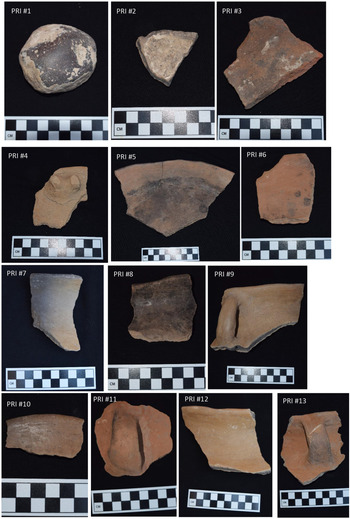
The overall goal of this study was to better understand how different vessel forms may have been used in food preparation and storage. Twelve ceramic samples (Figure 2)—seven ollas, one basin, two crude bowls, and two comales—were submitted to PRI for phytolith and organic residue (FTIR) analyses. In addition, one cobble with one flat polished surface and thick white residue on its sides was also tested to determine its function. Samples were selected from contexts associated with floors or midden deposits and represent plainware forms commonly associated with Early Postclassic deposits in Xaltocan (Table 1). Ollas represented a greater proportion of the sample because they are highly variable in form. The sample thus included ollas with high, medium, and low necks and those with handles off the rim and handles below the rim, because the positioning of the handle may relate to function. Early Postclassic comales in Xaltocan tend to be either high wall (Sample 5) or flat (Sample 6), so one sample was selected of each type. Basins with bilobed handles are a distinctive vessel type associated primarily with Early Postclassic contexts. These vessels are thick walled (average of 11.5 mm) and have a wide diameter (average of 26.7 cm). Given that basins with bilobed handles do not exhibit much variation in form, only one sample was selected. Crude bowls are shallow, wide-rimmed (average of 21.3 cm), poorly finished bowls with an average thickness of 9.4 mm. Crude bowls are commonly associated with Early Postclassic contexts in Xaltocan, but their usage declined in later periods.
Analyzed samples. Samples 2, 3, 5, and 6 show interiors, and samples 4 and 7–13 show exteriors. Photos by Kristin De Lucia. (Color online)

Phytoliths and Starch
This study sought to find and identify phytoliths and any starches that were present within the phytolith extract. Separate extractions to recover pollen, phytoliths, and starches were not conducted because of budgetary constraints. Because the extraction methodology includes an oxidation step, pollen analysis would have required a separate extraction process of an additional area of the artifact. Recovery of pollen in samples extracted to recover phytoliths and starch is rare and was considered a bonus but not part of the study goal. Funding covered only the production of a single set of samples, which required combining phytolith and starch analyses. We have found this combined technique retains a portion of the starch record and that it is possible to find more starches by reducing the organic load in the sample.
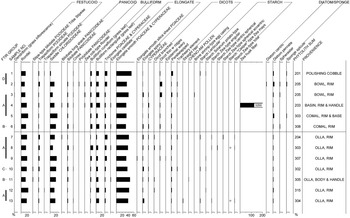
To recover phytoliths and starch, a portion of the surface of the samples was cleaned prior to washing using a sonicating toothbrush. A few drops of a dilute Triton solution were placed onto the surface to aid with removal of particles bonded to or deeply lodged within surface irregularities. Reverse-osmosis deionized (RODI) water was used periodically to flush the particles from the surface into a plastic container. After the phytolith- and starch-rich fraction was recovered, the samples were rinsed with RODI water and then with alcohol to remove the water. One sample (Sample 2) required additional processing because extraneous organic matter obscured our ability to view the phytoliths and any starches that might have been present. After several RODI water rinses Sample 2 was freeze-dried. The dried material was mixed with sodium polytungstate (SPT) at a density of 2.1 g/ml and centrifuged to separate the phytoliths, which will float, from the other silica, which will not. After the phytolith-rich fraction was recovered, the sample was rinsed with RODI water and then with alcohol to remove the water. After several alcohol rinses, the sample was mounted in immersion oil on an Olympus BH2 light microscope with cross-polar illumination capability to count phytoliths; to count starches a Nikon light microscope with cross-polar illumination capability was used, with both microscopes at a magnification of 500×. The phytolith and starch diagram (Figure 3) was produced using Tilia, a computer program developed by Eric Grimm of the Illinois State Museum for diagramming pollen. The PRI phytolith and starch references collections were used to verify identifications. We also compared the starches we identified with published references to determine the similarities between them and the published work of others.
Phytolith and starch diagram from analyzed samples.

FTIR (Fourier Transform Infrared Spectroscopy)
Infrared (IR) spectroscopy is an analytical technique that measures molecular vibrations. It is currently one of the more powerful methods used in organic and analytical chemistry to identify organic compounds. The infrared spectrum is produced by passing infrared radiation through residue that was removed from the tools using an azeotrope solution of chloroform and methanol and then allowing that residue to dry in an aluminum dish. The FTIR measurement was taken directly using an attenuated total reflection (ATR) diamond crystal. Measurement of this spectrum indicates the fraction of the incident radiation that is absorbed at a particular energy level (Stuart Reference Stuart2004), providing information on infrared radiation absorption and the structure of the organic molecules. Analysis of specific regions and peaks in the infrared spectrum enables identification of organic compounds, including both plant and animal fats/lipids, plant waxes, esters, proteins, and carbohydrates.
The FTIR spectrometer collects raw data and then, using Fourier transformations, creates the output that we see as a spectrum. Advantages of using this technique include the simultaneous measurement of all wavelengths and a relatively high signal-to-noise ratio with a short measurement time. Given that molecular structures absorb vibrational frequencies (wavelengths) of infrared radiation, we can use the bands of absorbency to identify organic compound compositions.
FTIR spectra are divided into two groups—the functional and the fingerprint regions— based on the effect of infrared radiation on the respective group's molecules. The functional group region is between 4,000 and about 1,500 wave numbers (cm−1), and the fingerprint region is below 1,500 cm−1. The molecular bonds display vibrations that we can interpret as characteristic of fats, lipids, waxes, lignins, proteins, amino acids, carbohydrates, and polysaccharides. ATR-FTIR is useful for the identification of organic compounds in food sources, which are mainly carbohydrates, lipids, and proteins. The portion of the infrared spectrum most useful for this research and in the identification of organic compounds (carbohydrates, lipids, proteins) is termed the mid-infrared, between 4,000 and 400 cm−1 (Isaksson Reference Isaksson1999:36–39). We compared recorded wavelengths of the electromagnetic spectra to reference collections housed in the PRI library, aiming to identify the closest match. For example, although plant lipids and fats are identifiable between 3,000 and 2,800 cm−1, this portion of the spectrum is not unique to plant lipids and fats; it also signals the C-H vibrations in alkyl chains, demonstrating the necessity to consider peaks in the fingerprint region of the spectrum to interpret the presence of fats and lipids. Therefore, although this portion of the spectrum can be suggestive of the presence of animal fats, plant oils, oily nuts (such as hickory, walnut, or acorn), or plant waxes, additional peaks representing fats/lipids and allied substances, including esters, are noted in the fingerprint portion of the spectrum. Samples from archaeological contexts are difficult to analyze because they often contain complex compound mixtures, whether from multiple uses or burial in contexts such as trash mounds. For instance, groundstone tools and ceramic cooking vessels were likely multipurpose artifacts used to process (crush, grind, cook) a variety of foodstuffs, ingredients, or medicines. Multipurpose artifacts can yield a spectrum of overlapping absorption bands with few distinctive characteristics.
We used an azeotrope mixture of chloroform and methanol (CHCL3:MEOH) as the solvent to remove lipids and other organic substances that had soaked into the sample surface of the ceramics and groundstone, thereby becoming part of the record preserved in the sample. Each sample was placed in a glass container with CHCL3:MEOH solvent, covered, and allowed to sit for several hours. Then the solvent was poured into a small aluminum evaporation dish, in which the solution was allowed to evaporate, leaving organic residues behind. To evaporate the entire quantity of CHCL3:MEOH, the aluminum dishes are filled repeatedly until all the solution has been evaporated. The aluminum dishes were tilted during evaporation to concentrate the residue, because often it is too thin to measure. This process ends up separating the lighter fraction (lighter molecular weight compounds) from the heavier fraction (heavier molecular weight compounds), leaving the residue of absorbed chemicals in the aluminum dish after the solvent has evaporated. This necessitates collecting signatures from multiple places within the dish, which is done by placing the aluminum dish containing the residue residue-side down on the FTIR ATR diamond crystal prior to collecting the spectra.
FTIR is performed using a Bruker Alpha optical bench FTIR with an ATR accessory and a diamond crystal. The aluminum dish containing the sample residue was placed residue-side down on the diamond crystal in the path of a specially encoded infrared beam that passes through the crystal, producing a signal called an “interferogram.” The interferogram contains information about the frequencies of infrared light that are absorbed and the strength of the absorptions, reflecting the sample's chemical makeup. A computer reads the interferogram, uses Fourier transformation to decode the intensity information for each frequency (wave numbers), and then presents the data as spectra. Lighter and heavier fractions are designated “upper” (lighter fraction) and “lower” (heavier fraction), respectively, in the subsequent analysis.
Results
Phytoliths
Phytoliths from these samples largely represented the presence of plants from the local environment, including various types of grasses, sedges, and woody plants; however, maize rondels and corn husk fibers were also identified (Figure 3), suggesting that processing and preparation of maize were associated with some of the vessels.
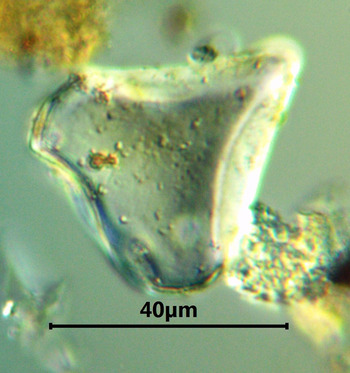
The phytolith record for these samples exhibits consistencies within the elongate, bulliform (Figure 4), and most of the grass short cell morphologies. Elongate smooth forms, representing grasses in general, dominate all samples (Figure 3) and are accompanied by a few elongated spiny forms, also typical of grasses. Pennate diatoms were observed in all samples and appear to be ubiquitous in this record. They might derive from contact with the local sediments.
Bulliform-cuneiform phytolith. (Color online)

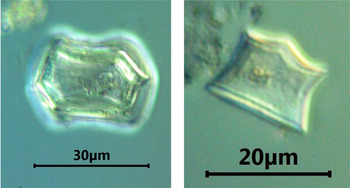
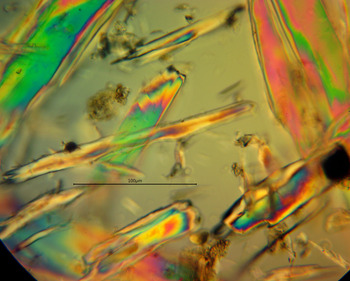
Zea-type rondels (Figure 5a and 5b) produced in maize cobs, which are different morphologically from phytoliths classified as rondels, were observed in the bowls (Samples 2 and 3) and the basin (Sample 4). This indicates that maize was prepared or processed in these samples. Fibers were also abundant in Sample 4. These fibers exhibit multiple colors when viewed using cross-polar illumination (Figure 6) and are typical of fibers observed in fresh maize husk reference samples. The abundance of these fibers in this sample and their virtual absence from other samples suggest that maize husks were either processed in this basin or were used to make foods contained in this basin. The presence of maize is further suggested by the recovery of Zea cob-type rondels in this sample.
(a) Zea cob-type phytolith (left); (b) Zea cob-type rondel side view (right). (Color online)

Example of corn husk fibers observed in Sample 4. (Color online)

Starches
Starches identified from this study include maize (or possibly sweet potato), chili pepper, and an unidentified underground storage organ (USO), such as yams. Most of the starches were recovered from olla samples. Only one olla (Sample 11) did not exhibit starches; instead, it contained a Cheno-am pollen grain that survived oxidative processing, which suggests that the contents of this vessel included Chenopodium (amaranth or chenopodium). None of the starches exhibited surficial cracks, fissures, or other evidence of either grinding or heating.
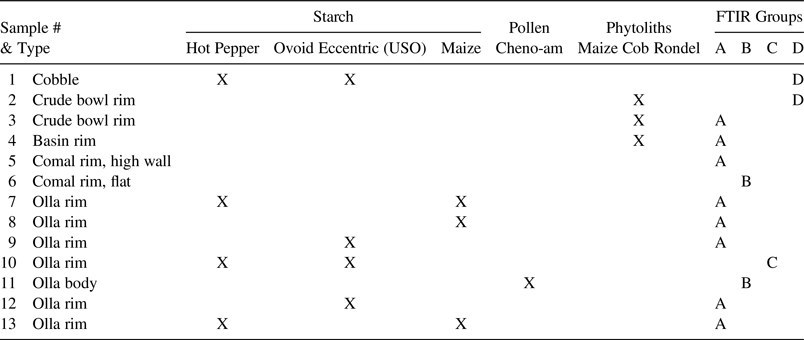
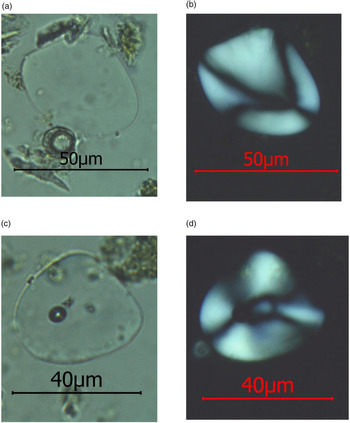
The starches were divided into lenticular–Capsicum-type, ovoid eccentric (USO), bulky, and Zea/Ipomoea-types (centric angular and centric spherical) types (Table 2). Both centric angular and centric spherical forms are observed in Zea mays and in Ipomoea batatas, making an absolute determination of the plant represented difficult when there is not a large population of starches present. Lenticular starches, common in large grass seeds and in Capsicum (peppers), were observed in three olla samples (7, 10, and 13). Lenticular starches are biconvex (shaped like lentils) with an elongated hilum. One non-olla sample (Sample 1) yielded starches that included a lenticular starch typical of those found in both cool-season grass seeds and Capsicum (peppers; Perry et al. Reference Perry, Dickau, Zarrillo, Holst, Pearsall, Piperno, Berman, Cooke, Rademaker, Ranere, Scott Raymond, Sandweiss, Scaramelli, Tarble and Zeidler2007) and an eccentric starch typical of yams and certain members of the lily family, but not Canna. These morphotypes are mentioned to emphasize the overlap in morphology of lenticular starches in multiple storage organs (seeds and fruit flesh) and of ovoid starches in tubers or USOs of different families. Ovoid eccentric starches, common in USOs of many plants, but most likely Dioscorea (yam; Figure 7), are present in olla Samples 9, 10, and 12. Lily family tubers are rich in inulin, a type of carbohydrate that is difficult to digest unless cooked at a low temperature for a long time, suggesting that yams are the more likely ingredient.
Ovoid eccentric starch, Sample 10: (a) photo using white light (left); (b) photo viewed using cross-polar illumination (right). (Color online)

Summary of Starch and FTIR Analyses.

Inclusion of Dioscorea tubers in this list is based on published images of Dioscorea starches (Ochoa Reference Ochoa, Rosenswig and Cunningham2017; Pagán-Jiménez et al. Reference Pagán-Jiménez, Guachamín-Tello, Romero-Bastidas and Constantine-Castro2016:152), because Dioscorea in our reference collection did not exhibit this morphology of starch. Although the eccentric starches are very typical of potatoes, there is no other documentation that potatoes were present in central Mexico prior to Spanish conquest. Pagán-Jiménez and colleagues (Reference Pagán-Jiménez, Guachamín-Tello, Romero-Bastidas and Constantine-Castro2016:152) show ovoid eccentric starches that they identify as modern yam (Dioscoreaceae). Dioscorea references at PRI based on common grocery store yams do not exhibit this morphotype; however, consulting published works that illustrate starches indicates that the ovoid eccentric type of starch could represent yam (Dioscorea). Hedrick (Reference Hedrick1972:240) notes that Dioscorea sativa grew in tropical America but is not specific about its location. Bruman (Reference Bruman2000:94) mentions the possibility that yams were used to make chicha. Many starch morphologies are simply not diagnostic to individual plants, so constitute weak evidence for the presence of specific plants unless pollen or distinctive phytoliths accompany the starch. The starches were not similar to other local plants such as arrowroot and calathea.
Three types of starches were classified as variants produced in Zea mays: angular, centric spherical, and spherical eccentric. In addition, these three morphotypes are present in sweet potato, as is the bulky starch morphotype. Because the angular starches in our reference collections for Zea mays and Ipomoea overlap in both angularity and size, we counted the angular starches of this morphology as Zea/Ipomoea-type starches. The bulky starch, observed in Samples 7, 8, and 13, also may be described as being centric spherical with an elongated and flattened end (Figure 8) but is not the appropriate size and shape to be considered as Zea mays. This bulky starch morphotype is observed only in Ipomoea in our reference collection, although a similar starch has been interpreted to represent Canna (canna lily tuber) by Ochoa (Reference Ochoa, Rosenswig and Cunningham2017). Given that this morphotype is the only one that could be attributed to Canna and that the same morphotype is observed in Ipomoea, which shares three morphotypes with Zea mays, three possibilities exist: either the starch record represents canna lily and sweet potato, or maize and sweet potato, or all three substances.
Bulky starch from Sample 10 (a and b) and Sample 8 (c and d). Photos a and c viewed using white light and b and d viewed using cross-polar illumination (Color online).

The simplest explanation for the variety of starches observed in these samples is that they represent the carbohydrates maize/sweet potatoes (both represented by the same three morphotypes), USOs such as yams or a member of the lily family (ovoid eccentric starches), and also chili peppers. No diagnostic starches indicating manioc, which exhibits a gumdrop shape, were observed, but these tubers cannot be ruled out, because they also produce an abundance of centric spheroidal forms that have been assigned to the Zea/Ipomoea-type, given that angular starches typical of these two foods were recorded. Sweet potatoes (Ipomoea batatas) were first domesticated in Central and South America. Hedrick (Reference Hedrick1972:314) cites Peter Martyr de Anghiera (Reference Anghiera1555) as noting the growth of nine varieties of this species in Honduras in 1514, but given that central Mexico is quite distant from these regions and that sweet potatoes were not widely consumed in central Mexico (Coe Reference Coe1994:93), maize is the more likely ingredient. Moreover, maize is common in macrobotanical samples from Structure 1 (McClung de Tapia et al. Reference de Tapia and Emily2012), as well as from Xaltocan's chinampa fields (Morehart Reference Morehart2016; Morehart and Eisenberg Reference Morehart and Eisenberg2010), so we have direct evidence that maize was produced and consumed regularly at this time.
The Zea mays/Ipomoea-type (maize/sweet potato) starch and ovoid eccentric (USO-type) starch are not recorded together in any of the ollas, suggesting that two recipes, each with a different primary carbohydrate, were used. Lenticular Capsicum-type starch co-occurs with at least one example of each of these other starches, suggesting that hot peppers likely were used as a flavoring in each type of liquid. The ollas represented by Samples 7 and 13 exhibit both maize/sweet potato-type and lenticular Capsicum-type (chili pepper) starch. The olla represented by Sample 8 yielded only maize/sweet potato-type starch. Samples 9, 10, and 12 yielded the ovoid eccentric starch that represents USOs. Of these samples, Sample 10 also contained lenticular starch that probably represents chili peppers (Table 2).
In sum, if ollas were used to make beverages or stews, there appear to be at least two basic recipes. One recipe used maize (or sweet potato) as the carbohydrate, whereas the other used USOs such as yam. Only one olla (Sample 11) failed to yield starch, but instead had Cheno-am pollen, suggesting the presence of amaranth. In contrast, only one non-olla sample (the cobble) exhibited starch. The cobble, represented by Sample 1, yielded both Capsicum and ovoid eccentric starch, suggesting its use to grind hot peppers and USOs. As noted earlier, two bowl rims and a basin rim with handle exhibited maize cob-type rondel phytoliths, indicating the presence of maize. Rondels typical of maize cobs were noted only in three samples (2, 3, and 4). Using their form to separate the sherds or ceramics into two populations (ollas and non-ollas), we created two populations to be examined using FTIR signatures, as discussed next.
FTIR
The FTIR signatures suggest that the recipes processed in ollas were complex and did not comprise a single ingredient. Maize was a likely contributor to the FTIR signatures recovered from the ollas and other ceramics. Animal products were possibly associated with a crude bowl, two comales, the basin, and one olla (Samples 2, 4, 5, 6, and 10) but were not regularly associated with the ollas. It is important to note that chemical signatures that soak into archaeological ceramics, which are porous, and adhere to the surfaces of groundstone or pecked stone, derive both from the culinary use of the vessel or tool and the organic compounds in the sediments in which they were buried. We have not identified a mechanism for separating these signatures, so we acknowledge we must deal with the signature in its entirety.
High-amplitude peaks typical of fats/lipids and plant waxes observed between 3,000 and 2,800 wave numbers (cm−1; Stuart Reference Stuart2004:78) were found in Samples 1, 2, and 10, representing the cobble, the rim of a crude bowl, and an olla rim, respectively. In Sample 1, these peaks are accompanied by all three required peaks (plus one) representing aromatic esters and two of the peaks suggesting saturated esters (Supplemental Table 1). This signature suggests the presence of lipids from plants rather than animals, because saturated esters present in animal products should be represented by all three required peaks and those three peaks were not recovered. In contrast, peaks suggesting esters in the crude bowl rim, represented by Sample 2, include the requisite three peaks for both saturated (at 1,750–1,735, 1,210–1,160, and 1,100–1,030 cm−1) and aromatic esters (at 1,730–1,705, 1,310–1,250, and 1,130–1,100 cm−1); an additional +1 peak at 750–700 cm−1 for aromatic esters (Smith Reference Smith1999:108) suggests the possible presence of both meat and plant foods. Sample 10, representing an olla rim, is the only olla fragment to exhibit high-amplitude fats/lipids peaks, which are accompanied by the three required peaks plus one representing aromatic esters, suggesting plants.
Peaks typical of amino acids are observed in three non-ollas (Samples 4, 5, 6; Supplemental Table 1) and in all olla samples by peaks near 1,578–1,560 and 1442 or 1,420–1,414 wave numbers. Most amino acids are polar as a result of containing polar functional groups; therefore, they are water soluble. Both water and methanol are polar solvents. Chloroform, in contrast, is nonpolar. We use the azeotrope chloroform/methanol solution because this combination of nonpolar and polar solvents has the potential to remove most organic compounds that interest us. These peaks are visible as independent peaks with little or no activity visible between them. Thus, they present visually as rabbit ears on the graphs. This pattern, although with peaks at different wave numbers, is observed in hydroxyproline but not in any other amino acid. Hydroxyproline is the most abundant amino acid in collagen but not in other animal tissues. Recovery of this pattern in multiple samples suggests similarity in use between the basin represented by Sample 4, the two comales (Samples 5 and 6), and the ollas (Samples 7–13). Some samples also exhibit either a high-amplitude or a smaller peak near 1,348 wave numbers. The simplest signatures containing these two peaks are observed in Samples 4, 5, 7, 8, and 9, followed by Samples 6, 12, and 13. Samples 10 and 11 exhibit the most complex signatures.
To assist in understanding the FTIR signatures and the relationship between ollas and the other items, four groups of samples were identified, based on FTIR organic signatures. Groups A, B, C, and D comprise between one and eight samples each. Group A exhibits the simplest signatures and is composed of Samples 3, 4, 5, 7, 8, 9, 12, and 13: three non-olla and five olla samples. Group B includes Samples 6 and 11, which exhibit relatively simple signatures that exhibit slight differences from Group A. Groups C and D exhibit the most complex signatures. Group C includes only Sample 10, whereas Group D comprises Samples 1 and 2.
The simplest FTIR signatures exhibit two relatively high-amplitude, isolated peaks that may or may not exhibit smaller peaks on the one side that appears to be part of the peak structure. These peaks, representing amino acids, are situated near 1,578–1,560 and 1,442 or 1,420–1,414 wave numbers, as described earlier. Two peaks with a clear separation were observed in a region suggesting amino acids. These peaks were dubbed “rabbit ears” due to their shape in some of the samples. They are noted in all samples except Samples 1 and 2, which comprise FTIR Group D, indicating they are part of both simple and complex signatures. Peaks observed in the ranges of 1,580–1,571 wave numbers and 1,425–1,411 wave numbers are associated with so many amino acids that they are not considered to be diagnostic. The general amino acid peak between 1,580 and 1,571 wave numbers is observed in Samples 6, 8, 9, 10, 11, and 13.
Peaks typical of saturated and aromatic esters that co-occur in amino acids and are observed only in Samples 1, 2, and 10 were assigned to their ester categories, because it is these three samples that exhibit high-amplitude functional group fats/lipids peaks. Therefore, these samples are the most likely to contain peaks representing esters.
Capsicum annuum (jalapeño chili in our reference collection) exhibits moderately high peaks in the fats/lipids functional group range (3,000–2,800 wave numbers), a high-amplitude peak at 1,028 wave numbers, and an associated smaller-amplitude side peak at 1,048 wave numbers, reflecting carbohydrates. Capsicum annuum does not contribute peaks between approximately 1,580 and 1,410 wave numbers. Several Solanum tuberosum (Peruvian blue potatoes) in our reference collection exhibit small to moderate amplitude peaks in the fats/lipids functional group range (3,000–2,800 wave numbers), accompanied by a jagged high- amplitude peak at 1,578 wave numbers, a moderately high-amplitude peak at 1,517 or 1,513 wave numbers, low-amplitude peaks in the vicinity of 1,458 wave numbers, and another high-amplitude peak at 1,400 wave numbers. A high-amplitude peak at 1,051 wave numbers reflects carbohydrates. Another specimen exhibited high-amplitude peaks at 1,053 and 949 wave numbers. When cooked, the peaks in the 3,000–2,800 wave number range are reduced, leaving the primary, high-amplitude peak near 1,050 wave numbers, indicating carbohydrates.
Numerous Zea mays kernel specimens in our reference collection exhibit elevated peaks in the fats/lipids functional group range (3,000–2,800 wave numbers), as well as peaks indicating esters in the vicinity of 1,743 and 1,711 wave numbers. In our raw maize kernel references, many distinct peaks are observed beginning at 1,764 wave numbers and continuing until approximately 995 and 752 wave numbers. It is interesting to note that none of the FTIR peak patterns observed in our maize reference samples fit well with the FTIR signatures obtained from the ollas. This does not indicate that maize was not present in the ollas, because it is represented by starches. It suggests instead that the recipe processed in the ollas was complex and did not comprise a single ingredient, such as maize mixed with water. It is likely that maize is a contributor to the FTIR signatures recovered from the ollas and other ceramics examined.
Discussion
Starch and Phytolith
The starch record suggests most of the ollas were used to make a product, likely a liquid (see the following discussion) that included either maize or USOs such as yams as the primary carbohydrate and hot peppers as a flavoring. Three ollas revealed maize starches. Such a corn-based liquid would most likely be atole (atolli), a traditional beverage consumed by the Aztecs. There were many variations of corn-based drinks, or atole, including nequatolli, which included maguey sap, and chillatolli, which is mixed with chili (Hernández Reference Hernández, Varey, Chabrán, Chamberlin and Varey2000:111–113; Redfield Reference Redfield1929). Three ollas exhibited USO-type starches. Historical sources suggest that several types of roots and tubers, or USOs, were eaten in central Mexico, including jicama, manioc, and the tuberous roots of the dahlia (Coe Reference Coe1994:94). None of these exhibit starches are similar to those observed in this study. Sahagún (Reference Sahagún, Anderson and Dibble1950–1982 [1575–1577]:Book 11:140) mentions various types of roots and tubers that were used for medicinal purposes, some of which he describes as “edible” or that “can be cooked in an olla,” suggesting that various types of plants were regularly incorporated into stews and eaten. Sahagún in Book 11:1330 lists dahlias (Acocotli) under “herbs” but does not provide any description to explain how they were used. Either way, it is likely that that some sort of USO, possibly yam, was cooked in these vessels and provided the base for stews.
One of the ollas that contained USO starches and two of the ollas exhibiting maize-type starches also contained hot pepper-type starches. The presence of chili starches suggests that savory atole recipes such as chillatolli were made at this time. Only one olla exhibited no starches (Sample 11); instead Cheno-am pollen was recovered, suggesting that amaranth or Chenopodium (goosefoot) grain may have been stored in this vessel. Amaranth was of great ritual significance in Aztec times and was often mixed with honey or maguey sap and shaped into the image of deities (Coe Reference Coe1994:91); Sahagún (Reference Sahagún, Anderson and Dibble1950–1582 [1575–1577]:Book 11:286–288) lists several varieties of edible amaranth. Sample 11 was a typical olla with strap handles on the sides of the vessel; it was the only sherd that was not a rim fragment. The strap handle may have been used to hang this vessel off the ground to prevent the grain it contained from getting infested; thus, it may have been used for storage. In summary, the results from the ollas suggest that recipes for beverages included either maize or USOs and sometimes hot peppers. The fact that the olla signatures are distinct suggests that different ollas were specially designated for cooking and storing different food types.
The bowls and basin were also used to hold starchy food, but this time only maize. The presence of large quantities of corn husk fibers in the Sample 4 basin indicates that corn husks were involved in food preparation associated with this vessel. The simplest explanation is that these vessels were used to boil or steam tamales. Sample 4 is a large open basin with thick, short handles, reminiscent of the large metal pots used to make tamales today. Depictions of tamales at several Classic Maya sites indicate that they date well before the Early Postclassic (Taube Reference Taube1989), and connections between the Maya region and central Mexico have been well documented (Stuart Reference Stuart, Carrasco, Jones and Sessions2000). In addition, the basin and the two crude bowls contained maize-type phytoliths. The presence of maize phytoliths also lends credence to the interpretation that maize is the more likely ingredient represented by the maize/sweet potato-type starch. Rondels typical of maize glumes and cobs recovered from the crude bowls (but not the ollas) suggest that crude bowls were used in an earlier stage of food processing. Rondels are often present in ground maize and thus are likely to be present either because maize kernels or ground maize was in the bowls. Recovery of rondels and also Zea mays pollen in experimental ground maize by Linda Scott Cummings indicates that both maize pollen and distinctive rondels are transported with the maize kernels, the latter due to the fact that they are present in the glumes that surround the base of the kernel. None of the “hard cob” is implied to have been present in the bowls. Although it is possible that crude bowls were used to prepare nixtamal (maize mixed with water and lime)—one of the earliest steps in processing maize kernels (Brumfiel Reference Brumfiel, Gero and Conkey1991; Katz et al. Reference Katz, Hediger and Valleroy1974; Rodríguez-Alegría Reference Rodríguez-Alegría, Graff and Rodríguez-Alegría2012)—no direct evidence of nixtamalization was observed on the starch, such as fissures or starch spherulites. The process of nixtamalization enhances both the flavor of the corn and the availability of protein to the body (Dezendorf Reference Dezendorf, Metheny and Beaudry2015; Katz et al. Reference Katz, Hediger and Valleroy1974).
Lastly, given that comales are typically interpreted as tortilla griddles, it is interesting that the two comales sampled from Early Postclassic Xaltocan yielded no starch and no maize-type rondel phytoliths. The cobble also did not exhibit maize but rather had both the USO and hot pepper-type starches. It was probably used to crush starchy foods including the USO and hot peppers and thus may have been used for making moles (molli) or sauces.
FTIR
Although most Zea mays evidence, either in the form of starch or phytolith rondels, aligns with the FTIR signature assigned to Group A, other samples in Group A yielded no evidence of maize. Peaks typical of amino acids in the olla samples compare favorably with the shape and approximate distribution of peaks observed in beer in the PRI reference collection, although the location of the peaks is not identical. Given the similarity to a fermented beverage, the olla samples were compared to chicha. Fermented corn beverages similar to chicha have been documented in central Mexico (Biskowski Reference Biskowski2000:294; Fournier Reference Fournier1998:21). Chicha produced locally in Denver, Colorado, was purchased and analyzed using the same FTIR process as the archaeological samples. The signature produced on this corn-based chicha was different from the signature of any archaeological sample. The two peaks described as resembling “rabbit ears” in many of the archaeological samples were absent from this modern chicha: the peaks observed in the fats/lipids/plant waxes area (3,000–2,800 wave numbers) were low, suggesting that the ollas were probably not used to produce chicha. The overall similarity of the samples to the reference for beer at PRI, however, suggests that ollas were used to create a beverage, which was possibly fermented. One olla, represented by Sample 10, yielded a more complex FTIR signature. The starch record indicates the presence of tubers and hot peppers, but the complex FTIR signature indicates that the ingredients were more complex than those produced in other ollas, suggesting it was used to cook stews with multiple ingredients or was used for multiple purposes.
The FTIR signatures, designated FTIR Group B, for a comal and the olla that contained the Cheno-am pollen suggest a different use. Given the lack of evidence for maize starch or pollen associated with comales, it is possible that they were used for toasting or frying different types of foods. Ethnographically and historically, we know that comales have been used for a variety of purposes such as popping amaranth, toasting mushrooms, or frying squash seeds (Coe Reference Coe1994; Fournier Reference Fournier1998). Finally, FTIR Group D, which is observed on the polishing cobble and the bowl represented by Sample 2, is the most complex. This suggests more varied and hence multiple purposes for these two items. This would make sense if the cobble were used to grind many different foods and if the bowl were used to prepare a variety of foods.
Conclusions
The findings from this study provide insight into how plainware vessels were used during the Early Postclassic in central Mexico. They support some common inferences made by archaeologists about cooking vessels. For example, variations in vessel form (olla, bowl, comal, and basin) correlated with different signatures, supporting the assumption that these vessels would have served distinct functions. In addition, in support of Brumfiel's (Reference Brumfiel, Gero and Conkey1991) analysis of foodways in Xaltocan, our study found that ollas were likely used for cooking stews and corn-based liquids such as atole. Interestingly, some of the ollas were used for a specific purpose. For example, atole cooked with chili pepper was made in a different vessel from atole without chili pepper; ollas for corn-based liquids were not used to make tuber-based stews, and vice versa. The use of different pots for different recipes might suggest that residues from one recipe could contaminate the flavor of a different recipe, especially if it included chili peppers. Follow-up studies could see if this is a consistent pattern in other contexts. Although not a vessel, we found that the cobble was used for grinding tubers and chilis but not corn. The lack of maize starches is not surprising given that this stone has a round, palm-sized shape that would indicate it was used in a downward grinding motion. In contrast, grinding nixtamal into flour requires “long, extended grinding strokes instead of the short downward crushing strokes of less intensive grinding” and would necessitate the use of long, flat metates (Biskowski Reference Biskowski2000:297). In addition, the small size of the stone would not be practical for grinding large quantities of nixtamal (Biskowski Reference Biskowski2000:300).
Other findings from this study contrasted with our expectations. Our results do not support the hypothesis that differences in olla rim form correspond to vessel contents. We found that atole was made in both high-neck and low-neck ollas and that USO porridges were associated with medium-high and high-neck ollas. Rim form also is not correlated with the location of production as found by De Lucia and colleagues (Reference De Lucia, Boulanger and Glascock2020). Perhaps olla rim variation is less significant than we have assumed. It is also possible that we were not able to discern differences in use with the methodology we employed. Future analyses with a larger sample size would help better evaluate the extent to which olla rim form is or is not associated with vessel contents.
Furthermore, comales, which are frequently interpreted as tortilla griddles, appear to have been used for cooking a variety of foods but lacked evidence for maize starches. The different FTIR signatures among the two types of comales indicate that high-walled comales were used for cooking different types of foods than flat comales. Comales were possibly used for cooking foods such as fish or other meats, explaining the presence of animal proteins, but the lack of evidence of maize starches indicates they were not used as tortilla griddles, at least in this context. These results support findings from the site of Santa Cruz Atizapán in the Valley of Toluca by Martín Terreros Olivares (cited in Pingarrón et al. Reference Pingarrón, Butrón and Pecci2014), where residue analysis found that some comales were used for cooking animal foods from the nearby lake such as fish and waterfowl, whereas high-walled comales were used for toasting seeds. At Santa Cruz Atizapán, a lack of carbonates and starches in residues suggested that comales from this site were not used for making tortillas (Pingarrón et al. Reference Pingarrón, Butrón and Pecci2014). In contrast, Ciofalo and colleagues (Reference Ciofalo, Sinelli and Hofman2019), studying griddles throughout the Caribbean, identified starches from a wide variety of plants, including maize, contradicting European accounts that griddles in this region were used primarily for preparing manioc. Thus, current evidence suggests that comales were highly variable in use (Fournier Reference Fournier1998; Souza Reference Souza, Englehart and Rieger2017:165).
Our findings further indicate that crude bowls were not used as salt evaporation pans but for food preparation. The presence of phytoliths typical of maize cobs was only noted in the crude bowl and basin samples, suggesting that crude bowls were used for an earlier stage of food processing. These vessels often have soot on the exterior, indicating that they may also have been heated. We also found that large basins likely were used to make tamales, as suggested by the abundant presence of corn husk fibers and the presence of maize glume/cob rondels. Basins are regularly found in Early Postclassic contexts in Xaltocan but represent only about 1% of the plainware sherds in Structure 1. If basins were used specifically to make tamales, their low frequency might suggest that tamales were made for special or ceremonial occasions in the Early Postclassic as they were in historic and modern times (Brumfiel Reference Brumfiel, Gero and Conkey1991; Redfield Reference Redfield1929; Rodríguez-Alegría Reference Rodríguez-Alegría, Graff and Rodríguez-Alegría2012) and are thus less likely to become broken. Ethnographically, people from Xaltocan have been documented putting a variety of foods including aquatic insects, crawfish, insect eggs, and algae into tamales (Ortega Reference Ortega1972; Roush Reference Roush and Brumfiel2005), possibly explaining the animal protein signature.
Most of the ingredients identified in this study were not surprising, such as maize, chili, and amaranth. The FTIR signatures suggest either that the recipes processed in the ollas were complex and comprised multiple ingredients or that ollas were used at different times with different ingredients. Nonetheless, the presence of a maize-based drink with chili and a maize-based drink without chili indicates that various recipes were used as has been described in historical accounts (Hernández Reference Hernández, Varey, Chabrán, Chamberlin and Varey2000:111–113). We also interpret that a USO provided a base to stews, which is not surprising given that a wide variety of wild plants were regularly eaten in addition to corn in Mexico (Barros and Buenrostro Reference Barros and Buenrostro2002:31; Coe Reference Coe1994; Zizumbo-Villarreal et al. Reference Zizumbo-Villarreal, Flores-Silva and Marín2012).
Although there was likely variation between sites or households, this study provides an important addition for thinking about foodways in Early Postclassic central Mexico. The patterns associated with the different sherds could be evidence that different types of vessels had different functions. Moreover, since cooking techniques and foods are closely linked to cultural and regional identity (Souza Reference Souza, Englehart and Rieger2017:156), recipes would likely have been similar between households; indeed, the same types of vessels are found in all Early Postclassic contexts across Xaltocan. Of course, foodways are not static and can be affected by various external or internal factors, as suggested by the changing ratio of ollas to comales following Aztec domination (Brumfiel Reference Brumfiel, Gero and Conkey1991; Rodríguez-Alegría Reference Rodríguez-Alegría, Graff and Rodríguez-Alegría2012). This study can therefore serve as a starting point for future research that can look at how changes over time or differences between households might reflect variation in foodways in prehispanic Mexico.
Acknowledgments
Fieldwork was conducted with the permission of the Instituto Nacional de Antropología e Historia of Mexico, the people of Xaltocan, and the Arenas Ramírez family. De Lucia would like to thank Colgate University for supporting this research and the PaleoResearch Institute for completing additional analyses outside the budget. Fieldwork was supported by a Dissertation Fieldwork Grant (#7706) from the Wenner-Gren Foundation and a National Science Foundation Doctoral Dissertation Improvement Grant (#0742249) awarded to De Lucia.
Data Availability Statement
Data from this study are stored on tDAR. Original field records are on file at the Instituto Nacional de Antropología e Historia, Mexico.
Supplemental Materials
For supplemental material accompanying this article, visit https://doi.org/10.1017/laq.2021.32.
Supplemental Table 1. FTIR Peak Summary for Samples.