INTRODUCTION
Malaria remains one of the most endemic infectious diseases in the world today as it continues to claim more than half a million lives annually (WHO World Malaria Report, 2012). Plasmodium falciparum causes the most severe form of human malaria and is responsible for the majority of deaths. Despite a concerted global effort to eradicate malaria, treatment of malaria is increasingly challenging due to the inherent difficulty in designing an efficacious vaccine (Vaughan and Kappe, Reference Vaughan and Kappe2012). Furthermore, the rapid emergence of drug-resistant Plasmodium strains has rendered many conventional antimalarial drugs ineffective against the malaria parasite (Petersen et al. Reference Petersen, Eastman and Lanzer2011). Resistance to artemisinin derivatives, the last line of defence against multi-drug resistant P. falciparum strains, has reportedly been observed in the Thai–Cambodia border (Wongsrichanalai and Meshnick, Reference Wongsrichanalai and Meshnick2008). The current circumstances thus highlight an urgent need to identify new targets and drugs for malaria control.
The P. falciparum heat shock protein 90 (PfHsp90) has emerged as a promising antimalarial drug target based on inhibitor studies conducted on in vitro P. falciparum blood cultures. Plasmodium falciparum cultures treated with Hsp90-specific inhibitor were arrested in their intra-erythrocytic development, particularly from the progression of ring to trophozoite stage (Banumathy et al. Reference Banumathy, Singh, Pavithra and Tatu2003). Similar experiments conducted in another independent study reported parasite death upon incubation of P. falciparum cultures with Hsp90-specific inhibitors (Kumar et al. Reference Kumar, Musiyenko and Barik2003). Collectively, these observations indicated that PfHsp90 is essential in the malaria parasite and thereby likely to be a promising antimalarial drug target. The potential application of PfHsp90 as a drug target has since been discussed and reviewed in several recent papers (Pallavi et al. Reference Pallavi, Roy, Nageshan, Talukdar, Pavithra, Reddy, Venketesh, Kumar, Gupta, Singh, Yadav and Tatu2010b ; Pesce et al. Reference Pesce, Cockburn, Goble, Stephens and Blatch2010; Shonhai, Reference Shonhai2010; Angel et al. Reference Angel, Matrajt and Echeverria2012; Rochani et al. Reference Rochani, Singh and Tatu2013).
In eukaryotes, Hsp90 is widely known as an ATP-driven molecular chaperone that is essential for the folding and activation of many proteins crucial for signal transduction and developmental regulation (Taipale et al. Reference Taipale, Jarosz and Lindquist2010). The client proteins include transcription factors p53, steroid hormone receptors (SHR) and many kinases such as Raf, v-Src, Mek, Cdk4 and CK2 that are involved in cell cycle regulation. To perform its chaperone function, Hsp90 undergoes conformational changes (‘open’ and ‘closed’) upon the binding and hydrolysis of ATP in a series of steps collectively known as the chaperone cycle (Prodromou, Reference Prodromou2012). This process is regulated by a group of accessory proteins termed co-chaperones. So far, more than 20 co-chaperones have been identified in the eukaryotic Hsp90 chaperone system (Li et al. Reference Li, Soroka and Buchner2012). Generally, Hsp90 requires the assistance of more than one co-chaperone to fold a client protein into its functional state and the combination of co-chaperones involved would vary depending on the client protein that is to be activated. Co-chaperones are known to (1) bridge the interaction between Hsp90 and other chaperones to facilitate the transfer of client proteins (e.g. Hop), (2) recruit specific classes of client proteins to Hsp90 for activation (e.g. Cdc37) and (3) regulate the ATPase activity of Hsp90 (e.g. p23, Aha1). Since the conformation of Hsp90 is tightly coupled to its nucleotide binding state, by modulating the ATPase activity, the co-chaperones are able to direct the structural transitions of Hsp90 for client protein interaction that leads to their functional maturation. Hence, the co-ordinated binding of co-chaperones would significantly enhance the efficiency of Hsp90 in the activation of its client proteins.
In contrast to the eukaryotic co-chaperones that have been extensively studied, the co-chaperones in the malaria parasite are lesser-known. With the recognition of PfHsp90 as a potential antimalarial drug target, there is an increasing interest in the study of its co-chaperones to understand how PfHsp90 is regulated in the malaria parasite. Furthermore, several studies have highlighted that co-chaperones can influence the cellular inhibitory activity of Hsp90-specific inhibitors. This review will summarize the current knowledge on the co-chaperones of PfHsp90 and discuss their regulatory roles as well as their potential influence and contribution in the design of antimalarial strategies targeted at PfHsp90 for malaria inhibition.
CO-CHAPERONES ARE IMPORTANT REGULATORS OF THE HSP90 CHAPERONE CYCLE
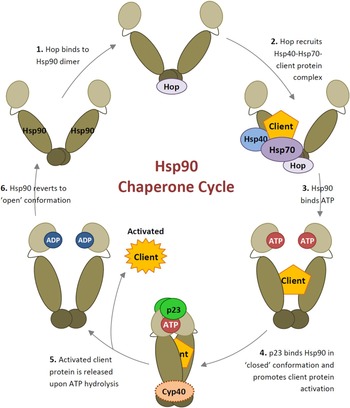
The roles of co-chaperones are best exemplified through their involvement with Hsp90 in the chaperone cycle (Fig. 1). The current knowledge of the Hsp90 chaperone cycle is largely constructed from studies on the activation process of SHR which involves several co-chaperones (Dittmar et al. Reference Dittmar, Hutchison, Owens-Grillo and Pratt1996; Owens-Grillo et al. Reference Owens-Grillo, Czar, Hutchison, Hoffmann, Perdew and Pratt1996; Pratt, Reference Pratt1998). Newly synthesized SHR nascent polypeptides are first recruited by Hsp40 to Hsp70 for folding (Laufen et al. Reference Laufen, Mayer, Beisel, Klostermeier, Mogk, Reinstein and Bukau1999; Russell et al. Reference Russell, Wali Karzai, Mehl and McMacken1999). Hsp70 would fold the nascent SHR partially and subsequently transfer it to Hsp90 through the co-chaperone Hop. Hop contains three TPR domains of which two are utilized to simultaneously bind the EEVD and MEEVD motifs present at the C-terminus of Hsp70 and Hsp90 respectively (D'Andrea and Regan, Reference D'Andrea and Regan2003). Thus, Hop serves as an adaptor that bridges the interaction between Hsp70 and Hsp90 to facilitate the transfer of client protein (Chen and Smith, Reference Chen and Smith1998). As Hsp90 functions as a dimer, a recent study has revealed that the binding of one Hop is sufficient to stabilize Hsp90 in the ‘open’ conformation for client loading (Li et al. Reference Li, Richter and Buchner2011). The other MEEVD motif in Hsp90 is preferentially occupied by an immunophilin, resulting in an asymmetric complex. Upon successful transfer of the partially folded SHR to Hsp90, the Hsp70-Hop complex would dissociate to allow progression of Hsp90 to a ‘closed’ conformation. This occurs with the binding of ATP to Hsp90 that ensues dimerization of the N-terminal domains of the Hsp90 homodimer (Prodromou et al. Reference Prodromou, Panaretou, Chohan, Siligardi, O'Brien, Ladbury, Roe, Piper and Pearl2000). This is followed by the binding of another immunophilin (i.e. FKBP51, FKBP52 or Cyp40) and the co-chaperone p23 at the N-terminal domain (Johnson and Toft, Reference Johnson and Toft1995; Sullivan et al. Reference Sullivan, Stensgard, Caucutt, Bartha, McMahon, Alnemri, Litwack and Toft1997, 2000). The immunophilins are known to regulate the activity of SHR and their interaction depends on the type of SHR to be activated. FKBP51 preferentially interacts with progesterone and glucocorticoid receptor complexes, while Cyp40 tends to accumulate with oestrogen receptor complexes (Barent et al. Reference Barent, Nair, Carr, Ruan, Rimerman, Fulton, Zhang and Smith1998). The binding of FKBP51 represses the affinity of SHR for hormones where the effect can be relieved by FKBP52 interaction (Storer et al. Reference Storer, Dickey, Galigniana, Rein and Cox2011). FKBP52 is known to potentiate hormone binding in SHR and has been implicated in the retrograde transfer of SHR from cytoplasm to nucleus. Nevertheless, the interaction sequence of FKBP51 and FKBP52 with SHR-Hsp90 complex during the chaperone cycle is still unclear. In vitro experiments indicated that the co-chaperone p23 only binds to Hsp90 in the ATP-bound state and its interaction slows the ATP hydrolysis of Hsp90 (McLaughlin et al. Reference McLaughlin, Sobott, Yao, Zhang, Nielsen, Grossmann, Laue, Robinson and Jackson2006). This led to the proposal that the role of p23 is to trap Hsp90 in the ‘closed’ conformation and prolong its interaction with the SHR. It was postulated that this ‘closed’ conformation is the stage where Hsp90 configures the client protein to the functionally active state. The importance of the co-chaperone is supported by in vitro chaperone reconstitution assay results where the activation of SHR is shown to require a minimum of five proteins, namely, Hsp40, Hsp70, Hsp90 and the co-chaperones Hop and p23 (Kosano et al. Reference Kosano, Stensgard, Charlesworth, McMahon and Toft1998). The eventual hydrolysis of ATP bound in Hsp90 would cause the dissociation of the N-terminal domains and the dislodgement of p23. Thereafter, Hsp90 would revert back to the nucleotide free or ADP-bound ‘open’ conformation and the activated SHR would be released. In the case of kinase activation, the kinase-specific co-chaperone Cdc37 is involved in the transfer and stabilization of the nascent kinase interaction with Hsp90 in the ‘open’ conformation, following recruitment by Hsp40 and Hsp70 (Kimura et al. Reference Kimura, Rutherford, Miyata, Yahara, Freeman, Yue, Morimoto and Lindquist1997; Caplan et al. Reference Caplan, Mandal and Theodoraki2007). Subsequently, another co-chaperone Aha1 would bind to Hsp90 and displace Cdc37 (Gaiser et al. Reference Gaiser, Kretzschmar and Richter2010). The co-chaperone Aha1 has been proposed as a positive regulator of Hsp90 client proteins as its binding promotes the hydrolysis of ATP in Hsp90 and leads to the release of the activated kinase. Hence, co-chaperones play a substantial role in the chaperone cycle of Hsp90 and their timely association would significantly enhance the protein folding and activation process.
The Chaperone Cycle of Hsp90. Hsp90 functions in concert with a cohort of chaperones and co-chaperones to fold and activate its client proteins. The chaperone cycle begins with the binding of co-chaperone Hop to Hsp90 in the ‘open’ conformation. Hop would then recruit the Hsp40-Hsp70-client protein complex and facilitate the transfer of the partially folded client protein to Hsp90. Subsequent binding of ATP induces dimerization at the N-terminal domain of Hsp90 resulting in the ‘closed’ conformation. The co-chaperone p23 would bind to the N-terminal domain of Hsp90 and stabilize the ‘closed’ conformation to prolong the interaction between Hsp90 and the client protein. The role of immunophilin co-chaperones (Cyp40) is not well-understood but their binding to Hsp90 has been shown to promote the activation of SHR. Upon the hydrolysis of ATP, Hsp90 reverts back to the ‘open’ conformation and the activated client protein is released.

CO-CHAPERONES IN P. FALCIPARUM
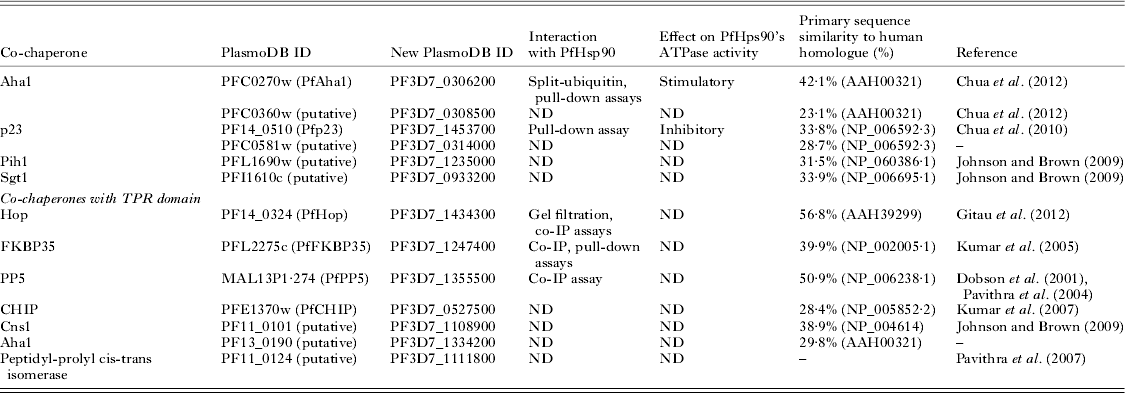
Genomic analysis has identified more than 10 co-chaperones encoded in P. falciparum based on the presence of protein motifs and domains (Table 1; Fig. 2). Nevertheless, many of them are currently annotated as putative co-chaperones as they have yet to be characterized for their functionality and association with PfHsp90. Furthermore, the putative co-chaperones share low sequence homology with the corresponding homologues in humans. So far, only five of the identified co-chaperones have been demonstrated to interact with PfHsp90, namely PfHop, Pfp23, PfAha1, PfPP5 and PfFKBP35 (Dobson et al. Reference Dobson, Kar, Kumar, Adams and Barik2001; Kumar et al. Reference Kumar, Adams, Musiyenko, Shulyayeva and Barik2005; Alag et al. Reference Alag, Bharatham, Dong, Hills, Harikishore, Widjaja, Shochat, Hui and Yoon2009; Chua et al. Reference Chua, Low, Goo and Sim2010, Reference Chua, Low, Lehming and Sim2012; Gitau et al. Reference Gitau, Mandal, Blatch, Przyborski and Shonhai2012). Expression study revealed that many of these co-chaperones (i.e. PfHop, Pfp23, PfAha1 and cyclophilins) were up-regulated together with PfHsp90 in the cluster of genes that was associated with the physiological state of P. falciparum in the active growth phase (Pallavi et al. Reference Pallavi, Acharya, Chandran, Daily and Tatu2010a ). This indicated that P. falciparum is likely to possess a functional Hsp90 chaperone system where the co-chaperones act in concert to assist the function of PfHsp90 in vivo. Apart from identifying putative co-chaperones, genomic analysis has also revealed the absence of a homologous co-chaperone Cdc37 in P. falciparum. The subsequent sections will review the current knowledge on each of the plasmodial co-chaperones identified in P. falciparum.
Comparison of protein domains of Hsp90 co-chaperones from human, Saccharomyces cerevisiae and Plasmodium falciparum. The Hsp90 co-chaperones from human (Hs), S. cerevisiae (Sc) and P. falciparum were subjected to analysis in Pfam to identify conserved protein domain(s). The GenBank accession numbers of the human and S. cerevisiae co-chaperones and PlasmoDB accession numbers of P. falciparum co-chaperones are shown. The domains are listed according to the classification used in Pfam. The numbering at the top of the bar indicates the length of the protein in amino acid residues.

PfHsp90 co-chaperones identified in P. falciparum

The percentage primary sequence similarities between the plasmodial and human homologues were determined using MatGAT. The accession numbers of the human co-chaperones are shown. ND indicates not determined.
PfHop
Studies on the eukaryotic Hsp90 system have identified Hop as a co-chaperone that mediates the interaction between PfHsp70 and Hsp90 to facilitate the transfer of client proteins (Chen and Smith, Reference Chen and Smith1998). In P. falciparum, genomic analysis revealed the presence of a single copy co-chaperone Hop (PfHop; PF14_0324). The association between Hop and Hsp70/Hsp90 was initially proposed to be conserved in the malaria parasite based on the observation of a co-immunoprecipitated complex which contained PfHsp90, PfHsp70 and a 60 kDa unknown protein that was predicted to be PfHop (Banumathy et al. Reference Banumathy, Singh, Pavithra and Tatu2003). It was not until recently that PfHop was validated to complex with PfHsp90 and PfHsp70 by gel filtration and co-immunoprecipitation analyses (Gitau et al. Reference Gitau, Mandal, Blatch, Przyborski and Shonhai2012). Localization studies further supported their association, as PfHop was observed to co-localize with PfHsp90 and PfHsp70 in the cytosol of the malaria parasite. Structural analysis revealed that PfHop contains three TPR domains (Fig. 2), similar to that observed in human Hop and yeast Sti1 (Hop homologue) where in two domains are involved in binding Hsp90 and Hsp70 simultaneously. Hence, PfHop is likely to assume a co-chaperone role in P. falciparum similar to that reported in humans and yeast.
In the genome-wide yeast two-hybrid study conducted by LaCount et al. (Reference LaCount, Vignali, Chettier, Phansalkar, Bell, Hesselberth, Schoenfeld, Ota, Sahasrabudhe, Kurschner, Fields and Hughes2005), PfHop was found to interact with a partial fragment of falcipain 2B. Falcipain 2B is a cysteine protease in P. falciparum that is involved in the degradation of haemoglobin, essential for providing amino acids to the parasite for protein synthesis (Rosenthal, Reference Rosenthal2004; Liu et al. Reference Liu, Istvan, Gluzman, Gross and Goldberg2006). Interestingly, earlier reports have implicated a role for PfHsp90 in haemoglobin metabolism. PfHsp90 and PfHsp70 were reported to associate with ferriprotoporphyrin IX, a toxic product from haemoglobin degradation (Famin and Ginsburg, Reference Famin and Ginsburg2003). The recent demonstration of PfHop association with PfHsp90 and PfHsp70 would hence suggest falcipain 2B to be a potential client protein of PfHsp90 and further support the involvement of PfHsp90 in haemoglobin metabolism.
Although Sti1 has been shown to be non-essential for viability in yeast (Giaever et al. Reference Giaever, Chu, Ni, Connelly, Riles, Veronneau, Dow, Lucau-Danila, Anderson, Andre, Arkin, Astromoff, El-Bakkoury, Bangham, Benito, Brachat, Campanaro, Curtiss, Davis, Deutschbauer, Entian, Flaherty, Foury, Garfinkel, Gerstein, Gotte, Guldener, Hegemann, Hempel, Herman, Jaramillo, Kelly, Kelly, Kotter, LaBonte, Lamb, Lan, Liang, Liao, Liu, Luo, Lussier, Mao, Menard, Ooi, Revuelta, Roberts, Rose, Ross-Macdonald, Scherens, Schimmack, Shafer, Shoemaker, Sookhai-Mahadeo, Storms, Strathern, Valle, Voet, Volckaert, Wang, Ward, Wilhelmy, Winzeler, Yang, Yen, Youngman, Yu, Bussey, Boeke, Snyder, Philippsen, Davis and Johnston2002), gene replacement studies in the parasitic protozoan Leishmania donovani have revealed LdSti1 to be crucial for the development of the parasite in the insect (promastigote) and mammalian (amastigote) stages (Morales et al. Reference Morales, Watanabe, Dacher, Chafey, Osorio y Fortea, Scott, Beverley, Ommen, Clos, Hem, Lenormand, Rousselle, Namane and Spath2010; Hombach et al. Reference Hombach, Ommen, Chrobak and Clos2012). Furthermore, deletion of the MEQVD motif in L. donovani Hsp90 that is required for interaction with LdSti1 inhibited amastigote intracellular proliferation (Hombach et al. Reference Hombach, Ommen, Chrobak and Clos2012). In the case of P. falciparum, the importance of PfHop for the growth and development of the malaria parasite has not been probed. Nevertheless, the co-expression of PfHop with PfHsp90, PfHsp70 and other co-chaperones (i.e. Pfp23, PfAha1 and cyclophilins) (Pallavi et al. Reference Pallavi, Acharya, Chandran, Daily and Tatu2010a ) may indicate a close collaboration between PfHop and PfHsp90/PfHsp70 that are essential for P. falciparum development. Hence, it may be worthwhile to explore the potential disruption of PfHop/PfHsp90/PfHsp70 pathway as a strategy for malaria inhibition.
Pfp23
The P. falciparum p23 (Pfp23; PF14_0510) was initially discovered as a 34-kDa major phosphoprotein that was highly expressed and phosphorylated in the trophozoite stage of P. falciparum intra-erythrocytic development (Wiser and Plitt, Reference Wiser and Plitt1987). Sequence analysis revealed the phosphoprotein to be a putative p23 as it shares 44% sequence identity with the Schizosaccharomyces pombe p23 (Wiser, Reference Wiser2003). Subsequent characterization study validated the role of Pfp23 as a co-chaperone of PfHsp90. Pfp23 was demonstrated to interact with PfHsp90 using GST pull-down assays and the association was dependent on the presence of ATP (Chua et al. Reference Chua, Low, Goo and Sim2010). This observation is consistent with that reported in yeast where Sba1 (p23 homologue) preferentially interacts with Hsp82 (Hsp90 homologue) in the ATP-bound state (Sullivan et al. Reference Sullivan, Stensgard, Caucutt, Bartha, McMahon, Alnemri, Litwack and Toft1997; Fang et al. Reference Fang, Fliss, Rao and Caplan1998). The residues K91, H93, W94 and K96 in Pfp23 were further identified to be crucial for PfHsp90 interaction based on site-directed mutagenesis experiments (Chua et al. Reference Chua, Low, Goo and Sim2010). The binding of Pfp23 was found to suppress the ATPase activity of PfHsp90, similar to that observed in the yeast and human homologues. By slowing the ATPase activity, p23 traps Hsp90 in the ATP-bound state and this has been proposed to prolong client protein interaction for promoting functional activation (McLaughlin et al. Reference McLaughlin, Sobott, Yao, Zhang, Nielsen, Grossmann, Laue, Robinson and Jackson2006).
Apart from being a co-chaperone, Pfp23 also exhibited intrinsic chaperone activity that is independent of PfHsp90. Pfp23 was able to suppress protein aggregation and this ability was attributed to its C-terminal tail (Chua et al. Reference Chua, Low, Goo and Sim2010). In addition, sequence analysis revealed the presence of a unique tandem sequence repeats of GNMGGL×7 in Pfp23. With the demonstration that the sequence repeats are non-essential for interaction with PfHsp90 using protein truncation experiments, their function currently remains unknown.
Genomic analysis also uncovered another putative p23 homologue (PFC0581w) in P. falciparum. PFC0581w was observed to possess the characteristic CS-domain found in p23 (Fig. 2). In addition, PFC0581w also contains a signal peptide at the N-terminal end. The signal peptide was predicted to be a nuclear localization signal (ESLPred). This is not surprising as the human p23 and yeast Sba1 have been reported to translocate into the nucleus to facilitate Hsp90 function (Tanioka et al. Reference Tanioka, Nakatani, Semmyo, Murakami and Kudo2000; Stavreva et al. Reference Stavreva, Muller, Hager, Smith and McNally2004; Picard, Reference Picard2006; Tapia and Morano, Reference Tapia and Morano2010). Nevertheless, PFC0581w has not been characterized and thus its association with PfHsp90 and function in P. falciparum are currently unknown.
In a recent study on cancer inhibition, the anti-cancer compound gedunin has been identified as a specific inhibitor of p23 (Patwardhan et al. Reference Patwardhan, Fauq, Peterson, Miller, Blagg and Chadli2013). Gedunin binds p23 and abrogates interaction with Hsp90, resulting in cancer cell death. Although gedunin was previously shown to inhibit the chaperone function of Hsp90, the precise inhibitory mechanism was unclear as gedunin did not bind to the N-terminal or the C-terminal of Hsp90 like most Hsp90-specific inhibitors (e.g. ansamycin antibiotics, radicicol and novobiocin, respectively) (Hieronymus et al. Reference Hieronymus, Lamb, Ross, Peng, Clement, Rodina, Nieto, Du, Stegmaier, Raj, Maloney, Clardy, Hahn, Chiosis and Golub2006; Matts et al. Reference Matts, Brandt, Lu, Dixit, Mollapour, Wang, Donnelly, Neckers, Verkhivker and Blagg2011). Hence, the recent study has revealed gedunin as a novel type of compound that inhibits cancer by disrupting the function of Hsp90 in an indirect manner through co-chaperone inhibition. Interestingly, gedunin is a natural compound found in the Meliacae family plants that have been used for centuries as a traditional medicine for malaria treatment (MacKinnon et al. Reference MacKinnon, Durst, Arnason, Angerhofer, Pezzuto, Sanchez-Vindas, Poveda and Gbeassor1997). The recent discovery of gedunin as a specific inhibitor of p23 thus provided two surprising and important insights: (1) the Hsp90 chaperone machinery may have long been a target of certain components in traditional medicine used for malaria treatment, even before the discovery of Hsp90 and (2) the inactivation of co-chaperone although indirect, could prove to be a feasible approach to inhibit the function of Hsp90.
PfAha1
Plasmodium falciparum encodes an Aha1 (PfAha1; PFC0270w) that shares approximately 20% amino acid identity with the human and yeast Aha1. So far, PfAha1 has been shown to interact with PfHsp90 using the split-ubiquitin and GST pull-down assays (Chua et al. Reference Chua, Low, Lehming and Sim2012). The binding of PfAha1 to PfHsp90 was found to be ATP-dependent similar to that observed for Pfp23-PfHsp90 interaction. However, unlike Pfp23 that exerts an ATPase inhibitory effect on PfHsp90, PfAha1 was found to stimulate the hydrolysis of ATP in Hsp90 upon binding. Site-directed mutagenesis further revealed the residue N108 in PfAha1 to be essential for PfHsp90 interaction. Mutation of PfAha1 residue N108 to an alanine resulted in reduced binding and stimulation of the ATPase activity of PfHsp90. In addition, PfAha1 was also found to compete with Pfp23 to interact with PfHsp90. Although the order of their interaction with PfHsp90 could not be established, biocomputational analysis revealed an overlapping binding site between PfAha1 and Pfp23 in PfHsp90. Hence, the two co-chaperones appear to compete with one another to regulate the function of PfHsp90 through modulating its ATPase activity.
Genomic analysis has further identified two putative Aha1 in P. falciparum, namely PFC0360w and PF13_0190. Comparison of the protein sequences revealed PFC0360w (140 amino acids) to be significantly smaller than PfAha1 (349 amino acids), the human Aha1 (338 amino acids) and yeast Aha1 (350 amino acids) (Chua et al. Reference Chua, Low, Lehming and Sim2012). Sequence alignment analysis also indicated that PFC0360w aligned to the C-terminal domain of the human and yeast Aha1 and it lacks a homologous N-terminal ‘Aha1_N domain’ (Fig. 2). As the N-terminal domain of Aha1 is known to be essential for interaction with Hsp90, it is thus unclear if PFC0360w is able to interact with PfHsp90. In contrast to PFC0360w, PF13_0190 is a relatively larger protein with 524 amino acid residues and is currently annotated as a putative chaperone binding protein in PlasmoDB. Interestingly, the ‘Aha1_N domain’ detected in PF13_0190 was found to be located at the C-terminal domain while the N-terminal domain was observed to contain a TPR domain (TPR_11 domain; Fig. 2). As Aha1 co-chaperones in eukaryotes are not known to possess TPR-domain, the unique combination of Aha1 and TPR domains in PF13_0190 is intriguing. It would be interesting to investigate if PF13_0190 engages PfHsp90 and examine the roles of Aha1 and TPR domains in PfHsp90 interaction.
Immunophilins in P. falciparum
Studies on the involvement of Hsp90 in the activation of SHR have led to the identification of another group of co-chaperones known as the immunophilins (Pratt and Toft, Reference Pratt and Toft1997). Immunophilins are proteins with peptidyl-prolylisomerase (PPIase) activity (Fanghanel and Fischer, Reference Fanghanel and Fischer2004) and are broadly classified into two protein families based on their drug-binding properties; immunophilin with PPIase activity inhibited by cyclosporine A is known as a cyclophilin (Cyp) whereas that abrogated by FK-506 is termed as a FK-506 binding protein (FKBP). The PPIase activities of cyclophilin and FKBP are attributed to the PPIase domains (also the inhibitor binding site) which have been shown to be structurally distinct between the two families (Barik, Reference Barik2006). Some members of the cyclophilin and FKBP families contain an additional TPR domain that allows interaction with Hsp90 at the conserved C-terminal MEEVD motif. So far, the mammalian Cyp40 (Cpr6 and Cpr7 in yeast) (Duina et al. Reference Duina, Marsh and Gaber1996; Ratajczak et al. Reference Ratajczak, Ward, Cluning and Allan2009), FKBP51 and FKBP52 (Pirkl and Buchner, Reference Pirkl and Buchner2001) have been shown to possess both the PPIase and TPR domains. They function as co-chaperones by interacting with Hsp90 and assisting the chaperone in the activation of SHR.
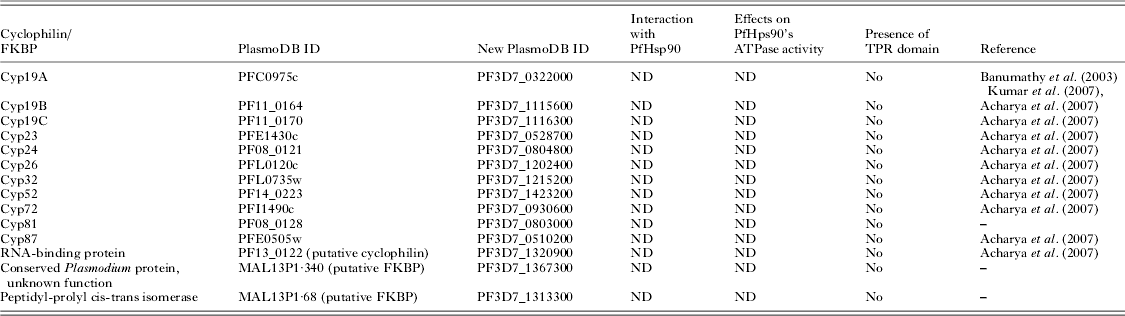
Genomic analysis indicated that P. falciparum encodes 11 cyclophilins and at least one FKBP (Table 2). One of the cyclophilins, PfCyp19a, has been proposed as a co-chaperone of PfHsp90 presumably due to its sequence similarity with the human Cyp40 (Kumar et al. Reference Kumar, Pavithra and Tatu2007). PfCyp19a contains a conserved Cyp-like PPIase domain that is found in Cyp40 and also present in the other 10 cyclophilins identified in P. falciparum. However, sequence analysis also revealed that all the 11 cyclophilins in P. falciparum lack a TPR domain. Since the TPR domain is essential for Hsp90 interaction, coupled with the lack of experimental evidence, it is currently unclear whether any of the P. falciparum cyclophilins could interact with PfHsp90 and function as a co-chaperone as proposed in previous studies.
Cyclophilins and FKBPs identified in P. falciparum

ND indicates not determined.
In the case of FKBPs, P. falciparum encodes three genes with FKBP-like PPIase domain (FKBP_C domain; Tables 1 and 2; Fig. 2). However, only one of them, namely PfFKBP35, possesses an additional TPR domain known to be important for Hsp90 interaction. PfFKBP35 has since been functionally characterized (Kumar et al. Reference Kumar, Adams, Musiyenko, Shulyayeva and Barik2005; Monaghan and Bell, Reference Monaghan and Bell2005).
The PfFKBP35 is a 35-kDa protein with an N-terminal FKBP-like PPIase domain and a C-terminal TPR domain. PfFKBP35 was shown to be functional in that it exhibited a PPIase activity that is sensitive to inhibition by FK-506, rapamycin and ascomycin (FK-506 derivative) (Kumar et al. Reference Kumar, Adams, Musiyenko, Shulyayeva and Barik2005). PfFKBP35 was further demonstrated to be a specific target of ascomycin in P. falciparum through affinity chromatography analysis. In addition, co-immunoprecipitation and pull-down assays have confirmed the ability of PfFKBP35 to interact with PfHsp90, providing support for its role as a co-chaperone. Truncation analysis further verified the TPR domain of PfFKBP35 to be essential for PfHsp90 interaction. However, the effect of PfFKBP35 binding on the activity of PfHsp90 has not been investigated and thus, it is currently unknown how PfFKBP35 would contribute to the function of PfHsp90 in the malaria parasite. Interestingly, the PPIase inhibitor ascomycin was found to demonstrate synergistic antimalarial activity with geldanamycin (Hsp90 inhibitor). Although FK-506 has previously been reported to have antimalarial activity when investigated singly (Bell et al. Reference Bell, Wernli and Franklin1994), the precise mechanism by which the abrogation of PfFKBP35 PPIase could lead to malaria inhibition was not elucidated. Currently it is unknown if the PPIase inhibition by FK-506 would have an effect on PfFKBP35 interaction with PfHsp90, and consequently, the biological processes that depend on their interaction for regulation/activation, or affect PfFKBP35 pathways that are independent of PfHsp90 involvement. The lack of information on the antimalarial mechanism of FK-506 would preclude understanding on the synergism observed between ascomycin and geldanamycin. Nevertheless, the synergism achieved has highlighted the possibility of targeting PfFKBP35 and PfHsp90 in combination for improved malaria inhibition.
Furthermore, X-ray and NMR crystallography studies have also revealed subtle differences between PfFKBP35 and the human FKBP12 that could be exploited for designing inhibitors that selectively inhibit the plasmodial homologue (Kotaka et al. Reference Kotaka, Ye, Alag, Hu, Bozdech, Preiser, Yoon and Lescar2008). The structural differences lie in the β5–β6 segment of the PPIase domain where PfFKBP35 contains a cysteine and serine residue at amino acid positions 106 and 109, respectively, instead of a histidine (H87) and isoleucine (I90) residue found at the corresponding position in human FKBP12. Indeed, a recent study on the design of small molecules that target the conserved C106/C105 and S109/S108 residues in PfFKBP35/Plasmodium vivax FKBP35 (PvFKBP35) to achieve selectivity, has identified a novel ligand D44 (N-(2-Ethyl-phenyl)-2-(3H-imidazao [4, 5-b] pyridin-2-ylsulfanyl)-acetamide) with potent inhibitory activity against the plasmodial FKBP35 (Harikishore et al. Reference Harikishore, Niang, Rajan, Preiser and Yoon2013). D44 displayed approximately 100-fold higher selectivity towards the inhibition of plasmodial FKBPs over the human FKBPs (FKBP12 and FKBP52). Structural analysis revealed that the high selectivity towards plasmodial FKBPs is attributed to improved proximity between D44 and the conserved C106/C105 and S109/S108 amino acid residues in PfFKBP35/PvFKBP35. In addition, another study has proposed the incorporation of a bulky hydrophobic group at C-11 of FK-506 that would cause steric clashes with the residues H87 and I90 in FKBP12, as a potential strategy for engineering inhibitors that are selective towards PfFKBP35 while avoiding off-target effects on human FKBP12 (Bharatham et al. Reference Bharatham, Chang and Yoon2011).
Apart from the PPIase and PfHsp90-binding properties, PfFKBP35 has also been shown to inhibit the phosphatase activity of calcineurin (Kumar et al. Reference Kumar, Adams, Musiyenko, Shulyayeva and Barik2005; Monaghan and Bell, Reference Monaghan and Bell2005). The inhibition of calcineurin by PfFKBP35 is independent of FK-506-binding which is distinct from the FK-506-dependent calcineurin inhibitory activity observed in human FKBP12. The inhibition of calcineurin activity by PfFKBP35 has been proposed to be related to cell-cycle regulation in the malaria parasite.
PfPP5
Plasmodium falciparum PP5 (PfPP5) is a Ser/Thr phosphatase and the first tetratricopeptide repeat-containing protein in P. falciparum that was characterized (Dobson et al. Reference Dobson, Kar, Kumar, Adams and Barik2001). PfPP5 was identified by PCR-based approach using degenerate deoxyoligonucleotide primers, prior to the availability of P. falciparum genome data. Sequence analysis indicated that PfPP5 contained an N-terminal TPR domain followed by a Ser/Thr phosphatase catalytic core at the C-terminal domain. PfPP5 demonstrated functional phosphatase activity through its ability to dephosphorylate phosphohistone. The phosphatase activity of PfPP5 was auto-inhibited by the TPR domain at the N-terminal region but can be relieved by unsaturated fatty acids (i.e. arachidonic acid) that bind to the TPR domain. Hence, the TPR domain has been suggested as a negative regulator of PfPP5 phosphatase activity. Apart from the regulation of the phosphatase activity, the TPR domain is essential for the interaction between PfPP5 and PfHsp90. PfHsp90 was found to co-immunoprecipitate with PfPP5 using anti-PfPP5 antibody. As the mammalian PP5 has previously been identified as a component of the mature glucocorticoid receptor complexes chaperoned by Hsp90 (Chen et al. Reference Chen, Silverstein, Pratt and Chinkers1996; Silverstein et al. Reference Silverstein, Galigniana, Chen, Owens-Grillo, Chinkers and Pratt1997), PfPP5 was consequently proposed to assume a similar co-chaperone role in P. falciparum.
In yeast, Ppt1 (PP5 homologue) has been demonstrated to specifically dephosphorylate Hsp82 (Wandinger et al. Reference Wandinger, Suhre, Wegele and Buchner2006). Deletion of Ppt1 in yeast led to hyperphosphorylation of Hsp90 and reduced efficiency of the Hsp90 chaperone system in activating client proteins (e.g. glucocorticoid receptors, v-Src and Ste11). In addition, PP5/Ppt1 was also found to dephosphorylate another co-chaperone Cdc37 at the phosphorylated S13 residue and modulate its activity in recruiting protein kinase clients to Hsp90 (Vaughan et al. Reference Vaughan, Mollapour, Smith, Truman, Hu, Good, Panaretou, Neckers, Clarke, Workman, Piper, Prodromou and Pearl2008). Hence, PP5/Ppt1 has been suggested as a positive modulator for the activation of Hsp90 client proteins. In the case of P. falciparum, although PfPP5 interacts with PfHsp90 (Dobson et al. Reference Dobson, Kar, Kumar, Adams and Barik2001), it remains unclear whether PfPP5 exerts its phosphatase activity on PfHsp90. Further investigation to examine the phosphorylation status of PfHsp90 in the presence or absence of PfPP5 is necessary to reveal any phosphoregulatory role that PfPP5 may have on PfHsp90.
In addition, the N-terminal TPR domain of PfPP5 has also been proposed as a useful site for designing selective inhibitors (Dobson et al. Reference Dobson, Kar, Kumar, Adams and Barik2001). This is due to the observation that PfPP5 possesses an unusually long TPR domain with four TPR motifs as opposed to three that are observed in homologues of other species, including human. The additional TPR motif and a preceding 22-spacer linker in the TPR domain of PfPP5 have thus been suggested as potential target sites for drug designing.
Other putative plasmodial co-chaperones identified
Several other putative PfHsp90 co-chaperones have been identified based on protein domain homology. They include homologues of Sgt1 (PFI1610c), Pih1 (PFL1690w), Cns1 (PF11_0101) and CHIP (PFE1370w). As these putative co-chaperones have not been characterized, their functionality and respective association with PfHsp90 in P. falciparum remain elusive.
The co-chaperone Sgt1 is best known for its involvement in the innate immune system of plants (Muskett and Parker, Reference Muskett and Parker2003). Sgt1 is distantly related to the co-chaperone p23. Both the co-chaperones possess a structurally similar CS-domain that mediates interaction with Hsp90 (Lee et al. Reference Lee, Jacob, Michowski, Nowotny, Kuznicki and Chazin2004). Nevertheless, the binding site of Sgt1 on Hsp90 is different from that of p23 and the interaction of Sgt1, unlike p23, does not appear to influence the ATPase activity of Hsp90 (Kadota et al. Reference Kadota, Amigues, Ducassou, Madaoui, Ochsenbein, Guerois and Shirasu2008; Zhang et al. Reference Zhang, Boter, Li, Kadota, Panaretou, Prodromou, Shirasu and Pearl2008). Although the human Sgt1 contains an additional TPR domain, the domain was not involved in Hsp90 interaction as demonstrated through binding studies. Recent evidence indicated that the Sgt1 associates with Hsp90 and another co-chaperone Rar1 to form a ternary complex that may be essential for the stabilization and activation of NLR (nucleotide-binding domain and leucine-rich repeat containing) proteins (Takahashi et al. Reference Takahashi, Casais, Ichimura and Shirasu2003; Kadota et al. Reference Kadota, Shirasu and Guerois2010). In support of the importance of NLR proteins as pathogen-sensing systems in plants and mammals, the knockdown of Sgt1 has been reported to inhibit the formation of inflammasome and NLR-mediated transcriptional response (Mayor et al. Reference Mayor, Martinon, De Smedt, Petrilli and Tschopp2007).
The co-chaperone Pih1 has been implicated with Hsp90 in regulating pre-rRNA processing (Zhao and Houry, Reference Zhao and Houry2005). Pih1 is an unstable protein that is prone to aggregation in vitro (Zhao et al. Reference Zhao, Kakihara, Gribun, Huen, Yang, Khanna, Costanzo, Brost, Boone, Hughes, Yip and Houry2008). Pih1 interacts with Hsp90 with the assistance of another co-chaperone Tah1 to form a stable and functional ternary complex (Eckert et al. Reference Eckert, Saliou, Monlezun, Vigouroux, Atmane, Caillat, Quevillon-Cheruel, Madiona, Nicaise, Lazereg, Van Dorsselaer, Sanglier-Cianferani, Meyer and Morera2010). Tah1 mediates the interaction by using its TPR domain to associate with Hsp90 while the C-terminus binds Pih1. Studies on yeast and mammalian cells revealed the involvement of the Hsp90-Tah1-Pih1 complex in the assembly of box C/D small nucleolar ribonucleoproteins and ribosomal RNA processing (Zhao et al. Reference Zhao, Kakihara, Gribun, Huen, Yang, Khanna, Costanzo, Brost, Boone, Hughes, Yip and Houry2008; Eckert et al. Reference Eckert, Saliou, Monlezun, Vigouroux, Atmane, Caillat, Quevillon-Cheruel, Madiona, Nicaise, Lazereg, Van Dorsselaer, Sanglier-Cianferani, Meyer and Morera2010). In the case of P. falciparum, BLAST analysis was unable to identify a Tah1 homologue in the genome of the malaria parasite. The sequence that showed the highest similarity to that of Tah1 was PfHop as it shares a homologous TPR domain. Hence, it is currently unknown whether the putative Pih1 identified in P. falciparum would assume a similar co-chaperone role to PfHsp90 in the absence of Tah1.
Cns1 is a TPR-domain-containing co-chaperone that is essential for the viability of Saccharomyces cerevisiae (Dolinski et al. Reference Dolinski, Cardenas and Heitman1998; Marsh et al. Reference Marsh, Kalton and Gaber1998). Overexpression of Cns1 was able to suppress the slow growth phenotype and reduced activity of Hsp90 that resulted from the gene deletion of Cpr7 (cyclophilin homologue in yeast). In a recent study where Cpr7 was shown to be essential in yeast strain carrying Hsp90 with the charged linker region deleted, overexpression of Cns1 was found to rescue the yeast strain lacking in Cpr7 from synthetic lethality (Zuehlke and Johnson, Reference Zuehlke and Johnson2012). Hence, Cns1 and Cpr7 appear to have some functional overlap. As P. falciparum does not possess a homologue of Cyp40/Cpr6/Cpr7, the putative Cns1 (PF11_0101) identified may potentially function in a similar manner to that of a cyclophilin homologue in regulating the function of PfHsp90.
CHIP (carboxyl-terminus of Hsc70 interacting protein) was first identified as a co-chaperone of Hsc70 involved in targeting proteins for degradation (Ballinger et al. Reference Ballinger, Connell, Wu, Hu, Thompson, Yin and Patterson1999; Murata et al. Reference Murata, Minami, Minami, Chiba and Tanaka2001). Subsequent interaction studies revealed that this co-chaperone also binds to Hsp90 (Connell et al. Reference Connell, Ballinger, Jiang, Wu, Thompson, Hohfeld and Patterson2001).The human CHIP contains two domains; a TPR domain for interaction with Hsc70 and Hsp90 and a U-box domain with ubiquitin ligase activity. The binding of CHIP results in the ubiquitination of client proteins and subsequent degradation by proteasome. Recent studies have indicated that the alternate binding of CHIP and Hop to Hsp90 are likely to determine the fate of the client protein, whether to be folded or degraded (Kundrat and Regan, Reference Kundrat and Regan2010; Muller et al. Reference Muller, Ruckova, Halada, Coates, Hrstka, Lane and Vojtesek2013). The binding of CHIP triggers protein degradation and is enhanced when the C-terminal of Hsp90 is unphosphorylated. On the contrary, Hop preferentially binds to a phosphorylated Hsp90 and promotes protein folding. The regulation of cellular protein levels has implicated CHIP in several diseases such as Alzheimer's, Parkinson's and cancer (McDonough and Patterson, Reference McDonough and Patterson2003; Dickey et al. Reference Dickey, Kamal, Lundgren, Klosak, Bailey, Dunmore, Ash, Shoraka, Zlatkovic, Eckman, Patterson, Dickson, Nahman, Hutton, Burrows and Petrucelli2007; Ko et al. Reference Ko, Bailey, Smith, Liu, Shin, Lee, Zhang, Jiang, Ross, Moore, Patterson, Petrucelli, Dawson and Dawson2009). Although shown to be an important Hsp90 co-chaperone, a CHIP homologue is absent in yeast whereas the homologue identified in P. falciparum was observed to lack a U-box domain essential for the ubiquitination process.
Plasmodium falciparum lacks Cdc37
Cdc37 is a co-chaperone of Hsp90 known to be important for the activation of a diverse group of protein kinases e.g. Cdk4, Akt, v-Src, Raf and CK2 (Lamphere et al. Reference Lamphere, Fiore, Xu, Brizuela, Keezer, Sardet, Draetta and Gyuris1997; Perdew et al. Reference Perdew, Wiegand, Vanden Heuvel, Mitchell and Singh1997; Basso et al. Reference Basso, Solit, Chiosis, Giri, Tsichlis and Rosen2002; Bandhakavi et al. Reference Bandhakavi, McCann, Hanna and Glover2003). Cdc37 has been proposed to function as an adaptor that would recruit nascent or unstable kinases to Hsp90 for folding into their active conformation. Indeed, as many as 65% of the kinases in yeast were reported to require Cdc37 for activation and stabilization (Mandal et al. Reference Mandal, Lee, Chen, Nillegoda, Heller, DiStasio, Oen, Victor, Nair, Brodsky and Caplan2007). As many of the kinases have essential signal transduction roles that regulate growth and development, Cdc37 is thus recognized as an important component of the Hsp90 chaperone machinery. Consequently, it is intriguing that inspection of the P. falciparum genome reveals the lack of a homologous Cdc37. On a broader perspective, a study that surveyed the presence of co-chaperones in 19 disparate eukaryotic organisms has found that Cdc37 appeared to be one of the co-chaperones that are least conserved, as it was present only in 9 of the 19 species examined (Johnson and Brown, Reference Johnson and Brown2009). In light of the observation, two plausible explanations have been suggested: (1) the kinases in these organisms have reduced dependency on Cdc37 and/or Hsp90 for stability and activation and/or (2) other co-chaperones such as Hop may have overlapping functions with Cdc37 and would carry out the ‘adaptor’ function in the absence of the latter. In the case of P. falciparum, the apicomplexan parasite is further known to possess a kinome that is divergent from other eukaryotes (Ward et al. Reference Ward, Equinet, Packer and Doerig2004). The divergent kinome would certainly add an additional layer of uncertainty as to whether plasmodial kinases are dependent on PfHsp90 for their functionality. Nevertheless, homologues of certain important kinases that are known to associate with Cdc37 such as Cdk1 (PfPK5; MAL13P1·279), Akt (PfPKB; PFL2250c) and CK2 (PfCK2; PF11_0096) are conserved and have been identified in P. falciparum. It would be interesting to investigate whether these plasmodial kinases would require PfHsp90 for their functional activation. This may potentially also reveal any unique mechanism by which kinases are recruited to PfHsp90 in the malaria parasite.
ARE CO-CHAPERONES POTENTIAL TARGETS FOR MALARIA INHIBITION?
Although Hsp90 is widely known to be a potent drug target and that co-chaperones are important regulators of its function, there has been little discussion and consideration on the targeting of co-chaperones for disrupting the activity of Hsp90 to achieve similar cellular inhibition outcome. This is likely to be due to two reasons: (1) Genetic deletion studies in yeast indicated that most co-chaperones are not essential for viability (Giaever et al. Reference Giaever, Chu, Ni, Connelly, Riles, Veronneau, Dow, Lucau-Danila, Anderson, Andre, Arkin, Astromoff, El-Bakkoury, Bangham, Benito, Brachat, Campanaro, Curtiss, Davis, Deutschbauer, Entian, Flaherty, Foury, Garfinkel, Gerstein, Gotte, Guldener, Hegemann, Hempel, Herman, Jaramillo, Kelly, Kelly, Kotter, LaBonte, Lamb, Lan, Liang, Liao, Liu, Luo, Lussier, Mao, Menard, Ooi, Revuelta, Roberts, Rose, Ross-Macdonald, Scherens, Schimmack, Shafer, Shoemaker, Sookhai-Mahadeo, Storms, Strathern, Valle, Voet, Volckaert, Wang, Ward, Wilhelmy, Winzeler, Yang, Yen, Youngman, Yu, Bussey, Boeke, Snyder, Philippsen, Davis and Johnston2002). While co-chaperones modulate and enhance the efficiency of Hsp90 chaperone activity, they are not an absolute requirement for Hsp90 to function per se. Hence, it is unlikely that their inhibition would result in cellular arrest expected from the inhibition of a drug target. (2) The identification of inhibitors that can disrupt the interaction between Hsp90 and co-chaperones are generally perceived to be difficult. This is because most of the interaction interfaces are located on the surface of the protein and finding small molecules that can bind to such exposed regions remains a challenge (Fletcher and Hamilton, Reference Fletcher and Hamilton2006). Hence, co-chaperones are rarely considered as drug targets and most of the studies conducted so far have focused mainly on understanding their roles in regulating the function of Hsp90.
Nevertheless, an increasing number of studies have emerged that seemed to suggest otherwise, indicating the potential in targeting co-chaperones for therapeutic purposes. Firstly, recent gene replacement studies on the protozoa L. donovani have revealed that the co-chaperone Hop is essential for the development of the parasite (Hombach et al. Reference Hombach, Ommen, Chrobak and Clos2012). The observation is in contrast with that of yeast where Hop was shown to be dispensable for viability. This discrepancy revealed that the roles and importance of co-chaperones may vary among organisms and they can potentially be exploited as drug targets in organisms where they are essential. Secondly, the recent discovery of gedunin as a specific inhibitor of p23 (Patwardhan et al. Reference Patwardhan, Fauq, Peterson, Miller, Blagg and Chadli2013) has demonstrated the possibility of designing compounds that can target the co-chaperones to achieve Hsp90 inhibition. Unlike the inhibitor celastrol that is known to bind to Hsp90 and prevent its interaction with the co-chaperone Cdc37 (Zhang et al. Reference Zhang, Li, Yu, Zou, Jiang and Sun2009), gedunin acts directly on the co-chaperone. Gedunin associates with p23 and inhibits its interaction with Hsp90, resulting in cancer cell death by apoptosis. This finding provides much encouragement for studies aimed at identifying chaperone-specific inhibitors and further supports investigation on the inhibition of co-chaperones as a potential approach to abrogate the function of Hsp90.
Lastly, several studies have revealed that co-chaperones can influence the sensitivity of cells towards Hsp90 inhibitors. Genetic studies in yeast revealed that strains with co-chaperone genes Sti1 and Sba1 deleted individually, displayed phenotypes that are hypersensitive to Hsp90-specific inhibitors. These observations indicated that the presence of Hop/Sti1 and p23/Sba1 would interfere with the biological effects of the inhibitors (Piper et al. Reference Piper, Millson, Mollapour, Panaretou, Siligardi, Pearl and Prodromou2003). Subsequent in vitro binding assays demonstrated that this could be due to diminished affinity of Hsp90 for the inhibitors when the molecular chaperone interacts and complexes with Hop/Sti1 and p23/Sba1, respectively. The binding of Hop/Sti1 resulted in an Hsp90 conformation with low affinity for the inhibitors (Prodromou et al. Reference Prodromou, Siligardi, O'Brien, Woolfson, Regan, Panaretou, Ladbury, Piper and Pearl1999), whereas p23/Sba1 trapped Hsp90 in the ATP-bound state, thereby preventing the inhibitor that shares the same binding site as ATP from interacting with Hsp90 (Forafonov et al. Reference Forafonov, Toogun, Grad, Suslova, Freeman and Picard2008). Similar protective effects against Hsp90-specific inhibitors have also been described for Aha1 (Zurawska et al. Reference Zurawska, Urbanski, Matuliene, Baraniak, Klejman, Filipek, Matulis and Bieganowski2010). It was observed that Hsp90 mutants that bind Aha1 tightly were able to suppress the lethal cellular effects exerted by Hsp90-specific inhibitors. As isothermal titration calorimetric analysis indicated that Aha1 interaction did not significantly affect the affinity of Hsp90 for the inhibitors, the protective effects observed were attributed to improved chaperone function of Hsp90 (by having a higher ATPase activity) upon Aha1 association. Conceivably, the activation of Hsp90 activity would negate the loss of function in a subset of Hsp90 with the inhibitors bound which normally would have caused a collapse in the cellular activities. Collectively, these studies indicated that the abrogation of certain co-chaperone interactions with Hsp90 could potentially enhance the lethal cellular effects of Hsp90-specific inhibitors.
Taken together, these recent findings have highlighted that targeting co-chaperones, whether singly or in combination with Hsp90-specific inhibitor, may have potential therapeutic value. Nevertheless, it is clear that co-chaperones have to be evaluated independently in the organism/pathogen of interest to assess their cellular importance and potential application as drug targets. In the case of P. falciparum, it is thus imperative to (1) examine the essential nature of the co-chaperones in the protozoan parasite (i.e. through gene knock-out studies) to determine if they are feasible targets for inhibition and (2) assess the influence of co-chaperone associations on the affinity of PfHsp90 for the inhibitors. The latter would explore the approach of targeting co-chaperones to accentuate the inhibitory effect of Hsp90-specific inhibitors for antimalarial purposes.
CONCLUSION
The eukaryotic co-chaperones have been extensively studied for their regulation on the function of Hsp90 over the past decade (Li et al. Reference Li, Soroka and Buchner2012; Prodromou, Reference Prodromou2012). Although biochemical and structural analyses have provided significant insights of how co-chaperones interact and modulate the activity of Hsp90, many aspects of their contributions to protein folding and activation process have remained unresolved. This could be largely due to the dynamic nature of Hsp90 which presents a constant challenge for structural analysis of its interaction with the co-chaperones, as well as the vast number and complexity of Hsp90 client proteins network. Some of the areas that have not been well-understood include (1) whether co-chaperones play a role in assisting Hsp90 in recognizing its large number of client proteins that do not seem to share a common protein motif for Hsp90 interaction, (2) the combination of co-chaperones specific to each client protein since Hsp90 is known to be assisted by different sets of co-chaperones when chaperoning various client proteins, (3) the order in which the various co-chaperones interact with Hsp90 during the chaperone cycle and (4) how post-translational modification (e.g. phosphorylation) would affect co-chaperone interactions with Hsp90 and the eventual activation of the client proteins. In addition, there is also an emerging interest in the investigation of the native biological functions of co-chaperones as some of them have demonstrated chaperone activity and interaction profiles that are independent of Hsp90.
The queries raised in the study of eukaryotic co-chaperones could similarly be extended to the P. falciparum Hsp90 chaperone system. However, as many of the putative co-chaperones identified in the genome of P. falciparum have yet to be experimentally validated, it is imperative to ascertain their functionality and interaction with PfHsp90 prior to further investigation. As PfHsp90 is considered to be a promising antimalarial drug target and that certain eukaryotic co-chaperones have been reported to confer protection against the lethal cellular effect of Hsp90-specific inhibitors, it would certainly be of interest to investigate if the plasmodial co-chaperone interactions would also influence the effects of the inhibitors in a similar manner. The simultaneous inhibition of co-chaperone may potentially enhance the lethal cellular effects of Hsp90-specific inhibitors through this combinatorial approach. Indeed, the Hsp90-specific inhibitor geldanamycin and PfFKBP35 inhibitor ascomycin have been reported to inhibit the growth of P. falciparum culture in a synergistic manner in vitro, although the precise mechanisms of the synergism observed have not been elucidated (Kumar et al. Reference Kumar, Adams, Musiyenko, Shulyayeva and Barik2005). In addition, the recent discovery of the anti-cancer compound gedunin, a p23-specific inhibitor found in traditional antimalarial medicine (Patwardhan et al. Reference Patwardhan, Fauq, Peterson, Miller, Blagg and Chadli2013), would suggest plasmodial co-chaperones as potential molecular targets that can be inhibited singly for antimalarial purposes. The cellular influences of co-chaperones that extend beyond the regulation of Hsp90 are certainly beginning to be appreciated. Their potential roles as drug targets and influence on the effects of Hsp90 inhibitors would warrant investigation of the plasmodial co-chaperones to facilitate and improve antimalarial inhibition strategies targeted against the Hsp90 co-chaperone interactions in P. falciparum.