


Introduction
Recent meta-analyses substantiate the effectiveness of brief positive interventions (Bolier et al., Reference Bolier, Haverman, Westerhof, Riper, Smit and Bohlmeijer2013) in reducing symptoms and fostering well-being. Such interventions aim to increase positive feelings, behaviours and cognitions. They complement approaches focusing on a reduction of problem factors and symptoms that are associated with stress. Effects of positive interventions are generally small for depressive symptoms, psychological and subjective well-being, but respectable considering the short duration of most interventions (Bolier et al., Reference Bolier, Haverman, Westerhof, Riper, Smit and Bohlmeijer2013).
The ‘Personal Model of Resilience’ (PMR) by Padesky and Mooney (Reference Padesky and Mooney2012) is a cognitive behavioural intervention focusing on the person's strengths. Padesky and Mooney define resilience ‘as the ability to cope and adapt in the face of adversity and/or to bounce back and restore positive functioning when stressors become overwhelming’ (Reference Padesky and Mooney2012, p.1). In the PMR, therapists focus on resilience skills, analyse them collaboratively with patients and try to make them fruitful for coping with current challenges and stressful life events.
To evaluate the PMR in this pilot study, we focused on a sample of first-year students confronted with interpersonal, intrapersonal, academic and environmental stressors (Ross et al., Reference Ross, Niebling and Heckert1999). As stress, depressive and other symptoms are prevalent among students at transition to university (Dyson and Renk, Reference Dyson and Renk2006) and resilience strategies enhance quality of life in students (Tempski et al., Reference Tempski, Santos, Mayer, Enns, Perotta and Paro2015) we chose this vulnerable sample as focus of this intervention originally developed for depression and anxiety. Following this research and other positive intervention studies (Bolier et al., Reference Bolier, Haverman, Westerhof, Riper, Smit and Bohlmeijer2013), the focus is on the following outcome criteria: reduction of distress (general symptomatology, depression and anxiety; e.g. Dyson and Renk, Reference Dyson and Renk2006), protective factors related to resilience like optimism (e.g. Herman-Stahl and Petersen, Reference Herman-Stahl and Petersen1996) and self-esteem (e.g. Dumont and Provost, Reference Dumont and Provost1999), as well as quality of life (e.g. Tempski et al., Reference Tempski, Santos, Mayer, Enns, Perotta and Paro2015).
Method
Study design
The intervention was evaluated in an intervention group–control group design with a sample of first-year psychology students. Online assessments were made pre-treatment and post-treatment for the intervention group; the control group was assessed parallel to the intervention group without intervention in between.
Sample
In an introductory course, students were invited to volunteer for the study in return for credits. One hundred and seventeen students registered, and 84 completed pre-treatment online assessment. They were assigned a random number and sequentially invited to the intervention. Self-selection bias was possible as participants were free not to follow the invitation. To account for such effects, intervention and control group participants were matched by propensity scores (age, gender, number of semesters of study, and degree programme; see Extended Report). In random order, nearest neighbours were matched with a 0.1 cut-off value. Fifty-eight participants could be matched, 26 could not be matched and were excluded; another five dropped out due to missing post-test data. The final sample (n = 53) consisted of 43 female (81%) and 10 male (19%) students. No significant differences were found between groups in terms of age, gender, number of semesters of study, degree programme and evaluation measures.
Intervention
The intervention consisted of three individual face-to-face sessions (90 min/90 min/30 min) in three consecutive weeks with four steps. Resilience is activated by focus on students’ experience of strengths and talents (Step 1: Search for talents/strengths). Successfully managed obstacles (difficulties, crises, trauma, etc.) that participants describe in a personal talent/strengths area are analysed and strategies connected to such resilient behaviours are delineated (Step 2: Construct personal model of resilience/PMR). Subsequently, these individual resilience strategies are applied to current difficulties (Step 3: Apply PMR), their feasibility is evaluated in behavioural experiments and they are transferred to further problem areas (Step 4: Evaluation and transfer). The intervention was delivered by two trained and supervised Master's level students.
Evaluation measures
Intervention effects were assessed by measures of psychological distress (Brief Symptom Inventory [BSI]; Derogatis, Reference Derogatis1993; pre–post measurement), self-esteem (Rosenberg Self-Esteem Scale [RSES]; Rosenberg, Reference Rosenberg1965; pre–post measurement) and optimism (Life Orientation Test [LOT]; Scheier & Carver, Reference Scheier and Carver1985; pre–post measurement) as protective factors, and change in quality of life directly evaluated by participants (Munich Quality of Life Dimension List [MLDL-V]; Heinisch et al., Reference Heinisch, Ludwig, Bullinger, Bullinger, Ludwig and Steinbüchel1991; post-only measurement).
Results
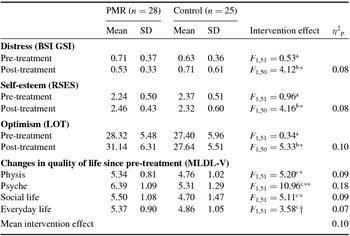
As shown in Table 1, pre-treatment distress level in the BSI total score (Global Severity Index, GSI) was moderate in both groups. Thirty-two per cent of the subjects exceeded 2SD of the German non-patient norm (mean = 0.31; SD = 0.23; Franke, Reference Franke2000) and were quite distressed. At pre-treatment, one-way ANOVAs did not indicate any significant differences between groups on outcome measures. One-way ANCOVAs, controlling for pre-treatment scores as covariates, indicated that at post-treatment the intervention group differed from the control group on all outcome measures: the intervention group showed a greater reduction of distress (BSI GSI) as well as a greater increase in self-esteem (RSES) and optimism (LOT). Further inquiry into subscales of the BSI showed that groups differed most on the BSI subscales ‘depression’ (F 1,50 = 7.63, P < 0.01, η2 p = 0.13) and ‘interpersonal sensitivity’ (F 1,50 = 5.58, P < 0.05, η2 p = 0.10). Furthermore, there were greater improvements in quality of life (MLDL-V) for the intervention group compared with the control group at post-treatment.
Distress (symptomatology) and protective factors (self-esteem, optimism) before (pre-treatment) and after the intervention (post-treatment); changes in quality of life directly assessed by participants (MLDL-V) after treatment (descriptives, ANOVAs and ANCOVAs)

a Pre-treatment between-group effects based on one-way ANOVAs. bPost-treatment between-group effects based on one-way ANCOVAs with pre-treatment scores as covariates. cPost-treatment between-group effects based on one-way ANOVAs. η2 p: partial eta squared of ANOVA and ANCOVA between-group effects. †P ≤ 0.10, *P ≤ 0.05, **P ≤ 0.01.
Discussion
In this study the PMR (Padesky and Mooney, Reference Padesky and Mooney2012) was evaluated in a student sample. As hypothesized, the matched PMR group showed greater reduction of psychological distress (symptomatology) and more improvement of positive constructs (self-esteem and optimism) as well as quality of life compared with the control group in the completer analyses. Effect sizes for the PMR group can be classified as medium to large.
Compared with effect sizes for other positive interventions reported by Bolier et al. (Reference Bolier, Haverman, Westerhof, Riper, Smit and Bohlmeijer2013), effects for the PMR are in the upper range with medium effect sizes for distress, self-esteem and optimism, and medium to large effect sizes for quality of life.
Limitations of the study are possible self-selection effects that may have jeopardized randomization. We tried to account for this by propensity score matching. Also, motivational factors due to being assigned to the untreated control group may have influenced control group baselines. Future studies should employ a wait-list design and randomize participants after binding consent. Furthermore, they should involve a larger and clinical sample and include follow-up assessments.
This pilot study supports the usefulness of the ‘Personal Model of Resilience’ by Padesky and Mooney (Reference Padesky and Mooney2012) as a promising intervention drawing systematically on positive behaviours, thoughts and experiences already part of an individual's repertoire. The intervention seems particularly relevant for first-year students, as the transition to university is associated with substantial stress, psychopathological symptoms and depression (Dyson and Renk, Reference Dyson and Renk2006). The PMR might also work for clients faced with critical life events, stress or moderate symptoms. It could be offered as a low-threshold intervention to overcome crisis and restore positive functioning or as an additional CBT component to foster positive emotions.
Acknowledgements
Financial support: This research received no specific grant from any funding agency, commercial or not-for-profit sectors.
Conflicts of interest: Philipp Victor, Tobias Teismann and Ulrike Willutzki have no conflicts of interest with respect to this publication.
Ethical standards: The authors assert that all procedures contributing to this work comply with the ethical standards of the relevant national and institutional committees on human experimentation and with the Helsinki Declaration of 1975, and its most recent revision.
The Ethics Committee of the Faculty of Psychology, Ruhr-University Bochum, Germany, approved the study together with a related clinical study.
Supplementary material
To view supplementary material for this article, please visit https://doi.org/10.1017/S1352465816000552




Comments
No Comments have been published for this article.