

Acquired brain injury (ABI) is a significant public health concern in Australia and other countries worldwide. In her review, Schneider (Reference Schneider2010) noted over 500,000 Australian citizens have an ABI, with three of five under the age of 65 years. Also, Kendall and Marshall (Reference Kendall and Marshall2004) pointed out that ABI is much more common among the Australian indigenous population compared to non-indigenous population. The needs of persons with ABI can affect all areas of human activity in such areas as cognitive abilities, personality, and physical function (Cunningham, Chan, Jones, Kamnetz, & Stoll, Reference Cunningham, Chan, Jones, Kamnetz, Stoll, Chan, Leahy and Saunders2005) presenting challenges for injured persons and their family caregivers.
A service challenge faced in countries across the world regards the lack of effective long-term services to meet the needs of persons with ABI and their caregivers. Kuipers, Gauld, Kendall, Smith, and Bowen (Reference Kuipers, Gauld, Kendall, Smith, Bowen, Muenchberger, Kendall and Wright2013), for instance, noted that most persons with ABI and other disabilities in developing countries lack access to formal rehabilitation, assistive technology, and employment support. Also, in the United States, persons with ABI and their families are challenged by a fragmented and insufficiently funded system of long-term, community-based supports (Degeneffe et al., Reference Degeneffe, Boot, Kuehne, Kuraishi, Maristela, Noyes and Will2008). Degeneffe and Tucker (Reference Degeneffe, Tucker, Wadsworth and Riggs2014) for instance, surveyed the leadership of 28 Brain Injury Association of America (BIAA) state affiliates regarding the availability and quality of brain injury services. In 12 different service areas (e.g., sexuality training, supported employment), BIAA leaders rated 73.7% of these services on average as inadequate. Also, interventions directed at community integration following ABI are often not evidence-based (McCabe et al., Reference McCabe, Lippert, Weiser, Hilditch, Hartridge and Villamere2007) and community-based professionals frequently lack adequate training and experience (Degeneffe & Bursnall, Reference Degeneffe and Bursnall2015).
At the acute stage of ABI rehabilitation, however, persons with ABI and their families benefit from a highly coordinated and complex set of multidisciplinary services (Greenwald, Reference Greenwald2010). Professionals in ABI acute-care settings often possess specific training on ABI aetiology, treatment, and rehabilitation, and can extend their services after discharge on a post-acute-care, outpatient basis.
The bulk of post-acute, long-term care for persons with ABI is provided by families (Degeneffe & Lee, Reference Degeneffe, Lee, Millington and Marini2015). In the early phase of post-acute care discharge, family caregivers can benefit from information, therapies, and emotional support provided by the same facilities that cared for their injured family members during the inpatient phase of ABI rehabilitation. Surprisingly however, previous research has not assessed family caregiver perceptions of which post-discharge services are the most helpful in the post-acute-care phase of ABI rehabilitation. This shortcoming is unfortunate given post-acute-care services can facilitate community re-integration and continued recovery for their family members with ABI.
To better understand how persons with ABI and their families use and benefit from post-acute-care ABI services, the present study was guided by the following research question: Which post-acute-care services are perceived by family caregivers as most helpful following in the early phase of acute-care discharge? Post-acute-care services set a foundation for long-term utilisation of community-based ABI services to increase independence for the injured person and decrease reliance on family caregivers. Perceptions of service satisfaction provide ABI professionals and policy makers information on what services are most needed during the early versus later stages of post-acute discharge. The study is presented as a Brief Report as it presents a foundation for larger scale future investigations.
Method
Participants
Demographic information for the participants and their family members with ABI are reported with the available data for each item. Participants were family caregivers of persons with ABI that received both acute-care and post-acute services from a rehabilitation facility located in a large south-western U.S. city.
A total of 21 family caregivers took part in the study. Most (76.2%) participants were female, and on average, were 48.6 years old (SD = 13.5 years), ranging from 23 to 75 years. The most common family member types were spouse/partners (71.4%) or children (14.3%) of the care recipient. Participants reported an average annual income of $79,916 (SD = 44,464). Sample members possessed high levels of education, with close to half (47.6%) holding an undergraduate or graduate level of education. Also, most (66.7%) participants were employed either part-time or full-time. The majority of participants were white (57.1%), endorsed a Christian faith (61.9%), and married (71.4%).
With regard to the care recipients of participants, most (61.9%) were male and like the study participants, were white (52.4%) and married (61.9%). Unlike their family caregivers, care recipients were mostly (61.9%) unemployed and most (33.3%) completed only a junior college/vocational school level of education. Care recipients had a mean age of 52.9 years (SD = 17.0 years), with ages ranging from 19 to 80 years. The mean time since the onset of ABI was 10.1 months (SD = 2.8), with this period ranging from 7 to 20 months. The average time since acute-care discharge was 8.1 months (SD = 1.5 months), ranging from 6 to 11 months.
Given the study's limited sample size and low survey return rate, other relevant care recipient data were compared to 2014 ABI facility inpatient information to determine representativeness to the population of interest. These comparisons present similar profiles. First, the average age of care recipients was 52.9 years compared to 59 years in the 2014 data. Second, a total of 19.1% of care recipients incurred traumatic forms of ABI compared to 17.5% in 2014. Third, most (81.0%) care recipients were discharged to a home setting compared to 83.1% in 2014. Fourth, the average time care recipients spent in acute-care was 1.4 months (SD = 0.7 months), ranging from less than one month to 3 months. Comparatively, 2014 data indicated an average of 20.3 days of acute-care. The difference in acute-care time was likely due to how time in acute-care was measured. The present study measured time in months, while the 2014 data measured this statistic in days.
Procedure
Two data collection strategies were used. Initially, a total of five participants completed surveys (which included demographic survey items) at discharge and again, approximately 6 months later (which included post-acute-care service use and satisfaction survey items). To add to the number of participants, the ABI facility sent study invitation survey packets (which included both demographic and service use and satisfaction survey items) to 168 recently (i.e., at least six months post-discharge) discharged acute-care recipients, which resulted in 17 returned surveys. Among the 22 completed surveys, one was not used for not meeting study inclusion criteria, where it appeared the participant answered survey items based on post-acute-care services received from a location other than the ABI facility. Participants’ perceptions of service satisfaction were based on their use of post-acute-care services provided by the ABI facility. Institutional board approval to conduct the study was obtained from the ABI facility and first author's university.
Instrumentation
Participants were asked to provide demographic information on themselves and their care recipients. Participants also addressed perceptions of depression (Center for Epidemiologic Studies-Depression (Radloff, Reference Radloff1977)), family functioning (General Functioning Scale of the Family Assessment Device (Epstein, Baldwin, & Bishop, Reference Epstein, Baldwin and Bishop1983)), and rehabilitation needs (Family Needs Questionnaire (Kreutzer & Marwitz, Reference Kreutzer and Marwitz1989)). With regard to the present study, participants rated their use and satisfaction with received services across 14 different post-acute service areas. These 14 areas represented the service areas provided by the ABI facility following acute-care discharge on an outpatient basis. Participants answered five open-ended questions concerning their use of ABI post-acute-care services. With regard to the present study, participants were asked, ‘Describe what has been helpful about the services you have received from the [ABI facility] since your family member with brain injury returned home’. The open-ended questions provided contextual information to better understand the nature of the quantitative outcomes. Previous survey results were reported in Degeneffe, Green, and Jones (Reference Degeneffe, Green and Jones2016a) and Degeneffe, Green, and Jones (Reference Degeneffe, Green and Jones2016b).
Data Analysis
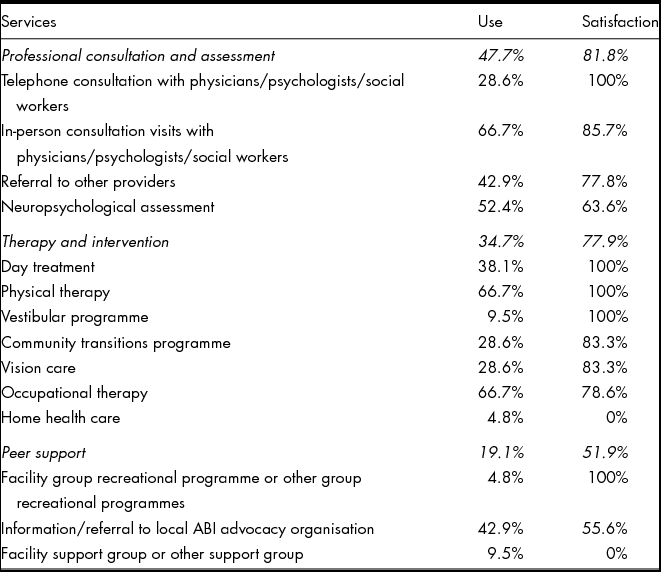
The study's research question was addressed quantitatively and qualitatively. Quantitatively, to provide information on the services provided by the ABI facility, participants were asked to respond to four questions for each of the 14 post-acute-care service areas including: (1) if the service was received, (2) satisfaction (i.e., yes or no) with any services received, (3) barriers experienced in not being able to use any of the 14 services, and (4) if an alternative provider was used for any of the 14 service areas not received. The present study focused on the services received and participant satisfaction with used services. When participants did not answer if a service was received, it was assumed they did not use the service. When participants did not rate their satisfaction with a received service, it was assumed they were not satisfied with the service. Services (Table 1) were placed into one of three areas, including (a) professional consultation and assessment, (b) therapy and intervention, or (c) peer support.
Post-acute-care service use and satisfaction with services

Qualitatively, the study's research question was analysed via one open-ended survey question that addressed the helpfulness of post-acute-care services. The open-ended responses were categorised following the identification of the three service categories as described earlier. The first author read each open-ended response and determined if it best described (a) professional consultation, (b) therapy and intervention, or (c) peer support. Following this process, the second and third authors confirmed the assignment of participant responses to the three service categories. Participant responses were categorised with the Saturate (Sillito, Reference Sillito2010) qualitative data analysis programme.
Results
Participants indicated a high level of satisfaction in most of the 14 service areas. The mean number of services received was 4.9 (SD = 3.6), ranging from 0 to 11 services. A total of three families received no post-acute-care services. The average satisfaction rating across the 14 service areas was 73.4% (SD = 34.1%), ranging from 0% (in two areas) to 100% (i.e., in five areas). The services rated lowest (i.e., home health care and facility support group or other support group) corresponded to their seldom use, with all other services rated at a 55.6% (i.e., information/referral to local ABI advocacy organisation) satisfaction level and above. With regard to categories of post-acute-care service (Table 1), professional consultation and assessment (81.8%) received the highest satisfaction rating, followed by therapy and intervention (77.9%), and third, peer support (51.9%). Further reflective of the positive opinion of post-acute-care services, there was a significant (p < .001) correlation (r = .91) between service use and service satisfaction.
Concerning the open-ended survey question on the helpfulness of post-acute-care services, participant responses were mostly related to (a) therapy and intervention (i.e., 12 responses) and (b) professional consultation and assessment (i.e., 10 responses). Only one participant comment discussed the value of peer support. Consistent with the high ratings of service satisfaction, the majority of comments conveyed gratitude for receiving helpful services in both service categories.
Day treatment programme – programme contact and staff terrific. Kept patient engaged and occupied, and moving forward with recovery. Outpatient therapy was also good, but therapists often changed. Both programmes easy to work with and very attentive to caregiver needs as much as patient (i.e., therapy and intervention).
The pain management/occupational and neuropsych evaluations and treatment programmes made amazing progress in our daughter's mental, physical and emotional well being and helping her return to a fully functioning life (i.e., therapy and intervention).
Outpatient rehab at [name of ABI facility] was invaluable. Therapists guided us through the rehabilitation/recovery and included the family in all decisions and really took the time to focus on strategies that were successful for our individual family (i.e., professional consultation and assessment).
The most helpful service was as the community resources we were made aware of (i.e., professional consultation and assessment).
Discussion
Findings from the present study underscore the importance of utilisation of post-acute-care services. In most areas, participants endorsed a high level of satisfaction with services and were able to identify specific ways in which services helped their family members with ABI and their own efforts at family caregiving. Findings from the study also highlight the positive benefits of a continuum of ABI (Uomoto & McLean, Reference Uomoto and McLean1989) care from acute to post-acute rehabilitation.
With regard to specific areas of service usage, the most endorsed areas were (a) professional consultation and assessment and (b) therapy and intervention. These findings highlight the benefits of these forms of supports especially in the early phase of ABI rehabilitation in response to the immediate physical, cognitive, and psychological changes persons with ABI are challenged by soon after acute-care discharge. It is likely the third area of service, peer support, would be more needed over time as persons with ABI and their family caregivers adjust to the longer-term implications of ABI, and could benefit from services like support groups and recreational and social groups. Findings also underscore the value of universal family access to post-acute-care specialised ABI support, and not only to those with the geographical proximity and financial resources to benefit from these types of supports.
With regard to limitations, the small sample size of the study limits it generalisability to the larger population of family caregivers of persons with ABI following acute-care discharge. Also, replacement of missing data might not accurately represent the true responses of participants.
This Brief Report highlights the need to create greater care continuity in ABI rehabilitation. Future studies, larger in scope, should track the use of ABI services from the acute-phase through long-term community adjustment to better understand which services are most needed at each phase of ABI rehabilitation. Given the high degree of satisfaction participants conveyed from working with professionals specifically trained in ABI, study findings also highlight the importance of better training ABI professionals working with persons with ABI in community settings, such as governmental vocational rehabilitation agencies, postsecondary institutions, and generalist medical and therapy providers.