


Second language (L2) learners often have trouble with L2 morphology and syntax, performing significantly worse than native speakers on tests of production (Paradis, Rice, Crago & Marquis, Reference Paradis, Rice, Crago and Marquis2008) and grammaticality judgment (Johnson & Newport, Reference Johnson and Newport1989; McDonald, Reference McDonald2000, Reference McDonald2006). They also fail to show native-like slowing in the presence of morphological errors in online reading or comprehension tasks (Jiang, Reference Jiang2004, Reference Jiang2007). While some posit that this may be due to problems with acquisition of syntactic knowledge per se (Meisel, Reference Meisel1997; Paradis & Crago, Reference Paradis and Crago2000), others claim that the knowledge is present, but it often fails to be expressed (Prévost & White, Reference Prévost and White2000). This latter viewpoint begs the question of what underlies this failure. One possible reason could be lack of mastery of non-syntactic aspects of the second language that are precursors to application of syntactic processes, or that poor non-syntactic mastery increases processing load or processing time, which in turn then affects expression of syntactic knowledge. Evidence for the involvement of non-syntactic processes in syntactic performance comes from McDonald (Reference McDonald2006). First, the study found that measures of L2 phonological ability and L2 working memory capacity were correlated with L2 morphological mastery as evidenced by performance on an L2 grammaticality judgment task. Second, in a demonstration of a possible causal link between these non-syntactic processes and morphological mastery, native speakers (who obviously have native command of morphology) were made to show similar non-native patterns of grammaticality judgment deficits by having them perform the task under an added noise condition (i.e., impairing their perception of the phonology), or under a memory load (i.e., decreasing their working memory capacity).
This paper further explores the possibility that problems involving non-syntactic aspects of language processing are at least partially responsible for poor morphosyntactic performance in L2 speakers. We focus on one aspect of morphology, English past tense, and investigate possible L2 non-syntactic processing deficits that might cause problems with past tense mastery. Since past tense has different patterns for regular (e.g., fill–filled) and irregular verbs (e.g., bite–bit, cut–cut), different factors may underlie performance on these two classes. Thus, past tense makes for an especially interesting test case for our purposes. In addition, since the differences between regular and irregular past tense performance have been the focus of a controversial debate in linguistic representation and processing, we can contribute data to this debate from the seldom examined population of L2 learners.
Evidence that different factors influence performance on the two verb types comes from the double dissociation seen in neurologically impaired populations. Native speaking populations that have trouble with regular past tense formation (those with Parkinson's disease or anterior aphasia) seem to have a problem centered in phonological mastery. They often produce regular past tense forms that are unmarked (the phonologically simpler show for showed), or contain phonological errors (tane for trained) (Bird, Lambon Ralph, Seidenberg, McClelland & Patterson, Reference Bird, Lambon Ralph, Seidenberg, McClelland and Patterson2003; Braber, Patterson, Ellis & Lambon Ralph, Reference Braber, Patterson, Ellis and Lambon Ralph2005; Lambon Ralph, Braber, McClelland & Patterson, Reference Lambon Ralph, Braber, McClelland and Patterson2005; Tyler, Randall & Marslen-Wilson, Reference Tyler, Randall and Marslen-Wilson2002b; Ullman, Corkin, Coppola, Hickok, Growdon, Koroshetz & Pinker, Reference Ullman, Corkin, Coppola, Hickok, Growdon, Koroshetz and Pinker1997; Ullman, Pancheva, Love, Yee, Swinney & Hickok, Reference Ullman, Pancheva, Love, Yee, Swinney and Hickok2005). Native speaking populations that seem to have problems with irregular past tense formation (those with Alzheimer's disease, semantic deficits or posterior aphasia, and children with poor comprehension) seem to suffer from semantic deficits and/or difficulties with lexical access. They often produce overregularization errors such as holded for held (Bird et al., Reference Bird, Lambon Ralph, Seidenberg, McClelland and Patterson2003; Miozzo, Reference Miozzo2003; Nation, Snowling & Clarke, Reference Nation, Snowling and Clarke2005; Patterson, Lambon Ralph, Hodges & McClelland, Reference Patterson, Lambon Ralph, Hodges and McClelland2001; Tyler, deMornay-Davies, Anokhina, Longworth, Randall & Marslen-Wilson, Reference Tyler, deMornay-Davies, Anokhina, Longworth, Randall and Marslen-Wilson2002a; Ullman et al., Reference Ullman, Corkin, Coppola, Hickok, Growdon, Koroshetz and Pinker1997; Ullman et al., Reference Ullman, Pancheva, Love, Yee, Swinney and Hickok2005). This pattern has been explained by some researchers as involving separate processing mechanisms for the two verb types (Pinker, Reference Pinker1999; Pinker & Ullman, Reference Pinker and Ullman2002) and by others as being consistent with a single associative mechanism (Joanisse & Seidenberg, Reference Joanisse and Seidenberg1999; McClelland & Patterson, Reference McClelland and Patterson2002; Rumelhart & McClelland, Reference Rumelhart, McClelland, McClelland and Rumelhart1986); we will return to this debate in the general discussion.
If factors that impact impaired native speakers also operate on non-native speakers, we can make the following predictions: (i) non-native speakers who have trouble with L2 phonology will struggle with regular past tense, and will be likely to produce unmarked forms or forms with phonological errors; and (ii) non-native speakers who have poor vocabulary and slow lexical access will have problems with irregular past tense, and will be likely to produce overregularization errors. These predictions are novel – of the studies that have specifically focused on non-native speakers’ regular and irregular past tense abilities (Basnight-Brown, Chen, Hua, Kostic & Feldman, Reference Basnight-Brown, Chen, Hua, Kostic and Feldman2007; Birdsong & Flege, Reference Birdsong and Flege2001; Cameli, Phillips, Kousaie & Panisset, Reference Cameli, Phillips, Kousaie, Panisset, Cohen, McAlister, Rolstad and MacSwan2005; Jia & Fuse, Reference Jia and Fuse2007), none have considered the possible underlying factors of phonological ability or lexical access ability as correlates or possible agents involved in regular and irregular past tense performance, respectively. In order to test these predictions, a group of L2 learners with wide variation in L2 phonological ability and L2 lexical access ability is needed. (Note that this also means that this group is likely to vary in factors that are correlated to mastery in these areas – e.g., age of acquisition, length of exposure, native language, etc.). Specifics of L2 speakers’ abilities in these areas and how weaknesses could impact performance on regular and irregular past tense in both a grammaticality judgment task and a production task are presented below.
Factors that may affect past tense in non-native speakers
L2 phonological ability
Non-native speakers often differ from native speakers in their receptive and productive mastery of L2 phonology (Yeni-Komshian, Flege & Liu, Reference Yeni-Komshian, Flege and Liu2000). Level of L2 mastery in this domain is highly variable, and correlates with such variables as age of L2 acquisition, length of residence, native language, phonological short term memory and even musical ability (Baker & Trofimovich, Reference Baker and Trofimovich2005; Flege, Bohn & Jang, Reference Flege, Bohn and Jang1997; Sleve & Miyake, Reference Sleve and Miyake2006; Yeni-Komshian et al., Reference Yeni-Komshian, Flege and Liu2000). Difficulty with L2 phonology makes it harder for non-native speakers to recognize L2 words – i.e., when non-native speakers are asked to recognize words presented in noise, significant variance in their word recognition performance is predicted by their L2 vowel and consonant perceptual abilities (Meador, Flege & MacKay, Reference Meador, Flege and MacKay2000). In addition, poor L2 phoneme discrimination can lead to more items competing in the word recognition process (Weber & Cutler, Reference Weber and Cutler2004). For example, if L2 learners have difficulty with the /ɪ/-/i/ distinction in English, both ship and sheep will remain in competition for recognition upon hearing ship, while native English speakers will not have this problem.
If non-native speakers have poorer L2 phonology than native speakers, they should have difficulties in tasks that involve the detection of subtle phonological differences, and perhaps also in producing more phonologically complex forms. Consider first a grammaticality judgment task in which people judge sentences containing either the correct or incorrect past tense form. For regular verbs, the contrast between the correct and unmarked form used in our task (e.g., filled–fill) is subtle, being only a single unstressed phoneme, and therefore may be difficult to detect. For irregular verbs, the contrast between the correct and overregularized form used in our task (e.g., bit–bited or cut–cutted) involves vowel changes, an extra unstressed syllable, or both, and therefore should be easier to detect. Thus, learners with poor L2 phonology may struggle more with detecting incorrect regular than irregular past tense; i.e., L2 phonological ability should correlate more highly with performance on regular verbs than irregular verbs.
Now consider a production task. Regular past tense forms are often phonologically more complex or phonologically odd than irregular past tense forms – i.e., relative to the base form, regular past tense forms have at least one additional phoneme, while irregular past tense forms often do not (Bird et al., Reference Bird, Lambon Ralph, Seidenberg, McClelland and Patterson2003; Burzio, Reference Burzio2002). Thus, a learner with poor ability to produce L2 phonology may struggle more with regular than irregular past tenses, and may be more likely to produce unmarked (i.e., phonologically simpler) or phonologically related errors across all verb types. Interestingly, a propensity for unmarked forms may increase performance on a subclass of irregular verbs – those that do not change form for the past tense (e.g., cut–cut). Producing an unmarked form due to phonological difficulties in this case would result in an increase in correct answers for this subset of irregulars. Thus, overall, we predict a higher positive correlation between phonological ability and production of regular past tense (fill–filled) than irregular past tense change verbs (bite–bit), and perhaps a negative correlation with production of irregular no change verbs (cut–cut).
L2 lexical access
Non-native speakers also often have weaker lexical access ability and vocabulary knowledge than native speakers. Level of L2 lexical ability may be tied to such factors as age of L2 acquisition, self-rated L2 proficiency and degree of L2 use (Kohnert, Hernandez & Bates, Reference Kohnert, Hernandez and Bates1998; Roberts, Garcia, Desrochers & Hernandez, Reference Roberts, Garcia, Desrochers and Hernandez2002). As a group, non-native speakers, even L2 dominant non-native speakers, tend to have lower picture naming scores and slower naming times than native speakers (Gollan, Montoya, Fennema-Notestine & Morris, Reference Gollan, Montoya, Fennema-Notestine and Morris2005; Roberts et al., Reference Roberts, Garcia, Desrochers and Hernandez2002). However, no such deficits are shown in a picture classification task, which calls upon semantic knowledge in the absence of lexical access (Gollan et al., Reference Gollan, Montoya, Fennema-Notestine and Morris2005). These results imply that non-native speakers have intact semantic representations, but have difficulty accessing lexical representations. Since naming time deficits between non-native and native speakers are found to disappear with repeated picture naming, Gollan et al. (Reference Gollan, Montoya, Fennema-Notestine and Morris2005) hypothesized that the strength of the connection between the phonological and the semantic representations in each language is simply weaker in bilingual than monolingual speakers – i.e., bilinguals have connections to two phonological representations for each semantic concept, and thus get effectively less practice on either one of these connections than does a monolingual. There is also possible interference from having two phonological representations, one from each language, active at the same time.
In addition, some less experienced non-native speakers may perform poorly on picture naming because of gaps in their lexical knowledge. In this case, they may treat unknown words in a past tense task as nonce forms. Previous work has shown that native speakers give more regularized forms to nonce verbs that have regular phonological characteristics than to nonce verbs that have irregular phonological characteristics – i.e., have irregular verbs as phonological neighbors (Ullman et al., Reference Ullman, Pancheva, Love, Yee, Swinney and Hickok2005); similar results were found when nonce verbs were given to non-native speakers (Murphy, Reference Murphy2004). Therefore, the past tense patterns given to words that a non-native speaker may not know should follow those of the known words, though perhaps not as strongly.
For non-native speakers who have poor lexical access ability, we might expect difficulties with past tense similar to other groups with impaired lexical access – i.e., problems with the past tense of irregular verbs, and production of overregularization (Miozzo, Reference Miozzo2003; Nation et al., Reference Nation, Snowling and Clarke2005; Patterson et al., Reference Patterson, Lambon Ralph, Hodges and McClelland2001; Ullman et al., Reference Ullman, Corkin, Coppola, Hickok, Growdon, Koroshetz and Pinker1997). For the grammaticality judgment task, there should be no problems with regular verbs (fill–filled), but there should be a correlation between lexical access ability and the ability to distinguish correct from overregularized irregular verbs (bit–bited or cut–cutted). Similarly, for the production task, we should see a positive correlation between lexical access ability and correct production of irregular forms, and a negative correlation to the production of overregularized forms.
Properties of the verbs that may influence performance
In addition to individual differences in phonological ability and lexical access across participants, properties of individual verbs themselves may make them more or less vulnerable to errors in past tense. Prior research has shown that past tense performance in native speakers is influenced by the properties of (i) verb frequency, (ii) the phoneme ending the present tense verb, (iii) the number and/or frequency of friends (verbs that form the past tense in the same way as the target), and (iv) enemies (verbs that form the past tense in a different way than the target) in a verb's neighborhood (Cortese, Balota, Sergent-Marshall, Buckner & Gold, Reference Cortese, Balota, Sergent-Marshall, Buckner and Gold2006; Marchman, Reference Marchman1997; Marchman, Wulfeck & Ellis Weismer, Reference Marchman, Wulfeck and Ellis Weismer1999). For example, children are more likely to overregularize irregular verbs that are low in frequency, and ones that have many regular neighbors. Children are also more likely to use an unmarked form rather than a past tense form for both regular and irregular verbs if the present tense verb ends in the alveolar stops /t/ or /d/ (Marchman, Reference Marchman1997; Marchman et al., Reference Marchman, Wulfeck and Ellis Weismer1999). Adults with Alzheimer's disease have difficulty with both regular and irregular verbs if there are high frequency phonological and orthographic enemies (Cortese et al., Reference Cortese, Balota, Sergent-Marshall, Buckner and Gold2006).
In these studies, neighborhoods were defined in terms of words having different onset, but the same rime – i.e., a neighborhood of a verb would include all other verbs that rhyme with it (e.g., the rime neighborhood of ride would include chide, hide, slide, etc.). However, in the current study, we also look at another type of phonological neighborhood. This neighborhood, which we call the vowel neighborhood, consists of all verbs that have the same onset and coda as the target verb, but which have a different vowel (e.g., the vowel neighborhood of ride would include raid, read, rid, etc.). Note that some of the verbs in a vowel neighborhood may be present tense verbs (e.g., raid), and some may be past tense irregular verbs (e.g., rode). If L2 learners are not certain if a verb is regular or irregular, having other verbs in the vowel neighborhood, particularly past tense forms, might tempt L2 learners to use a vowel change (i.e., an irregular process), and choose one of these vowel neighbors as their past tense. Note that this will sometimes yield a correct answer (e.g., ride–rode), but can also yield an incorrect answer for regular (e.g., raid–read), irregular change (e.g., ride–read) and irregular no change verbs (e.g., rid–read).
Looking at the relationship between various properties of individual verbs and performance on past tense tasks by non-native speakers will allow us to see whether factors known to be influential for native speaking populations also influence non-native speakers. While the influence of most of these verb properties has not been examined in L2 learners, the effect of verb frequency has been. However, the findings are mixed. Some have not found frequency effects on regulars but have found them on irregulars (Birdsong & Flege, Reference Birdsong and Flege2001), others have found frequency effects in both verb types (Brovetto & Ullman, 2001, as cited in Ullman, Reference Ullman2006), and others have found no frequency effects on irregulars (Beck, Reference Beck1997; Cameli et al., Reference Cameli, Phillips, Kousaie, Panisset, Cohen, McAlister, Rolstad and MacSwan2005). It is not clear whether these differences in results are due to the types of bilinguals tested (across studies they differ in native language and amount of experience in English), the actual verbs tested, or some other factor.
We now turn to Experiment 1, in which native and non-native English speakers perform tasks measuring phonological ability, lexical access ability, and past tense performance – including grammaticality judgment and production. In general, we predict that the native English speakers will outperform the non-native English speakers on all measures. Within the non-native English speakers, we hypothesize that L2 phonological ability should correlate positively to performance on regular verbs in both the grammaticality judgment and production test, and negatively to unmarked and phonological production errors across verb types; note that unmarked forms are the correct answer for irregular no change verbs. L2 lexical access ability should be correlated positively to performance on irregular verbs on both tasks, and negatively to overregularization errors in production. Within the L2 speakers, we predict that properties of the verbs (frequency, endings, and neighborhoods) will also impact performance; to foreshadow our results, vowel neighborhoods will turn out to be especially influential for L2 learners.
Experiment 1: Non-native English speakers
Method
Participants
Participants were 23 non-native English speaking graduate and undergraduate students (mean age = 26.87, range 19–39 years) at Louisiana State University. The non-native English speakers came from a variety of first language backgrounds, including 16 native speakers of Romance languages (Spanish, Romanian, Portuguese, and French) and seven native speakers of various other languages (Russian, Dutch, Arabic, Swahili, and Vietnamese). Having speakers from different L1 backgrounds should increase the range of phonological ability (Flege et al., Reference Flege, Bohn and Jang1997), but this also means that the specific influences of the various L1's may add noise to the data.
The non-native speakers’ average age of first English exposure was 9.17 (ranging from 0 to 19 years). The average age at arrival in the US was 21.56 (ranging from 2 to 33 years). The average length of residence in the US was 3.20 years (ranging from 1 month to 17 years). On a five-point Likert scale with 1 meaning poor and 5 meaning excellent, their subjective evaluation of their overall English ability was 3.74 (ranging from 2 to 5) and their evaluation of their native language ability was 4.74 (ranging from 3 to 5). Thus, the sample of bilinguals selected for this study was heterogeneous on many characteristics. As noted in the introduction, this was purposefully done, so the sample would contain a wide range of linguistic ability, including phonological ability and lexical access skill.
Fifteen native English speaking undergraduate students (mean age = 20.07, range 18–23 years) served as a control group. They were drawn from a pool of students overwhelmingly from the Southern US; any participant with Cajun French exposure was eliminated.
Stimuli and procedure
Phonological ability task 1: Gating
This task was used to assess ability to accurately recognize phonemes given minimal information. After a practice item (literature), participants were presented with the initial 100 msec gate of ten different polysyllabic words (cafeteria, refrigerator, carbohydrate, television, cauliflower, thermometer, kaleidoscope, vegetable, caterpillar, and encyclopedia; presentation order was the same for all), and asked to guess the word. The words had been recorded by a native English speaker and digitized for computer presentation. The dependent measure was the overlap in number of phonemes between the first syllable of the target word and the first syllable of the word that the participants guessed at the initial gate. For example, if the guess at the first gate of cafeteria, was bird, a score of 0 was given. Cup would receive a score of 1, and cat would receive a score of 2.
Phonological ability task 2: Word pair discrimination
This task assessed the ability to detect the presence or absence of the /d/ or /t/ phoneme in word final position – a necessary skill in detecting past tense forms of regular verbs. Stimuli, taken from Bird et al. (Reference Bird, Lambon Ralph, Seidenberg, McClelland and Patterson2003), were word pairs that were identical (coal–coal, cold–cold) or that differed by a final /d/ or /t/ phoneme (coal–cold, cold–coal). Across the stimuli, half the time the addition of the final phoneme formed a new, unrelated word (coal–cold), half the time it formed a regular past tense form of the other word (roll–rolled). A total of 128 word pairs, half identical and half different were presented auditorily. Participants’ responses (i.e., same/different judgment for same/different pairs) were recorded by pressing a key on the computer. The dependent measure used was the average reaction time for correct judgments.
Lexical access ability task: Verb picture naming
This task was used to assess the participants’ lexical ability. The stimuli consisted of 20 black-and-white drawings depicting verbs (brush, cry, laugh, push, watch, chase, crawl, kick, wave, comb, drip, scoop, trip, type, juggle, rake, salute, surf, vacuum, smile; the order was kept the same for all) taken from the UCSD International Picture Naming Project corpus (Szekely et al., Reference Szekely, Jacobsen, D'Amico, Devescovi, Andonova, Herron, Lu, Pechmann, Pleh, Wicha, Federmeier, Gerdjikova, Gutierrez, Hung, Hsu, Iyer, Kohnert, Mehotcheva, Orozco-Figueroa, Tzeng, Tzeng, Arevalo, Vargha, Butler, Buffington and Bates2004; http://crl.ucsd.edu/~aszekely/ipnp/). These pictures had greater than 90% name agreement in native English speakers, and varied in ln frequency from 0 to 5.5. None of these verbs were used elsewhere in the experiment. Participants’ task was to correctly name the action depicted in each drawing with a single verb. The response to each picture was recorded by the experimenter, and reaction time from picture onset to naming was recorded by a voice activated response key on the computer. Several dependent measures were derived from this task, including (i) the number of verbs correctly named, (ii) the number of verbs where no response or a don't know response was given, and (iii) median reaction time to correct naming.
Past tense grammaticality judgment task
The stimuli for both the grammaticality judgment task and the verb production task were based on 76 target and 18 filler verbs. The target verbs consisted of three classes of items: 31 regular verbs which formed their past tense by adding the regular -ed ending (e.g., fill–filled), 28 irregular change verbs which formed their past tense by altering either a vowel or a consonant, or both (e.g., bite–bit), and 17 irregular no change verbs which had identical present and past tense forms (e.g., cut–cut). The 18 filler verbs were all verbs with two possible past tenses (e.g., dive–dived/dove). The regular verbs (chew, cry, die, drop, fail, fill, flow, fry, gain, guess, lay, live, name, pay, play, pray, pull, seem, sew, show, sigh, slap, spray, stew tie, tow, train, try, use, view, wipe) and irregular change verbs (bend, bite, bring, build, buy, deal, dig, flee, freeze, grind, hold, keep, leave, lend, mean, ride, ring, sell, shake, sleep, slide, speak, steal, stride, swing, teach, win, wind) were taken from lists in Bird et al. (Reference Bird, Lambon Ralph, Seidenberg, McClelland and Patterson2003), and the irregular no change verbs (beat, bet, bid, cost, cut, hit, hurt, put, quit, rid, set, shed, shut, slit, split, spread, upset) from Stemberger (Reference Stemberger2004).
For each verb a grammatical past tense sentence was formed; all sentences started with the word yesterday to unambiguously indicate that the verb should be in the past tense. Then an ungrammatical counterpart of each grammatical sentence was made as follows: (i) For regular verbs, the ungrammatical sentence was the same as the grammatical sentence, except it contained the verb in its unmarked form (e.g., Yesterday the boy fill the bucket). Thus, the only difference between grammatical and ungrammatical sentences for regular verbs was the presence or absence of the /t/ or /d/ phoneme that marked regular past. (ii) For irregular change and irregular no change verbs, the ungrammatical sentence was the same as the grammatical sentence, except it contained the overregularized form of the verb (e.g., Yesterday the dog bited the man or Yesterday the man cutted the paper). The difference between grammatical and ungrammatical sentences for irregular verbs was thus more phonologically detectable than that for regular verbs – it involved differences in vowels, and/or the addition of an extra syllable /ɪd/ on the verb. Note that the type of errors used in the grammaticality judgment task were production errors frequently made by aphasic speakers who had difficulty on those verb types (e.g., Ullman et al., Reference Ullman, Corkin, Coppola, Hickok, Growdon, Koroshetz and Pinker1997, Reference Ullman, Pancheva, Love, Yee, Swinney and Hickok2005). For filler verbs, no ungrammatical versions were formed; rather, participants heard both of the possible past tense forms (e.g., Yesterday the boy dived into the pool and Yesterday the boy dove into the pool). Thus, both versions of the stimuli for the filler sentences were grammatical.
Sentences were recorded by a male native English speaker and digitized for computer presentation. Sentences were divided into two blocks. Each verb appeared once in each block; in one block it was in its grammatical form and in the other block in its ungrammatical form. Each block had half the target verbs in their grammatical form, and half in their ungrammatical form. The blocks presentation was counterbalanced and sentence presentation was randomized within each block for all participants.
Participants were told that they would hear grammatically correct and incorrect English sentences and that they were to judge each sentence as grammatically correct or incorrect by pushing the appropriately marked key on the computer keyboard. Responses were recorded by the computer. The dependent measure used was the A′ measure using the correctional formulas of Zhang and Mueller (Reference Zhang and Mueller2005; note that they call their corrected measure of A′ A), which corrects for bias from guessing by combining hits (correct responses to grammatical sentences) and false alarms (incorrect responses to ungrammatical sentences). Perfect discrimination between grammatical and ungrammatical sentences results in a score of 1, whereas chance performance results in a score of .5.
Past tense production task
The same verbs used in the grammaticality judgment task were used in production; note, however, that the production task actually preceded the grammaticality judgment task, so that production would not be contaminated by hearing either the grammatical or ungrammatical form of a verb during the judgment task. The present tense form of each verb was recorded by a female native English speaker and digitized for computer presentation. A single randomized order of the verbs was made and used for all participants. Verbs were presented without sentential context, similar to the method used for adults by Bybee and Slobin (Reference Bybee and Slobin1982), but without any time pressure. Participants were asked to say aloud the simple past tense form for each verb. Each response was written down by the experimenter on a response sheet.
Production answers were classified into one of seven categories: (i) The correct past tense form, e.g., rode given for ride. (ii) A regularized form, e.g., rided given for ride. Note that giving a regularized form for a regular verb was the correct answer, so this category did not apply to regular verbs. (iii) An unmarked form, e.g., ride given for ride. Note that giving an unmarked form for irregular no change verbs (e.g., cut for cut) was actually the right answer, so this category did not apply to that verb type. (iv) A phonologically related error. Here we used strict criteria for determining phonological relatedness. Only one phoneme was allowed to differ between (a) the answer and the target verb – for example, the answer saw differs by one phoneme from the target verb sew, (b) the answer and the past tense of the target verb – for example the answer thought differs by one phoneme from taught the past tense of the target verb teach, or (c) the present tense of the answer and the target verb – for example, the answer left comes from the present tense leave and this differs by one phoneme from the target verb live, or the answer loved comes from the present tense love which differs by one phoneme from the target live. (v) A participle – e.g., giving ridden for ride, (vi) A don't know or missing answer. (vii) Any answer not captured in the above categories. The majority of the answers fell into the first four categories, accounting for about 97% of the answers given by native and non-native English speakers alike; thus, only these categories were analyzed as the dependent measures for this task.
Task order
The experiment was run individually in sessions of up to 45 minutes for native English speaking participants and 60 minutes for non-native English speaking participants. Order of task administration was the production task, the gating task, half of the grammaticality judgment task, the verb picture naming task, the other half of the grammaticality judgment task, and the word pair discrimination task. Then the participants completed a demographic and language background questionnaire, wherein they gave their native and other languages, age at which they had first been exposed to English, age of arrival in the US, length of residence in the US, and self-ratings on their English and native language ability. All tasks except the questionnaire were computer administered with E-prime software. Auditory stimuli were played over headphones.
Verb characteristics
Building on past work (Cortese et al., Reference Cortese, Balota, Sergent-Marshall, Buckner and Gold2006; Marchman, Reference Marchman1997; Marchman et al., Reference Marchman, Wulfeck and Ellis Weismer1999), we examined the relationship between verb performance and six specific characteristics for each verb: (i) The total frequency of all uninflected and inflected forms of each verb (Francis & Kucera, Reference Francis and Kucera1982) – i.e., the frequency of ride included all verbal uses of ride, rides, rode, etc. (ii) Whether the present tense verb ended in the alveolar stops /t/ or /d/. This distinction was only relevant to our irregular change verbs, of which approximately one third had an alveolar ending. The regular verbs we used never ended with /t/ or /d/, and the irregular no change verbs we used all ended in /t/ or /d/. (iii) The number of phonological rime neighbors that were friends of the target verb – i.e., that formed their past tense in the same way as the target verb. For example, a friend of ride (rode) is stride (strode). (iv) The number of phonological rime neighbors that were enemies of the target verb – i.e., that formed their past tense in a different way. For example, enemies of ride would be regular verbs such as side (sided), but also irregular verbs such as slide (slid), which form their past tense in a different way. (v) The number of vowel neighbors that were present tense verbs. For ride this would include raid, read [present tense], etc. (vi) The number of vowel neighbors that were past tense irregular verbs. For ride this would include read [past tense], rode, etc. Neighborhood members were determined by using a combination of the online Washington University Speech and Hearing Lab neighborhood database (http://128.252.27.56/Neighborhood/Home.asp) and the University of Western Australia MRC Psycholinguistic database (http://www.psy.uwa.edu.au/mrcdatabase/uwa_mrc.htm). An appendix with these characteristics for each verb is available on the Journal's website as Supplementary Materials accompanying the online version of the present article (see journals.cambridge.org/bil, vol. 13 (4)).
Results
Typically, non-native speakers are poorer at past tense than native speakers. To establish this for the current study, we compared the performance of our non-native English speakers to that of native English speakers on both the grammaticality judgment task and the production task. Both subject and item analyses were performed, and combined into the min F′ measure (Clark, Reference Clark1973). Where necessary, analyses were corrected for unequal variances between the groups. We then examined performance on the phonological ability tasks, and correlated non-native English speakers’ performance on these tasks to their performance on the grammaticality judgment and production tasks. Finally, we examined performance on the picture naming task, and correlated non-native English speakers’ performance on this task to the grammaticality judgment and production tasks.
Overall performance on grammaticality judgment and production
As shown in Table 1 (which includes the group means, as well as partial eta squared, F1, F2, and min F′ statistics), non-native English speakers had lower grammaticality judgment scores than native English speakers for all verb types. They also showed poorer correct production and more phonological errors than native English speakers for regular verbs. There was a tendency – marginal in the subjects analysis and significant in the items – for non-native English speakers to have poorer correct production and more overregularizations than native speakers for irregular change verbs. There was also a tendency – significant in the subjects analysis and marginal in the items analysis – for non-native English speakers to produce more phonological errors than native speakers on irregular no change verbs. Thus, non-native English speakers were weaker than native speakers on past tense tasks for both regular and irregular verbs. The evidence was strongest in the grammaticality judgment task, but production also showed deficits.

n.a. = not applicable
ηp2 provided for marginal or significant effects only.
For all analyses the first degree of freedom is 1.
+p < .10; *p < .05; **p < .01; ***p < .001
We had hypothesized that the underlying sources of weakness in L2 speakers for regular (i.e., L2 phonology) and irregular (i.e., L2 lexical access) performance differ. We therefore now turn to analysis of the phonological ability and lexical access tasks, and look at how they correlate with regular and irregular performance in the non-native English speakers.
Phonological ability
On the first measure of phonological ability, overlap in phonemes between the target word and guess at the initial gate of a word, non-native English speakers (M = 1.53) somewhat surprisingly did not differ from native English speakers (M = 1.62), F(1,36) = .80, ns. Note here that a higher score means better phonological ability. The groups also did not differ in the accuracy on the word pair measure (non-native speakers M = 94.9%, native speakers M = 93.4%), F(1,36) = .54, ns, but did on the measure of interest on this task – the latency to judge the word pairs (non-native speakers M = 1790 msec, native speakers M = 1623 msec), F(1,36) = 5.96, p < .05, ηp2 = .12. Note here that a higher reaction time denotes poorer phonological ability. To see if phoneme overlap and word pair latencies were related, we computed their correlation. They were not significantly correlated, r = −.33, ns; however, removal of the participant with an outlying reaction time (> 2 standard deviations above the mean) caused the correlation to become significant, r = −.48, p < .05.
Phonological measures for non-native English speakers were predicted to correlate with performance on regular verbs on the grammaticality judgment and production tasks, and to production of phonological and unmarked forms for all verb types. A correlation to unmarked forms means that phonological measures may also correlate with production of the correct (i.e., unmarked) form of no change verbs such as cut. As shown in Table 2, the phoneme match at initial gate in the gating task had a marginal positive correlation (p < .06) with the A′ for regular verbs in the grammaticality judgment task. Further investigation showed that when grammatical and ungrammatical sentences were analyzed separately, the correlation was significant for grammatical sentences (r = .42, p < .05), but not for ungrammatical sentences (r = .14, ns). Thus, non-native English speakers with good phonological overlap in their initial guess on the gating task were more likely to accept grammatical regular past tenses (filled) as correct. Similar results were found for the word pair discrimination latency measure. There was a significant negative correlation (as high latencies signify slower discrimination) with A′ performance for regular verbs, and further investigation showed this relationship to be significant for grammatical sentences (r = −.48, p < .05), but not for ungrammatical sentences (r = −.32, ns). As predicted, the phonological measures were not correlated with performance on either type of irregular verb in the grammaticality judgment task.

asignificant for grammatical sentences p < .05
+p < .10; *p < .05; **p < .01; ***p < .001
On the production task, gating task performance showed a positive correlation to the production of correct regular forms, and a marginal negative one to production of unmarked regular verbs. The other measure of phonological ability, word pair discrimination latency, correlated significantly with the production of unmarked forms for regular verbs. The phonological ability measures were also predicted to correlate with production of unmarked forms for irregular change verbs and for irregular no change verbs – in the latter case this corresponds to the correct form. Although the correlations with either measure did not reach significance, the directions of the correlations were as expected – people with higher gating scores made fewer unmarked responses (negative correlation), and people with faster reaction times made fewer unmarked responses (positive correlation). Phonological measures were also predicted to correlate with phonological errors, but there was little evidence for this. Indeed, only the gating score marginally correlated with phonological errors for irregular change verbs, but this in the opposite direction from the prediction. That is, people with poor phonological ability were less likely to make this type of error. This result hints that phonological errors, or lack thereof, may be determined by some other factor. We will return to this issue when we look at verb level factors than influence phonological errors on each verb type.
Lexical access ability
Production of target picture names in non-native English speakers (M = .72) was significantly worse than that of native English speakers (M = .94), F(1,27) = 29.31, p < .001, ηp2 = .36. When both non-native and native English speakers were unable to give the target word, they almost always gave a synonym or a word that was somehow related to the picture (e.g., football for a picture of a person kicking a football); however, words given by the non-native English speakers were sometimes more general than the target word (e.g., play for juggle). Non-native English speakers were unable to supply any response for 3% of the pictures, which was significantly greater than that of the native speakers (M = 0%), F(1,22) = 11.73, p < .005, ηp2 = .17. Non-native English speakers (M = 1524 msec) were also slower than native English speakers (M = 1161 msec) to correctly name the pictures, F(1,36) = 2.80, p < .01, ηp2 = .18. The lack of response measure of lexical access was generally correlated with the other lexical access measures (lack of response–picture naming, r = −.40, p < .06; lack of response–latency, r = .64, p < .001), while correct picture naming accuracy and latency were not correlated (r = −.23, ns).
Lexical access measures from the picture naming task for the non-native English speakers were predicted to correlate with both change and no change irregular verb performance, and to relate to overregularization of these verbs. As shown in Table 2, correct picture naming correlated with many aspects of task performance across all verb types and tasks – i.e., non-native English speakers with larger vocabularies did better on regulars as well as irregulars. Thus, this measure failed to give us the discrimination we wished to see; perhaps it is too general a measure to capture the nature of difficulties with lexical access that may cause problems for L2 learners. This measure does not give L2 learners credit for being able to come up with a synonym, which indicates some success in accessing the relevant concept. However, the second measure – lack of response, which does reflect being truly stymied in access, did show correlations more specific to irregular verbs. It correlated significantly to A′ scores on the grammaticality judgments of irregular change verbs. Further investigation showed this was specific to grammatical sentences (r = .52, p < .05) and not ungrammatical sentences (r = .15, ns). While lack of response failed to correlate with A′ scores for irregular no change verbs, it was significant for grammatical sentences (r = .44, p < .05), and not for ungrammatical (r = .26, ns). Additional support for lexical access effects was found in the third measure – median correct picture naming. This measure was significantly correlated with performance on grammatical sentences (r = −.54, p < .01) for irregular no change verbs. Thus, non-native English speakers with good vocabularies and quicker lexical access were better able to correctly accept irregular forms.
On the production task, lack of response significantly correlated with the production of correct irregular change verbs and to overregularization of these verbs. However, it failed to significantly correlate on the same forms for irregular no change verbs, but the correlations were in the expected direction.
Correlations of verb characteristics with non-native English speakers’ performance
In this section we examine the correlations between the six properties of the individual verbs we had measured (frequency, /t/ or /d/ ending, rime neighborhood friends, rime neighborhood enemies, vowel neighborhood present tense verbs, and vowel neighborhood past tense irregular verbs) and performance by the non-native English speakers on the grammaticality judgment and production tasks (see part (a) of Table 3). Consistent with previous research in native English speakers (Marchman, Reference Marchman1997; Marchman et al., Reference Marchman, Wulfeck and Ellis Weismer1999), we found that verb frequency had no relationship to performance with regular verbs, but did correlate with performance on irregular change and no change verbs. Non-native English speakers were less likely to make correct grammaticality judgments and give the correct irregular past tense for low frequency verbs, and they were more likely to overregularize these forms. These findings echo those of Birdsong and Flege (Reference Birdsong and Flege2001) but were different from some others who have examined L2 speakers (Beck, Reference Beck1997; Brovetto & Ullman, 2001, as cited in Ullman, Reference Ullman2006; Cameli et al., Reference Cameli, Phillips, Kousaie, Panisset, Cohen, McAlister, Rolstad and MacSwan2005). Also consistent with previous research with native English speakers (Marchman, Reference Marchman1997; Marchman et al., Reference Marchman, Wulfeck and Ellis Weismer1999), non-native speakers showed a correlation between the /t/ or /d/ ending and production of unmarked forms for irregular change verbs. However, contrary to previous research with native English speakers (Cortese et al., Reference Cortese, Balota, Sergent-Marshall, Buckner and Gold2006), we did not find an effect of rime friends or enemies on correct grammaticality judgment or correct production for any verb type. Rime friends showed a correlation only to phonological errors for irregular change verbs, while rime enemies showed significant correlations to unmarked form production but these were opposite in direction for the regular and irregular change verbs.
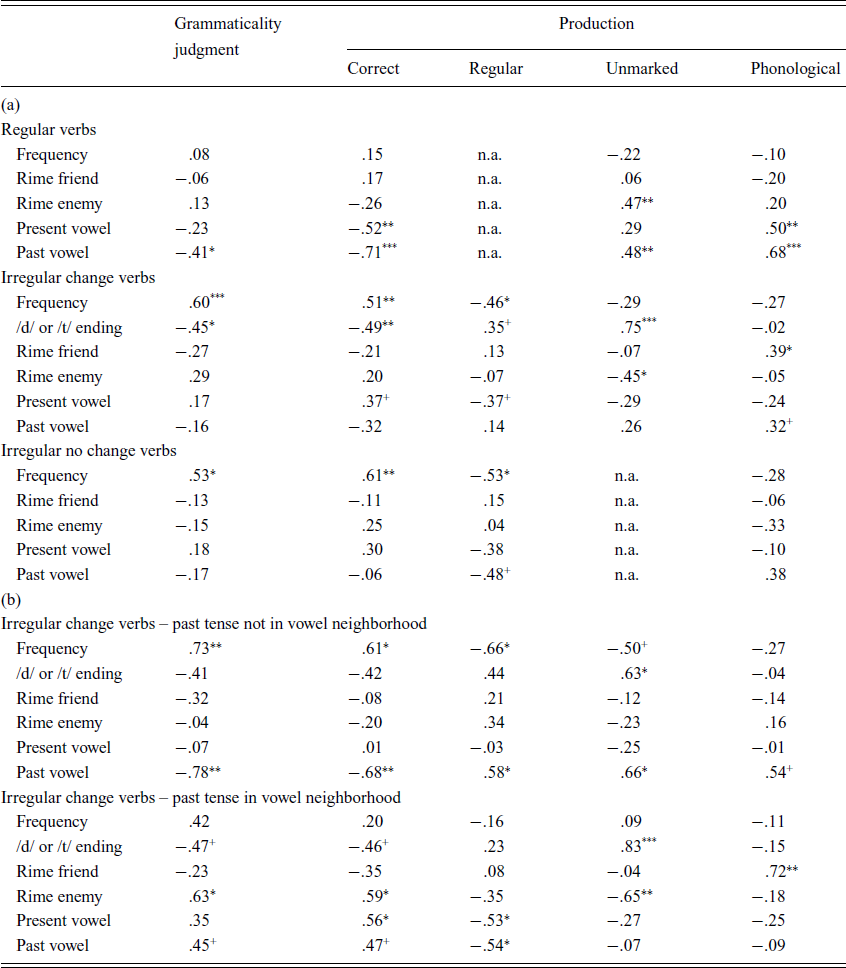
n.a. = not applicable
+p < .10; *p < .05; **p < .01; ***p < .001
However, there was strong evidence that a different type of neighborhood, that of the vowel, was strongly influential for non-native English speakers. First, the number of present and past vowel neighbors showed strong correlations to performance by non-native English speakers for regular verbs. Consider the correlations for present tense vowel neighbors. Target regular verbs having many such neighbors were less likely to be produced correctly, and more likely resulted in a phonologically related error. This indicates that the non-native English speakers may have misheard the original verb, and then given the past tense of the misheard verb. Indeed, an examination of the errors made by the non-native English speakers showed that they often gave left as the past tense of live, indicating they may have misheard the target verb as leave. They also often gave felt as the past tense of fill, indicating that they heard the original verb as feel. (Note that both of these errors are consistent with the /ɪ/–/i/ confusion many speakers of Romance and other languages have in English.)
Now consider the correlations for regular verbs for past tense vowel neighbors. Having a large number of past tense neighbors correlated with low grammaticality judgment scores, production of fewer correct forms, and more unmarked forms and phonological errors. An examination of the type of phonological errors given showed that non-native English speakers indeed often gave an irregular past tense vowel neighbor rather than the correct regular form – for example, flew was often given as the past tense of flow, rather than flowed. This pattern suggests that having an attractive past tense form in the vowel neighborhood confused non-native English speakers, and since it was a plausible answer (it was past tense, and it had strong phonological resemblance to the target verb), they occasionally produced it.
If non-native English speakers are indeed attracted to past tense forms in the vowel neighborhood of a target verb, this has different implications for regular verbs (such a past vowel neighbor will always be wrong, and always result in a phonologically related error) and irregular change verbs (such a past tense vowel neighbor may actually be right, and would result in a decrease in phonologically related errors – something that may explain the previously mentioned tendency of low phonological ability non-native English speakers to make fewer phonologically related errors – see Table 2). To test this idea, however, we need to break down our irregular change verbs into two classes: (i) those that do not have their correct past tense in their vowel neighborhood – this includes verbs such as bend, build, deal, etc., which have a consonant change or addition in addition to any vowel change, and (ii) those that do have their correct past tense in their vowel neighborhood – this includes verbs such as hold, ride, speak, etc. The former class should show similar effects of past vowel neighbors as regular verbs, while the latter class should not. The correlations for these two subclasses of irregular change verbs are shown in part (b) of Table 3.
Note that, as predicted, for irregular change verbs that did not have the correct past tense in their vowel neighborhood, the size of the past vowel neighborhood was correlated with poor grammaticality judgment and low correct production. It was also correlated with more regularization, and with more unmarked forms; there was also a marginal correlation with phonologically related forms. As an example of the latter type of error, non-native English speakers gave flew as the past tense of flee.
For irregular change verbs that did have the correct past tense in their vowel neighborhood, we did not find these same correlations – in fact, they were generally in the opposite direction. There were marginal positive correlations of past vowel neighborhoods with correct grammaticality judgments and correct production and significant negative correlation with overregularization. That is, for this type of irregular verb, having past tense vowel neighbors was found to be beneficial, probably because one of the neighbors is actually the correct past tense. For this subclass of verb there was no correlation between past vowel neighborhood size and production of phonologically related errors. Rather, this type of error was strongly correlated with the number of rime friends. And errors for this type of verb were consonant with this – for example, slung was given as the past tense of swing, indicating that it was misheard as sling, and brought was given as the past tense of ring, indicating that it was misheard as bring.
Discussion
Experiment 1 showed that non-native English speakers were worse than native English speakers in their mastery of both regular and irregular past tense. It further showed that different factors were related to poor performance on regular and irregular past tense. Poor phonological ability corresponded to inaccurate regular past tense performance, and higher production of unmarked forms for regulars. The lexical access measure of lack of response on the picture naming task correlated with poor irregular past tense performance, and overregularization. Verb characteristics were also significant: frequency effects were found for irregular verbs, and more interestingly, a new type of vowel centered neighborhood (i.e., containing present or past tense vowel neighbors), proved to be highly influential for non-native English speakers. Verbs with other present tense verbs in their vowel neighborhood could be plausibly misheard as another verb (e.g., live perceived as leave), due to the increased competition non-native English speakers have in word recognition because of problems in phoneme discrimination (Weber & Cutler, Reference Weber and Cutler2004). Verbs with past tense verbs in their vowel neighborhood had a plausible phonologically related irregular form available, tempting non-native English speakers to irregularize both regular (flow–flew) and some irregular (flee–flew) verbs, while actually promoting correct answers for irregular verbs with the correct past form in the vowel neighborhood (fly–flew).
The influence of the vowel neighborhoods indicates that the type of phonological difficulty L2 learners have – discriminating L2 phonological categories – seems to hit vowels particularly hard. Since our sample was largely comprised of speakers of Romance languages, this was perhaps not surprising. Romance languages generally have fewer vowels than English (e.g., Spanish has five vowel phonemes, Romanian has seven, and most dialects of English have 15). Romance language speakers learning English thus have to take their fewer vowel distinctions and use them to perceive and produce the more numerous English vowels. This results in many English vowel confusions – for example, Romance language speakers have trouble distinguishing /ɪ/ and /i/, as well as other English vowel pairs (Flege & MacKay, Reference Flege and MacKay2004; Fox, Flege & Munro, Reference Fox, Flege and Munro1995). However, even the native speakers of non-Romance languages in our current sample showed the same difficulties with vowel perception in our current study: six of the seven non-Romance speakers showed errors on regular verbs due to present or past tense vowel neighbors, a ratio very similar to the 14 out of 16 Romance speakers who showed the same trend. Even the native English speakers in our sample showed some influence of vowel neighborhoods on their behavior. They showed positive correlations between the production of phonologically related incorrect past tense forms for regular verbs and both present tense (r = .38, p < .05) and past tense vowel neighbors (r = .37, p < .05). These correlations were smaller in magnitude (and significantly so for past tense neighbors, t(28) = 3.21, p < .005) than those for non-native English speakers, but showed that native English speakers were also attracted to vowel neighbors. Some of this attraction may also be helped along by the influence of irregular verb patterns. For example, giving flew as the past tense of flow is probably aided by the blow–blew irregular verb pattern. However, at least some of the past tense forms from the vowel neighborhood that were given appear not to be driven by irregular patterns (e.g., saw as the past tense of sew).
Previous work using impaired native speaking populations has often failed to find a correlation between simple phonological measures, such as word pair discrimination and regular past tense performance – often measured by a production task (Lambon Ralph et al., Reference Lambon Ralph, Braber, McClelland and Patterson2005; Tyler et al., Reference Tyler, Randall and Marslen-Wilson2002b). However, we were able to find this relationship using an L2 population. Note, however, that our strongest correlation for the word pair discrimination task occurs for regulars in the grammaticality judgment task. The discrimination needed for regulars in the grammaticality judgment task (fill–filled) is parallel to that in the word pair discrimination measure (coal–cold), making it therefore more likely to find a correlation with the grammaticality judgment than production task.
Previous work on past tense in L2 speakers has usually found that this population has more difficulty with irregular than regular past tense (Basnight-Brown et al., Reference Basnight-Brown, Chen, Hua, Kostic and Feldman2007; Birdsong & Flege, Reference Birdsong and Flege2001; Cameli et al., Reference Cameli, Phillips, Kousaie, Panisset, Cohen, McAlister, Rolstad and MacSwan2005). We find a similar trend in our production task (F(2,44) = 13.51, p < .001). But we should not conclude that irregulars are harder than regulars for non-native English speakers. First, note that native English speakers also show this same pattern – they also find regulars easier to produce than irregulars. Second, if a different task is used, a different pattern can result. We used the same verbs in the grammaticality judgment as in the production task, but in the former task, non-native English speakers actually found irregular change verbs to be easier than the other two types (F(2,44) = 5.52, p < .01). Thus, task type might be highly influential in determining which verbs are disadvantaged.
Experiment 2: Stressed native English speakers
Experiment 1 demonstrated that L2 phonological ability correlated with regular past tense performance, while L2 lexical access correlated with irregular past tense performance in non-native English speakers. However, such correlations say nothing about causation. We therefore turn to native English speakers, who have native mastery of past tense formation, and look to see if impairing their phonological ability selectively impacts regular past tense performance, and if impairing their lexical access ability selectively impacts irregular past tense performance. Such a demonstration would provide evidence for a causal link – showing that non-native speakers’ deficits in syntactic performance can be simulated in native speakers by causing deficits in non-syntactic processing. Imposing such processing stress manipulations on unimpaired speakers has been successful in modeling performance on grammatical tasks by such diverse groups as aphasics (Blackwell & Bates, Reference Blackwell and Bates1995; Dick, Bates & Ferstl, Reference Dick, Bates and Ferstl2003; Dick, Bates, Wulfeck, Utman, Dronkers & Gernsbacher, Reference Dick, Bates, Wulfeck, Utman, Dronkers and Gernsbacher2001; Miyake, Carpenter & Just, Reference Miyake, Carpenter and Just1996), and children with specific language impairment (Hayiou-Thomas, Bishop & Plunkett, Reference Hayiou-Thomas, Bishop and Plunkett2004) as well as late L2 learners (McDonald, Reference McDonald2006).
In order to simulate the phonological weakness seen in L2 learners, we needed to put native speakers under perceptual stress that made it difficult to accurately process phonology. We did this by adding an overlay of white noise to the stimuli, which should make it more difficult to distinguish what was being heard. This should result in more errors in grammaticality judgment on regular verbs than irregular verbs, because the distinction in the former case is more subtle than in the latter. There may also be more production errors for regular than irregular verbs, and a greater number of phonological errors in general. However, since noise was added across the whole verb length, the nature of these phonological errors may not show the vowel centric focus we had observed in the L2 learners.
In order to simulate problems with lexical access as seen in the L2 learners, we placed the native speakers under time pressure by giving them a short response deadline. This may not enable them to complete lexical access before they are forced to respond. Inadequate time to complete lexical access should result in more errors in grammaticality judgment on irregular than regular verbs, with people accepting the overregularized forms of the irregular verbs. There should also be more production errors on irregular than regular verbs, with many errors being overregularized forms.
Method
Participants
Forty-five adult native English speakers participated in Experiment 2. Fifteen were the native English speakers from Experiment 1; they served as an unstressed control group here. Fifteen were in the noise condition (mean age = 24.33, range 18–56 years), and 15 were in the deadline condition (mean age = 20.60, range 18–26 years). All native English speakers were current undergraduate students and received course credit for their participation.
Stimuli and procedure
The materials and procedures used were identical with those used in Experiment 1 except for the administration of the grammaticality judgment and past tense production tasks, which were presented with an appropriate stress manipulation. In the noise stress group, the stimuli were heard through a layer of white noise. Pilot testing led to a selection of noise level where stimuli were noticeably harder, but not impossible to perceive. This chosen noise level was kept constant across tasks and participants. In the deadline condition, the stress manipulation involved a 1000 msec response deadline after stimulus offset. This was signaled by a ding; participants were instructed to give their response (i.e., push the button in the grammaticality judgment task, or say the past tense of the verb in the production task) before the ding occurred. Participants’ responses were still recorded if they occurred after the deadline, but they were urged to respond faster.
Results
We analyzed the data by comparing each stressed group to the control group. Both subject and item analyses were performed, and combined into the min F′ measure.
Grammaticality judgment
The noise manipulation was predicted to selectively impact regular verbs. As shown in Table 4, this is exactly what happened. Adding noise impacted the ability of native English speakers to hear the difference between past tense regular verbs and their unmarked form (a difference of a /t/ or /d/), but did not impact their ability to hear the difference between past tense irregular verbs, and their overregularized form (a difference of a vowel contrast and/or syllabic /ɪd/).

n.a. = not applicable
ηp2 provided for marginal or significant effects only.
For all analyses the first degree of freedom is 1.
+p < .10; *p < .05; **p < .01; ***p < .001
The deadline group was predicted to have selective impairment on irregular verbs. As shown in Table 4, they differed from the control on the judgment of irregular change verbs, but failed to do so for the irregular no change verbs. As predicted, they did not differ from the control on regular verbs.
Thus, on the grammaticality judgment task we were able to mimic what we found in the non-native English speakers. Noise stress selectively impacted regular verbs, while leaving irregular verbs unharmed. Simple deadline pressure selectively impacted irregular verbs (or at least irregular change verbs), while leaving regular verb performance intact.
Production
Compared to the control group, the noise stress group was predicted to have lower correct production of regular verbs, and have a greater number of phonologically related errors in general. As shown in Table 4, the noise stress group showed a general decrement of correct production across all verb types. They also showed corresponding increases in phonological errors across all verb types. All effects that were marginal in the min F′ analysis were significant in subjects analysis and significant or marginal in the items analyses (correct production of irregular no change verbs, F1(1,56) = 5.60, p < .05; F2(1,16) = 10.48, p < .01; phonological errors for irregular change verbs, F1(1,56) = 16.90, p < .001; F2(1,27) = 4.05, p = .05; phonological errors for irregular no change verbs, F1(1,56) = 29.64, p < .001; F2(1,16) = 3.45, p < .09). Thus, the noise manipulation failed to selectively impair the production of regular verbs. As discussed below, this was because the nature of the phonological errors made by the noise stress group was different from the type made by non-native English speakers in Experiment 1, and thus impacted all verb types.
We examined the nature of the phonological errors made by the noise group, by comparing it both to the control native English speakers, and the non-native English speakers from Experiment 1. Table 5 breaks down phonological errors by the location of the error. Onset errors involved mishearing the target word's onset – such as giving tried as the past tense of fry or said as the past tense of pay. Vowel errors involved mishearing the target's word vowel, or replacing that vowel with another when giving the past tense. For example, giving slipped as the past tense of slap or flew as the past tense of flow. Coda errors involved mishearing or missing the end of a word – for example, giving gave as the past tense of gain or saw as the past tense of seem. A three-way ANOVA on group, verb type and location yielded a significant three-way interaction, F(8,200) = 3.51, p < .001. Tukey follow-up tests after one-way ANOVAs on group by each verb type and location showed that while non-native English speakers had high rates of phonological errors involving vowels, native English speakers under noise made more errors on onsets for all verb types, as well as on codas for irregular no change verbs. Thus, while non-native English speakers had trouble with the perception of vowels, adding noise to the signal caused native English speakers to have trouble with the perception of onsets.

Note: Different superscripts indicate that means on a line are different by a Tukey post-hoc test.
When compared to the control group, the deadline group was predicted to have lower correct production of irregular verbs, and to show higher rates of overregularization. As shown in Table 4, the deadline group did indeed show significantly lower correct production of irregular change verbs. They also had lower rates of correct production for irregular no change verbs, but this difference failed to reach significance in the subjects analyses (F1(1,56) = .85, ns) although it did in the items analysis (F2(1,16) = 5.59, p < .05). As predicted, correct production of regular verbs was not impacted by deadline pressure. There was a numerical tendency for this group to produce more overregularized forms for irregular change verbs, but it was not statistically significant. A comparison of the deadline group's performance on the irregular change and no change verbs to that shown by the L2 learners in Table 1 shows extremely close parallels in the magnitude of performance across the correct and various error categories.
Discussion
The purpose of Experiment 2 was to show that a stress manipulation that made phonological processing more difficult would impact regular, but not irregular past tense. In addition, a stress manipulation that made lexical access more difficult would impact irregular, but not regular past tense. This would allow us to make a causal connection between these non-syntactic processes and morphosyntactic performance. The results of the grammaticality judgment task provided support for these hypotheses. Noise stress impacted regulars, but did not impact irregular verbs. The overlay of noise across the sentence made the subtle discrimination needed for regulars (fill–filled) more difficult, but had less impact on the more perceptible contrast present for irregulars (bit–bited, cut–cutted). Deadline pressure did not impact regulars, but did impact irregular change verbs.
In the production task, the noise manipulation failed to be specific to regular verbs. Further analysis showed this was because added noise strongly impacted the perception of verb onsets, which led to phonological errors across all verb types. Non-native English speakers with phonological difficulties in Experiment 1 showed attraction to present or past tense verbs in the vowel neighborhood, which resulted in more errors on regular verbs. Thus, adding a uniform amount of noise to the verb might not be the best simulation of the phonological deficit suffered by L2 learners in production; rather, adding noise specifically to the vowel portion might be a better way to model this deficit.
The lexical access time manipulation did succeed in having the desired effect in the production task. Poor correct performance on irregular change verbs with intact regular performance was achieved in the deadline condition.
It is important to emphasize that the native English speakers in Experiment 2 obviously have native command of English past tense. Yet, their past tense performance was impaired in specific ways when non-syntactic processes were disturbed. Thus, it is possible that poor syntactic performance can be the result of specific non-syntactic problems. The current study adds to studies that have used intact native speakers under processing stress as a method of modeling difficulties experienced by other populations (Blackwell & Bates, Reference Blackwell and Bates1995; Dick et al., Reference Dick, Bates, Wulfeck, Utman, Dronkers and Gernsbacher2001; Dick et al., Reference Dick, Bates and Ferstl2003; Hayiou-Thomas et al., Reference Hayiou-Thomas, Bishop and Plunkett2004; McDonald, Reference McDonald2006; Miyake et al., Reference Miyake, Carpenter and Just1996). This method is particularly useful in testing what aspect of processing (e.g., processing time, phonological ability, memory capacity, etc.) may underlie the particular syntactic deficit.
General discussion
Why do non-native English speakers have trouble with L2 morphosyntax? Do they lack the underlying knowledge (Meisel, Reference Meisel1997), or do they have knowledge that they are unable to consistently apply or demonstrate (Prévost & White, Reference Prévost and White2000)? Perhaps there is a combination of both. For example, if a learner has never or rarely encountered the past tense of a low frequency irregular verb such as stride–strode, this knowledge would be absent. However, there may be other relevant past tense knowledge or processes that the learner possesses, but is not able to access at a particular time, or on a particular task (see Johnson, Shenkman, Newport & Medin, Reference Johnson, Shenkman, Newport and Medin1996 for a relevant model of L2 grammaticality judgment performance). Reasons for this variable accessibility may lie with high processing or working memory demands, inadequate time to access the more weakly represented L2 information, or problems with the processing of linguistic information that must be completed as an input for syntactic analysis. The fact that we were able to largely induce similar profiles of problems that L2 speakers show with past tense performance by placing native English speakers under various types of processing stress gives at least an existence proof that impaired performance can occur in the presence of full syntactic knowledge.
The ability to simulate the deficits of any atypical group (aphasics, language impaired, L2 learners) by putting native speakers under stress (see also Dick et al., Reference Dick, Bates, Wulfeck, Utman, Dronkers and Gernsbacher2001; Hayiou-Thomas et al., Reference Hayiou-Thomas, Bishop and Plunkett2004; McDonald, Reference McDonald2006) has implications for models of syntactic processing. Problems with syntax in such atypical populations are often used as evidence for a domain specific, modular syntax processing mechanism that has suffered neurological damage or for a biologically based age limitation specific to syntax acquisition (Lenneberg, Reference Lenneberg1967; Pinker, Reference Pinker1994). However, simulation of these problems in intact native speakers is consistent with the opposing viewpoint that syntax is a non-modular system, and open to the influences of other cognitive processes. Such an approach also allows the same processing architecture for typical and various atypical populations; what may differ between these populations is the type of underlying or basic cognitive process that is impaired.
The results of the current experiments also show that morphosyntactic difficulty may have different sources for different morphemes, or in this case, different forms of the same morpheme – regular and irregular past tense. Further evidence across other morphemes indicates that this is probably generally true. For example, in native speaking children, working memory capacity has been shown to be important in grammaticality judgments for third person agreement, but not for plurals. Similarly, in this same group, phonological ability has been shown to be relevant to grammaticality judgment for single phoneme realizations of regular plurals (e.g., flute–flutes) and third person agreement (e.g., jump–jumps), but not for syllabic realizations of the same morphemes (e.g., plural: glass–glasses; agreement: watch–watches) (McDonald, Reference McDonald2008). Similarly, the poor mastery that L2 speakers often show for L2 morphosyntax may have different underlying sources for different morphemes. Depending on the profile of strengths and weaknesses of an individual learner on various non-syntactic aspects of the second language such as L2 phonology, L2 working memory capacity, and L2 access speed, different patterns of difficulty across L2 morphemes may occur.
A new type of neighborhood was shown to be influential in the past tense production performance for non-native English speakers, as well as native English speakers. Vowel neighborhoods were especially influential for the production of phonologically related errors. Having a plausible vowel-change irregular form in the neighborhood made it an attractive alternative. These types of phonological errors are different in nature than the type often reported for native English speakers with phonological impairments. Such impaired populations tend to make simplification errors of consonant clusters (e.g., tane for trained). Thus, it appears that the nature of the phonological impairment for L2 learners is centered on the correct perception of L2 phonemes, particularly vowels, while it is more of a production deficit for at least some impaired populations.
Across both the grammaticality judgment and production tasks and in both experiments, predicted differences that occurred for irregular change verbs were often not significant for irregular no change verbs, although means were generally in the same direction. This may partly be due to the fact that there were fewer verbs in this latter category, giving less power to the items analyses. However, these two subclasses of irregular verbs may have somewhat different properties. For example, irregular no change verbs actually benefit if phonological limitations favor the production of unmarked forms, while irregular change verbs would be disadvantaged. Similarly, the tendency for unmarked forms to be given to verbs with a /d/ or /t/ final phoneme would promote correct (i.e., unmarked) answers for our no change verbs as all ended in /d/ or /t/, while promoting incorrect answers for those change verbs (36% of our sample) that ended in /d/ or /t/.
The past tense debate
As noted in the introduction, there are two theoretical positions that attempt to explain the data on past tense performance. One group maintains that regulars are formed by a productive rule, while irregulars are formed by lexical look up in declarative memory, or through an associative network (Pinker, Reference Pinker1999; Pinker & Ullman, Reference Pinker and Ullman2002). This theory predicts a double dissociation between regular and irregular past tense performance. When a person has an impairment of the parts of the brain involved with grammar (i.e., the ‘rules’ part of the model, associated with left anterior damage), regular past tense is affected, and irregular past is intact. When a person has an impairment of lexical memory (i.e., the ‘words’ part of the model, associated with left posterior damage), irregular past tense is affected, leaving regular past tense intact (Pinker & Ullman, Reference Pinker and Ullman2002). This model does not predict a connection between phonological ability and regular past tense; it does predict a connection between lexical access and irregular past tense.
A second group maintains that regular and irregular past tenses are formed by a single associative mechanism. Connectionist models actualize this by associating the phonological form of regular and irregular verbs with their corresponding past tense forms and meaning (Joanisse & Seidenberg, Reference Joanisse and Seidenberg1999; McClelland & Patterson, Reference McClelland and Patterson2002; Rumelhart & McClelland, Reference Rumelhart, McClelland, McClelland and Rumelhart1986). According to this single process model, phonology is more associated with the formation of regular past tense, because of the high phonological overlap between regular present and past tense forms, while semantics is more important for the linkage between present and past tense forms for irregular verbs. Indeed, a connectionist simulation of the single process model found that when severe phonological damage and random noise were added to the model, regulars were more severely impacted than irregulars. When semantic units were lesioned, irregular past tense showed a marked decrease in accuracy, while regulars were only slightly impacted (Joanisse & Seidenberg, Reference Joanisse and Seidenberg1999). Thus, single mechanism accounts specifically predict that individual differences in factors such as phonological ability or strength of semantic representation should differentially impact regular and irregular verbs, respectively.
Congruent with both models, the current experiments do show that different factors impact the processing of regulars and irregulars. However, only the single process model predicts a relationship between phonology and regulars – because of the different phonological characteristics of the regular vs. irregular verbs, not because of the nature of the syntactic subclasses. In general, many characteristics – phonological complexity (Bird et al., Reference Bird, Lambon Ralph, Seidenberg, McClelland and Patterson2003), phonological regularity (Burzio, Reference Burzio2002), phonological rime neighborhoods (Cortese et al., Reference Cortese, Balota, Sergent-Marshall, Buckner and Gold2006), semantic neighborhood density (Baayen & Moscoso del Prado Martin, Reference Baayen and Moscoso del Prado Martin2005) – are confounded in lists of irregular and regular verbs used in studies investigating past tense formation, and removing these confounds often changes performance, leveling differences between regular and irregular verbs (Bird et al., Reference Bird, Lambon Ralph, Seidenberg, McClelland and Patterson2003).
We find a similar situation in our data. L2 learners in Experiment 1 show a relationship between phonological ability and regular performance, but it is due to the difference in phonological characteristics between regular and irregular verbs. In the grammaticality judgment task, regulars contained a more subtle contrast (fill–filled) than the irregular (bit–bited), thus putting more demands on phonological processing. In the production task, the vowel neighborhoods of regular verbs never contained the correct past tense form, while they often did for irregular verbs, causing this phonological neighborhood property to have a more negative effect on regulars than irregulars. Indeed, when we separated irregular change verbs into those with and without the correct past tense in the neighborhood, the latter showed correlations similar to those for the regular verbs. This indicates that it was not verb class per se, but characteristics of the neighborhood that influenced production. Until all such confounds between verb subclass and other properties have been found and controlled for, it is too soon to conclude that differences in performance on regular and irregular verbs provide evidence of separate processing mechanisms. In addition, it is unlikely that phonological factors will exclusively affect regulars and not irregular, while lexical access factors will exclusively affect irregulars and not regulars. Rather, the relative importance of these factors may differ for the different verb types.
Improving L2 past tense performance
There are some applied implications of our results with non-native English speakers. L2 learners tend to have problems with the phonology of their second language, and the severity of these problems also increases with age of L2 acquisition (Baker & Trofimovich, Reference Baker and Trofimovich2005; Flege & MacKay, Reference Flege and MacKay2004; Yeni-Komshian et al., Reference Yeni-Komshian, Flege and Liu2000; in the current study age of exposure to English for the non-native speakers significantly correlated to the phonological measure of phoneme overlap, r = −.42, p < .05). Poor phonological discrimination may leave more words in competition during lexical recognition (Weber & Cutler, Reference Weber and Cutler2004), and may leave L2 learners more vulnerable to the influence of strong phonological neighbors. Since the current study showed the particular vulnerability L2 speakers had to vowel perception in producing correct past tense forms, specialized training on vowel perception (e.g., Lambacher, Martens, Kakehi, Marasinghe & Molholt, Reference Lambacher, Martens, Kakehi, Marasinghe and Molholt2005) may benefit past tense production as well as generally decreasing lexical competition for late L2 learners.
Regular past tense is one of the more difficult constructions for late L2 learners to master in grammaticality judgment tasks (McDonald, Reference McDonald2006), perhaps due to the difficulty in discriminating the slight phonological difference between unmarked and past tense forms. The results of the current study are consistent with this interpretation – poor grammaticality judgments were found specifically for regular past tense items in Experiment 1 for L2 learners with poor phonological ability and in Experiment 2 for native English speakers stressed with noise. Additional training on extracting phonological information from the ends of words may help L2 learners improve regular past tense comprehension, and would be useful for other constructions such as third person singular verbs, and plural nouns.
Lexical access in L2 speakers may be poor due to weaker links between semantic and phonological representations that result from knowing more than one language (Gollan et al., Reference Gollan, Montoya, Fennema-Notestine and Morris2005). In addition, lexical access may be influenced by the age of acquisition; in the current study, age of exposure to English for the non-native speakers marginally correlated to the lexical access measure of picture naming accuracy, r = −.38, p < .08. Lexical access speed is also known to be influenced by the age at which a lexical item is acquired for both native and non-native speakers, with later acquisition resulting in slower speed (Ellis & Morrison, Reference Ellis and Morrison1998; Hirsh, Morrison, Gaset & Carnicer, Reference Hirsh, Morrison, Gaset and Carnicer2003). Since irregular past tense forms are more vulnerable to problems with lexical access, this implies that L2 learners, and particularly L2 learners with a late age of L2 acquisition, may have particular problems with irregular past tense verbs. Indeed, Birdsong and Flege (Reference Birdsong and Flege2001) found that age of L2 acquisition showed stronger effects on knowledge of irregular than regular past tense forms. Extra practice accessing irregular verbs may be helpful in offsetting the negative effects of weaker lexical access and age of acquisition effects for late L2 learners.
Conclusion
The difficulties L2 speakers have with L2 morphosyntax could have their origin in non-syntactic aspects of the second language that are not well mastered by the non-native speaker. In the specific case of English past tense, phonological weaknesses may impact regulars more than irregulars, while poor lexical access may impact irregulars more than regulars.



