I. INTRODUCTION
High temperature oxidation and lubrication used in special conditions is still a great subject and significant challenge to the Materials Science and Engineering as well as tribology community. Reference Spikes1–Reference Xu, Shi, Wang, Zhai, Yao, Song and Zhang3 Metal matrix composites (MMCs) constitute an important class of materials for tribological applications. Reference Moghadam, Omrani, Menezes and Rohatgi4 As a kind of representative and very promising MMCs, Ni-based composites are well known for their various properties such as prompt thermal stability and excellent anticorrosion and wear resistance. Reference Ding, Li, Ran, Tian and Zhou5–Reference DellaCorte and Edmonds7 But the high temperature wear is still the major technical limitation factor for a wide use of Ni-based composites in the tribology system. Reference Bi, Liu, Yang, Ma and Xue8–Reference Rynio, Hattendorf, Klöwer and Eggeler10 To improve the wear resistance properties of Ni-based composites at elevated temperature, the addition of a relatively small amount of ceramic phases to the nickel alloy matrix can remarkably improve the characteristics of the alloy due to the synergetic effect of hard ceramic reinforcements and the matrix. Among ceramic particulates, TiC and Al2O3 have high melting points (>2000 °C), high hardness (>2000 Hv), good thermal stability, notable corrosion, and erosion resistance, as well as excellent wear resistance. Those outstanding features make them have potential prospects for tribological applications especially as constituents of a multi-component protective coating or composites to enhance resistance against thermal and mechanical wear. Reference Deng11–Reference Kumar, Chaubey, Bathula, Jha and Dha15 Tian et al. had prepared Ni–Al2O3 nanocomposite coating by electrophoretic-electroplating deposition displayed a better wear resistance property than pure Ni coating. Reference Tian, Zhu, Qu and Zhu16 Lu et al. studied and analyzed the tribological behaviors of a Ni-based alloy/Al2O3 tribo-pair at elevated temperatures, and considering that the dominate wear mechanism of a metal/Al2O3 tribo-pair at high temperature is adhesive wear which is evident by severe material transfer from alloy to Al2O3. Reference Lu, Shang, Meng, Wang and Paulo Davim17 Liu et al. have reported that the NiCr/Al2O3 composites exhibited excellent mechanical properties and good antioxidation ability and satisfying friction and wear properties over the entire temperature range from room temperature to 1000 °C. Reference Liu and Jia18,Reference Liu, Jia, Yi, Wang and Shan19 Bartuli found Ni–Cr–40 vol% TiC coating obtained by self-propagating high-temperature synthesis (SHS) exhibit good sliding wear performance when sliding against Al2O3 ball. Reference Bartuli and Smith20 Choi et al. had investigated the corrosion and wear properties of TiC/Ni–Mo composites and found that the wear resistance of the composite was improved with molybdenum addition. Reference Choi, Baik, Lee, Hong and Hahn21 Sliney and co-workers from NASA have developed a series of self-lubricating Ni-based composites prepared by plasma-spraying or hot-pressing such as PS/PM212, PS/PM300, PS304, and PS400. Those composites consist of a NiCr or NiMoAl matrix and two or three solid lubricants, NiCr or NiMoAl acts as a binder and offers excellent high temperature oxidation/corrosion resistance and essential mechanical strength. Using Cr2O3 or Cr2C3 ceramic particles as a hardener, meanwhile, they can act as a high temperature lubricant when the temperature is above 500 °C, silver and BaF2/CaF2 eutectic are added as low and high-temperature solid lubricants, exhibited low friction from room temperature to 650 °C. Reference Li and Xiong6,Reference Sliney, Dellacorte and Lukaszewicz22–Reference Blanchet, Kim, Calabrese and DellaCorte24
Though a large number of Ni-based composites with ceramic phases as additive or reinforcement have been fabricated and evaluated, and some results are quite good indeed. Such as PS/PM composites designed by NASA and the previously mentioned NiCr-based composites prepared in our laboratory. All those composites show good tribological properties at high temperature or wide range temperatures. However, in most of those researches, the ceramic phases were commonly added to the Ni matrix directly in the form of micro or nanoscale powders, the phenomenon of the agglomeration and inhomogeneous distribution of ceramic particles in the matrix are likely to occur during process. So the combination of the interface between the ceramic particles and the matrix has been affected greatly, and result in some corresponding performance degradation, for instance, the decline of mechanical properties and oxidation of the PS coating deteriorated its wear resistance when the temperature was above 800 °C, thus limits its practical application. Reference Liu and Jia18 To overcome the limitations, in situ processes have recently received much attention because of its interesting characteristics. Reference Zhao25 By in situ methods, reinforcements are formed directly in the matrix through chemical reactions between elements or compounds, consequently the reinforce phases formed by chemical reactions is compatible with the matrix, and the reinforcements–matrix interface is clean. Reference Tjong and Ma26,Reference Yang, Liu and Zhong27 This can ensure a sufficient strength of the composite to transfer stresses, by which the problem of interface crack propagation could be inhibited. Reference Zhao25,Reference Zohari, Sadeghian, Lotfi and Broeckmann28 Wang et al. had prepared a Fe-based composite coating reinforced by in situ multiple TiB2–TiC–Al2O3 ceramic particles developed by gas tungsten arc welding (GTAW) melting process and found that the hardness and wear resistance of the coatings increased drastically in comparison with that of the substrate. Reference Wang, Zhang and Du29 In our previous work, Reference Liu, Gao, Jia, Bai and Wang30 it had been found that the NiAl-based nanocomposites reinforced by in situ Mo2C ceramic precipitates showed good mechanical properties and lower friction coefficient (0.35) than that of NiAl alloy (0.48) at 700 °C, and the improvement of high temperature tribological properties could be attributed to the formation of molybdenum trioxide tribofilm and the second phase hardening effect of Mo2C ceramic particulates. Subsequently, the Ni-based composites reinforced by in situ TiC ceramic precipitates, and the NiAl-based composites reinforced by in situ TiC and Al2O3 ceramic precipitates have been studied. Reference Zohari, Sadeghian, Lotfi and Broeckmann28,Reference Sheng, Yang, Xi and Guo33 However, the relevant properties such as oxidation resistance and tribological properties at even higher temperatures than 700 °C up to 1000 °C have not been investigated and the mechanism is not very clear in those works. In addition, the study of Ni-based composites reinforced by in situ one or more ceramic precipitates is still very few.
In present work, we take NiMoAl as the matrix based on the formulation design of PS400, mixture of aluminum (Al), boron carbon (C), and titanium dioxide (TiO2) powders was used as precursors for the formation of the TiC and Al2O3 ceramic phases in Ni-based matrix, and it is expected that the composites have excellent mechanical properties especially good oxidation resistance and tribological properties at elevated temperatures. The feasibility of the friction and wear properties of the composite at elevated temperatures could be improved by in situ Al2O3 and TiC is also expected. Meanwhile, the composites directly added Al2O3 and TiC ceramic particles were also fabricated for comparison. The difference in the high-temperature friction, wear behavior, and self-lubrication mechanism of those composites reinforced by in situ/ex situ Al2O3 and TiC ceramic phases from room temperature to 1000 °C were investigated in detail.
II. EXPERIMENTAL PROCEDURES
A. Materials and process
Commercially available nickel, molybdenum, aluminum, titanium, carbon, titanium carbide, alumina, and titanium dioxide powders were used as the starting materials of the composites. The composites containing in situ/ex situ Al2O3 and TiC ceramic phases were denoted as NAT, NATC, respectively. Ni, Mo, Al (mass ratio 85:10:5) was used as the baseline material. The amount of 20 wt% ceramic particles was added to the matrix as reinforcement. The details about the composition of the powders of those Ni-based composites are given in Table I. The following reaction explains the in situ formed Al2O3 and TiC phase in the composites during sintering process:
 $$3{\rm{Ti}}{{\rm{O}}_2} + 4{\rm{Al}} + 3{\rm{C}} = 2{\rm{A}}{{\rm{l}}_2}{{\rm{O}}_3} + 3{\rm{TiC}}\;{\rm{[29]}}$$
Composition, density and Vickers hardness of the hot-pressed Ni-based composites.

The combined powders were prepared by wet ball milling in alcohol for 20 h with stainless steel balls. Following drying, the final densification of the combined powders was accomplished by hot pressing with a pressure of 25 MPa at a dynamic vacuum of about 10−2 Pa for 30 min to produce a composite disk. The powders were pressed under the pressure of 25 MPa at 1200 °C holding 30 min. Then the sintered samples were machined to different sizes for examining the mechanical and tribological properties. Prior to the tests, the samples were polished with an 800-grit emery paper, followed by ultrasonic cleaning in acetone for 10 min and then drying in hot air.
B. Friction and wear test
The tribological tests were conducted on a UMT high-temperature tribometer (Bruker Corp., Madison, Wisconsin) with ball-on-disk contact configuration. The Ni-based composites were used as the lower specimens, and commercially available Al2O3 ceramic balls [Ø 10 mm, hardness value (HV) of approx. 16.5 GPa] were used as the upper specimens. The schematic diagram of the ball-on-disk at high-temperature tribometer can refer to the relevant literature. Reference Wang, Shan, Guo, Wang, Yi and Jia31 Prior to the test, the surfaces of the disk were cleaned with acetone and then dried in hot air. The selected test temperatures were 20, 200, 400, 600, 800, and 1000 °C. The tests were run at an applied load of 20 N, sliding speed of 0.108 ms−1, and testing time of 60 min. The friction coefficient curves were recorded automatically using a computer connected with the friction and wear tester. The wear volume loss was measured using a Nano Map 500LS three dimensional (3D) contact surface mapping profiler (AEP Technology, USA). The wear rate is calculated as:
 $$K = {V \mathord{\left/ {\vphantom {V {SL}}} \right. \kern-\nulldelimiterspace} {SL}},$$
where V is the wear volume loss in mm3, S is the total sliding distance in m, and L is the normal load in N.
C. Characterization of composites
The phase composition of the composites powders and composites after wear test at different temperatures were determined with a Rigaku D/max-RB x-ray diffractometer (XRD; Cu Kα radiation, potential 40 kV, current 150 mA; Rigaku Corporation, Tokyo, Japan) over a 2θ range of 20–80°. The morphologies of powders and sintered composites were analyzed with a JSM-5600LV scanning electron microscope (SEM; JSM-5600LV; JEOL Ltd., Tokyo, Japan) coupled with an energy dispersive spectroscopy (EDS; Kevex Corp, Foster City, California). After the wear test, the morphologies of the wear scars were also observed with the SEM. And the variations of the chemical constituents of the worn surface were analyzed using a Renishaw's inVia Micro-Raman spectrometer (Renishaw Plc, London, United Kingdom) equipped with an argon-ion laser source at an excitation wave length of 633 nm. Reference Liu, Gao, Jia and Bai32 The antioxidation performance test was conducted in a muffle furnace. The Vickers micro-hardness of the composites was measured using an MH-5 tester (Shanghai Hengyi Corp., Tianjin, China) with a load of 300 g and a dwell time of 10 s. The density was determined using a helium pycnometer (AccuPyc 1330, Micromeritics Int. Corp, Atlanta, Georgia) after calculating the volume. Reference Liu, Jia, Yi, Wang and Shan19
III. RESULTS AND DISCUSSION
A. Physical and mechanical properties of the Ni-based composites
The hardness and density of the sintered Ni-based composites with in situ (NATC) and ex situ (NAT) TiC and Al2O3 ceramic phases are listed in Table I. It is clearly shown that the Vickers hardness and density of NATC is higher than NAT, and this is mainly attributed to NATC more densely than NAT. Meanwhile, the homogeneity of the distribution of in situ formed Al2O3 and TiC ceramic in the NATC composite is the another factor which can be specified by the elemental composition mappings displayed in Fig. 3.
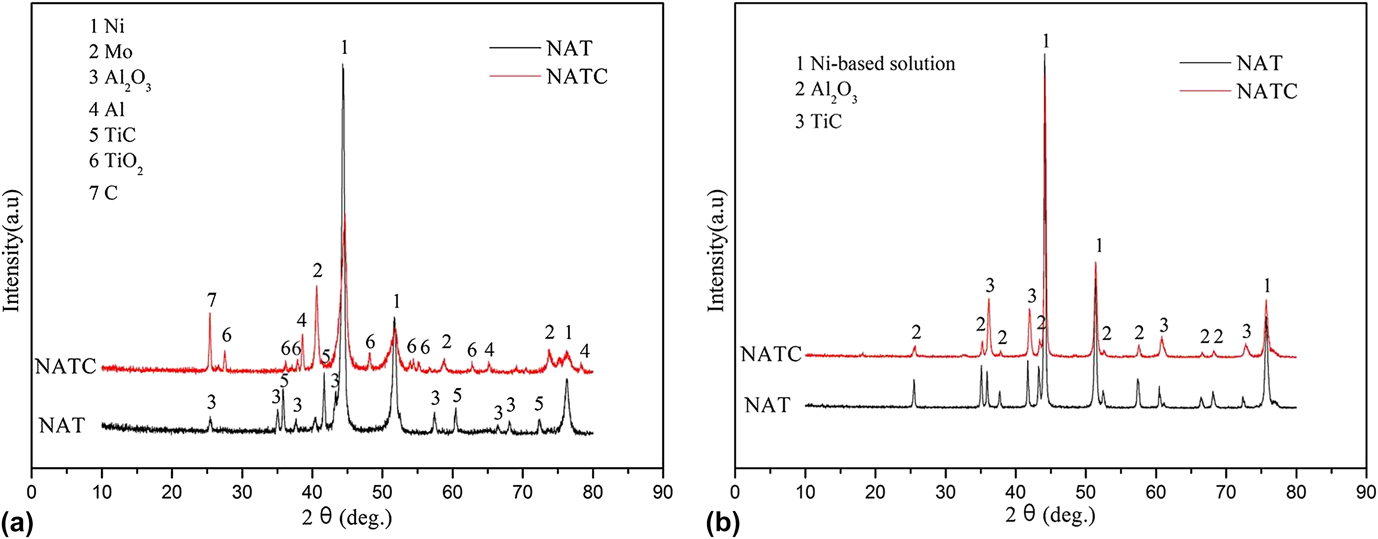
Figure 1 gives the XRD patterns of the Ni-based composite before and after sintering. It can be seen that the Ni, Mo, TiC, TiO2, Al2O3, and Al phases can be identified from the mixed powders [Fig. 1(a)]. After hot-pressing sintering, the intensities of Ni-based solution diffraction peaks become stronger than before and the phase compositions are almost unchanged for NAT composite. However, there are obvious change for the phase compositions of NATC composite, the diffraction peaks of TiO2, Al, and C disappeared, and the diffraction peaks of Al2O3 and TiC appeared in the sintered composite [Fig. 1(b)]. It means that the solid phase reactions happened for the NATC composite and in situ Al2O3 and TiC ceramic phases formed during the sintering process. It is worth to note that the Al2O3 peaks in NATC composite are relatively weaker than that of NAT composite after sintering, which indicates TiC is easier to be generated than Al2O3 during the high-temperature sintering process. In addition, according to the XRD patterns of the before and after sintering [Figs. 1(a) and 1(b)], the Mo diffraction peaks disappeared after sintering [Fig. 1(b)], it means that Mo has been solid dissolved in the Ni matrix during the high-temperature sintering process.
XRD patterns of the Ni-based composites: (a) before and (b) after hot-pressing.
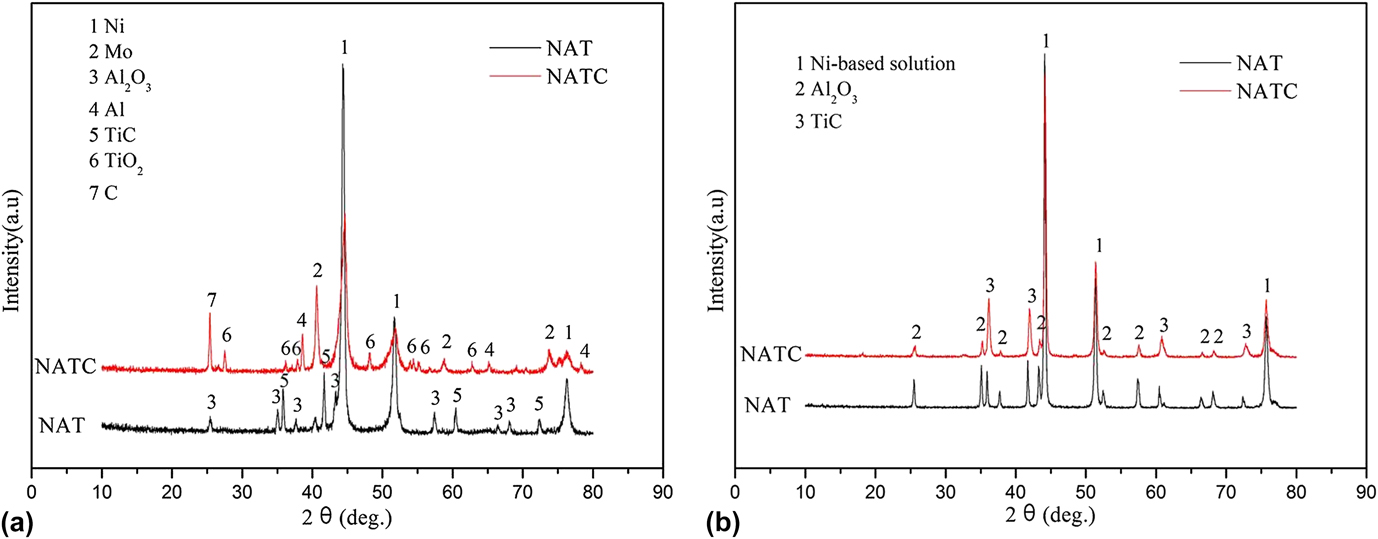
Figure 2 shows the typical microstructures of the Ni-based composites. The microstructure of the composites is relatively dense, and there are three types of phases in the NAT and NATC composites [Figs. 2(a) and 2(b)]. Combing with EDS analysis reveal that the gray area is rich in Ni, Al, and Mo phases; the deep gray region is rich in Mo, Al, and Ti phases, while the oatmeal area is rich in Al, C, and O phases. In the NAT composite, a mass of fine TiC particles is uniformly distributed in the form of agglomerates in the metallic matrix. However, the TiC product is uniformly distributed in the NATC composite.
SEM micrographs of the (a) NAT and (b) NATC composites.

Elemental composition mappings of the NAT and NATC composites are displayed in Fig. 3. It is clearly found that the elements of Ni and Mo are homogeneously distributed in all the composites. However, the elements of Ti and C are relatively concentrated in some areas of the NATC composite. This phenomenon suggests that the compatibility of in situ TiC ceramic phase and matrix in NAT composites is lower than that of the NATC composite, segregation is easy to develop for in situ TiC ceramic phase in NAT composite.
Elemental composition mappings of the Ni-based composites: (a) NAT; (b) NATC.

B. Tribological properties of the composites
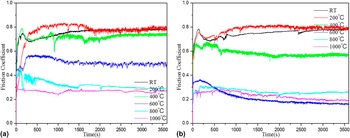
The variations of friction coefficient of the composites sliding against Al2O3 ceramic ball at elevated temperatures are shown in Fig. 4. It can be seen that both of the NAT and NATC composites exhibit high friction coefficients at low temperatures (≤400 °C). When sliding at 600 °C, NATC composite exhibits lower friction coefficients than NAT composite. In addition, according to Fig. 4, both composites exhibit a relatively low friction coefficient at 800 °C and 1000 °C, and the lowest value for NATC composite is about 0.19. As for NAT composite, the lowest friction coefficient is almost close to 0.3. The NATC composites show remarkable high-temperature self-lubricating ability.
Variation of the friction coefficient of the composites versus sliding duration under a normal load of 20 N and a sliding speed of 0.108 ms−1 from room temperature to 1000 °C: (a) NAT and (b) NATC composites.

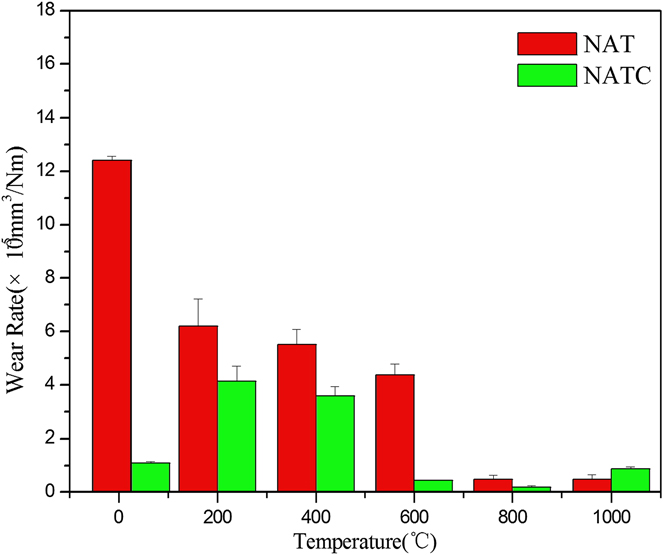
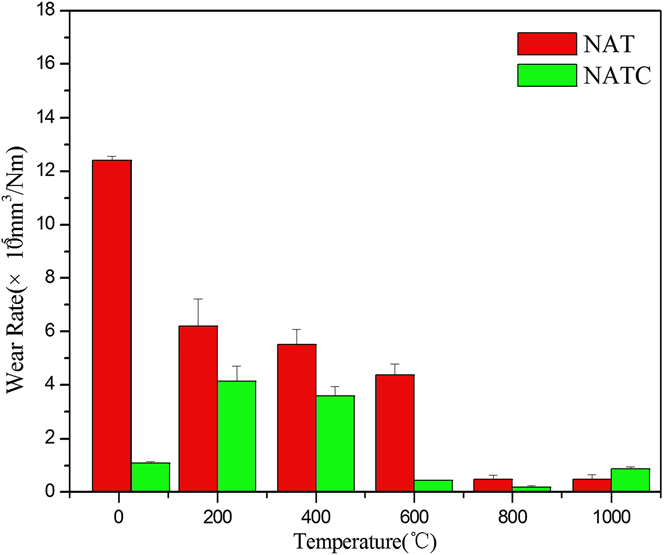
Figure 5 gives the variations of the wear rate of all the composites sliding against Al2O3 ball at different temperatures. It can be seen that the wear rate of NATC composites (10−5–10−6 order of magnitude) is far lower than that of NAT composites (10−4–10−5 order of magnitude) over the whole temperature range, which means that the ability of antiwear of the composite reinforced by in situ Al2O3 and TiC ceramic phases is superior to the composite with Al2O3 and TiC added directly. The reason could be ascribed to Al2O3 and TiC hard particles formed by in situ reactions, which are combined well with the metal matrix and during the sintering process, and this make the composite possess excellent mechanical property; thereby the action of hindering the relative movement of the frictional pair is relative low and displaying relatively low friction coefficient. Reference Sheng, Yang, Xi and Guo33 The lowest wear rate of NATC composite is 1.9 × 10⁻⁶ mm3/(N m), and the lowest wear rate of NAT composite is 4.8 × 10⁻⁶ mm3/(N m). Though the tribological properties of the composites at room temperatures are relatively poor, the tribological properties at high temperatures are superior to the TiC/Ni–Mo composites prepared by self-propagating high temperature synthesis, and the wear resistance of the TiC x /50 wt% Ni materials is slightly improved with molybdenum addition, which seems to be related to the higher interfacial bonding strength between matrix and carbide and the high dislocation density around carbide due to the difference of thermal expansion coefficient between carbide and matrix. Reference Bartuli and Smith20 And the friction coefficient of NAT and NATC composites (the lowest value is about 0.19) was significantly lower than that of NiAl–Mo2C nanocomposites at 700 °C (0.35). Reference Liu, Gao, Jia, Bai and Wang30 The improvement of high temperature tribological properties could be attributed to the formation of some oxides tribofilm and the Al2O3 and TiC ceramic particulates.
The wear rate of the Ni-based composites with Al2O3 and TiC ceramic phases as a function of the test temperature.
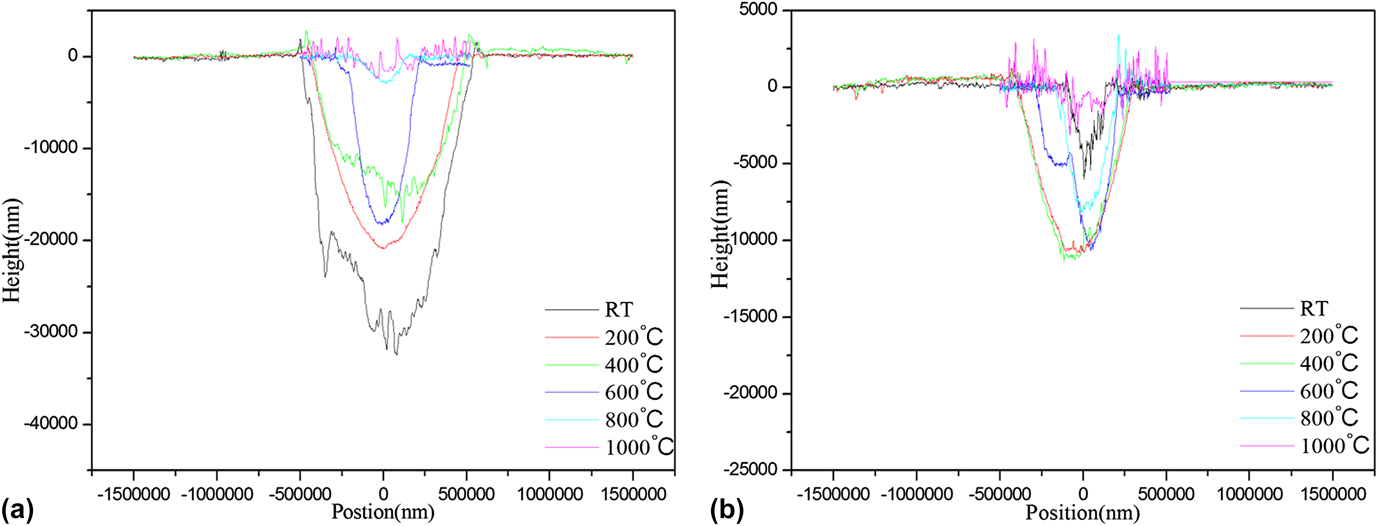
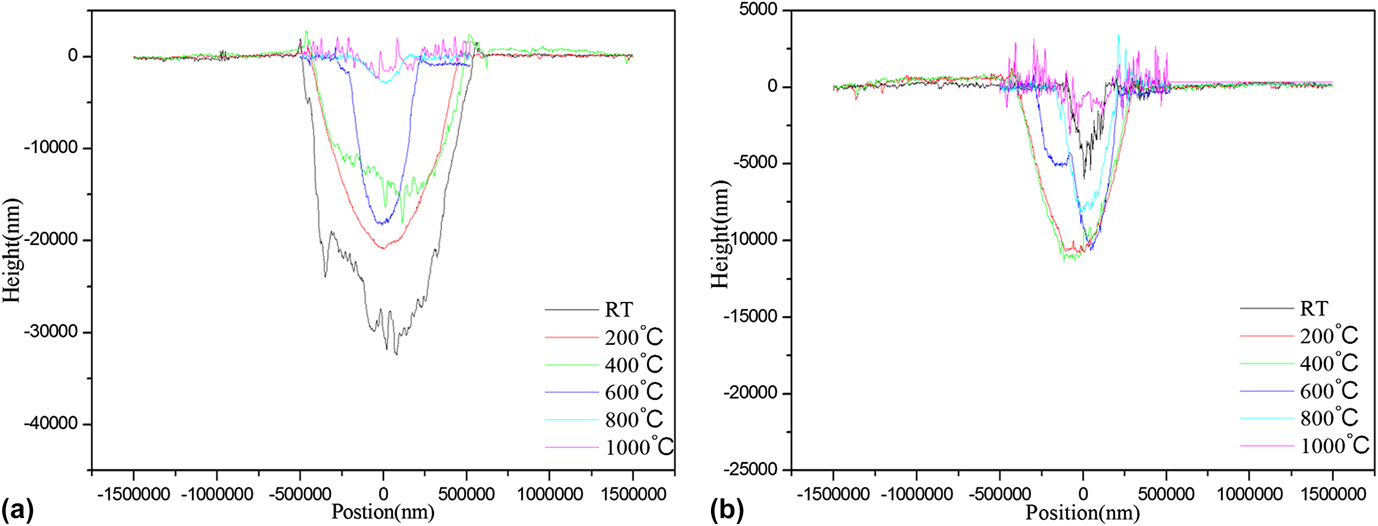
To illustrate the change of the wear rate of NAT and NATC composites, a typical profile of the tracks for each tribotest at elevated temperatures is illustrated in Fig. 6. It is clearly found that almost all the profiles of width and depth of NAT composite are larger than that of NATC composites at different temperatures, the height profiles in the tracks of the NAT composite illustrate a rough track surface and ridges piling up to a similar volume as the groove in the track, indicating a combination of adhesive material transfer and plastic deformation of the contact area between the friction pair. So the wear rate of NAT composites are relatively high compared with NATC composite.
Cross section profiles of the wear tracks of the Ni-based composites after sliding tests at various temperatures: (a) NAT; (b) NATC.
C. SEM morphologies of the worn surfaces of the composites at different temperatures
Figure 7 shows the SEM images of the worn surfaces of NAT and NATC composites sliding against the Al2O3 ceramic ball under different temperatures. It can be seen that long parallel grooves and some pits are clearly found on the worn surface of the NAT composite at room temperature and 200 °C, which illustrates the NAT composite undergoes severe plastic deformation [see Fig. 7(a)], it is due to the severe abrasive action between the tribological pairs, and the wear mechanism is dominated by abrasive wear. According to the profile of the tracks show in Fig. 6(a), the track is deep and wide, so the wear rate of these composites is high at room temperature. With the temperatures increasing to 400 and 600 °C, the worn surface becomes smooth and the plastic deformation and some fine grooves can be found on the worn surfaces of NAT composite; furthermore, the profile of track become narrow and the wear rate of the composite reduced. Differing from NAT composite, NATC composite display plastic deformation at room temperature [see Fig. 7(a)], which might be closely related to the enhancement of its mechanical properties upon the incorporation of Al2O3 dispersion. Besides, the wear rates of NATC composite in the temperature range of 600–1000 °C are clearly lower than that at low temperature (≤400 °C), which might be attributed to the formation of oxidation induced by wear and friction at higher temperatures. Reference Sheng, Yang, Xi and Guo33 Interestingly, the wear rates of all the composites at 800 and 1000 °C are lower than those at room temperature as well as 200, 400, and 600 °C, largely because sliding at high enough temperatures facilitates the formation of a continuous, intact, and thicker ‘glazed layer’ [see Figs. 7(c)–7(f)] on worn surfaces thereby effectively reducing wear damage. Reference Liu and Jia18,Reference Hou, An, Zhao, Zhou and Chen34 At 1000 °C, the friction coefficient of all the composites keeps low value, but the wear rate has increased slightly, which is mainly due to the destroy of the ‘glazed layer’ [Fig. 7(f)].
Morphology of the worn surfaces of (I) NAT and (II) NATC Ni-based composites with Al2O3 and TiC ceramic phases after sliding tests at various temperatures: (a) room temperature, (b) 200 °C, (c) 400 °C, (d) 600 °C, (e) 800 °C, (f) 1000 °C.

D. Raman analysis and XRD results of the wear tracks of the composites
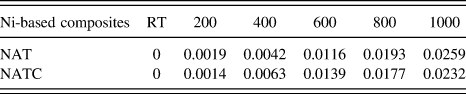
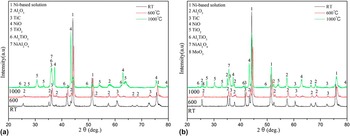
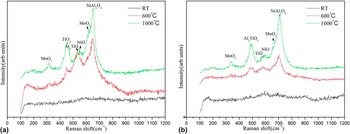
To further study the tribo-chemical changes on the worn surfaces of those composites at high temperatures, micro-Raman analysis and XRD were conducted. Figure 9 gives the Raman spectra of the worn surfaces as well as the unworn surfaces of the Ni-based composites after friction tests at room temperature (RT), 600 °C and 1000 °C, respectively. The Raman peaks of the NAT composite do not appear at RT. When temperatures reaches to 600 °C, TiO2 and MoO3 peaks can be clearly found for the Raman spectrum of the NATC composite after friction tests, MoO3 is considered to be an effective high temperature lubricant, thus, the formation of MoO3 lubricating film contributes for the improvement of tribological properties. Reference Liu, Gao, Bai, Yi, Wang, Zeng and Jia35 Furthermore, the peaks of new compound NiAl2O4 have appeared in the Raman spectra of NATC composite. At 1000 °C, TiO2, MoO3, and NiAl2O4 peaks can also be clearly found for the two composites, all those compounds can play the role of lubrication at high temperatures. The results reveal that the composite exhibits self-lubricating behavior and excellent wear resistance properties at high temperatures, which should be ascribed to the lubricant film formed on the surfaces of the composite during the sliding wear test. This viewpoint is similar to Sheng's work. Reference Sheng, Yang, Xi and Guo33 However, their NiAl–TiC–Al2O3 composite fabricated by self-propagation high-temperature synthesis with extrusion technique is inferior to NAT and NATC composites in the respect of high temperatures tribological properties [0.24 versus 0.19 for COF; 10−5 mm3/(N m) versus 10−6 mm3/(N m) for wear rate]. In addition, according to the changes of the oxidation weight gain of the composites at different temperatures is showed in Table II, oxidation is not obvious at low-medium temperature, but relatively conspicuous at high temperatures. So the reason for the excellent lubrication properties of those composites is considered to be the related to the change of the oxidation resistance. According to the XRD patterns of NAT and NATC composites after the wear test at different temperatures showed in Fig. 8, it can be seen that the diffraction peaks of the Ni-based solution, TiO2, MoO3, and NiAl2O4 are identified on the worn surfaces of those composites at high temperatures, at 1000 °C, the diffraction peaks of those compounds are very clear. Moreover, at 1000 °C, note that the NiO diffraction peaks appeared on the worn surfaces of the composites, and the intensity of NiO diffraction peaks of the NATC is stronger, which showed that the composites have poor antioxide capacity, and results agreed well with the Raman analysis results (Fig. 9).
The oxidation weight gain of the hot-pressed Ni-based composites at different temperatures.

XRD patterns of the Ni-based composites with Al2O3 and TiC ceramic phases after the tribological property test at elevated temperatures: (a) NAT; (b) NATC.

Raman spectra of the Ni-based composites with Al2O3 and TiC ceramic phases after sliding test at different temperatures: (a) NAT; (b) NATC.

IV. CONCLUSIONS
In this work, nickel-base composites reinforced by (in situ and ex situ) Al2O3 and TiC ceramic phases were fabricated by powder metallurgy technique, and the tribological properties of sliding against Al2O3 ceramic balls from room temperature to 1000 °C were studied. The main conclusions can be drawn as follows:
-
(1) In situ synthesis of Al2O3 and TiC ceramic phases in Ni-based composite using TiO2, Al, and C powders as precursor has been produced by powder metallurgy method. After hot pressed, the composition of NATC composite changed significantly, the phases of TiO2, Al, and C disappeared and the phases of Al2O3 and TiC appeared. The phases of the NAT composite have not changed, mainly composed of Ni-based solution, Al2O3 and TiC.
-
(2) With the increasing of temperature, the tribological properties of NATC composite are better than NAT composite almost in the whole range of the temperature when sliding against Al2O3 ceramic ball. The lowest fiction coefficient of NATC composite is lower than 0.2, and the wear rate is in the order of magnitude of 10−6 mm3/(N m) at high temperatures (≥600 °C).
-
(3) The excellence tribological properties at high temperatures are mainly ascribed to the formation of adhesion layer on the worn surface. The compound of MoO3, NiAl2O4, TiO2, and NiO formed by tribochemical reaction on the worn surface at high temperatures is the predominant factor leading to the improvement of the tribological properties of the composites at high temperatures.
-
(4) The antioxygenic property of the NAT composite is inferior to the NATC composite at high temperatures, which lead to the property of wear inferior to the NATC composite, and the wear mechanisms are mainly delamination, micro-plowing, and plastic deformation. The oxidation weight gain of those composites at low-medium temperature was not obvious, so the COFs and wear rate are relatively high, and the wear mechanisms are characterized by abrasion and microscuffing.
ACKNOWLEDGMENTS
The authors acknowledge the financial support of the National Natural Science Foundation of China (Grant Nos. 51471181, 51575505, and 51675508).