Introduction
A preplant burndown program is a crucial component of managing weeds in cotton production throughout the southern United States. Cotton is susceptible to early-season weed competition because of its slow emergence and growth (Sosnoskie and Culpepper Reference Sosnoskie and Culpepper2014). As a result, cotton fields need to be weed-free at the time of emergence for a successful crop. Preplant burndown programs have frequently utilized glyphosate or paraquat in the past; however, more effective weed control burndown programs include 2,4-D or dicamba in the tank mix (Culpepper et al. Reference Culpepper, Carlson and York2005, Reynolds et al. Reference Reynolds, Crawford and Jordan2000, York et al. Reference York, Culpepper and Stewart2004). With the introduction of 2,4-D- or dicamba-tolerant cotton varieties, producers can apply new formulations of 2,4-D or dicamba in burndown applications very close to planting or use them in PRE applications (Anonymous 2018a, 2018b). This new use pattern allows cotton producers more flexibility to control weeds and plant their crop.
Many cotton varieties are sensitive to synthetic auxin herbicides such as 2,4-D or dicamba; these injure cotton by disrupting the plant hormone systems, causing twisting or epinasty of stems, leaf strapping and/or cupping, and abnormal veins in leaves. Previous research has observed that cotton is more sensitive to 2,4-D drift than to dicamba drift, especially at the preflowering and squaring stages (Egan et al. Reference Egan, Barlow and Mortensen2014, Everitt and Keeling Reference Everitt and Keeling2009; Marple et al. Reference Marple, Al-Khatib, Shoup, Peterson and Classen2007). However, these studies do not address preplant application effects on cotton. 2,4-D is not persistent in soil under most environmental conditions, with a half-life of 4 to 6 d, and is generally dissipated by 20 d after application (Altom and Stritzke Reference Altom and Stritzke1973; Peterson et al. Reference Peterson, McMaster, Riechers, Skelton and Stahlman2016; Wilson et al. Reference Wilson, Geronimo and Armbruster1997; Voos and Groffman Reference Voos and Groffman1997). Dicamba is more persistent in soil than 2,4-D, with an average half-life of 31 d under aerobic conditions and 58 d under anaerobic conditions (Krueger et al. Reference Krueger, Butz and Cook1991). Overall, 2,4-D and dicamba are not persistent in soils, unless a high amount of organic carbon is present, conditions are dry, or soil microbial activity is low (Paszko et al. Reference Paszko, Muszyński, Materska, Bojanowska, Kostecka and Jackowska2016; Voos and Groffman Reference Voos and Groffman1997; Walters Reference Walters1999).
Following an application of dicamba, a minimal waiting period according to the label is 21 d between application and planting, with at least 2.5 cm of water from either rainfall or irrigation, whereas 2, 4-D requires 30 d and 2.5 cm of water prior to planting of sensitive cotton (Anonymous 2018a, 2018b). Baker (Reference Baker1993) observed that cotton needed to be replanted because of poor stands when 2,4-D was applied at 2,200 g ae ha−1 or dicamba at 300 g ai ha−1 and 600 g ai ha−1 9 d before planting (DBP), whereas earlier applications did not lead to significant injury. In another study, dicamba 140 g ae ha−1 and 280 g ae ha−1 and 2,4-D at 560 g ae ha−1 and 1,120 g ae ha−1 applied 2 WBP caused significant stand losses (Everitt and Keeling Reference Everitt and Keeling2009). York et al. (Reference York, Culpepper and Stewart2004) found that 2,4-D at 530 and 1,060 g ae ha−1 applied 3 wk or more prior to planting did not cause significant stand or yield losses.
The use of 2,4-D or dicamba in preplant burndowns can be very important to a successful weed control program, but producers need to plan for a sufficient plant-back interval and be very cautious with the use of 2,4-D or dicamba on resistant cotton varieties. With the PRE application option available for 2,4-D- or dicamba-resistant cotton, if an acceptable stand of a resistant variety is not achieved as a result of excessive rain, plant disease, planter malfunction, or soil herbicide injury, a short-season variety may be the best replant option. A legitimate concern is whether the intervals between application and replanting are long enough to prevent injury to susceptible varieties. This injury could further delay maturity when the remaining growing season is already short. Minimal data have been published evaluating sensitive cotton responses to 2,4-D or dicamba residuals in soil if they are not degraded completely. Therefore, a field study was needed to determine whether cotton injury and yield loss may occur in these situations. The objective of this trial was to evaluate cotton establishment and yield in response to various rates of 2,4-D or dicamba residues in soil applied 3 WBP and at planting.
Materials and Methods
Six field trials were conducted in Macon (32.4939° N 85.8903° W) and Baldwin (30.5477° N 87.8598° W) counties, AL, and Santa Rosa County (30.7765° N 87.1432° W), FL, in 2016, and in Macon, Baldwin, and Henry counties (31.3512° N 85.3146 W) AL, in 2017. These trials were set up as a completely randomized block design with four replications at each location. Plots at all locations were 7.62 m long, except for Macon County in 2016, where plot lengths were 6.1 m. Cotton was planted in rows 0.9 m wide, and all locations had four rows per plot. All trials were irrigated as needed throughout the season. The cotton variety planted in Santa Rosa and Macon counties was PHY 499 (PhytoGen®, Dow AgroSciences. Indianapolis, IN). PHY 444 was planted in Henry and Baldwin counties. All fields were conventionally tilled prior to herbicide application. Treatments were applied either 3 WBP or within 1 h after planting (at planting) with an ATV sprayer (Teejet TTI 110025 at Alabama locations and 11003VK flat-fan nozzles at Florida location) (Teejet®, Spraying Systems Co., Wheaton, IL) propelled by compressed air at a spray volume of 187 L ha−1. Treatments of 2,4-D included 532 and 1,063 g ae ha−1 applied 3 WBP and 53, 160, 266, 532, and 1,063 g ae ha−1 applied at planting. Dicamba treatments included 560 and 1,120 g ae ha−1 applied 3 WBP and 56, 168, 280, 560, and 1,120 g ae ha−1 applied at planting. In 2016, 2,4-D at 53 g ae ha−1 and dicamba 56 g ae ha−1 were evaluated at planting; however, they were removed from the treatment list in 2017 as a result of lack of cotton responses, and two higher rates at planting were included at all locations (1,063 g ae ha−1 of 2,4-D or 1,120 g ae ha−1 of dicamba). Clarity® (BASF®, Research Triangle Park, NC), a diglycolamine salt formulation, was used for all dicamba treatments. 2,4-D Amine (Alligare LLC®, Opelika, AL), a dimethylamine salt formulation, was used for all 2,4-D treatments. Soil texture, planting, harvesting dates, and rainfall are listed in Tables 1 and 2. The Baldwin County location did not receive treatments applied 3 WBP in 2017 because of a prolonged rainfall period prior to cotton planting and field inaccessibility.
Locations, application, planting, and harvesting dates and soil information of field trials conducted in 2016 and 2017. a, b

a Soil information was provided by Auburn University Soil Testing Laboratory (Auburn, AL) and Waters Agricultural Laboratories, Inc. (Camilla, GA).
b Abbreviations: OM, organic matter; WBP, weeks before planting.
c Treatments applied immediately after planting within the same day.
d Fine-loamy, kaolinitic, thermic Rhodic Kandiudults.
e Fine-loamy, kaolinitic, thermic Plinthic Kandiudults.
f Fine-loamy over sandy or sandy-skeletal, siliceous, semiactive, thermic Typic Hapludults
Rainfall amounts for each field location in 2016 and 2017. a

a Cells containing a dash indicate that the study or applications were not conducted at that location that year.
b Abbreviations: DAP, days after planting; DBP, days before planting.
All treatments, including the nontreated control (NTC), were maintained weed-free throughout the growing season with standard cotton POST herbicide treatments (glyphosate or glufosinate + S-metolachlor), layby (flumeturon or diuron + MSMA), and hand weeding as needed. Overall, there was very little visual cupping and leaf strapping present on the cotton plants; therefore, stand counts and height measurements were chosen as the growth parameters to determine the effect of 2,4-D or dicamba on cotton. At approximately 3 and 7 wk after planting, cotton stands were evaluated by counting all plants in 1-m-long stands from each of the two center rows, and cotton heights were recorded for 10 randomly selected plants in the two center rows of the plots. Seed cotton yield was collected at each location from the two center rows and averaged for statistical analysis. Only yield data were collected from the Santa Rosa County site.
All data collected were converted to a percentage of NTC prior to statistical analysis, then processed with PROC GLIMMIX procedure in SAS® 9.4 (SAS Institute Inc, Cary, NC). All means were separated with Fisher’s protected LSD (P ≤ 0.05) to reveal statistical differences. Treatment and location were considered fixed effects, whereas block was treated as a random effect. If treatment-by-location interaction was significant (P ≤ 0.05), results were separated and analyzed by location and presented by each location individually in the results. If treatment-by-location interaction was not significant, then location was used as a random effect and data were averaged over all locations.
Results and Discussion
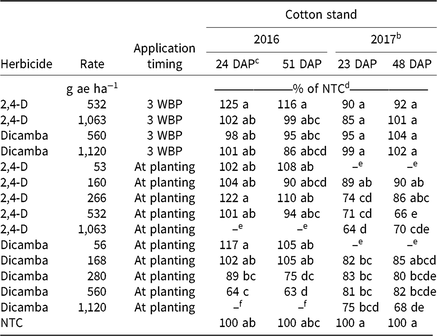
None of the treatments applied 3 WBP affected cotton stands, heights, or yield (P ≤ 0.05) in 2016 and 2017 at any location (Tables 3 and 4). Therefore, only treatments applied at planting are discussed in this section. Treatment-by-location interaction was not significant (P ≤ 0.05) for stand counts, so data from all locations were pooled in 2016 and 2017. Dicamba at 280 and 560 g ae ha−1 applied at planting were the only treatments that lowered cotton stands by 36% and 37% in 2016. In 2017, 160 g ae ha−1 of 2,4-D at planting was the only rate of either herbicide evaluated that did not reduce cotton stand at 20 to 23 DAP. Cotton stands were not affected by 2,4-D rates of 266 g ae ha−1 and lower at 47 to 48 DAP. 2,4-D at 266 to 1,063 g ae ha−1 caused stand losses of 26% to 36% at 20 to 23 DAP. All rates of dicamba reduced cotton stands at 20 to 23 DAP, whereas only the 168 g ae ha−1 rate did not exhibit a stand loss at 47 to 48 DAP. Dicamba caused more cotton stand loss than 2,4-D in 2016 and 2017, most likely a result of its longer soil residual activity than 2,4-D. Therefore, dicamba mistakenly applied to sensitive cotton may cause more damage early on cotton seedlings than 2,4-D.
Cotton stand as affected by residual 2,4-D and dicamba in soil. a

a Means followed by the same letter in the same column do not differ significantly based on a mixed model ANOVA of a randomized complete block (P = 0.05). Data are expressed as percentage of nontreated control (NTC). Blank cells with dash indicate treatments not tested that year.
b Treatments applied 3 wk before planting were only evaluated in Henry County and Macon County in 2017.
c Abbreviations: DAP, days after planting; WBP, weeks before planting.
d Data collected in Macon County May 31 and June 30, 2016; Baldwin County June 9 and July 5, 2016; Henry County May 26 and June 20, 2017; Macon County June 30 and July 18, 2017; Baldwin County July 5 and July 27, 2017.
e These two rates were not evaluated in 2017 because of lack of cotton response. These two rates were not evaluated in 2017 due to lack of cotton response.
f These two rates were not evaluated in 2016.
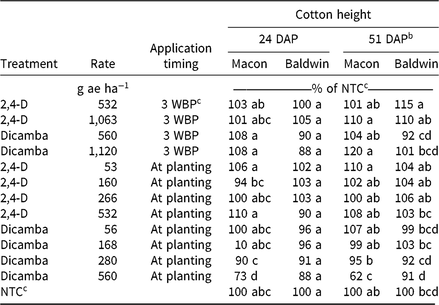
Cotton plant height as affected by residual 2,4-D and dicamba in soil in 2016. a

a Means followed by the same letter in the same column do not differ significantly based on a mixed model ANOVA of a randomized complete block (P = 0.05). Data are expressed as percentage of nontreated control (NTC). Plant heights were not affected by treatments in 2017.
b Abbreviations: DAP, days after planting; WBP, weeks before planting.
c Data collected in Macon County May 31 and June 30, 2016. Baldwin County June 9 and July 5, 2016.
Treatment-by-location interactions were significant (P ≤ 0.05) for cotton plant heights, so they were evaluated and presented by location in 2016 (Table 4). Cotton plant heights were not affected by any treatment at Baldwin County in 2016 at 24 DAP. Dicamba at 560 g ae ha−1 applied at planting was the only treatment that reduced cotton plant heights at the other three locations. Interestingly 2,4-D applied at 532 g ae ha−1 increased plant height in 2016 at Baldwin County when applied 3 WBP. Cotton plant heights were not affected by any treatments in 2017 (data not shown).
Seed cotton yield at each location in both years was not affected by any of the treatments evaluated in this study (data not shown), even though stand losses were documented with multiple treatments. Overall, cotton stands should have two to four plants per row foot for optimum yield (Boman and Lemon Reference Boman and Lemon2007). Cotton stand losses can cause significant yield reductions when there are large gaps within the row and stand variability throughout a field (Boman and Lemon Reference Boman and Lemon2007). A study from Texas documented a 13% yield loss with a 25% stand loss (Supak and Boman Reference Supak and Boman1999). However, as apparently occurred in this study, cotton can compensate for significant stand losses and still produce an acceptable yield.
Overall, these results align with previous studies by Everitt and Keeling (Reference Everitt and Keeling2007), York et al. (Reference York, Culpepper and Stewart2004), and Baker (Reference Baker1993), which reported that dicamba caused more cotton stand and yield loss than 2,4-D when applied preplant. These earlier reported results are similar to the conclusion drawn from our study that 2,4-D or dicamba can be safely applied 3 WBP without significant stand or yield. At the time this study was conducted, no previous studies could be found evaluating the effect of full preplant rates of 2,4-D or dicamba applied at planting on sensitive cotton varieties. It should be noted that our studies received at least 2 cm of rainfall prior to planting and that a period of drought could increase injury and potential stand loss. Our study and all aforementioned studies demonstrated that if 2,4-D or dicamba is applied close to the planting date, especially with high rates, or if preplant applications do not have a long enough plant-back interval, a producer can expect to see more stand reductions with the potential for yield losses on sensitive cotton varieties.
Although cotton stand losses were observed in both years over all locations, no yield losses were observed. Thus, damage to cotton foliage and stand loss from 2,4-D or dicamba preplant applications should not be used as a yield loss predictor based on these data. Baker (Reference Baker1993) found that yield loss occurred when 600, 1,100, 2,200 g ae ha−1 2,4-D and 300, 600 g ae ha−1 dicamba were applied 3 DBP. Another study observed a 23% yield loss in 1 out of 3 yr for dicamba applied 1 WBP at 280 g ae ha−1 (Everitt and Keeling Reference Everitt and Keeling2007). Similar to the findings of our study, Everitt and Keeling (Reference Everitt and Keeling2007) did not find a consistent correlation between yield reductions and visual injury or stand reductions. York et al. (Reference York, Culpepper and Stewart2004) observed significant yield loss when 2,4-D at 1,060 g ae ha−1 and dicamba at 560 g ae ha−1 were applied 1 WBP at several, but not all, locations in their study. Although we did not find any significant yield losses, it is possible that different soil and environmental conditions from the ones in this study could result in yield losses after 2,4-D or dicamba preplant applications. Overall, based on this and previous studies, it is difficult to predict yield outcome from stand loss and visual injury in cotton, especially when it is early in the growing season.
Rainfall and temperature are factors needing more in-depth research to elucidate their impact on cotton yield loss when there is a short plant-back interval after a 2,4-D or dicamba preplant burndown program. Previous research has shown that cotton injury and stand loss due to dicamba were more severe when there was little rain between application timing and cotton planting (Ferguson Reference Ferguson1996; Guy and Ashcraft Reference Guy and Ashcraft1996; York et al. Reference York, Culpepper and Stewart2004). However, we observed more injury and stand loss with 2,4-D or dicamba treatments in 2017 at locations that received more rainfall than 2016, the opposite of what other studies have reported (Table 2). Everitt and Keeling (Reference Everitt and Keeling2009) saw more stand reductions during one year of their study compared to the other year because of cooler temperatures leading to slower germination. It is possible that cooler and wetter weather conditions in 2017 slowed cotton germination and allowed more herbicide injury, which reduced stands to a greater extent than 2016. The combination of these field conditions and herbicide residues in the soil should be evaluated further.
Overall, more negative effects were observed with dicamba treatments in this study in terms of stand loss and plant height reductions than with 2,4-D treatments. Higher rates of dicamba or 2,4-D caused more cotton stand loss than lower rates. Treatments applied at planting caused more stand loss than applications made 3 WBP. The early-season stand loss did not result in significant yield loss when cotton had a full growing season to recover. Therefore, without a full growing season to recover, it is possible that stand and yield losses could be observed for the higher rates of 2,4-D or dicamba if accidentally applied close to planting or at planting. According to results of this study and previous studies, if cotton producers want to plant a sensitive cotton variety after utilizing 2,4-D or dicamba as part of a preplant burndown program, they should allow a minimal 3-wk plant-back interval to prevent stand loss and cotton injury.
Acknowledgments
The authors would like to thank the Alabama Cotton Commission for providing funding support and Alabama Agricultural Experiment Stations and West Florida Research and Education Center for assisting with trial management and data collection. No conflict of interest is reported.