

Developments in scientific archaeology, including the ability to radiocarbon date calcined bone and the Bayesian modelling of radiocarbon dates, have contributed to a resurgence of interest in refining the chronology of Irish passage tombs (Bayliss & O’Sullivan Reference Bayliss and O’Sullivan2013; Bergh & Hensey Reference Bergh and Hensey2013; Hensey et al. Reference Hensey, Meehan, Dowd and Moore2014; Kador et al. Reference Kador, Geber, Hensey, Meehan and Moore2015; Schulting et al. Reference Schulting, Bronk Ramsey, Reimer, Eogan, Cleary, Cooney and Sheridanforthcoming; Schulting Reference Schulting2014a). Aside from the important tomb of the Mound of the Hostages, Tara, Co. Meath (O’Sullivan Reference O’Sullivan2005), the main focus has been on large passage tomb complexes, leaving a question over the place of more isolated sites. Baltinglass is a multi-phase, multi-chamber Neolithic passage tomb in Co. Wicklow, lying on the summit of a hill to the south-east of the Wicklow Mountains. The site is unusual for a passage tomb in yielding a deposit of charred cereal grain, along with charred hazelnut shells, a stone axehead, some flint scrapers, and a flint javelin head, all within a layer of burnt material underlying the cairn. Cremated human remains were found in and near two of the chambers, and other finds include burnt fragments of two bone pins, a few sherds of pottery, a flint scraper, a smooth ovoid pebble, and the partial remains of a single unburnt skeleton. The presence of these various materials and the site’s multi-phase nature provided the opportunity for a radiocarbon dating programme, initially aimed simply at an understanding of the relationship between the deposit of charred cereals and the cremated remains. The results, however, have significance far beyond this, both for the monument’s history, and for the wider typochronology of Irish passage tombs.
THE SITE
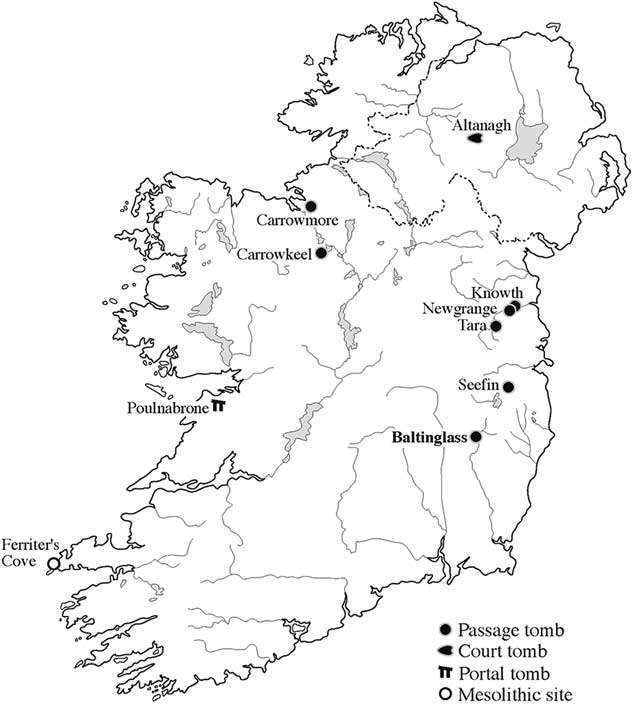
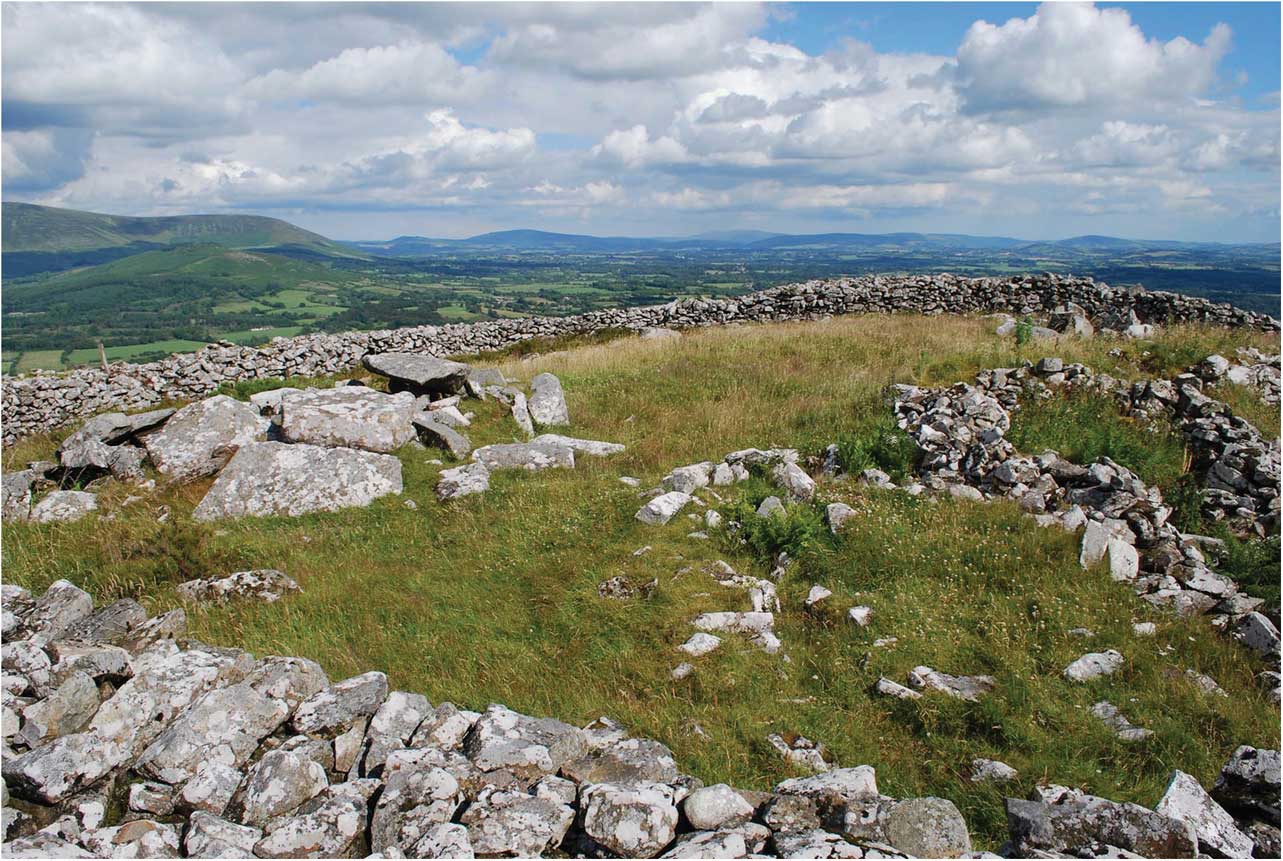
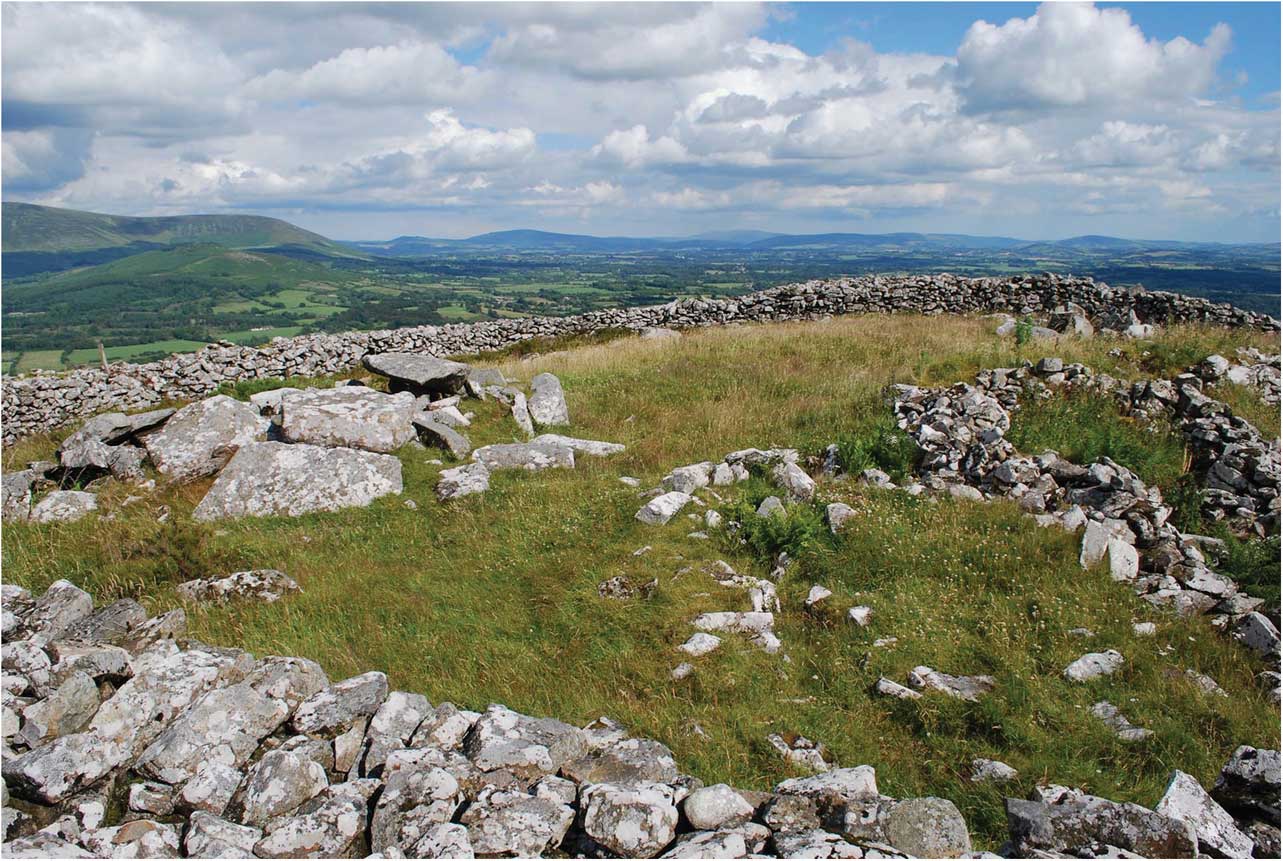
The Baltinglass passage tomb is located on the summit of the hill of the same name, at an altitude of c. 382 m above sea level, on the junction of the townlands of Pinnacle, Coolinarrig Upper, and Tuckmill Hill, Co. Wicklow (Figs 1 & 2). This commanding position is typical of passage tombs, in contrast to the lower elevations characteristic of court and portal tombs (Bergh Reference Bergh1995, 130, 161; Reference Bergh2002; 140; Cooney Reference Cooney2000, 142; Herity Reference Herity1974, 41, 71; O’Kelly Reference O’Kelly1989, 97). This is clearly seen in median elevations for Irish passage tombs (145 m, n=147) in comparison to those for court tombs (89 m, n=398) and portal tombs (81 m, n=185: McLaughlin et al. Reference McLaughlin, Whitehouse, Schulting, McClatchie and Barratt2016, table 1).
Map showing location of the Baltinglass passage tomb and other key sites mentioned in the text

Baltinglass its landscape setting, with Chamber I to the left and Chamber III in immediate middle foreground. View to ~west. Photo: Professor William O’Brien
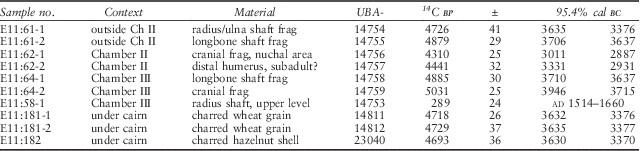
ams radiocarbon results on human bone & charred plant remains from baltinglass

Sample E11:58-1 is on unburnt bone; all other human samples are fully calcined.
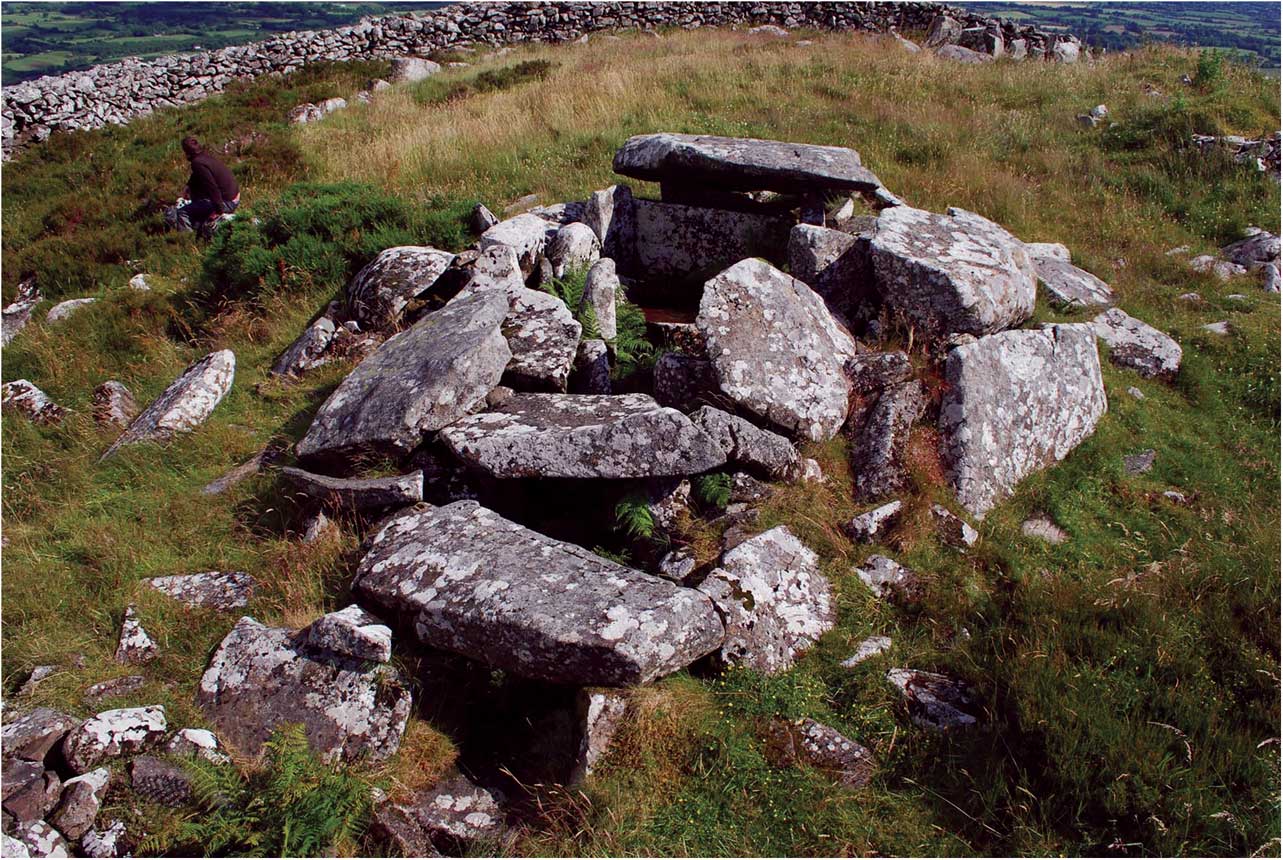
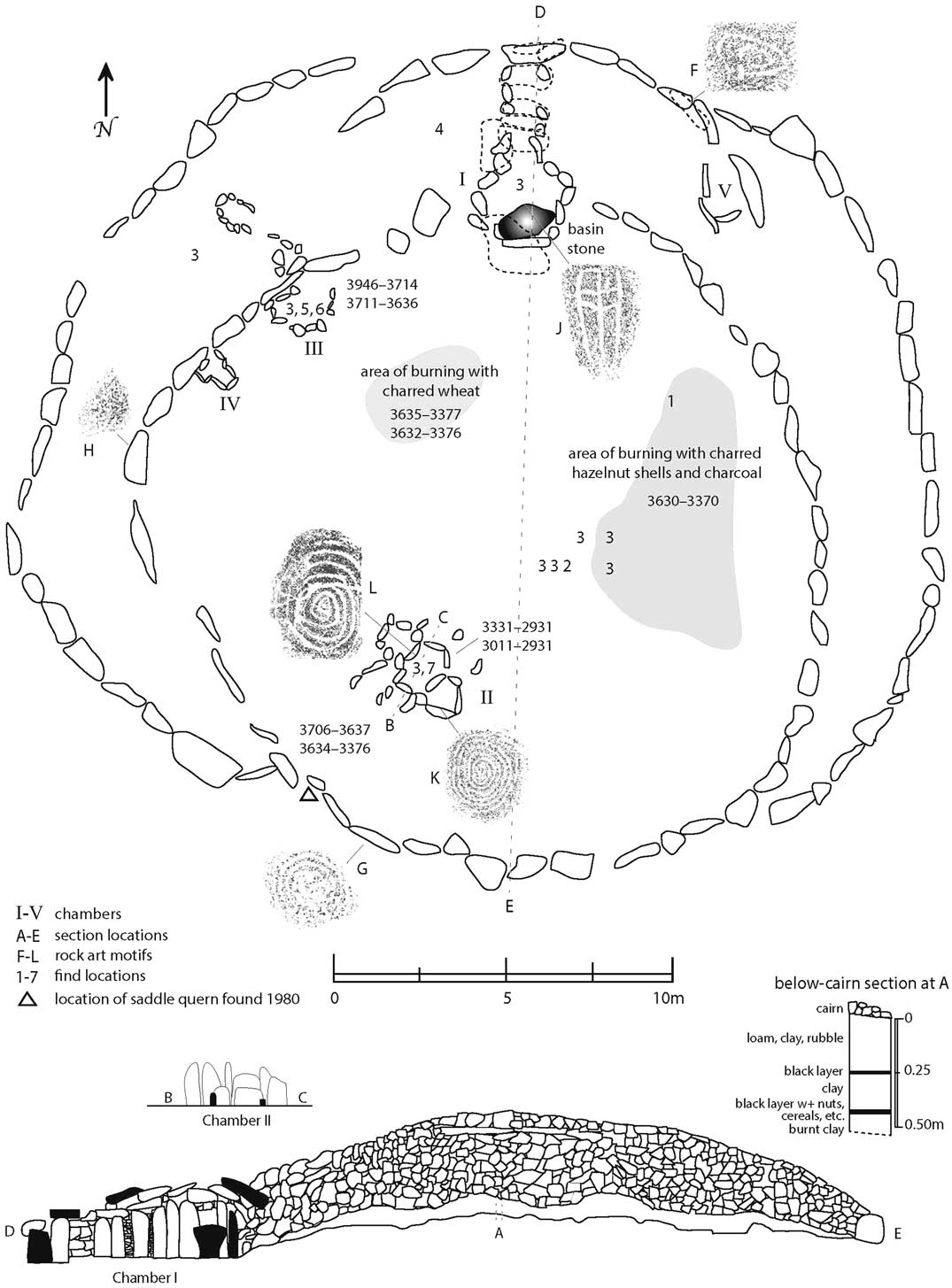
Patrick T. Walshe excavated the site over three seasons from 1934 to 1936 (Walshe Reference Walshe1941). At the time of its excavation, it measured 25.6 m N–S by 27.7 m E–W in diameter. There is some discrepancy in the cairn’s reported surviving height, which is given as 15 ft (c. 4.6 m) in the text (Walshe Reference Walshe1941, 222), while the section drawing (ibid., pl. xviii, fig. 2) indicates a height of only c. 10 ft (3.0 m). The latter measurement seems more reasonable, although the cairn would originally have been higher, since by 1907 it had already been partly denuded for the construction of a drystone wall. Large kerbstones were visible on three sides of the cairn even before excavation commenced, as were some of the stones of the large north chamber, Chamber I (Fig. 3; Walshe Reference Walshe1941). The excavations revealed a multi-phase monument with five chambers of various shapes, sizes, and methods of construction (Figs 4 & 5). What the excavator proposed as the earliest chamber to be constructed, Chamber II, appears to have been roughly of cruciform shape, with traces of a short passage, around 3 m long, leading to the south-west edge of the first-phase cairn. The proposed subsequent enlargements of the cairn did not impact upon the southern quarter of the earlier cairn, so that Chamber II could have remained accessible.
Baltinglass, Chamber I. Part of Chamber II is visible to the upper right. View to ~south. Photo: Professor William O’Brien

Plan and section of the Baltinglass passage tomb (after Walshe Reference Walshe1941, pl. xviii, with overlain rock art rubbings from figs 8 and 9, not to scale), showing C14 dates approximate locations of main finds: 1) polished stone axe; 2) flint javelin head; 3) flint scrapers; 4) oval white pebble; 5) calcined bone pin & needle; 6) Carrowkeel sherds; 7) coarse sherd

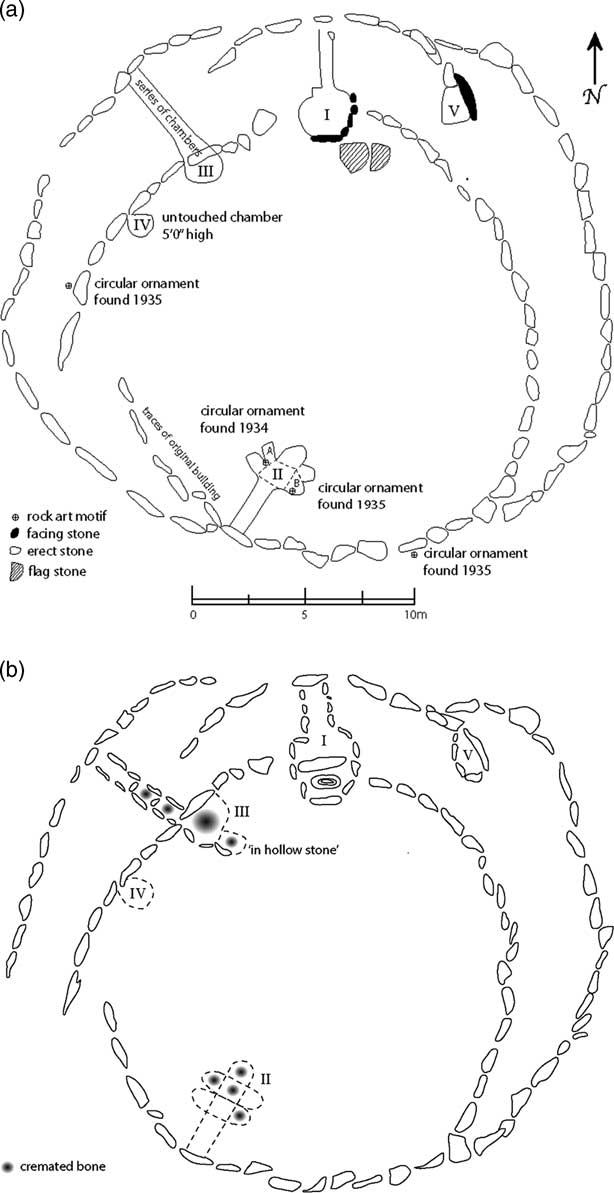
Unpublished plans of the Baltinglass passage tomb: a) sketch plan by Padraic T Breathnach specifying the locations of the cremated remains, dated 5/9/1934 (NMI archive); b) plan dated 1935, annotations as marked on original; note the different location of the southernmost motif on this and the published plan (‘G’ on Fig. 4) (both figures redrawn by RJS)

The placement of Chamber III in the sequence is less clear, not helped by the modern boundary wall running through this part of the cairn. Walshe described Chamber III as ‘a long low rudely built structure’ (Walshe Reference Walshe1941, 225); no trace of any covering mound or cairn seems to have been found. A long passage, defined by exceptionally small upright slabs just 2 in (c. 5 cm) to 5 in (c. 13 cm) in height, ran between the outer and inner kerbs, leading to a roughly circular – though possibly originally cruciform – chamber, presumably constructed of similarly low stones, abutting the north-west edge of the first cairn. The passage was divided into four small compartments by three small slabs laid cross-wise (ibid.); this is seen most clearly in an early draft of the site plan in the National Museum of Ireland (NMI) archives, which also specifies where cremated bone was found (Fig. 5a). A subsequent draft plan refers to the passage as a ‘series of chambers’ (Fig. 5b), which is how this area is presented on the final plan (Fig. 4). In all three plans it appears that the kerb of the inner cairn overlies the stones of the chamber, although this is not explicitly stated in the published account. As will be seen, the position of Chamber III in the monument’s construction sequence is of central importance in this paper, and will be revisited in the discussion.
Chamber I is the largest, most imposing and best-preserved chamber in the monument, though it lacks any finds that would aid with its dating. The circular chamber had been built into the body of the earlier cairn, breaking the line of its kerb, with a partly surviving roofed passage running directly north for 5 m. Against the upright of the back wall was a large recumbent stone (c. 1.8 m long by 0.9 m wide and 0.6 m high) with what the excavator interpreted as an artificial depression, 15 cm deep, on its upper surface (Walshe Reference Walshe1941, 224), recalling the well-known basin stones of the Brú na Bóinne passage tombs. This affinity is emphasised further by the presence of an incised motif on the side of the stone facing into the chamber and down the passage (Fig. 4). Chamber I and its associated cairn extension is clearly late in the Neolithic sequence, post-dating Chambers II and III.
Minimal information is available concerning the final two chambers, IV and V. Chamber IV takes the form of a small ‘beehive’ chamber, and is seen by the excavator as pre-dating Chamber I; the fact that it lies within the first-phase cairn material, with its entrance opening out between two kerbstones, strongly suggests that it must have been constructed when that cairn was built (Walshe Reference Walshe1941, 235, pl. xvii). Chamber V is described as a small ruined chamber or cist, enclosing an area around 6×3 ft (1.83×0.91 m; Walshe Reference Walshe1941, 226). It held no finds other than some charcoal and a lump of clay that may represent disintegrated pottery. On the plan its stones appear large enough to suggest a rectangular megalithic chamber but too little information is available regarding its structure to say much more. Walshe considered it to be probably a late addition, post-dating even Chamber I (1941, 235), although he did not explain his reasoning. If it had indeed been an Early Bronze Age cist, as seems quite possible, then it might have been associated with a final episode of cairn enlargement during the Early Bronze Age, building out from the Chamber I cairn extension. There is, after all, ample evidence for Early Bronze Age re-use of passage tombs elsewhere, most notably at the Mound of the Hostages, Tara (O’Sullivan et al. Reference O’Sullivan, Scarre and Doyle2013), as well as of court and portal tombs (Schulting Reference Schulting2014b; Schulting et al. Reference Schulting, Murphy, Jones and Warren2012).
THE FINDS
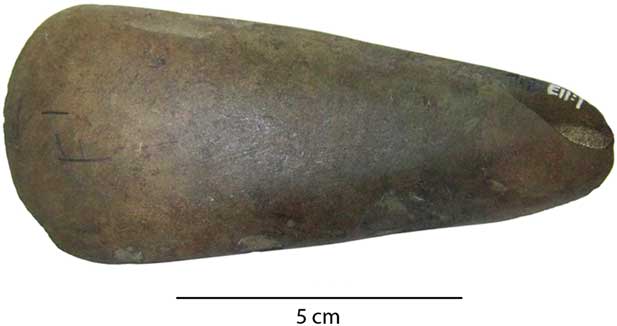
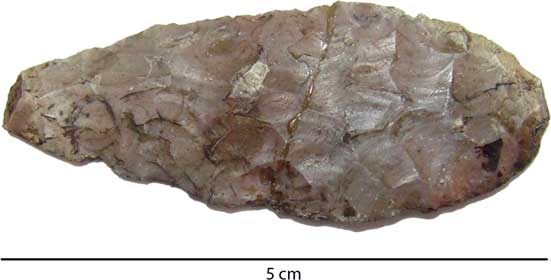
Underlying the stones of the central part of the cairn was a layer of ‘loam, rubble, and clay’ 0.23 m thick, under which was found an intermittent thin black layer, another layer of firmer clay 0.15 m thick, and then another irregular black layer 1–2 cm thick. Between this and the bedrock was a layer of burnt yellow clay (Fig. 4; Walshe Reference Walshe1941, 227). The lowermost black layer – Walshe’s ‘fire site’ – contained abundant charcoal and two concentrations of charred hazelnut shells. Near one of these concentrations was found a polished stone axehead (Fig. 6). Outside of the ‘fire site’ was found a bifacially-flaked flint javelin head with a broken tip, with a surviving length of c. 8 cm (ibid.) (Fig. 7). In addition to those found in Chamber III, five flint scrapers – one of which had been burnt – were recovered from the black layer underlying the cairn (ibid., 229, fig. 7). In a separate concentration of burnt material from the hazelnuts, between Chambers I and III and the cairn’s centre, was a quantity of charred wheat grains (Triticum sp.), most probably emmer, though identification in the absence of chaff is difficult. Upon recent examination for sampling, both the hazelnut shells and the cereal grains were found to be extremely well preserved, suggesting burial soon after charring. (Note that O’Connor (in Walshe Reference Walshe1941, 236) is mistaken in his statement that the hazelnut shells and cereal grains were preserved by some inherent ‘chemical disintegration’ rather than by charring.) Since flotation was not practised in the 1930s, the charred grains must have been hand-collected, implying that there had been a dense concentration, and probably a much larger total than the extant c. 200 grains in the NMI.
Ground and polished greenstone axehead from black layer underlying the cairn (NMI E11:1)

Unburnt flint javelin head from black layer underlying the cairn (NMI E11:1). Image courtesy of the NMI

Aside from cremated human remains, finds in and around the chambers at Baltinglass were limited. Other than a flint scraper, Chamber I was empty. This could suggest that material was removed at some point before the recorded excavation – a not unlikely scenario given the easy access to the passage and chamber. Alternatively, as suggested by ApSimon (Reference ApSimon1986, 9), the chamber may have held inhumed human remains that have not survived. (The presence of unburnt human remains in good condition in the upper levels of Chamber III does not contradict this since, as will be seen, those remains are of relatively recent date.) But since cremation is very much part of the passage tomb tradition, with the deposition of cremated and unburnt bones occurring as alternative, contemporary rites in several passage tombs (Cooney Reference Cooney2014; Schulting et al. Reference Schulting, Bronk Ramsey, Reimer, Eogan, Cleary, Cooney and Sheridanforthcoming), the absence of even tiny fragments of cremated bone from Chamber I is somewhat puzzling, given the evident care with which Walshe’s diggers recovered material from the site.
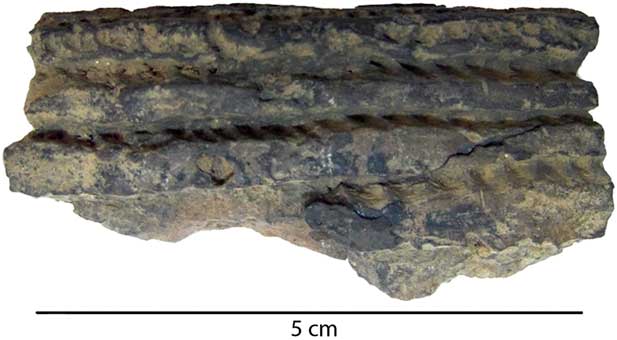
In Chamber II, cremated human remains belonging to at least one adult (probably more, to judge from the quantity of bone present: the material would benefit from a more thorough osteological study than was possible here) and one child were mixed with white quartz fragments. Only two sherds of pottery were found, one in the chamber, and another, a rim sherd, among the spread of cremated bone found just outside the chamber (Walshe Reference Walshe1941, 224–5, fig. 2) (Fig. 8). Whether this bone belongs to the same individuals as those from inside the chamber is unclear and needs further research. The sherds are both decorated coarseware sherds belonging to the tradition generally referred to as ‘Carrowkeel Ware’, and it is not impossible that they belong to the same pot, although a re-examination of the sherds would be necessary to verify that. Although once thought of as ‘passage tomb pottery’, this is an over-simplification, as finds from non-passage tomb contexts make clear (Sheridan Reference Sheridan1995).
Rimsherd of Carrowkeel Ware from Chamber II (NMI E11:32). Image courtesy of the NMI

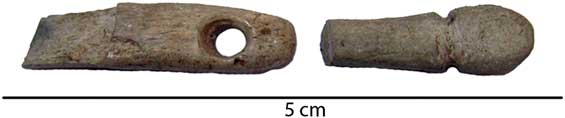
Chamber III also held the cremated remains of at least one adult and one child (again, more individuals than this were probably present), mixed with charcoal and white quartz. The chamber’s inner recess is noted as holding a large quantity of cremated bone, some of which was in a small ‘hollow or basin-shaped stone which was found on a large slab which was lying immediately outside the chamber on the south-east side’ (Walshe Reference Walshe1941, 225, pl. xvi, fig. 2). Additional cremated bone was present in the ‘chambers’ of the passage (Fig. 5a). Three flint scrapers were also recovered from the chamber, along with two burnt fragments of worked bone and a small, thick, heavily-worn (but seemingly undecorated) pottery sherd (ibid., fig. 2.3). The worked bone fragments appear to be the heads of slender pins with one having a constriction, and the other, a perforation close to its end (Walshe Reference Walshe1941, 230, fig. 4A, B) (Fig. 9). These features would have allowed the fixing of a thread or thong that would have passed around the other end of the pin to prevent it from slipping loose when in use. Pins of bone or antler are not an uncommon find in Irish passage tombs (eg, Hensey & Bergh Reference Hensey and Bergh2013), and a parallel for the slender perforated pin can be cited from Fourknocks I, Co. Meath (Herity Reference Herity1974, fig. 144.34). Although not mentioned either in the publication or in the site archive, the upper levels of Chamber III held a group of well-preserved, unburnt longbones probably belonging to a single adult. This individual will be revisited below.
Burnt bone pin fragments from Chamber III (NMI E11:37, 38). Image courtesy of the NMI

Along with the small quartz fragments mixed with the calcined bone, quartz cobbles were noted around the cairn’s circumference, leading Walshe to suggest that the cairn may have had a capping of quartz at some stage, and that this might have had some significance for the builders (1941, 229). Such an association with quartz is a well-known feature of Irish passage tombs – and indeed occurs from at least the Early Neolithic to medieval and more recent times (eg, Bergh Reference Bergh1995, 153; Cooney Reference Cooney2000, 177; O’Sullivan Reference O’Sullivan1993a; Thompson Reference Thompson2005), its prominent use at Knowth and Newgrange being well documented (eg, Eogan Reference Eogan1974; Reference Eogan1984, 106; O’Kelly Reference O’Kelly1982; Meighan et al. Reference Meighan, Simpson, Hartwell, Fallick and Kennan2003; Mitchell Reference Mitchell1992; Stout & Stout Reference Stout and Stout2008, 1–4, 6–7, 58–60). The association extends beyond this to western Britain (Fowler & Cummings Reference Fowler and Cummings2003; Hemp Reference Hemp1930; Mitchell Reference Mitchell1884).
In addition to the practice of cremation and the presence of Carrowkeel Ware pottery, bone pins, and quartz spreads, the place of Baltinglass in the passage tomb tradition is further supported by the occurrence of ‘passage tomb art’ in Chambers I and II and on two kerbstones of the inner kerb. Spiral designs are found on one of the kerbstones, and on two uprights in Chamber II (Fig. 4; Walshe Reference Walshe1941, fig. 8G, K, L). Walshe immediately made the obvious comparison with megalithic art at Newgrange and Loughcrew, and also mentioned that found at the passage tomb at Seefinn (also spelt Seefin) in the north of Co. Wicklow (Walshe Reference Walshe1941, 233), although the rectilinear chevrons and lozenges carved on two stones of the Seefinn passage (Macalister Reference Macalister1932) are in fact very different from anything at Baltinglass, their closest parallels rather being found at Barclodiad y Gawres on Anglesey, north Wales (Rynne Reference Rynne1963). Designs akin to those at Baltinglass occur on the stones of the destroyed passage tomb at Tornant Upper, Co. Wicklow, now in the NMI (Stout Reference Stout1989), and of course other comparanda for the Baltinglass motifs can be found (eg, within the large Knowth repertoire: Eogan Reference Eogan1986; C. O’Kelly Reference O’Kelly1973; O’Sullivan Reference O’Sullivan1993b). There is also what Walshe (Reference Walshe1941, 234) refers to as a ‘curious design’, a rounded rectangle motif on the outward facing side of the basin stone in Chamber I, narrowing at the bottom and bearing a central vertical line, and two upper horizontal cross-bars (ibid., fig. 8J; Fig. 4, J).
AMS RADIOCARBON DATING
Seven human bone samples, two cereal grains and a hazelnut shell were selected for AMS radiocarbon dating, undertaken at the 14CHRONO laboratory at Queen’s University Belfast. All but one of the human bone samples was fully calcined (hence no stable nitrogen isotope values are available, since nitrogen occurs only in the collagen fraction of bone, and stable carbon isotope values are unrelated to diet). The degree of warping and the curved ‘fingernail’ fracture lines are consistent with the burning of fleshed corpses, as opposed to dry bone (McKinley & Bond Reference McKinley and Bond2001). Cremated bone was recovered from three contexts, each of which is represented here by two samples: the interior of Chamber II (from an unspecified chamber segment), a deposit outside Chamber II, and the central part of Chamber III. There is no guarantee that distinct individuals are represented, with the exception of sample E11:62-2, which is of subadult size, whereas the others are of adult size. Unfortunately, as noted above, no material suitable for dating was recovered from Chamber I. The only unburnt sample is a human radius, part of a group of largely complete longbones reportedly (see below) found in the upper levels of Chamber III, and almost certainly belonging to a single adult individual. The two charred wheat grains and the charred hazelnut shell derive from two different locations within the black, charcoal-rich layer found underlying the cairn (Walshe Reference Walshe1941, 228).
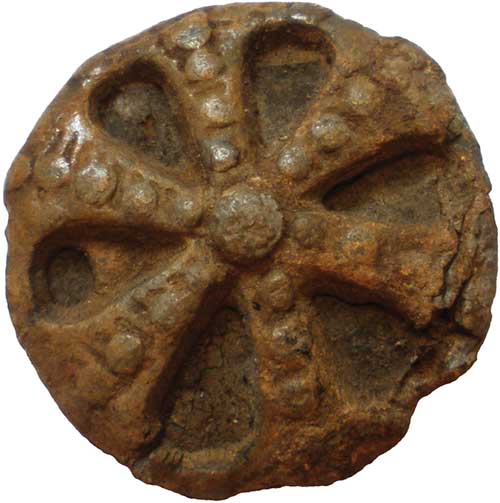
The results all fall within the Neolithic period, with the exception of the unburnt human radius from the upper levels of Chamber III, which proved to be recent (cal AD 1514–1660; UBA-14753: 289±24bp; δ13C=–20.1‰; note that all ranges are quoted at 95.4% confidence unless otherwise specified). There is no indication of any contamination, so that the result does reflect the true age of this individual and situates the deposition of the remains within a turbulent period of Irish history – Henry VIII’s conquest of Ireland. Interestingly, no mention was made of the recovery of any unburnt bones in either the published report (Walshe Reference Walshe1941) or the surviving site archive (comprising a series of notes, sketch plans, and correspondence relating to the excavations). Their attribution to Baltinglass, and specifically to the upper levels of Chamber III, derives from an associated paper label in the NMI. This discrepancy was noted by Etienne Rynne in a comment added to the site files (NMI archives, 5/11/1960). Also not mentioned in the published paper is a ‘decorated lead stud’ (E11:183; Fig. 10) listed in the NMI site files. Although no specific findspot is provided; the stud (or rather, button) is entirely consistent with the 16th–17th century ad date on the human bone (A. Halpin, pers. comm.; E. Standley, pers. comm.). One possible explanation is that, considering the human remains to be of recent date and perhaps with the potential of being politically sensitive (ie, related to the Irish Civil War of 1922–3), Walshe chose not to mention them in his report. If so, the decision to keep and label the remains at all is puzzling. In any case, while intriguing, this individual will not be discussed further here.
Lead button 14 cm diam., unknown find location (NMI E11:183). Image courtesy of the NMI

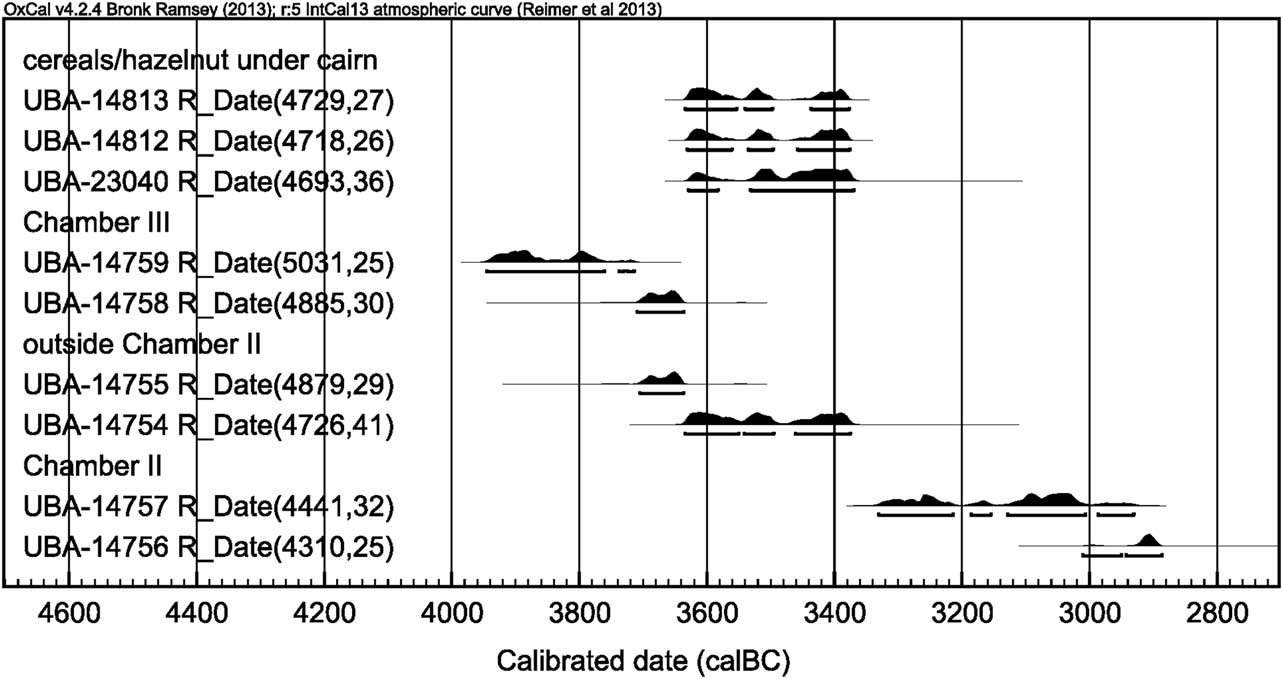
The calcined human bone determinations span an unexpectedly large range, from 3946–3715 cal bc to 3011–2887 cal bc (Table 1). Taken at face value, the results suggest the presence of as many as five phases of activity involving the deposition of cremated remains (Fig. 11). The earliest result, 3946–3715 cal bc (UBA-14759), was obtained from a calcined bone sample from Chamber III. Next is a calcined bone sample found outside Chamber II at 3706–3637 cal bc (UBA-14755), statistically indistinguishable from the second result from Chamber III at 3710–3637 cal bc (UBA-14758). The second sample from outside Chamber II falls in the range 3635–3376 cal bc (UBA-14754), contemporary with the results for the two wheat grains and the hazelnut shell (UBA-14812, 14813, 23040), which can be successfully combined using OxCal 4.2 (4717±17 BP, 3630–3378 cal bc, χ2 T=0.6 (5%, 6.0)). Finally, the two calcined bone samples from the interior of Chamber II reflect the most recent radiocarbon-dated Neolithic activity, at 3331–2931 cal bc (UBA-14757) and 3011–2887 cal bc (UBA-14756) respectively.
Calibrated radiocarbon dates from Baltinglass (OxCal 4.2, using IntCal13)

The location of the charred grain/hazelnut shell deposit underlying the cairn and the cremated human bone from within and outside of the chambers should provide the opportunity for Bayesian modelling making use of this stratigraphic relationship (cf. Bronk Ramsey Reference Bronk Ramsey2009; Buck et al. Reference Buck, Cavanagh and Litton1996). However, it is clear that the two cereal and the hazelnut determinations, while perfectly consistent with one another (and therefore with a short-lived episode of activity), post-date three of the calcined bone results. Not surprisingly, then, such a model is rejected outright, with individual agreement indices of c. 5% (versus the required minimum 60% – see Bayliss et al. Reference Bayliss, Bronk Ramsey, van der Plicht and Whittle2007 for an explanation of this statistic) for the three early calcined bone results, leading to the rejection of the model as a whole (Amodel=5%). The implications of this for reconstructing the sequence of activities on Baltinglass Hill are explored below.
DISCUSSION
The radiocarbon results from Baltinglass are intriguing in a number of respects. Foremost is the unexpectedly early date of 3946–3715 cal bc for a calcined human bone from Chamber III. To put this into context, this determination is currently among the very earliest from a definite Neolithic context in all of Ireland. It pre-dates the modelled earliest deposition thus far known for human remains in court tombs, placed at 3700–3550 bc (Schulting et al. Reference Schulting, Murphy, Jones and Warren2012, table 6; date ranges resulting from Bayesian models are presented in italics, in ‘bc’ rather than ‘cal bc’ since the modelled range no longer relies entirely on the calibration curve), as well as the Irish Neolithic ‘house horizon’, the onset of which is very robustly modelled on short-lived materials – mainly charred cereal grains – as 3720–3660 bc (McSparron Reference McSparron2008; Schulting Reference Schulting2011; Whitehouse et al. Reference Whitehouse, Schulting, McClatchie, Barratt, McLaughlin, Bogaard, Colledge, Marchant, Gaffrey and Bunting2014). A recent Bayesian model on 25 dated bone and antler pins from two simple passage tombs at Carrowmore, Co. Sligo confirms a phase of deposition at those passage tombs commencing 3775–3520bc (Bergh & Hensey Reference Bergh and Hensey2013), contemporary both with the use of court tombs and with the house horizon. Excluding the much-discussed dates from the causewayed enclosure at Magheraboy, Co. Sligo, the earliest result from Baltinglass also largely pre-dates model 2 of Cooney et al. (Reference Cooney, Bayliss, Healy, Whittle, Danaher, Cagney, Mallory, Smyth, Kador and O’Sullivan2011, 663) for the beginning of the Irish Neolithic at 3750–3680bc . (Their model 3, however, accepts the possibility of an earlier beginning at 3850–3740 bc , a date range that is closer to Sheridan’s (Reference Sheridan2010) proposed late 5th–early 4th millennium date for the appearance of megalithic closed chambers and simple passage tombs in Ireland.)
The earliest date from Baltinglass also pre-dates the robust new chronology for the use of the portal tomb at Poulnabrone, Co. Clare (Lynch Reference Lynch2014; Schulting Reference Schulting2014b). This site currently constitutes the only incontrovertible evidence for a directly radiocarbon-dated Neolithic presence in Ireland prior to 3750 cal bc, if one sets aside:
-
1. the early domestic cattle bones from the Mesolithic site at Ferriter’s Cove, Co. Kerry (Woodman et al. Reference Woodman, Andersen and Finlay1999; see Sheridan Reference Sheridan2010 for a discussion);
-
2. the above-mentioned Magheraboy dates; and
-
3. the problematic charcoal dates obtained for some of the Carrowmore simple passage tombs by Göran Burenhult (Bergh & Hensey Reference Bergh and Hensey2013).
At Poulnabrone, the deposition of unburnt human remains has been modelled as commencing 3820–3745bc (Schulting Reference Schulting2014b, table 5.3). A single result from a large series of AMS radiocarbon dates on calcined human bone from Knowth is comparable to the earliest Baltinglass date, but its validity has been called into question in the Bayesian modelling of the site as being anomalously early (Schulting et al. Reference Schulting, Bronk Ramsey, Reimer, Eogan, Cleary, Cooney and Sheridanforthcoming). This may be a statistical outlier, or else – and arguably more probably – the dated sample may actually be a burnt animal bone from the Neolithic settlement underlying, and therefore pre-dating, the construction of the main mound at Knowth (Eogan & Roche Reference Eogan and Roche1997). Similarly, though for different reasons, there is uncertainty concerning the interpretation of two early outlying dates on calcined bone from the court tomb at Altanagh, Co. Tyrone: 3942–3710 calbc (UBA-14390: 5020±29bp) and 3912–3693 calbc (UBA-14392: 4987±26bp: Murphy & Ó Donnabháin forthcoming) – although such dates are not impossibly early for the traditional Carinated Bowl pottery that was also found in this monument.
One possibility for the early date from Baltinglass is that cremated bone fragments were brought to the site and placed in Chamber III some centuries after the cremation of the body. A selection of calcined bone may either have been curated or retrieved from an earlier site. A similar practice was initially suggested as an explanation for the early dates on human bone from the Poulnabrone portal tomb and the lack of any correlation with the deposit’s stratigraphy (Lynch & Ó Donnabháin Reference Lynch and Ó Donnabháin1994). However, the final publication of that site – which includes new analyses of the human skeletal assemblage and a new series of AMS radiocarbon determinations on unburnt bone – makes it clear that this is very unlikely, and that instead the tomb saw successive primary inhumations, with considerable subsequent disturbance (Schulting Reference Schulting2014b). While one cannot rule out the ‘curated bone’ hypothesis for Baltinglass, it is difficult to find a comparable example of the practice of placing older human bone in a Neolithic monument, in either Ireland or Britain, that holds up to close scrutiny (cf. Schulting et al. Reference Schulting, Sheridan, Crozier and Murphy2010).
Another possible explanation that could apply to all the aforementioned early dates on calcined bone from Neolithic monumental mortuary contexts is that they have been affected by carbon from the fuel used in the cremation pyre. Experiments have shown that, during cremation, bone becomes susceptible to incorporating carbon from the CO2 emitted by the pyre fuel (Huls et al. Reference Hüls, Erlenkeuser, Nadeau, Grootes and Andersen2010; Snoeck et al. Reference Snoeck, Brock and Schulting2014; Zazzo et al. Reference Zazzo, Saliège, Person and Boucher2009; Reference Zazzo, Saliège, Lebon, Lepetz and Moreau2012). In most circumstances, the wood used for cremation pyres was probably branch wood or small trunks with an age measured in decades, making it comparable to the age of the adult human corpse, given the slow turnover rate of radiocarbon in bone collagen (Hedges et al. Reference Hedges, Clement, Thomas and O’Connell2007). Thus, early comparisons of cremated human bone and associated charcoal did not identify significant offsets between the two, implying that the dating of calcined bone gave reliable results for the actual age of the sample (Lanting & Brindley Reference Lanting and Brindley1998; Lanting et al. Reference Lanting, Aerts-Bijma and van der Plicht2001; Sheridan Reference Sheridan2003). However, if older wood – such as structural oak timbers from an Early Neolithic house (cf. McLaughlin et al. Reference McLaughlin, Whitehouse, Schulting, McClatchie and Barratt2016) – had been used for the cremation pyre fuel, then it is entirely possible (indeed, almost certain) that the resulting AMS radiocarbon measurement on calcined bone would be 1–2 centuries too old (Snoeck et al. Reference Snoeck, Brock and Schulting2014). This issue will be very difficult to resolve and comes down to an interpretation based ultimately on the accumulation of more radiocarbon dates from similar contexts and a balance of probabilities regarding the likelihood of precocious outliers from such contexts. This issue does not arise with Poulnabrone, since the human remains there were unburnt, well preserved, and not subject to any discernible reservoir offsets from either marine or freshwater resources: in other words, the associated δ13C and δ15N values indicate no appreciable consumption of such resources (Ditchfield Reference Ditchfield2014). As far as the Baltinglass date is concerned, the ‘old wood’ effect cannot be ruled out as a possible explanation.
If, however, the early date is indeed valid, and if we are not dealing with the importation of curated ancient cremated remains, then this raises the intriguing possibility that Chamber III – an anomalous structure as far as the canon of Irish passage tomb architecture is concerned – had genuinely been constructed and used early in the 4th millennium bc. That Chamber III belongs to the passage tomb tradition is suggested by several characteristics: its hilltop position; the later presence of unquestionable passage tomb chambers in the monument; the presence of bone pin fragments; the practice of cremation; and the deposition of some cremated remains within a stone basin-like receptacle. However, there are no parallels for the use of basin stones among the earliest dated passage tombs in Ireland; and despite a vague similarity in ground plan to some of the simple passage tombs in the Carrowmore cemetery (Burenhult Reference Burenhult1984; Reference Burenhult2001), Chamber III contrasts with Ireland’s simple passage tombs in the diminutive scale of its construction and in the absence of a large (or indeed any) capstone. The single abraded sherd found in Chamber III fails to provide any additional clues. The absence of decoration suggests that it is not of Carrowkeel Ware, yet its thickness and coarse appearance shows that it unlikely to be an example of traditional Carinated Bowl pottery either. While occasional thick and relatively coarse-textured pots have been found in the traditional Carinated Bowl repertoire, other characteristics of Chamber III point away from an association with the ‘Carinated Bowl Neolithic’ (Sheridan Reference Sheridan2010).
Aside from the intriguing early date of 3946–3715 cal bc, perhaps the most important result of the present dating programme is the evidence for the monument’s use from c. 3700/3600 to 3400 cal bc, based on multiple AMS radiocarbon dates on cremated human bone from Chamber III and outside Chamber II, and on charred wheat grains and hazelnut shell from underneath the cairn (Fig. 10).
As regards the question of whether the three cremated bone dates might display an ‘old fuel’ effect, this appears unlikely: while a single outlier might be regarded as a possible candidate, having three early dates is harder to explain in such terms – and besides, had the use of old timbers for funerary pyres been a common practice, one would expect to have encountered several such outliers among the large series of cremated bone dates obtained from Knowth and the Mound of the Hostages, Tara (and not just the single potential candidate from Knowth, discussed above). Support for the idea that the Baltinglass cremated bone dates are accurate comes from the fact that the charred cereal and hazelnut shell results confirm activity at Baltinglass prior to c. 3370 cal bc, a date that is clearly earlier than that of the use of the large developed passage tombs in the Brú na Bóinne and of the Mound of the Hostages, Tara, Co Meath, as discussed further below. This pre-c. 3370 cal bc date is also consistent with what we understand to be the currency of flint javelin heads in Ireland (Nelis Reference Nelis2004; cf. Woodman et al. Reference Woodman, Finlay and Anderson2006, 144–9). This artefact type has been found associated not only with passage tombs (as here – indirectly – and at Listoghil in the Carrowmore cemetery, Co. Sligo), but also with court and portal tombs (Collins Reference Collins1981; Bergh Reference Bergh1995, 199; Herity Reference Herity1974, 264 & fig. 149.15).
In an island-wide context, this phase of activity at Baltinglass is contemporary with the initial use of court tombs (Schulting et al. Reference Schulting, Murphy, Jones and Warren2012), the continuing use of the earliest portal tombs (Schulting Reference Schulting2014b), the use of simple passage tombs at Carrowmore (Bergh & Hensey Reference Bergh and Hensey2013), and the onset of the Irish Neolithic ‘house horizon’ (McSparron Reference McSparron2008; Schulting Reference Schulting2011; Whitehouse et al. Reference Whitehouse, Schulting, McClatchie, Barratt, McLaughlin, Bogaard, Colledge, Marchant, Gaffrey and Bunting2014). More locally, it is contemporary with the use of a Linkardstown-type cist at Ballintruer More, less than 5 km to the north of Baltinglass (Fig. 1; Raftery Reference Raftery1973). The radiocarbon determination of 3705–3372 calbc (GrN-10469: 4800±70bp) on a single disarticulated unburnt adult skeleton from here (Brindley et al. Reference Brindley, Lanting and Mook1983) is fully contemporary with this second phase of burial activity at Baltinglass. While portal tombs and court tombs have long been accepted as at least partly contemporary (Schulting et al. Reference Schulting, Murphy, Jones and Warren2012, fig. 10), the apparent contemporaneity of two strikingly different funerary traditions, located in very different topographic settings is remarkable (Ballintruer More lies at an elevation of 170 m, which is high for this monument class, but is still ‘low-lying’ in the context of its setting in the Wicklow Mountains, in contrast to the 382 m, hilltop setting of Baltinglass).
The presence of the charred wheat grains, hazelnut shells, and artefacts (including an axehead and a flint javelin head) underlying the cairn associated with Chamber II requires an explanation. That the cereals, nuts, and artefacts had not simply trickled down from the overlying cairn material is clear from their position in a sealed stratigraphic context: they were found in a layer of burnt (and unburnt) material underlying a layer of compact clay some 0.15 m thick, in turn capped by 0.23 m of clay and rubble, the whole sealed by cairn material. Was this material, as Walshe implied, related to a preparatory rituals associated with the construction of the cairn and its chamber? Does it relate to funerary pyres, for cremating the individuals whose remains ended up in Chamber II? Or could it derive from a pre-cairn settlement?
Of these three suggestions, the last is the least probable. The hilltop position is a most unlikely location for a Neolithic domestic structure (Smyth Reference Smyth2014) and the site is clearly not a hilltop causewayed enclosure (in contrast, for example, to Donegore Hill, Co. Antrim: Mallory et al. Reference Mallory, Nelis and Hartwell2011). The discovery of a saddle quern in 1980 among the cairn stones inside the southern kerb, near where the passage entrance to Chamber II would have been (Cooney Reference Cooney1981, fig. 29), does not support a ‘Neolithic hilltop settlement’ interpretation since, quite apart from its stratigraphic dissociation with the burnt layer, the quern could easily relate to much later activity associated with the bivallate hillfort of Rathcoran on Baltinglass Hill, as Cooney points out (ibid., 105). Finally, the dating evidence does not fit with this idea in any case, since the site had seen earlier use for mortuary purposes.
If the burning layer recognised during the excavations is, in fact, the remnant of a funeral pyre, or a series of pyres, then it might be suggested that wheat and hazelnuts were thrown onto the fire as part of the rites, as seems to have been the case with some Bronze Age cremations (Johnston Reference Johnston2007). That such finds are not duplicated at other passage tombs could then relate to fact that pyre sites are rarely encountered (a notable exception being Fourknocks II; Hartnett Reference Hartnett1971). However, the total absence of cremated remains from the burning layer – despite the fact that the excavators had been sufficiently careful and observant as to recover small charred wheat grains and hazelnut shells – militates against the ‘pyre hypothesis’.
Thus, the most plausible interpretation is that this material does indeed relate to the ritual preparation of the site prior to the construction of Chamber II and its associated cairn. Such a practice appears to have antecedents in the court tomb tradition (Collins Reference Collins1954; O’Kelly Reference O’Kelly1958). The fact that one of the two dates on cremated bone found outside Chamber II (UBA-14754) is contemporary with the cereal grain/hazelnut shell dates is consistent with this hypothesis. It suggests – as Walshe had indeed argued – that there had not been a long interval between the episode of burning and the construction of the cairn (which, as we have seen, appears to be related to the construction of Chamber II). It remains to be seen whether the wheat could have been grown locally: Cooney had suggested that during the Neolithic, arable farming could theoretically have been possible near the hill’s summit (ibid., 105). In any case, cultivation would certainly have been possible in the area immediately below the hill.
The nearest palaeoenvironmental sequence to the site is c. 10 km away, at Arts Lough, Co. Wicklow, a small upland lake situated at an altitude of 490 m. During the main period of usage of Baltinglass, Pinus, Ulmus, Quercus, Corylus, and Betula dominate the landscape, with increasing levels of Alnus (Bradshaw & McGee Reference Bradshaw and McGee1988). Ulmus habitats decline just before 3000 cal bc, coinciding with a relatively brief expansion of Fraxinus, a tree that often occupies secondary gaps in the forest. In-wash of organic material into the lake and low levels of Plantago pollen (an agricultural indicator of disturbance) are also evident at this time, suggesting disturbance and clearance within the lake catchment from c. 3000 calbc. Plantago does not become persistent until after c. 2000 cal bc, however, while cereal-type pollen appears only from c. 1500 cal bc. This record suggests that upland areas around Arts Lough, and by extension around Baltinglass Hill, probably remained relatively undisturbed during the 4th millennium. It was only during the Late Neolithic and Bronze Age that we see much evidence for sustained agricultural activities. Of course, sheltered areas away from the hilltops likely supported agricultural activities as has been previously demonstrated (McClatchie et al. Reference McClatchie, Bogaard, Colledge, Whitehouse, Schulting, Barratt and McLaughlin2014; Reference McClatchie, Bogaard, Colledge, Whitehouse, Schulting, Barratt and McLaughlin2016; see also Bulfin et al. Reference Bulfin, Radford and Comey1979).
As for the other dates on cremated bone relating to Chamber II, the fact that UBA-14755 (3706–3637 cal bc) on bone from just outside the chamber is contemporary with UBA-14758 (3710–3637 cal bc) on bone from Chamber III could be interpreted to mean that the contents of Chamber III were disturbed when Chamber II was built. It could be that some of the by-then ancestral human remains were transferred from Chamber III to Chamber II, only to be cast out of that chamber during a subsequent episode of disturbance.
The other two dates from cremated bone associated with Chamber II are from inside the chamber and they fall towards the end of the monument’s Neolithic use-life, at least in terms of the dates presented here (it is highly likely that the Carrowkeel Ware sherds found inside and outside Chamber II belong to this phase of activity). Yet these two results, lying in the range 3300–2900 cal bc, are the only ones that are consistent with the increasingly well-supported chronology of the developed passage tombs of the Brú na Bóinne, the Mound of the Hostages, Tara, Co. Meath and Carrowkeel, Co. Sligo. The preferred Bayesian model for a large series of dates on both cremated and unburnt human remains from the passage tomb complex at Knowth places the start of burial activity there between 3160 and 3045bc (Schulting et al. Reference Schulting, Bronk Ramsey, Reimer, Eogan, Cleary, Cooney and Sheridanforthcoming, table 4.10). The start of burial deposition at the Mound of the Hostages, Tara, is similarly modelled at 3285–3075bc (Bayliss & O’Sullivan Reference Bayliss and O’Sullivan2013). While no human bone dates are yet available for Newgrange, a Bayesian model of the available dates relating to various phases of construction suggest that the turf mound was initiated sometime in the range 3305–3125bc , and the overlying cairn in the range 3190–2865bc (Schulting Reference Schulting2014a). The wider ranges for Newgrange are the result of the much smaller number of dates, combined with the uncertainties introduced by the well-known late 4th millennium plateau in the calibration curve (Ashmore Reference Ashmore2004; Schulting et al. Reference Schulting, Bronk Ramsey, Reimer, Eogan, Cleary, Cooney and Sheridanforthcoming). New results on cremated human bone from Carrowkeel fall in this same period (Hensey et al. Reference Hensey, Meehan, Dowd and Moore2014; Kador et al. Reference Kador, Geber, Hensey, Meehan and Moore2015). It is noteworthy that Chamber II held the ‘Carrowkeel’ sherds and the spiral motifs on its uprights; again, both are classic passage tomb associations.
At first glance these results are not in agreement with the excavator’s suggestion that Chamber II belonged to the earliest phase of the monument. However, it must be recalled that the expansion of the cairn with the construction of Chamber I did not block access to the passage to Chamber II, so that cremated bone could continue to be deposited there after Chamber I was built.
While the larger and more imposing Chamber I is undated, several features suggest that it was probably constructed and used between 3300/3200 cal bc and 2900 cal bc. Stratigraphically, it clearly post-dates the construction of Chamber II, and both its scale and the presence of a sizeable basin stone suggest an aggrandisement of the monument consistent with the emulation of developments in the Boyne Valley. The presence of ‘passage tomb art’, not only on the basin stone but also on kerb stone F of the enlarged cairn – in the form of a crude spiral – offer further pointers in the same direction. As noted above, Chamber II was still being used for the deposition of cremated human remains between 3300/3200 cal bc and 2900 cal bc, and so some overlap in the use of Chambers I and II seems likely.
As noted above, there are no dates relating to Chambers IV and V but it seems likely, on structural grounds, that Chamber IV had been built when the first-phase cairn was constructed, and it is not unreasonable to argue that Chamber V may be an Early Bronze Age cist, associated with a final phase of cairn aggrandisement.
Putting together all the evidence outlined above, and acknowledging the problematic nature of some of it, we can now attempt a provisional account of the sequence of activities on Baltinglass Hill as follows.
Phase 1
The sequence began with construction of the simple, small monument Chamber III and deposition of cremated remains within it, prior to 3600 cal BC (EN II in Whitehouse et al. Reference Whitehouse, Schulting, McClatchie, Barratt, McLaughlin, Bogaard, Colledge, Marchant, Gaffrey and Bunting2014, table 1), and possibly as early as c. 3900 calbc (EN I), though anything pre-3700 cal bc relies entirely on the acceptance of the earliest result, UBA-14759. Given the absence of substantial uprights, Chamber III may have lacked a cairn altogether, or had a modest covering mound that has not survived: some protection seems to be implied by the presence of the cremated remains. Regarding the two statistically identical results within the range c. 3700–3640 cal bc on calcined bone found within Chamber III and outside Chamber II, as discussed above, this should not be taken to indicate that the more substantial Chamber II belongs to this phase of activity. Rather, the manipulation of cremated remains formerly housed inside Chamber III (and suggesting the long use of that chamber, if one accepts UBA-14759) is the most plausible interpretation.
Phase 2
Substantial on-site burning – arguably as part of a purification rite – took place, leading to the deposition of artefacts (including the axehead and javelin head, bone pins, etc), hazelnuts, and cereals, with the latter radiocarbon dated to c. 3600–3400 calbc (MN I). This was then sealed by a substantial layer of compacted clay and rubble. The excellent preservation condition of the charred cereals and hazelnut shells, many of which were in very large fragments, suggests that this covering quickly followed their initial deposition. That more than one fire was lit is indicated by the second, irregular, black layer found within the clay/rubble (as visible in the section drawing, Fig. 4).
Phase 3
Phase 3 saw the construction of Chamber II and of the first kerbed cairn covering these chambers and overlying part of Chamber III. Due to its position within the first phase, inner cairn, the enigmatic ‘beehive’ Chamber IV can also be attributed to this phase. The date of 3635–3376 cal bc (MN I) from cremated bone that had probably subsequently been cast out from Chamber II suggests that this episode of construction followed on from the ‘purification and preparation’ activities of Phase 2 without a significant interval. As suggested above, the presence of an older bone fragment dating to 3706–3637 calbc outside Chamber II could be due to the previous removal of some human remains from Chamber III for relocation to Chamber II on its construction – in other words, maintaining a link with the past by rehousing ancestral remains in a bigger and better monument. (An alternative interpretation, of an ‘old wood’ effect, has been discussed above and deemed unconvincing.)
Phase 4
Deposition of cremated remains in Chamber II continued, dating to what appears to be an island-wide horizon of the construction and use of developed passage tombs in the period 3300/3200–2900 cal bc (MN II/LN I). The circular motifs on an upright of Chamber II (K) and a nearby kerb stone (G), along with the less well-defined motif (H) on an inner kerb stone on the west side of the first cairn, would probably have been created at this time. The sherds of Carrowkeel Ware found inside and outside the chamber probably also belong to this phase. It may be during Chamber II’s re-use that older cremated bone was cast out of the chamber.
Phase 5
The larger second cairn with its substantial Chamber I was added, as was potentially also Chamber V (though see below). The dating of this is uncertain, but is almost certainly to be found within the range given for Phase 4 (MN II/LN I) and, indeed, may have followed on relatively quickly from the construction of the initial cairn, though we are potentially dealing with a number of centuries here. The alignment of the outer kerb itself does not suggest a unitary construction, so that this may have been subject to a series of modifications. The passage tomb art on the outer kerb stone near Chamber V (F) and the unusual motif on the basin stone of Chamber I (J) can arguably be attributed to Phase 5, with the caveat that they could equally be re-cycled stones from Phase 4.
Phase 6?
Phase 6 related to the potential Early Bronze Age re-use of the monument, with the addition of a cist (Chamber V) and possibly a final enlargement of the cairn.
It is difficult to make comparisons with the structure of the other passage tombs of Co. Wicklow, since very little information is available. The only other recorded excavation was undertaken at Seefin, around the same time as that at Baltinglass. Only a brief report has been published, but the large cairn’s central chamber takes the form of a classic developed passage tomb with a series of recesses set around a central space (Macalister Reference Macalister1932, fig. 2). It should thus be contemporary with phase 4 at Baltinglass. The example at Upper Tornant was destroyed before being properly recorded.
CONCLUSIONS
The radiocarbon dates reported on here have not only shed new light on the lengthy sequence of activities and construction at this complex monument, but have also provided the first directly-dated evidence relating to passage tomb construction and use in eastern Ireland outside the Brú na Bóinne and Tara. They demonstrate the value of targeted dating programmes, and the pressing need for more such programmes in order to clarify the overall development of the passage tomb tradition in Ireland (cf. Schulting et al. Reference Schulting, Bronk Ramsey, Reimer, Eogan, Cleary, Cooney and Sheridanforthcoming; Sheridan Reference Sheridan1986; Hensey Reference Hensey2015).
Among the questions that this exercise has thrown up is the nature, significance, and date of the curious Chamber III structure. If the earliest date is valid, then this ranks among the earliest dated funerary monuments in Neolithic Ireland, contributing to the evidence for the appearance of the Irish Neolithic prior to the 38th century bc. Even if the date is invalid, others on calcined bone from Chambers III and outside Chamber II suggest that it was in existence by the 38th/37th century cal bc, and its possible relationship with other monuments belonging to the early stages of the passage tomb tradition in Ireland needs to be explored in more depth.
The other radiocarbon dates for Baltinglass make it clear that early activity at this monument was coeval with the use of court tombs, portal tombs and Linkardstown cists, as well as deposition in the simple passage tombs of Carrowmore in the west of Ireland, pre-dating by some centuries the earliest use of the developed passage tombs of the Knowth and Newgrange complexes in the Brú na Bóinne and of the Mound of the Hostages, Tara.
Additional work on the intriguing assemblage from Baltinglass would no doubt be worthwhile, including additional radiocarbon determinations (on calcined bone from all the deposits and charcoal, once examined and identified to species), a reassessment of the potsherd from Chamber III and an attempt to source the stone used for the axehead. A new survey of the site, to address some of the questions about its structural history, would also be useful, as would a search for comparanda for the curious beehive structure, Chamber IV. In the meantime, however, the new information that has already been gathered has greatly improved our understanding of this complex, multi-phase monument, and its place in Irish prehistory.
Acknowledgements: We would like to thank the National Museum of Ireland for permitting sampling of the Baltinglass material, Andy Halpin for his help during visits to the collections, and to Eleanor Standley and Andy Halpin for their comments on the dating of the lead button. We are grateful to the anonymous referees for their comments, from which this paper has benefitted. Radiocarbon dating was undetaken at the 14CHRONO facility of the School of Geography, Archaeology and Palaeoecology, Queen’s University Belfast. Many thanks to Eileen Murphy and Barra Ó Donnabháin for allowing us to cite the early dates from Altanagh prior to publication, and to Billy O’Brien for the site photos. This research was undertaken and funded as part of the Heritage Council INSTAR Programme’s (2008–2010) project entitled ‘Cultivating Societies: Investigating the evidence for agriculture in Neolithic Ireland’ (Ref: 16682)