INTRODUCTION
Proanthocyanidins (PAs) are produced from the condensation of flavan-3-ol units that accumulate in the vacuoles of plants (Debeaujon et al. Reference Debeaujon, Nesi, Perez, Devic, Grandjean, Caboche and Lepiniec2003; Dixon et al. Reference Dixon, Xie and Sharma2005; Lepiniec et al. Reference Lepiniec, Debeaujon, Routaboul, Baudry, Pourcel, Nesi and Caboche2006). Proanthocyanidin biosynthesis results from a pathway controlled by structural genes and regulatory genes, and these regulatory genes can activate both the structural genes and other regulatory genes. Some recent studies have shown that PA biosynthesis branches from the flavonoid biosynthetic pathway, and most models of PA biosynthesis maintain that the extension units arise by condensation of molecular units derived from 3-OH-anthocyanidins under the catalytic action of anthocyanidin reductase (ANR) (Xie et al. Reference Xie, Sharma, Paiva, Ferreira and Dixon2003; Lepiniec et al. Reference Lepiniec, Debeaujon, Routaboul, Baudry, Pourcel, Nesi and Caboche2006).
In some Brassica plants, the seeds produce a transparent testa and appear yellow because they do not express PA biosynthetic pathway genes in the seed coat (Marles et al. Reference Marles, Gruber, Scoles and Muir2003; Yan et al. Reference Yan, Liu, Liu, Guan, Yuan and Xiong2008, Reference Yan, Liu, Guan, Chen and Liu2011). Compared to black rapeseeds with the same genetic background, yellow rapeseeds have thinner seed coats and higher oil content. Recent studies have elucidated the molecular mechanism of BrTT8 transcriptional regulation of PA accumulation in Brassica rapa (Li et al. Reference Li, Chen, Hong, Zhang, Zu, Wen, Yi, Ma, Shen, Tu and Fu2012). BANYULS (BAN) orthologues have been cloned from B. napus, B. rapa and B. oleracea, and these genes were determined to be involved in PA accumulation in Brassica seed (Auger et al. Reference Auger, Baron, Lucas, Vautrin, Bergès, Chalhoub, Fautrel, Renard and Nesi2009). The promoter of Arabidopsis ANR can enhance the synthesis of PAs in the seed coat of B. napus, suggesting that the regulatory mechanisms are conserved among the Brassicaceae (Nesi et al. Reference Nesi, Lucas, Auger, Baron, Lécureuil, Guerche, Kronenberger, Lepiniec, Debeaujon and Renard2009). The seed coat of black-seeded B. juncea stains blue with p-dimethylaminocinnamaldehyde (DMACA), a type of dye that specifically binds with PAs, but the yellow seed coat cannot be dyed (Yan et al. Reference Yan, Liu, Guan, Chen and Liu2011). These and other results indicate that PAs are absent from the yellow seed coat (Marles & Gruber Reference Marles and Gruber2004; Sharma & Dixon Reference Sharma and Dixon2005). Thus, the PA content in the seed coat is known to differ between yellow- and black-seeded B. juncea; however, there are no reports describing BAN orthologues in B. juncea or its parental species B. nigra.
In the current study, orthologueous BAN genes were identified in B. juncea and B. nigra, and expression patterns in the seed coat and embryo were characterized. Proanthocyanidins were also detected by DMACA staining and a butanol–hydrochloric acid (BuOH–HCl) colorimetric assay in seed coats. Based on comparisons with the published BAN gene sequences of Brassica species (B. napus, B. rapa and B. oleracea) in GenBank, primers were designed that can effectively identify the B genome origin of BAN in Brassica by allele-specific polymerase chain reaction (PCR). The study sheds light on the structural and evolutionary aspects of the BAN genes and reveals their involvement in the Brassica yellow seed trait. These findings provide a foundation for BAN-based molecular breeding of Brassica crops and indicate that the BAN genes could be candidates for production of yellow-seeded oilseed rape.
MATERIALS AND METHODS
Plant material
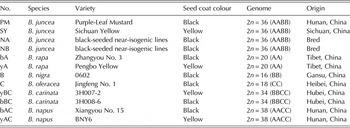
Brassica juncea varieties Purple-Leaf Mustard (PM, black-seeded), Sichuan Yellow (SY, yellow-seeded) and their derived black-seeded near-isogenic lines NA and NB (Yan et al. Reference Yan, Liu, Guan, Chen, Yuan and Liu2009, Reference Yan, Liu, Guan, Chen and Liu2011), together with eight other Brassica genotypes (five black-seeded and three yellow-seeded) were used in the current study. Seed coat colour, genome and origin of Brassica species are shown in Table 1.
Brassica species used in the current study

Nucleic acid manipulations
Genomic DNA was extracted from leaves by the cetylmethylammonium bromide method. For gene cloning and expression analysis, total RNA from separated seed coats and embryos were isolated using a Trizol kit (TianGen, Beijing, China) according to the manufacturer's instructions. In order to confirm no contamination of seed coat with embryo, the seed coats and embryos were isolated under a magnifier. Each RNA sample was treated with RNase-free DNase I (TaKaRa, Dalian, China) to eliminate possible contaminating DNA. Integrity of RNA was examined by agarose gel electrophoresis and RNA concentrations were measured with an ultraviolet (UV) and visible spectrophotometer (UVmini-1240, Shimadzu). For reverse transcription polymerase chain reaction (RT–PCR) studies, 2·0 µg of the DNA-free RNA extract was converted into first-strand cDNA using a first-strand synthesis kit (ReverTra Ace, ToYoBo, Shanghai, China), following the manufacturer's recommendations.
Cloning of BANYULS genes from B. juncea and B. nigra
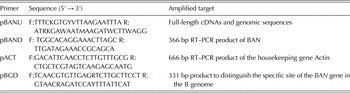
BANYULS genes were amplified from seed coat cDNA and gDNA of B. nigra variety 0602 and B. juncea variety PM, respectively. Polymerase chain reaction primers were designed based on the sequences of BAN from Brassica species in the GenBank database (FJ938339, FJ938340, FJ938333, FJ938334, FJ938335, FJ938336, FJ938337 and FJ938338). The designed primers were used to amplify the full-length cDNAs and genomic sequences of the BAN genes (Table 2). Polymerase chain reactions were performed using high-fidelity Pfu enzyme (Ambiogen, Changsha, China). The amplified products were purified with an agarose gel purification kit (Solarbio, Beijing China), and a poly (A) tail was then added using a dA Tailing Kit (TIANGEN, Beijing, China). The target fragments were ligated to the vector pMD18-T (TaKaRa, Dalian, China). Competent cells (DH5α) were prepared by the calcium chloride (CaCl2) method for vector transformation (Wei Reference Wei2010). The positive clones were completely sequenced using the Applied Biosystems 3710 DNA capillary sequence.
Nucleotide sequences of the primers used in polymerase chain reaction and the amplified targets

Sequence analyses
The full-length cDNA sequences were analysed using the software DNAMAN (LynnonBiosoft, San Ramon, CA). Similarities of sequences were checked online at the nucleotide level with the nucleotide Basic Local Assignment Search Tool (BLASTn) and at the amino acid level with protein BLAST (BLASTp). The molecular weight and isoelectric point value were estimated online (http://www.expasy.org/tools/pi_tool.html) and the protein family was classified online (http://www.ncbi.nlm.nih.gov/Structure/cdd/wrpsb.cgi).
Reverse transcription polymerase chain reaction analysis of BANYULS transcription
The transcription patterns of BAN genes were detected by RT–PCR. The specific primer pair pBAND was designed for transcriptional analysis according to the BAN sequence of Brassica species (Table 2), and the expected length of the amplified fragment was 366 base pairs (bp). Actin was used as an internal gene, and the primers were designed to amplify a 666 bp cDNA fragment (Table 2).
Polymerase chain reaction identification of specific sites of the BANYULS gene in the B genome
Polymorphisms of BAN gene sequences were analysed between genomes A, B and C using DNAMAN 7.0 software. To find a specific primer set capable of distinguishing a BAN gene origination, primer design and PCR condition optimization were performed based on Brassica BAN gene sequence polymorphisms (Yan et al. Reference Yan, Liu, Guan, Liu, Lu and Liu2010). After software analysis, no specific sequence variation was present between genome A and genome C, thus, only a primer pair (pBGD) was designed for detection of the genome B-specific BAN gene (Table 2).
Colorimetric assays for qualitative detection of flavonoids in Brassica species seed coats
The DMACA histochemical assay is specific for detection of (epi)-flavan-3-ols and PA polymers (Li et al. Reference Li, Tanner and Larkin1996). The presence of PAs in the 40 days after pollination (DAP) seed coats was monitored by immersing the tissues in DMACA solution (Yan et al. Reference Yan, Liu, Guan, Chen and Liu2011). After staining for 10 min, seed coat samples were washed three times with distilled water and subsequently observed and photographed under a microscope (BX53, Olympus, Tokyo, Japan).
To rapidly detect both anthocyanins and PAs, a simplified BuOH–HCl protocol was adapted from Nesi et al. (Reference Nesi, Lucas, Auger, Baron, Lécureuil, Guerche, Kronenberger, Lepiniec, Debeaujon and Renard2009). Approximately 20 rapeseed seed coats at 25 DAP were crushed into an eppendorf tube and flavonoids were extracted by incubation in 1 ml of a mixture of methanol/acetone/water/trifluoroacetic acid (40/32/28/0·05, v/v/v/v) for 15 min at room temperature. Then 6 ml of BuOH/12 m HCl (95/5, v/v) and 300 µl of the ferric reagent (2% ferric ammonium sulphate in 2 m HCl) were added to the samples. An aliquot (2 ml) of the supernatant was removed from the eppendorf tube, dispensed into a transparent glass bottle and photographed. The remaining sample in the eppendorf tube was subsequently boiled for 15 min and cooled on ice for a further 15 min. Next, 2 ml of the boiled supernatant from the eppendorf tube was dispensed into a transparent glass bottle and photographed. A pink or orange colouration before boiling is consistent with the presence of cyanidin or pelargonidin derivatives, respectively. A red to purple colouration after boiling indicates the presence of (epi)-catechin-derived PAs (Nesi et al. Reference Nesi, Lucas, Auger, Baron, Lécureuil, Guerche, Kronenberger, Lepiniec, Debeaujon and Renard2009).
RESULTS
Four BANYULS genes in the B. juncea genome and 2 BANYULS genes in the B. nigra genome
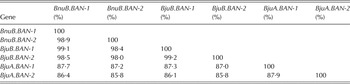
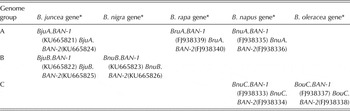
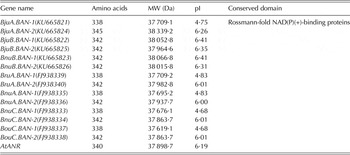
Four unique full-length cDNA clones, named BjuA.BAN-1, BjuA.BAN-2, BjuB.BAN-1 and BjuB.BAN-2, were isolated from B. juncea. The lengths of the isolated BjuA.BAN-1, BjuA.BAN-2, BjuB.BAN-1 and BjuB.BAN-2cDNAs were 1073, 1068, 1077 and 1077 bp, respectively (Accession numbers KU665821, KU665824, KU665822 and KU665825). Two unique full-length cDNA clones, named BnuB.BAN-1 and BnuB.BAN-2, were also amplified from B. nigra, BnuB.BAN-1 and BnuB.BAN-2 cDNAs with lengths of 1077 and 1080 bp, respectively (Accession numbers KU665823 and KU665826). Genomic sequences corresponding to these six genes were amplified successfully from B. juncea or B. nigra using the primer pair pBANU. Alignment of these sequences and their comparisons with the BAN genomic sequences from Arabidopsis or other Brassica species showed that all BAN sequences from B. juncea and B. nigra contained six exons and five introns. The similarities between BAN genes from B. nigra and B. juncea are 85·8–99·2% (Table 3). These nucleotide sequences had high similarities (80–99%) to the reported sequences of BAN genes from Arabidopsis (NM_104854), B. rapa (FJ938339 and FJ938340), B. oleracea (FJ938337 and FJ938338) and B. napus (FJ938333, FJ938334, FJ938334 and FJ938336), with an E value of 0·0. In addition, the four clones from B. juncea belonged to groups A and B, whereas the other two clones, originating from B. nigra, belonged to group B (Table 4). This suggested that the B. juncea BAN genes were derived from B. rapa and B. nigra. It was confirmed through online analysis that all of the inferred BAN proteins from B. juncea and B. nigra belonged to Rossmann-fold NAD(P)(+)-binding proteins. The characteristics of the BAN proteins are shown in Table 5.
Similarities between the BAN genes from B. nigra and B. juncea

BANYULS sequences in Brassica genomes (modified from Auger et al. Reference Auger, Baron, Lucas, Vautrin, Bergès, Chalhoub, Fautrel, Renard and Nesi2009 )

* Corresponding sequences originated from GenBank with accession numbers.
Calculated basic parameters and predicted important features of BAN proteins in Brassica and Arabidopsis

MW, molecular weight and pI, isoelectric point.
Relationship between BANYULS expression and seed colour traits of Brassica species
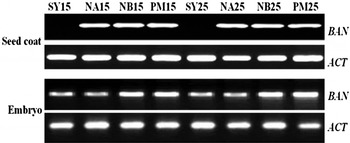
Semi-quantitative RT–PCR was carried out to measure tissue-specific expression patterns of the BAN gene. The BAN gene was richly expressed in embryos of PM, SY, NA and NB at 15 DAP and 25 DAP (Fig. 1). The BAN gene was also expressed in the seed coats of NA, NB and PM, but not in the seed coats of Sichuan Yellow at 15 and 25 DAP (Fig. 1), possibly resulting in the inhibited biosynthesis of PAs and yellow seeds.
Expression patterns of BAN in the embryo and seed coat of B. juncea. The internal Actin gene (ACT) acts as a control for constitutive expression in the assays. SY15, NA15, NB15 and PM15 indicate the 15-DAP seed coats of Sichuan Yellow (SY), black-seeded near-isogenic line A (NA), black-seeded near-isogenic line B (NB) and Purple-leaf Mustard (PM), respectively. SY25, NA25, NB25 and PM25 indicate the 25-DAP seed coat of SY, NA, NB and PM, respectively.

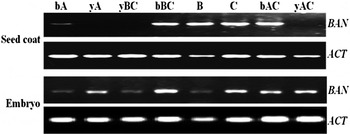
To determine whether BAN is involved in formation of the seed coat colour in other Brassica species aside from B. juncea, expression profiles of the BAN were further investigated in 20-DAP seed coats of other eight Brassica accessions (Table 1; Fig. 2). The BAN transcripts could be detected in the seed coat of the five black-seeded varieties (B. rapa Zhangyou No. 3, B. carinata 3H008-6, B. nigra 0602, B. oleracea Jingfeng No. 1, B. napus Xiangyou No. 15), whereas it was not expressed in the seed coat of the three yellow-seeded varieties (B. rapa Pengbo Yellow, B. carinata 3H007-2, B. napus BNY6). This implies that BAN could be involved in the formation of seed coat colour in Brassica species.
Expression patterns of BAN in the embryo and seed coat of Brassica varieties using the reverse transcription polymerase chain reaction (RT–PCR) method. The internal Actin gene (ACT) acts as a constitutively expressed control in the assays. bA, B. rapa Zhangyou No. 3; yA, B. rapa Pengbo Yellow; yBC, B. carinata 3H007-2; bBC, B. carinata 3H008-6; B, B. nigra 0602; C, B. oleracea Jingfeng No. 1; bAC, B. napus Xiangyou No. 15; yAC, B. napus BNY6.

Genome-specific polymerase chain reaction detection of variable BANYULS nucleotides in Brassica
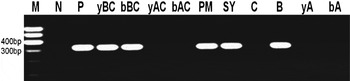
Based on the polymorphic sites of the BAN coding sequences in three diploids (B. rapa, B. oleracea, B. nigra) and two allotetraploid (B. napus, B. juncea) Brassica species, primer pairs were designed to distinguish genome-specific PCR detection of variable BAN nucleotides. Due to the high sequence similarity between BANs from the A and C genomes, genome-specific BAN primers to distinguish these two genomes could not be found. However, primers based on B genome-specific loci were designed and could precisely identify the B genome origin of BAN using the allele-specific PCR method. As shown in Fig. 3, the primer pair pGDB amplified the expected 331 bp fragment only from samples that contained the Brassica B-genome DNA (B. nigra, B. juncea and B. carinata) but not from B. rapa, B. oleracea or B. napus samples (Fig. 3). This demonstrated that the primer pair can merely distinguish BAN genes originating from the B genome. Detection of variable nucleotides in the BAN sequences by PCR could effectively identify the B genomic origin of Brassica BAN sequence variations.
Polymerase chain reaction-based assay of ten Brassica species with different genome composition. M, molecular weight marker; N, negative control; P, positive control (plasmid containing BnuB.BAN-1); yBC, B. carinata 3H007-2; bBC, B. carinata 3H008-6; yAC, B. napus BNY6; bAC, B. napus Xiangyou No. 15; PM, B. juncea Purple-Leaf Mustard; SY, B. juncea Sichuan Yellow; C, B. oleracea Jingfeng No.1; B, B. nigra 0602; yA, B. rapa Pengbo Yellow; bA, B. rapa Zhangyou No. 3.

Detection of proanthocyanidins in the seed coat of Brassica species
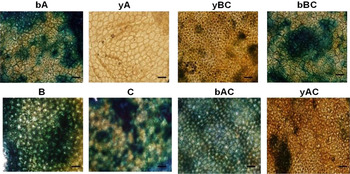
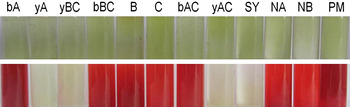
The seed coats of Zhangyou No. 3, Pengbo Yellow, 3H007-2, 3H008-6, 0602, Jingfeng No. 1, Xiangyou No. 15 and BNY6 at 40 DAP were separated and stained with DMACA to determine the presence of PAs. Blue staining was detected in seed coats of black-seeded Brassica species but not in those of yellow-seeded Brassica species (Fig. 4). A BuOH–HCl colorimetric assay was conducted on isolated seed coats to qualitatively evaluate the nature and amounts of PAs in six Brassica species (12 varieties; Fig. 5). The samples of black-seeded Brassica species showed red colouration after boiling (Fig. 5b ), while those of yellow-seeded Brassica species did not. These results suggest that PA biosynthesis is inhibited in seed coats of the yellow-seeded accessions. Since samples treated by the BuOH–HCl method showed no colour changes before boiling (Fig. 5a ), it can be concluded that anthocyanins do not exist in the seed coat of Brassica species (Nesi et al. Reference Nesi, Lucas, Auger, Baron, Lécureuil, Guerche, Kronenberger, Lepiniec, Debeaujon and Renard2009). Epi-flavan-3-ols are not only the catalytic product of BAN but also of leucoanthocyanidin reductase (LAR). To confirm the speculation that Epi-flavan-3-ols are only the catalytic product of BAN in Brassica, the B. juncea (PM) genomic library was screened using PCR with the primers designed from LAR coding sequences of Lotus corniculatus, Onobrychis viciifolia and Medicago truncatula. The results indicated that no clones were found in the genomic library. The B. rapa sequence database (http://brassicadb.org/brad/blastPage.php) was also screened using LAR coding sequences from L. corniculatus, O. viciifolia and Medicago truncatula and no LAR homologue was identified (data not shown). This inferred that the LAR pathway could not exist in Brassica, after a comprehensive analysis of previous reports (Lepiniec et al. Reference Lepiniec, Debeaujon, Routaboul, Baudry, Pourcel, Nesi and Caboche2006; Nesi et al. Reference Nesi, Lucas, Auger, Baron, Lécureuil, Guerche, Kronenberger, Lepiniec, Debeaujon and Renard2009).
Seed coat of Brassica species stained with p-dimethylaminocinnamaldehyde (DMACA). Scale bar = 10 µm. bA, B. rapa Zhangyou No.3; yA, B. rapa Pengbo Yellow; yBC, B. carinata 3H007-2; bBC, B. carinata 3H008-6; B, B. nigra 0602; C, B. oleracea Jingfeng No. 1; bAC, B. napus Xiangyou No. 15; yAC, B. napus BNY6.

Flavonoid detection in the seed coat of Brassica species using BuOH–HCl assays. Flavonoid extracts from the seed coat of Brassica species were submitted to a BuOH–HCl colorimetric test to detect anthocyanins and proanthocyanidins. Observations were made before (a) and after (b) boiling the samples. The red to crimson colouration after boiling indicates the presence of (epi)-catechin-derived PAs. bA, B. rapa Zhangyou No. 3; yA, B. rapa Pengbo Yellow; yBC, B. carinata 3H007-2; bBC, B. carinata3H008-6; B, B. nigra 0602; C, B. oleracea Jingfeng No. 1; bAC, B. napus Xiangyou No. 15; yAC, B. napus BNY6; SY, B. juncea Sichuan Yellow; NA, B. juncea black-seeded near-isogenic lines NA; NB, B. juncea black-seeded near-isogenic lines NB; PM, B. juncea Purple-leaf Mustard.

DISCUSSION
Sequences homology of BANYULS genes in Brassicaceae
Two BAN orthologue genes were isolated from each of three diploid species, B. rapa, B. oleracea and B. nigra, and four BAN genes were cloned from the two amphidiploid species, B. napus and B. juncea (Auger et al. Reference Auger, Baron, Lucas, Vautrin, Bergès, Chalhoub, Fautrel, Renard and Nesi2009). BANYULS genes from Brassica juncea and Brassica nigra were isolated using one primer pair in the present study. Because of the high sequence conservation between Brassicaceae genomes (Parkin et al. Reference Parkin, Lydiate and Trick2002, Reference Parkin, Gulden, Sharpe, Lukens, Trick, Osborn and Lydiate2005; Auger et al. Reference Auger, Baron, Lucas, Vautrin, Bergès, Chalhoub, Fautrel, Renard and Nesi2009), the homology cloning approach is very useful for gene cloning from Brassica species (Yan et al. Reference Yan, Liu, Liu, Guan, Yuan and Xiong2008, Reference Yan, Liu, Guan, Liu, Lu and Liu2010, Reference Yan, Liu, Guan, Chen and Liu2011; Auger et al. Reference Auger, Baron, Lucas, Vautrin, Bergès, Chalhoub, Fautrel, Renard and Nesi2009; Chai et al. Reference Chai, Lei, Huang, Li, Yin, Tang, Wang and Chen2009). In the current work, four BAN clones were obtained from B. juncea that belong to two homology groups, and two BAN genes were identified in the B. nigra genome that belong to one homology group. The results indicated the validity of U-triangle from a single gene level.
A polymerase chain reaction-based B-genome-specific gene marker can distinguish BANYULS originating from the B genome in Brassica
The genomes (A, B and C) of allopolyploid Brassica and their hybrid progeny have been distinguished using genomic in situ hybridization (GISH) or fluorescence in situ hybridization (FISH) (Howell et al. Reference Howell, Kearsey, Jones, King and Armstrong2008; Cui et al. Reference Cui, Ge, Gautam, Kang and Li2012; Heneen et al. Reference Heneen, Geleta, Brismar, Xiong, Pires, Hasterok, Stoute, Scott, King and Kurup2012). However, these processes are difficult. Allele-specific PCR markers can be used to detect variation in gene sequences easily. The BAN gene could serve as a candidate marker gene for detecting pollen flow of Brassica and could provide an alternative method for detection of pollen drift as well as risk assessment of gene flow in Brassica species, especially when transgene selection markers are lacking (Wu et al. Reference Wu, Xiao, Wu and Lu2007). Hence, this B-genome-specific gene marker will also be useful in comparative mapping and phylogenetic studies among the Brassicaceae. The availability of PCR-based gene sequence markers will allow a detailed investigation of the sequences and distribution of genomes throughout different crucifer genera and provide new molecular phylogenetic information regarding Brassica genome evolution.
BANYULS genes are expressed in proanthocyanidin-accumulating cells in seed coat of Brassica species
The BAN gene was expressed abundantly in the seed coat of all black-seeded varieties, whereas its transcript was not detected in the seed coat of yellow-seeded varieties. Detection of the precursor of PAs in the early developmental stages of the Brassica seed coat helps to positively identify the seed coat colour (Lu et al. Reference Lu, Liu, Liu, Yue, Guan and Liu2012). The results indicated that flavon-3-ol-derived PAs were accumulated abundantly in testa of developing Brassica seeds, as indicated by the blue colouration with DMACA staining and the deep red colouration following BuOH–HCl treatment. In addition, there is no LAR homologue in the genome of B. rapa or other rapeseed genomes (Cheng et al. Reference Cheng, Liu, Wu, Fang, Sun, Liu, Li, Hua and Wang2011). Based on the flavonoid synthesis pathway, PAs are proposed to be synthesized from the catalytic products of anthocyanidin synthase (Lepiniec et al. Reference Lepiniec, Debeaujon, Routaboul, Baudry, Pourcel, Nesi and Caboche2006; Yan et al. Reference Yan, Liu, Guan, Chen and Liu2011). Similar results have previously been reported in mature seeds of Brassica species (Marles et al. Reference Marles, Gruber, Scoles and Muir2003; Marles & Gruber Reference Marles and Gruber2004; Nesi et al. Reference Nesi, Lucas, Auger, Baron, Lécureuil, Guerche, Kronenberger, Lepiniec, Debeaujon and Renard2009).
BANYULS transcripts are restricted to seeds from the very early developmental stages (5 DAP) until the end of maturation (45 DAP) (Auger et al. Reference Auger, Baron, Lucas, Vautrin, Bergès, Chalhoub, Fautrel, Renard and Nesi2009). Therefore, 15-DAP and 25-DAP seed coats and embryos from B. juncea and 20-DAP seed coats from the other eight Brassica species were selected to analyse the transcription levels of BAN gene in the current study. BANYULS transcripts accumulated in the seed coat, specifically in the inner integument, as revealed by laser microdissection assays orcryo-sectioning methods for visualizing PAs in plant tissue by light microscopy. These spatio–temporal expression patterns of BAN gene were in agreement with the contentsof PAs in B. napus seeds and B. juncea (Nesi et al. Reference Nesi, Lucas, Auger, Baron, Lécureuil, Guerche, Kronenberger, Lepiniec, Debeaujon and Renard2009; Yan et al. Reference Yan, Liu, Wang and Yao2013) and were also consistent with the expression profiles of the AtANR gene in Arabidopsis (Debeaujon et al. Reference Debeaujon, Nesi, Perez, Devic, Grandjean, Caboche and Lepiniec2003). In the present study, the BAN gene was also expressed in embryo and the seed coat of black-seeded varieties, whereas expression of this transcript was not detected in the seed coat of yellow-seeded varieties. Debeaujon et al. (Reference Debeaujon, Nesi, Perez, Devic, Grandjean, Caboche and Lepiniec2003) reported that transcripts of the ANR gene were detected in the PA-accumulating cell layer in Arabidopsis testa. In addition, PA accumulation was restricted to the seed coat of B. carinata (Marles et al. Reference Marles, Gruber, Scoles and Muir2003) and these pigments were primarily localized in the innermost cell layer of the inner integument, as revealed by DMACA staining or vanillin staining of seed sections (Nesi et al. Reference Nesi, Lucas, Auger, Baron, Lécureuil, Guerche, Kronenberger, Lepiniec, Debeaujon and Renard2009; Yan et al. Reference Yan, Liu, Wang and Yao2013). Combining the current results with those of previous studies, it was speculated that the BAN gene was expressed in some cells of the seed coat and closely correlated with PA accumulation in the Brassica seed coat. Whether seeds are yellow or black, the funiculi are always black, suggesting that PAs may not (or only rarely) exist there, as indicated by the fact that RT–PCR analysis could not detect BAN transcription in this organ.
Although the BAN sequences from Arabidopsis and Brassica displayed high levels of conservation at the structural level, the question still remains whether the Brassica hits represent functional orthologues of Arabidopsis proteins. According to the expression levels of BAN in yellow and black seeds of Brassica, the expression of BAN genes was deduced to be regulated by upstream transcription factors. In Arabidopsis, expression of BAN was regulated by TT2, TT8, TTG1 and TT16 transcription factors (Lepiniec et al. Reference Lepiniec, Debeaujon, Routaboul, Baudry, Pourcel, Nesi and Caboche2006). The promoter of the Arabidopsis thaliana BAN gene was also activated by similar components in B. napus seed, suggesting that rapeseed proteins could bind to the promoter of the Arabidopsis BAN and regulate its expression (Nesi et al. Reference Nesi, Lucas, Auger, Baron, Lécureuil, Guerche, Kronenberger, Lepiniec, Debeaujon and Renard2009). In Vitis bellula, ANR is an NADPH-/NADH-dependent enzyme, leading to the formation of flavan-3-ols and PAs in the leaves (Zhu et al. Reference Zhu, Peng, Li and Xie2014). The apple MdMYB9 could activate the ANR promoters of apple and poplar, which could be employed for metabolic engineering of the PA pathway in apple (Gesell et al. Reference Gesell, Yoshida, Tran and Constabel2014). Therefore, it is inferred that the patterns of PA accumulation among Brassica, Arabidopsis, Vitis and Malus × domestica are highly similar. A pair of primers could amplify four copies of BAN from B. juncea and two copies of BAN from B. nigra, implying high similarity in the BAN promoters (1–32 bp upstream to the start of the codon) of genome A and genome B. It can be inferred that the promoter regions of the BAN copies have the same binding site for regulatory proteins or complexes of regulatory proteins, which can explain the presence of two or four copies in B. rapa or B. juncea; however, the seed coat colour was controlled by one or two genetic loci (Zhang et al. Reference Zhang, Lu, Yuan, Zhang, Geng, Chen, Cloutier, McVetty and Li2009; Padmaja et al. Reference Padmaja, Agarwal, Gupta, Mukhopadhyay, Sodhi, Pental and Pradhan2014).
The authors thank Professor Jinling Meng at Huazhong Agricultural University, Professor Wanchang Sun at Gansu Agricultural University and Professor NimaZhuoma at Tibet Autonomous Region Institute of Agricultural Science for providing a part of accessions for this study. This work was funded by the Hunan Provincial Natural Science Foundation of China (Grant no. 2016JJ1010).