Introduction
In Australia, 21.8 per cent (4.1 million) of the population were born overseas (Australian Bureau of Statistics (ABS) 2001). This compares to 8.3 per cent (4.9 million) in the United Kingdom (National Statistics Online 2001) and 10.4 per cent (28.4 million) in the United States (US Census Bureau 2000). In 2006, Australians claimed more than 250 different ancestries and spoke almost 400 different languages at home (ABS 2006a). This increasingly multi-ethnic and pluralistic demographic composition, which is also in prospect across the United States and Europe, is indicative of a shift away from western populations comprised of one majority ethnic group (Yancey, Ortega and Kumanyika Reference Yancey, Ortega and Kumanyika2006).
Of the overseas-born living in Australia in 2001, 17.7 per cent (723,900) were over the age of 65, and of these approximately 18.5 per cent (134,000) either did not speak English, or did not speak English well (ABS 2001). By 2011, it is estimated that 22.5 per cent (653,800) of people aged 65 or more years will be from countries where English is not the main language (Gibson et al. Reference Gibson, Braun, Behnam and Mason2001). This substantial and increasing group of older people from culturally diverse backgrounds justifies the investigation and inclusion of their experiences, in their own right, in ageing research. There have, however, been few empirical studies of culturally diverse issues in the older population, in part because of the particular challenges relating to their recruitment as research participants (Curry and Jackson Reference Curry and Jackson2003; Hinton et al. Reference Hinton, Guo, Hillygus and Levkoff2000).
This study explored the impact of the built environment on the levels of physical activity of older people and sought to investigate and compare the experiences of older people from different cultures. It is one of only a few in Australia or internationally that has specifically included older adults from different cultural communities. While the findings will be reported elsewhere, this article focusses on a methodological issue, the experiences and challenges that the research team faced in undertaking research with culturally diverse communities.
Most of the literature on the recruitment of culturally diverse communities in research focuses on the American experience. It has burgeoned through a policy introduced by the National Institutes of Health in 1994 that mandated the inclusion of women and members of ‘ethnic minority’ groups in research (Garber and Arnold Reference Garber and Arnold2006; McLean and Campbell Reference McLean and Campbell2003; Miranda Reference Miranda1996). The primary aim of the policy was to generate a better representation of the entire population in clinical research (Garber and Arnold Reference Garber and Arnold2006; McLean and Campbell Reference McLean and Campbell2003).
An American review that investigated the effective recruitment and retention of ‘minority’ research participants identified four particularly relevant factors: sampling approach and identification of targeted participants; community involvement and the nature and timing of contact with prospective participants; incentives and logistical issues; and cultural adaptations (Yancey et al. Reference Yancey, Ortega and Kumanyika2006). In summary this review of the American literature identified a considerable number of studies that both supported and negated the influence of race/ethnicity on key recruitment and retention variables. It must be noted that while the majority of the literature derives from the United States, the European experience makes a substantial contribution to the record of researchers' experiences and is appropriately acknowledged below.
The key themes to emerge from the available literature are: the importance of trust and established connections with culturally diverse communities; the central involvement of culturally diverse researchers and interviewers; that barriers to recruitment can be attributed to the research institutions as well as the culturally diverse communities themselves; and the need to acknowledge and understand issues from a culturally diverse perspective (Bowes and Dar Reference Bowes and Dar2000; Brown and Alexander Reference Brown and Alexander2004; Curry and Jackson Reference Curry and Jackson2003; Levkoff, Levy and Weitzmann Reference Levkoff, Levy and Weitzmann2000; Sixsmith, Boneham and Goldring Reference Sixsmith, Boneham and Goldring2003; Yancey, Ortega and Kumanyika Reference Yancey, Ortega and Kumanyika2006). Indeed, the emphasis is not just on recruitment itself but also on gaining access to the community (Bowes and Dar Reference Bowes and Dar2000; Sixsmith, Boneham and Goldring Reference Sixsmith, Boneham and Goldring2003).
There is also evidence to suggest that there is a specific need for information regarding practical strategies for recruitment and retention of ethnic minority populations in research (Curry and Jackson Reference Curry and Jackson2003; Keyzer et al. Reference Keyzer, Melnikow, Kuppermann, Birch, Kuenneth, Nuovo, Azari, Oto-Kent and Rooney2005; McLean and Campbell Reference McLean and Campbell2003). In acknowledgement of the dearth of literature, researchers have been encouraged to disseminate findings that have specifically included people that are usually under-represented or excluded from public health research (Brown and Alexander Reference Brown and Alexander2004), as well as to highlight the processes involved in their successful recruitment (Sixsmith, Boneham and Goldring Reference Sixsmith, Boneham and Goldring2003).
An examination of the literature indicates that some of the reasons for not investigating culturally diverse issues are the increased time and resources that are required, as in finding bilingual speakers, translating documents, and ensuring materials are cross-culturally sensitive (Brown et al. Reference Brown, Long, Weitz and Milliken2000; Hughes, Fenton and Hine Reference Hughes, Fenton and Hine1995; Moreno-John et al. Reference Moreno-John, Gachie, Fleming, Napoles-Springer, Mutran, Manson and Perez-Stable2004; Shelton and Rianon Reference Shelton and Rianon2004; Sin Reference Sin2004; Sixsmith, Boneham and Goldring Reference Sixsmith, Boneham and Goldring2003). Sin (Reference Sin2004: 270) argued that ‘such costs are not “inflated” or “excessive”, but legitimate and necessary’. Others have noted tensions such as the lack of trust and scepticism shown by culturally diverse participants (Gallagher-Thompson et al. Reference Gallagher-Thompson, Rabinowitz, Tang, Tse, Kwo, Hsu, Wang, Leung, Tong and Thompson2006; O'Brien et al. Reference O'Brien, Kosoko-Lasaki, Cook, Kissell, Peak and Williams2006; Moreno-John et al. Reference Moreno-John, Gachie, Fleming, Napoles-Springer, Mutran, Manson and Perez-Stable2004), the impact of a history of discrimination (Dennis and Neese Reference Dennis and Neese2000; Stahl and Vasquez Reference Stahl and Vasquez2004), and the different values and perspectives of people from culturally diverse communities (Levkoff, Levy and Weitzmann Reference Levkoff, Levy and Weitzmann2000). In response to such tensions, strategies have been identified to address some of these challenges, such as building relationships, feeding back findings to communities, and working with culturally specific community organisations (Moreno-John et al. Reference Moreno-John, Gachie, Fleming, Napoles-Springer, Mutran, Manson and Perez-Stable2004; Yancey, Ortega and Kumanyika Reference Yancey, Ortega and Kumanyika2006). Furthermore, Stahl and Vasquez (Reference Stahl and Vasquez2004: 14) concluded that:
Experience indicates that intensive effort, cultural sensitivity, specialized skill, creativity, and time are needed to foster acceptance in minority communities and among its members for participation and retention in research projects.
Better to understand and to address the complexity of the challenges of recruiting people from culturally diverse communities for research, Levkoff, Levy and Weitzmann (Reference Levkoff, Levy and Weitzmann2000) proposed the ‘Matching Model of Recruitment’. It is a consumer-centred model (Arean et al. Reference Arean, Alvidrez, Nery, Estes and Linkins2003), which posits that matches between the perspectives of culturally diverse groups and researchers lead to recruitment success, whereas mismatches are a recipe for failure. Perspectives are distinguished at three different levels: micro (individual participant or interviewer); mediator (gate-keeper or research team); and macro (community agency or academic institution). Thus, recognising and understanding the culture of each community, and their perceptions about research and research participation, may be essential to successful recruitment (Brown and Alexander Reference Brown and Alexander2004; Levkoff, Levy and Weitzmann Reference Levkoff, Levy and Weitzmann2000; Levkoff and Sanchez Reference Levkoff and Sanchez2003). Gallagher-Thompson et al. (Reference Gallagher-Thompson, Rabinowitz, Tang, Tse, Kwo, Hsu, Wang, Leung, Tong and Thompson2006) and McLean and Campbell (Reference McLean and Campbell2003) have also noted the potential benefits of ‘ethnic matching’ for recruitment success, but caution that it can be problematic because of heterogeneity within cultural groups. Likewise, Twine (Reference Twine, Twine and Warren2000) questioned the assumption that matching helps or that there is a single community to match with, while Yancey, Ortega and Kumanyika (Reference Yancey, Ortega and Kumanyika2006) argued that matching may not be sufficient to ensure recruitment success.
This article addresses the gaps in the literature by describing and analysing a number of themes that emerged regarding the recruitment and retention of older people from culturally diverse groups in our study of physical activity and the built environment. The background to the study and the methods used are initially presented. Issues that the team were cognisant of before embarking on the research are discussed, as well as the strategies put in place to address them. Despite having such strategies in place, many challenges emerged. As Sin (Reference Sin2004) observed, ‘Given the recognised problems in this field, it is of concern that some studies have been presented as if sampling was unproblematic. There can be a lack of transparency in the reporting of the research process. Issues pertaining to sampling frame and sampling method should merit lengthier discussion as this facilitates the interpretation of findings by various users of the research’ (p. 270). In acknowledgement of Sin's cautionary note, it is pertinent first to provide some background information and describe the methodological approach of the current research study.
Background
Study location
The study was conducted in three local government areas (LGAs) in the western suburbs of Melbourne, in the State of Victoria, Australia. The percentage of the population over 60 in these three LGAs ranges from 7.2 to 18.2 per cent. In the Socio-Economic Indexes for Areas (SEIFA) analysis, the Melbourne region is divided into 32 LGAs, and of the three areas in which the participants lived, two are rated in the top three for greatest disadvantage, and the third ranks 11th (Melbourne Development Board 2005). Additionally, the Victorian Burden of Disease study (Department of Human Services 2001) identified Melbourne's western metropolitan region as having a poorer than average health profile in terms of both morbidity and mortality. The area is also one of the most multi-cultural regions in Australia. Based on the 2001 ABS census data, 17.2, 44.3 and 53.9 per cent of people in the three participating LGAs spoke languages other than English, as compared to 25.8 per cent in the entire Melbourne Statistical Division (MSD). The percentage of people born overseas in each of these LGAs was 21.1, 39.9 and 43.1 per cent respectively, as compared to 28.6 per cent in the MSD.
Method
This collaborative study involved researchers from two universities and a hospital, as well as representatives from the three LGAs. The team aimed to recruit 350 participants, 50 from each of seven different cultural groups (Vietnamese, Greek, Italian, Maltese, Macedonian, Croatian and Anglo-Celtic). These cultural groups were the largest in the region and included both established and newly-arrived migrant communities. Representatives from the three participating local councils took responsibility for the active recruitment of participants with guidance from the research team. ‘Active’ recruitment involved bringing project staff directly into contact with prospective participants, as opposed to more ‘passive’ means that rely on dissemination through flyers and advertisements (Yancey, Ortega and Kumanyika Reference Yancey, Ortega and Kumanyika2006). The team chose not to recruit through the media because of the additional costs of having to manage and screen potential participants. As well as being more targeted, another reason for choosing a council-based recruitment strategy was that councils had access to and established relationships with the selected communities. This meant that potential participants could be targeted through local senior centres and as clients of the Home and Community Care Services (HACC). The HACC Programme is a main component of the Australian Government's aged-care policy, which provides community care services to frail aged and younger people with disabilities, and their carers. This meant that people who would not normally be recruited into such studies because of health-associated difficulties and being unable to leave their homes could be recruited.
In order to raise awareness and interest in the study, council workers either approached individuals or groups such as those found at a seniors' centre. On several occasions a member of the research team made a presentation to council workers to prepare them for the recruitment role. Such training sessions have been referred to as ‘partner education’ (Nichols et al. Reference Nichols, Martindale-Adams, Burns, Coon, Ory, Mahoney, Tarlow, Burgio, Gallagher-Thompson, Guy, Arguelles and Winter2004: 170S). The benefits of using ‘insiders’ or ‘lay outreach workers’ are well documented (Kauffman Reference Kauffman1994; Yancey, Ortega and Kumanyika Reference Yancey, Ortega and Kumanyika2006).
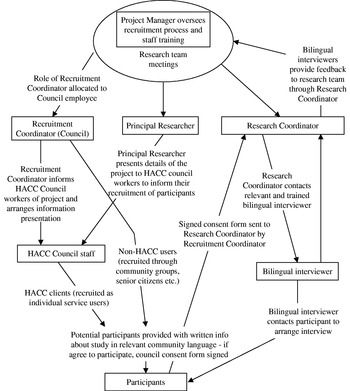
The decision was made to stagger recruitment of the different cultural groups over nine months. This facilitated the co-ordination and management of the data collection. Each potential participant was provided with written information about the study, a letter of invitation, and an information sheet in plain language. This written information was translated into the appropriate community language. In accordance with the ethics approval, the participants were also required to sign an initial consent form, which gave the council permission to pass on participant details to the research co-ordinator at the university. Once the research co-ordinator received participants' details, they were entered into a database, and the relevant bilingual interviewer was contacted. The interviewer then called the participant to arrange a mutually appropriate time and place to conduct the structured interview. The questionnaire took about one-hour to complete and included questions about the type and amount of physical activity, perceptions of the built environment and leisure satisfaction. Figure 1 summarises the recruitment process.
The recruitment process.

Bilingual interviewers were recruited and trained by the research co-ordinator and project manager. This was to ensure that the interviewers were aware of their role, as well as of issues around confidentiality (Edwards Reference Edwards1998). An average of two interviewers were recruited for each cultural group. They were of both genders, and varied considerably age, research experience and in the extent to which they had interacted with and had contact with their own cultural communities. The interviewers conducted between one and 62 interviews. They regularly reported back to and communicated with the research co-ordinator. Research team meetings occurred every six weeks at one of the participating council offices, where team members reported back to the group. It was through these several forums of communication, between team members and interviewers, that recruitment issues specific to working with older culturally diverse communities emerged. These issues were recorded in the meeting minutes as well as in the research co-ordinators' field notes.
Promoting recruitment and retention
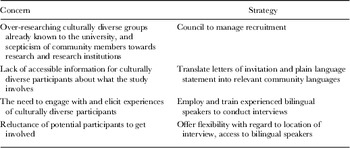
The research team came to this study with disparate experiences of conducting research with older people and, more specifically, with culturally diverse communities. They were aware of many of the challenges of conducting research with culturally diverse communities and were eager to address these initially so as to maximise the likelihood of conducting high-quality research with meaningful and relevant outcomes. Table 1 summarises some of the concerns identified at the outset and the associated strategies that were employed to ameliorate their potentially detrimental impacts on the research.
Research concerns and the associated strategies employed by the team

Building trust and meaningful relationships within and between the project team, bilingual workers, participants and respective communities are vital to the success of recruitment and retention (Barata et al. Reference Barata, Gucciardi, Ahmad and Stewart2006; Dennis and Neese Reference Dennis and Neese2000; Moreno-John et al. Reference Moreno-John, Gachie, Fleming, Napoles-Springer, Mutran, Manson and Perez-Stable2004; Sixsmith, Boneham and Goldring Reference Sixsmith, Boneham and Goldring2003; Stahl and Vasquez Reference Stahl and Vasquez2004; Yancey, Ortega and Kumanyika Reference Yancey, Ortega and Kumanyika2006); so too is valuing participants, offering incentives, flexible interview arrangements, and feeding back the research findings (Chadiha et al. Reference Chadiha, Morrow-Howell, Proctor, Picot, Gillespie, Pandey and Dey2004; Dilworth-Anderson and Williams Reference Dilworth-Anderson and Williams2004; Levkoff and Sanchez Reference Levkoff and Sanchez2003; McLean and Campbell Reference McLean and Campbell2003; Moreno-John et al. Reference Moreno-John, Gachie, Fleming, Napoles-Springer, Mutran, Manson and Perez-Stable2004; Nichols et al. Reference Nichols, Martindale-Adams, Burns, Coon, Ory, Mahoney, Tarlow, Burgio, Gallagher-Thompson, Guy, Arguelles and Winter2004; Stahl and Vasquez Reference Stahl and Vasquez2004). These themes have been discussed widely in the literature and all are important in promoting recruitment to research.
By allowing the councils to take responsibility for recruitment, and identifying those thought to be suitably appropriate, the research team believed that the study would better target those people most likely to benefit as a result of the findings. This action was intended to support a key outcome of the study, namely for councils to use the findings directly to inform public policy and increase the effectiveness of service delivery. Another reason for councils taking responsibility for recruitment was to avoid ‘burning out’ and ‘over-researching’ the same community groups (Sin Reference Sin2004). A consultation in the United Kingdom, for example, identified that Black older people felt that they had been ‘researched to death’ (Butt and O'Neil Reference Butt and O'Neil2004: 2). The university research team members had some existing networks with community groups, and had been involved in a similar study two years earlier, which required recruiting a large number of older Vietnamese and Italian women. Recruiting participants through councils' own networks, therefore, decreased the likelihood that the same groups of people were being repeatedly targeted for research purposes (Sin Reference Sin2004).
Of particular importance when conducting research with people from culturally diverse communities is the accessibility of the research to potential participants. Of all Australian migrants over the age of 55 years, who mainly speak a language other than English at home, 70 per cent do not speak English well or do not speak English at all (ABS 2006b). It is likely that this percentage is higher for reading proficiency. It was therefore imperative to provide information about the study in the participants' own community language. Providing accessible information may also increase the likelihood of recruitment, as it may convey to potential participants that the research team are serious about wanting to include them. However, the team were aware that there may be differences in outcomes across the culturally diverse groups regarding the effectiveness of providing letters of invitation and information about the study. For example, Napoles-Springer et al. (Reference Napoles-Springer, Fongwa, Stewart, Gildengorin and Perez-Stable2004) found that sending a letter prior to a satisfaction survey increased the response rate of white participants, but not of African Americans.
The team also believed that it would be difficult to access the experiences of some of these older people without having bilingual interviewers to translate their responses and explain the questions in their native languages. Bowes and Dar (Reference Bowes and Dar2000) found this to be the case in their experience with older Indian-origin participants in the United Kingdom. However, the presence of bilingual interviewers, whose role was also as an interpreter, presented additional concerns for the research. Whilst bilingual speakers certainly enabled the research team to access the responses of non-English speaking participants, it was difficult to monitor and assess their influence on the collected data.
Emerging recruitment and retention issues
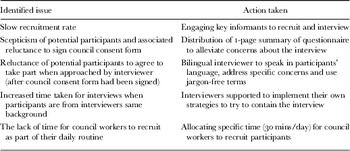
Despite the strategies discussed above that were put in place by the research team to maximise the engagement and retention of culturally diverse people in the study, recruitment was slow and often ran behind schedule. The original plan was to recruit and interview each cultural group over three months, and stagger all seven groups over nine months, namely to recruit and interview all 350 participants over that period. As the study progressed, the research team identified several issues that undermined their recruitment efforts. Some of these issues, and the associated actions taken, are listed in Table 2 and are described in more detail below.
Emerging issues and associated actions

Key informants and gate-keeping
While it was originally the team's intention for all participants to be actively recruited through the three participating councils, it was realised that recruitment targets would not be met by relying on this method alone. Instead, the team decided to employ a combination of strategies which included snowballing and personal contacts. This resonates with McLean and Campbell's (Reference McLean and Campbell2003) study, where they justified the use of a variety of techniques as consistent with their socio-cultural framework. Essentially, this means that the appropriateness and effectiveness of strategies are likely to vary according to the social and cultural context in which a person is located. Therefore, to engage people from various cultural backgrounds, it is both necessary and expected that several strategies are employed; to use only one technique would not achieve an adequately diverse sample (Sixsmith, Boneham and Goldring Reference Sixsmith, Boneham and Goldring2003).
Employing additional recruitment strategies not only served to increase the rate of recruitment, but also to reduce the burden on council resources. As Brown and Alexander (Reference Brown and Alexander2004: S6) found, ‘extraordinary efforts’ are ‘needed to gain the trust and approval of minority elders and their community leaders’. It can take a long time to build relationships and trust. And furthermore, Nichols et al. (Reference Nichols, Martindale-Adams, Burns, Coon, Ory, Mahoney, Tarlow, Burgio, Gallagher-Thompson, Guy, Arguelles and Winter2004) identified that the most successful recruitment strategies involved working with community partners and key informants, who can provide linkages to potential participants in terms of referrals and rapport. Therefore, despite the desire to avoid repeatedly targeting the same people, the team decided to follow up and request some assistance from their existing contacts. These contacts, or ‘key informants’, namely a well-known member of the community, managed to decrease significantly the time taken and to increase the rate of recruitment. Despite some advantages in using key informants it also had its problems. For example, using key informants to recruit may have meant that only one particular ‘type’ of participant was recruited (Sixsmith, Boneham and Goldring Reference Sixsmith, Boneham and Goldring2003). Key informants may also employ forms of coercion that are not easily monitored by the research team. Further, whilst key informants have local influence and the potential to add credibility and validity to a project, they also have the ability to prevent access and essentially shut the project down (Sixsmith, Boneham and Goldring Reference Sixsmith, Boneham and Goldring2003). Some of the complexities of using key informants to assist with recruitment are illustrated in the following case example:
The research co-ordinator contacted a Vietnamese woman who had previously assisted the university in a similar research study. She organised the recruitment and interviews of 50 participants over a period of two months. This proved to be invaluable for reaching the recruitment targets, especially as the councils struggled to recruit Vietnamese participants. However, one issue that emerged was that the majority of the participants recruited were not home and community care (HACC) service users. The aim was to get an equal proportion of HACC and non-HACC users. This was expected to enable the research team to investigate any differences in the levels of physical activity reported between the two groups. At the outset, because councils manage HACC services, the team relied on them to recruit the HACC users. It became evident, however, that participants were much more likely to participate when they were approached by someone they knew, or knew of, from their own community. Interestingly, the interviewer noted that in her experience many Vietnamese chose not to use the HACC services as they failed to meet their needs. The reasons cited were that the meals-on-wheels service was not culturally appropriate, and they do not trust the home help workers. Gathering such anecdotal evidence proved to be extremely useful for informing the ongoing efforts of the participating councils.
The research team's experience of using key informants reflects current debates about how key informants can also act as ‘gate-keepers’. Clearly, in this study, using key informants enabled access to many additional participants and impacted on the quantity of data produced, but it is more difficult to assess the impact that using key informants had on the quality of the data. Key informants, intentionally or otherwise, had a powerful role in determining who took part, why they took part, and on the dynamics of their involvement. Key informants were also gate-keepers of knowledge, and were able to choose which information was or was not imparted. There are many possible reasons for gate-keeping, including the desire to portray the community in a positive light as well as political sensitivity. The research team acknowledge that they had limited control over this aspect of the study.
The participants' concerns about the questionnaire
There is often a lot of mistrust amongst culturally diverse community members towards councils and other institutions (Moreno-John et al. Reference Moreno-John, Gachie, Fleming, Napoles-Springer, Mutran, Manson and Perez-Stable2004). People from Vietnamese backgrounds, for example, may be suspicious because of their past experiences with government, war and migration. One Macedonian interviewer reflected that mistrust derives from not speaking the language and coming from a communist country. This interviewer, and several others, noted how much time was required in which to explain some of the fundamentals of research, in particular the ethical aspects, namely about how participants would remain anonymous, how their responses would be entirely confidential and would not affect their government social-security benefits. Furthermore, participants often appeared wary about the sorts of questions that they would be asked. To overcome their initial fear and worries about participating in the research, one of the council representatives suggested giving participants a summary of the themes that are raised in the questionnaire. The research co-ordinator drafted a summary sheet and it was then distributed to the other councils. Whether it helped to alleviate some of the potential participants' concerns about getting involved is unclear. The council staff recruiters also noted the reluctance of participants to sign the initial consent form. They suggested that it was due to mistrust and uncertainty about what they were signing up for. While the team was supportive of participants' wariness of signing documents that they did not understand, it meant the task of alleviating participant concerns was more difficult and time-consuming.
Encouragement and jargon-free language
The challenges observed in retaining participants once they had signed the council consent form suggests that, while some initially were happy to take part, gave their consent, and trusted the council workers, once approached by an interviewer a number were unwilling to participate. One interviewer noted how she had learnt which terms that described the research processes were less likely to deter participants (e.g. using the term ‘survey’ instead of ‘interview’). Council workers may have initially used a degree of coercion to recruit participants who later felt more able to decline participation with someone they did not know. Indeed, a Maltese interviewer noted that comments made by a participant implied that the council worker recruiting her had said that participating in the study ‘would be good for you’ and had explained ‘oh, you do lots of exercise, this would be good for you’. By contrast, other interviewers suggested that while some participants may have been a little reluctant at first, once they started talking (in their own language about their backgrounds), they began to relax and enjoy the experience. Confirmation of this came in the form of a letter written by the daughter of one participant, which emphasised how positive the interview experience had been for her father. These findings appeared to confirm those in a study by Dilworth-Anderson and Williams (Reference Dilworth-Anderson and Williams2004) that suggested friendly and persistent contact with participants was likely to increase participation rates. However, there is clearly a fine line between appropriate encouragement and harassment.
Supporting bilingual interviewers
Having paid and trained bilingual interviewers was invaluable, not only for capturing and elucidating the experiences of the participants but also for developing the team's understanding of the complex dynamics of involving culturally diverse participants in research. However, most of the interviewers described having to give extended ‘introductions’ before proceeding with the business of the interview. This often involved both the participant and the interviewer describing their life histories, particularly during the time spent in Australia and their plans for the future. The interviewers described these chats as essential in building up rapport and trust with the participant, and for alleviating their concerns. One Maltese interviewer indicated that it would also be rude to decline an offer of cake and tea. Thus, while interviews with people from culturally diverse backgrounds may have taken more time, it was an essential part of the process and interviewers were supported and encouraged to implement their own strategies to contain the interviews. These observations reflect findings from the United States that indicate it is more resource intensive to include people from minority groups in research (Brown et al. Reference Brown, Long, Weitz and Milliken2000). However, while it is mandatory in the United States to include people from minority groups in research studies, the additional resources it demands are often not provided.
Allocating time for recruitment
Finding the time to do research is difficult in a local government context. Council managers and HACC staff often have a multitude of responsibilities and research does not have priority. High council staff turnover rates also impacted on the efficiency of recruitment. Despite these challenges, having council HACC staff specifically informed and directed to recruit participants worked well. Workers already had established relationships with their clients and were likely to be able to dispel many fears about taking part. Involving people who worked ‘hands-on’ in this way with older culturally diverse people reinforces Levkoff and Sanchez’s (Reference Levkoff and Sanchez2003) view that this enables recruitment. However, as was also noted by Levkoff and Sanchez (Reference Levkoff and Sanchez2003), recruitment was greatly facilitated by allocating time specifically for the activity, in a time-pressured and resource-stretched environment. In one council, 30 minutes per day was allocated to HACC staff to enable sufficient time for recruitment. Supporting the councils to manage recruitment was clearly essential to facilitate access to HACC users; it may however be important to utilise a range of additional recruitment strategies. The next section looks more closely at who recruited participants in this study and the implications this had for the attrition rates in each cultural group.
Patterns of recruitment and attrition within groups
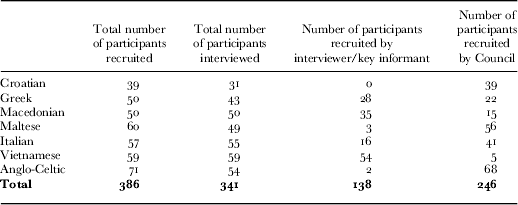
The team found that for some cultural groups (e.g. Greek, Vietnamese and Macedonian), it was more effective and efficient to recruit through the interviewers' or the key informants' own networks. Table 3 indicates the total number of participants that were recruited by cultural group, as well as whether they were recruited by council staff or the interviewer. Specifying how participants were recruited was important because, given the nature of the recruitment process, drop-outs were only recorded when participants were recruited by council staff. This is because those who declined an interviewer's invitation to participate did not drop out, as they had not been ‘recruited’ in the first place.
Numbers of participants recruited and interviewed in each cultural group
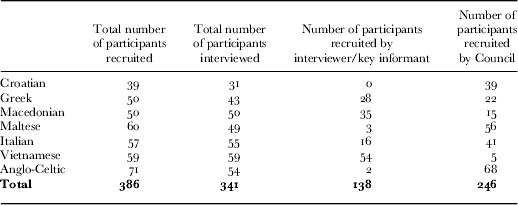
Note: These figures exclude those participants that were interviewed but excluded due to not fitting the inclusion criteria, e.g. did not live in one of the three LGAs, or did not identify with one of the seven cultural groups.
One reason for using interviewers and key informants to assist with recruitment was that council staff only had limited time and resources to allocate to the research. At times, the lack of research experience and knowledge of the research process may have served to hinder progress, with one council representative noting that it was much more demanding and time consuming than she had thought it would be. A second reason was that some cultural groups appeared to be more ‘willing’ to participate than others, which meant that the team were forced to use interviewers to recruit as well as the council staff. For example, 55 out of 62 Vietnamese participants were recruited by the interviewers. It is pertinent to note that this was also made possible by the fact that the interviewers were happy to do so, and had the appropriate networks. It was not possible to do this for the Maltese because the Maltese interviewers had less time and fewer contacts, and so they were not able to assist with recruitment in the same way. Allowing interviewers to manage recruitment also meant that initial consent forms were not needed and that there was a significantly reduced period between being approached about the study and being interviewed. As indicated above, it also meant that attrition was not a factor.
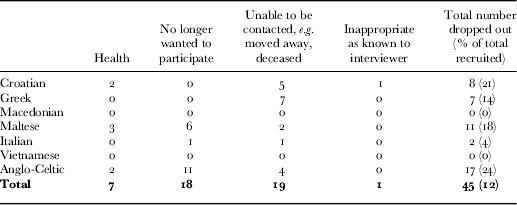
One way to explore trends in recruitment and retention of the different cultural groups in this study is to look at attrition rates and the reasons provided for dropping out. Table 4 indicates the total number of participants that dropped out after they had signed the initial council consent form, along with the reasons for withdrawing. Among the Maltese recruits, six ‘no longer wanted to participate’ and three withdrew for ‘health’ reasons. Among the former, some said that they did not have enough time, and others that they did not want interviewers to come to their homes. While a telephone interview was offered, interviewers felt that there were more issues underlying participants' reluctance to take part – such that it was ‘just a cultural thing’, a ‘can't be bothered type attitude’, that it is easy to make ‘chitchat’ but very difficult to get them to commit to being interviewed. This reluctance to take part was not as prevalent amongst the Italian, Greek and Macedonian participants.
Number of participants that dropped out and reasons for doing so
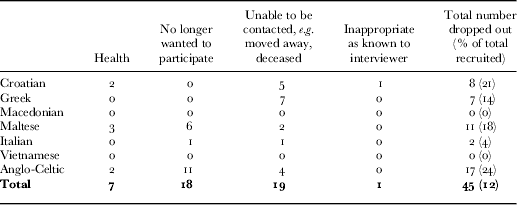
The high rate of Anglo-Celtic participants no longer wanting to participate may have been due to the council worker who recruited them. About 50 per cent of those who dropped out were recruited at the same time from one community group by the individual. This very high drop out rate did not occur to the same extent with other groups and indicates that the information provided to them at the outset may have been inadequate. Of interest also is that the same person conducted interviews with all those people that did agree to be interviewed. This particular interviewer was in the same age group as the participants, which suggests that the age of the interviewer may have influenced their willingness to participate. This reflects findings in the literature that promote the benefits of ‘matching’ interviewers to participants by age group to enhance recruitment outcomes (McLean and Campbell Reference McLean and Campbell2003).
The attrition rates and the known reasons for withdrawal indicate that there are numerous factors that influence recruitment and retention. While self-reported ethnicity may be one of those factors, it is also just as likely to be influenced by the skills and personal characteristics of the interviewer, as well as those of the council worker who had been assigned the task of recruitment. The team's observations therefore indicate that while ethnic matching may be important for recruitment, as asserted by Levkoff and Sanchez (Reference Levkoff and Sanchez2003), many other factors influence the likelihood of success.
Summary
More often than not among gerontological studies, even that minority that study cultural and ethnic differences tend to compare only one or two communities with the mainstream majority which inevitably supports only limited conclusions (Burnette Reference Burnette1998). This study, by contrast, has examined key issues in the recruitment and retention of participants from seven different cultural minority communities in Australia. Three prerequisites were identified for ensuring the success of recruitment and high retention. First, the importance of having access to key local informants, with their own networks and knowledge, who were able to assist with both recruitment and conducting interviews. Second, the central role of bilingual interviewers for facilitating engagement and access to people from different cultural groups and the importance of ensuring that they were fully trained and supported through the process. Thirdly, linking with and supporting the council staff in their recruitment activities through training and guidance.
In addition to these key issues, the recruitment strategy had to be flexible in order to adapt to the challenges that emerged. The experience of the research team indicated that a ‘one size fits all’ approach was not appropriate and that a flexible recruitment strategy was required to ensure adequate numbers of participants from each cultural group. This resonated with McLean and Campbell's (Reference McLean and Campbell2003) observation that combining a range of strategies is required to enhance recruitment and ensure a diverse sample. This issue also reflected the literature that suggests the culture of participants, and the communities they represent, may need to be explicitly incorporated into models of recruitment (Dilworth-Anderson and Williams Reference Dilworth-Anderson and Williams2004; Levkoff and Sanchez Reference Levkoff and Sanchez2003). Or, at the very least, the impact of race and culture needs to be explicitly acknowledged in the research process (Twine Reference Twine, Twine and Warren2000). Interestingly, however, it appears that differences observed in this study relating to recruitment and retention rates may be more dependent on the skills and characteristics of those responsible for the recruitment and interviewing, rather than the specific cultural group being interviewed. This observation supports Twine (Reference Twine, Twine and Warren2000), who cautioned that the feasibility and benefits of ethnic matching should not be taken for granted, and that investigators should be keenly aware that diversity exists on a range of variables. Heterogeneity rather than homogeneity is the norm which makes matching at any level problematic.
Considerations for research with culturally diverse groups
This research addressed a distinct gap in the methodological literature regarding the investigation of the experiences of older people from culturally diverse communities. Several issues and challenges in the recruitment and retention of the study sample have been explicated and should be noted by those embarking on similar research. Like McLean and Campbell (Reference McLean and Campbell2003), the research team found that having bilingual interviewers and key informants was invaluable for recruiting and retaining culturally diverse participants, but they also created challenges for the research. Despite the training that was provided, each interviewer had his or her own style and way of asking questions and documenting the responses. They also brought their own ideas and expectations, and without realising it may have impacted on participant responses. This may be compounded by the cultural differences in the team of interviewers. For example, if Vietnamese participants are found to report significantly lower levels of sedentary activities, this may in part be attributable to the way in which the interviewer asked, perceived or translated the question itself, rather than the face value of the question. The importance of critically reflecting on the impact of bilingual interviewers, and their powerful role in translation and interpretation, has been raised by previous investigators (Edwards Reference Edwards1998; Temple Reference Temple2002). These reflections relate to the issues around gate-keeping, and cautions researchers against over confidence in the benefits of employing bilingual staff and not monitoring their effects on the outcomes of the research.
Drawing on Smith's (Reference Smith1999) discussion about ‘decolonising methodologies’, as well as Twine's (Reference Twine, Twine and Warren2000) observations about not acknowledging race in research, researchers need to be cognisant of the influence of their dominant white and western ideologies on research approaches and methodologies. They cannot fail to have an impact, and possibly undermine their relevance to non-white populations; researchers need always to be critically reflexive (Dennis and Neese Reference Dennis and Neese2000; Temple, Reference Temple2002). This may necessitate that researchers themselves receive some form of cultural awareness training (Edwards Reference Edwards1998).
Critical reflection can also highlight the impact of inequitable power relations. For example, when a potential participant is approached by a council worker, clinician or person in a position of authority, he or she may feel obliged to take part. They may believe that a refusal would jeopardise their pensions or existing services. This is despite assertions by the team to the contrary and the confirmation of participant anonymity. One interviewer noted that many of the people he interviewed had little or no education, and this may have exacerbated their experiences of powerlessness and deferential behaviour. It raises ethical dilemmas for such research. Furthermore, a widespread tendency was observed to pathologise old age and this is compounded by a tendency to pathologise minority ethnic status (Sin Reference Sin2004). ‘This discourse of “special needs” and “deprivation” reinforces the power imbalance between researcher and the researched’ (Sin Reference Sin2004: 268). It also may perpetuate the mistrust and fear experienced by older people from culturally diverse backgrounds (Moreno-John et al. Reference Moreno-John, Gachie, Fleming, Napoles-Springer, Mutran, Manson and Perez-Stable2004).
An alternative way to address the impact of inequitable power relations in formal interviews is to employ more participatory approaches; that is, to involve participants and culturally diverse groups in formulating the research questions and methods of data collection (Hanley Reference Hanley2005). However, when including community members in the research effort, it is important that their roles are meaningful (Dennis and Neese Reference Dennis and Neese2000). Levkoff and Sanchez (Reference Levkoff and Sanchez2003) claimed that qualitative methods might be more appropriate to use with culturally diverse groups, as they have the potential to alleviate the participants' concerns. Hence, a more qualitative and participatory approach may allay some of the challenges that the team experienced with regard to recruitment and retention (Moreno-John et al. Reference Moreno-John, Gachie, Fleming, Napoles-Springer, Mutran, Manson and Perez-Stable2004).
Whilst this research did approach the challenging task of investigating the experiences of culturally diverse communities, it must be noted that the research did not fully acknowledge the heterogeneity amongst the different cultural groups (Dennis and Neese Reference Dennis and Neese2000). This is certainly an area that the team recommend addressing in future studies. There should also be more studies of recruitment methods and outcomes across different cultural groups. Australia's large land mass, relatively small population, increasing cultural diversity, and distinct migration patterns may be a unique setting in which to study the experiences of recruiting people from culturally diverse communities for research. Nevertheless, the findings of this study resonate with much of the literature from Europe and the United States and thereby are likely to make an important and interesting contribution.
Acknowledgements
The research team would like to acknowledge VicHealth and Brimbank Melton Primary Care Partnership for their financial support. The study would also not have been possible without the ongoing support and commitment from key representatives in the local government areas of Maribyrnong, Brimbank and the Shire of Melton. The team also thank the tireless efforts of all the interviewers who were not only happy to interview but recruit as well. Finally, thanks to all those people who gave generously of their time, often overcoming initial fears, to participate in this study.