INTRODUCTION
The Hawaiian Islands are known as a major receiver area for introduced species in the Pacific Ocean (Carlton, Reference Carlton1987) and the non-indigenous species, especially marine algae, have been a serious threat to the health of coastal ecosystems. Over 20 non-indigenous algal species have been introduced to Oahu since 1950 and at least five of these have become successful (Eldredge & Smith, Reference Eldredge and Smith2001; Smith et al., Reference Smith, Hunter and Smith2002). Avrainvillea amadelpha (Montagne) Gepp & Gepp and Gracilaria salicornia (C. Agardh) are good examples of recent introductions and highly successful propagation along the Hawaiian Islands (Huisman et al., Reference Huisman, Abbott and Smith2007). A current high investment in research and removal efforts is an attempt to restore ecosystems devastated by A. amadelpha and an early detection of possible successful invaders might save entire ecosystems.
We report a new record of an Indo-Pacific seaweed, Udotea argentea Zanardini, Reference Zanardini1858 from a sand habitat off the south-west coast of Oahu collected during routine benthic community studies at this site. The seaweed was first collected in 2007 with Avrainvillea amadelpha. The most recent collections (25 January 2010) indicated that the seaweed was much more abundant and covered a larger area than previously. This study is in response to requests from the City and County of Honolulu because of the spread of the alga in their sampling area, and to resolve questions as to whether it is an accidental introduction or invasive and if there are any potential negative environmental effects to the ecology of the area.
MATERIALS AND METHODS
Plants were collected by SCUBA diving in 2007 from 30 m and with a modified van Veen grab sampler from depths of 60 m on 25 January 2010 at 21°15′27.4–7″N and 158°03′16.2–9″W with medium fine sand containing shell fragments. The values for ORP (oxidation-reduction potential) ranged from 103 to 120 (mv).
Some plants were dried and pressed, others were stored in 5% formalin solution to preserve them and the associated epifauna, and others stored in a freezer. Plants of various sizes were photographed and samples of the blades and stipes were placed in dilute HCl to decalcify. Siphons and filaments were examined with a phase-contrast compound microscope.
RESULTS
Habit and anatomy
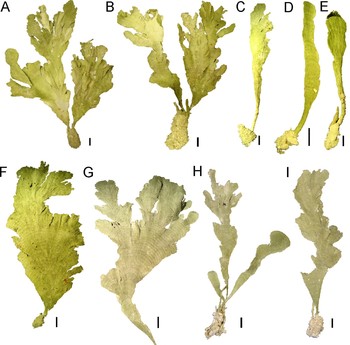
Thirty-three plants were analysed ranging from 5 to 16 cm in length to the top of holdfast. Blades are fan-shaped, with distinct zoned bands and branch forming blades range from 3.5 to 16 cm in length (Figure 1A–I). Blades are multistratose, lightly calcified, dark olive green on one side and pale green and white on the other. The most distal margins are deep green (Figure 1E). Stipes are calcified, 2–2.5 cm long and are jointed (usually three joints). Stipes are slightly flattened, cylindrical, 0.5–0.8 cm long and hollow at the centre. Small plants have one or two shoots (Figure 1C–E) emerging from the rhizoidal mass and a blade (5.5 cm long) and one to four shoots in larger ones (up to 16 cm). Rhizoidal mass is elongated and sand encrusted, some are more bulbous in shape (Figure 1A–F, H&I). One rhizoidal mass had eight growths, four blades and four small shoots without blades (Figure 1H).
Udotea argentea. Nine plants from south-west Oahu, Hawaii. (A, B) Blade, stipe, and holdfast of large plants; (C, D, E & I) young plants with single blade; (F, G) plants showing zonation, holdfasts and filamentous distal margins; (H) four blades and four shoots emerging at holdfast. Scale bars: 1 cm.

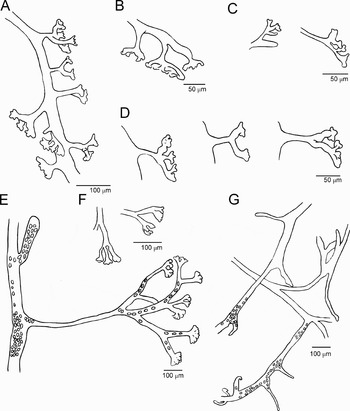
Blade siphons without constrictions, densely covered with lateral digitate appendages (Figure 2A–D). Stipe siphons with highly branched apices and digitiform appendages (Figure 2E–G).
Udotea argentea. (A–C & D) Blade siphons; (E–G) stipe siphons.

Distribution
Udotea argentea is broadly distributed in the Pacific and Indian Oceans. The type locality is Suez, Egypt (Zanardini, Reference Zanardini1858). More recent records include it from the Pacific island of Guam (Kooistra, Reference Kooistra2002; Lobban & Tsuda, Reference Lobban and Tsuda2003) and the Solomon Islands (Womersley & Bailey, Reference Womersley and Bailey1970), from sandy reef flat with seagrass in Indonesia (Coppejans & Prud'homme van Reine, Reference Coppejans and Prud'homme van Reine1989) and Gepp & Gepp Reference Gepp and Gepp(1911) as Udotea argentea var. spumosa (in Coppejans & Prud'homme van Reine, Reference Coppejans and Prud'homme van Reine1989, p. 137) and from Papua New Guinea (Littler & Littler, Reference Littler and Littler2003).
Remarks
Seaweeds belonging to Udotea have not been recorded from the Hawaiian Islands except as Udotea javensis syn. Rhipidosiphon javensis Montagne (Vroom et al., Reference Vroom, Page, Peyton and Kukea-Shultz2006; Huisman et al., Reference Huisman, Abbott and Smith2007). The U. argentea specimens from Oahu, Hawaii present elongated blades probably due to their presence in a deep area. Udotea flabellum is the most widespread species of Udotea and also commonly found in the Pacific Ocean, but presents a distinct habit being heavily calcified and found to a depth of 10 m (Littler & Littler, Reference Littler and Littler1990) while U. argentea is lightly calcified and apparently is a plant of fairly deeper waters (20–60 m).
Associated fauna
An interesting sessile micro filter-feeding fauna was found associated with the blades of Udotea argentea including folliculinid protozoans, sponges, bryozoans, and colonial tunicates. The identity and origin of these species will be investigated.
DISCUSSION
The presence of Udotea argentea in Hawaiian waters is dated from 2007 and the origin and source of introduction is unknown. Since it is growing in sand, a fouling community habit is unlikely for U. argentea and it may not have any commercial value in the Hawaiian Islands. The most likely vector of transport of this alga is by shipping to south shore harbours (Carlton, Reference Carlton1987) followed by vegetative growth and asexual fragmentation once established. Members of the Bryopsidales, including four species of Udotea have been observed spawning in waters off Panama just before dawn (Clifton, Reference Clifton1997; Clifton & Clifton, Reference Clifton and Clifton1999). These episodes of synchronous spawning produced negatively buoyant, flagellated gametes over periods of 5–35 minutes during the summer months. Invasive algae in Hawaii have been studied and asexual vegetative reproduction documented for four of them (Smith et al., Reference Smith, Hunter and Smith2002). The ability of these algae to fragment readily, disperse widely before recruitment, and successfully attach in short periods of time are all important characteristics of successful invasive species. Therefore, the ecological and reproductive characteristics of U. argentea in Hawaiian waters need to be established to prevent future ecological disasters.
ACKNOWLEDGeMENTS
Collections were made by the Oceanographic team, City and County of Honolulu, and Dr Richard Brock. Drs Diane and Mark Littler, Smithsonian Institution; Dr Kenneth Clifton, Lewis and Clark, Dr Jeanine Olsen and two anonymous referees provided guidance.