Introduction
Meaning-centered psychotherapy (MCP) is an effective intervention for medical patients struggling with existential despair at the end of life (Greenstein and Breitbart, Reference Greenstein and Breitbart2000; Breitbart et al., Reference Breitbart, Rosenfeld and Gibson2010; Rosenfeld et al., Reference Rosenfeld, Cham and Pessin2018). By facilitating a patient's connection to historical, attitudinal, creative, and experiential sources of meaning, MCP offers an evidence-based, manualized intervention whose goal is to ameliorate distress (Breitbart et al., Reference Breitbart, Rosenfeld and Gibson2010). Memorial Sloan Kettering Cancer Center's (MSKCC) Psychiatry Department offers a two-day training whereby clinicians gain additive proficiencies for conducting MCP with patients with cancer. Beyond treating patients, MCP may have a valuable application among healthcare professionals to enhance meaning at work, thus positively impacting burnout. Burnout is characterized as an imbalance between the demands of a clinician's job and the resources available to them (National Academies of Sciences, Engineering, and Medicine, 2019). COVID-19 highlighted deleterious effects on the healthcare workforce fueling a parallel pandemic in wellbeing (Dzau et al., Reference Dzau, Kirch and Nasca2020). For example, social support proved challenging during a time of physical distancing but has been found to be one of the most important factors in overall wellbeing (Siedlecki et al., Reference Siedlecki, Salthouse and Oishi2014).
Levels of burnout, emotional exhaustion, and depersonalization have all increased among healthcare providers, including social workers, during the COVID-19 pandemic (Martínez-López et al., Reference Martínez-López, Lázaro-Pérez and Gómez-Galán2021; Van Wert et al., Reference Van Wert, Gandhi and Gupta2022). Using MCP principles to provide a framework for engaging these clinicians in meaning-centered exploration might offer a novel approach to reduce burnout and enhance wellbeing through heightening personal meaning (Fillion et al., Reference Fillion, Dupuis and Tremblay2006). To date, however, there are limited studies examining the use of MCP for this purpose (Fillion et al., Reference Fillion, Dupuis and Tremblay2006; Kang et al., Reference Kang, Kim and Kim2021). This paper describes the process in which MCP was taught to masters-trained social workers primarily for use with their patients. Secondary qualitative observations emerged and are described as important lessons learned in the context of this project.
Project context
The National Institutes of Health (NIHCC) Clinical Center Social Work Department was offered virtually an overview of MCP in September 2020. Seventeen NIHCC social workers working on medical/surgical and behavioral health units attended this initial department-wide didactic presentation. Social workers who attended this session were invited to participate in a 6-session MCP pilot from October 13th to November 24th, 2020 to learn how to employ the manualized techniques on their respective units including inpatient, outpatient, and day-hospital settings. After each session, participants were asked to complete an anonymous continuing education evaluation with questions regarding clarity, organization, and relevance of the presentation related to use with their patient populations. Additional open-ended items queried participants for general comments about their experience. Qualitative information was gathered during a 7th session with the aims of culling information around MCP's impact on meaning, comradery, and community in the workplace during COVID-19. An exploratory thematic analysis using an open coding procedure was used to analyze the qualitative data derived from the evaluation responses for each session, along with the feedback in the form of notes taken by the facilitator obtained in the 7th session. The coding process was guided by the work of Linneberg and Korsgaard (Reference Linneberg and Korsgaard2019). Responses were coded by hand by a primary coder (AMM) and a secondary coder (DJS) who reviewed the data to corroborate the decisions. Consensus meetings occurred when necessary to resolve any discrepancies. Due to the nature of this project, IRB approval was not required.
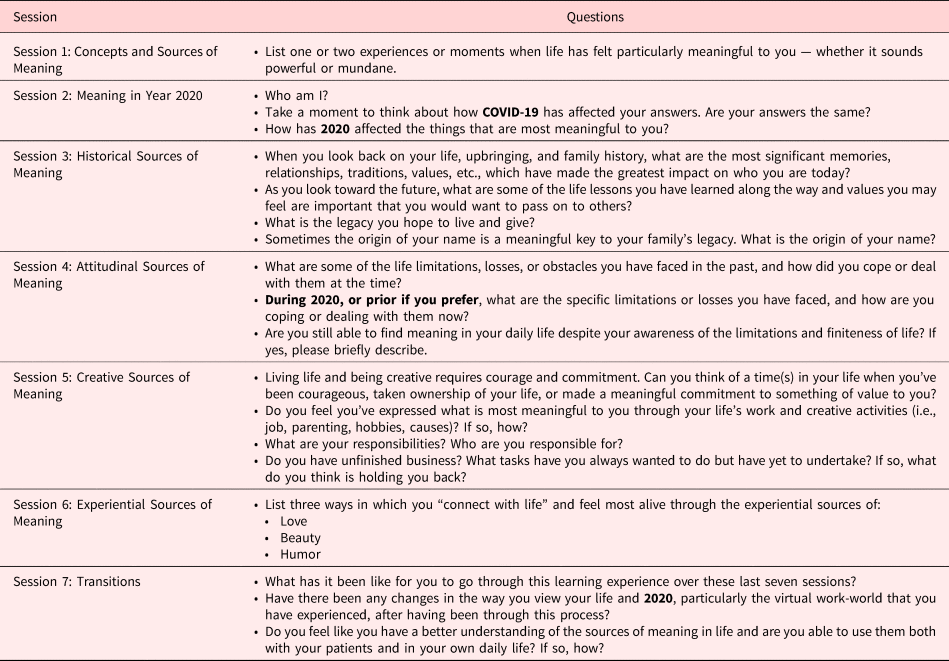
MCP traditionally consists of seven 1-h sessions with distinct goals and exercises revolving around explicit weekly themes (Breitbart and Poppito, Reference Breitbart and Poppito2014). The masters-trained social work facilitator of these sessions (DJS) completed a formal, in-person MCP training course at MSKCC in April 2018. Due to COVID-19, all sessions were conducted virtually over six consecutive weeks. Some of the questions were adapted using the universal experience of being a healthcare professional during COVID-19 as a means of getting the social workers to connect more with the questions, disclosing only as much as they were comfortable and in a manner which felt safe to them (see Table 1). The first five sessions were conducted over a period of 1.15 h each to account for possible technical difficulties; the sixth and seventh topics were combined into a 1.5-hour joint final session. All occurred at the completion of the workday.
MCP questions adapted for social work healthcare professionals

Note: Bold text notes language from the original MCP questions that were modified.
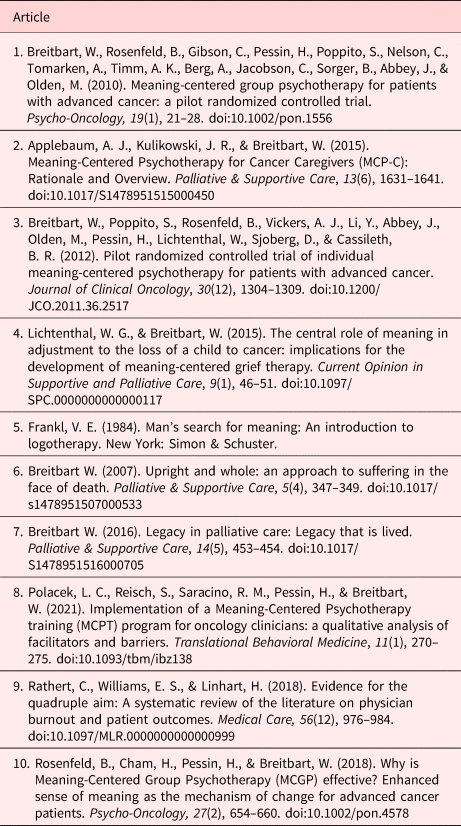
Each session opened with a check-in, review of new content relevant to the session theme, time for self-reflection, reflection as a group, and questions for discussion. The MSKCC MCP manual with adaptations (see Table 1), was used as the primary guide. Relevant MCP articles were distributed (Table 2).
Articles used for MCP program

MCP course evaluations
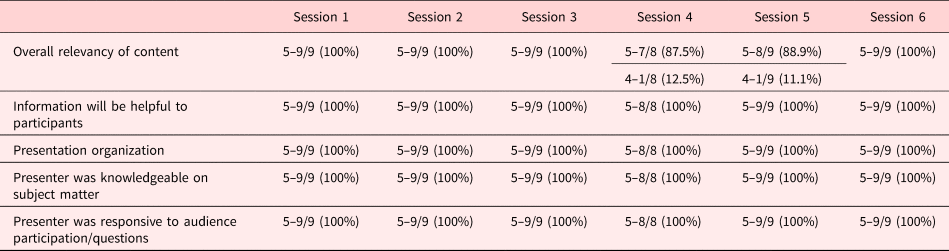
Of 17 clinical social workers, 10 (59%) women self-selected to participate, and a total of 9 (53%) were selected to join the six-session MCP pilot. One was unable to participate due to time constraints. Of the nine who participated, four were new employees who onboarded working virtually in 2020. Eight participants attended all sessions; one participant attended six sessions. All attended the additional focus group session. Across all sessions, all participants (9/9 and 8/8) rated the presentation organization as “excellent.” Specifically, knowledge of the subject matter, being responsive to audience participation and questions, and presenting information that will be helpful in the participants’ work with their patient populations were identified as salient. With regard to the relevancy of the information from the session to participants’ understanding of the topic, for sessions 1, 2, 3, and 6, all nine participants (9/9) rated the presentation as “excellent.” For sessions 4 and 5, eight participants (8/9) rated the presentation as “excellent” and one participant (1/9) rated the presentation as “good.” Participant ratings of the sessions are summarized in Table 3.
Evaluation of MCP program

Note: Likert-scale for all items: 1 = poor, 5 = excellent.
Enhancing meaning, communication, connection, and agency in the virtual workplace
Throughout the sessions, participants commented on the extent to which they were isolated working entirely from home, including seeing patients virtually, thus contributing to feelings of burnout through physical disconnection from the workplace. They reported a strong desire to experience personal connection and regain a lost sense of agency, with their work being redefined. Participants openly used the questions as a jumping off point in sharing how their personal and professional lives had been impacted in a COVID-19 world. In addition to learning how MCP modules could connect their patients to meaning, participants remarked that the module prompts unexpectedly allowed for further connection to meaning in their own lives.
Participants engaged in self-disclosure over the course of the six-week training sessions. Interestingly, some social workers spontaneously shared aspects of personal experiences with their own medical diagnoses. One participant following the first session stated that she “appreciated classmates’ willingness to be vulnerable and so candid.” Another participant described the experience as a “great opportunity to get to know my fellow social workers.” After the fifth session, a participant stated that “the participants’ willingness to share personal journeys allowed for incredible depth in the discussions.” Other participants commented that sharing about historical sources of meaning themselves allowed for greater professional intimacy. One stated, “I know your faces … we feel more connected now.” Participants commented that this increase in connection with their coworkers allowed for improved professional fulfillment and reduced feelings of isolation. After the final session, a participant summed up her experience:
“It's about identifying meaning in your life, creating a life narrative, and being intentional about living life based on your values, whatever that is. On a personal note, I have found it helpful to my present circumstance. I've been working from home for 9 months experiencing a pandemic and a changing country and world. It is stressful. Exploring meaning in my life in a group (connecting!) is centering and life affirming.”
Just under half of the participants began their job during COVID-19 never having met their colleagues in-person. Consequently, it is notable that many expressed an openness to reveal aspects related to personal and professional identity, thus creating less transactional and more intimate workplace relationships. This sense of psychological safety among the participants was likely enhanced because the group self-selected to participate was mental health clinicians, and the facilitator was skilled in delivering MCP in a group format. Furthermore, the questions themselves allowed for a level of disclosure that the individual participants desired. Personal and familial narratives including descriptions of ethnic and cultural sources of meaning were shared openly, driving conversations around diversity and appreciation of difference. Positive feedback about the virtual format included the point that ending the workday with the group session was conducive to the development of a “conversation that is real” without concern for how this time might impact the typical commute home. The unexpected ease with which participants engaged and applied the material to their own lives is likely in-part secondary to the fact that the MCP questions lent themselves to exploration around universally experienced challenges to meaning.
Potential barriers: burnout
With regard to adapting MCP to benefit other healthcare disciplines, several participants highlighted barriers to be addressed. These included challenges of “getting healthcare providers in the door”; however, one stated, “once you get them in, they will benefit….” Furthermore, many felt that six sessions would likely be too lengthy a commitment for some, especially physicians. One person commented that participant number should be limited, stating that “9 people” felt like an ideal number for the time spent in the sessions.
The global prolonged shared experience of COVID-19 has caused exhaustion, a key ingredient in burnout in healthcare professionals (Swensen and Shanafelt, Reference Swensen and Shanafelt2020). With so many already existing time constraints, adding another workplace training may pose additional burden to already burntout clinicians. Alternatively, an adaptation of MCP may represent a way to address the ongoing challenge of burnout in the healthcare setting by offering a creative approach with regard enhancing important conversations around diversity, equity, and inclusion initiatives in the workplace. Creating an opportunity for staff to share reflections at the end of their workday allowed the development of nuanced relationship-building, provided an avenue to mitigate distress, enhanced a sense of agency, and heightened connection to meaning during a time of unprecedented dislocation.
While the purpose of this project was to teach MCP to social workers to use with their patient populations and not to address burnout questions directly, MCP's framework in creating a venue for enhancing comradery in this group appears to have had a positive impact and might improve professional fulfillment. Meaning is inherently derived through the intrinsic nature of work in healthcare. This project demonstrates that teaching MCP in a modified virtual format can be a novel intervention that allows staff to proactively connect with one another and in a structured format around meaning, thus serving to mitigate burnout. Future research should investigate how teaching principles of MCP may be used among healthcare workers to reduce occupational burnout and enhance wellbeing.
Conclusions
This project provides a first glimpse into how the process of adapting MCP instruction for hospital-based social workers during the COVID-19 pandemic ended up facilitating professional wellbeing through active conversations about meaning. Although the focus of this endeavor was to teach MCP virtually, the benefits and application of the described project go beyond the virtual workplace. Additionally, while MCP was originally created for use with patients with life-threatening illnesses, the brief, manualized experiential nature of the intervention lends itself to potential modification for use with staff for the purpose of enhancing meaning and community in their own professional lives. For example, a central principle of MCP highlighted during the pandemic for participants themselves included: choosing one's attitude during suffering and isolation. This led to robust discussions about the uncertain nature of the pandemic, in some ways paralleling the experience of their patients suffering from life-threatening medical diagnoses.
Ultimately, this application of MCP with social workers suggests that an adapted version of MCP may be applicable to other groups of healthcare professionals, including physicians and nurses. Given the growing realization of the importance of inclusive and diverse work environments, MCP might offer a novel approach to engaging clinicians in hospital settings about sources of meaning, adding to the important conversations already occurring. Several barriers were highlighted, including future challenges of getting non-behavioral healthcare providers to participate, the time commitment, and the size of the group. Moreover, future applications of MCP instruction to novel populations may consider investigating whether MCP has greater appeal to targeted groups, such as residents-in-training where there is a regulatory mandate to promote resident wellbeing (Accreditation Council for Graduate Medical Education, 2019).
Acknowledgments
The authors would like to thank all of the participating social workers such as Jennifer Hendricks, Lisa Felber, Carla Calhoun, Julie Angel, Nicole Hester, Mary Morrow, Sylvia Stearn, Patricia Prince, Tascha Washington, Melika Smith, Kathy Baxley.