INTRODUCTION
Neuropsychological abnormalities occur in as many as 50–75% of individuals with multiple sclerosis (MS; Bobholz & Rao, 2003; Martin et al., 1996), and memory impairment is among the most common deficits (Rao et al., 1991). Yet, despite this morbidity, there are few interventions to remediate memory dysfunction in MS. Among the few available investigations, some have shown no benefit (Lincoln et al., 2002) and others have demonstrated mild improvement (Allen et al., 1998; Fischer et al., 2000). No intervention is expected to enhance memory function to premorbid levels (Robertson & Murre, 1999; Wilson, 1992, 2000), but people may learn to encode information in a more effective manner, thereby improving memory.
One promising remediation method involves self-generated learning. In this form of encoding, self-generated information is learned better than didactically presented material. The effect of self-generation on memory is robust and has been demonstrated in several contexts, including implicit and explicit memory, verbal and nonverbal information, and in young and old subjects (e.g., Begg et al., 1989; Burns, 1992; Peynircioglu, 1989; Slamecka & Graf, 1978).
Several models attempt to explain the generation effect (e.g., Begg et al., 1989; Hirshman & Bjork, 1988; McDaniel et al., 1988; Slamecka & Katsaiti, 1987). Despite their differences, all agree that self-generation enhances memory through intensive encoding. In particular, self-generated learning is considered a form of “deep” encoding in which information is processed with greater elaboration, distinctiveness, and personal relevance than didactically presented material (Slamecka & Graf, 1978).
Perhaps the most common paradigm used to study self-generated learning consists of paired word associates (e.g., Slamecka & Graf, 1978). The associates consist of either complete word pairs (the didactic condition) or pairs in which the entire first word is given, but only the first letter of the second is present (the self-generation condition). To learn the second word, it must be self-generated. To do so, the learner must consider the relationship between the two words, and then generate the second word based on this association. After generating the second word, both words are read aloud, and then rehearsal occurs. For both conditions, the second word is the target of learning.
Despite wide investigation in neurologically normal individuals, self-generated learning has received scant attention by clinicians. Several experiments have evaluated whether self-generation benefits memory in people with Alzheimer's disease and frontal subcortical dementia (Barrett et al., 2000; Dick et al., 1989, Mitchell et al., 1986). Generally, mild but significant memory enhancement occurred, but this was mitigated by severity of dementia and type of recall (i.e., implicit vs. explicit; cf. Barrett et al., 2000; Dick et al., 1989). Regarding MS, Chiaravalloti and DeLuca (2002) compared self-generated and didactic encoding in non–memory-impaired patients and a control group. Both groups remembered more words that were self-generated, and the memory benefit of self-generated over didactic learning was equivalent between the MS and control groups. More recently, Basso et al. (2003) extended this finding by including MS patients with memory impairment in addition to unimpaired MS patients and a control group. All groups remembered more words that were self-generated than didactically encoded. Although the mildly–moderately memory-impaired group recalled less information overall, they remembered significantly more information that was self-generated than didactically encoded. Consequently, people with MS may use self-generation to enhance their memory, and they may do so as well as people without MS.
Despite these implications, they are limited. In particular, Chiaravalloti and DeLuca (2002) included MS patients who performed equivalently to a control group on a clinical memory measure, suggesting normal memory function. Basso et al. (2003) included only mildly memory-impaired MS patients. Thus, it remains uncertain whether moderately–severely memory-impaired MS patients may benefit from self-generated encoding.
Additionally, the research by Chiaravalloti and DeLuca (2002) and Basso et al. (2003) examined memory for words. Such paradigms are typically used in research concerning self-generation, but generalizability of such research may be limited. For instance, it may be questioned whether memory for words generalizes to memory for activities of daily living. As such, the real-world application of self-generated learning in MS remains untested.
Accordingly, the present investigation examined whether mildly–moderately and moderately–severely memory-impaired MS patients benefit from self-generated encoding. Using an objective measure of memory, patients were classified as unimpaired, mildly–moderately impaired, and moderately–severely impaired. Subsequently, they were compared with each other and with a control group. Based on past research (e.g., Basso et al., 2003; Chiaravalloti & DeLuca, 2002; Dick et al., 1989), we expected memory-impaired patients to recall less information than the control group. We further anticipated a benefit of self-generation over didactic encoding for all participants regardless of memory impairment.
To provide a basis by which to evaluate the construct validity of self-generated learning, the same word-stem completion paradigm used by Slamecka and Graf (1978) was used. If memory for self-generated information exceeded didactically encoded material, then these data would provide convergent validity for self-generated encoding. Furthermore, the memory benefit of self-generation for activities of daily living was assessed. Insofar as self-generation improves memory for daily activities, it may emerge as a method of ameliorating forgetfulness in MS patients.
METHODS
Participants
To recruit participants, notices were published in the newsletter of the local National Multiple Sclerosis Society chapter and in newspapers. The principle investigator also met with MS support groups. Ultimately, data were collected from 95 individuals. Diagnoses were confirmed by a board-certified neurologist through chart review (including magnetic resonance imaging and other laboratory studies) and physical examination, and these diagnoses were according to the Poser et al. (1983) criteria. The control group included 22 participants without MS. Patients were excluded if they had a psychiatric disorder that preceded onset of MS, current or past substance abuse or dependence, history of learning or developmental disorders, or any neurological disease or injury in addition to MS. Current psychiatric illness was not a criterion for exclusion. The control group was screened for each of these characteristics. All data included in this manuscript were obtained in compliance with the Institutional Review Board of the University of Tulsa.
Materials
Paired associate learning task
To examine self-generated learning, word pairs developed by Slamecka and Graf (1978) were used. The word pairs consist of five sets of 20 paired word associates printed on individual 3- × 5-inch index cards. One set included pairs of words that are typically associated with one another (e.g., Lock–Key). Another set included word pairs that belong to the same category of objects (e.g., Wheat–Corn). Synonyms (e.g., Street–Road), antonyms (e.g., Love–Hate), and rhymes (e.g., Sell–Bell) comprised the remaining three sets of word pairs. Before presenting them, the semantic principal of each set was explained and an example word pair was demonstrated.
In presenting the word pairs, participants were instructed to pay close attention to the second word, because they would be asked later to recall it. Both learning conditions, self-generated and didactic, were administered to all participants. In total, they were presented with 50 self-generated and 50 didactically-presented word pairs. Within each set, half were didactically presented (i.e., 10 words), and half were self-generated (i.e., 10 words). Administration of the 10 didactic pairs occurred separately from administration of the 10 self-generated pairs. Order of self-generated and didactically presented words was counterbalanced across individuals.
During didactic presentation, participants read both word pairs aloud. In the self-generation condition, participants received the entire first word but only the first letter of the second. Based upon the previously explained relationship between the word pairs in each set, participants would generate the second word (e.g., Wheat–C___). Upon generating the second word, participants read the entire word pair aloud. For both didactic and self-generated conditions, the word pairs were presented at a rate of 1 every 5 seconds. The presentation of succeeding word pairs occurred regardless of whether patients were able to generate the second word. Prior research indicates that the target word is later correctly recalled even when the word is incorrectly generated (Slamecka & Fevreiski, 1983).
After all word pairs were presented, free recall was assessed. Twenty minutes later, free recall was again measured. Afterward, a recognition test was administered. Items on the recognition test consisted of word trios. Participants circled one word from the three which completed the word pairs. During the free-recall and recognition tests, participants were asked to write down and circle the correct responses.
Memory pertinent to activities of daily living
Wilson (1992) analyzed memory errors of amnesic individuals during activities of daily living. She showed that the most frequently forgotten units of information are names and faces of individuals, location of misplaced objects, and dates of appointments. Wilson developed measures to assess these details, and they discriminated between amnesic and normal individuals. Moreover, her tests possess ecological validity, as they predict impairment in activities of daily living. In the present study, these same memory tasks were adapted to permit a comparison of self-generated and didactic encoding.
Specifically, regarding recall of names and faces, the same set of photographs originally used by Wilson were presented along with fictional names of individuals in the photos. The faces and names were of nonfamous individuals and were unfamiliar to the participants. Participants were asked to learn the individuals' names. Similar to the word-pair associates, first and last names were paired with another word. The association of the name and its stem were explained with an example. Similar to the word pairs of Slamecka and Graf (1978), five semantic relationships were used to associate names and their preceding stems. These relationships included association (e.g., Doubting–Thomas), category (Sparrow–Robin), synonym (Cut–Nick), antonym (Poor–Rich), and rhymes (Plain–Jane). The photograph of a face was presented along with the word stem and name for 8 seconds. In the didactic condition, participants read aloud and studied the stem and its associated name. In the self-generated condition, the entire word stem and the first letter of the person's name were presented. Participants then generated the name based on its relationship to the word stem. Upon doing so, they read aloud and studied the stem and name until the 8 seconds ended. Regardless of whether the participant generated the name, the next name was presented after time expired. Presentation order of the didactic and self-generated conditions was counterbalanced between participants. Free recall was assessed after all names were presented. In particular, participants were shown pictures of faces, and they were asked to name the person. Likewise, delayed free recall occurred 20 minutes later. Recognition testing for names was administered after completion of delayed cued recall. Faces were presented, and a series of first and last names were given. Participants were asked to select the correct name of the person from a set of three distractors.
Further paralleling Wilson (1992), memory for appointments was assessed. Five appointments were encoded didactically, and five were self-generated. The didactic condition was designed to parallel typical scheduling in which an appointment is given to the participant. As such, participants were given dates and times with five different individuals (e.g., physicians, auto-repair, etc.). Upon presentation of each appointment, the participant repeated the appointment and then studied it for 8 seconds. In the self-generated condition, the experimenter indicated an individual with whom the participant must meet. The participant generated and repeated the appointment date and then studied it for 8 seconds. In both conditions, a monthly calendar was presented and only one appointment could occur during a single day. As the appointment was made, the experimenter wrote it on the calendar. After all appointments were made, immediate recall of day, date, and time of each appointment was tested. Delayed recall for these details occurred 20 minutes later, and this recall was followed by recognition test of appointments. In assessing recall, a blank monthly calendar was provided and recalled appointments were written into the calendar. To assess recognition memory, participants were given a designated person with whom they must meet. From two choices, they then selected the correct day, date, and time of the appointment. All participants received both conditions in counterbalanced order across individuals.
Consistent with Wilson (1992), location of objects was assessed. Participants were shown photographs of an office and a kitchen. Objects that are not normally located within these areas were presented to the participants (e.g., pack of gum, matches, spool of thread, etc.). Such objects were used rather than typical kitchen and office items (e.g., spatula or typewriter) to preclude recall benefits of cognitive schema associated with each location. Although this strategy may influence the generalizability of results to real-world events, it minimizes biases that could confound the experiment. Each scene contained ten objects, and encoding condition for each scene was counterbalanced across participants. Specifically, half of the participants encoded object locations didactically for the office scene, and they self-generated locations for objects in the kitchen scene. The remaining participants encoded objects in a converse manner for each scene.
In the didactic condition, participants were shown an illustration of an object, and they were told where the object would be placed within the room. Participants acknowledged and repeated where the object was placed and then they studied the object and location for 8 seconds. In the self-generated condition, participants generated and repeated a location within the room where the object would be placed. Afterward, they studied the location for 8 seconds. After items for both rooms were presented, immediate recall was assessed. The room and individual item were presented, and participants were asked to designate the location in which the object was placed. After 20 minutes, delayed recall was similarly assessed and, subsequently, recognition memory was assessed. Specifically, the object and room were shown, and participants chose the correct location from three choices.
California Verbal Learning Test-II
All participants were administered the California Verbal Learning Test-II (CVLT-II), which is a standardized clinical measure of memory function. This test was administered to obtain an objective benchmark of memory function for each participant. In accordance with clinical practice (e.g., Heaton et al., 2004), as CVLT-II Total Recall performance fell from 1 to 1.5 standard deviations below the normative mean (16th–6th %ile), individuals were classified as mildly–moderately impaired, and those whose total recall fell from 1.5 standard deviations and lower (5th %ile and below) were classified as moderately–severely impaired.
Procedure. After obtaining informed consent, the CVLT-II was administered. During the interval between immediate and delayed recall, self-report measures of mood and adaptive function were administered. Upon completion of the CVLT-II, the experimental paired-associate learning task was administered. Participants were randomly assigned to conditions in which either the self-generation or didactic encoding procedure was administered first. After completing both conditions, immediate free recall was measured. Twenty minutes later, delayed recall and the recognition test was administered. During the delay interval, neuropsychological tests unrelated to the present study were administered. Subsequently, the name and face learning task was administered. Between immediate and delayed recall, non–memory-related cognitive measures from the neuropsychological battery were administered. Following delayed recall and recognition recall, the appointment learning task was administered. During the interval between immediate and delayed free recall of appointments, additional non–memory-related cognitive tasks were administered. Upon completion of the delayed and recognition recall tests, the object location learning task was administered. Between the immediate and delayed recall for the location learning task, the remaining cognitive measures from the neuropsychological test battery were administered. Subsequently, delayed recall and a recognition test of memory for object locations was assessed.
RESULTS
Demographics
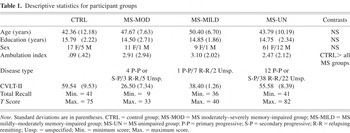
Based on their CVLT-II Total Recall performance, participants were classified as follows: 22 members of the control group (CTRL), 73 unimpaired patients with MS (MS-UN), 10 mildly–moderately impaired patients with MS (MS-MILD), and 12 moderately–severely impaired patients with MS (MS-MOD). To evaluate whether the four participant groups differed in demographic composition, a series of one-way ANOVAs was conducted. These analyses revealed that participant groups failed to differ according to age [F(3,113) = 1.96; p = .12] and education [F(3,113) = 1.30; p = .28]. However, the groups differed significantly on a measure of disability [F(3,108) = 9.58; p < .001; i.e., the 25-foot timed walk; Fischer et al., 2001]. Bonferroni contrasts showed that the three patient groups had significantly greater disability than the control group, and there were no differences between the patient groups. Table 1 shows average age, education, and CVLT-II Total Recall T scores of the groups. A nonparametric test was conducted to evaluate whether groups differed according to gender composition, and the results indicated the groups did not differ in this regard (χ2(3) = 1.52; p = .68). Table 1 summarizes descriptive statistics of the participant groups.
Descriptive statistics for participant groups

Paired Associate Task
The number of words recalled from the paired-associate task was examined in a mixed-factor ANOVA. Specifically, participant group (CTRL, MS-UN, MS-MILD, MS-MOD) served as a between-groups factor, and presentation method (self-generated vs. didactic) and time (immediate vs. delayed) were within-subjects factors. This strategy yielded a 4 (group) × 2 (encoding method) × 2 (time) design. To protect against Type I error, significant main effects were followed by Bonferroni group contrasts.
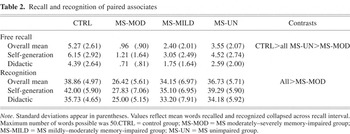
The main effect of participant group was significant [F(2,113) = 11.99; p < .001; η2 = .24]. Bonferroni contrasts revealed that the CTRL group remembered more words than the three MS groups, and the MS-UN group recalled more words than the MS-MOD group. The MS-MILD and MS-MOD groups were equal. Mean recall of the groups is depicted in Table 2.
Recall and recognition of paired associates
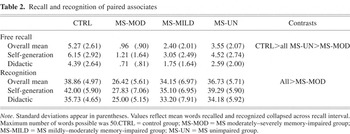
The main effect of time was also significant [F(3,113) = 37.94; p < .001; η2 = .25], and participants recalled fewer words during delayed recall than immediate recall (Immediate Recall M = 4.23, SD = 2.73; Delayed Recall M = 2.80, SD = 2.32). The main effect of presentation method was significant [F(3,113) = 25.64; p < .001; η2 = .19], and self-generated words (M = 4.36; SD = 2.96) were remembered better than didactically presented words (M = 2.66; SD = 2.25). The effect of participant group failed to interact with either time or presentation condition. Effect size estimates for these terms ranged from η2 = .01 for participant group by time to η2 = .04 for the interaction of participant group by encoding condition. Effect sizes of such magnitude are considered small and not meaningful. Thus, despite significant memory impairment among the MS-MILD and MS-MOD participants, self-generated encoding yielded enhanced memory to the same extent as the control and MS-UN groups. Mean recall of groups across encoding conditions appears in Table 2.
The number of words recognized was analyzed within a four participant group (CTRL, MS-UN, MS-MILD, MS-MOD) × 2 presentation condition (self-generated vs. didactic) mixed-factor ANOVA, and the latter factor served as a within subject variable. The main effect of participant group was significant [F(3,113) = 13.95; p < .001; η2 = .27]. Bonferroni contrasts showed that the MS-MOD group recognized fewer words than all groups. Mean performance of the groups is presented in Table 2. The main effect of encoding method likewise was significant [F(3,113) = 32.14; p < .001; η2 = .22], with self-generated words (M = 38.26; SD = 7.84) being recognized more often than didactically presented words (M = 33.44; SD = 6.46). The interaction of participant group and presentation method failed to reach significance and possessed a small effect size [F(3,113) = 1.85; p = .14; η2 = .04], suggesting that self-generated encoding enhanced memory to an equivalent degree across participant conditions.
Memory for Names
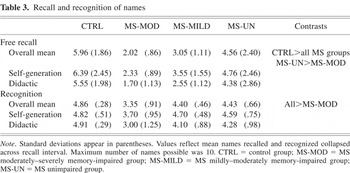
Names were entered into a 4 (participant group) × 2 (presentation method) × 2 (time) mixed-factor ANOVA, with the latter two factors being repeated within subjects. A large and statistically significant main effect of participant group was found [F(3,113) = 10.55; p < .001; η2 = .22], and Bonferroni contrasts showed that the MS-MOD group recalled fewer names than the CTRL and MS-UN groups (see Table 3). Moreover, the CTRL group remembered more names than the three patient groups. Additionally, the main effect of presentation method was modestly large and statistically significant [F(1,113) = 6.91; p = 01; η2 = .06], with all participants recalling more names that were self-generated (M = 4.71; SD = 2.52) than didactically presented (M = 4.12; SD = 2.69). The interaction of participant group and presentation method was very small and not significant [F(3,113) = .41; p = .75; η2 = .01]. Likewise, the main effect of time and its interaction terms failed to reach significance, and the effect sizes were small. It should be acknowledged that failure to generate correct names was recorded, and the groups did not differ in inability to generate a correct name.
Recall and recognition of names

Names on the recognition test were entered into a 4 (participant group) × 2 (presentation method) mixed-factor ANOVA, with the latter factor being repeated within subjects. The main effect of participant group was significant and large [F(3,112) = 13.86; p < .001; η2 = .29]. Bonferroni contrasts showed that all groups recognized more names than the MS-MOD group (see Table 3). Additionally, the main effect of presentation method was significant and modestly large [F(1,112) = 7.93; p < .001; η2 = .07], with self-generated encoding (M = 4.56; SD = .76) yielding better learning than didactic encoding (M = 4.27; SD = 1.01). The interaction of participant group and presentation method failed to reach significance and was modestly sized [F(3,112) = 1.75; p = .16; η2 = .05], suggesting that the benefit of self-generated encoding did not differ as a function of memory impairment.
Object Location
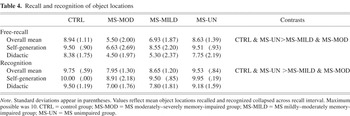
Number of object locations were entered into a 4 (participant group) × 2 (presentation method) × 2 (time) mixed-factor ANOVA, with the latter two factors being repeated within subjects. The main effect of participant group was significant, and the effect size was large [F(3,111) = 18.18; p < .001; η2 = .33]. Bonferroni contrasts showed that the CTRL and MS-UN groups recalled more locations than the MS-MILD and MS-MOD groups, and no other significant contrast was found (see Table 4). The main effect of presentation method was likewise significant, and its effect size was very large [F(1,111) = 63.11; p < .001; η2 = .36]. Locations that were self-generated (M = 9.15; SD = 1.56) were recalled more often than those that were didactically presented (M = 7.37; SD = 2.39). No other effect was significant, including the interaction of participant group and presentation method [F(3,111) = 2.64; p = .053; η2 = .07]. Nonsignificance notwithstanding, the latter interaction term nearly reached statistical significance and was modestly large. Inspection of the mean recall of self-generated and didactically encoded locations between participant groups shows that the control group benefited less from self-generated encoding than the MS participants. This finding may be explained by ceiling effects in the control group, with nearly perfect recall achieved with self-generated encoding (cf. Table 4).
Recall and recognition of object locations

Recognition of object locations was entered into a 4 (participant group) × 2 (presentation method) mixed-factor ANOVA, with the latter being repeated within subjects. The main effect of participant group was significant, and its effect size was large [F(3,111) = 13.62; p < .001; η2 = .27]. Similar to free-recall performance, the CTRL and MS-UN groups remembered significantly more locations than the MS-MILD and MS-MOD groups, and no other group contrast was significant (see Table 4). The main effect of presentation method was significant, and its effect size was large [F(1,111) = 34.13; p < .001; η2 = .24]. Self-generated locations (M = 9.83; SD = .75) were recognized more often than didactically presented locations (M = 8.93; SD = 1.70). The interaction of participant group and presentation method was marginally significant and modest in size [F(3,111) = 2.59; p = .06; η2 = .07]. Similar to the free-recall scores, this interaction seems attributable to ceiling effects in the CTRL group, which achieved nearly perfect scores with self-generated and didactic encoding, whereas the other groups had a more pronounced difference between self-generated and didactic encoding (see Table 4).
Appointments
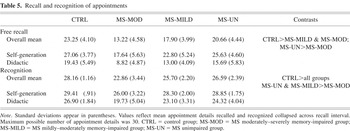
Appointments were entered into a 4 (participant group) × 2 (presentation method) × 2 (time) mixed-factor ANOVA, with the latter two factors repeated. The main effect of participant group was significant, and the effect size was large [F(3,112) = 14.15; p < .001; η2 = .28]. Bonferroni contrasts showed that the CTRL group remembered more appointments than the MS-MILD and MS-MOD groups. Additionally, the MS-MOD group recalled fewer appointments than the MS-UN group. Mean scores of participant groups collapsed across presentation method and time appear in Table 5. The main effect of time was also significant [F(3,112) = 58.97; p < .001; η2 = .35], with fewer appointments recalled at delay (M = 19.46; SD = 5.27) than during immediate recall (M = 20.96; SD = 4.97). Moreover, the main effect of presentation method was significant, and its effect size was very large [F(1,112) = 184.14; p < .001; η2 = .62]. More appointments were recalled through self-generated encoding (M = 24.91; SD = 5.24) than with didactic encoding (M = 15.52; SD = 6.16). The interaction of participant group and presentation method failed to reach significance [F(3,112) = 1.11; p = .35; η2 = .03], suggesting that cognitive impairment did not moderate the memory benefit of self-generated encoding. No other effect reached significance.
Recall and recognition of appointments
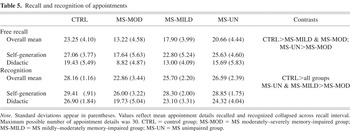
Recognition for appointments was entered into a 4 (participant group) × 2 (presentation method) mixed-factor ANOVA, with the latter factor being repeated within subjects. The main effect of participant group was significant, and its effect size was large [F(3,112) = 13.15; p < .001; η2 = .26]. Bonferroni contrasts showed that the CTRL group outperformed all groups, and the MS-MOD group was surpassed by all groups (see Table 5). The main effect of presentation method was also significant and very large [F(3,112) = 99.24; p < .001; η2 = .47], with self-generated appointments (M = 28.64; SD = 2.02) being remembered better than didactically encoded appointments (M = 24.57; SD = 4.16). Moreover, the interaction of participant group and presentation method was significant, and its effect size was modest [F(3,112) = 3.03; p < .05; η2 = .08]. Simple effects analyses revealed that all groups had significantly better recognition with self-generated encoding than with didactic presentation. The interaction seems to be due to ceiling effects of the CTRL group. That group showed nearly perfect memory with self-generated encoding, and its rate of improvement from didactic encoding was somewhat less than was demonstrated by the remaining groups. The mean recognition scores for each participant group shows that the MS-MOD group had a greater benefit of self-generation than any other participant group (see Table 5). Notably, with self-generated encoding, the MS-MOD group recognized as many appointments as the CTRL group did with didactic presentation.
DISCUSSION
The present investigation attempted to replicate and extend the findings of Chiaravalloti and DeLuca (2002) and Basso et al. (2003) in several ways. First, we examined whether moderately–severely memory-impaired MS patients benefit from self-generated encoding on a paired associate learning paradigm. We further evaluated whether self-generation enhanced recall pertinent to activities of daily living.
The experiment showed that memory-impaired MS patients remembered fewer word pairs than the control group or the unimpaired MS patients. Nonetheless, a significant main effect of encoding condition was found. Namely, all groups remembered more words that were self-generated than didactically presented. Compared with the highly similar experiment of Basso et al. (2003), the effect size of encoding condition was nearly doubled. Thus, the memory benefit of self-generated encoding generalized across studies, and it seems to be reliable. Furthermore, similar to the previous Basso et al. experiment, there was no interaction of encoding condition and participant group. As such, memory enhancement was comparable across participant groups, and memory benefits of self-generated encoding were robust to even moderate–severe memory impairment in MS.
In addition to memory for word pairs, ability to learn names, appointments, and object locations was diminished in memory-impaired MS patients. Indeed, moderately–severely memory-impaired MS patients generally remembered less than the control group or the unimpaired MS patients. Such deficits notwithstanding, self-generation enhanced recall and recognition of names, appointments, and object locations. Moreover, effect sizes for encoding condition were generally substantial, especially for recognition memory. This finding suggests that the significant differences observed in the experiment did not emerge merely because of a large sample size. Rather, the benefit of self-generated encoding appears to be clinically meaningful.
These are novel findings, as prior studies of self-generated encoding have generally been limited to abstract information (i.e., words, illustrations) with relatively modest real-world application (e.g., Slamecka & Graf, 1978). As such, the self-generation effect seems to generalize from abstract words to information pertaining to daily activities.
Moreover, self-generation enhanced memory in all participant groups. Indeed, regardless of whether participants were memory-impaired, self-generated encoding yielded enhanced memory compared with didactic learning. It should be acknowledged that participant group interacted with encoding condition to influence recognition of appointments only. Additionally, the interaction approached significance for recall and recognition of object locations. Yet, these interactions seem attributable to ceiling effects demonstrated by the control group. Namely, that group displayed nearly perfect recall and recognition, and their benefit of self-generation over didactic recall was less than observed in people with memory impairment. In contrast, the three MS patient groups showed significant memory benefits of self-generated over didactic encoding. Indeed, the impaired MS groups typically achieved as much memory benefit from self-generated learning as did the unimpaired MS group. Thus, presence of memory impairment in MS did not diminish memory enhancement associated with self-generated learning.
These data provide grounds for exciting speculation. In particular, most rehabilitation theorists assert that amnesic patients will not achieve normal memory performance (Robertson & Murre, 1999; Wilson, 1992, 2000). In the present research, even with self-generated encoding, the memory-impaired groups tended to recall and recognize less information than the control group, despite an obvious memory advantage over didactic encoding. Yet, with memory for appointments and object location, the moderately–severely impaired MS group recalled and recognized almost as much as the control group remembered during didactic presentation. Because didactic encoding is a commonly used method of learning, self-generated encoding yielded nearly normal memory function for these memory-impaired MS patients. Thus, perhaps people with MS may be taught to use self-generated encoding strategies, thereby enhancing their learning of important information in daily activities. Presently, this proposition awaits investigation.
Before concluding, it seems important to acknowledge potential limitations of the current research. Notably, the research was conducted with a relatively small number of memory-impaired MS patients. Although our findings were statistically significant and the effect sizes were meaningful, replication with a larger sample of impaired patients may be necessary to ensure more substantial confidence in these data. Additionally, it is not entirely certain whether self-generation was the sole encoding strategy used by participants. For example, when learning appointments or names, participants could have encoded them according to an idiosyncratic but otherwise effective mnemonic strategy. Because it is difficult to exclude such strategies, they may have contributed to learning outcomes. Nonetheless, a systematic benefit of self-generated over didactic encoding was consistently observed. Indeed, a significant benefit of self-generated learning has now been observed across several investigations involving MS and other neurological conditions (Barrett et al., 2000; Chiaravalloti & DeLuca, 2002; Dick et al., 1989; Mitchell et al., 1986). Thus, the present data are likely reliable, and they may provide a meaningful basis to pursue memory rehabilitation strategies based on self-generated learning.
ACKNOWLEDGMENTS
Portions of this data were presented at the 31st annual convention of the International Neuropsychological Society in Honolulu, Hawaii. These data were supported by grants to the first author from the National Multiple Sclerosis Society and the Oklahoma Center for the Advancement of Science and Technology. The authors extend their appreciation to J. Carpenter for his assistance with this project. The information in this manuscript and the manuscript itself is new and original, and it has never been published either electronically or in print. The authors have no financial relationships with any commercial enterprises that might bias the current findings.