1. Introduction
Since 2012, a vast area in the north and east of China, including the capital city of Beijing, has frequently been surrounded by thick hazardous haze and fog. The serious air pollution in China vividly illustrates the mounting environmental pressure faced by the Chinese government as China's economy has boomed in recent years. As recognized by Chinese officials in the Third Plenary Session of the 18th CPC Central Committee (9–12 November 2013), China is now at the crossroads of modifying its economic development model and deepening various aspects of reforms to ensure sustainable economic development. The same committee's reform roadmap would accelerate sustainable development, which requires that economic growth should be environmentally friendly rather than detrimental to the environmental quality. Given China's unitary political system, a series of institutional changes and reforms must be performed by the Chinese government to reverse the worrisome trend of environmental deterioration. As an important institutional reform, China's fiscal decentralization is considered by many scholars and experts to be a possible breakthrough for future reform. For instance, as Ding et al. (Reference Ding, McQuoid and Karayalcin2019) summarize in a recent study, because the current fiscal decentralization does not effectively address the issue of extra-budgetary revenues which essentially gave implicit support to local governments that seek supplementary resources for local economic development, the future reform direction of decentralization should be the devolution of decision-making powers to local governments.
Fiscal decentralization was one of the most far-reaching and controversial reforms during China's post-1978 opening-up and reform era.Footnote 1 As Davoodi and Zou (Reference Davoodi and Zou1998) noted, the conventional wisdom is that fiscal decentralization is favorable to economic growth. Since the mid-1990s, some scholars have empirically studied the effects of fiscal decentralization on economic growth with actual data from China, but the estimation results are rather controversial. Although some researchers found evidence that fiscal decentralization has a positive influence on economic growth (e.g., Lin and Liu, Reference Lin and Liu2000; Jin et al., Reference Jin, Qian and Weingast2005; Chu and Zheng, Reference Chu and Zheng2013; Sun et al., Reference Sun, Chang and Hao2017),Footnote 2 others reported that the impact of fiscal decentralization on China's economic growth is negative (Zhang and Zou, Reference Zhang and Zou1998; Jin and Zou, Reference Jin and Zou2005).
Given that fiscal decentralization would influence economic growth, because economic development may be related to environmental quality (as the Environmental Kuznets Curve, or EKC for short, describes), fiscal decentralization might exert influence on environmental quality in an indirect way. Initially introduced by Grossman and Kruger (Reference Grossman and Kruger1991, Reference Grossman and Kruger1995), the EKC is an empirical hypothesis that describes an inverted-U shaped relationship between economic development and the environment: pollutions would at first increase and then decrease after the peak is reached along with economic development. Most of the existing literature on this topic presents empirical estimations to examine the existence of an inverted-U shaped EKC (e.g., Shafik and Bandyopadhyay, Reference Shafik and Bandyopadhyay1992; Selden and Song, Reference Selden and Song1994; Cole, Reference Cole1998; Kearsley and Riddel, Reference Kearsley and Riddel2010); a few theoretical studies also interpret the existence of the inverted-U shaped EKC by developing proper models (e.g., López and Mitra, Reference López and Mitra2000; Brock and Taylor, Reference Brock and Taylor2010).Footnote 3 As economic development may affect the environmental quality, fiscal decentralization would indirectly affect environmental conditions through its impacts on economic growth.
Additionally, fiscal decentralization may also have a direct effect on environmental quality. On one hand, greater fiscal decentralization might contribute to the improvement of environmental quality, as the provincial governments under higher fiscal decentralization have more freedom and financial resources for environmental protection. Because the provincial governments have better knowledge of local residents' need for environmental quality, in theory they could spend more on environmental protection and improve local environmental quality more efficiently than the central government.Footnote 4, Footnote 5
On the other hand, fiscal decentralization might worsen environmental conditions. It is noteworthy that the original motivation for conducting fiscal decentralization was to foster economic growth (Lin and Liu, Reference Lin and Liu2000), and the turnover of Chinese provincial leaders primarily depends on local economic performance and the comparisons with their predecessors (e.g., Chen et al., Reference Chen, Li and Zhou2005; Li and Zhou, Reference Li and Zhou2005; Shi et al., Reference Shi, Chang, Jang and Hao2018). Therefore, provincial leaders generally have strong incentives to make every effort to promote provincial GDP growth rates, sometimes even at the cost of local environmental quality (Chen et al., Reference Chen, Hao, Li and Song2018). Moreover, greater fiscal freedom enables provincial and local governments to increase investment in various productive projects and infrastructure construction programs and support the development of heavy industries, which consumed tremendous amounts of energy and produced a remarkable level of pollution.Footnote 6
After taking both the direct and indirect effects into consideration, the total effect of fiscal decentralization on environmental quality can be calculated. This method has been used by some researchers to examine the impact of corruption (Welsch, Reference Welsch2004; Cole, Reference Cole2007; Leitão, Reference Leitão2010) and government spending (López et al., Reference López, Galinato and Islam2011; Halkos and Paizanos, Reference Halkos and Paizanos2013; López and Palacios, Reference López and Palacios2014) on the environmental conditions.Footnote 7
Therefore, to sum up, this study makes contributions to both the theoretical and empirical literature, and the main contribution is threefold. First of all, a theoretical model based on the framework of the endogenous growth model is developed to thoroughly explain the relationship between fiscal decentralization, economic development and environmental pollution. Second, the impact of fiscal decentralization on the environmental quality is divided into the direct and indirect effects, which are estimated separately so that the total effect can be evaluated precisely and reasonably. Third, given the potential spatial correlation in air pollutants, the spatial term is introduced to avoid biased estimations caused by the spatial correlations. Therefore, this study could also give some hints to policymakers to coordinate the fiscal, energy and environmental policies through better and deeper understanding of the mechanisms and reasons for the impacts of fiscal decentralization on environmental quality.
The remainder of this paper is organized as follows. In section 2, the theoretical model is developed, and several testable propositions deduced from the solutions to the model are introduced. In section 3, the data utilized in this study are briefly discussed, and the regression specifications and corresponding econometric methods are interpreted. In section 4, the estimation results are presented and discussed. In the final section, the conclusions and policy implications are presented.
2. Theoretical model
In this section, a simple growth model is developed to theoretically explain how fiscal decentralization would affect pollution levels. The simple model consists of one central government and one provincial government with a choice of distribution of tax revenues (hence financial resources) to capture the main spirit of Chinese fiscal decentralization, without modelling many provincial governments. As discussed previously, the key characteristic of China's fiscal decentralization is the distribution of financial resources between central and provincial governments rather than among provincial governments. Decentralization is the opposite of centralization and means the central government assigns more freedom and decision power over collecting and distributing fiscal resources to provincial and local governments.
It is also noteworthy that, as Jin and Zou (Reference Jin and Zou2005) and Chu and Zheng (Reference Chu and Zheng2013) summarized, fiscal decentralization in China essentially reflects the allocation of tax revenues and restructuring of fiscal powers between the Chinese central government and provincial governments. In this regard, a choice of distribution of expenditures from tax revenues on environmental improvement among a central government and a representative provincial government is critical to understanding relationships between pollutant emissions and GDP growth. Davoodi and Zou (Reference Davoodi and Zou1998) also used a similar simple theoretical model with one central government and sub-national governments to analyze the issues of fiscal centralization and growth in the U.S. This study utilizes the same logic for the setup of the theoretical model to investigate the relationship between pollution and fiscal decentralization in China with one central government and one representative provincial government.
Specifically, pollution is incorporated into a standard dynamic growth model to study the role of one representative local government on cutting pollution. The government expenditure channeled via taxes is introduced to reduce the level of pollutants $({p_t})$ , which has a detrimental effect on consumers' utility $u({c_t},{p_t})$
 , where c t is per capita income. Following Forster (Reference Forster1975) and Baumol and Oates (Reference Baumol and Oates1988), the explicit utility function follows the form:

where $\psi \ge 0$ and $\gamma \ge 0$
 are positive parameters, $\partial u/\partial c \gt 0$
 and $\partial u/\partial p \lt 0$
 . The utility function is commonly used in economic literature such as Rogerson (Reference Rogerson1988) and Hansen (Reference Hansen1985).
Governmental actions usually involve specific environmental taxation and use monetary income to tackle pollution emission and discharge, in addition to legislation and regulations to force firms to hold pollutant emissions to an acceptance level. Considering the fact that Chinese provincial governments have strong incentives to foster economic growth by pouring fiscal resources into productive projects, this assumption is reasonable for China. Given that the decision power of sub-provincial governments in fiscal affairs is rather limited, this model includes only two tiers of government – central government and provincial government. To keep the model as simple as possible without losing generality, suppose that there are only one provincial government and one central authority in the economy. Following the conventional assumptions of the standard neoclassical growth model such as in Romer (Reference Romer1986) and Lucas (Reference Lucas1988), a simple AK model without technological growth is utilized,

where ${k_t}$ is capital per capita and $A$
 represents simple constant technological level in the economy. We assume the government conducts a balanced budget, and government environmental expenditure is financed contemporaneously by a flat-rate income tax $\tau$
 related to pollutants reduction. Then

where g, g 1 and g 2 are environmental expenditure in per effective worker terms for total government, provincial government and central government, respectively. Suppose the share of provincial government expenditure in total government expenditure is $\phi$ , then g 1 = ϕg and g 2 = (1–ϕ)g. As Bach et al. (Reference Bach, Blöchliger and Wallau2009) noted, in reality the level of fiscal decentralization is usually determined by the central government, which is the case for China. Under the current Tax Sharing System (TSS) launched in 1994, the dominant position of central government is further strengthened (Sun et al., Reference Sun, Chang and Hao2017). Therefore, in this model $\phi$
 is assumed to be fixed. In addition, for simplicity, following Barro (Reference Barro1990) and Devarajan et al. (Reference Devarajan, Swaroop and Zou1996), we assume that the tax rate τ is fixed. The capital accumulation equation with consideration of capital depreciation is:

Correspondingly, the differential equation for the accumulation of pollutants is

where $\delta$ is the constant depreciation rate of pollutant level, ${\delta _1}$
 denotes the pollutant ratio accompanied by production of firms, and ${\beta _c}$
 and ${\beta _l}$
 are parameters related to reduction via central and provincial governments spending on reducing pollutants. It is further assumed that ${\beta _c} \lt {\beta _l}$
 to reflect higher effectiveness of local governments on cracking down on illegal activities leading to pollutants generated by ${\delta _1}A{k_t}$
 .Footnote 8
The representative consumers maximize the following intertemporal utility by choosing consumption ${c_t}$ over time,

where $\rho$ is the constant time-preference rate. The social planner is facing an intertemporal utility maximization problem with a view to keeping moderate economic growth/level with a reduction of pollutant level in the steady state. It is assumed that the central and provincial governments would jointly pick an optimal tax rate $\tau$
 once the equilibrium pollutants and per capital consumption are realized in the steady state.
To sum up, the equilibrium levels of capital stock $k$ , per capita consumption $c$
 , and pollutant emissions $p$
 at the steady state are shown in equations (7)–(9). The corresponding proof can be found in online appendix B.


According to these steady-state values of k, c and p, the following testable propositions can be obtained.Footnote 9, Footnote 10
Proposition 1. There is an inverted-U shaped nexus of per capita pollutant emissions and fiscal decentralization. In other words, the maximum level of per capita pollution emissions is reached when fiscal decentralization is chosen to be at a certain level.
Proof: See online appendix D.
Proposition 2. At the steady state, the relationship between per capita GDP and decentralization is positive.
Proposition 3. With pollutant emissions entering citizens' utility function, per capita pollutant emissions would grow at a decreasing rate and eventually reach its maximum level.
Because propositions 1–3 can be tested using proper econometric techniques, the following section identifies suitable regression specifications and econometric methods to test these propositions using actual data for China.
3. Data and methodology
3.1 Data
In this study, SO2 and CO2 are the two representative pollutants under investigation. The main differences between these two pollutants are reflected in the severity of their effects on human health and the government's willingness to control for their emission. As stressed by Cole (Reference Cole2007) and Halkos and Paizanos (Reference Halkos and Paizanos2013), SO2 is a traditional industrial pollutant that mainly affects local people, and the damage caused by SO2 has long been recognized. In the early stage of China's industrialization during the late 1980s and 1990s, SO2 was the pollutant of highest concern because high emissions of SO2 were causing acid rain in many Chinese cities (Wang and Wang, Reference Wang and Wang1995; Liu and Diamond, Reference Liu and Diamond2005). Therefore, the provincial and local governments have a strong willingness and motivation to limit the emission of SO2. When the central government loosens the fiscal control, the provincial government has more fiscal resources to improve local environmental conditions.
In contrast, because CO2 does not directly affect human health in the short run, CO2 has not received enough attention from China's government until recently when the pressure from the international community to curb CO2 emissions mounted (Hao et al., Reference Hao, Liao and Wei2015a). Given these differences, investigating both pollutants may help Chinese policymakers to more deeply and comprehensively understand the effect of fiscal decentralization on China's environmental quality. In fact, other researchers have also examined both of these pollutants at the same time (e.g., Yaguchi et al., Reference Yaguchi, Sonobe and Otsuka2007; Halkos and Paizanos, Reference Halkos and Paizanos2013).
As a conventional pollutant, SO2 has long been monitored. Since the mid-1990s China's National Bureau of Statistics (NBS) has been reporting SO2 emissions from the industrial and residential sectors each year, at both national and provincial levels. The data of provincial SO2 emissions are available in the China Environment Statistical Yearbooks and China Environment Yearbooks 1995–2016.Footnote 11 However, there are no official statistics on China's CO2 emissions; therefore, the emissions of provincial CO2 emissions were calculated following the IPCC (2006). The basic idea is to estimate CO2 emissions from the combustion of each type of fossil fuel and then add them together.
This method was also used by several authoritative international academic institutions, including the International Energy Agency and the Carbon Dioxide Information Analysis Center, and some researchers (e.g., Huang and Meng, Reference Huang and Meng2013; Wang and Zhang, Reference Wang and Zhang2014). Notably, this study also takes into account the CO2 emissions generated from cement production, a sizable industry that creates approximately 10–15 per cent of total CO2 emissions in China (Liu et al., Reference Liu, Kuang, Huang, Wu and Wang2009). The provincial energy consumption data are collected from the China Energy Statistical Yearbooks 1996–2016, while provincial cement production data are taken from the China Industry Statistical Yearbooks 1996–2016.
Determining the level of fiscal decentralization is essential for this study. Recall that fiscal decentralization ϕ, as defined in the theoretical model, is the share of total government expenditure in the province that is expended by the provincial government. Considering the data availability and previous similar research studies, the ratio of per capita provincial fiscal expenditure to per capita national fiscal expenditure is utilized as the benchmark measurement of fiscal decentralization, as in Zhang and Zou (Reference Zhang and Zou1998) and Jin and Zou (Reference Jin and Zou2005). The calculation is based on per capita terms rather than total values so that the provincial population scale can be controlled.Footnote 12 As mentioned previously, because the decentralization mechanisms and the relationship between central and local governments under the Fiscal Responsibility System (before 1994) and the TSS (since 1994) are quite different, in order to keep consistency and comparability, the post-1994 period is chosen as the sample period in this study just as in some recent studies like Jia et al. (Reference Jia, Guo and Zhang2014) and Sun et al. (Reference Sun, Chang and Hao2017).
The other explanatory variables include capital stock per capita, average schooling years, population density, industry structure (the ratio of secondary industry in GDP), and trade openness (the ratio of total foreign trade volume to GDP). Capital stock and average education time are generally included in standard growth regressions because they measure the quantity of physical capital and the quality of human capital, respectively (Wang and Yao, Reference Wang and Yao2003; Islam et al., Reference Islam, Dai and Sakamoto2006). Population density, industry structure and trade openness are often used as controlling variables in the regressions examining the EKC-type relationships (e.g., Auffhammer and Carson, Reference Auffhammer and Carson2008; Du et al., Reference Du, Wei and Cai2012; Halkos and Paizanos, Reference Halkos and Paizanos2013). The data for these variables are collected from or calculated based on official statistics. The data for provincial population, GDP and foreign trade volume (the sum of imports and exports) are taken from the China Statistical Yearbook 1996–2016 and various Provincial Statistical Yearbooks. The perpetual inventory approach suggested by Shan (Reference Shan2008) is utilized to estimate provincial real capital stock.Footnote 13
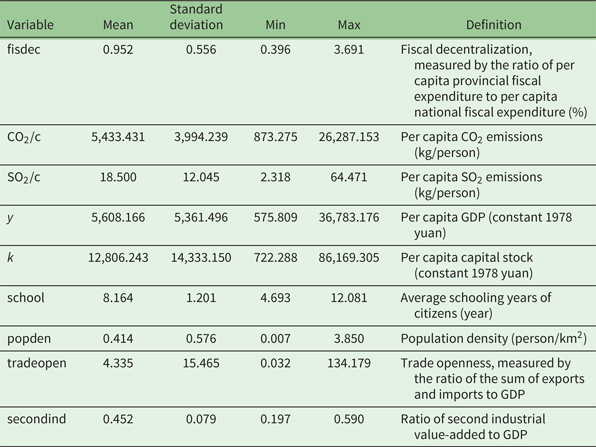
A summary of the statistics and definitions of the variables used in this research are reported in table 1.
Sample statistics and definitions

3.2 Method
Following Halkos and Paizanos (Reference Halkos and Paizanos2013), the model used in this study consists of two equations, (10) and (11), as follows:


In these two equations, $\mathord{\buildrel{\lower3pt\hbox{$\scriptscriptstyle\rightharpoonup$}} \over x}$ and $\mathord{\buildrel{\lower3pt\hbox{$\scriptscriptstyle\rightharpoonup$}} \over z}$
 represent the column vectors of control variables. The subscripts i and t represent province and time, respectively. ${\theta _i}$
 and ${\mu _i}$
 are cross-sectional effects that capture the time-invariant provincial factors that would affect GDP per capita and pollutant emissions per capita, respectively. ${\lambda _t}$
 and ${\zeta _t}$
 are time effects in the two equations. ${u_{it}}$
 and ${\varepsilon _{it}}$
 are independent and identically distributed residual terms.
Due to the high flowability of air pollution, the air quality of a certain province may be affected by the pollution situations of its neighboring areas (Auffhammer and Carson, Reference Auffhammer and Carson2008; Kang et al., Reference Kang, Zhao and Yang2016). Therefore, in equation (11) the spatial term $\sum\nolimits_{j = 1}^k {{w_{ij}}} \ln ({p_{j,t - 1}})$ is introduced to account for the spatial correlation of pollutant emissions to avoid biased estimations (Elhorst, Reference Elhorst2014). w ij is an element of the spatial weights matrix w and measures the spatial correlation between provinces i and j. Specifically, wij are the spatial weights given to the pollutant emissions of the previous year by its m neighboring provinces. In this study, we construct the most commonly utilized rook contiguity weights, in which w ij = 1 if provinces i and j are contiguous (share a section of the same border) and otherwise w ij = 0. Plenty of previous studies investigating China's provincial air pollution also utilized this rook contiguity weight matrix (e.g., Auffhammer and Carson, Reference Auffhammer and Carson2008; Kang et al., Reference Kang, Zhao and Yang2016). After the weight matrix is constructed, the weights are row standardized (each weight is divided by its row sum). It is also noteworthy that the spatial lags are introduced in the spatial term.Footnote 14
Equation (10 )is a conventional growth regression. Equation (11) investigates the impacts of economic development and fiscal decentralization on environmental quality. Similar to equation (10), the level of fiscal decentralization (fiscdec) and its squared and cubic terms are included in equation (11) to allow for a nonlinear relationship between pollutant emissions and fiscal decentralization that is predicted by proposition 1. Logarithmic per capita GDP (lny) and its squared term are incorporated in equation (11) to capture the potential inverted-U shaped EKC relationship (proposition 3). It is noteworthy that the square and cube of fisdec and lny are incorporated as explanatory variables to allow for various possible relationships between pollutant emissions and fiscal decentralization as well as between pollutant emissions and GDP per capita.Footnote 15 Following Cole (Reference Cole2007) and Halkos and Paizanos (Reference Halkos and Paizanos2013), the estimation procedure of the equation set composited by equations (10) and (11) is as follows: first equation (10) is estimated, and then the fitted values of lny obtained from equation (10) rather than the original levels of GDP per capita are used to estimate equation (11), so that the net effects of fiscal decentralization on pollutant emissions can be evaluated.
In this study, the Generalized Method of Moments (GMM) developed by Arellano and Bover (Reference Arellano and Bover1995) and Arellano and Bond (Reference Arellano and Bond1998) is employed to estimate equations (10) and (11). Compared with the conventional ordinary least squares and the fixed- or random-effects of panel data approaches, GMM has several advantages. First, GMM allows for the incorporation of the lags of the dependent variable and regressors as predetermined explanatory variables. In this way, the dynamics can easily be taken into account. Second, GMM can control for the potential inertia that may exist when the dependent variables are determined. Third, the potential reverse causality biases of the regressors, which occur when predetermined and exogenous variables are selected as instruments, can be dealt with in a reasonably systematic way.Footnote 16 The most commonly used GMM estimators include first-difference GMM (Arellano and Bond, Reference Arellano and Bond1991) and system GMM (Arellano and Bover, Reference Arellano and Bover1995; Blundell and Bond, Reference Blundell and Bond1998), for which the main differences lie in the instrumental variables utilized. Based on previous discussions, the provincial cross-section fixed effects should be controlled for; therefore, the first-difference GMM is preferred to system GMM and chosen as the benchmark estimation method because the differencing transformation of the data can easily remove the fixed effects.
Moreover, as Huang (Reference Huang2010) pointed out, when the number of cross-section units N is not big enough, the system GMM estimator may suffer from weak finite-sample bias although it might be more efficient. Similar to Halkos and Paizanos (Reference Halkos and Paizanos2013), in addition to the benchmark first-difference GMM, the orthogonal-difference GMM estimator is also employed for the robustness check. These two difference GMM approaches differ in the way the differentiation is conducted: in the first-difference GMM, only the differences in the backward direction are allowed, while in the orthogonal-difference GMM, the forward orthogonal deviations can also be taken.
3.3 The calculation of direct, indirect and total effects
According to the definition, following Halkos and Paizanos (Reference Halkos and Paizanos2013), after estimating the two regression equations (10) and (11), the direct, indirect and total effects of fiscal decentralization on environmental quality can be calculated as follows:Footnote 17


4. Results analysis and discussion
4.1 Estimation results of the regression model
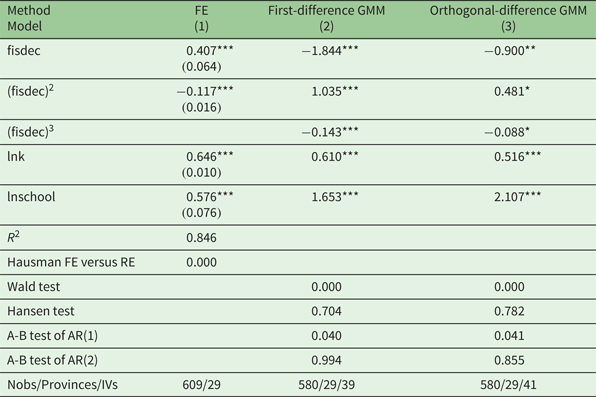
As described previously in the section on empirical estimation methods, equation (10) should be estimated first. Table 2 presents the estimation results for equation (10), employing different estimation approaches.
Estimates of equation (10) for the impact of fiscal decentralization on GDP per capita

Notes: Standard errors are in parentheses. p-values are reported for all tests. (fisdec)2 and (fisdec)3 represent the square and cube of fiscal decentralization level, respectively. lnk and lnschool stand for the logarithmic per capita capital stock and average schooling years, respectively. Given the problem of potential heteroskedasticity, the two-step Arellano-Bond GMM estimator is utilized. *, ** and *** indicate significance at the 1%, 5% and 10% levels, respectively.
The benchmark first-difference GMM estimates are shown in the second column of table 2. The coefficients of the GMM estimations shown in table 2 are long-run estimates, which are equal to the short-run estimates divided by the difference of one and the coefficient of the first-order lagged dependent variable. According to the first-difference GMM and orthogonal GMM estimates, the coefficients of fisdec, (fisdec)2 and (fisdec)3 are significantly negative, positive and negative, respectively.
Therefore, these results suggest that the relationship between GDP per capita and fiscal decentralization is inverted-N shaped. Because for some economically-developed provinces such as Beijing, Tianjin, Shanghai and Guangdong, the level of the fiscal decentralization has been rather higher than the first inflection of the inverted-N shaped curve but still far below the second turning point, this suggests that for these rich provinces GDP per capita is positively related with the level of decentralization. It is noteworthy that proposition 2 is valid for the economy in the steady state, which may describe the relatively prosperous provinces given the remarkable differences in economic development across Chinese provinces. As such, the empirical evidence supports proposition 2.
In other words, raising the level of fiscal decentralization would foster provincial economic growth when the provincial economy is developed enough and enters the steady state. Note that this finding is consistent with Lin and Liu (Reference Lin and Liu2000), Jin et al. (Reference Jin, Qian and Weingast2005), and Chu and Zheng (Reference Chu and Zheng2013), despite the differences in the definition of fiscal decentralization and the sample period used in this study. Compared to the static panel data fixed-effects estimation, the coefficients of average schooling years (lnschool) by GMM estimations are larger, which highlights the importance of education and human capital in economic growth. The similarity of the estimates obtained from the first difference GMM and orthogonal-difference GMM to some extent reflects the robustness of the results.
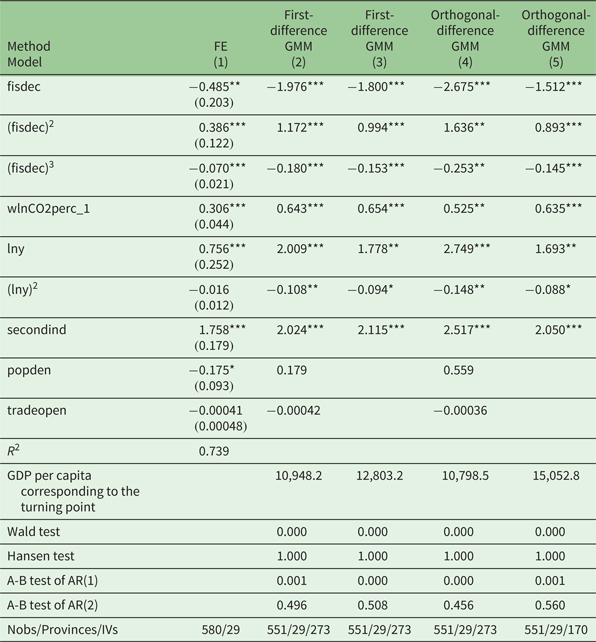
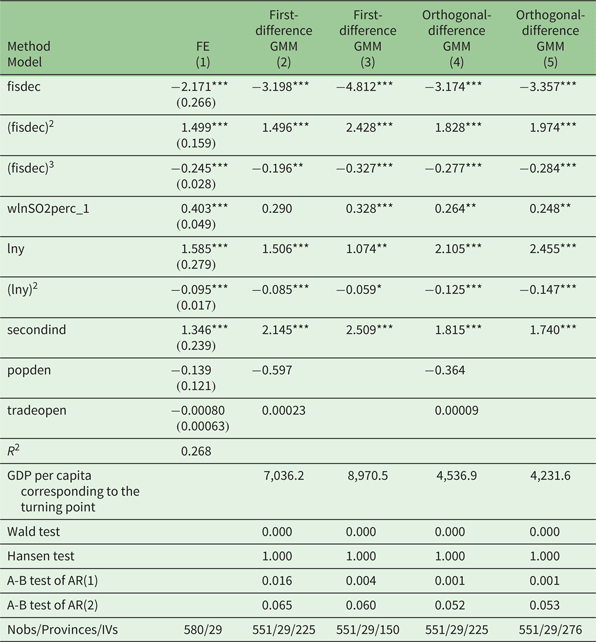
Using the fitted values of per capita GDP obtained from the benchmark first-difference GMM estimation results, equation (11) is estimated. The corresponding regression results for the two representative pollutants, CO2 and SO2, are shown in tables 3 and 4, respectively. As Leitão (Reference Leitão2010) noted, in the pollution equations, a series of specific provincial characteristics including climatic conditions, geographic features, fossil fuels endowments and even citizens' energy use habits may all potentially affect pollutant emissions. As a result, these provincial fixed-effects should be accounted for by employing the FE and the first- and orthogonal-difference GMM estimators. Moreover, because the coefficients of the cube of logarithmic GDP per capita, (lny)3, are estimated to be statistically insignificant, this cubic term is excluded from the regression equations.
Estimates of equation (11) with logarithmic per capita CO2 emissions as the dependent variable

Notes: Standard errors are in parentheses. The probabilities are reported for all tests. For GMM estimations the long-term coefficients are reported. (fisdec)2 and (fisdec)3 represent the square and cube of fiscal decentralization level, respectively. (lny)2 stands for the square of lny. wlnCO2perc_1 is the spatial term for CO2 emissions per capita. The meanings of the other variables are described in table 2. The two-step Arellano-Bond GMM estimator is utilized. *, ** and *** indicate significance at the 1%, 5% and 10% levels, respectively. It is also noteworthy that the spatial correlations are controlled for by introducing the spatial term $\sum_{j=1}^k\,w_{ij}\ln(p_{j,t-1})$ following the seminal research of Auffhammer and Carson (Reference Auffhammer and Carson2008), and the standard errors do not reflect the characteristics of spatial correlations.

The GMM estimates reported in tables 3 and 4 are also long-run estimates. As discussed previously, the first-difference GMM estimator is the benchmark estimation method, based on which all discussions below are made unless otherwise specified. The most important findings from the results shown in tables 3 and 4 are that propositions 1 and 3 are verified for both pollutants. Because the coefficients of logarithmic GDP per capita and its square (i.e., lny and (lny)2) are significantly positive and negative respectively by GMM estimates, the relationship between pollutant emissions per capita and GDP per capita is inverted-U shaped as proposition 3 suggests.
In other words, the conventional EKC relationship for pollutant emissions exists: the growth rate of per capita pollutant emissions would gradually slow down and eventually peak as the economy continues to grow. Because the coefficients of fiscal decentralization and its square and cube (i.e., fisdec, (fisdec)2 and (fisdec)3) are statistically significant and their magnitudes are negative, positive and negative respectively, the nexus of pollutant emissions per capita and fiscal decentralization is estimated to be inverted-N shaped. However, because for the vast majority of provinces, during the whole sample period, the levels of fiscal decentralization were higher than the first inflection point of the estimated inverted-N curve, the actual relationship is essentially inverted-U shaped as proposition 1 predicts (Song et al., Reference Song, Zheng and Tong2008).Footnote 18 For CO2, it can easily be calculated that the inflection point occurs when the level of fiscal decentralization is approximately 3.1 per cent. For SO2, the turning point appears at the level of fiscal decentralization of about 3.6 per cent.
Another interesting finding from the direct effect results shown in tables 3 and 4 is that the inverted-U shaped relationship between fiscal decentralization and pollutant emissions also to some extent reflects the fact that at less developed stages of economic development, the impact of ‘more decision power’ that is brought by a higher level of fiscal decentralization may not necessarily have too much benefit. One possible reason for this finding is that the decision makers in the less developed regions might know less about effective policy design, despite the fact that they could have better knowledge of the local preferences if they have enough resources to detect those preferences.
Among the control variables introduced in equation (11), only the ratio of second industry value-added to GDP and the spatial term are estimated to be significant. As expected, the second industry contributes significantly to the emissions of CO2 and SO2 in China (Hao et al., Reference Hao, Zhang, Zhong and Li2015b). On average, a 1 per cent increase in the ratio of secondary industry to GDP would lead to an increase in per capita emissions of CO2 and SO2 of approximately 2 per cent. Remarkably, the spatial correlation of pollutant emissions is verified since nearly all estimated coefficients of the spatial terms are statistically positive at least at the 5 per cent significance level (except for model (2) for SO2 emissions per capita), which indicates that one province's air quality is indeed affected by its neighboring provinces, as Auffhammer and Carson (Reference Auffhammer and Carson2008) and Kang et al. (Reference Kang, Zhao and Yang2016) found. However, for the other two control variables, the population density (popden) and trade openness (tradeopen), the coefficients turn out to be insignificant by both GMM methods. As Du et al. (Reference Du, Wei and Cai2012) summarized, population density and trade openness may have both positive and negative impacts on the environment, therefore the insignificant results may suggest that the relative strengths of the opposite directions for these two factors are roughly the same.Footnote 19
Despite the similarity, there are still some important differences in the estimation results for CO2 and SO2. For instance, the levels of GDP per capita corresponding to the emission peak of the two pollutants are quite different. As shown in table 3, per capita CO2 emissions peak when GDP capita reaches the interval between 11,000 and 15,000 yuan (constant 1978 price). In contrast, as shown in table 4, the turning point of SO2 emissions per capita is reached before per capita GDP reaches 9000 yuan (constant 1978 price). If the medium values of the intervals are taken as the levels of GDP per capita at the inflection points of the two pollutant emissions approximately, the turning points would occur at around 13,000 yuan and 6,600 yuan for CO2 and SO2, respectively. The levels of GDP per capita for a majority of provinces surpassed 6,600 yuan in 2006 when total national SO2 emissions peaked in China. However, as of 2015 (the end of the sample period), only a few rich provinces' GDP per capita was higher than 13,000 yuan, while the turning point of CO2 emissions per capita for the whole nation is still yet to come.
The differences in the estimated turning points for CO2 and SO2 may to some extent reflect the differentiated attitudes of the Chinese government toward these two pollutants. In China, SO2 has long been recognized as a pollutant by the Chinese government and the public. Partly thanks to the continuous efforts of environmental educators, it has become general knowledge that SO2 may cause serious environmental problems like acid rain and harm human beings' health severely (Qing, Reference Qing2004). In contrast, CO2 has not yet been recognized as a pollutant by the Chinese government, and the Chinese people are in general more tolerant of CO2 than of traditional air pollutants, such as SO2 and NOx (Duan, Reference Duan2010; Guo and Marinova, Reference Guo, Marinova, Chan, Marinova and Marinova2011).
Moreover, as Harris (Reference Harris2006) pointed out, according to the results of a series of surveys on environmental perspectives and behaviors in China, most Chinese people pay attention to the local pollutants that threaten their health (like SO2 and NOx) but normally have little knowledge about global environmental issues such as global warming. Nor does the public have enough information about the techniques to curb CO2 emissions (Duan, Reference Duan2010). Therefore, it is reasonable to assume that the emissions of SO2 entered citizens' utility function quite early, but the emissions of CO2 may not enter residents' utility function even when per capita income is considerably high. In fact, some researchers have found evidence that the Chinese government has not taken serious actions to control CO2 emissions until recently (Yaguchi et al., Reference Yaguchi, Sonobe and Otsuka2007; Yuan and Zuo, Reference Yuan and Zuo2011). In the meantime, it should be noted that the reduction in SO2 emissions may have partly resulted from the effective SO2 reduction policies. For instance, as Karplus et al. (Reference Karplus, Zhang and Almond2018) stressed in a recent study, China has achieved great success in reducing SO2 emissions with various emission control methods in the power sector.
4.2 The impact of fiscal decentralization on environmental quality
After estimating equations (10) and (11), the direct, indirect and full impacts of fiscal decentralization on the environment can be calculated. Concretely, the estimates by the benchmark first-difference GMM approach are chosen for the calculations in this subsection.
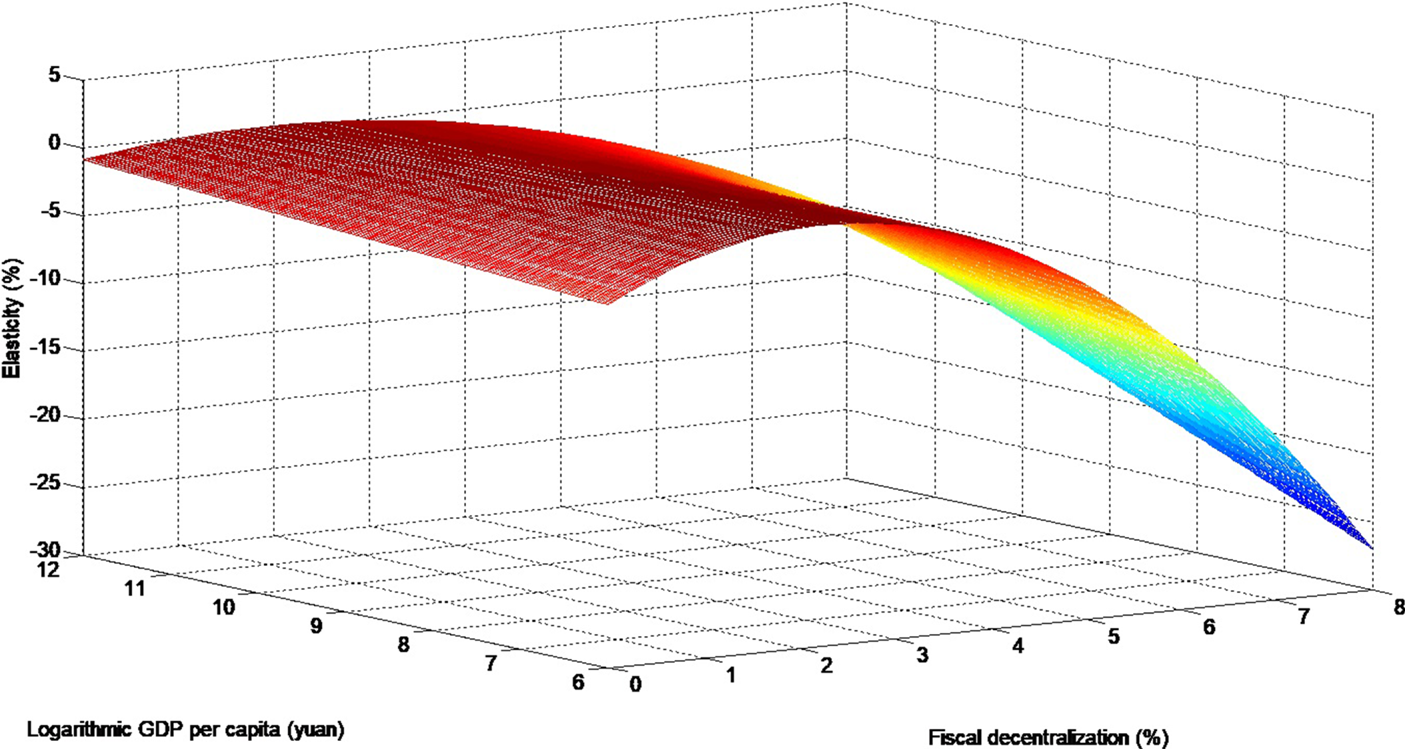
Based on the first-difference GMM estimates shown in table 3, the total environmental impact of fiscal decentralization on CO2 can be gauged. The overall effect of fiscal decentralization on CO2 emissions per capita is depicted in figure 1. Because the direct and indirect effects both depend on the values of per capita GDP and level of fiscal decentralization, figure 1 has three dimensions: per capita GDP, fiscal decentralization, and the elasticity of CO2 emissions per capita with respect to fiscal decentralization.
The effect of fiscal decentralization on CO2 emissions per capita.

As shown in figure 1, as the level of fiscal decentralization rises, the total effect of fiscal decentralization is at first increasing and then decreasing after the turning point of the total effect is reached. This is mainly because the direct effect dominates the indirect effect during the sample period. It is noteworthy that the direct effect of fiscal decentralization for CO2 emissions per capita is inverted-U shaped, the shape of the three-dimensional figure which has a similar inverted U-shape as the level of economic development does not significantly affect the total effect. It is also noteworthy that the range of fiscal decentralization is between 0.396 and 3.691 (as shown in table 2). In the past years during the sample period, fiscal decentralization led to an increase in CO2 emissions per capita in China, while it will decrease the emissions as the fiscal decentralization continues in the future.
The relationship between fiscal decentralization and per capita CO2 emissions shown in figure 1 intuitively reflects some important characteristics of CO2. The estimation results suggest that the nexus of per capita CO2 emissions and per capita income is shaped like an inverted U, which verifies proposition 3. As discussed previously, the harm from global warming and its main cause (the emissions of greenhouse gases, especially CO2) have not been completely recognized by Chinese citizens for a long time. In this regard, the demand for curbing CO2 emissions has not been strong, and therefore China's CO2 emissions will continue to rise as the economy grows, as long as the public is not fully aware of the negative effects of CO2 emissions (Yu et al., Reference Yu, Wang, Zhang, Wang and Wei2013).Footnote 20
Finally, there is a caveat: although the estimation results indicate the existence of an EKC relationship for both pollutants in China, it cannot be concluded that the environmental issues can be automatically solved with economic development. It should be noted that, with the data observed so far, the empirical evidence merely suggests that the decrease in environmental pollution may occur as the economy continuously grows. In other words, there is statistical rather than deterministic evidence for the existence of an EKC, as there might also be uncertainties that may affect the shape and position of the EKC relationship (e.g., Kijima et al., Reference Kijima, Nishide and Ohyama2011; Bernard et al., Reference Bernard, Gavin, Khalaf and Voia2015; Stern, Reference Stern2017). Moreover, as Roberts and Grimes (Reference Roberts and Grimes1997) and Cole (Reference Cole2004) stressed, considering the limited ecological boundaries of the earth and the colonial history of most currently rich nations that supports their ‘grow now clean later’ strategy, even if the EKC relationship indeed exists, the EKC growth patterns might not be obtainable for the developing countries nowadays.
In this regard, given that China currently contributes the largest shares of almost all main pollutants to the world, various policies and measures – such as specific environmental regulations (Chen et al., Reference Chen, Hao, Li and Song2018), promoting technology progress (Yin et al., Reference Yin, Zheng and Chen2015) and increasing green investment (Liao and Shi, Reference Liao and Shi2018) – should be formulated and implemented to accelerate the improvement of the environmental quality in China. Moreover, as the observed EKC usually already incorporates effects from environmental policies, the empirical evidence for the EKC does not reflect the ‘policy-free’ outcomes, so future environmental policies are still very necessary. The estimation results of this study also indicate that a properly designed fiscal decentralization system could help to improve China's environmental quality.
5. Conclusions and policy implications
In this paper, the effect of fiscal decentralization on China's environmental quality is comprehensively investigated. To examine the impact in a reasonable and convincing way, a theoretical model based on those of Barro (Reference Barro1990), Devarajan et al. (Reference Devarajan, Swaroop and Zou1996) and Ordás Criado et al. (Reference Ordás Criado, Valente and Stengos2011) is developed, and several testable propositions are raised on the basis of the solutions to the model. Using China's provincial panel data for the period 1995–2015, a two-equation model similar to that of Halkos and Paizano (Reference Halkos and Paizanos2013) is employed to examine the validity of the three propositions and estimate the direct, indirect and total effects of fiscal decentralization on per capita emissions of two representative pollutants – CO2 and SO2. The first-difference GMM approach is utilized to control for potential endogeneity and allow for the dynamics.
The estimation results support the three propositions of the theoretical model, and the total effects of fiscal decentralization on both pollutants is found to be dependent on the levels of fiscal decentralization and GDP per capita. Specifically, when the economic development level is high enough, the level of fiscal decentralization is positively related to GDP per capita for relatively rich provinces which are considered to be at or near their steady state (proposition 2), and the relationship between fiscal decentralization and per capita pollutant emissions (for both SO2 and CO2) is estimated to be essentially inverted-U shaped (proposition 1). Moreover, the inverted-U shaped EKC relationship between pollutant emissions per capita and GDP per capita is also verified by empirical estimations (proposition 3).
On the basis of these conclusions, some important and straightforward policy implications are as follows. First, at the current stage of China's economic development, to further promote the level of fiscal decentralization is beneficial not only to economic growth but also to the environment. As suggested by the theoretical model and the empirical results, there exists a certain interval of the fiscal decentralization level at which economic growth is enhanced and environmental quality improves as the fiscal decentralization is further expanded. As such, China's central authority should deepen fiscal reform and conduct corresponding appropriate policies to increase provincial fiscal decentralization to achieve two goals at one stroke. Second, given the considerable gap in economic and social development across regions, different provinces may choose different levels of fiscal decentralization to maximize its positive effects on environmental quality and economic growth. Specifically, for the rich provinces for which the fiscal decentralization is conducive to economic growth, a higher level of fiscal decentralization is suitable. However, for the economically-backward inland provinces that are still far away from their steady states, a reasonable level of fiscal decentralization should be carefully chosen based on the economic conditions. Third, more provincial fiscal resources should be put toward environmentally friendly projects. Currently, many provincial and local governments focus on promoting construction of new infrastructure and the development of secondary industries, especially heavy industry. Although these activities are likely to push up economic growth in the short run, they are in general not environment-friendly. Increasing the ratio of fiscal expenditure for environmental protection and improvement could therefore be vital and may be immediately effective in reversing the trend of China's environmental deterioration.
This paper quantitatively investigates the dynamic relationship between fiscal decentralization, economic development and environmental quality, both theoretically and empirically. Although this study fills a research gap and makes a contribution to the existing literature, there are still some remaining limitations that could be possible directions for future research. For instance, for the theoretical model setup, it is more interesting and insightful to introduce one central government and two provincial governments so that the competition among different regions can be well captured and accounted for at the expense of increasing complexity of calculations. Moreover, given that China's economy has a series of new features as economic growth shifts gear from the previous high speed to a medium-to-high speed at the ‘new normal’ stage, the influences of fiscal decentralization on China's economic development and environmental quality may be different now compared to the past decades investigated in this study. Therefore, in the empirical aspect, this relationship could be further analyzed by employing recently developed econometric tools like panel threshold regression models as long as more data in the ‘new normal’ era are available.
Acknowledgements
The authors acknowledge financial support from the National Natural Science Foundation of China (71761137001, 71403015, 71521002), the Beijing Natural Science Foundation (9162013), the key research program of Beijing Social Science Foundation (17JDYJA009), the National Key Research and Development Program of China (2016YFA0602801, 2016YFA0602603), and the Special Fund for Joint Development Program of the Beijing Municipal Commission of Education. The authors are also very grateful to two anonymous reviewers and Editor-in-Chief Prof. E. Somanathan for their insightful comments that helped us sufficiently improve the quality of this paper. The usual disclaimer applies.
Supplementary material
The supplementary material for this article can be found at https://doi.org/10.1017/S1355770X19000263