China's sixth census revealed that its floating urban population (liudong renkou 流动人口) exceeded 221 million in 2010. It also showed that an increasing number of migrants have chosen to keep their children by their sides over the last decade, giving rise to an estimated 20 million migrant children (under 18 years old) by 2010. A total of 58.4 per cent of these children are aged between 6 and 14 and so should be in school. Although officially dubbed the floating population, a large proportion of these children have in fact resided in the city since they were young, and some were even born there.Footnote 1 In contrast to their parents, migrant children have no farming experience and thus cannot consider land in the countryside as “social insurance.” Although they are described as “rural” (nongcun ren 农村人) in the household register, they are more at home in the city and identify little with rural life.Footnote 2
Under the current urban–rural dual structure, the most daunting challenge facing migrant children is education, which is tightly controlled by the household registration system.Footnote 3 For example, if a migrant child wants to enrol in a public school, his family must pay an additional charge to the school, a temporary studying fee, which is only applicable to migrant children. In addition, prior to 2005, because of the limited number of places made available to migrant children in public schools, most migrant children were forced to attend privately run, fee-funded, profit-driven migrant schools, which offered poor facilities and inferior teaching.
To improve migrant students' rights to education in urban centres, in 2002 the Ministry of Education suggested that “both the government and the public schools of receiving cities should play a key role in safeguarding the education of migrant children” (liangweizhu zhengce 两为主政策). Following this directive, public schools in Shanghai have gradually opened their doors to migrant children. By mid-2008, 379,980 migrant students in Shanghai – including 297,000 primary school-age children and 83,000 junior high school-age adolescents – had enrolled in either public or locally approved private schools. These students accounted for 57.2 per cent of the school-age migrant population. The rest of the migrant students attended private migrant schools.Footnote 4 The greatest difference between private migrant schools and public schools in terms of governance is that private migrant schools come under the jurisdiction of the education authority of the migrant students' original domicile, whereas public schools are managed and monitored directly by the local education authority. From the students' perspective, private migrant schools are seen as inferior to public schools because they are generally housed in dilapidated buildings, have low hygiene standards and poor quality teaching.Footnote 5 In general, students from private migrant schools do not mix with the local school-age students and young people in their neighbourhood.
With regard to education's influence on social mobility, opinions differ between those who emphasize education's contribution to upward social mobility and those who focus on its contribution to social reproduction.Footnote 6 The former believe that education is an important way for an individual to gain social mobility that can promote social equality to a high degree.Footnote 7 According to this view, schools not only provide a knowledge base and the human capital essential for a modern technical division of labourFootnote 8 but also function as institutional pillars that guarantee meritocratic access to valued occupational positions and other resources.Footnote 9 The second school of thought, however, sees schools as centres of power for producing and reproducing social and institutional inequality.Footnote 10 Education is viewed as a tool used by social elites to monopolize the better professions and exclude other social classes. Bourdieu's social reproduction thesis emphasizes the role of cultural capital in the links between family social class, teachers, schools and students' educational outcomes. Cultural capital is assumed to be one of the central family-based endowments whereby social class value has an unequal impact on intergenerational educational probabilities.Footnote 11 Thus, according to this view, in settings in which policies fail to ensure equal access to educational resources, education functions as a conduit for social reproduction and reinforces previously existing inequalities of social structure and cultural order.Footnote 12 However, with respect to migrant children in the milieu of Chinese urban cities, it remains unclear which model best explains the dynamics at work.
To address this issue, this article focuses on a specific social group, Chinese migrant children who live in Shanghai, and explores the role of education in migrant children's socio-economic development. I posit that it is better to scrutinize the meaning of schooling to a particular group situated in a specific social context than to generalize this meaning. I look at what schools mean to migrant children who form part of the lower classes in the city, and explore whether schools provide a ladder for achieving upward social mobility or are vehicles for class reproduction. I also discuss whether opening public schools to migrant children will provide them with more opportunities for social mobility.
Previous studies on this topic are either ethnographic studies of migrant schools or quantitative studies based on large-sample surveys.Footnote 13 Some ethnographic studies provide rich and meticulous descriptions but lack a comparative perspective and are thus unable to reveal differences in schools. Other ethnographic research, such as studies by Lu Wang and Charlotte Goodburn, shows that migrant children are unable to enrol at public schools as a result of institutional exclusion, which in turn restricts their social mobility.Footnote 14 However, the present article demonstrates that access to a school is not sufficient in itself: migrant children find it difficult to achieve upward social mobility even if they do attend public schools. Examining what occurs inside different types of schools facilitates movement beyond an “access paradigm” in the analysis of the role of education in the socio-economic opportunities of migrant children.Footnote 15 Studies that are based on large-sample data are able to reflect overall status and are helpful in determining the relationship between variables. For instance, large-sample surveys conducted by Chen and Feng reveal the enormous impact that school type has on migrant children's academic achievements.Footnote 16 However, these surveys do not investigate the manner and mechanisms through which schools affect students. In this article, I combine qualitative and quantitative methods in an attempt to reveal the micro-level mechanism involved in class reproduction in two types of educational environments: the public schools and the private migrant children's schools.
The Dual Education System and Class Reproduction in China
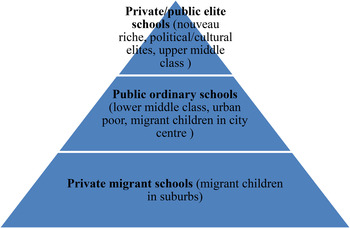
It needs to be noted that a dual education system is being operated in Chinese cities. This system consists of an official education system composed mainly of public and private schools approved by the local governments, and an unofficial education system of private migrant schools without school licences. The so-called official education system can be further divided into two layers. In the top layer are elite schools in both the public and private sectors. Public elite schools at the primary and junior high school levels offer quality education free of charge and recruit mainly outstanding local students, most of whom graduate to enter leading universities in China or else leave China to further their studies overseas. Private elite schools, characterized by exorbitant tuition fees, cater mainly to children of high-income parents who are the “nouveau riche” of China. Although both types of schools are high quality, the latter is less examination-orientated. In private elite schools, English and arts education are stressed, and students are prepared for study abroad. Students at the lower end of the educational hierarchy attend “public ordinary schools.” Although such schools are also funded by the government, they are only capable of providing mediocre education, and their entrance requirements are accordingly not as strict as those of public elite schools. In recent years, such public ordinary schools have begun to institute quotas for migrant students.
Private migrant schools are part of the unofficial education system; unlike “public ordinary schools,” they are not funded by the government. A rapidly growing number of such schools has been established since the early 1990s, when migrant workers flooded into Shanghai for employment but were prohibited from sending their children to public schools. Although private elite schools accept students with non-local hukou 户口, their expensive tuition fees are far beyond the means of most migrant families. Official statistics show that out of 519 private migrant schools operating in Shanghai in 2001, only 124 had received official approval from the local education authorities. The others had no legal status, lacked teaching resources and operated with outdated facilities. However, because private migrant schools charged low tuition fees (600–800 yuan per term), many parents chose to send their children there. Between the 1990s and 2005, many migrant schools were operating without the proper licences and leasing at-risk buildings, which led to health and safety issues such as fires and food poisoning. Consequently, the municipal government began to examine these schools more closely and, as a result, students in such schools were required to transfer to public schools to continue their education.
The Basic Education System in Urban China

Methodology and Data
Fieldwork for this article was conducted mainly in Yangpu 杨浦 district of Shanghai. Although my study focuses on one place, past studies suggest that there is a high degree of similarity among migrant children in Beijing, Shanghai, Kunming, Xiamen and other cities.Footnote 17 Nonetheless, compared with other major metropolises (such as Beijing and Guangzhou), Shanghai is relatively receptive to migrant workers. The Shanghai municipal government closed the migrant schools in the city centre and allowed migrant children access to public schools. The government even retained and provided funding to improve schools for migrant children in the suburbs. However, there is no substantive difference between Shanghai and other cities in terms of core systems such as the household registration system and the college entrance examination system. Migrant children in Shanghai face the same bottlenecks as migrant children in other cities after completing junior secondary education.
The data for this study was gathered by collecting as much information as possible on the group's living, learning, values and behaviour patterns. Both quantitative and qualitative data were collected and analysed. In September and October 2007, I accepted a temporary teaching position at Jinxiu School, the largest private migrant school in Yangpu district.Footnote 18 Through my short teaching experience at the school, I was able to gain a preliminary understanding of the students and their relationships with teachers, as well as the internal administrative workings of a private migrant school. In addition, in-depth interviews were conducted with eight migrant children and their parents; three government officials; the principal and three teachers at a public school; the principal and four teachers at a private migrant school; the leaders of three NGOs; and seven volunteers.
Between April and May 2008, I conducted a small-scale survey of migrant children currently enrolled at school. Given the relative homogeneity of the migrant cohort in terms of financial conditions, social status and living environment, I decided to use cluster sampling, i.e. the children were sampled by class. A private migrant school (Jinxiu School) and a public school of a similar scale (Hucheng Secondary School) were selected for comparison following the suggestion from King, Keohane and Verba to avoid random selection when aiming for a small sample size and instead select in accordance with the independent variable.Footnote 19
The pool used for random selections was comprised of students in grades 5, 6 and 9 at the private migrant school and grades 7 and 8 at the public school. Of the 252 questionnaires distributed, 251 were completed and returned. The sample consisted of 224 migrant children, 155 of whom were attending the private migrant school and 69 of whom were attending the public school. The average age of the migrant children was approximately 14, and their average age when they first arrived in Shanghai was approximately seven, which indicated that the average amount of time each migrant child had spent in Shanghai was seven years. Twenty-seven local children also participated in the survey (all in grade 6). The questionnaire distributed among the local children was identical to that used for the migrant correspondents, except that two questions, which were designed specifically for migrant children, were eliminated.
Interviewees' Basic Information

Source:
“Survey questionnaire on migrant children's social psychology and political awareness,” conducted by the author (April–May 2008). Unless otherwise stated, all statistical tables are based on this survey questionnaire.
Micro-level Mechanisms for Reproduction: Comparing Public Schools with Private Migrant Schools
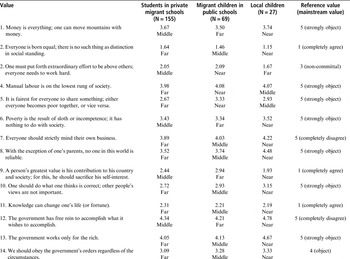
This study sought to understand the value systems of migrant children by using questionnaires that examine the value that migrant children place on money (topic 1), equality (topics 2–4), fairness (topics 5–6), collectivism (topics 7–10), knowledge (topic 11) and politics (topics 12–14).Footnote 20 A total of 14 topics were designed to elicit interviewees' opinions. The questionnaire used a 5-point Likert scale that ranged from “completely agree” to “completely disagree.” Each point on the scale was assigned a value from 1 to 5. A reference value was selected to represent the mainstream value, i.e. the value espoused by the government. The closer the “level of agreement” was with the reference value, the more consistently the value correlated with the mainstream value. The questionnaire conveyed the relationship between the values expressed by the three sample groups and the mainstream values in terms of the proximity of the values the sample groups expressed to the mainstream values, i.e. “near,” “middle” or “far.” The results are presented in Table 2.
Level of Agreement of Three Sample Groups on All 14 Topics and Proximity of their Values to Mainstream Values

Source:
See Table 1.
Regarding the 14 topics, 11 of the values held by the local children are very close to the mainstream values, whereas one is very far from the mainstream value (in part because of the ambiguity of the official stance). By contrast, although migrant children in public schools strongly espouse three of the 14 mainstream values, the values of migrant students in private migrant schools strongly diverge from the mainstream values, and nine of the 14 are far from the mainstream values. In other words, our survey questionnaire is more inclined to support the argument that migrant children in public schools uphold values that are closer to those officially upheld by the government than do migrant children in migrant schools, which may be owing to the existence of well-developed systems of symbols in public schools that foster the methodical imparting of values.
Because migrant children in public schools are more willing to accept mainstream values, they tend to believe that their life opportunities can be affected by knowledge. As such, they are more willing to study hard and achieve better results.Footnote 21 In fact, the academic performance of migrant children in public schools is better than that of migrant children in private migrant schools. Based on a survey and standardized test given to 2,131 students from 20 elementary schools in Shanghai in 2010, Chen and Feng find that migrant students who are unable to enrol in public schools perform significantly worse than their more fortunate counterparts in both Chinese language and mathematics. The effect of school type on test scores is significant and overwhelms many important student and family effects: if all migrant students in migrant schools were reassigned to public schools, the overall test score gap between migrant students and Shanghai students would shrink from 9.7 to 6 for Chinese and from 13.6 to 8.3 for mathematics.Footnote 22
A variety of pictures and slogans were posted on the walls of Hucheng Secondary School, such as pictures of famous people and their teachings and the mottos of successful previous students. Photographs and summaries of the achievements of outstanding students, in addition to posters for various types of competitions, were also on display. All of these items were aimed at showcasing mainstream values involved in personal achievement. By contrast, Jinxiu School only exhibited the school administration's notices on school fees, lunch and transportation charges, and various regulations regarding student safety, all of which were poorly presented with no attention to the presentation form.
In other words, the symbol system and etiquette that characterized the public school were focused on student autonomy and self-discipline. By contrast, the symbol system and etiquette that characterized the private migrant school stressed student compliance with authority. The latter emphasis is an indirect indication of poor discipline among the students in the private migrant school, which was so severe that the administration at Jinxiu School apparently felt that it must repeatedly assert its authority.
Nevertheless, the differences in values between these two types of schools should not be exaggerated. If the ranking of the three sample groups were disregarded and they were viewed in terms of level of agreement, it would be clear that there is little difference between migrant children and local children, regardless of whether a school is a public school or a private migrant school. The children tended to have similar value systems. The only notable difference was that local children were probably more inclined to be politically correct. In other words, local children vocalized greater support for mainstream values, whereas migrant children tended to reject these values. Simply put, relative to local children, migrant children's values deviate slightly from mainstream values. However, the students in the two groups are not polar opposites.
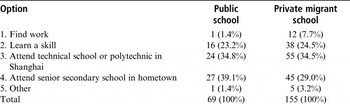
The survey found that there was no statistically significant difference in aspirations for the future between migrant children who studied at public schools and those who attended private migrant schools after they graduated from these schools (p > .05). It is noteworthy that in the private migrant schools, a greater proportion of students hoped to find work immediately after graduation and that only 10 per cent of these students were willing to return to their home cities to continue their senior high school education (see Table 3), which indicates that this group of students had less desire for learning than their peers in public schools. This trend is even more pronounced in higher grades. Children in upper grades were more pessimistic about their future. When compared with children in grades 5 and 6 from the same school, a significantly lower percentage of children in grade 9 at the private migrant school wished to continue their higher education in their hometown. Likewise, the percentage of migrant children in grade 8 who wished to continue their higher education was lower than that in grade 7 in public school. Additionally, a significant difference was found between these two years regarding options before graduation (see Table 4). Such a difference is largely the result of children's expectations for higher education and success. Children at the higher grade levels were more aware of the system's bottleneck than those at lower grade levels. They were unable to attend senior secondary school or even sit for university entrance examinations in Shanghai; additionally, they had no competitive advantage in their own hometowns because of the poor teaching resources and administration at the private migrant schools in Shanghai. Most children opted to abandon their educational aspirations once they discovered that there was no chance of furthering their studies.
Plans of Migrant Children in Different Types of Schools after Completing Junior Secondary Education

Plans of Migrant Children at Different Levels after Completing Junior Secondary Education*

Source:
See Table 1.
Notes:
Results of chi-squared test: chi-squared value: 45.0553; degree of freedom: 16; P-value: 0.0001.
* During the 2008 survey, there was only one grade 9 class in the junior secondary section of Jinxiu Private Migrant School. Moreover, Hucheng School only accepted migrant children into its grade 7 and 8 classes.
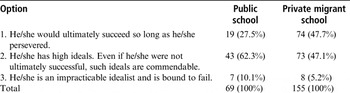
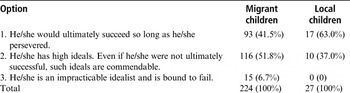
One of the questions in the survey questionnaire began with: “If you have a classmate whose dream it is to become the mayor of Shanghai, would you think that he/she…” The three choices given are in accordance with three different attitudes. The first indicates an optimistic attitude towards upward social mobility; the second option indicates a positive view of social mobility but recognizes that such mobility may be limited; and the last option demonstrates a pessimistic view of minimal social mobility and opportunity. The results of the survey question are as follows.
Migrant children at the public school were more pessimistic than children in the private migrant schools, with 20 per cent fewer migrant children at the public school choosing Option 1 than students at the private migrant schools. Moreover, 15 per cent fewer migrant children at the public school chose Option 2 than students at the private migrant schools. In addition, twice as many migrant students at public school chose Option 3 than students at the private migrant schools. Statistically, there was a significant difference between the two groups with respect to their attitudes. The data support the author's hypothesis that students in public schools have lower expectations regarding their personal prospects as a result of their awareness of the obstacles to their further education.
As they grow older, it appears that migrant children become more pessimistic about their future social mobility and opportunities. The percentage of children who selected Option 1 decreased for children in a higher grade, whereas the percentage of those who selected Options 2 and 3 gradually increased. The only exceptions occurred in grades 8 and 9, but I speculate that the result may not have reflected the real situation and may have been caused by school type. As one of the delimitations of the present study, all the students in grade 8 were public school students, whereas all the students in grade 9 attended the private migrant school. Additionally, there is a statistically significant difference between students in different grades.
In contrast, local children were far more optimistic about social mobility and opportunities. As many as 63 per cent of the students believed that success could be achieved through perseverance, whereas the remaining 37 per cent chose Option 2, and none chose Option 3. More than half of the migrant children chose Option 2, and there were 20 per cent fewer migrant children than local children who thought that perseverance breeds success. As many as 6.7 per cent of migrant children had abandoned the prospect of social mobility. The p-value of the chi-squared test is 0.068; this result amounts to a significant difference in views between the two types of students.
“If You Have a Classmate Whose Dream It Is To Become the Mayor of Shanghai, Would You Think That …” (Answers of Migrant Children in Different Types of Schools)

Source:
See Table 1.
Notes:
Results of chi-squared test: chi-squared value: 8.6023; degree of freedom: 2; P-value: 0.0136.
“If You Have a Classmate Whose Dream It Is To Become the Mayor of Shanghai, Would You Think That …” (Answers of Migrant Children in Different Grades)

Source:
See Table 1.
Notes:
Results of chi-squared test: chi-squared value: 27.8664; degree of freedom: 8; P-value: 0.0005.
“If You Have a Classmate Whose Dream It Is To Become the Mayor of Shanghai, Would You Think That …”

Source:
See Table 1.
Notes:
Results of chi-squared test: chi-squared value: 5.3807; degree of freedom: 2; P-value: 0.06786.
It is difficult not to notice that the ceiling for further studies has had a significant impact on migrant children studying in public schools, such that they become increasingly pessimistic as they grow older. This ceiling is a bottleneck for personal development in real life and represents low expectations for one's personal future. In this case, the “ceiling effect” refers to a situation in which migrant children, through their interaction with the outside world, have relatively low expectations for their future prospects (a ceiling prevents their upward mobility). As a result, they abandon, without prompting, any efforts at further studies. We may call this phenomenon “institutional self-disqualification.”Footnote 23
The largest difference between migrant children at public schools and those at private migrant schools is the “counter-school culture” as defined by Paul E. Willis, which is strong among children at private migrant schools.Footnote 24 Many higher-grade students in these schools have no respect for the teachers' authority and believe that the principal is merely a boss who is only interested in making money. Many of the students in the private migrant schools also voluntarily drop out of school to work, and some even become gang members. They see most of the knowledge they gain at school as useless and have no belief that it can alter their destiny or situation. Thus, the promise of the school's slogan, “Helping migrant children to step out of the footsteps of their parents,” is viewed as an unattainable goal. Instead, these children view fooling around, experiencing teenage love and fighting as “cool” behaviour – much in the same way that working class children pursued “masculinity” in the works by Willis.Footnote 25 School observations show that the public schools provide order, whereas the private migrant schools clearly lack discipline.
As a volunteer tutor at a private migrant school, I spent more than half of the lesson time maintaining order. Wei Wen, a university student who is a long-term volunteer at a private migrant school, angrily reported the following during an interview: “These children will form the main criminal force in Shanghai when they reach 16 or 17; in fact, I think 80 per cent of the children in my class will commit crimes in the future.” Although it sounds rather extreme, this comment nonetheless indicates how teachers in private migrant schools react when faced with rebellious student behaviour. In contrast, there is a “study first” atmosphere at the public schools, which greatly increases the likelihood that the migrant children in these schools will choose to pursue further education.
Almost every private migrant junior high school examined during the current study had a small “gang” (some gang members were even in the higher primary school grades). The members of such “gangs” typically had a strong sense of honour regarding their own class, so they generally did not bully their own classmates. Instead, they tended to take issue with students in other classes with whom they were uncomfortable. If students from other classes bullied their classmates, they frequently stepped in to assist in maintaining the honour of their class. When children at private migrant schools were bullied outside of school, some asked the members of these “gangs” to address the problem. The ensuing fights created many problems for school officials. The “gang” members were sharp-tongued and liked to challenge the teachers' authority by determining a teacher's weaknesses or individual characteristics and creating secret nicknames for them. When the teacher addresses the class seriously, these “gang” members may target the instructor's flaws to make the entire class laugh. If the teachers punish them, gang members may threaten revenge.
The emergence of such “gangs” is relatively recent. Reports show that among the children under the age of 18 who committed crimes in Shanghai between 2000 and 2002, the ratio of local perpetrators to those from outside Shanghai was 6:4. This ratio reversed to 4:6 in 2003 and was 3:7 in 2005. All the young criminals from outside Shanghai were migrant workers' children.Footnote 26
After graduating from junior high school, migrant children have three options: they may stay in Shanghai to study at vocational schools; they may return to their hometowns to take senior high school admission exams; or they can go to work. A survey conducted by the Shanghai Committee of the Communist Youth League and Shanghai Community Youth Affairs Office shows that after migrant children graduated from junior high school in Shanghai, approximately half stayed in Shanghai to do business, work with their parents, or study at a vocational or other type of secondary technical school, whereas the other half were scattered geographically and were neither in school nor employed. Only a few students (mostly boys) with good exam results returned to their hometowns to continue their studies.
If migrant children do return to their hometowns to continue their studies, they and their families must pay not only high financial costs but also high costs in terms of separation. In addition, the teaching materials and methods used in rural schools are different from those in Shanghai, so these students will be in yet another disadvantaged position. All these factors drive most migrant children in Shanghai to choose to work or receive secondary vocational education, both of which accelerate the reproduction of their social class. Although vocational training enables rural children to be more competitive in terms of securing a job, it does not provide any opportunity for upward mobility. Almost all migrant children end up employed in blue-collar jobs – such as factory workers, hotel service staff, cooks and salespersons – after they graduate from vocational institutions. I found that the wage level of migrant children after graduating from vocational schools was 2,000–2,500 yuan per month in 2013. Thus, it is apparent that the return for vocational education is on the low side; the average monthly salary for a university graduate in Shanghai was 4,746 yuan in 2013.Footnote 27
Among those who return to their hometowns for senior high school, only a small number are able to attend college (and in the process, change their household registration and achieve upward social mobility). Overall, urban students have 5.8 times more opportunities to gain a higher education than rural students.Footnote 28 Thus, the educational resources (secondary vocational schools and vocational high schools) available to migrant children are likely to cause the reproduction of social class rather than enable upward social mobility.Footnote 29 As soon as they graduate from junior high school, many children take up “3D” (difficult, dirty and dangerous) jobs, following the paths taken by their parents to some extent. Some may not find a job or are unwilling to work after graduating from junior high school and become what Yang Yang (a 15-year-old girl from Sichuan province) referred to as “loafers in society.”Footnote 30 To a large extent, the counter-school culture is caused by the ordinary life challenges faced by migrant children.
It is important to note that public schools prioritize the type of teaching that focuses on discipline over students' bodies and minds because these schools are under pressure to ensure that students progress to higher grades. A teacher from Hucheng High School indicated that the teacher's task is to “impart how to behave and how to work.” This task is undertaken sincerely. By contrast, the mission of most private migrant schools does not extend further than ensuring the physical safety of the students. Benchmarks that the education authority uses for appraising such schools typically address safety and hygiene. As long as students are safe at school, the schools are considered satisfactory.
The mobility of teachers in these private migrant schools also leads to a low sense of responsibility and little emotional communication with students. For instance, the home visit, which is common at public schools, rarely occurs at private migrant schools. In private migrant schools, migrant children can easily observe conflicts of interests between the school and themselves. For instance, students at Jinxiu School privately call the principal “boss” and believe that the principal's car was bought using the students' “tuition fees and donated money.” They doubt every aspect of the school's operations. Unlike migrant children at public schools, those at private migrant schools do not consider poor exam results or dropping out of school as marks of failure, and even students with high grades at private migrant schools cannot wait to step into society and enjoy being working adults.
Discussion and Conclusion
Previous studies on migrant children tend to treat schools as homogenous entities and ignore the differences between them.Footnote 31 This paper investigates the impact of school types on migrant children's values and social mobility. Different schools have different reproduction mechanisms. The “counter-school culture” proposed by Willis operates mainly in private migrant schools, whereas for public schools, it is the “ceiling effect” that inhibits the upward mobility of migrant children. The opening of social mobility channels does not necessarily produce positive results for migrants if the elites open only lower-level schools. Under an unjust social system, half-measures and local resistance typically do not change the system. Local resistance, in fact, strengthens and reproduces an unjust social system.
The answer to the question of whether schools serve as reproduction mechanisms or promoters of social mobility depends on the interactions among four agencies: the government, the market, society and the family. The school is sited in an environment shaped by these agencies, and to a large extent, education itself is determined by these agencies rather than existing in an autonomous field.
The first issue that must be emphasized is that of the role of the government. The dual education system in Chinese cities is the result of governmental action. The government has institutionalized a two-track system that produces systemic discrimination against migrant children. The government provides neither subsidies nor funding for private migrant schools and is concerned only with the safety and sanitation of the school compound. It pays no attention to internal administration and teaching quality. As such, migrant children cannot compete with their local counterparts on an equal basis. Although public schools have recently been opened to migrant children, migrant children have been offered only low-level teaching resources.
The second issue is the role of the market.Footnote 32 Private schools are in essence a type of market institution that collects school fees from students for a profit. However, migrant children's parents typically have low incomes – their average income can be 30–60 per cent lower than the average income of an urban resident. Thus, migrant workers can only afford to send their children to private migrant schools which charge low fees. Similarly, given the low profits of private migrant schools, the operators of these schools are typically unwilling to invest in additional facilities. In addition, many teachers at private migrant schools have no proper teaching qualifications. Some schools are also handicapped by employing teachers with low educational qualifications and little teaching experience. Furthermore, most migrant workers themselves have not received a good education. Modern education tends to be “all-round” and “three-dimensional,” which means that parents, private tutors and professional training institutions should all be involved in education. Exemplifying this trend, the competition among children in terms of exam results begins long before tests are taken. Hence, “kindergarten wars” have begun to occur. These features of modern urban life signify the demand for a longer and larger investment in education, but migrant workers can hardly afford the steep costs necessary to educate their children.
The role of society is also an issue. Although five to six NGOs in Shanghai provide free extramural guidance, arts education and civic education for migrant children, these groups generally operate on a small scale, with each organization capable of holding only 50 to 200 children at one time.Footnote 33 Fellow migrants from the same hometown, village or county provide a social support network in addition to NGOs. Whether looking for a job, securing a loan or upholding their rights, migrant workers will frequently seek help from other migrants from their hometowns first. Their social network is therefore small in scale, high in homogeneity, exhibits a significant degree of exclusiveness, and typically consists of other migrant workers with low socio-economic status.Footnote 34 These traits facilitate migrant workers' residence in the city but do not frequently aid them in achieving upward mobility. Well-connected urbanites can use their social networks to place their children in the best schools.Footnote 35 For wealthy individuals, an urban registration may no longer be crucial because high-quality and high-priced private schools have been organized to serve their needs. Migrants, however, are deprived of financial and social capital, and the cheapest option – the public school – is inaccessible to most.
Finally, there is the issue of migrant children's families. The parents of migrant children generally secure low-income jobs which require considerable manual work. Migrant children experience distinct disadvantages with respect to cultural capital during their schooling.
These disadvantages can be observed in several areas. The first hindrance for migrant children is the low level of their parents' education, with most having completed only primary and junior secondary education. These parents lack financial resources and cultural capital and do not have the financial means to invest in their children's education. They also lack the time and energy to guide their children in completing their school work. Conversely, urban parents are able either to help their children with homework or to employ home tutors for their children.
The second hindrance is education style. Migrant workers are more likely to use corporal punishment and demand total submission from their children. By contrast, urban parents (particularly the middle class) tend to counsel and display affection and attention when educating their children. Urban parents are more likely to tolerate their children's mistakes and are more focused on cultivating their children's independence and their ability to reflect on past mistakes.
The third obstacle is the interaction between home and school. Urban parents, and particularly those from the middle class, have a similar social status to the teachers and thus use similar language and share identical values and tastes. As such, they find it easier to communicate with teachers. However, migrant workers are not used to speaking with teachers, partly because of their lower socio-economic status.
In summary, these migrant children are “non-citizens” from the state's perspective, and therefore lack entitlement to public services.Footnote 36 From the market perspective, migrant children's parents have been restricted to the secondary labour market, in which they provide equal work for unequal pay. In terms of social capital, migrant children's parents lack a social support network. Finally, from the migrants' perspective, the migrant family lacks economic and cultural capital. The combined effect of these four forces means that migrant children face more barriers and obstacles than their local counterparts, which forces them down to the lowest levels of urban society. Certainly, social mobility is not the binary opposite of class reproduction. I do not believe that education has no impact on the social mobility of migrant children; instead, I believe that education has only a limited impact, such that it does not enable a break from class reproduction.
Why has the resistance of migrant children been ineffective? Once migrant children in public schools realize that there is no chance or no point for them to continue with their studies, they tend to become disdainful of the need to acquire new knowledge. Students in private migrant schools even refuse to recognize the authority of their schools and teachers. Indeed, whether because of the “ceiling effect” or “counter-school” culture, there is an unorganized resistance without collective consensus. Rather than viewing this resistance as directed against the current system, one should view it as an adaptation to the external environment and the system's bias; the inevitable result of this protest is the academic failure of migrant children. This failure, in turn, becomes a “self-fulfilling prophesy,” and to a large extent, reinforces the inequalities in the system.