

Introduction
There is an increasing use of long-term care across Europe, and the built environment is important for elderly people's ability to live independently (Estman, Kamphuis, Pierik, Burdorf, & Van Lenthe, Reference Estman, Kamphuis, Pierik, Burdorf and Van Lenthe2016). As people live longer, which more and more people are doing, they acquire functional disabilities and chronic diseases (Thodelius, Ekman, Lundälv, & Ekbrand, Reference Thodelius, Ekman, Lundälv and Ekbrand2017). In the developed countries, many injuries are due to traffic, occupational and leisure accidents (Strandberg, Reference Strandberg2006; World Health Organization, 2004). However, some residential environments are unsafe and can lead to injury. An injury event may cause a trauma (Allen, Reference Allen1995; Hodgkinson & Stewart, Reference Hodgkinson and Stewart1998; Joseph, Reference Joseph and Yule1999; Snyder & Ford, Reference Snyder and Ford1988; Yule, Reference Yule1999), which may affect the individual's ability to cope with different life situations (Strandberg, Reference Strandberg2009). Fall injuries in residential environments, leading to traumatic brain injury, largely affect children between 0 and 5 years and people aged 60 years and over. Fear of falling in vulnerable groups, such as persons with Parkinson's disease, has been noted elsewhere (Jonasson, Reference Jonasson2016; Jonasson, Nilsson, Lexell, & Carlsson, Reference Jonasson, Nilsson, Lexell and Carlsson2018). In Sweden, there is some research concerning elderly people's experiences and perspectives of falls and the impact of absorbing flooring (Gustavsson, Reference Gustavsson2017, Gustavsson, Bonander, & Nilson, Reference Gustavsson, Bonander and Nilson2018a; Gustavsson, Jernbro, & Nilson, Reference Gustavsson, Jernbro and Nilson2018b). To survive an injury event involves ‘progressing from the event and its aftermath, and transforming the experience’ (Hodgkinson & Stewart, Reference Hodgkinson and Stewart1998, p. 2). This study aimed to explore strategies that people with disabilities and chronic diseases in Sweden used in their residential environment after sustaining an injury. A further aim of the study was to describe how people with residential injury experienced their recovery, including support both from their social network and from the welfare system.
Coping strategies with health compromising events include a focus on the problem, emotions, social support, acceptance and avoidance (Lazarus, Reference Lazarus1993). As an example, problem-focused coping is to alter the environment to suite one's personal needs. Emotion-focused coping is to change regulate one's affect towards a situation. Social support is mostly reliance on one's social network, whereas avoidance coping is to not confront the problem situation. It is unclear from the literature what coping strategies the elderly with residential living injuries utilize for managing their health and wellbeing.
Significance of the Residential Living Environment
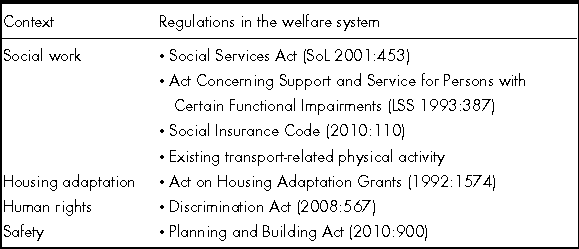
Social participation in one's residential environment is important for health and wellbeing (Thordardottir, Reference Thordardottir2016). Moreover, social support is a basic human right and is increasingly important to elderly with housing arrangements (United Nations, 2007; World Health Organization & The World Bank, 2011). Regrettably, there are apparent reductions in support for elderly people with disabilities for various reasons (Post et al., Reference Post, Nooijen, Postma, Dekkers, Penninx, Van den Berg-Emons and Stam2017). In Sweden, people with disabilities are eligible to receive housing and personal assistance under the Swedish personal assistance system. Table 1 gives a list of social interventions and regulations in Sweden concerning social work, housing adaptation, safety and human rights.
Social Intervention and Regulations in the Swedish Welfare System

LSS = Law regulating support and services to persons with certain functional impairments; SoL = Social Services Act.
Several studies describe injuries in residential environments (Bonander, Gustavsson, & Nilson, Reference Bonander, Gustavsson and Nilson2016; Thodelius, Ekman, Lundälv, & Ekbrand, Reference Thodelius, Ekman, Lundälv and Ekbrand2017), which may also include injury from violence occurring in the homes, sometimes leading to fatality. However, few studies in residential environment injuries have included elderly people with disabilities and chronic diseases, to report on their coping strategies. One study investigated elderly mobility and safety issues for elderly people and what this issue means for elderly people in different kind of environments (Bamzar, Reference Bamzar2017). Bamzar argue: ‘One immediate answer could be that safety perception is an outcome of both emotional and physical comfort. However, the magnitude of each of these factors varies from older individual to older individual’ (Bamzar, Reference Bamzar2017, p. 26). Another study focused on injuries sustained by wheelchair users with spinal cord injury (Butler Forslund, Reference Butler Forslund2017), while yet another focused on actively adjusting to changed living conditions about women with chronically reduced physical abilities (Prack, Reference Prack2017).
The research study aimed to address the following questions regarding the residential injury experiences of elderly Swedish people with chronic illness or disability: (1) Which coping strategies do the elderly people report to use to manage risks and injury events in their residential environments? and (2) What significance do elderly people in residential environment attach to recovery resources following the experience of injury event? Findings would be important for support interventions for elderly people with chronic illness or disability and with residential injury experience.
Method
Study Sample and Procedure
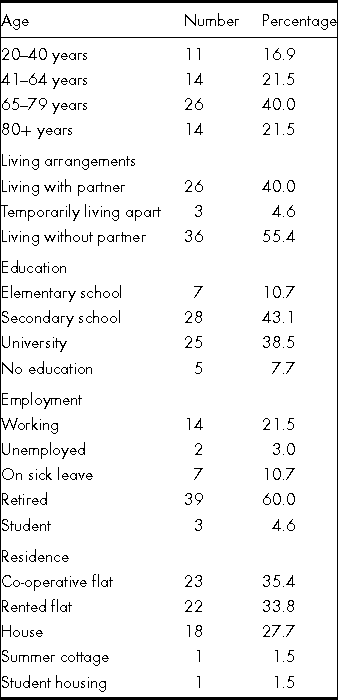
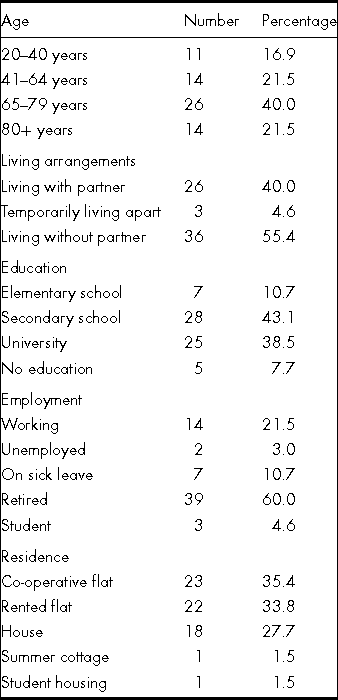
Informants were 65 people with different disabilities and chronic diseases, living in southern Sweden (see Table 2). In total, 40 women (61.5%) and 25 men (38.5%) participated. Participants were 20–90 year old. The study sample included individuals who had both congenital impairments (N = 10, 15.4%) acquired disabilities (N = 23, 35.4%) and chronic diseases (N = 32, 49.2%). They presented with disabilities including: osteoporosis; acquired brain injuries; visual impairments and blindness; physical (motor) impairments; neuropsychiatric impairments; Parkinson's disease; rheumatic diseases; and hearing impairments. The sample was selected by random selection conducted in consultation with different patient association and disability organizations. The majority of the participants were 65 and older (N = 40, 61.5%). More than half lived alone (see Table 2). The most common type of accommodation was an apartment, or co-operative flat. Altogether, 38.5% of participants had a university education, and 70.7% were retired or on sick leave.
Characteristics of Participants: Age, Living Arrangements, Educational Level, Employment and Residence
Data Collection and Procedure
The study has been conducted in Västra Götaland County, in the southern part of Sweden. The participants self-reported their social demographics, including marital status, housing conditions, education, social networking (family and children), employment and diagnosis. Data were collected utilizing an interview guide (protocol) and were developed in cooperation with a patient representatives from seven different patient associations and disability organizations in Sweden: the Osteoporosis in the Sweden Union, the Swedish organization for People with Acquired Brain Injury (Hjärnskadeförbundet Hjärnkraft), the Swedish Association of the Visually Impaired, DHR – Organization for People With Impaired Mobility, the Swedish Parkinson´s Disease Association, the Swedish Rheumatism Association and the Swedish Association of Hard of Hearing People (HRF). Experiences and knowledge from these associations and organisations have a unique insights and input for this research study (Priestley, Reference Priestley2003; Priestley, Waddington, & Bessozi, Reference Priestley, Waddington and Bessozi2010; Rönnmark, Reference Rönnmark2011; Wermeling & Nydahl, Reference Wermeling and Nydahl2011).
The participants self-reported their demographics (gender, age, living situation, vocational status, occupations, educational level and residence). They then completed an open-ended interview question on the following area of questions: injury event; experience; space; aids; attitude; and injury prevention and knowledge of injuries. Probe questions were utilized to encourage all participants to reflect on the issues they raised during the interview. The author of this article has conducted all interviews with the participants (N = 65).
In total, 47 out of the 65 interviews took place in the premises of the patient associations. There were no specific selection criteria set of the participants in the present study. All participants in the study have some connection with the patient association or disability organization as a member. In total, 16 interviews were conducted in a single room at the university, while 2 were conducted via telephone. The individual interviews were conducted during a face-to-face interview by the author of this article. The interviews lasted between 30 and 60 minutes. The interviews took place from November 2016 to June 2017. The interviews data were sound recorded and subsequently transcribed verbatim for the data analysis. The investigator also made living situation observations in two residential environments.
Ethics and Ethical Considerations
Approval for the study was granted by the Swedish Civil Contingencies Agency in Stockholm, Sweden (2013–4176) and the Regional Ethical Review Board in Gothenburg, Sweden (Dnr 366-16). In addition, the collaborating patient organizations approved of the interview questions as previously noted. All the interviewees provided written and oral consent to participate in the study. They were informed of the aim of the study and also assured that their data would be used for research purposes only.
Data Analysis
Data were thematically analysed following standard procedures (see Braun & Clarke, Reference Braun and Clarke2006; Chapman, Hadfield, & Chapman, Reference Chapman, Hadfield and Chapman2015; May, Reference May2011; Miles & Huberman, Reference Miles and Huberman1994). Data codes were marked and analysed into different themes.
Findings and Discussion
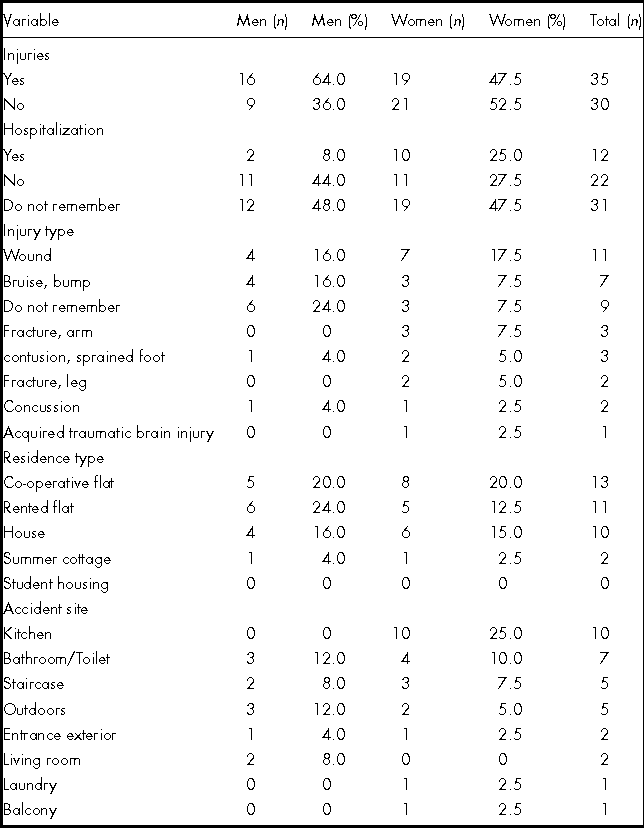
The participants described risky situations in the residential environments and also described injury events, the outcome (consequences) and their own coping strategies (see Table 6). Both theoretical concepts (coping and social support) and previous research have been used in the analysis. The empirical findings in the study including three themes have been described with quotations.
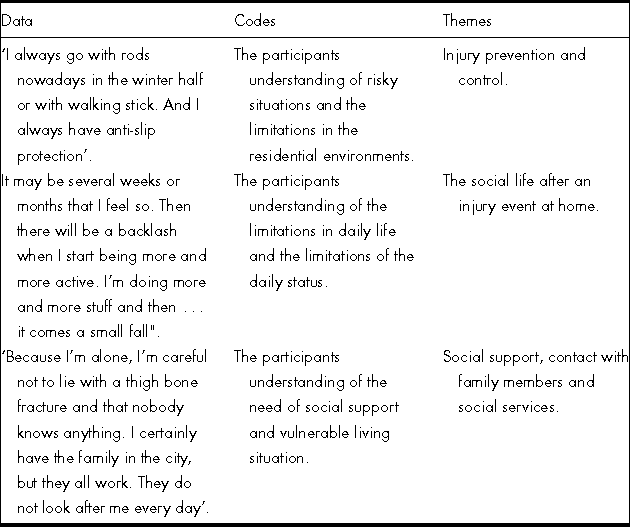
A total of three themes emerged from the thematic analysis (see Table 3): (1) injury prevention and control, (2) the social life after an injury event at home and (3) social support and contact with family members.
Illustrations of Codes and Three Themes in the Qualitative Study

Theme 1. Injury prevention and control
The participants described the injury events (see Table 6). Several participants told about situations at the residential environments. One participant described his experiences of an injury event:
I've hit my head most but that's because I'm most wild. [. . .] Like, I have no clothes on. I'm completely naked and it's wet on the floor and it's going to be great. And I can get . . . but I have spasticity in the body that makes me suddenly stop working altogether. And it may happen in the middle of a move. So then I get stiff like a stick. You know how a stick falls . . . yes. And then one can just hope that it will be fine (male, 45 year old, motor impairments).
Several participants had experience of fall-related injuries. One participant described the vulnerability and disability like this:
I've had a cerebral palsy injury since birth, which makes me suffer. Unfortunately, when I use my crutches, it's very easy to fall and usually so . . . I fall very easily because my feet and legs are weak on me. I do not have much muscle and I'm prone to contractions in my feet (female, 37 year old, motor impairments, cerebral palsy).
There were participants who did not like to dwell on the injury event. One participant observed: ‘I've decided that if I hit myself then it's a passing event and that event has not existed since. Without it it's done and it's done as long as I can stand and I can handle myself’ (man, 67 year old, blindness and visual impairments).
One participants diagnosed with osteoporosis described the importance of injury prevention in her daily living:
‘I always go with rods nowadays in the winter half or with stick. And I always have anti-slip protection’ (female, 65 year, osteoporosis).
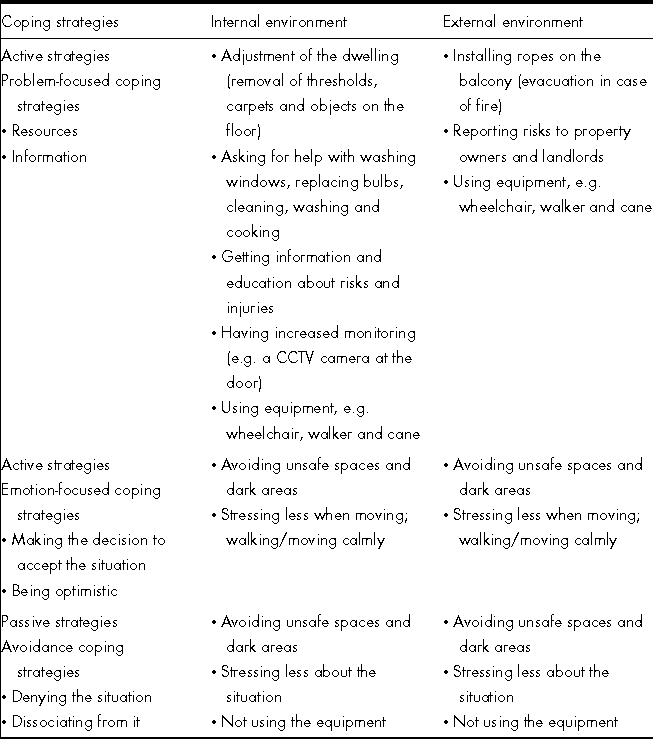
The participants reported to use both active and passive coping strategies (see Table 4). These strategies can also be described as strategies for injury prevention. In addition, they said to have access to many resources, including equipment such as mobility aids, personal assistance, their employment and their participation in disability organizations. They had support from friends and family. By ‘resources’ is also meant information about their illness, which could be learnt from listening to their social service providers and participating in information meetings to get acquainted with training opportunities and preventive measures.
Coping Strategies of Disabled People in Residential Environments

Active coping strategies comprised being optimistic and meaning focused. For instance, a young woman who had a fall-related accident (staggered backwards) said:
You are constantly learning to deal with this and find strategies. . . .to handle situations in a new way and . . .at home. But now I've found strategies for most situations and it's getting better and better (female, 27 year old, acquired brain injury)
A man with the diagnosis rheumatism explains that he cautiously moves in the apartment and he is very wary of rushing to the phone:
If the phone rings, it will get ring. We do not run to the phone that you may want to do to answer. In that case it is better you call (male, 70 year, rheumatism).
A man told about living in cellar in the house that had no housing adaptation (not adapted):
I also have a special bike on three wheels. I could not take the bike up and down for that staircase even when I was 25 years old. It's really steep. I actually risked getting the whole bike over me, which I almost got too (male, 43 year old, motor impairments and neuropsychiatric impairments).
A man told the meaning to use ladders and to sit on chairs to avoid fall-related incidents:
I have learned to stand on ladders without tumbling down. I can not do that. I learned that at school. Today I'm not on ladders and I do not recommend anyone in my age to stand on a ladder. And if I do, I'll have stairs that are wide. Not those rounds because then the foot may turn out when you get tired (male, 80 year old, hearing loss impairments).
A female participant with acquired brain injury said:
Before, when I walked up or down stairs, I could stay on the phone while walking and I could also . . . but now you need to totally focus when climbing stairs [. . .] And if there are no handles, I do not usually use the stairs. Try to avoid them and take the elevator instead. I see some stairs are very steep or there's not a good handle or . . . so that's clear (female, 27 year old, acquired brain injury).
Theme 2. The social life after an injury event at home
The second theme in the study describes the participants understanding of the limitations in daily life and the limitations of the daily status. A young participant described the limitations in daily living:
It may be several weeks or months that I feel so. Then there will be a backlash when I start being more and more active. I'm doing more and more stuff and then . . . it comes a small fall (female, 21 year old, acquired brain injury).
Another participant describes different restrictions in social life. A young woman wants to be involved in recycling waste. She wants to be able to throw away her garbage in a special recycling station house outside the home. But the recycling station is not adapted to her:
They have not thought about it. It is not on their agenda. I also want to be involved. I also want to go there like other people and throw my garbage. I do not want to have my garbage lying for several days on the balcony. I also want to be able to contribute and help and facilitate the environment (female, 37 year old, motor impairments).
A participant with acquired brain injury described his social life:
I do not meet so many people today but earlier I was more social and met a lot of people. It has decreased. I'm having my brain injury and is so sound sensitive now (male, 57 year old, acquired brain injury).
An elderly woman diagnosed with Parkinson's disease describes how she feels lonely in her home after suffering from several fall-related incidents:
Loneliness is apparent. More or less. I eat a lot more when I have a company. For now I've lost weight. Now they come home to me to make sure I'm eating. That is fortunate (female, 84 year old, Parkinson´s disease).
Theme 3. Social support, contact with family members and social services
The third theme in the study describes participants understanding of the need of social support, vulnerable living situation and contact with family members. Participants reported the need of social support to facilitate everyday life. A woman describes the loneliness of everyday life:
Because I'm alone, I'm careful not to lie with a thigh bone fracture and that nobody knows anything. I certainly have the family in the city, but they all work. Do not look at me every day (female, 84 year old, Parkinsons disease).
About 17 participants (26%) were of the view that they had a very good relation with the social service professions after the injury events. Four of the participants (6.1%) perceived social workers untrustworthy. One of the participants said:
I think I feel that the government officials I have met often have a very bad understanding and I think they listen more to . . . I had a conversation with the social worker this week and I feel that she is listening more to what the personnel in the habilitation profession says than to what I say. And for anyone for whom it's easy to fix everything, it's hard to understand how such little things can matter so much to me (female, 28 year old, motor impairments).
A participant described a social worker who made a home call to discuss her life situation:
My son wasn't able to help but then the assessor saw the whole situation. So did I, once we discussed it. I would like to have an alarm at my summer cottage. Because I have a telephone problem, I get into problems there. And I can say that in the end, my communication problem was the biggest problem because I could not talk to people on the phone (female, 82 year old, deaf, hearing loss impairments).
A participant with an acquired brain injury described the importance to get cleaning help from his housing assistant. However, another participant said to be self-dependent:
Because the one I want they can't give. They [professionals] are interested in how many patients are passing through the system (male, 43 year old, motor impairments and neuropsychiatric impairments).
Another participant with motor impairments describe himself to be powerless in his interactions with an occupational therapist. ‘[the] occupational therapist approves everything. . . .[and] constantly monitor what needs you have’ (male, 45 year old, motor impairments).
The participants' experiences show that they have difficulties to communicate with authorities and professions as occupational therapists and social workers. Particularly, difficulties are to be listened to by social workers and other professionals in the field of the habilitation services.
A study of provision of home help service for elderly people in Sweden and the possibilities to reduce the incidence of fall-related injuries show ‘that there was no evidence of an average effects of the home help services intervention on municipality-level hospital admission rates’ (p. 418, Bonander et al., Reference Bonander, Gustavsson and Nilson2016). The present study shows that several participants have limited experiences of support from home help services intervention (see also Bonander et al., Reference Bonander, Gustavsson and Nilson2016).
However, some personal assistant found the help giving stressful. A women with motor impairments said:
My assistant [was] very stressed and walked around doing nothing. I sensed her distress while I was calling my relatives and the ambulance [after a fall] (female, 37 year old, motor impairments).
One participant described vulnerability to a personal assistant as follows:
On a number of occasions I've had an assistant with me who has been aggressive. And then it is that you are so vulnerable because I am myself with this other person and I am very defenceless (female, 28 year old, motor impairments).
Others related that they were afraid to apply for housing adaptation because they feared losing the right to assistance. One participant had a personal assistant but was afraid to lose this support due to cuts:
The assistance will disappear so . . . yes, what can I do? I just have to adjust and I dare not think what it means, so I don't. Without getting it . . . I will have to make a plan. I'm just very glad we didn't have the house adapted. Because I know that would have increased the chance of getting rid of the assistance. [. . .] I use it as an argument to get assistance, i.e. that the apartment is inappropriate (male, 45 year old, motor impairments).
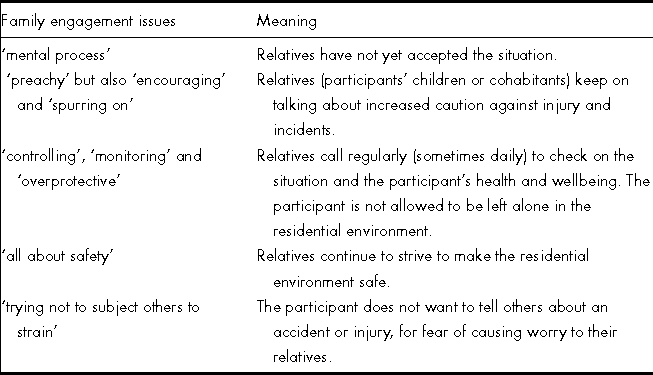
Participants with older parents who lived in their own homes were concerned about their family situations (see also Table 5). For instance, a participant said:
Once I had a knee ache but I did not take it so seriously. I did not even call my daughter, living in the house next to me. I sat there for a while and then I went to bed because it was in the middle of the night. It was the first time. But by that event, I got a brainwash (female, 84 year old, visual impairments).
Interviewers’ Perceptions of Concerns of Members of their Social Network

Another said:
I have two parents working in care so they have helped me very much. But you don't want to be a burden to your relatives. You just want as much help as is possible without inconveniencing anyone (female, 27 year old, acquired brain injury).
One participant expressed the fear of being trapped in a broken elevator. The participant said:
The only thing I've heard in the house was that people had got stuck in the elevator. Two young men screamed in the elevator and called the emergency service so they could come to rescue them (female, 70 year old, osteoporosis).
Another talked about the danger of going to the toilet because the toilet seat was broken. The participant described:
So I need a new toilet seat because the old one is broken. It's not easy for me in my situation because I do not have someone who can help me and my economy is so bad so it is hard to buy things but also because nobody can help me go shopping. It's really not easy (female, 28 year old, motor impairments).
The participants not only described vulnerable situations at the home environment and the need of support from family members but also social services in the society.
Participants Experiences of Injury Events in Residential Environments

Discussion and Conclusion
Previous study has shown that there has been some barriers to disabled people when personal assistance comes from family members (Dunér & Olin, Reference Dunér and Olin2018; Thordardottir, Reference Thordardottir2016). Further research could bring more knowledge and awareness about the effects and importance of housing adaptations in terms of quality of life, economic costs and social sustainability. A study by Bamzar (Reference Bamzar2017) shows, for example, ‘distance decay’ concerning elderly people´s perception of safety. The consequence of this is that elderly people's perceived safety is closest to the housing environment and decreases when the distance increases.
The first theme shows that the participants have become more risk conscious after they suffered injury events at home. They are now moving slower and trying to avoid risks. Participants tell them to stress less and have learned to use anti-slip protection.
The second theme is about limitations in the individual's social life. The daily form determines how social life becomes. The lack of understanding of the environment and lack of accessibility in the housing environment can cause people not to feel involved in social life. Impairment can also lead to the person becoming less active and spending time with fewer friends. Loneliness is perceived as a major problem.
The last and third themes describe the importance of social support from family members and from authorities. Several participants realize that their family members do not always have time to visit them. Sometimes, several participants in the study experience that personal assistants and social workers are stressed and do not have time to listen to their stories.
The most common coping strategy among the participants was problem-focused coping. Participants using this strategy had learned from the injury event and adapted their behaviour in order to avoid risks and prevent injuries. Several felt strengthened by this type of active coping. They felt optimistic. Support from family members was important in encouraging them.
Most European countries are faced with challenges regarding the ability of their welfare systems to provide social intervention, especially in the older population, when injury events have occurred. Sweden belong to those countries where the proportion of old people and people with disability in the population is increasing. In the future, the demands for social support and efforts from social workers will increase further as the population grows older.
This study shows that a great deal can be learnt from people with experience of injury events. Most participants in this study had become more aware of their own vulnerability, while several had become increasingly dependent on support. Personal assistance is an example of support, but at the same time it may mean increased dependence or helplessness if the assistant does not provide adequate assistance.
Acknowledgements
The author thanks the participants in the study who contributed with their experiences. He would also like to thank the involved disability organizations. Also, the Swedish Civil Contingencies Agency (MSB) for funding the study, as well as to the members of the research group (ArchSafe) at the Department of Architecture and Civil Engineering, Chalmers University of Technology. He also thank Barbro Lennéer-Axelson, psychologist and colleague at the Department of Social Work, University of Gothenburg for providing comments on this manuscript.