Linguistic landscape (LL) research has been subject to a great deal of attention since the publication of the well-known research paper by Landry and Bourhis (Reference Landry and Bourhis1997), whose most quoted definition of LL covers diverse linguistic tokens, including but not restricted to government-related inscriptions, street-name signs, commercial signs, and noticeboards. There is an increasing number of contributions on the use of English in many LLs worldwide. However, there are relatively few LL publications on the use of English in the LL in Arabic-speaking countries (but see Al–Naimat & Alomoush, Reference Al–Naimat and Alomoush2018; Alomoush, Reference Alomoush2019). The vast majority of previous LL studies in non-Arabic contexts (e.g. Backhaus, Reference Backhaus2007; Griffin, Reference Griffin2004; Hasanova, Reference Hasanova2010; Jaworksi & Thurlow, Reference Jaworksi and Thurlow2010; Lanza & Woldemariam, Reference Lanza and Woldemariam2014; Ross, Reference Ross1997; Schlick, Reference Schlick2003) focus on analysing language on fixed or relatively stable signs, such as shop names.
LL studies conducted in Jordan to date have only focused on fixed signage. Therefore, providing data on little-explored mobile LLs on printed shopping bags is an opportunity to examine the kind of language use that has received little theoretical and empirical research attention to date. To explore how and why code choices are used on both monolingual and bi/multilingual signs, I will specifically analyse language use on printed shopping bags, because these might be taken to be representative of the mobile linguistic sources in the LL (and are certainly the most frequently occurring). Typically, LL studies have focused on fixed signs so focusing on shopping bags provides an opportunity to explore the linguistic practices of printed advertisement sign designers (e.g. shop owners and commercial enterprises) in the mobile LL.
Research on LL can provide important information about the attitudes of the local population towards multilingual communication in advertising (Holmes, Reference Holmes2013). ‘The language of advertising’ is used for ‘a particular purpose’ in the sense that advertisers utilise ‘linguistic fetishes’ associated with the languages that consumers regularly use or admire in an attempt to ‘lend credibility to the product’ (Kelly–Holmes, Reference Kelly–Holmes2005: 9, 54). Even though English is not widely spoken in Jordan, the mobile linguistic resources in the LL have important symbolic functions in Jordanian commercial discourse. Thus, based on what has been established so far, my goal in the current paper is to examine how and why sign designers (e.g. shop owners and commercial enterprises) tend to use English and mixed codes (i.e. Arabicised English [AE] and Romanised Arabic [RA]) on advertisements printed on shopping bags. In examining the commodification discourses in operation, in the current paper I make the theoretical assumption that the local businesses are represented as commodities through employing advertisements printed on shopping bags as a means of justifying the consumption of products and services provided by the relevant stores.
Data
The LL data and samples presented in this paper are obtained from a corpus of advertisements on shopping bags in different cities in Jordan (i.e. Amman, Zarka, and Tafila) collected between September 2018 and January 2019. These cities were chosen due to their diversity from one another. Amman, with a population of over 4 million, is the largest, most modern, and most cosmopolitan city in Jordan, as well as being the seat of government. Zarqa (population 635,000) is Jordan's second city, is historically associated with the military, and is heavily industrialised: it thus lacks the cosmopolitan flavour of Amman. Tafila (population 28,000) is a relatively inaccessible provincial city: the economy is dominated by agriculture and mining, with significant domestic, but not international, tourism. Thus, the chosen cities together provide a broad socio-cultural context for LL study, representing large, medium-sized and small population centres, and cosmopolitan-professional, urbanised-industrial, and traditional-local cultures, respectively.
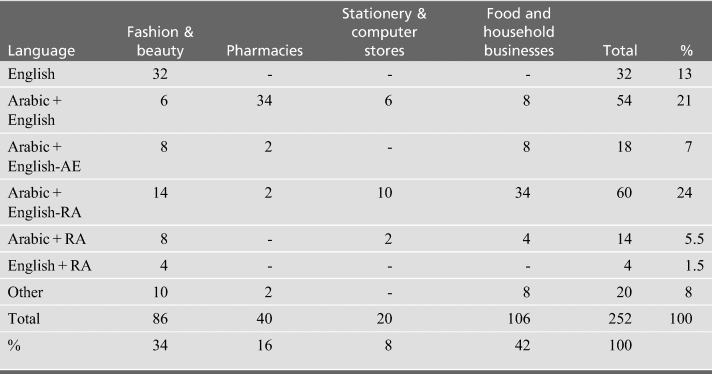
As Table 2 shows, photographed samples of language printed on 252 shopping bags were obtained from fashion stores, pharmacies, bookshops, computer stores, restaurants, supermarkets, and bakeries. As far as the unit of analysis is concerned, each text on a shopping bag is considered a separate sign, but all shopping bags belonging to the same business or establishment are categorised as a single sign. Any shopping bags that do not display specifically linguistic material have been excluded.
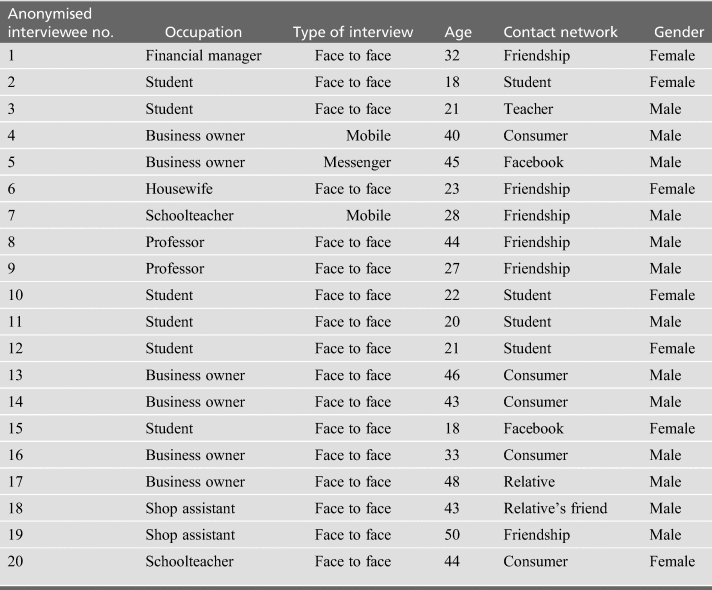
The second phase of data collection and analysis included 20 interviews with Jordanians from all three cities (see Table 1). A copy of the questionnaire may be obtained from the author at alomoushomar@ttu.edu.jo; alomoushomar@yahoo.com. Contrary to previous LL studies (e.g. Caldwell, Reference Caldwell2017; Peck & Stroud, Reference Peck and Stroud2015; Selvi, Reference Selvi2016) that have tended to elicit responses and reactions from particular participants (i.e. t-shirt wearers, designers, and manufacturers, tattoo clients and artists, and business owners, respectively), the current study has obtained ethnographic data based on the diversity of the Jordanian population, as defined by gender and occupation. The interviews are important in that they contribute significantly to the elaboration of the results from the LL fieldwork. Table 1 shows the different types of interviews conducted, using face-to-face as well as non-traditional techniques such as mobile and messenger interviewing. In addition, six students (three male and three female) and two (male) professors based in the English Department of Tafila Technical University were interviewed, in order to understand the public's perceptions of the use of English on transient signs, and by extension to understand the advertisers’ motivations for using English.
Interviewee details

The aim of the sociolinguistic interviews was to obtain information from the participants that can account for the widespread use of English on advertisements on shopping bags. The interview was structured into three main parts. The first part was designed to elicit details about the participants’ age, gender, and occupation. The second part asked the participants whether they use English and, if so, in which domains and whether their parents, relatives, or friends tend to also use English, ending with a question about the participants’ personal opinions and perceptions about Jordanians’ proficiency in English. The third part was primarily designed to elicit information about the participants’ views on the extent of the use of English in the LL, types of stores more likely to use English, and whether the use of English in the mobile LL is reflective of Jordanians’ linguistic competence in English (and if not, what it represents).
Findings
Table 2 displays the relative and raw frequency of languages used on advertisements on printed shopping bags. The data provided in Table 2 show that fashion and beauty on the one hand, and food and household businesses on the other, feature very different LLs. As far as monolingual signs are concerned, Arabic-only signs are found on about 20% of all signs (50 signs). On the other hand, monolingual English signs are found on 32 signs (approximately 13% of all signs).
Summary of languages used on advertisements on printed shopping bags

There are different bi-/multilingual patterns that typically emerge as a result of global forces. Most remarkably, English does not only appear in Roman script, but it may be provided in Arabic letters, as the printing of business names on shopping bags (e.g. ساندي بل Sandy Bell, صيدلة اوكسيد Oxide Pharmacy). RA appears alongside both Arabic and English on 60 signs (about 24%), instances of which include the business names محامص الشعب Al Shaab Nuts and الهاشمية مول Al-Hashmiah Mall.
Fashion and cosmetics companies constitute some of the best-known brands in Jordan, and there is a cultural expectation that Jordanian women will keep up with the latest fashion styles and apply the latest cosmetics (e.g. natural creams, skincare products, and colour cosmetics). Therefore, many fashion and cosmetics enterprises in Jordan have to both reflect and keep up with the latest Muslim and Western fashion trends. According to the figures provided in Table 2, 34% (86/252) of all signs are closely related to advertisements printed on the shopping bags of fashion and cosmetics shops. Despite the very low proficiency in English in the Jordanian community generally, monolingual English signs appear on 32 out of 86 bags (e.g. M-SIXTY FASHION LIFE, ONE minute out let, CMYK accessories, THANK YOU for shopping, and H HARDY Shoes & Bags). RA appears alongside Arabic and English on fourteen signs (e.g. ملبوسات حواتمة البسة سبورات للجميع HAWATMEH STORES CASUAL WEAR FOR ALL, ضراغمة ضراغمة للكل Daraghmeh for all), alongside Arabic on eight signs (e.g. the Arabic business name in Roman script ALNAJAR followed by an elaborative message, information in Arabic about the location and the cell phone number, and the duplicating bilingual business name القبس Al-QABAS), and four times alongside English (e.g. the business name Tashtoush COSMETICS & PERFUMES). AE alongside Arabic and English features in eight signs. It is surprising that bilingual Arabic–English signs only appear twice (شكرا لتسوقكم بضاعتنا, meaning ‘Thank you for shopping our goods’, followed by the business name GOOD TIME and مهرجان الخمسة FIVE). Other signs, which total 10 out of 86 signs, include other languages such as Turkish and Italian-English (e.g. ANGELO ARDELLI AMMAN-Gardens St. TEL:5519978).
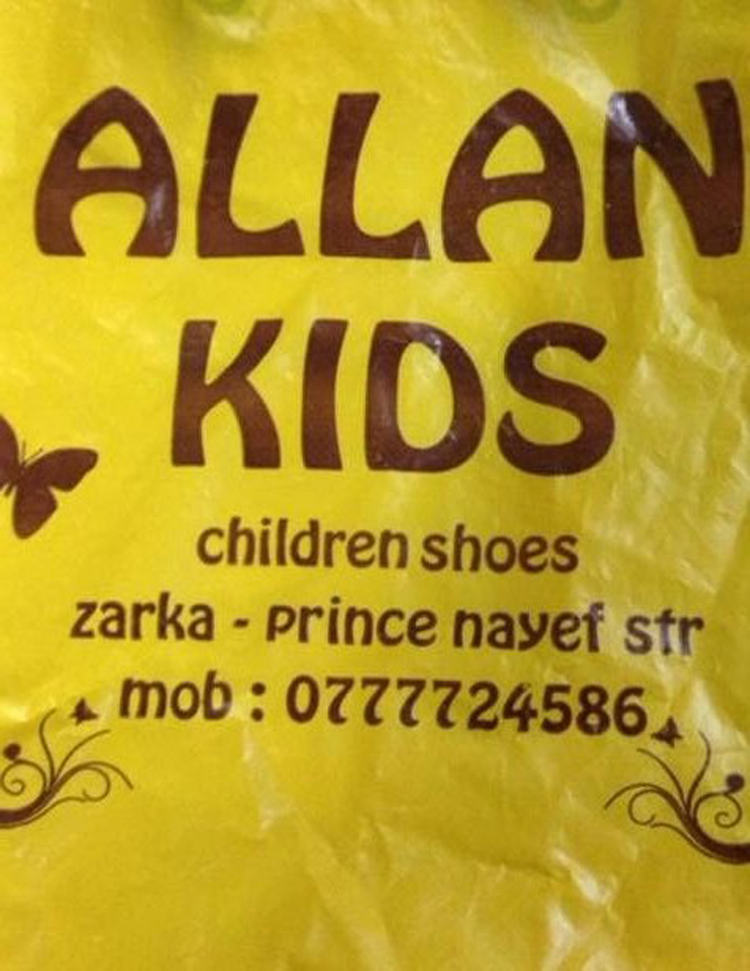
We can agree that English and code-mixing practices are more widespread than Arabic, as linguistically manifested on fashion storefronts. This is in alignment with previous studies (Al–Naimat, Reference Al–Naimat2015; Alomoush, Reference Alomoush2015; Alomoush, Reference Alomoush2019) that provide credible evidence regarding the value of English in achieving commercial success and social prestige attuned to the needs of the local consumers. Figure 1 presents a prime instance of English lettering alongside some Arabic words in Roman letters. It should be noted that business names in English, in most advertisements on fashion shopping bags, appear in larger font sizes.
English alongside RA featuring an advertisement on a printed shopping bag

Food and household businesses include supermarkets, traditional Arab dessert shops, restaurants, and bakeries. Of the 252 signs, 106 (approximately 42% of all signs recorded) are used to advertise these stores. In comparison with other commercial enterprises, Arabic-only signs (44 out of 106, approximately 20% of all signs) take up the lion's share. Unlike fashion shopping bags, which do not tend to display many Arabic-only vis-à-vis English-only signs, advertisements displayed on food business shopping bags tend towards not featuring monolingual English texts, a distinctive characteristic feature that marks the written fashion business discourse in the Jordanian LL (see Alomoush, Reference Alomoush2019). This can be partly attributed to the assumption that many food businesses tend to use highly attractive business name signs of Arabic origin so as to add uniqueness and originality both to the business itself and the products sold, such as the business name ‘بزورية بيلس’ followed by an elaborative message related to the food items sold: ‘مكسرات قهوة عطارة بهارات’ meaning ‘nuts’, ‘coffee’, ‘herbs’, and ‘spices’, respectively. As generally noted in Jordan's written commercial domain, in low- and middle-prestige areas, monolingual Arabic texts are often used as a means of promoting the relevant food business enterprises and consequently achieving commercial objectives.
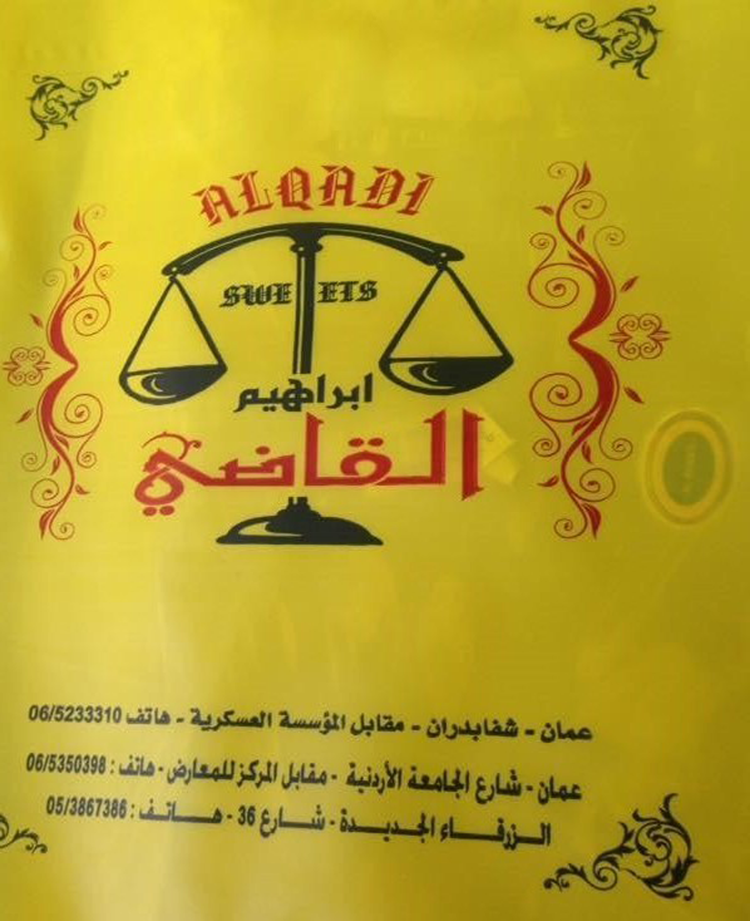
The Arabic–English-RA multilingual pattern (34 out of 106) is the second most used combination printed on the shopping bags of food businesses, as noted on the vast majority of advertisements printed on those initiated by prestigious business stores, traditional Arab dessert shops, and many restaurants. As Figure 2 illustrates, the brand name in the Arabic lettering ‘إبراهيم القاضي’ reads ‘IBRAHIM ALQADI’. The single RA word in red, ‘ALQADI’, represents a highly reputed traditional Arab dessert shop name nationally, which is duplicated in the red lettering in Arabic in a much bigger font size. In using English as a symbol of Western culture, internationality, and commercial success, it mirrors the construction of globalised identities. Equally importantly, it seems plausible that the use of Arabic in Roman letters reflects the covert language policy of the store to attract not only customers coming from outside the local community, but also members of the local population, particularly the younger generations. On the other hand, it seems that Arabic is used by the commercial enterprise to reconcile with the local population (i.e. using Arabic as a sign of solidarity with the local community), emphasising its preference for Arabic through the much larger font size of the Arabic wording.
A prime example of Arabic–English–RA pattern to advertise the products of a traditional Arab dessert shop

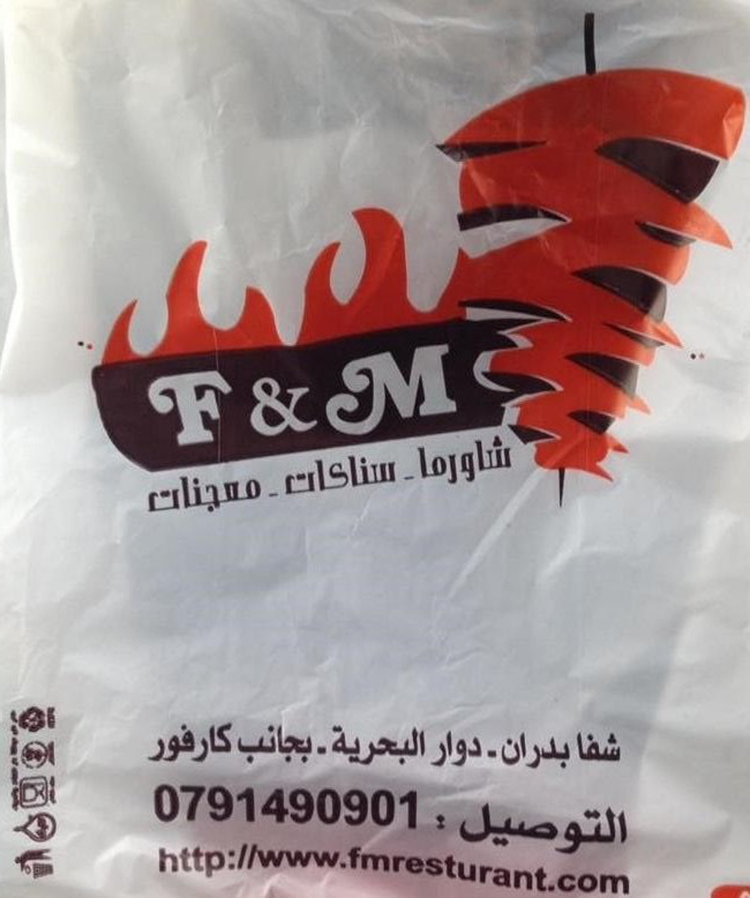
It is possible that English appears alongside Arabic (as it does in eight signs) and Arabic and AE (also in eight signs). In what follows, the sign in Figure 3 represents a prime example of complementary multilingualism, as noted and suggested by Reh (Reference Reh2004), that has multiple words. The business name is presented in the initials of unidentified words in Roman script: F & M. The sign also indicates the meals and snacks provided in the restaurant: شاورما سناكات معجنات, meaning ‘Shawarma, snacks, and pastries’. Additionally, the advertisement in Figure 3 includes an elaborative message, important information about the location of the restaurant (i.e. شفا بدران دوار البحرية بجانب كافور, meaning ‘Shafa Badran, Marine Academy Roundabout, near Carrefour Stores’), contact details for delivery provided in Arabic, and the website through which people can identify a list of the meals offered in the restaurant.
An English–Arabic bilingual pattern displayed on a shopping bag provided by a restaurant

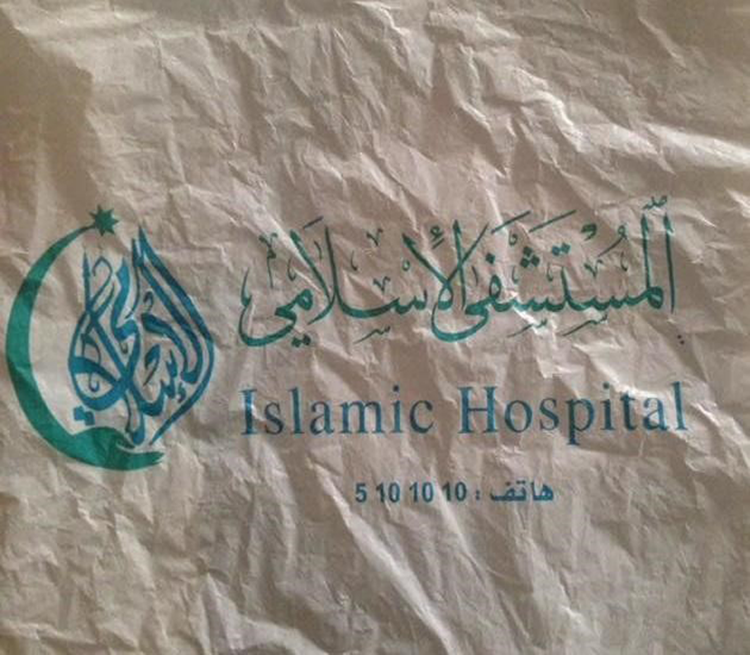
All types of medicines obtained from the local pharmacies and hospital dispensaries are bagged up in white plastic bags displaying linguistic texts, often in both Arabic and English. A total of 34 signs out of all medical bags (40 signs, approximately 16% of all signs) are provided in Arabic and English, most of which include صيدلية and Pharmacy and not necessarily including the business name. The bag in Figure 4 is a prime example of Arabic–English duplication, a relatively constant feature of the Jordanian medical LL; more specifically, the hospital name المستشفى الاسلامي has been duplicated into Islamic Hospital, but الهاتف, meaning ‘telephone’ has not been translated into English. The remaining bi-/multilingual patterns include Arabic–English–AE (two signs), Arabic–English–RA (two signs), and other signs (two signs).
A hospital dispensary bag displaying both Arabic and English

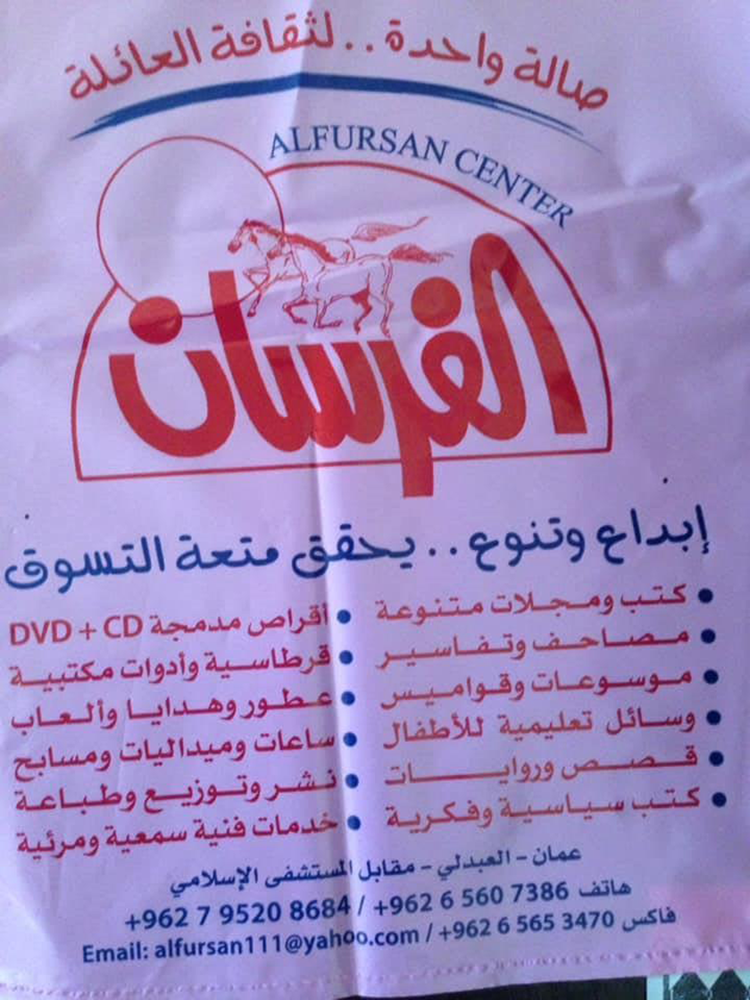
One of the most important impetuses for printing English on computing and stationery bags is to indicate the quality of stationery products sold and services offered. The trilingual (Arabic–English–RA) pattern appears on 10 out of 20 signs (see Table 2). The sign in Figure 5 displays the English wording (i.e. the business name ALFURSAN CENTER, DVD and CD) in a smaller font size than the Arabic lettering, which includes the stationery store name الفرسان as transliterated above and the items sold and services offered. Other monolingual and bilingual patterns include six Arabic–English signs (e.g. محطة لوازم الحاسوب Computer Supply Depot followed by information about the location of the store), two Arabic–RA signs (e.g. محلات العلبي لجميع انواع الحقائب OLABI, meaning ‘Olabi Stores for all kinds of bags’ and two Arabic-only signs.
A stationery shopping bag displaying the trilingual (Arabic–English–RA) pattern

Attitudinal assessment of the visibility of English on linguistic texts printed on shopping bags
In a response to a question about whether the use of English in the LL represents the linguistic competence of Jordanians, most of the participants stated that it is only used for symbolic values. Participant 9 commented:
Fashion & cosmetics and electronics stores are keen on using English more than others, but this does not reflect the linguistic competence of the Jordanian community; its presence is only cosmetic and is mainly used for attracting the consumers and showing the quality of the products in these stores.
(Male professor aged 27)The reasons provided by the participants for the widespread use of English in the commercial LL are: (a) to ensure the standard and quality of the products; (b) to attract the attention of the consumers and achieve social prestige and commercial success; (c) to symbolise advancement, refinement, and modernity; and (d) promote the tourism industry.
Most of the participants (nearly 70%) thought that the usage of English terms in the LL does not contribute to the contamination of the Arabic language. The foreign terms that have been consistently used in the Jordanian mobile and non-mobile LLs are mainly from English. In recent decades, the Academy of the Arabic Language in Jordan has been taking active steps to elevate the status of Arabic. Notwithstanding this, six participants (almost 30%) stated that the visibility of English in the LL poses a threat to Arabic in Jordan and they are seemingly familiar with the status and functions of English in the Jordanian context. Participant 2 provided the following response to the above question:
It doesn't pollute the Arabic language, but it is only related to the young generation who show off by using English words and phraseology. Another thing is that people are largely monolingual in Arabic so that they are not proficient in English.
(Female student aged 18)However, Participant 8 was worried about the increasing use of English in the mobile and non-mobile linguistic resources in the LL:
From a psychological point of view, the use of English business names reflects the disintegration of Arabic-speaking individuals from their own mother tongue. Since a language is an essential component of national identity, this undoubtedly reflects a linguistic identity crisis from which the Arabic native speaker suffers.
(Male professor aged 44)The interviewed business owners tended to use English to indicate the existence of small non-Arabic-speaking populations. Participant 14 commented:
There are many customers coming to the store from different countries: the USA, the Philippines, and the UK, so that when they see English words on our shopping bags, they buy our products. For example, if one goes to France, he will buy according to English words.
(Male business owner aged 43)The overall opinions and perceptions of the Jordanian community towards the Englishisation of the LL indicate that the widespread use of English on printed shopping bags is not perceived as a linguistic threat to Arabic. Specifically, advertising business and brand names in English is attributed to symbolic interpretations and explanations in the first place rather than representing Jordanians’ proficiency in English, which means that English words and phraseology on mobile linguistic resources in the LL are no longer understood as ‘linguistic contaminants’.
Discussion and concluding remarks
Based on the discussion in the previous paragraphs, despite the fact that English is not recognised as a co-official language in Jordan, and the local population is not competent in it, it is evident that the popularity of English in the public sphere is an emblem of cosmopolitanism, fashionableness, and commercial success. It plays a key role in the construction of glocal identities among members of the younger generations.
The study results show that monolingual English signs are more used on the shopping bags of fashion stores than on those provided by other stores. In addition, code-mixing practices (i.e. AE and RA) that reflect a melding of local and global identities are frequently found on shopping bags provided by fashion stores and electronics and PC stores. Therefore, English is seen as a prestige language associated with luxury, or as aspiring to global values. Reflecting global English linguistic fetishes in beauty and food businesses and commercial activities, English business names are preferred on the shopping bags of fashion and beauty businesses, and on those of top-end restaurants, which is also true of mixed codes (i.e. AE and RA). This is somewhat in line with other studies (Curtin, Reference Curtin, Shohamy and Gorter2009; Dougill, Reference Dougill1987; Ong, Ghesquière & Serwe, Reference Ong, Ghesquière and Serwe2013; Ross, Reference Ross1997).
The overall unintelligibility of English to Jordanians, meanwhile, is relatively unimportant, since there are socio-symbolic meanings associated with it, which play a key role in the attraction of consumers. This is reflected in the observation obtained from the fieldwork that relatively expensive, single-occasion purchase goods attract the English language, while relatively cheap, multiple-purchase everyday goods attract the Arabic language. This is consistent with Kelly–Holmes (Reference Kelly–Holmes2005), who found that advertisements in the UK tended to use French for symbolic rather than communicative values. To conclude, ‘English seems fetishized with a number of associations such as modernity, internationalism or cosmopolitanism, trendiness, success’ (Kelly–Holmes, Reference Kelly–Holmes2005: 104).
 OMAR IBRAHIM SALAMEH ALOMOUSH is Assistant Professor of English linguistics at English Department, Tafila Technical University, Jordan where he is currently Head of English Department. He completed his Ph.D. at the University of Liverpool, UK. His research focuses on sociolinguistics, English and globalisation, language policy and planning, linguistic landscape, and Arabic linguistics. He has published a number of papers in Arabic sociolinguistics and other sub-fields of linguistics. His address details are as follows: P. O. Box 179, Tafila 66110, Jordan. Email: alomoushomar@ttu.edu.jo; alomoushomar@yahoo.com.