INTRODUCTION
Depression is a leading cause of disability worldwide, affecting 2–5% of the adult population (Regier et al. Reference Regier, Boyd, Burke, Rae, Myers, Kramer, Robins, George, Karno and Locke1988). The pathophysiology of depression is uncertain and is probably varied and complex, but current evidence suggests that inflammation is likely to be involved in at least some cases (Ford & Erlinger, Reference Ford and Erlinger2004). This hypothesis is supported by the fact that inflammation has also been involved in the pathophysiology of atherothrombosis (Ross, Reference Ross1999; Verma et al. Reference Verma, Devaraj and Jialal2006), and depression in later life has been associated with an increased risk of atherothrombotic risk factors and sequelae (e.g. cerebrovascular disease) (Alexopoulos et al. Reference Alexopoulos, Meyers, Young, Campbell, Silbersweig and Charlson1997; Thomas et al. Reference Thomas, Kalaria and O'Brien2004). Furthermore, inflammatory changes have been observed in the blood vessels of people with depression, particularly in later life (Thomas et al. Reference Thomas, Davis, Morris, Jackson, Harrison and O'Brien2005).
C-reactive protein (CRP) is a commonly used non-specific marker of low-grade inflammation that has been prospectively associated with increased risk of cardiovascular disease (Danesh et al. Reference Danesh, Wheeler, Hirschfield, Eda, Eiriksdottir, Rumley, Lowe, Pepys and Gudnason2004). High levels of CRP have also been linked to depression. Kop et al. (Reference Kop, Gottdiener, Tangen, Fried, McBurnie, Walston, Newman, Hirsch and Tracy2002) found that older people with depression (n=510) had significantly higher CRP than non-depressed subjects (n=3750). Further cross-sectional studies have confirmed that high CRP is associated with increased risk of depression in young and older adults (see review by Kuo et al. Reference Kuo, Yen, Chang, Kuo, Chen and Sorond2005), but questions remain as to the causal role of CRP on the development of depression. For example, the findings from the Rotterdam study suggest that the association between CRP and depression may be explained by age, gender, education, use of antidepressants and, importantly, poor health (Tiemeier et al. Reference Tiemeier, van Tuijl, Hofman, Kiliaan and Breteler2003b). In other words, high CRP could simply indicate the presence of an ongoing process of deteriorating physical health, which, in turn, increases the risk of depression. As a result, the association between CRP and depression in later life can only be adequately investigated by studies that measure physical health in a systematic way and that have sufficient statistical power to take its presence into account.
We designed this study to determine the association between CRP concentration and the presence of clinically significant depression in a community-dwelling sample of older adults. Based on the findings from the Rotterdam study (Tiemeier et al. Reference Tiemeier, van Tuijl, Hofman, Kiliaan and Breteler2003b), we hypothesized that the association between CRP and depression is entirely explained by poor physical health.
METHOD
Recruitment of the study cohort
Our analyses are based on data from a prospective cohort investigation of older male residents of Perth, Western Australia, the Health in Men Study (HIMS). Details regarding the enrolment of participants have been described elsewhere (Jamrozik et al. Reference Jamrozik, Norman, Spencer, Parsons, Tuohy, Lawrence-Brown and Dickinson2000). In brief, 12 203 men aged 65 years or older were recruited by random sampling from the Australian electoral roll between 1996 and 1998, enrolment to vote being compulsory for all adult Australian citizens. The participants represented 70·5% of all eligible invitations issued. During the years 2001–2004, those men who were still alive were contacted and invited for a follow-up assessment. This report refers to those who were still alive and consented to follow-up. The study was approved by the Human Research Ethics Committee of the University of Western Australia.
Procedures and assessment
Consenting men were asked to complete a self-report questionnaire that included items assessing demographic and clinical information. Age was calculated as the difference in years between the date of the assessment and the subject's date of birth. Participants were considered to come from a non-English-speaking background (NESB) if they reported that the first language they learnt as a child was not English. Education was rated as the highest level of education attained: no schooling, primary school, some high school, completed high school, completed university or other tertiary degree. We used subjects' postcodes to generate the Socio-Economic Indicator for Areas (SEIFA) Index: ratings lower than 1000 indicate relative socio-economic disadvantage (Bray, Reference Bray2001).
Subjects were asked to indicate whether or not they had ever smoked [Have you ever smoked cigarettes, cigars or a pipe regularly? (yes/no)] and whether they were still smoking at the time of the assessment [How often do you smoke now? (every day/not every day/not at all)]. Men were considered to be current smokers if they answered ‘every day’ or ‘not every day’. Participants were then asked whether they had been previously treated for an emotional or nervous illness such as depression (yes/no) and whether they were having treatment (pills or psychotherapy) for an emotional or nervous illness such as depression now (yes/no).
All men were requested to complete the 15-item Geriatric Depression Scale (GDS-15) and, a priori, those with a total score of 7 or more were considered to display clinically significant depressive symptoms (point prevalence). This relatively high cut-off point was chosen to ensure high specificity for the diagnosis of depression in this sample (Almeida & Almeida, Reference Almeida and Almeida1999). A trained research nurse then administered the Mini-Mental State Examination (MMSE; Folstein et al. Reference Folstein, Folstein and McHugh1975), with scores lower than 24 indicating the presence of cognitive impairment (Crum et al. Reference Crum, Anthony, Bassett and Folstein1993).
Measurement of physical co-morbidity
The assessment of physical co-morbidity involved three components. First, we used the Charlson weighted index (Charlson et al. Reference Charlson, Pompei, Ales and MacKenzie1987) to determine the presence of significant medical co-morbidity in our sample. We obtained administrative medical information from the Western Australian (WA) Linked Database (Holman et al. Reference Holman, Bass, Rouse and Hobbs1999). In brief, the Database links together records of all hospital admissions (private and public) since 1980 with the Mental Health Information System (MHIS), WA cancer register, WA death register and WA hospital morbidity data (which includes all admissions to private and public hospitals). We obtained linked data for all participants until the end of 2004, which was the time of the last assessment at HIMS. Coding algorithms to define co-morbidities followed the procedures described by Quan et al. (Reference Quan, Sundararajan, Halfon, Fong, Burnand, Luthi, Saunders, Beck, Feasby and Ghali2005) and were calculated using Stagg's Stata routine to calculate the Charlson index (StataCorp, 2006).
Second, as part of the assessment for HIMS, men were asked whether they had ever been advised by a doctor that they had had a myocardial infarction (yes/no), stroke (yes/no), or any of the following surgical procedures (yes/no): open heart surgery, carotid endarterectomy, bypass surgery to the aorta or leg arteries, abdominal surgery, hip or knee replacement, lung surgery, brain surgery, prostate surgery, major neck surgery and surgery on the oesophagus.
Third, participating men used the 36-item Short-Form Health Survey (SF-36) to rate their health (Ware et al. Reference Ware, Kosinski and Gandek2000). For the purposes of this study, the analyses were limited to the physical component summary (PCS) measure. The mean PCS for the Australian population is 50, with a standard deviation of 10 (ABS, 1995). Participants with PCS ⩽40 were considered to have poor perceived physical health at the time of the assessment (i.e. 1 standard deviation or more below the mean of the population).
Biochemical analyses
HIMS participants were invited to donate a fasting blood sample for biochemical analyses. We measured the serum concentration of CRP with a high-sensitivity assay that used a particle-enhanced immunonephelometry system on a BNII analyser (Dade Behring, Birmingham, UK). The interassay coefficient of variation (CV) for this test ranges from 4% to 7%. CRP concentration >3 mg/l has been associated with a twofold increased relative risk of cardiovascular events (Pearson et al. Reference Pearson, Mensah, Alexander, Anderson, Cannon, Criqui, Fadl, Fortmann, Hong, Myers, Rifai, Smith, Taubert, Tracy and Vinicor2003). Therefore, we considered that men in our study with CRP >3 mg/l had ‘high CRP’.
Analysis of data
The data were analysed with the statistical package Stata release 9.2 (StataCorp, 2006). Participants were divided into two groups according to whether or not they met the study criterion for clinically significant depressive symptoms. We used Student's t test to compare the differences between the groups for age and the Mann–Whitney test for serum concentration of CRP. We measured the association between ranked ordinal variables with the Spearman correlation coefficient (Spearman's ρ). We calculated odds ratios (ORs) and respective 95% confidence intervals (CIs) from 2×2 tables to measure the strength of the association between demographic, clinical and biochemical characteristics of participants and CRP concentration grouping (according to quartiles and the cut-point of 3 mg/l). We then used multiple logistic regression to clarify whether the association between CRP and depression, as measured by the OR, could be explained by other measured factors.
RESULTS
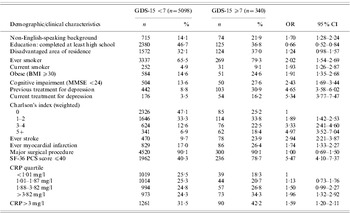
Of the 5438 men who completed the self-rating questionnaire at the follow-up assessment for HIMS in 2001–2004, 340 (6·2%, 95% CI 5·6–6·9%) reported clinically significant depressive symptoms (GDS score ⩾7) and 4245 had a venous blood sample taken. Subjects who scored within the depression range were 2·17 (95% CI 1·71–2·74) times less likely to consent to blood tests, and men who did not have a blood test had a higher weighted Charlson index than those who did (z=6·01, p<0·001). Subjects with depression were also older than their non-depressed counterparts [mean±standard deviation (s.d.): 76·6±4·4 v. 75·4±4·1, t=5·08, p<0·001, range 70–88 years]. Other demographic and clinical characteristics of the sample are displayed in Table 1.
Demographic and clinical characteristics of subjects with and without clinically significant depressive symptoms, as determined by the 15-item Geriatric Depression Scale (GDS-15)

OR, Odds ratio; CI, confidence interval; BMI, body mass index; MMSE, Mini-Mental State Examination; SF-36, 36-item Short-Form Health Survey; PCS, physical component summary; CRP, C-reactive protein.
The distribution of CRP data was positively skewed and although skewness of the data diminished after logarithmic transformation, the variable remained unfit for parametric analysis (Shapiro–Wilk test for normality z score=13·79, p<0·001). Median CRP concentration was significantly higher among men who were depressed than those who were not [2·5 (95% CI 2·2–2·8) v. 1·8 (95% CI 1·8–1·9); Mann–Whitney z statistic=4·04, p<0·001]. There was a very weak direct correlation between depression scores and CRP concentration (Spearman ρ=0·09, p<0·001). There was also a modest association between the weighted Charlson index and PCS score (Spearman's ρ=–0·26, p<0·001).
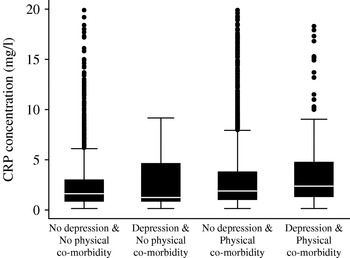
We divided participants into four groups to explore the relationship between depression/physical co-morbidity and CRP (Fig. 1). The first group of men showed no evidence of clinically significant depression or physical co-morbidity (n=1666) and had a median CRP concentration of 1·6 mg/l (binomial 95% CI 1·6–1·7). The group with clinically significant depression but no physical co-morbidity (n=24) had a median CRP concentration of 1·3 mg/l (binomial 95% CI 0·9–4·9). The third group of men had significant physical co-morbidity but no depression (n=3435), and a median CRP concentration of 2·0 mg/l (binomial 95% CI 1·9–2·0). The last group included men who met the study's criteria for depression and physical co-morbidity (n=313); they had a median CRP concentration of 2·5 mg/l (binomial 95% CI 2·2–3·1) (Fig. 1). Men with no depression or physical co-morbidity (group 1) had a significantly lower CRP concentration than men with no depression and physical co-morbidity (z=–5·95, p<0·001) (group 3), or men with depression and physical co-morbidity (z=–5·83, p<0·001) (group 4). Participants with depression associated with physical co-morbidity (group 4) had a higher CRP concentration than men with physical co-morbidity but no depression (z=–3·38, p=0·004) (group 3). There were no significant differences between any other two groups. All analyses were adjusted for multiple comparisons using the Bonferroni method.
Boxplots displayed according to group membership. The solid blocks represent the 25th to 75th centile of C-reactive protein (CRP) concentration for each group. The white horizontal lines across the boxes represent the median CRP concentration.

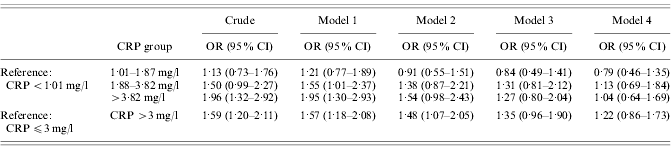
We used logistic regression to clarify whether the association between CRP and depression remained after adjusting for age (in years), NESB, education, disadvantaged area of residence, smoking status, cognitive impairment, previous or current treatment for depression, the weighted Charlson index of co-morbidity, history of stroke, myocardial infarction or major surgery, and PCS score ⩽40 (Table 2). The highest CRP quartile was associated with at least a 19% increase in the risk of depression (lower confidence limit for the crude OR), but the association between CRP and depression weakened once physical health was taken into account (Table 2, models 3 and 4). We performed an additional analysis to investigate the association between depression and CRP, but this time adjusting the results for the measures of physical co-morbidity only (i.e. no other measured factors were included in the analysis). The association between CRP and depression was no longer statistically significant (OR 1·23, 95% CI 0·61–1·53; for the highest CRP quartile).
Odds ratios of clinically significant depression according to CRP concentration
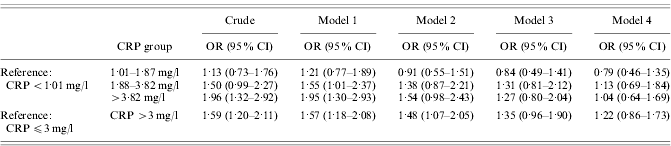
OR, Odds ratio; CRP, C-reactive protein; CI, confidence interval.
Model 1: adjusted for age, non-English-speaking background (NESB), education, disadvantaged area of residence.
Model 2: adjusted for age, NESB, education, disadvantaged area of residence, and prior or current smoking, obesity, prior or current treatment for depression, cognitive impairment.
Model 3: adjusted for age, NESB, education, disadvantaged area of residence, prior or current smoking, obesity, prior or current treatment for depression, cognitive impairment, and weighted Charlson's index group, prior history of stroke, myocardial infarction or major surgery.
Model 4: adjusted for age, NESB, education, disadvantaged area of residence, prior or current smoking, obesity, prior or current treatment for depression, cognitive impairment, weighted Charlson's index group, prior history of stroke, myocardial infarction or major surgery, and physical component summary (PCS) score ⩽40.
CRP concentration >3 mg/l was detected in 1361 subjects (32·1%). Men with high CRP were more likely to display clinically significant depressive symptoms (31·4% v. 42·2%; OR 1·59, 95% CI 1·20–2·11). This association remained statistically significant after the analyses were adjusted for age (in years), NESB, education, disadvantaged area of residence, smoking status, cognitive impairment, and previous or current treatment for depression (Table 2, models 1 and 2). However, the association between high CRP and depression was no longer statistically significant when measures of physical co-morbidity were included in the models (Table 2, models 3 and 4).
Finally, we investigated whether the association between depression and high CRP would change with increasing severity of depressive symptoms (i.e. greater specificity for the diagnosis of depression). The increase in the cut-points of the GDS-15 was associated with progressive decline in the OR associated with high CRP, culminating in a non-significant univariate association between the two when GDS-15 scores reached 10 (OR 1·28, 95% CI 0·81–2·02).
DISCUSSION
The results of this study show that the serum concentration of CRP is only weakly associated with depression scores in older men (Spearman's correlation ρ=0·09). They also demonstrate that the association between CRP and the presence of clinically significant depressive symptoms can be explained by the presence of other factors, most notably poor physical health.
CRP is a moderate predictor of coronary heart disease and, apart from periods of acute illness, its concentration remains relatively stable over time (Ridker et al. Reference Ridker, Cushman, Stampfer, Tracy and Hennekens1997; Danesh et al. Reference Danesh, Wheeler, Hirschfield, Eda, Eiriksdottir, Rumley, Lowe, Pepys and Gudnason2004). There is evidence that older people with impaired grip strength, decreased walking speed, fatigue, weight loss and low level of physical activity have higher CRP than non-frail individuals, even after the exclusion of subjects with established cardiovascular disease and diabetes (Walston et al. Reference Walston, McBurnie, Newman, Tracy, Kop, Hirsch, Gottdiener and Fried2002). Moreover, high CRP is associated with increased mortality in later life (Gruenewald et al. Reference Gruenewald, Seeman, Ryff, Karlamangla and Singer2006). These findings are consistent with the possibility that CRP is but a biomarker of underlying poor physical health, although some investigators have suggested CRP may play a causal role in atherothrombosis (Verma et al. Reference Verma, Devaraj and Jialal2006) and, through activation of the complement system, lead to neuronal dysfunction and death. In a recent review of the topic, Raison et al. (Reference Raison, Capuron and Miller2006) speculated that the complex interaction between depression and inflammatory markers is mediated by stress-responsive pathways involving the neuro-endocrine and autonomic nervous systems, and that depression might be a behavioural by-product of early adaptive advantages conferred by genes that promote inflammation. Kuo et al. (Reference Kuo, Yen, Chang, Kuo, Chen and Sorond2005), however, suggested that high CRP triggers a cascade of events that results in cerebral atherosclerosis, microangiopathy, disruption of fronto-subcortical circuits, loss of motivation and depression. This model is based on the vascular depression hypothesis put forward by Alexopoulos et al. (Reference Alexopoulos, Meyers, Young, Campbell, Silbersweig and Charlson1997) that postulates that depression in later life is the result of cerebrovascular disease, although our previous findings suggest that the contribution of cardiovascular factors to the development of depression in later life is minimal (Almeida et al. Reference Almeida, Flicker, Norman, Hankey, Vasikaran, van Bockxmeer and Jamrozik2007).
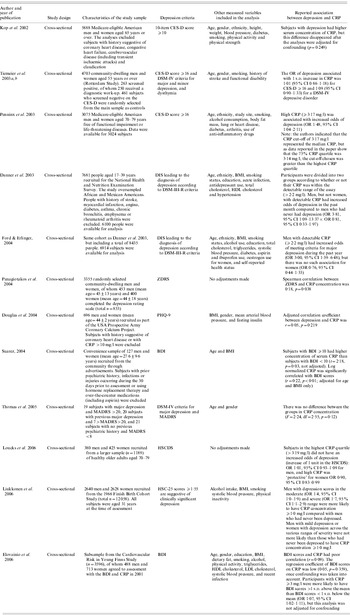
According to the model of Kuo et al. (Reference Kuo, Yen, Chang, Kuo, Chen and Sorond2005), high CRP should predate the development of depression. However, currently available data on the association between depression and CRP are limited to cross-sectional studies, making it impossible to establish a temporal relationship between the presence of high CRP and the onset of depression. In addition, the results of studies published to date indicate that the association between serum concentration of CRP and depression is equivocal, and our findings show that it is possible that high CRP might in fact contribute to a decrease in the risk of depression in older men. Table 3 summarizes the findings of observational studies that investigated the association between CRP and depression. Only two of the 13 reports indicated that high CRP increases the risk of depression. Penninx et al. (Reference Penninx, Kritchevsky, Yaffe, Newman, Simonsick, Rubin, Ferrucci, Harris and Pahor2003) found that older men and women with CRP ⩾3·17 mg/l (greater than the highest quartile) were 1·48 (95% CI 1·04–2·11) times more likely to score 16 or more on the Center for Epidemiologic Studies Depression Scale (CES-D). The analysis was adjusted for a number of variables, but not for current physical health. Likewise, Suarez (Reference Suarez2004) reported that subjects with a score of 10 or more on the Beck Depression Inventory (BDI) had higher serum concentrations of CRP than participants with scores lower than 10, although the analysis was not adjusted for confounding. Kop et al. (Reference Kop, Gottdiener, Tangen, Fried, McBurnie, Walston, Newman, Hirsch and Tracy2002) published the first and largest study investigating the association between CRP and depression in later life. They recruited a sample of 5888 men and women older than 65 years who were free of significant cardiovascular disease. Subjects with a 10-item CES-D score ⩾10 had higher serum concentration of CRP than those who were not depressed, but this difference became non-significant once the analysis was adjusted for age, gender, ethnicity, height, weight, blood pressure, diabetes, smoking, physical activity and physical strength (p=0·249). Other studies that included a measure of current physical function in the investigation of the association between CRP and depression were equally negative (Tiemeier et al. Reference Tiemeier, Hofman, van Tuijl, Kiliaan, Meijer and Breteler2003a; Ford & Erlinger, Reference Ford and Erlinger2004).
Summary of observational studies investigating the association between C-reactive protein (CRP) and depression

BDI, Beck Depression Inventory; BMI, body mass index; CES-D, Center for Epidemiologic Studies Depression Scale; CI, confidence interval; df, degrees of freedom; DIS, Diagnostic Interview Schedule; HDL, high density lipoprotein; HSC-25, 25-item Hopkins Symptom Checklist; HSCDS, Hopkins Symptom Checklist Depression Subscale; LDL, low density lipoprotein; MADRS, Montgomery–Asberg Depression Rating Scale; OR, odds ratio; PHQ, Patient Health Questionnaire; s.d., standard deviation; ZUNG, Zung Depression Rating Scale.
The results of our study should be interpreted in light of its strengths and limitations. This survey has the merit of having used a large and well-established community representative sample of older people for whom a wealth of relevant clinical information was available. We also used a well-validated scale and a demanding cut-point to establish the presence of depression in this sample. Previous studies have shown that such an approach is associated with high specificity and positive predictive values for the diagnosis of major depression according to ICD-10 and DSM-IV criteria (Almeida & Almeida, Reference Almeida and Almeida1999). In addition, we used a comprehensive measure of physical health that included information obtained from administrative health data (weighted Charlson index), self-report of previous major health events (such as stroke, myocardial infarction and surgery) and subjective rating of physical health (SF-36 PCS score). This enabled us to adjust carefully for physical health when investigating the association between CRP concentration and depression. Despite our efforts to retrieve detailed information about the physical health of participants, we are aware that some events might have been under-reported. For example, Anderson et al. (Reference Anderson, Jamrozik, Burvill, Chakera, Johnson and Stewart-Wynne1993) showed that up to 40% of older adults who have a stroke are not admitted to hospital in Western Australia. This would have resulted in a lower Charlson index although the self-reports may have helped us to avoid missing such events in our study. Overall, the statistical adjustments made for poor physical health in the analysis of the association between CRP concentration and depression are likely to have been conservative, and further highlight the importance of these findings (Table 2, models 3 and 4). We also adjusted our results for relevant sociodemographic and lifestyle factors that could potentially explain the association between high CRP and depression, and took into account the potential role of antidepressant treatment in changing CRP concentration (Lanquillon et al. Reference Lanquillon, Krieg, Bening-Abu-Shach and Vedder2000), although this seems to have had limited impact on the association between CRP and depression (Table 2, model 2). Importantly, the use of a high-sensitivity assay to determine the serum concentration of CRP enhanced the study's ability to investigate the association between CRP and depressive symptoms.
We acknowledge that we cannot infer causality between the factors under investigation because of the cross-sectional nature of the study. Only a very small proportion of men in our sample had depression but no significant physical co-morbidity (0·4%), which limited the power of the study to investigate the independent association between high CRP and depression. Notwithstanding, the distribution of CRP concentration according to group membership, as outlined in Fig. 1, is entirely consistent with the hypothesis that CRP concentration is not independently associated with depression in older men. There is also evidence that our older men with depression were less likely to agree to a blood test, and that those who did not have a blood test had greater co-morbidity (higher weighted Charlson index). This would have biased our results towards a healthier sample and diminished our ability to adjust the analyses for the effect of poor physical health on any association between depression and CRP concentration. The diagnosis of ‘clinically significant depression’ in this study was based on a relatively high cut-point for the GDS-15. This approach aimed to increase the specificity of the diagnosis of depression according to accepted clinical criteria (Almeida & Almeida, Reference Almeida and Almeida1999). We recognize, however, that our classification of depression was not based on a formal assessment of mental state leading to the diagnosis of a depressive episode. As a result, we cannot be certain that our findings would be directly transferable to patients meeting DSM-IV criteria for major depression or ICD-10 criteria for depressive episode. O'Brien et al. (Reference O'Brien, Scott and Dinan2006) reported that their 20 women with DSM-IV major depression experienced significant decline in the concentration of CRP after a 3-week treatment with various antidepressants in an open-label fashion. The authors argued that their subjects were free of significant physical illness, but reported exceedingly high mean CRP concentrations of 12·0 and 8·0 mg/l before and after treatment (approximate ranges: 5–22 and 4–15 mg/l respectively). CRP concentrations greater than 10 mg/l are indicative of acute infection or inflammation (Pearson et al. Reference Pearson, Mensah, Alexander, Anderson, Cannon, Criqui, Fadl, Fortmann, Hong, Myers, Rifai, Smith, Taubert, Tracy and Vinicor2003). In addition, the investigators used statistical parametric tests, but it is unclear from the data provided whether this was the most appropriate analytical approach. We conducted a series of analyses to clarify whether the association between CRP and depression is particularly pertinent for severe cases of depression (e.g. depression defined by a GDS-15 score ⩾10). We found no evidence in support of the existence of such an association. Finally, we acknowledge that our study included only men and that our findings may not necessarily apply to women. As the results of previous studies have shown that high CRP is associated with depression particularly in men (Table 3), it seems improbable that CRP would have had a greater independent role in the pathogenesis of depression among women.
In conclusion, the physiological mechanisms that ultimately lead to the onset and maintenance of depressive symptoms in later life are yet to be determined, but our results indicate that high CRP is unlikely to play a significant role in that process.
ACKNOWLEDGEMENTS
This project was supported by a grant from the National Health and Medical Research Council of Australia. The investigators thank Kim Carter for assisting with the coding of medical events, as well as participants and the research staff of the Health In Men Study.
DECLARATION OF INTEREST
None.