Substance use disorders (SUD; addictions) are outcomes of phenotypic development superimposed on the physiological and behavioral ontogenesis (Tarter & Vanyukov, Reference Tarter and Vanyukov1994). Genetic differences play a significant role in individual variation in these developmental processes and liability (Falconer, Reference Falconer1965) to addiction, but the contribution of environment to liability variance is also substantial (e.g., Vanyukov et al., Reference Vanyukov, Kim, Irons, Kirisci, Neale, Ridenour and Iacono2015). In addition to the obvious candidates, such as availability of drugs, concrete factors that may account for the environmental component are of special interest because of their possible malleability.
Neurotropic infections, particularly human herpesviruses (HHV), may play a role in these mechanisms by influencing the central nervous system (CNS) and thus behavior regulation. Virions can migrate to ganglia (Herpes simplex Types 1 [HSV-1] and 2 [HSV-2], and Varicella zoster), or B-cells (Epstein–Barr virus [EBV]), or lymphoid tissue (cytomegalovirus [CMV], HHV-6, HHV-7, HHV-8) where they enter latency, during which the viral genomes may lie dormant throughout the lifetime of the host (Gilden, Mahalingham, Cohrs, & Tyler, Reference Gilden, Mahalingam, Cohrs and Tyler2007; Steiner, Kennedy & Pachner, Reference Steiner, Kennedy and Pachner2007). Upon reactivation, however, all of HHV except HHV-8 (Kaposi sarcoma-associated herpesvirus) can cause severe, albeit infrequent, neurological disease (Gilden et al., Reference Gilden, Mahalingam, Cohrs and Tyler2007). Acute CNS pathology due to HHV is rare, and these infections are thus considered relatively benign for the CNS. Nonetheless, HSV-1 and CMV have been repeatedly associated with cognitive deterioration, even in apparently healthy adults without a history of encephalitis (Ahn et al., Reference Ahn, Meyer, Uebel, Sempé, Djaballah, Yang and Tampé1996; Aiello, Haan, Pierce, Simanek, & Liang, Reference Aiello, Haan, Pierce, Simanek and Liang2008; Dickerson, Schroeder, et al., Reference Dickerson, Schroeder, Stallings, Origoni, Katsafanas, Schwienfurth and Yolken2014; Dickerson, Stallings, et al., Reference Dickerson, Stallings, Origoni, Katsafanas, Schweinfurth, Savage and Yolken2014; Prasad, Watson, Dickerson, Yolken, & Nimgaonkar, Reference Prasad, Watson, Dickerson, Yolken and Nimgaonkar2012; Shirts et al., Reference Shirts, Prasad, Pogue-Geile, Dickerson, Yolken and Nimgaonkar2008; Tarter, Simanek, Dowd, & Aiello, Reference Tarter, Simanek, Dowd and Aiello2014; Thomas et al., Reference Thomas, Bhatia, Gauba, Wood, Long, Prasad and Deshpande2013). Cognitive decline was also observed in adult HSV-1-exposed individuals with schizophrenia (Prasad et al., Reference Prasad, Eack, Goradia, Pancholi, Keshavan, Yolken and Nimgaonkar2011) and in older individuals exposed to CMV (Nimgaonkar et al., Reference Nimgaonkar, Yolken, Wang, Chung-Chou, McClain, McDade and Ganguli2016).
The impact of an environmental SUD risk factor may be particularly important if it occurs in childhood, thus contributing to the trajectory of liability phenotype development (Vanyukov & Tarter, Reference Vanyukov and Tarter2000). Although the association of childhood EBV infection with IQ-measured intelligence in adolescence did not reach significance after adjustment for potential confounders, this infection was associated with elevated risk for psychotic experiences (Khandaker, Stockl, Zammit, Lewis, & Jones, Reference Khandaker, Stochl, Zammit, Lewis and Jones2014). Reports also suggest associations of HSV-1 and CMV exposure with cognitive function impairment in children (Tarter et al., Reference Tarter, Simanek, Dowd and Aiello2014), and HSV-1 but not CMV or EBV in adolescents (Jonker et al., Reference Jonker, Klein, Duivis, Yolken, Rosmalen and Schoevers2014). The length (6 months vs. 6 weeks) of antiviral treatment of neonates with symptomatic congenital CMV disease was related to cognitive improvement at 24 months (Kimberlin et al., Reference Kimberlin, Jester, Sánchez, Ahmed, Arav-Boger and Michaels2015). In turn, cognitive deficits have long been associated with behavioral sequelae, such as antisociality and SUD (e.g., Aytaclar, Tarter, Kirisci, & Lu, Reference Aytaclar, Tarter, Kirisci and Lu1999; Giancola, Martin, Tarter, Pelham, & Moss, Reference Giancola, Martin, Tarter, Pelham and Moss1996). Substance abuse results in further cognitive deterioration (Gould, Reference Gould2010). Focusing on SUD thus provides an opportunity of identifying a relationship of high importance. It is essential to examine these associations in children, particularly, from peri-adolescence, characterized by active brain maturation, which is also a period of vulnerability to neurocognitive precursors of SUD (Casey & Jones, Reference Casey and Jones2010) that may have long-term behavioral consequences.
We hypothesize that exposure to highly prevalent neurotropic HHV (HSV-1, EBV, and CMV) is related to cognitive function as measured by IQ in children, and to their risk for drug addiction in adulthood, possibly mediated by IQ. In addition, the study tested the effects of a nonviral agent, Toxoplasma gondii, which has been implicated in lower levels of cognitive functioning in adults (Flegr et al., Reference Flegr, Preiss, Klose, Havlicek, Vitakova and Kodym2003).
These relationships are also hypothesized to vary by sex. Extensive sex differences exist for SUD and its mechanisms (e.g., reviewed in Becker & Hu, Reference Becker and Hu2008; Becker, McClellan, & Reed, Reference Becker, McClellan and Reed2017; Sanchis-Segura & Becker, Reference Sanchis-Segura and Becker2016), as well as in IQ, including differential item functioning (Maller, Reference Maller2001). These mechanisms involve neuroanatomical, neurochemical, and psychological differences, many of which are relevant to the variables under study (e.g., reviewed in Ngun, Ghahramani, Sanchez, Bocklandt, & Vilain, Reference Ngun, Ghahramani, Sanchez, Bocklandt and Vilain2011). It is important that differential susceptibility to and recovery from viral infection of the CNS in males and females have been demonstrated in both experimental animals (Bama, Komatsu, Bi, & Reiss, Reference Barna, Komatsu, Bi and Reiss1996; Geurs, Hill, Lippold, & French, Reference Geurs, Hill, Lippold and French2012) and humans (Muenchhoff & Goulder, Reference Muenchhoff and Goulder2014), likely related to sex differences in immune response. This calls for not only controlling for effects of sex, or even taking into account the potential interactions of sex (and, implicitly, related biological factors) with other variables by entering respective interaction terms into equations, but also studying these relationships separately in males and females. For instance, in our research, an association of SUD risk with a polymorphism in the arginine vasopressin receptor 1A (AVPR1A) gene, known to be involved in variation in social and affiliative behaviors in a sexually dimorphic fashion, was detected in males, but not in females (Maher et al., Reference Maher, Vladimirov, Latendresse, Thiselton, McNamee, Kang and Vanyukov2011). Analyses separated by sex not only provide greater detail, but also regression-based conditioning does not allow estimating sex-specific effects, one of the goals of this study. While the nonsignificance of an interaction term in a regression framework may result from insufficient power, a Type II error, a stratified analysis may reveal an important effect. Sex is an important biological factor rather than merely a confounder or nuisance variable, and its potential effects are beyond quantitative. Moreover, females are an understudied population in addiction research. These considerations, as well as understanding that “disaggregation of data by sex allows for sex-based comparisons and may inform clinical interventions” (NIH, 2015), have converged into the current NIH “rigor and reproducibility” requirement of thorough consideration of sex in research, including “appropriate analysis and transparent reporting of data by sex” (NIH, 2016), with which this study comports. To our knowledge, there have been no publications covering these relationships, involving highly prevalent neurotropic infections and cognitive and behavioral development, and HHV–cognitive function association studies have been largely conducted in middle-aged and older adults.
Method
Participants
The participants were 160 White and 61 Black females, and 425 White and 108 Black males, for 569 of whom (395 males and 174 females) blood serum samples were available for immunoassays related to the infectious agents under study. The participants were recruited at age 10–12 (mean ± SE: 11.4 ± 0.04) and assessed prospectively until age ~30 in the Center for Education and Drug Abuse Research, a longitudinal family/high-risk study of etiology of SUD (substance abuse or dependence; Tarter & Vanyukov, Reference Tarter and Vanyukov2001). The probands in that study were the participants’ fathers who either had a lifetime DSM-III-R diagnosis of SUD consequent to use of illicit drugs (47.5%) or did not have SUD (52.5%), or had another psychiatric disorder (psychiatric control; 11%). Among the mothers, 23.6% were also affected with SUD. The affected fathers were recruited from treatment programs, social service agencies, newspaper and radio advertisements, public service announcements, and random digit telephone calls. The unaffected probands were recruited using the same sources, except treatment facilities. The family was excluded from study if the father had a history of neurological disorders, schizophrenia, or uncorrectable sensory incapacity, or the participant child had a history of neurological injury requiring hospitalization, an IQ of <70, a chronic physical disability, uncorrectable sensory incapacity, or psychosis. This study used IQ data and blood serum obtained at the baseline assessment, and the SUD outcome by the participant's last available assessment. The average age of the participants at their last assessment was 25.2 ± 0.19 years (range = 10–31).
This study was reviewed and approved by the institutional review board of the University of Pittsburgh. Participants under age 18 signed assent forms before the research protocols were administered, and written informed consent was obtained from the parents. Upon reaching age 18, participants provided informed consent themselves. In addition, a copy of the Certificate of Confidentiality issued by the National Institute on Drug Abuse to the Center for Education and Drug Abuse Research was given to the participants. Prior to implementing the assessment protocols, breath, saliva, and urine samples were collected and analyzed to ensure that alcohol, nicotine, and drugs did not impact the cognitive performance tests.
Variables
The main predictor of interest was the infection status pertaining to HSV-I, EBV, and CMV, as well as to T. gondii, as indicated by the levels of antibodies (see Laboratory Analysis below). Ethnicity (Black or White) was determined by self-report. Socioeconomic status (family SES; Hollingshead, Reference Hollingshead1975) was measured according to the standard factors: education (7-point score based on years of schooling: 1 = less than a seventh-grade education, 7 = graduate training), occupation (9-point score based on the category of occupation based on a comprehensive list of professional titles: 1 = farm laborer/menial service or unemployment, 9 = higher executives, owners of large businesses and major professionals), sex, and marital status. The family score is computed from the weighted rankings of education (rank multiplied by 3), occupation (rank multiplied by 5), and marital status of the heads of household and their relationship to the labor force. Computed family SES scores range from 8 to 66. To control for parental SUD, which can be a correlate or indicator of factors relevant to the risk for infections, we included both paternal and maternal SUD diagnoses in the models, summarized in the number of affected parents (NAP; 0–2), as employed in our prior research (Kirillova, Vanyukov, Kirisci, & Reynolds, Reference Kirillova, Vanyukov, Kirisci and Reynolds2008). Diagnosis of SUD (alcohol or illicit drug use disorder) in parents and children (if age 19 or older) was determined using an expanded version of the Structured Clinical Interview for DSM-III-R Outpatient Version (SCID-OP; Spitzer, Williams & Gibbon, Reference Spitzer, Williams and Gibbon1996), and finalized in a consensus conference using the best estimate procedure (Kosten & Rounsaville, Reference Kosten and Rounsaville1992). The expanded SCID-OP evaluates current episode (past 6 months) and worst past episode of psychopathology (before the past 6 months). The third edition of the Wechsler Intelligence Scale for Children (full-scale IQ) at the baseline visit was used as a measure of cognitive capacity. The Wechsler Intelligence Scale for Children is measured on an interval scale, standardized to have a mean of 100 and a standard deviation of 15 (Wechsler, Reference Wechsler1991).
Laboratory analysis
Blood samples were collected from children at the baseline visit, and serum was separated by centrifugation, aliquoted in 1-ml samples, and stored at –80 °C until assay. Antibodies to HSV-1 were assayed using kits (Focus Diagnostics, Cypress, CA) for microplate solid-phase enzyme immunoassays for immunoglobulin G (IgG) antibody detection (Dickerson et al., Reference Dickerson, Boronow, Stallings, Origoni, Ruslanova and Yolken2003). These assays utilized purified glycoproteins, and reference samples were placed on every plate. Antibody level was expressed as the ratio of the sample signal and the mean reference standard on the same microplate. Exposure was defined as a level of antibody greater than the cutoff indicated by the manufacturer. IgG class antibodies to T. gondii, CMV, and EBV (viral capsid antigen) were measured using solid phase immunoassay kits (IBL-America, http://www.ibl-america.com) according to protocols provided by the manufacturer. To maximize certainty, data with the manufacturer-suggested indeterminate values for a particular agent (~1%–3% of the sample for the various agents) were not used in the analyses of the relationships involving that agent.
Statistical methods
The bivariate relationships were initially evaluated using correlation analysis (contingency coefficients, point biserial, or product moment, as appropriate for the types of variables involved) and linear regression (for IQ as the dependent variable). The relationships of predictors with the rate of SUD development were assessed by survival analysis (Cox proportional hazard regression). Correlation and survival analyses were conducted using IBM SPSS for Windows Version 24. All multivariate analyses were specific to each infectious agent.
The multivariate relationships evaluating effects of infections on SUD outcome and the potential role of IQ as a mediator of these relationships, taking into account SES, ethnicity, and parental SUD, were then modeled using path analysis. Path models were estimated using IBM SPSS Amos 24 (Arbuckle, Reference Arbuckle2016). Males and females were analyzed separately, and two-group (males and females) path analysis was conducted to test the models relating childhood infections and cognitive function, and SUD in adulthood, controlling for SES, parental SUD, and ethnicity as potential confounders, and compare the infections’ effects between sexes.
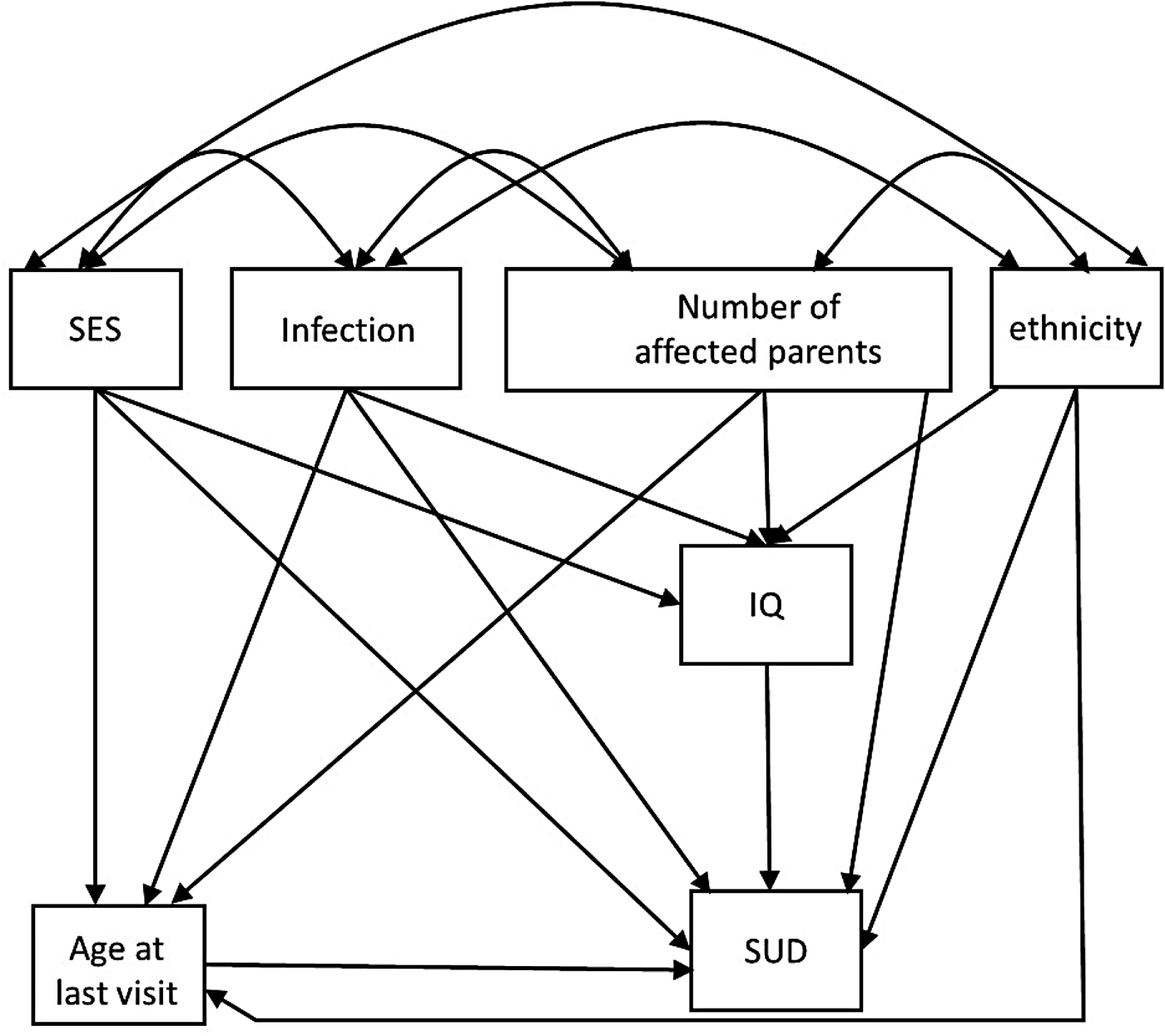
Path analysis allows controlling for the relationships between independent variables, such as SES, parental SUD, ethnicity, and the infections in this study, thus taking care of both multicollinearity and the unaccounted-for common sources of variance or directional relationships causing correlations among exogenous variables (SES, NAP, and ethnicity; data not shown, available upon request). It is also possible that SES, NAP, and infections are related to attrition, and thus the age at the last available assessment, which, in turn, may contribute to the risk for drug exposure and SUD. Evaluation of indirect effects enables testing mediation (MacKinnon, Reference MacKinnon2008). Bayesian structural equation modeling implemented in Amos was used to test the models. Bayesian structural equation modeling has been shown to be more robust than the maximum likelihood approach in parameter estimation in relatively small samples by using proper or improper prior distributions (Lee & Song, Reference Lee and Song2004). It employs the Markov chain Monte Carlo algorithm, which draws samples from the posterior distribution of model parameters, an iterative process that is allowed to continue until convergence is established. The latter is evaluated by the convergence statistics, measuring how much uncertainty about a parameter can be reduced (or precision gained) by increasing the number of observations to infinity. We used the conservative default criterion of overall convergence statistics of <1.002 to diagnose convergence. To evaluate the uncertainty about a parameter estimate, analogous to a confidence interval, Bayesian analysis uses a credible interval, the range of parameter values between percentiles of the marginal posterior probability distribution, for example, 2.5 and 97.5. This would correspond to a 95% confidence interval (CI), interpretable as a 95% certainty of a parameter's true value lying between the lower and upper parameter values of the interval. In addition, this analysis provides an opportunity to estimate the probability of a dichotomous state of a parameter (dichotomous estimand), such as being greater or less than zero, using areas under a marginal posterior distribution to evaluate paths where the credibility interval covers zero (a tail area is then an analog of a p value for testing the null hypothesis). The program also allows estimation of custom parameters, including specific indirect paths and total effects (sums of direct and indirect paths) from exogenous to endogenous variables (e.g., from the infection status to the SUD diagnosis). While focusing on direct paths from infections to IQ and SUD and indirect paths from infections to SUD mediated by IQ, all direct and indirect effects were tested accordingly. Default prior distributions (priors) provided by the software were used. To control for the positive relationship of the age of the last assessment with the risk for SUD, this age was entered as a regressor for the SUD diagnosis in the path models (Figure 1).
Path model relating seropositivity for infections (HSV-1, EBV, CMV, or T. gondii) childhood intelligence (IQ), and risk for substance use disorder in adulthood, controlling for socioeconomic status (SES), ethnicity (Blacks or Whites), and age at last available assessment. Error terms are not shown. SES is household SES (Hollingshead, Reference Hollingshead1975); parental substance use disorder is indicated by the number of affected parents, sum of parental affectedness statuses (0, 1, or 2); IQ is the Wechsler Intelligence Scale for Children, Third Edition, full-scale IQ.

Results
Descriptive statistics
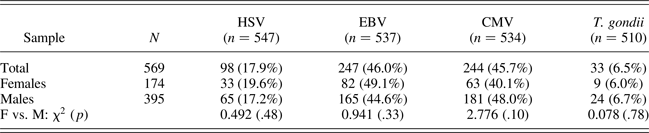
Table 1 presents seropositivity for the participants at the baseline assessment for HSV-1, EBV, CMV, and T. gondii. There were no significant sex differences for seropositive status, as well as for SES (mean ± SE: 41.3 ± 0.50), and age at the last visit (25.2 ± 0.19), whereas the differences in age at the first visit were trivial (11.4 ± 0.04 vs. 11.5 ± 0.06 in males and females, respectively; p = .02, ns after Bonferroni correction).
Seropositivity in the sample

Note: HSV, Herpes simplex virus Type 1; EBV, Epstein–Barr virus; CMV, cytomegalovirus; T. gondii, Toxoplasma gondii.
Males had on average a 3-point higher IQ than females (107.8 ± 0.67 vs. 104.8 ± 1.06; p = .016). There were no significant sex differences in the age of SUD onset (males: 17.7 ± 0.21; females: 17.6 ± 0.36; p = .7). However, there were sex differences in SUD prevalence by the last assessment (31.9% in females vs. 44.1% in males, p = .002). While both female and male groups were enriched for SUD due to the high-risk design of the study, and the prevalence-based estimates thus should not be considered population estimates, the sex differences in SUD prevalence hold at the same level within the offspring of unaffected fathers (26.4% vs. 38.7%). These differences, as well as other relevant facts and considerations presented above, entail the necessity of analyzing males and females separately, with the goal of obtaining sex-specific estimates.
Bivariate relationships
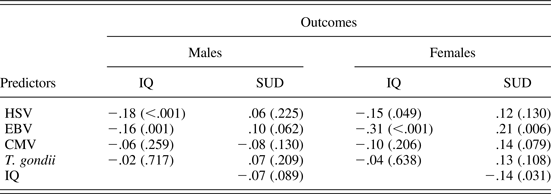
Table 2 presents associations between the infection status for the agents under study and the outcomes of interest: IQ and SUD diagnosis. As can be seen, serological evidence of HSV-1 and EBV infections is associated with the phenotypic variables, except that the correlations of HSV with SUD in both sexes, and EBV in males, do not reach significance. Both HSV-1 and EBV infections negatively correlate with IQ. These correlations, including the nonsignificant CMV and T. gondii ones, do not, however, take into account the potential confounding effect of family environment such as that indicated by the SES.
Correlations between the predictors and the outcomes
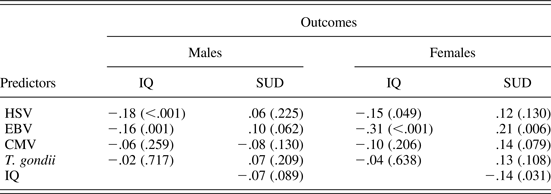
Note: The cells contain correlation coefficients (contingency coefficient between binary variables, point biserial between binary and continuous variables, and product moment between continuous variables), with their two-tailed p values in parentheses. HSV, Herpes simplex virus Type 1; EBV, Epstein–Barr virus; CMV, cytomegalovirus; T. gondii, Toxoplasma gondii; IQ, Wechsler Intelligence Scale for Childen, Third Edition, full-scale IQ; SUD, DSM-III-R diagnosis of substance use disorder.
Supporting the study's hypotheses, HSV-1 and EBV exposures are associated with lower IQ. In males and females, respectively, HSV-1 exposure is related to an average IQ decrease of 7.3, 95% CI for the difference: [3.16, 11.34]; p = .001, and 6.9, 95% CI [0.38, 13.52]; p = .039, units. Similarly, EBV is related to a 5.3, 95% CI [2.16, 8.39]; p = .001, and 10.7, 95% CI [5.87, 15.60]; p = 2 × 10⁻⁵, unit difference in IQ in males and females, respectively.
Multivariate analysis
Survival analysis
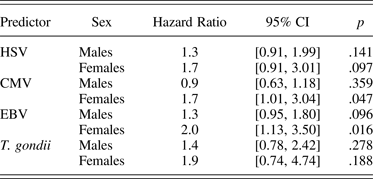
Results (Table 3) of Cox regression analysis, controlling for SES and stratified by ethnicity, indicate a relationship of childhood EBV infection with the rate of SUD development in females: hazard ratio [HR] = 2.0, 95% CI [1.13, 3.50]; p = .016. This relationship does not reach significance in males: HR = 1.3, 95% CI [0.95, 1.80]; p = .096. CMV is also associated with the SUD rate in females, HR = 1.7, 95% CI [1.01, 3.04], p < .05, but not in males. There appears to be a trend for the HSV-1 relationship with the rate of SUD development in females, HR = 1.7, 95% CI [0.91, 2.95]; p = .097, and, somewhat weaker, in males, HR = 1.3, 95% CI [0.91, 1.99]; p = .141. It may be noted that even where these relationships are not significant, they are numerically comparable and trend in the same direction, indicating a possibility of indirect/mediated effects and/or insufficient power. This is in contrast to the effects of T. gondii, where no such trend is apparent. The overlapping confidence intervals of respective hazard ratios do not support sex dimorphism in these effects.
Survival (Cox proportional hazard regression) analysis or the relationships between infections (each analyzed separately) and the rate of substance use disorder development
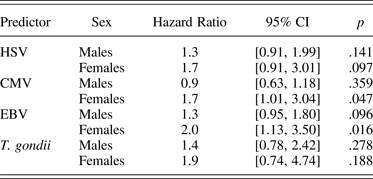
Note: Household socioeconomic status was entered as a covariate in all equations, and the analysis was stratified by ethnicity. HSV, Herpes simplex virus Type 1; CMV, cytomegalovirus; EBV, Epstein–Barr virus; T. gondii, Toxoplasma gondii; IQ, Wechsler Intelligence Scale for Childen, Third Edition, full-scale IQ; SUD, DSM-III-R diagnosis of substance use disorder.
Path analysis
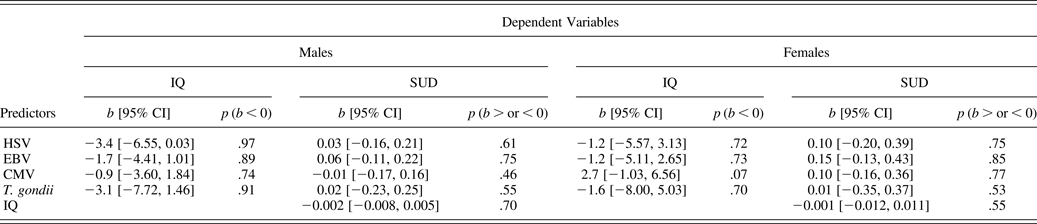
To evaluate the relationship between exposure to the infections under study and the phenotypic characteristics (IQ and SUD liability), while controlling for possible confounders (ethnicity, SES, and parental SUD diagnosis), we tested the path model presented in Figure 1, estimating direct and indirect effects of exposure to an infection. The unstandardized path coefficients (b) are presented in Table 4. The results for IQ in males suggest a drop of ~3 points due to HSV-1, ~2 points for EBV, and ~3 points for T. gondii. There is only a small effect detected for CMV. The estimates for females are somewhat lower for HSV and EBV (both at ~1 unit), show no IQ decrease for CMV (if not, paradoxically, an increase), and are suggestive of a decrease by 1.6 for T. gondii.
Direct relationships in the path models
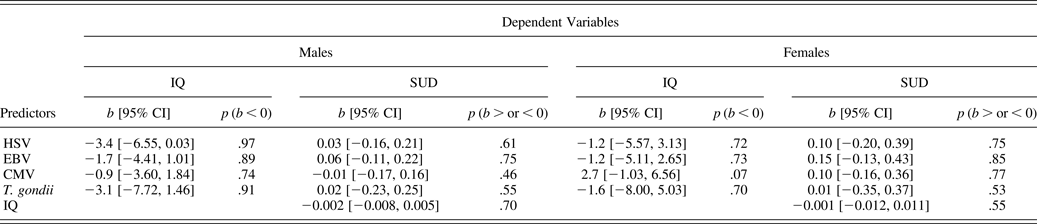
Note: See Figure 1. SUD, substance use disorder; HSV, Herpes simplex virus Type 1; EBV, Epstein–Barr virus; CMV, cytomegalovirus; T. gondii, Toxoplasma gondii. The cells contain unstandardized estimates of path coefficients (b), with 95% credible intervals in parentheses and the probabilities that b is either less (for effects on IQ) or greater (for SUD) than 0. A 95% confidence interval (CI, the Bayesian analog of confidence interval, approximately equal to it if the distribution is symmetric), is the range in which the true value of a parameter is located with 95% certainty. The p (b) values indicate the probability that the regression coefficient is either less than 0 (for the agent–IQ relationships and the IQ–SUD relationship) or greater than 0 (for the predictor–SUD relationships).
For SUD, the results are suggestive of EBV effect in both sexes; the effect of HSV-1 in females and, somewhat weaker, in males; the effect of CMV in females, but no effect for CMV in males; and no T. gondii effect in either sex. Nevertheless, the overlapping credible intervals for the respective parameters in males and females do not indicate sex dimorphism in the relationships studied. These results largely parallel those observed in survival analysis. No infectious agent–SUD diagnosis relationship is mediated by IQ (data not shown), as the indirect paths involving IQ are not significant because the direct effect of IQ on SUD risk is close to 0 (corresponding to an odds ratio close to 1.0). In addition, none of the probabilities of a higher than 0 indirect effect from the infectious agents to SUD was greater than 0.5.
Discussion
The results of this longitudinal study are suggestive of relationships between seropositivity for common neurotropic infections HSV-1, EBV, and T. gondii in both sexes, and possibly CMV in males but not females, with lowered intelligence. Independent of these relationships, childhood EBV and HSV-1 infections in both sexes, and CMV in females, are associated with elevated risk for SUD in adulthood. This is the first study that relates childhood HHV and T. gondii infections, cognitive function, and SUD risk, and establishes the HHV-SUD risk connection. Most publications regarding cognitive impairment are in middle-aged or older individuals, whereas this study spans ages from preadolescence to adulthood. Few studies have addressed the association between HHV exposure and cognitive dysfunction. Few studies that we are aware of examined HHV seropositivity in relation to cognitive function in children (Jonker et al., Reference Jonker, Klein, Duivis, Yolken, Rosmalen and Schoevers2014; Kimberlin et al., Reference Kimberlin, Jester, Sánchez, Ahmed, Arav-Boger and Michaels2015; Tarter et al., Reference Tarter, Simanek, Dowd and Aiello2014).
Substance abuse is an enormous health and societal burden. It is often lethal and contributes to morbidity and mortality on virtually every major health condition. A tremendous opportunity cost is incurred, due to arrested social development, criminality, educational underachievement, and under- and unemployment. The cost to society is estimated at over $600 billion (Volkow, Reference Volkow2012). The persistent severity of the problem calls for novel research that could be readily translated into prevention and treatment. The effect of any malleable factor on liability to addiction may be of great significance for intervention even if it is statistically small under natural conditions. It would be especially important if that factor contributed to variation in nondrug-specific, general liability to addiction, substantially shared in common between risks for drug-specific disorders (Vanyukov et al., Reference Vanyukov, Tarter, Kirillova, Kirisci, Reynolds, Kreek and Ridenour2012).
It is possible that one of such factors is HHV and other neurotropic infections. Cycles of HHV latency and recurrence in relatively small brain regions may lead to cumulative impairment in cognitive function, even though each cycle individually may produce no overt symptoms. It is also possible that initial exposure to neurotropic infections in childhood causes subclinical brain damage that does not recur, but affects neurodevelopment and compromises cognitive function over time. The relationship between cognitive function and risk for behavior deviations including antisociality and SUD is well established (Aytaclar et al., Reference Aytaclar, Tarter, Kirisci and Lu1999; Giancola et al., Reference Giancola, Martin, Tarter, Pelham and Moss1996; Kirisci, Tarter, Vanyukov, Reynolds, & Habeych, Reference Kirisci, Tarter, Vanyukov, Reynolds and Habeych2004). Cognitive impairment has been also observed in adult nonalcoholic offspring of alcoholics, suggesting its role in SUD risk (Gierski et al., Reference Gierski, Hubsch, Stefaniak, Benzerouk, Cuervo-Lombard, Bera-Potelle and Limosin2013). Addiction is a recognized complex psychiatric disorder, but a necessary prodromal condition for its development, drug use, is often voluntary and deliberate, thus requiring cognitive involvement. Inasmuch as HHV infection may contribute to cognitive function, it may be one of the potential developmental mechanisms of SUD liability variation.
Our results are consistent with several studies that showed significant cognitive dysfunction in persons who had elevated serum HSV-1 antibody levels in the absence of signs of encephalitis (Dickerson et al., Reference Dickerson, Boronow, Stallings, Origoni, Ruslanova and Yolken2003, Reference Dickerson, Boronow, Stallings, Origoni, Cole, Krivogorsky and Yolken2004, Reference Dickerson, Stallings, Sullens, Origoni, Leister, Krivogorsky and Yolken2008, Reference Dickerson, Stallings, Origoni, Vaughan, Khushalani and Yolken2012; Prasad et al., Reference Prasad, Eack, Goradia, Pancholi, Keshavan, Yolken and Nimgaonkar2011, Reference Prasad, Watson, Dickerson, Yolken and Nimgaonkar2012; Schretlen et al., Reference Schretlen, Vannorsdall, Winicki, Mushtaq, Hikida, Sawa and Cascella2010; Shirts et al., Reference Shirts, Prasad, Pogue-Geile, Dickerson, Yolken and Nimgaonkar2008; Strandberg, Pitkala, Linnavuori, & Tilvis, Reference Strandberg, Pitkala, Linnavuori and Tilvis2003; Tarter et al., Reference Tarter, Simanek, Dowd and Aiello2014; Watson et al., Reference Watson, Prasad, Klei, Wood, Yolken, Gur and Nimgaonkar2013; Yolken, Torrey, Lieberman, Yang, & Dickerson, Reference Yolken, Torrey, Lieberman, Yang and Dickerson2011). The HSV-1-related cognitive dysfunction is typically more focal and less severe than the widespread deficits in HSV-1 encephalitis. Brain imaging studies indicate damage in regions that mediate memory and cognition (Prasad et al., Reference Prasad, Eack, Goradia, Pancholi, Keshavan, Yolken and Nimgaonkar2011, Reference Prasad, Watson, Dickerson, Yolken and Nimgaonkar2012). Supporting the role of nonencephalitic HSV-1 infection in cognitive function, in a randomized controlled trial, HSV-1-exposed schizophrenia patients who received adjunctive valacyclovir, an anti-HHV drug, showed significant improvement in working, verbal, and visual memory compared with the adjunctive placebo group (Prasad et al., Reference Prasad, Eack, Keshavan, Yolken, Iyengar and Nimgaonkar2013). A plausible association between HSV-1 and cognitive dysfunction is also supported by in vitro studies indicating that persistent HSV-1 infection can alter the functioning induced pluripotent stem cell-derived neurons (D'Aiuto et al., Reference D'Aiuto, Prasad, Upton, Viggiano, Milosevic, Raimondi and Nimgaonkar2015). HSV-1 exposure is associated with reduced prefrontal cortical gray matter volume among schizophrenia patients (Prasad et al., Reference Prasad, Eack, Goradia, Pancholi, Keshavan, Yolken and Nimgaonkar2011; Prasad, Shirts, Yolken, Keshavan, & Nimgaonkar, Reference Prasad, Shirts, Yolken, Keshavan and Nimgaonkar2007). HSV-1 DNA has been detected in up to 35% of nonencephalitic postmortem brain tissues (Baringer & Pisani, Reference Baringer and Pisani1994; Karatas et al., Reference Karatas, Gurer, Pinar, Soylemezoglu, Tezel, Hascelik and Saygi2008), suggesting viral spread to the brain during persistent infection.
While the observed associations have small to medium effect sizes, the high prevalence of HHV infections may result in a large population attributable risk. Exposure to HSV-1 is noted among approximately 40% of children/teens and over 70% among older adults in the United States (Kruszon-Moran et al., Reference Kruszon-Moran, Porter, McQuillan, Billioux, Kim-Farley and Hirsch2012). Seropositivity for EBV increases from ~50% at age 6–8 to over 80% by age 18–19 (Cohen, Reference Cohen2000; Dowd, Palermo, Brite, McDade, & Aiello, Reference Dowd, Palermo, Brite, McDade and Aiello2013). The cost of cognitive deterioration, particularly if it starts in childhood, is high as it may translate into unrealized potential in academic and consequent professional achievement and quality of life. While cognitive impairment related to HHV infection is per se a potential problem, its possible contribution to behavioral disorder risks, including liability to SUD, considerably raises its significance.
The relationship of IQ with SUD is weak to nonexistent, which precludes mediation of the infections’ effects on SUD risk by IQ. Nevertheless, there are direct effects of infections on SUD risk, somewhat more prominent in females. Although the overlapping confidence and credible intervals in the survival and path analyses, respectively, do not indicate sex dimorphism in the studied relationships, the hazard ratio for SUD associated with CMV in females is significant and double that in males, in whom it is not significant despite a larger sample. A similar finding is observed for EBV. Notably, the risk for impaired neurodevelopment due to CMV infection is twice as high in females as in males (Picone, Costa, Dejean, & Ville, Reference Picone, Costa, Dejean and Ville.2005). Hence, mechanisms other than those indexed by IQ, by which the infections may influence behavior, as well as their sex dimorphism, need to be examined. Such mechanisms may pertain to the executive aspect of cognitive function as well as to behavior regulation. HSV-1 seropositivity was found to be associated with lower reading and spatial reasoning test scores in children, while in a separate sample of middle-aged adults, HSV-1 and CMV seropositivity were associated with impaired coding speed (Tarter et al., Reference Tarter, Simanek, Dowd and Aiello2014). In older adults, HSV-1 seropositivity was associated with immediate memory impairment. The differences in group profiles raise questions about temporal changes after childhood HHV exposure. We are currently exploring these potential connections.
HSV-1 infection is not generally targeted for prevention, and we are aware of no vaccines under development for it. EBV causes substantial morbidity, including infectious mononucleosis, lymphomas, and carcinomas, but vaccine development for this virus has yet to come to fruition as well (Cohen, Reference Cohen2015). In the translation of research findings, it is also important to consider sex differences observed in the immune response to viral infections, including herpesviruses, and in the efficacy of antiviral drugs and vaccines (Klein, Reference Klein2012).
Several caveats should be noted. It is possible that attrition, unavoidable in a longitudinal study, is greater among those who have developed SUD, and occurs earlier among those whose SUD risk is greater. Considering that attrited individuals in this project have had a lower IQ (Tarter, Vanyukov, Kirisci, Reynolds, & Clark, Reference Tarter, Vanyukov, Kirisci, Reynolds and Clark2006), this may result in the underestimation of the relationships tested. However, the age at last available visit positively correlated with SUD diagnosis (data not shown), likely corresponding to increasing opportunities for drug exposure and consumption with age within the study's scope, perhaps offsetting potential effects of SUD on attrition.
The direct relationship of viral exposure with SUD development is, as expected, relatively weak: the odds ratios, into which the respective path coefficients (b) can be readily converted as exp[b], reach 1.16 (b = 0.15) at maximum (for EBV in females). However, the associations observed in our study are similar to or greater than the effects of other biological variables (e.g., DNA variants) on behavior and related variables that are considered compelling enough to be intensively studied (e.g., Hibar et al., Reference Hibar, Stein, Renteria, Arias-Vasquez, Desrivières, Jahanshad and Medland2015; Saccone et al., Reference Saccone, Saccone, Hinrichs, Stitzel, Duan, Pergadia and Bierut2009). There is a considerable functional distance between the behavioral phenotype and the biological mechanisms involved. In a multistep mechanistic relationship, the statistical association between the initial cause (e.g., HSV-1 infection) and the distal outcome (a behavioral trait such as SUD liability) weakens with each consecutive link in the long causal chain (possibly, to nonsignificance) even if the relationship between the adjacent links is strong. The weakness of association may thus belie its importance. The effect of potential practical implementation of findings is expected to be much greater than the “naturally” observed associations.
The results of the path analysis, while promising, are not fully satisfactory, because the model does not provide a good fit by the available Bayesian fit criterion, posterior predictive p (ppost or ppp). That value should be around .5 for a well-fitting model, but it is zero in this case, indicating lack of fit. The causes for that are unclear, but the literature on the topic suggests that “ppost is simply a way to summarize the results numerically, and has little do with the probability of rejecting a model in the already known to be false situation where the model is correct” (Levy, Reference Levy2011). Although it is not entirely certain to what degree the parameter estimates are trustworthy, their congruency with the EBV- and CMV-related Cox regression results in females supports their validity. Bayesian analysis, while fitting both male and female data simultaneously, does not allow a formal comparison of models with restricted (e.g., equal between the groups) and free parameters. Nevertheless, the overlapping confidence and credible intervals in the survival and path analyses, respectively, do not indicate sex dimorphism in the studied relationships. That, however, may result from insufficient power.
It should also be noted that regardless of the associations’ validity, causality cannot be firmly established based on these data. It is a common problem that the relationship between exposure and the outcome cannot be readily interpreted in causal terms, particularly in the observational in contrast to experimental studies, and especially when the outcome varies due to multiple causes. For instance, it is possible that the exposure to infections, IQ, and the other variables under study, particularly those measured at the same time, have a common source of variation determining their relationships. In part, this possibility is addressed by including relevant variables in the analysis and modeling the uncertain relationships between them as correlations rather than regression paths. Modeling the relationships of the predictors with IQ and SUD as directional also does not necessarily denote causality, but rather reflects the predictors’ status as fixed variables (no measurement error), whereas IQ and SUD are random variables. Nevertheless, it remains possible that the relationships between the infections and the phenotypic variables are due to an unobserved confounder that is related to both exposure and the outcome. An infection cannot be randomly assigned to humans, to evaluate the average causal effect as is done in treatment response studies or to apply as an instrumental variable (Greenland, Reference Greenland2000) that could turn exposure into a random variable, and solve the problem addressed by Koch postulates and their contemporary developments. Counterfactual reasoning, which derives causality from the positive outcome when a virus is eliminated (e.g., Kimberlin et al., Reference Kimberlin, Jester, Sánchez, Ahmed, Arav-Boger and Michaels2015; Prasad et al., Reference Prasad, Eack, Keshavan, Yolken, Iyengar and Nimgaonkar2013), is also often impractical due to the absence of vaccines and effective antivirals (Moore & Chang, Reference Moore and Chang2014). To rule out the third-variable possibility, it is necessary to elucidate a pathophysiological process by which a neurotropic infection can result in cognitive deterioration and/or elevation of SUD risk. Studies in that direction, however, can be undertaken only upon detecting the associations to be elucidated.
Conclusions
The results suggest associations of childhood neurotropic infections (HSV-1, EBV, and T. gondii in boys and girls, and CMV in boys) with reduced cognitive capacity. Exposure to EBV in girls and possibly boys, and CMV and possibly HSV-1 in boys, was also associated with greater risk for subsequent development of SUD. The study results may point to new avenues for alleviating cognitive decline and SUD risk through prevention or treatment.