1 Introduction
Multilingual nature of the Web makes interlingual translation a crucial requirement for information management applications. Bilingual humanly constructed dictionaries are the basic available resources for translation, but they do not provide sufficient coverage for translation purpose due to out of vocabulary words, phrases and neologisms. This naturally motivates the use of data-driven translation systems. Machine translation systems need bilingual training data, which plays a central role in the accuracy of translations provided by the systems. Thus, providing appropriate training data is an important factor for machine translation systems. Parallel corpora are high quality training data that can be provided for such translation systems. However, building these corpora with suitable coverage of different domains is a costly task.
Comparable corpora are key resources for translation systems concerning languages and domains lacking linguistic resources. Aligned documents in a comparable corpus describe the same or similar topics. Loose alignments of comparable corpora compared to parallel ones can be created at lower costs. This facilitates building domain-specific comparable corpora or expanding translation resources for language pairs with limited linguistic resources. Comparable corpora can be used to directly obtain translation knowledge, or to train machine translation systems by extraction of parallel sentences/phrases (Fung and Cheung Reference Fung and Cheung2004; Munteanu and Marcu Reference Munteanu and Marcu2006; Smith et al. Reference Smith, Quirk and Toutanova2010).
The most common approach for building comparable corpora is based on Cross-Language Information Retrieval (CLIR) (Tao and Zhai Reference Tao and Zhai2005; Talvensaari et al. Reference Talvensaari, Laurikkala, Järvelin, Juhola and Keskustalo2007, Reference Talvensaari, Pirkola, Järvelin, Juhola and Laurikkala2008; Huang et al. Reference Huang, Zhao, Li and Yu2010; Paramita et al. Reference Paramita, Guthrie, Kanoulas, Gaizauskas, Clough, Sanderson, Sharoff, Rapp, Zweigenbaum and Fung2013; Hashemi and Shakery Reference Hashemi and Shakery2014). For each document in one corpus (referred to as the source document), a driver query is generated. Documents of another corpus (referred to as target documents) are then ranked with respect to the driver query using a model for cross-lingual information retrieval. In the next step, source and target documents with a similarity score higher than a predefined threshold constitute an alignment. Finally, some heuristics, such as matched named entities, publication dates and ratio of document lengths, are used to select most reliable alignments. Using different criteria for measuring the similarity between source and target documents improves the accuracy of alignments.
Aligning documents by separately considering CLIR scores, named entities and other possibly available features such as publication dates, does not provide the flexibility and control over the impact of each feature on document similarities. This deficiency is important because the reliability of employed heuristics or features in indicating the degree of document similarity varies depending on language pairs of corpora. For example, features such as named entities, numbers and events are important indicators of comparability for languages sharing many cognates. On the other hand, when language alphabets are totally different, matching named entities and events can exhibit as much noise as matching content words. Therefore, named entity and event features for such languages are not as reliable as they are for languages with large similarity.
In this paper, we propose an approach to build high quality comparable corpora. The proposed approach employs a learning-based ranking algorithm to derive an alignment model for building comparable corpora. In order to train the alignment model, we need cross-lingual features and training data. We derive features based on cross-lingual information retrieval, cross-lingual document similarity and named entities. To provide appropriate training data for the learning to rank algorithm, we simulate a comparable corpus from an available parallel corpus where properties of comparable corpora, namely differences in the similarity degrees between alignments and the length of aligned documents, are considered. The proposed method has the following advantages:
(1) Our proposed approach facilitates the integration of any signal on the similarity of a specific language pair into the process of building comparable corpora.
(2) Adopting a learning-to-rank method for ranking target documents with respect to a source document enables learning the weights of various similarity features for a specific language pair.
(3) The incorporated cross-lingual features allows ranking of target documents not only based on matching translated driver queries, but also according to cross-lingual document similarities and named entities.
We exploit the proposed approach for building two comparable corpora. The first comparable corpus is built using the websites of the Open Directory Project (ODP) in different domains. A collection of documents also crawled from websites in Persian as the target collection for this comparable corpus. The built m-domain English–Persian Comparable Corpus (MUDEPCC) covers twelve different domains. MUDEPCC is 1.9 GB on disk and includes 218,140,126 terms. This corpus is publicly available to the research community. MUDEPCC is a valuable resource for training a machine translation system or obtaining translation knowledge for CLIR. Covering different domains facilitates translation using an in-domain bilingual corpus which improves the accuracy of translations. This is because the sense of extracted translations from a bilingual corpus for a word is affected by the domain of the constituting documents of the corpus.
Applying comparability measures, binary and cosine comparability measures (Saad et al. Reference Saad, Langlois and Smaïli2013), on MUDEPCC and TEP parallel corpus (Pilevar et al. Reference Pilevar, Faili and Pilevar2011) reveals that aligned documents of MUDEPCC have high degrees of comparability. In particular, alignments of MUDEPCC achieve comparability of 49.32 percent and 40.60 percent of that of the parallel corpus based on binary and cosine comparability measures, respectively. Building MUDEPCC shows the effectiveness of our approach on large, noisy datasets of diverse documents in terms of size and writing style (formal/informal language usage).
The second comparable corpus is built using two independent news collections, BBC newsFootnote 1 in English and Hamshahri newsFootnote 2 in Persian. These two collections were exploited in the creation of an available comparable corpus (Hashemi and Shakery Reference Hashemi and Shakery2014). Building this comparable corpus allows comparison of our approach to the approaches based on CLIR for building comparable corpora. Experimental results show that the alignments of our comparable corpus improve binary and cosine comparability measures by 11.3 percent and 0.2 percent compared to those of the previously created comparable corpus. In addition, using translations extracted from our comparable corpus compared to those from the available comparable corpus, improves the performance of CLIR in terms of Mean Average Precision (MAP) by sixty-eight percent and seventy-five percent for two CLEF query sets (Agirre et al. Reference Agirre, Di Nunzio, Ferro, Mandl and Peters2009; Ferro and Peters Reference Ferro and Peters2009).
The remainder of the paper is organized as follows. We present related work in Section 2. The proposed learning-based approach for building comparable corpora, defined features, generated training data and the overall process of building a multi-domain comparable corpus are presented in Section 3. Section 4 describes the experimental setup, evaluation of the proposed approach for building comparable corpora and the built multi-domain comparable corpus. Finally, we conclude in Section 5.
2 Related work
There are two main approaches for building comparable corpora. The most common approach is based on cross-lingual information retrieval, while in the other approach, source documents are translated using a machine translation system. The translated documents are then compared with documents in the target language to find the most similar documents. Herein, we focus on the first approach since one of the primary purposes of building comparable corpora is to provide translation resources for resource-limited language pairs, and machine translation systems may not be available for these language pairs.
Comparable corpora are usually built from news documents, Wikipedia articles, available monolingual collections, or texts mined from the Web. In the literature on comparable corpora, Sheridan and Ballerini (Reference Sheridan and Ballerini1996) and Braschler and Schäuble (Reference Braschler and Schäuble1998) are among the first works on creating comparable corpora which exploit news collections for this purpose. In (Sheridan and Ballerini Reference Sheridan and Ballerini1996), features used to create alignments are publication dates and language-independent descriptors of news articles. Braschler and Schäuble (Reference Braschler and Schäuble1998) also consider proper names, numbers and shared words based on a simple dictionary.
Tao and Zhai (Reference Tao and Zhai2005) propose a more principled method for measuring document similarities. In their method, document similarity is estimated based on the expected correlation between any pair of source and target words. They also consider heuristics like document length normalization and inverse document frequency weighting to penalize long documents and more popular words, respectively. Talvensaari et al. (Reference Talvensaari, Pirkola, Järvelin, Juhola and Laurikkala2008) align documents of news collections based on document scores in a retrieval process and their publication dates. In their method, a query is built from each source document based on Relative Average Term Frequency criterion. The queries are translated into the target language, which are then used to retrieve relevant documents from the target collection. Target documents whose relevance scores are higher than a threshold are aligned with the source document. Threshold values for aligning documents depend on proximity of documents’ publication dates. This approach is further exploited for building a comparable corpus in a specific domain from the Web with the difference that the feature of publication date is not available for web pages (Talvensaari et al. Reference Talvensaari, Laurikkala, Järvelin, Juhola and Keskustalo2007). Huang et al. (Reference Huang, Zhao, Li and Yu2010) also employ CLIR to build a comparable corpus.
In order to reduce the cost of building comparable corpora, Aker, Kanoulas and Gaizauskas (Reference Aker, Kanoulas, Gaizauskas, Chair, Choukri, Declerck, Doan, Maegaard, Mariani, Moreno, Odijk and Piperidis2012) suggest to obtain only the title and some meta-data information, such as publication date and time, for each document instead of its full content. Cosine similarity between the frequency vectors of titles’ terms is then used to match titles, and the actual contents of paired titles are only crawled.
Strötgen, Gertz and Junghans (Reference Strötgen, Gertz and Junghans2011) introduce a document similarity measure based on events. To compute this measure, a document is modeled as a set of events which are temporal and geographic expressions in the document. Target documents are then ranked based on temporal and geographic hierarchies. Paramita et al. (Reference Paramita, Guthrie, Kanoulas, Gaizauskas, Clough, Sanderson, Sharoff, Rapp, Zweigenbaum and Fung2013) also propose an automatic technique to acquire a comparable corpus from the Web using news web pages, Wikipedia and Twitter. They employed extracted entities, time interval filtering, URL of web pages and document lengths as features for gathering comparable data. The scores obtained by CLIR are also used in the alignment process.
In the current study, we aim to build high quality comparable corpora from available monolingual corpora in different languages. The proposed approach is based on adopting a learning-based method to dynamically determine the weights of diverse similarity features. Finally, built comparable corpora can be used to directly obtain translation knowledge, or to train machine translation systems by extraction of parallel sentences/phrases. Different approaches are proposed to extract parallel data from noisy parallel or comparable corpora. Fung and Cheung (Reference Fung and Cheung2004) represent each sentence as a vector of words. The cosine similarity of vectors of source and target sentences are calculated to determine parallel sentences. Munteanu and Marcu (Reference Munteanu and Marcu2005) use a binary classifier to determine parallel sentences in a comparable corpus. To avoid the class imbalance problem in detecting parallel sentences, a ranking model is learned for this purpose in (Smith et al. Reference Smith, Quirk and Toutanova2010; Pal, Pakray and Naskar Reference Pal, Pakray and Naskar2014) exploit a textual entailment technique and a baseline MT system. Moreover, parallel sentences can be extracted using tools such as Yalign toolFootnote 3 or ACCURAT system described in (Skadia et al. Reference Skadia, Aker, Mastropavlos, Su, Tufi, Verlic, Vasijevs, Babych, Clough, Gaizauskas, Glaros, Paramita, Pinnis, Chair, Choukri, Declerck, Doan, Maegaard, Mariani, Moreno, Odijk and Piperidis2012).Footnote 4 All these approaches can be adopted on comparable corpora built using our approach in order to obtain translations.
3 A learning-based method to build comparable corpora
In this section, we describe our approach for building a comparable corpus from the Web. A comparable corpus consists of a set of alignments between documents in two languages. Two aligned documents in a comparable corpus cover the same or similar topics, but they are not necessarily literal translations of each other. We can formally define a comparable corpus as an alignment vector (Rahimi and Shakery Reference Rahimi and Shakery2013):
 $$\begin{equation}
A=\big \lbrace (d_{s_1}, d_{t_1}, s_1), \ldots , (d_{s_n}, d_{t_n}, s_n)\big \rbrace , \;
\end{equation}$$
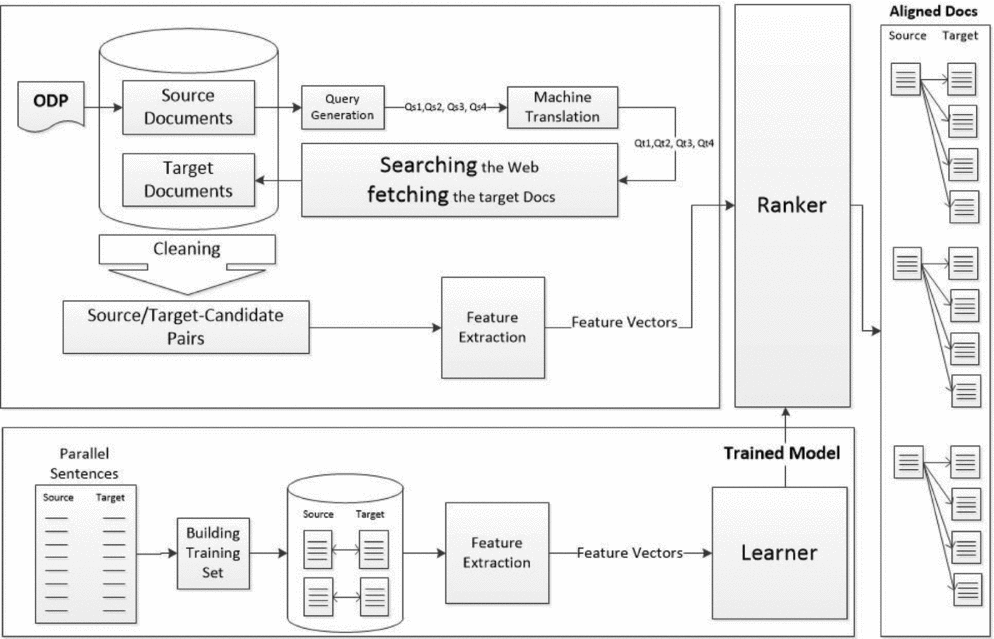
The overall process of building a multi-domain comparable corpus.

3.1 Acquiring the documents
Data collection is the first step in building comparable corpora (the upper left component in Fig. 1). For the source documents, we use the ODP (data of ODP 2012)Footnote 5 which contains URLs of 5,169,997 websites in over 1,017,500 categories. The ODP organizes URLs in a hierarchical structure of domains where URLs of each domain are further categorized into sub-domains. Using the ODP to obtain source documents guarantees that initial seeds will cover different domains. This point is essential in building comparable corpora since increasing the size of a comparable corpus in a specific domain does not necessarily improve the quality of obtainable translations (Xu and Weischedel Reference Xu and Weischedel2005; McNamee, Mayfield and Nicholas Reference McNamee, Mayfield and Nicholas2009). The contents of the websites in ODP constitute our collection of source documents.
In the next step, candidate websites in the target language are gathered for each source document. This step is performed by generating a number of driver queries for each source document and then finding documents relevant to the translations of the driver queries. To ensure obtaining proper candidate target documents for each source document (in English), we use different available information for web pages in ODP and build four driver queries for each source document. More specifically, for each source document, four driver queries are built as follows:
(1) Keywords: The first query is composed of keywords that are extracted from the source documents. Keywords of a document are extracted by analogy with mixture-model feedback method (Zhai and Lafferty Reference Zhai and Lafferty2001) in the KL-divergence retrieval framework. We estimate a language model for each document by modeling noise words in the document with the collection language model, in a way that the probability of each word given the document is a linear combination of its new language model and the collection language model as follows:
where λ is a parameter that controls the amount of noise, p(.|C) is the collection language model, and θ′D is the new language model for document D which captures its topic. We then rank the words of document D by their probabilities in θ′D. The five most probable words form the first query.(2) $$\begin{equation}
p(w|D) = \lambda p(w|\theta _D^{\prime }) + (1 - \lambda ) p(w|C), \;
\end{equation}$$
(2) Title of websites: The second query is built from terms of the websites’ title after removing the stopwords.
(3) Description of websites: The third query is extracted from the description provided for each page in ODP. The description of each page is part of the page’s metadata information and gives an objective statement of the content of the page. Queries from provided descriptions are derived based on the discrimination values of terms of description texts. Each term’s discrimination value is calculated similar to IDF as
$ \frac{1}{df(t)}$, where df(t) represents the document frequency of term t. We estimate the document frequency of a term based on its hit count in Web search results in response to a query consisting of that term using Bing search API.Footnote 6 After sorting terms of the description part based on this criterion, five top-scored terms are selected as query terms.(4) Domain hierarchies: The fourth query is built using the hierarchy structure of domains in ODP where URLs are organized. Each URL is a leaf in the domain tree of ODP. For each URL, the domain labels of its parent, grandparent and great-grandparent constitute a query for the document constructed from that URL.


In the next step, we translate each derived query into the target language (Persian) using Google machine translation system. The translated queries are then searched on the Web using the Google Web Search APIFootnote 7 and top eight pages are fetched for each query. After this step, we have at most thirty-two candidate documents for each source document.
3.2 Exploiting a learning-to-rank method to build alignments
Creation of alignments between source and target documents can be viewed as a task of ranking candidate target documents for each source document. Learning to rank methods are extensively used for constructing ranking models from labeled training data with promising performance. Therefore, we employ a learning to rank method for ranking target documents. In this regard, Ranking SVM (Joachims Reference Joachims2002) is used as the learning method in our approach since it has been shown to be effective for the ranking purpose in different tasks (Li and Hirst Reference Li and Hirst2011). Ranking SVM is a pairwise ranking method that uses Support Vector Machines (Cortes and Vapnik Reference Cortes and Vapnik1995), one of the state-of-the-art classifiers in several IR and NLP applications, to learn a ranking function. The lower left component in Fig. 1 shows the learning step in the proposed approach to build comparable corpora. Following, we first introduce the employed features to build the ranking model and then describe the process of building appropriate training data for the task of creating a comparable corpus.
3.2.1 Features
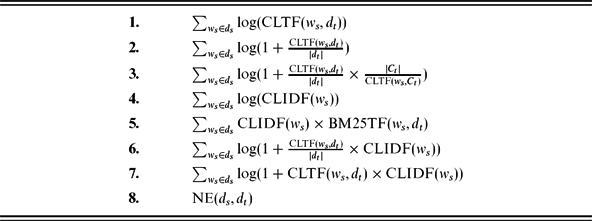
In this section, we define the features exploited in the learning to rank method, which are listed in Table 1. We divide the features into four groups, frequency-based features, discrimination-based features, features based on cross-lingual document similarity, and named entity feature. Before proceeding to formal definition of features, let us define some notations. Let ws and wt denote source and target words, respectively. Similarly, ds and dt denote documents in the source and target languages, respectively.
Features for learning a model using ranking SVM
Frequency-based features. Features in this category capture the frequencies of words of a source document in a target document. The first three features of Table 1, defined in (Azarbonyad et al. Reference Azarbonyad, Shakery and Faili2012), belong to this category. Frequency of a word belonging to one language in a document written in another language, referred to as cross-lingual term frequency, is defined as follows (Darwish and Oard Reference Darwish and Oard2003):
 $$\begin{equation}
\mathrm{CLTF}(w_s,d_t)=\sum _{w_t \in V_t}p(w_t|w_s)\times \mathrm{TF}(w_t,d_t), \;
\end{equation}$$
Frequency-based features, defined using cross-lingual term frequency, reflect different roles of term-frequency heuristics in ranking documents. The first feature is based on the fact that the larger frequency of words of a source document in a target document indicates a higher similarity between two documents. However, the increase in the similarity score of two documents due to an increase in the frequency of words that are translations of each other is smaller for larger values of the frequency (see TFC2 in (Fang et al. Reference Fang, Tao and Zhai2011)). The second feature incorporates lengths of documents in order to penalize long documents. The third feature uses the inverse of collection frequency of terms to penalize matching of frequent but non-content terms in deriving document similarities.
Discrimination-based feature. Feature 4 captures the inverse document frequency heuristic of information retrieval in the computation of document similarities. This is important because matching more specific terms between a source and a target document is a better indicator of comparability. For this purpose, cross-lingual inverse document frequency is used which measures the popularity of a word in a collection of documents in another language of that of the word, and is defined as
 $$\begin{equation}
\mathrm{CLIDF}(w_s)= \sum _{w_t \in V_t}p(w_t|w_s)\times IDF(w_t). \;
\end{equation}$$
Features based on cross-lingual document similarity. Features 5, 6 and 7 of Table 1 measure cross-lingual document similarity between documents in two languages using cross-lingual term frequency and cross-lingual inverse document frequency defined above. In the fifth feature, BM25TF(ws, dt) is calculated as
 $$\begin{equation}
\mathrm{BM25TF}(w_s,d_t) = \frac{(k+1)\times \mathrm{CLTF}(w_s,d_t)}{k((1-b)+b(\frac{|d_t|}{|d|_{avg}}))+ \mathrm{CLTF}(w_s,d_t)}. \;
\end{equation}$$
Named entity feature. This feature for a pair of source and target documents shows the percentage of named entities in the source document whose translations/transliterations exist in the target document. The NE feature for documents ds and dt is calculated as follows:
 $$\begin{equation}
\mathrm{NE}(d_s, d_t) = \frac{ \sum _{n \in \mathrm{NE}_s} \mathrm{trans} (n, d_t)}{|\mathrm{NE}_s|},
\end{equation}$$
3.2.2 Training data
Since Ranking SVM is a supervised learning method, we need training data which should be of high quality to result in high performance ranking. In our problem, the goal is to find the most similar documents to a source document in order to build alignments. Thus, we need a set of high-quality aligned documents as training data to construct a model using the Ranking SVM method. A perfect alignment includes documents that are literal translations of each other. These document pairs better reveal the importance degree of each feature in determination of comparable documents. Therefore, we employ a parallel corpus to generate training data. Most of available parallel corpora are sentence aligned, in contrast to document level alignments of comparable corpora. Thus, the fine-grained level of alignments of a parallel corpus are not suitable for our task. To resolve this issue, we construct source and target documents by concatenating a number of source sentences and their aligned target sentences in the parallel corpus, respectively.
The obvious way for building artificial documents is to select a constant number of sentences as introduced in (Ture, Elsayed and Lin Reference Ture, Elsayed and Lin2011). However, selecting a constant number of sentences would not yield a perfect training set for our task. This is because all the built documents in the source or the target language have approximately equal lengths. This training set is not compatible with actual contents of web pages that we aim to align. Documents extracted from web pages can have different sizes. Thus, in measuring the similarity of these documents, longer documents need to be penalized more since they have more chance of being aligned with other documents. To consider this point in the learning process, we built artificial documents with different lengths from the sentence-aligned parallel corpus. In the first step, we estimate the probability mass function of the length of documents acquired for the source part of our comparable corpus from ODP. Then, a random number is repeatedly generated from a uniform distribution in the range [0, 1] and mapped to the estimated probability mass function. The corresponding value of document length in the probability mass function indicates how many parallel sentences should be concatenated to create a new document. For each built document in the source language, a corresponding document in the target language is also created by concatenating the sentences that are aligned with the sentences of the source document in the parallel corpus. This parallel document provides a sample of similar document for the source document and is labeled as ‘1’. Supervised learning to rank methods should be trained on examples of similar and dissimilar document pairs. In this regard, nine target documents are created by concatenating randomly selected target sentences. These non-parallel documents are labeled as ‘0’. Therefore, this training data contains only parallel and non-parallel document pairs. We refer to this training data as ‘Training Data with One Similarity Degree’. However, considering only parallel documents as similar documents does not totally capture the characteristics of comparable corpora. For example, only parts of aligned documents in a comparable corpus may be on the same topic. To provide more samples of similar documents, another training data with three degrees of similarity is built.
In the second training data, there are three categories of similar documents for each built document in the source language:
(1) A parallel document: This document contains the literal translations of the sentences of the source document as described above.
(2) A semi-parallel document: This document contains the whole literal translation of the sources document along with a randomly generated part where its length is determined by a random number drawn from uniform distribution in the interval U[0, 3*|Ds|] (|Ds| shows the length of the source document).
(3) A comparable document: The first part of this document contains the literal translation of the source document where its length is obtained randomly from a normal distribution with mean 0.5*|Ds| and standard deviation 0.3*|Ds|. The second part of this target document is randomly generated and its length is determined by a random number drawn from uniform distribution in the interval U[0, |Ds|].
All three built documents in the target language are considered as similar documents to the source document, and are labeled as ‘3’, ‘2’, and ‘1’ in order of decreasing similarity degree. Therefore, in this training data, there are twelve alignments for each source document where three of them contain similar documents with different similarity degrees and the other nine alignments are random dissimilar documents. We refer to this training data as ‘Training Data with Three Similarity Degrees’. Finally, both training data are used to learn a ranking model, and ranks of candidate target documents provided by the learned ranking model are used to align documents.
4 Experiments
In this section, we present our experimental results on the evaluation of the proposed approach to build comparable corpora and the quality of the two built comparable corpora. We first introduce the measures for evaluating the alignment qualities of a comparable corpus. Next, the exploited datasets and linguistic resources, preprocessing steps and experimental setups are described. Finally, we report the characteristics and quality of the two built comparable corpora and compare our approach with the previous approaches.
4.1 Evaluation measures
We employ two types of evaluation metrics. The first type of metrics measure the comparability degree of aligned documents. The second type of measures evaluates the quality of alignments by assessing translation knowledge that can be extracted from comparable corpora.
4.1.1 Comparability measures
The comparability degree of alignments of a comparable corpus is measured using ‘binary Comparability Measure’ (binCM) and ‘cosine Comparability Measure-Vector Space Model’ (cosine-CM-VSM) metrics introduced in (Saad et al. Reference Saad, Langlois and Smaïli2013). The binCM measure is computed based on the number of words of a source document whose translations exist in its aligned document, and is defined as follows:
 $$\begin{equation}
\mathrm{binCM}(d_s,d_t)=\frac{\sum \limits _{w_s\in d_s \cap V_s^{\mathrm{dic}}} \mathrm{trans}(w_s,d_t)}{|d_s \cap V_s^{\mathrm{dic}}|}, \;
\end{equation}$$
 $$\begin{equation}
{\mathrm{binCM}}(A)=\sum _{a_i\in {A}} \frac{\mathrm{binCM}(d_{s_i},d_{t_i})+\mathrm{binCM}(d_{t_i},d_{s_i})}{2|A|}, \;
\end{equation}$$
The second comparability measure is cosineCM-VSM. To calculate this metric, source and target documents of an alignment are represented by vectors of size m, the number of entries in a bilingual dictionary. Let ws → wt denote an entry of the dictionary. The value for this entry in the vectors of the source and target documents (ds and dt) are tf(ws, ds) and tf(wt, dt), respectively, where tf(w, d) shows the frequency of word w in document d. The cosineCM-VSM measure for an alignment is then estimated by computing the cosine similarity of the vectors of its source and target documents as follows:
 $$\begin{equation}
\mathrm{cosineCM}-\mathrm{VSM}(V_{d_s},V_{d_t}) = \frac{\sum \limits _{i=1}^{m}V_{d_s}.V_{d_t}}{\Vert V_{d_s}\Vert \times \Vert V_{d_t}\Vert }, \;
\end{equation}$$
4.1.2 Evaluation based on extraction of translations
In this evaluation approach, the goal is to measure the quality of extracted translation models from comparable corpora. The higher the quality of alignments of a comparable corpus, the higher the quality of obtainable translations. There are different methods to extract translation models from comparable corpora (Gaussier et al. Reference Gaussier, Renders, Matveeva, Goutte and Déjean2004; Talvensaari et al. Reference Talvensaari, Laurikkala, Järvelin, Juhola and Keskustalo2007; AbduI-Rauf and Schwenk Reference AbduI-Rauf and Schwenk2009; Garera, Callison-Burch and Yarowsky Reference Garera, Callison-Burch and Yarowsky2009; Vulić and Moens Reference Vulić and Moens2012). We focus here on approaches that extract translations from comparable corpora without using any other translation resources such as machine-readable dictionaries (Sheridan and Ballerini Reference Sheridan and Ballerini1996; Tao and Zhai Reference Tao and Zhai2005; Talvensaari et al. Reference Talvensaari, Laurikkala, Järvelin, Juhola and Keskustalo2007; Rahimi and Shakery Reference Rahimi and Shakery2013). We adopt the language modeling approach proposed in (Rahimi and Shakery Reference Rahimi and Shakery2013; Rahimi, Shakery and King Reference Rahimi, Shakery and King2016). In this approach, each word is modeled by a probability distribution based on the alignment representation as in Equation (1). Let ws/wt denote a source/target word. The parameters of generated models for ws and wt are p(d si|ws)ni = 1 and p(d ti|wt)ni = 1, respectively, where n is the size of alignment vector in Equation (1). Similarity of two words is then estimated using cross entropy of their models as follows:
 $$\begin{equation}
\mathrm{sim}(w_s,w_t) \stackrel{\mathrm{rank}}{=} \exp \big (\beta \sum _{i=1}^{|A|} p(d_{s_i} | w_s) \log p(d_{t_i} | w_t)\big ), \;
\end{equation}$$
 $$\begin{equation}
p_{\mathrm{cc}}(w_{t_i} | w_s) = \frac{\mathrm{sim}(w_s, w_{t_i})}{\sum _{j=1}^{|V_t|} \mathrm{sim}(w_s, w_{t_j})}, \;
\end{equation}$$
For CLIR, we opt the query translation approach based on the language modeling framework (Nie Reference Nie2010). In this approach, a new language model is estimated for the query, and documents are ranked using
 $$\begin{equation}
\mathrm{score}(Q,D) = \sum _{w_t \in V_t} \big (\sum _{w_s \in V_s} p_{\mathrm{cc}}(w_t | w_s) p(w_s | \theta _Q)\big ) \log p(w_t | \theta _D), \;
\end{equation}$$
4.2 Datasets and experimental setup
Training data. The required training data is constructed using TEP parallel corpus (Pilevar et al. Reference Pilevar, Faili and Pilevar2011). TEP parallel corpus is a sentence-aligned English–Persian corpus built from movie subtitles. The two training datasets consist of 56,846 parallel document pairs by concatenating the parallel sentences of TEP. In addition, training datasets contain 5,011,614 non-parallel document pairs where their target documents are created by concatenation of random Persian sentences. Table 2 shows the statistics of generated training data with one similarity degree.
Statistics of training data with one similarity degree
Feature extraction. The translation model, used for feature extraction, is trained using the GIZA++ toolkit (Och and Ney Reference Och and Ney2003) on TEP parallel corpus. The obtained model is of the form p(w|u) which indicates the probability of translating word u in one language to word w in another language. In order to extract the named-entity feature in our experiments, named entities in the source documents (in English) are first identified using the Stanford Named Entity Recognizer (Finkel, Grenager and Manning Reference Finkel, Grenager and Manning2005). The identified named entities are then translated using the Google machine translation system and searched in the target documents.
Dataset. To evaluate the quality of built comparable corpora based on CLIR (Equation 12), a test collection is needed for which we use Hamshahri collection containing 166,774 documents in Persian with two sets of queries (topics in CLEF 2008 and CLEF 2009) (AleAhmad et al. Reference AleAhmad, Amiri, Darrudi, Rahgozar and Oroumchian2009) in English and Persian languages. We use the title of Ham’08 and Ham’09 topics for the evaluation. Stopwords are removed from queries and documents of Hamshahri collection.
Tools. Experiments are done using the Lemur toolkit.Footnote 8 For training the ranking model, the SVMrank toolFootnote 9 is used.
Data preprocessing. After crawling the URLs of the ODP, preprocessing steps are performed to gather only informative data from the websites. To get the main content of each web page, the jusText toolFootnote 10~(Pomikálek Reference Pomikálek2011) is used for document cleaning which eliminates noise of the web pages, such as navigation bars and advertisements. Furthermore, the target documents are refined by removing non-Persian documents. The words of remained Persian documents are then normalized by replacing all orthographic variations of letters by one form.Footnote 11
4.3 Characteristics of crawled data
In this section, we present the characteristics of the source and target collections that are used to build our multi-domain comparable corpus. The source collection is obtained by crawling the URLs provided in the ODP. The documents of this source collection cover twelve different domains that are listed in Table 3. We choose domains at the top level of the ODP hierarchy that have a large number of URLs and also few intersections with each other.
Domains of MUDEPCC comparable corpus
The target collection is obtained by generating driver queries and crawling documents retrieved by the Google search engine with respect to the driver queries. Statistics of each domain in the source and target collections are reported in Table 4, which include the number of documents and Average Document Lengths. In addition, Fig. 2 shows the distribution of the length of English document, which is used to generate training data.
Distribution of the length of English documents obtained by crawling the websites of ODP.
Statistics of each domain (denoted by Di) in the obtained source and target collections before the alignment of documents
4.4 Assessing the quality of MUDEPCC
We first construct a ranking model using ‘Training Data with One-Degree Similarity’. This model is used to rank candidate Persian documents for each English document. Each English document is then aligned with its most similar document in Persian. The obtained comparable corpus is referred to as MUDEPCC and its statistics are reported in Table 5.
MUDEPCC statistics. #UT-EN and #UT-FA show the numbers of unique terms in the English and Persian sides of the corpus, respectively
We assess the quality of our multi-domain comparable corpus by computing the comparability measures introduced in Section 4.1.1. Calculation of these comparability measures needs a reference bilingual dictionary. Employing a machine-readable bilingual dictionary for this purpose requires a reliable morphological analyzer to derive the base form of words. However, due to the lack of such analyzer for Persian language, which yields missing some important inflectional formations (Dadashkarimi, Shakery and Heshaam Reference Dadashkarimi, Shakery and Heshaam2014), we employ a dictionary which is extracted from a parallel corpus.
We use the word-to-word translation model trained on TEP parallel corpus as the translation reference. The obtained translation model is exploited in two different ways for computing the binCM measure. First, only the top translation of each source word is considered. We denote the comparability degrees computed using this dictionary as binCMtop. The cosine-CM-VSM measure is only computed based on the mentioned dictionary. The second reference dictionary is built by considering translations with probabilities greater than 0.1 per source word. To use this dictionary in computation of the binCM measure, binary function trans(ws, dt) in Equation (7) equals 1 if at least one of the translation alternatives of ws exists in dt. We denote the comparability degrees computed using this probabilistic dictionary as binCM(p ⩾ 0.1). Table 6 shows the computed comparability degrees for MUDEPCC and the parallel part of our training data referred to as TEP-Parallel-Docs. Alignments of our comparable corpus, MUDEPCC, achieve comparability of 49.32 percent and 40.60 percent of that of TEP-Parallel-Docs in terms of binCM and cosine-CM-VSM, respectively.
Comparability degrees of comparable corpora built using our approach (MUDEPCC and MUCC3), and a document-level parallel corpus
We also built a comparable corpus by using ‘Training Data with Three Similarity Degrees’, which is referred to as ‘MUCC3’. Table 6 also includes the comparability degrees of the alignments of this comparable corpus. The results show that the alignments of MUDEPCC have higher degrees of comparability compared to MUCC3, but the differences are not significant.
Moreover, we evaluate how well our trained ranking model performs in selection of the best target document (in Persian) for a source document (in English) by using the comparability measures. In particular, we aim to investigate whether our ranking model has selected the target document with the highest comparability degree to a source document for the alignment purpose. In this regard, we first compute the comparability measure binCM or cosine-CM-VSM between each English document and all of its candidate documents in Persian. The candidate Persian document with the highest binCM or cosine-CM-VSM score is judged as relevant for the English document. Then, the ranked lists for each English document, provided by our learned ranking model, is evaluated against its judged Persian document according to recall at top 1, 3 and 5 documents (Saad et al. Reference Saad, Langlois and Smaïli2013). Figure 3 shows these recall values computed based on both comparability measures on MUDEPCC. The figure clearly indicates that our approach for ranking candidate target documents has a high performance.
Evaluation of MUDEPCC using binary and cosine comparability measures.
In order to provide error analysis, we adapted the five-level relevance scale which was first introduced by Braschler and Schäuble (Reference Braschler and Schäuble1998) and later used in other studies, such as (Talvensaari et al. Reference Talvensaari, Laurikkala, Järvelin, Juhola and Keskustalo2007), (Hashemi, Shakery and Faili Reference Hashemi, Shakery and Faili2010) and (Rahimi and Shakery Reference Rahimi and Shakery2011). Five levels of relevance are defined as:
(1) Same story. Documents cover the same topic.
(2) Related story. Documents are about the same topic but are written from slightly different viewpoints, or one of the documents also cover other topics besides the common topic.
(3) Shared aspect. Documents are about the related events, such as events about same persons.
(4) Common terminology. Documents share a considerable amount of shared terminologies.
(5) Unrelated. Documents have no apparent relation.
In this regard, we randomly select some alignments of MUDEPCC and judge their similarities according to this five-level relevance status. Following, we mention two reasons for creation of alignments in MUDEPCC that are judged as level 4 or 5. The first reason is that there is no or very limited Persian web pages related to some English web pages. For example, there is almost no web page in Persian that describes Queen Mary, University of London. Therefore, the web page of the School of History at this universityFootnote 12 is aligned with the homepage of a person that has been graduated from there, which we considered to be not very related. Second, some web pages have keywords that are ambiguous such that they are specific words in one sense, while they are general words in the other sense. In this case, translation of keywords according to their general senses causes imperfect alignments. This is the case that occurred for a web page about the VW Beetle car.Footnote 13 Beetle is translated as an insectFootnote 14 in Persian. Therefore, the aligned documents are unrelated.
4.5 Comparison with previous approaches for building comparable corpora
We compare our proposed approach for building comparable corpora with the building approach exploited in (Talvensaari et al. Reference Talvensaari, Laurikkala, Järvelin, Juhola and Keskustalo2007), (Hashemi et al. Reference Hashemi, Shakery and Faili2010) and (Hashemi and Shakery Reference Hashemi and Shakery2014). To provide an exact comparison, we employ our approach on two monolingual collections that are used to build UTPECC comparable corpus in (Hashemi and Shakery Reference Hashemi and Shakery2014). These source and target collections contain 53,697 English documents and 191,440 Persian documents which are gathered from BBC newsFootnote 15 and Hamshahri newspapers,Footnote 16 respectively. Documents of these collections are aligned in a four-step method in (Hashemi and Shakery Reference Hashemi and Shakery2014):
(1) Extraction of keywords from the documents in the source language (English).
(2) Translation of the keywords into the target language (Persian).
(3) Ranking documents of the target collection w.r.t. the query including the translated keywords. The top r target documents are considered as candidate documents for the source document.
(4) Aligning a source and a target document based on the similarity score of the target document to the corresponding query of the source document and the proximity of their publication dates.
The details of step 4 are as follows. For each English document D, the r most similar Persian documents are searched to create alignments. First, Persian documents in r which are published in the same day as D and their retrieval scores are greater than θ1, are aligned with D. If no candidate Persian document satisfies these conditions, then Persian documents in r which are published in +/ − 4 days of D are considered. However, the score threshold increases to θ2 and Persian documents with retrieval scores greater than θ2 are selected to be aligned. Again, in case of no alignment, the score threshold increases to θ3 and a difference of 14 days in publication dates becomes allowed. Following (Hashemi and Shakery Reference Hashemi and Shakery2014), the score thresholds are set as θ1 = 60, θ2 = 80 and θ3 = 95. The values of score thresholds are percentiles, e.g. θ = 60 means that the retrieval score is greater than sixty percent of retrieval scores of all candidate target documents w.r.t. their corresponding source documents.
We also use this approach to align the documents, but the following parts are implemented differently:
(1) Keyword extraction: Keywords are extracted based on the language modeling framework, Equation (2), in our approach, while ‘relative average term frequency’ is used in (Hashemi and Shakery Reference Hashemi and Shakery2014).
(2) Selection of candidate documents: The KL-divergence retrieval model is used with pseudo relevance feedback to select r candidate documents per source document in (Hashemi and Shakery Reference Hashemi and Shakery2014), whereas we use the same model without pseudo relevance feedback.
(3) Number of candidate documents : Value of r in our approach is 15, while r is set to 50 in (Hashemi and Shakery Reference Hashemi and Shakery2014).
(4) Ranking of candidate documents: The candidate documents are ranked based on their retrieval scores with respect to generated queries from source documents in (Hashemi and Shakery Reference Hashemi and Shakery2014), whereas we use a learning to rank method, as described in Section 3.2, for ranking candidate documents.
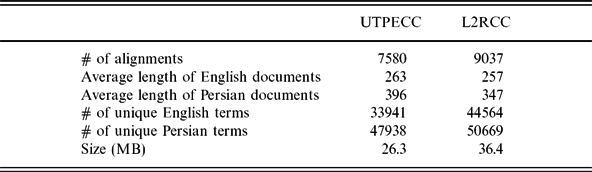
Statistics of the exploited news collections, UTPECC comparable corpus which is built in (Hashemi and Shakery Reference Hashemi and Shakery2014), and the built comparable corpus using the proposed method (referred to as L2R Comparable Corpus) on the news collections, are reported in Table 7. The statistics show that more documents of the news collections are aligned using the proposed learning-based method compared to the previous method. Following, we evaluate the quality of alignments in two comparable corpora.
Statistics of UTPECC and our comparable corpus (L2RCC)
Comparability measures.Table 8 shows the results of comparing UTPECC and L2R comparable corpus in terms of the comparability measures. The results show that our L2R comparable corpus has alignments with higher quality and improves binCM by 11.3 percent compared to UTPECC.
Evaluation of UTPECC and our comparable corpus (L2R comparable corpus) using binary and cosine comparability measures
In addition, we compare the two comparable corpora based on the recall measure as described before, where relevant documents are only judged by the cosine comparability measure. The results are depicted in Fig. 4, which show that our approach outperforms the previous approach.
Comparing the quality of UTPECC and our L2R comparable corpus using the binary comparability measure.
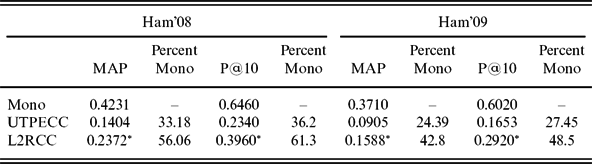
Performance of CLIR. We also compare the L2R comparable corpus (built using our approach) with UTPECC (built in (Hashemi et al. Reference Hashemi, Shakery and Faili2010)) in terms of the quality of translations extracted from both comparable corpora. First, two translation models are obtained from UTPECC and L2RCC comparable corpora. For this purpose, stopwords are removed from both sides of comparable corpora. English words are stemmed using Porter stemmer. The translation models are then evaluated based on the performance of CLIR. For each experiment, MAP and Precision at top ten documents (P@10) are reported. We also report the performance of monolingual retrieval using Ham’08 and Ham’09 query sets as a baseline for CLIR evaluation in Table 9. These results are obtained using the KL-divergence retrieval model.
CLIR performance using translations extracted from UTPECC and L2R corpus. ‘*’ sign indicates statistical significant differences at the 0.01 level using a two-tailed paired t-test
To perform CLIR using the language modeling framework, we smooth document language models using Dirichlet Prior smoothing and do not tune the smoothing parameter μ which is set to the default value of 1,000. Performance of CLIR is reported in Table 9, which shows that using translations extracted from our comparable corpus compared to those from UTPECC, MAP performance of CLIR is improved by sixty-eight percent and seventy-five percent for Ham’08 and Ham’09, respectively. This shows the higher quality of alignments built using our learning-based approach.
To provide a more complete analysis, we present the Average Precision (AP) difference between results obtained for each query using our L2R comparable corpus and UTPECC comparable corpus as the translation resource in Fig. 5. As the figure illustrates, AP of thirty-five out of fifty queries in Ham’08 is improved. In addition, seven out of nine queries that have zero AP using UTPECC (Hashemi et al. Reference Hashemi, Shakery and Faili2010) corpus, get non-zero precision values using our L2R corpus. Similarly, we reached better AP for forty of fifty queries in Ham’09.
Per query AP difference for topics in Ham’08 and Ham’09.
5 Conclusion and future work
In this paper, we proposed a new approach for building comparable corpora from Web data. Our approach is based on a learning to rank method to derive a ranking of candidate target documents for each source document. In this regard, we exploited features based on CLIR, cross-language document similarity and named entity. We also proposed to generate training data from a parallel corpus so that training data simulates the characteristics of comparable corpora. Employing a learning-based approach for building alignments of a comparable corpus allows the addition of any language pair- or domain-specific feature. We used our approach to build a large-scale multi-domain comparable corpus from the Web and demonstrated its quality by different evaluation measures. In addition, we compared the proposed approach for building comparable corpora with the existing methods and indicated that our approach builds higher quality alignments through several experiments.
In the current work, we employed de-facto standard methods for removing noise from translation models and matching named entities. However, using more sophisticated methods, such as methods of Aker, Paramita and Gaizauskas (Reference Aker, Paramita and Gaizauskas2013) and (Aker et al. Reference Aker, Paramita, Pinnis and Gaizauskas2014), for these steps may help to improve the quality of alignments. Another direction is to expand training data with aligned Wikipedia articles using multilingualism characteristic of Wikipedia, and study how much this training data affects the quality of learned ranking model and subsequently comparable corpora.
Looking forward, we are interested in defining more features to measure document similarity. We also aim to explore other learning to rank methods for training a ranking model suitable for the task of creating comparable corpora. In addition, extracting parallel segments from built comparable corpora to train a SMT is an important future work.
6 Acknowledgments
This research was in part supported by a grant from Institute for Research in Fundamental Sciences (No. CS1393-4-43).