Introduction
Electronics and photonics drive innovation in society. Future products are anticipated to form seamless links between living beings and the digital world, and will become ever more indispensable for improving safety and quality of life, without impairing comfort. Only a decade ago, such a vision was not much more than a distant goal, with some tentative approaches toward stretchable electronics and photonics. Reference Wagner and Bauer1 In the last five years, we have seen tremendous progress in the field, with the introduction of epidermal, Reference Kim, Lu, Ma, Kim, Kim, Wang, Wu, Won, Tao, Islam and Yu2 transient, Reference Hwang, Tao, Kim, Cheng, Song, Rill, Brenckle, Panilaitis, Won, Kim and Song3 and imperceptible Reference Kaltenbrunner, Sekitani, Reeder, Yokota, Kuribara, Tokuhara, Drack, Schwödiauer, Graz, Bauer-Gogonea and Bauer4 forms of electronics, being ultrathin, -lightweight, -flexible, and even -conformable. Such extremes in mechanical behavior are achievable with nearly all kind of materials (inorganic and organic, brittle and elastic, hard and soft) by positioning active electronic layers in the neutral mechanical plane and by aggressively scaling the flexural rigidity of the thin-film on foil devices. Reference Suo, Ma, Gleskova and Wagner5
In this article, we review recent developments in organic, large-area imperceptible electronic and photonic devices and their applications, ranging from ultralightweight solar cells for energy supply, to wearable health monitors and biomedical implants.
From early flexible electronics to imperceptible systems that stretch
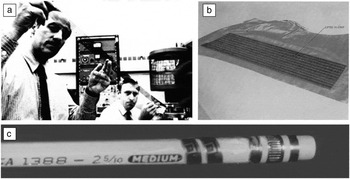
Organic electronics rely on the thin-film field-effect transistor (TFT) architecture. The first functional devices were introduced as early as 1962 at RCA laboratories as a base for integrated thin-film circuits. Reference Weimer6 The thin-film transistor also won the “race” for the first flexible logic and power circuits on paper and plastic foils at the Westinghouse Laboratories in 1967 Reference Brody and Page7,Reference Brody8 ( Figure 1a). The history of the TFT itself is full of setbacks and obstacles before turning into the success story we know today with the ascent of flat-panel displays.
The dawn of modern flexible electronics in 1967. (a) Thin-film transistors fabricated on mylar plastic foils by the yard at Westinghouse Laboratories. Reprinted with permission from Reference Reference Brody8. © 1984 IEEE. (b) Thin silicon solar cells on polymer substrates designed for space exploration. Reprinted with permission from Reference Reference Ray9. © 1967 IEEE. (c) Thin-film hydrogenated amorphous silicon (a-Si:H) transistors fabricated on steel foil, wrapped around a pencil. Reprinted with permission from Reference Reference Suo, Ma, Gleskova and Wagner5. © 1999 AIP Publishing.

The first steps in modern flexible electronics were born out of curiosity, but the large potential of such unusual electronics was not immediately obvious. The apex of space exploration in the mid-1960s necessitated the development of solar cells with improved power per weight. Consequently, light, flexible silicon solar panels attached to plastic foils were introduced in 1967 to maximize rocket payload and minimize cost Reference Ray9 (Figure 1b). “High-tech” flexible electronics were surprisingly well developed in the mid-1960s, then forgotten until renewed interest was sparked in the late 1990s with studies on the mechanics of flexible and rollable electronics. In a milestone contribution published in 1999, Reference Ma and Wagner10 amorphous silicon thin-film transistors on 3-µm-thick steel substrates were described, comparable to the thinnest plastic substrates used today for ultraflexible electronics, allowing bending around a pencil (Figure 1c). Placing the thin-film electronic layer in the neutral plane of a support encapsulation structure further reduces allowable bending radii. Reference Suo, Ma, Gleskova and Wagner5,Reference Sekitani, Iba, Kato, Noguchi, Someya and Sakurai11,Reference Kim, Ahn, Choi, Kim, Kim, Song, Huang, Liu, Lu and Rogers12
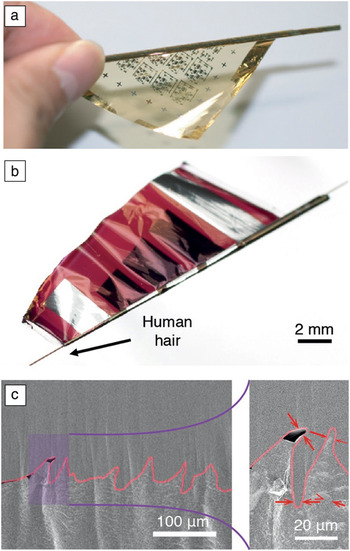
The minimum allowable radius of curvature of a flexible sheet supporting thin-film electronics linearly scales with the total thickness, when we assume that the active electronic layer fails upon reaching a critical strain value, typically on the order of 1% or lower for most materials. Reducing the substrate thickness down to 12.5 µm, combined with an ultrathin field-effect transistor architecture consisting of 4-nm aluminum oxide and a 2-nm-thick self-assembled monolayer dielectric enabled the fabrication of organic circuits able to withstand bending radii as small as 300 µm. Reference Sekitani, Zschieschang, Klauk and Someya13 There was the additional benefit of reduced operating voltage of the transistors of less than 3 V ( Figure 2a). Reducing the thickness of the substrate is key for the fabrication of ultraflexible devices.
Quest for record flexibility. (a) Organic field-effect transistors, inverters, and ring oscillators on a 12.5-μm polyimide foil tightly rolled into a tube with a 300-μm radius. Reference Sekitani, Zschieschang, Klauk and Someya13 (b) Organic solar cell on 1.4-µm-thick poly(ethylene terephthalate) wrapped around a human hair with a radius of 35 µm. Reference Kaltenbrunner, White, Glowacki, Sekitani, Someya, Sariciftci and Bauer14 (c) Cross-sectional scanning electron microscope image of a wrinkled plastic foil with an organic field-effect transistor bent down to a radius of less than 5 µm within the transistor area. The device-carrying foil on top of the elastomer is outlined in red, with bending radii of less than 5 um marked by red arrows. Reference Kaltenbrunner, Sekitani, Reeder, Yokota, Kuribara, Tokuhara, Drack, Schwödiauer, Graz, Bauer-Gogonea and Bauer4

The next step in the quest for record bending radii was achieved by employing plastic films with a thickness of 1.4 µm, typically used in foil capacitors on an industrial scale. Organic solar cells Reference Kaltenbrunner, White, Glowacki, Sekitani, Someya, Sariciftci and Bauer14 on such plastic foils enabled us to wrap the solar cell around a human hair, without failure of the device (Figure 2b). In designs with the thin-film electronics placed in the neutral plane of support and encapsulation, such that tensile and compressive strains largely cancel under flexion, it is possible to significantly further reduce the bending radius. This marked the birth of “imperceptible” electronics, Reference Kaltenbrunner, Sekitani, Reeder, Yokota, Kuribara, Tokuhara, Drack, Schwödiauer, Graz, Bauer-Gogonea and Bauer4 being ultrathin with a total thickness of 2–3 µm and ultraflexible with bending radii down to 5 µm (Figure 2c).
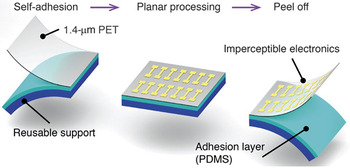
Imperceptible electronic circuits are readily being manufactured in all their complexity with conventional process techniques on planar geometries. Conveniently, ultrathin poly(ethylene terephthalate) and poly(ethylene naphthalate) foils are commercially available at low cost in rolls for foil capacitors. The ultrathin foil is temporarily adhered to a reusable support, allowing all subsequent processing steps to be scalable by adopting a roll-to-roll fabrication scheme ( Figure 3 ). After fabrication, the foil is simply peeled from the temporary support and ready to use. Reference Drack, Graz, Sekitani, Someya, Kaltenbrunner and Bauer15
Scheme for the preparation of imperceptible electronic devices. The ultrathin polymer foil is mounted on a reusable support, for example, thicker plastic films with a poly(dimethylsiloxane) (PDMS) adhesion layer. After planar processing of the thin-film electronics, the skin-inspired electronic device is ready to use. Reference Drack, Graz, Sekitani, Someya, Kaltenbrunner and Bauer15 Note: PET, poly(ethylene terephthalate).

The flexural rigidity D of a thin plate of a material is given by its plane-strain modulus
 $\bar E = E/\left( {1 - {\nu ^2}} \right)$
and thickness t, as
 $D = \bar E{t^3}$
. Here ν is the Poisson’s ratio of the material and E is the elastic modulus. This cubic dependence on the thickness implies that even materials with an elastic modulus exceeding 100 GPa can become highly flexible when scaled down to the nanometer regime such as in nanoscale membranes. This opens up many possibilities for the fabrication of ultraflexible electronic circuits, including silicon-
Reference Khang, Jiang, Huang and Rogers16–Reference Kim, Lu, Huang and Rogers20
and oxide-based
Reference Salvatore, Münzenrieder, Kinkeldei, Petti, Zysset, Strebel, Büthe and Tröster21–Reference Petti, Münzenrieder, Vogt, Faber, Büthe, Cantarella, Bottacchi, Anthopoulos and Tröster24
semiconductors and nanomaterials.
Reference Choi, Yang, Kang, Kim, Choi, Park, Kim, Chae, Kim, Kim and Hyeon25–Reference Georgiou, Jalil, Belle, Britnell, Gorbachev, Morozov, Kim, Gholinia, Haigh, Makarovsky and Eaves29
The extreme flexibility of ultrathin electronic foils can be used to create circuits that are mechanically stretchable and conformable to arbitrary surfaces. Reference Wagner and Bauer1,Reference Rogers, Someya and Huang30 The ability to reversibly deform and freely shape electronics intuitively bridges the gap between the digital world and our soft, organic environments. Two main strategies exist to create complex stretchable electronic devices: (1) functional compounds on flexible islands interconnected with stretchable wirings, and (2) thin electronic foils laminated on prestretched elastomers, forming a wrinkling structure when the strain is released. Wrinkling of thin films on soft substrates is abundantly found in nature, for example, drying fruits or skin, and can be described mathematically. Reference Cerda and Mahadevan31 It also enabled the birth of stretchable electronics, with metallic thin films deposited on thermally expanded poly(dimethylsiloxane) substrates. Reference Bowden, Brittain, Evans, Hutchinson and Whitesides32,Reference Lacour, Wagner, Huang and Suo33
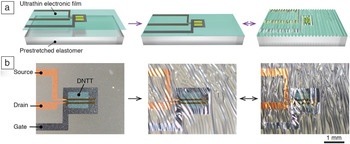
The wrinkling approach makes full use of the extremely low flexural rigidity of imperceptible electronic foils. Here, the thin films are directly deposited on prestretched rubber. With a one-step pick-and-place transfer onto prestretched elastomers, soft yet sophisticated devices with unprecedented uniaxial and biaxial stretchability can be formed ( Figure 4a). The films deform out of plane upon relaxing and accommodate compressive strain by pure bending deformations (Figure 4b). High levels of prestrain in the elastomer matrix typically lead to nonlinear responses and the formation of ridge wrinkles, folds with high-aspect ratio and extreme bending radii. Reference Zang, Ryu, Pugno, Wang, Tu, Buehler and Zhao34,Reference Cao, Chan, Zang, Leong and Zhao35 The design concepts with such imperceptible foils on pre-stretched rubber are general and readily applicable to practically all classes of thin-film devices.
Stretchable ultraflexible organic transistors. (a) With a one-step pick-and-place transfer, the imperceptible electronic foil is laminated on a prestretched elastomer. When the prestrain in the elastomer is relaxed, the electronic foil forms out-of-plane wrinkles accommodating tensile strains. (b) Picture sequence of the formation of folds in an ultraflexible organic field-effect transistor when the elastomer is relaxed stepwise. Reference Kaltenbrunner, Sekitani, Reeder, Yokota, Kuribara, Tokuhara, Drack, Schwödiauer, Graz, Bauer-Gogonea and Bauer4 Note: DNTT, dinaphtho[2,3-b:2′,3′-f] thieno[3,2-b]thiophene.

A whole new world for soft devices
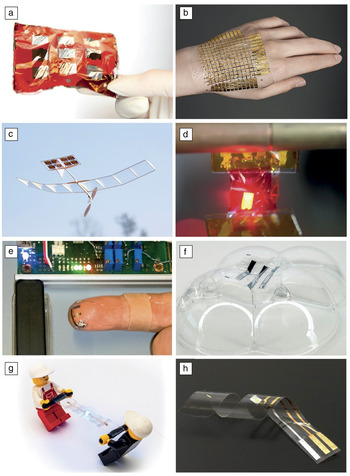
Ultraflexible and highly conformable forms of electronics have the potential for wide-ranging applications, crossing the line between the living and the digital world. Excellent recent reviews on the topic are available. Reference Hammock, Chortos, Tee, Tok and Bao36,Reference Bauer, Bauer-Gogonea, Graz, Kaltenbrunner, Keplinger and Schwödiauer37 In the following, we briefly summarize the progress in imperceptible electronics from 2012 to 2016. We illustrate the concept with organic solar cells less than 2-µm thick with an unprecedented power output of 10 W/g providing energy for untethered soft electronics Reference Kaltenbrunner, White, Glowacki, Sekitani, Someya, Sariciftci and Bauer14 ( Figure 5a). Besides power, sensor skins carrying thousands of sensor nodes eventually require addressing schemes for their pixels beyond individual wirings. Active-matrix transistor arrays allow individual units to be addressed via rows and columns, reducing wiring needs and offering an elegant route to large-area devices. We introduced design concepts, materials, and methods for large-area imperceptible plastic electronics Reference Kaltenbrunner, Sekitani, Reeder, Yokota, Kuribara, Tokuhara, Drack, Schwödiauer, Graz, Bauer-Gogonea and Bauer4 (Figure 5b), as well as demonstrated tactile sensor arrays based on active-matrix organic thin-film transistors that can be operated at elevated temperatures and in aqueous environments.
Imperceptible electronics development from 2012 to 2016. (a) Ultrathin and light organic solar cells with 10 W/g power per weight. Reference Kaltenbrunner, White, Glowacki, Sekitani, Someya, Sariciftci and Bauer14 (b) Imperceptible tactile sensor foils, only 2-μm thick, weigh 3 g/m2 and conform to human skin. Reference Kaltenbrunner, Sekitani, Reeder, Yokota, Kuribara, Tokuhara, Drack, Schwödiauer, Graz, Bauer-Gogonea and Bauer4 (c) Air-stable perovskite-based solar foils with 23 W/g can power aviation models such as miniature planes and blimps. Reference Kaltenbrunner, Adam, Głowacki, Drack, Schwödiauer, Leonat, Apaydin, Groiss, Scharber, Schuette White, Sariciftci and Bauer38 (d) Imperceptible organic light-emitting diode displays can be crumpled like paper and become highly stretchable on elastomer membranes. Reference White, Kaltenbrunner, Głowacki, Gutnichenko, Kettlgruber, Graz, Aazou, Ulbricht, Egbe, Miron, Major, Scharber, Sekitani, Someya, Bauer and Sariciftci39 (e) Magnetoception is introduced as a “sixth sense” to imperceptible skins with giant-magnetoresistance-based sensor arrays. Reference Melzer, Kaltenbrunner, Makarov, Karnaushenko, Karnaushenko, Sekitani, Someya and Schmidt40 (f) Thin electronic foil with resistive temperature sensors floating on a soap bubble. (g) Eye-catching illustration of the mechanical characterization of stretchable electronic devices with an open-source toy-brick tensometer (not shown). Reference Drack, Graz, Sekitani, Someya, Kaltenbrunner and Bauer15,Reference Moser, Kettlgruber, Siket, Drack, Graz, Cakmak, Major, Kaltenbrunner and Bauer44 (h) Shape-memory polymers enable deployable and 3D reconfigurable plastic electronics. Reference Reeder, Kaltenbrunner, Ware, Arreaga-Salas, Avendano-Bolivar, Yokota, Inoue, Sekino, Voit, Sekitani and Someya46

Photovoltaic technology requires light-absorbing materials that are highly efficient, lightweight, low cost, and stable during operation. Organolead halide perovskites constitute a highly promising class of hybrid materials, but suffer from limited stability under ambient conditions without heavy and costly encapsulation. These issues were addressed by introducing a chromium oxide-chromium interlayer, effectively protecting the top metal contacts from reactions with the perovskite and thus facilitating air-stable operation. This led us to develop imperceptible perovskite solar cells with stabilized 12% efficiency and power-per-weight ratio as high as 23 W/g. Reference Kaltenbrunner, Adam, Głowacki, Drack, Schwödiauer, Leonat, Apaydin, Groiss, Scharber, Schuette White, Sariciftci and Bauer38 These solar cells were successfully used to power ultralight aviation models outdoors and pave the way for stable power supplies in soft electronics (Figure 5c).
Highly flexible, stretchable polymer light-emitting diodes (PLEDs) Reference White, Kaltenbrunner, Głowacki, Gutnichenko, Kettlgruber, Graz, Aazou, Ulbricht, Egbe, Miron, Major, Scharber, Sekitani, Someya, Bauer and Sariciftci39 naturally expand the concept of imperceptible foils optoelectronic applications that include displays and ambient lighting. These organic light-emitting diode displays conform to arbitrary three-dimensional (3D) free forms and provide electrical functionality in yet unexplored ways through simple and cost-effective fabrication (Figure 5d). Such ultrathin light-emitting foils constitute a step toward integration with malleable materials such as textiles and artificial skin.
Technology enables us to go beyond imitating the capabilities of human skin and allows us to introduce unfamiliar senses. For example, magnetoception is a sense not found in humans, which allows bacteria, insects, and even some vertebrates such as birds and sharks to detect magnetic fields for orientation and navigation. Giant magnetoresistive sensor foils with high sensitivity, unmatched flexibility, and mechanical endurance Reference Melzer, Kaltenbrunner, Makarov, Karnaushenko, Karnaushenko, Sekitani, Someya and Schmidt40 have been added to the family of imperceptible electronics (Figure 5e). These foils are only 2-μm thick, extremely flexible (bending radii of 3 μm), lightweight (3 g/m2), and wearable as magnetosensitive skin that enables proximity detection, navigation, and touchless control. Ultrathin magnetic field sensors offer a new sense for soft robotics, safety and health care monitoring, consumer electronics, and electronic skin. Reference Melzer, Mönch, Makarov, Zabila, Bermúdez, Karnaushenko, Baunack, Bahr, Yan, Kaltenbrunner and Schmidt41–Reference Makarov, Melzer, Karnaushenko and Schmidt43 The performance of metallic and polymer conductors during cyclic stretching has been investigated and remarkable durability for ductile metals such as copper and gold, and amorphous conducting polymers has been found. These ultralight foils weigh a few grams per square meter, enabling them to float on a soap bubble, and have potential as low-cost, resistive-metal-film-based temperature sensors for food monitoring, quality control, or in disposable smart plasters Reference Drack, Graz, Sekitani, Someya, Kaltenbrunner and Bauer15 (Figure 5f).
In a hybrid approach, off-the-shelf microelectronics were merged with stretchable imperceptible interconnects. With this method, a wide range of powerful, industry-standard microelectronics is made available for soft devices. Here, interconnects with strain-independent conductivity are advantageous, especially for high-power electronics such as light-emitting diodes. Bonding of the plastic electronics to silicone elastomers is critical for sophisticated stretchable devices. This can be solved with suitable surface modification and siloxane linker chemistry. Interfacial bonding strength and mechanical response were evaluated with custom-built, open-source tensile testers constructed from Lego toy bricks Reference Moser, Kettlgruber, Siket, Drack, Graz, Cakmak, Major, Kaltenbrunner and Bauer44 (Figure 5g), with open-source availability of the detailed plans of the measurement device. Benchmarked against certified equipment, this work demonstrated that precise laboratory tools for the mechanical analysis of stretchable electronics can be fabricated purpose-designed at a low cost.
Shape-memory polymers that are biocompatible and drop several orders of magnitude in modulus at physiological temperatures open a unique path for implantable electronics. Structures that are relatively stiff initially and soften after implantation due to temperature changes and moisture uptake may become the material of choice for surgeons because of their ease of handling. Reference Ware, Simon, Arreaga-Salas, Reeder, Rennaker, Keefer and Voit45 In the body, the modulus is matched to the surrounding soft tissue and helps to reduce mechanically induced chronic damage. Fully reconfigurable, adaptable 3D electronics were demonstrated using shape-memory polymers with imperceptible organic transistors, potentially serving as signal amplifiers or multiplexers. Reference Reeder, Kaltenbrunner, Ware, Arreaga-Salas, Avendano-Bolivar, Yokota, Inoue, Sekino, Voit, Sekitani and Someya46 These devices deploy into preprogrammed shapes upon thermal stimulus without impairing the function of the electronic circuitry (Figure 5h). The softening nature of the polymer allowed the realization of organic electronics that are sufficiently stiff before insertion, and become soft after implantation. This may pave the way for future bioharmonized devices.
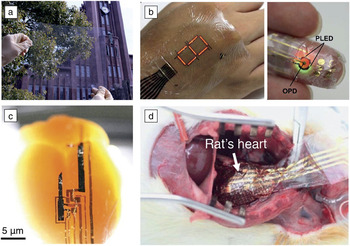
Electronics that pair softness and adaptability with biological compatibility have the potential to revolutionize medicine and health care. Many research groups have contributed to this vision, with an abundance of organic and inorganic materials at hand. Reference Chortos, Liu and Bao47–Reference Yokota, Inoue, Terakawa, Reeder, Kaltenbrunner, Ware, Yang, Mabuchi, Murakawa, Sekino and Voit55 Addressing issues in accurately measuring small normal pressures is essential for evaluating external stimuli in dynamic surfaces such as natural tissues, for example, during monitoring of vital signs such as pulse and arterial pressure. An integrated sensor matrix that is only 2-μm thick was recently introduced, Reference Lee, Reuveny, Reeder, Lee, Jin, Liu, Yokota, Sekitani, Isoyama, Abe and Suo56 using electrospun composite nanofibers of carbon nanotubes and graphene as the piezoresistive transducer material for measuring normal pressure, even under extreme bending conditions ( Figure 6a). Such sensor arrays may prove useful in soft robotics and medical applications.
Imperceptible electronic biosensors. (a) Photograph of transparent, large-area-deposited carbon- and graphene-based nanofibers using electrospinning (25 × 20 cm2). Reference Lee, Reuveny, Reeder, Lee, Jin, Liu, Yokota, Sekitani, Isoyama, Abe and Suo56 (b) Organic photonic skins using organic photodetectors (OPDs) and polymer light-emitting diodes (PLEDs) operate as digital or analog displays and measure blood oxygenation levels. Reference Yokota, Zalar, Kaltenbrunner, Jinno, Matsuhisa, Kitanosako, Tachibana, Yukita, Koizumi and Someya57 (c) Ultrathin, high-gain-bandwidth product organic amplifier conforming to a model rat brain. Reference Reuveny, Lee, Yokota, Fuketa, Siket, Lee, Sekitani, Sakurai, Bauer and Someya58 (d) In vivo recording of ischemia (inadequate blood supply) using an array of organic amplifiers and biocompatible gel electrodes. Reference Sekitani, Yokota, Kuribara, Kaltenbrunner, Fukushima, Inoue, Sekino, Isoyama, Abe, Onodera and Someya60

Thin-film electronics intimately laminated onto the skin imperceptibly equip the human body with electronic components for noninvasive health monitoring or for interactively displaying information. Incorporating ultraflexible and conformable three-color, highly efficient PLEDs and organic photodetectors, optoelectronic skins Reference Yokota, Zalar, Kaltenbrunner, Jinno, Matsuhisa, Kitanosako, Tachibana, Yukita, Koizumi and Someya57 with multiple electronic functionalities such as sensing and displays directly on human skin, have been introduced (Figure 6b). Recording vital data from within living organisms poses a new set of challenges, including small signal amplitudes and high noise. Reference Khodagholy, Doublet, Quilichini, Gurfinkel, Leleux, Ghestem, Ismailova, Hervé, Sanaur, Bernard and Malliaras53 On-site amplification of biosignals is thus highly beneficial, and can be achieved using organic amplifiers with high-gain-bandwidth product and cutoff frequency up to 45 and 25 kHz. Reference Reuveny, Lee, Yokota, Fuketa, Siket, Lee, Sekitani, Sakurai, Bauer and Someya58,Reference Lee, Kim, Rivnay, Matsuhisa, Lonjaret, Yokota, Yawo, Sekino, Malliaras and Someya59 The appropriate choice of materials enabled low operation voltages (5 V) and small feature size (<20 mm2) for designs entirely fabricated on an imperceptible plastic foil. The ultrathin form factor allows intimate contact with complex shapes, such as the model rat brain depicted in Figure 6c. In the form of large arrays, and in conjunction with biocompatible adhesive gels, systems comprising matrix-addressable amplifiers can monitor cardiac signals and characterize induced trauma in vivo, Reference Sekitani, Yokota, Kuribara, Kaltenbrunner, Fukushima, Inoue, Sekino, Isoyama, Abe, Onodera and Someya60,Reference Lee, Inoue, Kim, Reuveny, Kuribara, Yokota, Reeder, Sekino, Sekitani, Abe and Someya61 as shown in Figure 6d. Reducing the thickness of the substrate and encapsulation layers to 1 μm or less, Reference Reuveny, Yokota, Shidachi, Sekitani and Someya62,Reference Nawrocki, Matsuhisa, Yokota and Someya63 or using substrate-free fabrication of organic field-effect transistors and subsequent transfer printing, Reference Ko, Pan, Grigoropoulos, Fréchet, Luscombe and Poulikakos64 further improves conformability and adhesion to arbitrarily shaped surfaces. At these extreme regimes, mechanical stability may ultimately limit device yield and stability.
Conclusions and future prospects
Weight, flexibility, and conformability are pivotal for future wearable, soft, and stretchable electronics to proliferate. The ability to be imperceptible, Reference Kaltenbrunner, Sekitani, Reeder, Yokota, Kuribara, Tokuhara, Drack, Schwödiauer, Graz, Bauer-Gogonea and Bauer4 epidermal, Reference Kim, Lu, Ma, Kim, Kim, Wang, Wu, Won, Tao, Islam and Yu2 transient, Reference Hwang, Tao, Kim, Cheng, Song, Rill, Brenckle, Panilaitis, Won, Kim and Song3 self-healing, Reference Benight, Wang, Tok and Bao65 and intrinsically stretchable Reference Printz and Lipomi66 are fueling the vision of autonomous smart appliances to be embedded everywhere, in textiles, Reference Cherenack and van Pieterson67 on our skin, Reference Chortos and Bao68 and even in our body. Reference Park, Brenner, Shin, Morgan, Copits, Chung, Pullen, Noh, Davidson, Oh, Yoon, Jang, Samineni, Norman, Grajales-Reyes, Vogt, Sundaram, Wilson, Ha, Xu, Pan, Kim, Huang, Montana, Golden, Bruchas, Gereau and Rogers52 The family of ultrathin, imperceptible electronics is rapidly growing. Fully printed transistors on large-area, Reference Takeda, Yoshimura, Shiwaku, Tran, Sekine, Mizukami, Kumaki, Tokito and Fukuda69 metal oxide semiconductor circuits, Reference Khodagholy, Rivnay, Sessolo, Gurfinkel, Leleux, Jimison, Stavrinidou, Herve, Sanaur, Owens and Malliaras70 organic polymer-based biosensors, Reference Khodagholy, Doublet, Quilichini, Gurfinkel, Leleux, Ghestem, Ismailova, Hervé, Sanaur, Bernard and Malliaras53,Reference Lee, Kim, Rivnay, Matsuhisa, Lonjaret, Yokota, Yawo, Sekino, Malliaras and Someya59,Reference Khodagholy, Rivnay, Sessolo, Gurfinkel, Leleux, Jimison, Stavrinidou, Herve, Sanaur, Owens and Malliaras70,Reference Khodagholy, Gelinas, Thesen, Doyle, Devinsky, Malliaras and Buzsáki71 carbon nanotube- Reference Cao, Cao and Zhou72 and organic single-crystal- Reference Yi, Payne, Anthony and Podzorov73 based devices are a few recent examples. Modular systems that merge soft, large-area sensor systems with advanced microelectronics represent a frugal route for future research. Direct fabrication of optoelectronic, magnetic, temperature, and electrophysiological sensor and actuator nodes as a single large ultrathin and autarchic platform is a technologically challenging, yet fruitful, vision for electronic skins.
Integrating advanced sensor networks, actuation, and power supply with new soft, bioinspired materials is a recent research trend. The newest class of such materials are hydrogels that are tough yet flexible and stretchable, Reference Sun, Zhao, Illeperuma, Chaudhuri, Oh, Mooney, Vlassak and Suo74 are able to conduct ionic currents, Reference Keplinger, Sun, Foo, Rothemund, Whitesides and Suo75 and can be designed to closely match the properties of mammalian tissue. In fact, animal bodies are mainly composed of hydrogels with varying properties, such as tendons, muscles, or brain tissue. Electronics integrated with these fascinating materials Reference Lin, Yuk, Zhang, Parada, Koo, Yu and Zhao76 is at the forefront of soft-matter research. Such a bioharmonized interfacing of the digital and the living world provides ample opportunities for future research.
Acknowledgments
We acknowledge funding by the Austrian Science Funds, the European Research Council, and the JST Someya Bio-Harmonized ERATO Grant.

Takao Someya has been a professor in the Department of Electrical and Electronic Engineering at The University of Tokyo, Japan, since 2009. He received his PhD degree in electrical engineering in 1997 from The University of Tokyo. He is a global scholar of Princeton University and has been an IEEE/EDS Distinguished Lecturer since 2005. He was a member of the Materials Research Society’s Board of Directors from 2009 to 2011. His current research interests include organic transistors, flexible electronics, plastic integrated circuits, large-area sensors, and plastic actuators. Someya can be reached by email at someya@ee.t.u-tokyo.ac.jp.

Siegfried Bauer is a full professor and head of the Soft Matter Physics Department at Johannes Kepler University, Austria. He received his PhD degree from the University of Karlsruhe, Germany, in 1990. He worked at the Heinrich Hertz Institute for Communications Engineering in Berlin and at the University of Potsdam, Germany. He currently serves as an associate editor of the journal Applied Physics Review. He is a 2016 IEEE Fellow. His current research focuses on soft materials in flexible and stretchable electronics, studying the electroactive properties of elastomers and polymers and their applications in actuators and energy harvesting. Bauer can be reached by phone at +43-732-2468-9760 or by email at sbauer@jku.at.

Martin Kaltenbrunner is an associate professor in the Soft Matter Physics Department at Johannes Kepler University, Austria, and heads the Soft Electronics Laboratory. He received his master’s and PhD degrees in physics from Johannes Kepler University in 2008 and 2012, respectively. He then joined the Someya-Sekitani Lab for Organic Electronics at The University of Tokyo, Japan, as a postdoctoral researcher. Kaltenbrunner’s current research interests include soft electronics and machines, photovoltaics, lighting, and thin-film transistors, flexible and stretchable electronics, and electronic skin. Kaltenbrunner can be reached by phone at +43 732 2468 9764 or by email at martin.kaltenbrunner@jku.at.