Introduction
Agricultural pests are harmful to crops worldwide, as they can generate up to 25–40% yield losses at the world scale (based on eight major crops in Oerke & Dehne, Reference Oerke and Dehne2004; Oerke, Reference Oerke2006), with similar impact in pre- and post-harvest (Flood, Reference Flood2010). The impact of insects is regarded as a global threat for current and future agricultural production systems. In addition to the direct losses due to feeding activity, insects cause yield losses via indirect damages (Weintraub & Beanland, Reference Weintraub and Beanland2006). Spittlebugs can indeed transmit virus and bacteria (e.g. Xylella fastidiosa (Wells et al., Reference Wells, Raju, Hung, Weisburg, Mandelco-Paul and Brenner1987) transmitted by Philaenus spumarius L., and responsible for Pierce disease of grapevines (Nunney et al., Reference Nunney, Yuan, Bromley, Hartung, Montero-Astua, Moreira, Ortiz and Stouthamer2010) and leaf scorch of olive trees (Saponari et al., Reference Saponari, Loconsole, Cornara, Yokomi, De Stradis, Boscia, Bosco, Martelli, Krugner and Porcelli2014)). Leafhoppers and planthoppers can transmit phytoplasmas (e.g. Flavescence dorée of grapevines, transmitted by Scaphoideus titanus Ball et al., 2014), which are prokaryotes colonizing plant phloem (Weintraub & Beanland, Reference Weintraub and Beanland2006). Phytoplasmas transmitted by insects are responsible for diseases in hundreds of plant species (Lee et al., Reference Lee, Davis and Gundersen-Rindal2000; Weintraub & Beanland, Reference Weintraub and Beanland2006), e.g., grapevine (Johannesen et al., Reference Johannesen, Lux, Michel, Seitz and Maixner2008; Chuche & Thiery, Reference Chuche and Thiery2014), lavender (Danet et al., Reference Danet, Sémétey, Gaudin, Verdin, Chaisse, Foissac, Bertaccini, Laviña and Torres2010; Germain et al., Reference Germain, Matile-Ferrero, Kaydan, Malausa and Williams2015), maize (Jovic et al., Reference Jovic, Cvrkovic, Mitrovic, Krnjajic, Redinbaugh, Pratt, Gingery, Hogenhout and Tosevski2007), and strawberry (Danet et al., Reference Danet, Foissac, Zreik, Salar, Verdin, Nourrisseau and Garnier2003).
Among them, cixiid planthoppers (Hemiptera: Cixiidae) are considered of great economic importance, as they can transmit phytoplasmas agents of prominent and emerging plant diseases worldwide (e.g., Danet et al., Reference Danet, Foissac, Zreik, Salar, Verdin, Nourrisseau and Garnier2003; Jovic et al., Reference Jovic, Cvrkovic, Mitrovic, Krnjajic, Redinbaugh, Pratt, Gingery, Hogenhout and Tosevski2007; Maniyar et al., Reference Maniyar, Kehrli and Johannesen2013). One of the most studied planthopper is Hyalesthes obsoletus Signoret, which is the vector of the stolbur phytoplasma causing the grapevine yellow disease ‘bois noir’ (Bressan et al., Reference Bressan, Turata, Maixner, Spiazzi, Bondon-Padieu and Girolami2007; Johannesen et al., Reference Johannesen, Lux, Michel, Seitz and Maixner2008). H. obsoletus is a polyphagous species, which overwinters as nymphs on the roots of host plant species (Sforza et al., Reference Sforza, Bourgoin, Wilson and Boudon-Padieu1999), and completes one generation per year in Central and South Europe (e.g., Sforza et al., Reference Sforza, Bourgoin, Wilson and Boudon-Padieu1999). H. obsoletus adults’ flight occurs from June til late August, depending on meteorological conditions and host plants (Sforza et al., Reference Sforza, Bourgoin, Wilson and Boudon-Padieu1999; Darimont & Maixner, Reference Darimont and Maixner2001). The insect can acquire phytoplasma at two different periods: first at larval stage, when feeding in the phloem of host–plant species during overwintering (Johannesen et al., Reference Johannesen, Lux, Michel, Seitz and Maixner2008); second at adult stage, when sucking infected plants (Weintraub & Beanland, Reference Weintraub and Beanland2006).
The population size, distribution and dispersal of H. obsoletus are largely influenced by the spatial structure of host plant species (Bressan et al., Reference Bressan, Turata, Maixner, Spiazzi, Bondon-Padieu and Girolami2007) and by the range of their contacts (Maniyar et al., Reference Maniyar, Kehrli and Johannesen2013). In vineyard systems of Central and Southern Europe, bindweed -Convolvulus arvensis L.- and stinging nettle -Urtica dioica L.- (both herbaceous species) are the major host species (Sforza et al., Reference Sforza, Clair, Daire, Larrue and Boudon-Padieu1998; Langer & Maixner, Reference Langer and Maixner2004; Imo et al., Reference Imo, Maixner and Johannesen2013) considered as reservoir plants for stolbur phytoplasma (Maniyar et al., Reference Maniyar, Kehrli and Johannesen2013), while grapevine is considered as ‘an erratic feeding host’ (Bressan et al., Reference Bressan, Turata, Maixner, Spiazzi, Bondon-Padieu and Girolami2007; Maixner, Reference Maixner2011). More than 50 species were identified as host species in Europe (Bulgaria, Crete, France, Greece, Italy), other Mediterranean countries (Israel, Liban, Maroc, Turkey), and Russia (Suchov & Vovk, Reference Suchov and Vovk1946; Kovaceski, Reference Kovaceski1958; Aleksic et al., Reference Aleksic, Sutic and Aleksic1967; Leclant & Lacote, Reference Leclant and Lacote1969; Hoch & Remane, Reference Hoch and Remane1985; Güçlü & Özbek, Reference Güçlü and Özbek1988; Fos et al., Reference Fos, Danet, Zreik, Gamier and Bove1992; Sforza et al., Reference Sforza, Clair, Daire, Larrue and Boudon-Padieu1998). Based on these studies, hosts of H. obsoletus cover a wide range of species, including tree species (e.g., Populus spp., Quercus spp., Ulmus spp.), cultivated crops (e.g., Medicago sativa L., Onobrychis viciifolia Scop., Zea mays L.) and wild species (e.g., Amaranthus retroflexus L., Cirsium arvense Scop., Melilotus officinalis Des Rouss.). Lavender (Lavandula angustifolia Miller) and lavandin (infertile hybrid; Lavandula hybrida Reverchon) were also identified as host plants for H. obsoletus (Sforza et al., Reference Sforza, Clair, Daire, Larrue and Boudon-Padieu1998, Reference Sforza, Bourgoin, Wilson and Boudon-Padieu1999), as well as clary sage (Salvia sclarea L.) very recently (Chuche et al., Reference Chuche, Danet, Rivoal, Arricau-Bouvery and Thiery2017). In addition, aromatic plants, such as immortelle (Helichrysum stoechas (L.) Moench) and thyme (Thymus vulgaris L.), can locally be suspected of being potential hosts for H. obsoletus, as some aromatic plants were identified as hosts (e.g., Lavandula spp., Vitex agnus castus L.) (Hoch & Remane, Reference Hoch and Remane1985; Sforza et al., Reference Sforza, Clair, Daire, Larrue and Boudon-Padieu1998, Reference Sforza, Bourgoin, Wilson and Boudon-Padieu1999).
In vineyards, Panassiti et al. (Reference Panassiti, Hartig, Breuer and Biedermann2015) assumed to 50 m per year the range of active dispersal (i.e., flight) of an individual H. obsoletus. But dispersal of the insect both within-field and between crops were also found in other studies (Orenstein et al., Reference Orenstein, Zahavi, Nestel, Sharon, Markalifa and Weintraub2003; Bressan et al., Reference Bressan, Turata, Maixner, Spiazzi, Bondon-Padieu and Girolami2007; respectively). Testing of push and pull strategy in Israel to avoid dispersal of H. obsoletus in adjacent vineyards even highlighted attraction of the insect by its preferred host plant for feeding (i.e., Vitex agnus castus L.) up to 400 m, which was the maximum tested distance (Zahavi et al., Reference Zahavi, Peles, Harari, Soroker and Sharon2007). The lack of attractiveness of H. obsoletus for Vitis vinifera L. could explain the short distances sometimes observed (e.g., in Panassiti et al., Reference Panassiti, Hartig, Breuer and Biedermann2015). The presence of H. obsoletus on grapevine would result from random landing rather than selective flight (Bressan et al., Reference Bressan, Turata, Maixner, Spiazzi, Bondon-Padieu and Girolami2007). As H. obsoletus flies mostly during the day, with a peak of activity between 15 and 21 h (Bressan et al., Reference Bressan, Turata, Maixner, Spiazzi, Bondon-Padieu and Girolami2007), a driving factor of its long-range dispersal could be wind speed, as demonstrated for species with diurnal flight activity (Larsen & Whalon, Reference Larsen and Whalon1988; Orenstein et al., Reference Orenstein, Zahavi, Nestel, Sharon, Markalifa and Weintraub2003).
In Provence (southern France), the stolbur phytoplasma (transmitted by H. obsoletus) causes a lavender and lavandin disease called ‘yellow decline’ (Danet et al., Reference Danet, Sémétey, Gaudin, Verdin, Chaisse, Foissac, Bertaccini, Laviña and Torres2010; Gaudin et al., Reference Gaudin, Semetey, Foissac and Eveillard2011; Germain et al., Reference Germain, Matile-Ferrero, Kaydan, Malausa and Williams2015), which is responsible for important economic losses (Gaudin et al., Reference Gaudin, Semetey, Foissac and Eveillard2011). When infected, lavender and lavandin plants become yellow, puny, and finally die, leading to an early uprooting due to lower and non-profitable yields (uprooting after 6–7 years instead of 12–15 years). This crop, grown in Provence since many generations, is adapted to dry and hot summers, and contributes €30 million per year to the local economy (Germain et al., Reference Germain, Matile-Ferrero, Kaydan, Malausa and Williams2015). As no curative method exists against stolbur phytoplasma, farmers grow tolerant cultivars on part of the acreages (Gaudin et al., Reference Gaudin, Semetey, Foissac and Eveillard2011). While symptom severity does not correlate either with the tolerance status of cultivars, or with the phytoplasma titer (Gaudin et al., Reference Gaudin, Semetey, Foissac and Eveillard2011), Yvin (Reference Yvin2011) showed that highly diseased areas were associated with high captures of H. obsoletus in lavender and lavandin fields.
Gathering knowledge on the epidemiological pattern of yellow decay caused by H. obsoletus in this area is essential to design effective strategies in lowering its impact. As a first step towards this aim, the objective of this paper is to understand the effect of the local landscape characteristics on the presence and density of H. obsoletus in the ‘Plateau de Valensole’, southern France. To this aim, this study was carried out to: (1) better characterise the polyphagous nature of H. obsoletus, i.e., the diversity of host plants whose location and abundance should be characterized, and (2) highlight the dynamic between sources and sinks for the crop species of interest by estimating likely distance travelled by H. obsoletus.
Materials and methods
Study area
The ‘Plateau de Valensole’ is a dry plateau located in the south of France, in the NUTS-2 region Provence-Alpes-Côte-d'Azur (coordinates ≈43°40′05″N – 43°58′41″N; 5°47′06″E – 6°17′32″E). It covers about 50,000 ha, with altitude ranging between 450 and 850 m, and it is spatially delimited by surrounding valleys. About one third of its area is covered by crops (15,500 ha in 2012), with the lavandin, the infertile hybrid of lavender crop (Lavandula hybrida Reverchon; Lavandula latifolia Medik x Lavandula angustifolia Miller), covering 22–24% of agricultural land (ASP, 2016; data for 2014 and 2010, respectively). The main lavandin cultivar is Grosso, while cultivar Sumian is less represented because of lower yields (70 kg ha−1 vs. 100 kg ha−1; CIHEF, 2012). Both cultivars are considered tolerant to stolbur phytoplasma (Gaudin et al., Reference Gaudin, Semetey, Foissac and Eveillard2011).
Field experimental design
The field campaign was carried out in 2015 on three zones (Brunet, Montagnac and Saint-Jurs). These three zones were chosen as representative of contrasted levels of lavandin yellow decline (i.e., low, medium and high), of the presence of woods (where alternative hosts of H. obsoletus could be found), and of the presence of potential alternative plant hosts (i.e., sainfoin -Onobrychis viciifolia Scop.- and clary sage -Salvia sclarea L.). All of them included one field of a 1-year old lavandin, cultivar Grosso (target field). H. obsoletus cannot complete its reproduction cycle in these 1-year lavandin, as the plant transplanting occurs after the flying period of the insect. The altitude of the study zones was 620, 670, and 740 m for Montagnac, Brunet and Saint-Jurs, respectively. Weather conditions of the studied year (monthly rainfalls and monthly minimum, mean and maximum air temperatures) mostly did not differ from data of the 19 previous years (August 1995–July 2015). For the studied year, we considered the period August 2014–July 2015 (i.e. from the beginning of laying period til the end of flying period; Appendix A). Weather data were recorded in Valensole (altitude of 600 m, 43°50′18″N 6°00′00″E) from the beginning of 2015 by Meteo France, in a weather station located at 10, 15, and 19 km from Brunet, Montagnac, and Saint-Jurs, respectively.
The identification of the sources of H. obsoletus was performed with two types of in-field surveys: the identification of larvae on plant roots and the capture of emerging adults. The presence of potential sources of H. obsoletus on the surrounding fields was investigated by capturing flying adults and recording the composition of the local landscape. Local landscape was characterized in terms of location (field observations) and proportion (GIS computations) of the different land uses. Polygons figuring the field borders of land uses were digitized at a 1:1000 scale using an IGN orthophoto (https://www.geoportail.gouv.fr/; Lambert 93 coordinates) dated from 2015 with a resolution of 20 cm. Classification of the polygons in different land uses was done manually on the basis of an homogeneity of texture and color, and verified with field observations to distinguish the following categories: woods, and cultivated crops: alfalfa (Medicago sativa L.), clary sage (Salvia sclarea L.), durum wheat (Triticum durum Desf.), grassland (mixed species), lavandin (Lavandula hybrid Reverchon), pea (Pisum sativum L.) rapeseed (Brassica napus L.), sainfoin (Onobrychis viciifolia Scop.), and sunflower (Helianthus annuus L.). Crop age was also recorded for perennial species (lanvandin and clary sage, cropped for 6–15 years and 3–4 years, respectively), based on farmers’ interview. The covered landscape area including target field was chosen according to the potential sources of H. obsoletus. In-field measurements were performed in an area of 500 m radius around the target field for Montagnac and Saint-Jurs, while the area in Brunet was larger (1 km) in order to include one plot of an additional potential source of H. obsoletus (clary sage). Due to the larger area in Brunet, not all fields around the target field were surveyed; survey included all the fields between supposed source and target, as well as their direct neighbouring fields.
Searching for larvae and emerging adults
Potential host plants for H. obsoletus were searched based on studies performed in France (Sforza et al., Reference Sforza, Bourgoin, Wilson and Boudon-Padieu1999) and abroad (Kovaceski, Reference Kovaceski1958; Aleksic et al., Reference Aleksic, Sutic and Aleksic1967; Hoch & Remane, Reference Hoch and Remane1985; Güçlü & Özbek, Reference Güçlü and Özbek1988), including both cultivated and non-cultivated plants. Extra aromatic plants – that were not included in the above-mentioned studies – were also investigated, as they were suspected hosts according to local knowledge of farmers and technical advisers. Potential hosts, identified in previous studies or suspected by local authorities, were investigated in the three studied areas: (1) cultivated crops, i.e., lavandin, clary sage, alfalfa, sainfoin, alfalfa; and (2) natural vegetation, i.e., immortelle (Helichrysum stoechas (L.) Moench), thyme (Thymus vulgaris L.), bindweed (Convolvulus arvensis L.), yellow melilot (Melilotus officinalis Des Rouss.), dandelion (Taraxacum spp.), lamb's quarters (Chenopodium album L.), amaranth (Amaranthus retroflexus L.), bedstraw (Galium spp.), creeping thistle (Cirsium arvense Scop.), stinging nettle (Urtica doica L.) and wild lavender (i.e., found in woods or in field edges). The surrounding fields with other crops were also searched: grassland (mixed species), durum wheat, and rapeseed.
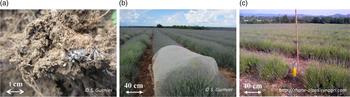
Larvae were searched and counted on plant roots. Plants uprooting was performed on June 2015 for larvae to be on L5 stage, i.e., when they are grouped in a white molt (Brcak, Reference Brcak, Maramorosch and Harris1979) and thus easily identifiable (fig. 1a). For cultivated plants (lavandin and clary sage), around five plants per field were randomly uprooted. For natural vegetation (wood, field edge), ten plants were uprooted for each species. Fields cropped with 1-year lavandin were not tested, as H. obsoletus could not complete its reproduction cycle.
In-field measurements performed for larvae detection (a), capture of emerging adults (b) and flying adults (c).

Capture of H. obsoletus emerging adults was realized with emergence traps. Emergence traps consisted of a yellow sticky trap, surrounded by a net held by two metal hoops (fig. 1b). The yellow sticky trap is a PVC tube, 40 cm high, surrounded by a sticky yellow strip, and held by a stem of Provence rod of 50 cm embedded in the soil. Each trap covered 1 m2. Emergence traps were placed around mid-June in fields of lavandin, sainfoin, alfalfa (1–2 traps per field of the studied zone) and natural zones (4–5 traps per studied zone) at the same time than larvae surveys. In natural zones the abundance of potential host plants was recorded as the percentage of area covered by these plants in the emergence trap. These traps could not be set up for clary sage because of a too dense vegetation (except for the 2-year clary sage of Saint-Jurs, where crop cover was less dense).
Capturing flying adults
Flying adults of H. obsoletus were captured with yellow sticky traps (fig. 1c) located in cultivated crops and natural zones. About 40 traps were set up in each study zone, during the last week of June (i.e., before the start of the flying period of H. obsoletus). Three to five traps were randomly placed within each field in clary sage (presumed source) and young lavendin (host), while 1–2 traps in durum wheat, rapeseed, grassland, and woods. The traps were weekly monitored from the end of June till the end of July, and the number of adults of H. obsoletus was counted.
Characterization of lavandin management and surrounding landscape
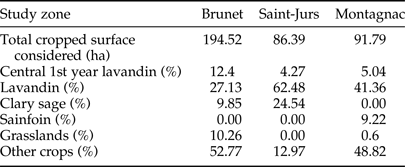
Local farmers were interviewed to gather information on the management of lavandin fields located in the three studied zones. Surveys focused on the management practices that may affect the presence and abundance of H. obsoletus: the age of the lavandin crop, the cultivar, the harvest date, the use of irrigation, and clay spraying (a prevention technique consisting covering the plants’ leaves with clay (in powder) to prevent H. obsoletus bites). Note that spraying insecticide on lavandin is not allowed during the flying period of H. obsoletus, as it coincides with the flying period of bees. Landscape characteristics in terms of cultivated crops and natural areas (i.e., woods) were recorded in the three study zones (table 1).
Main characteristics of observed landscape composition in the three studied zones.

Other crops include rapeseed, durum wheat, sunflower and pea. Local landscape was characterized in terms of location (field observations), and proportion (GIS computations) of the different crops. The age of perennial crops (lavandin and clary sage) were also recorded (farmers’ interview).
Statistical analyses
Based on the results of larvae search and emergence traps, the sources of H. obsoletus were identified. Firstly, the spatial autocorrelation of weekly and total catches of H. obsoletus in yellow sticky traps was determined using Moran's I spatial statistics (Cliff & Ord, Reference Cliff and Ord1981). The values of this index range between −1 (i.e., perfect negative correlation between observations) and 1 (i.e., perfect positive correlation between observations). No spatial autocorrelation is associated to a Moran's I index of 0, i.e., indicating that observations are independent (P < 0.05). This analysis was performed in the study zones where H. obsoletus was captured. For this analysis, we considered clary sage field as the source of H. obsoletus, and lavandin field as the target. Secondly, we fitted negative binomial and Poisson models using the logarithm of the sum of captures over the season as dependent variable to assess the dispersion pattern of H. obsoletus. These two models have the same number of parameters (i.e., intercept + slope parameters, depending on the number and type of explanatory variables) (Ver Hoef & Boveng, Reference Ver Hoef and Boveng2007). Negative binomial model assumes an over-dispersion of the dependent variable (i.e., conditional variance higher than conditional mean), and the Poisson model corresponds to a negative binomial model with variance equal to mean, by setting the over-dispersion parameter to 0 (Greene, Reference Greene2008). We considered two explanatory variables in the tested models, both together and separately: (1) the minimum distance between the trap and the border of the source field (m); and (2) the host type in which the trap was placed (Crop_code), including information about the crop (clary sage or lavandin), the cultivar (for lavandin only), and the age. Such categorization was performed because of the uneven distribution of crop characteristics (i.e., not every combination crop × cultivar × age).
The overall performances of Poisson and negative binomial models per se were compared with Akaike criterion (AIC, a measure of model goodness of fit penalyzing more complex models; Burnham & Anderson, Reference Burnham and Anderson2002). As these models do not share the same likelihood function, they were compared via a likelihood ratio test corrected for degrees of freedom (Self & Liang, Reference Self and Liang1987). We assessed the goodness-of-fit of the best model (according to AIC and likelihood ratio test) and the significance of the explanatory tests with χ2 test on residual deviance. The comparison between coefficients associated with the different modalities of the Crop_code explanatory variable was performed with Wald test, by considering 95% confidence intervals for each coefficient in the best model. Model residuals were visually checked for independence from fitted values. Poisson and negative binomial models were fitted for the study zone Brunet, due to missing values in Saint-Jurs, as these models require an identical length and timing of observation. No field source of H. obsoletus was found in Montagnac.
Statistical analyses and figures were performed with R software (R Development Core Team, 2013). Between-trap distances for computing Morans’ I were calculated with the function ‘dist’, and minimal distances between each trap and the pre-identified source field were computed with the ‘gDistance’ function of the R package rgeos (Bivand & Rundel, Reference Bivand and Rundel2016), based on trap and field coordinates. Maps and land uses proportions were realised with the QGIS software version 2.10.1-Pisa (QGIS Development Team, 2015). Morans’ Indices were computed with the function ‘Moran.I’ of the R package ape (Paradis et al., Reference Paradis, Claude and Strimmer2004). Poisson models were fitted with the R function ‘glm’ (R Development Core Team, 2013), and negative binomial models were fitted with the R function ‘glm.nb’ of the package MASS (Venables & Ripley, Reference Venables and Ripley2002). Likelihood ratio tests for comparing Poisson and negative binomial models were performed with the R function ‘lrtest’ of the package lmtest (Zeileis & Hothorn, Reference Zeileis and Hothorn2002). Akaike values, χ2 test analysis of deviance, and Wald test were computed with the R functions ‘AIC’, ‘pchisq’, ‘anova’, and ‘summary’, respectively.
Results
Host plants of Hyalesthes obsoletus at larval and emergence stages
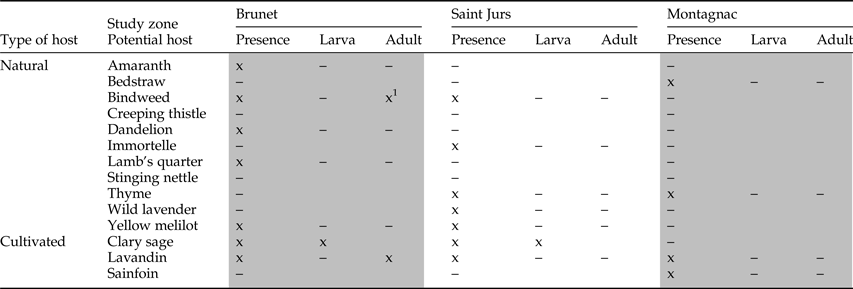
In Brunet study zone, bindweed was the most widespread potential natural host of H. obsoletus, as it was found in all the tested zones (including the cultivated grasslands and the field edges of durum wheat), except in the woods and in the field of durum wheat. Other potential natural hosts for H. obsoletus were yellow melilot, dandelion, lamb's quarters and amaranth, which were less frequently found as compared with bindweed. No larva of H. obsoletus was detected on these natural species (table 2). For these species, emerging adults were captured in only one trap located in cultivated grassland, where bindweed covered about 10% of the trap surface (four and one individuals in the weeks 2–9 and 9–17 July, respectively). Among the four lavandin fields (two 3-year and two 4-year fields), random plant's uprooting did not reveal to find any larva of H. obsoletus. However, a few adults (three) were caught during the survey of week 2–9 of July in a 3-year lavandin field (cultivar Grosso). Larvae of H. obsoletus were also found in the 4-year clary sage field, on about 70% of the uprooted plants with an average of 13 larvae per plant (between 4 and 23 larvae per plant). No larvae were found in the 2-year clary sage field.
Summary of potential host plants found in the three study zones, and the associated results for plants’ uprooting and captures of H. obsoletus in the emergence traps.

x, presence; –, absence; empty case, non-tested.
1 Bindweed located in the cultivated grassland.
In the natural zones of Saint-Jurs, wild lavender and thyme species were found in the woods, and yellow melilot was present in the field edge between 1-year and 5-year lavandin fields. Bindweed was identified in all areas but in rapeseed and durum wheat fields. No larva of H. obsoletus was found in the roots of these species, and no adult was captured in the emergence traps (table 2). In the cultivated areas, no H. obsoletus was found in lavandin fields, neither by uprooting plants nor with the emergence traps. For clary sage, the six fields located in the study zone were tested for the presence of H. obsoletus (one field of 2-year clary sage, four fields of 3-year clary sage, and one field of 4-year clary sage). The insect was found in the 4-year clary sage only, on 30% of the plants, for an average of 7 larvae per host plant (between 2 and 15 larvae per plant). All positive plants were located in a strip in the middle of the field.
In Montagnac natural areas, the potential hosts of H. obsoletus were thyme and bedstraw species in woods, and sainfoin and lavandin (4, 9 and 10 years-old) in cropped areas. Based on both plant uprooting and emergence traps, no source of H. obsoletus was identified in Montagnac during the survey (table 2).
Density and pattern of Hyalesthes obsoletus flying adult captures
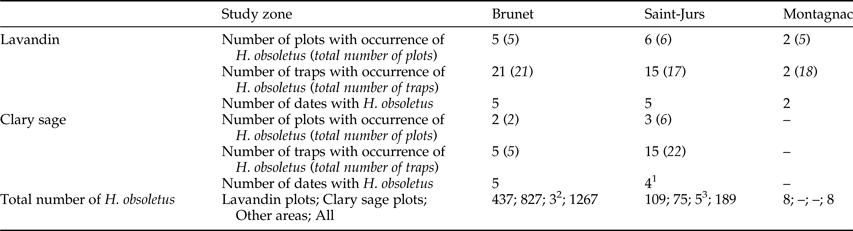
Most H. obsoletus flying adults were captured in Brunet, which were found in all the traps in lavandin and clary sage fields, for 34 and 65% of insects, respectively (table 3). The peak of H. obsoletus flight was shifted by 1 week in these two crops (9 and 17 July for lavandin and clary sage, respectively) (fig. 2), probably because of the lavandin harvest in this period (lower attractiveness). In clary sage, more insects were captured in 4-year than in 2-year fields, while in lavandin, the relation between the number of captures and the age of the crop was less clear (fig. 2). The insect was marginally found in the other areas tested, i.e., grassland, wood and durum wheat (average of 1, 1 and 1.5 insect per trap over the whole period, respectively). Spatial autocorrelation was significantly positive (I ∈ [0.085; 0.229]; P = 0.001) in all observation dates but for the first one (2 July, I = 0.048, P = 0.069). Moran's I was significantly positive when considering the total number of captured H. obsoletus (I = 0.176; P < 0.001).
Number of trapped Hyalesthes obsoletus in lavandin and clary sage fields for the study site Brunet. Means per field are shown in order to take into account the different numbers of traps within each field.

Summary of Hyalesthes obsoletus flying adults found in the yellow sticky traps.

–, no such crop in the considered study zone.
1 Two surveyed dates (among the five performed on most fields) were partial, i.e., missing fields at the beginning of the season (2 first surveys).
2 Trapped in wood and grassland.
3 Trapped in the edge between wood and 5-year infertile lavandin.
In Saint-Jurs, 189 adults of H. obsoletus were captured, 58% in lavandin fields, and 40% in clary sage fields (table 3). For the latter, most insects (66 out of 75) were found in the 4-year clary sage field, with a large variability between the traps (standard deviation (SD) = 34 insects). In lavandin fields, 39% of captures (43 out of 109) were done in 4-year lavandin (SD = 7 insects) and 43% (47 out of 109) in 1-year lavandin fields irrigated and sprayed with clay (SD = 6 insects), with a lower number in 3-year fields. Almost no H. obsoletus were captured in durum wheat, field edges, in the wood, and in rapeseed (average of 1, 2.5, 0, and 1 insect per trap, respectively). The peak of insects captures occurred at the beginning of July. Spatial autocorrelation was not significantly different from 0 at any observation date (P > 0.227).
In Montagnac, almost no flying adults of H. obsoletus were captured with the yellow sticky traps (table 3), which were found only in lavandin fields, in two out of five surveyed dates.
Potential source-target relationships in the study zone Brunet
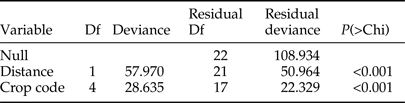
In Brunet, the 4-year clary sage was considered as the source of H. obsoletus, according to larva and adult emergence detection, thus considering 2-year clary sage and lavandin as target fields. Both negative binomial and Poisson models highlighted better fitting of captures when including the minimum distance between the trap and the source, and the type of crop as explanatory variables (see the values of AIC in Appendix B). Negative binomial performed better than Poisson models (Χ2 test based on log-likelihood, Appendix B). Both the minimal distance to the source and the crop type had a significant effect on H. obsoletus captures (table 4). Increasing the minimum distance between the source and the trap significantly decreased the number of adults (table B1 in Appendix C), while the differences between the crop types were not always significant. The number of insects did not significantly differ (P = 0.05) between 1-year, 3-year lavandin (cultivar Grosso), and 2-year clary sage (table B2 in Appendix C). A significantly smaller number of adults was captured in 3-year and 4-year lavandin (cultivar Sumian and Grosso, respectively), as compared with both 2-year clary sage and 1-year lavandin. The difference between the insects caught in 3-year Sumian and Grosso fields was significant (P = 0.05), with a lower number of captures for Sumian (table B2 in Appendix C).
Analysis of variance of the best performing model fitted for the study site Brunet, i.e., negative binomial model including both the Minimum distance to the source and the Crop code (Distance and Crop code, respectively).

Df, number of degrees of freedom.
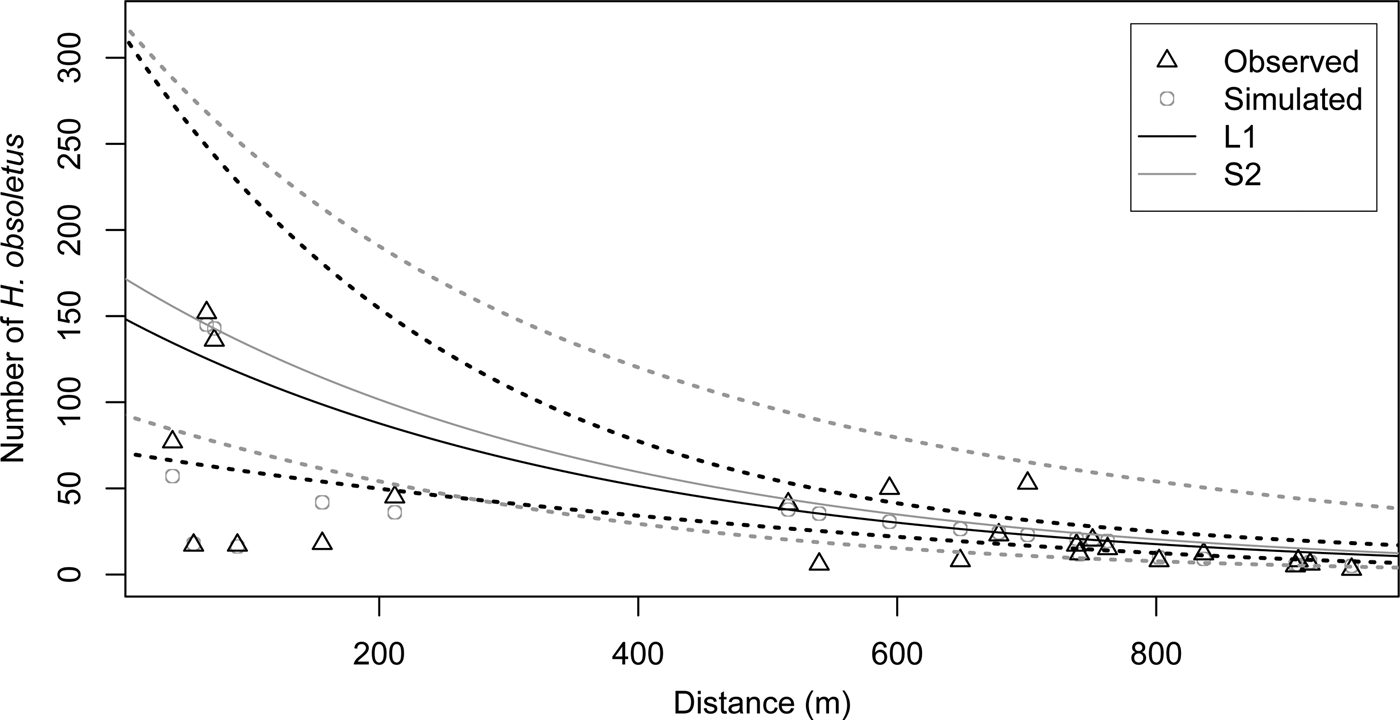
This negative binomial model highlighted a high goodness-of-fit (fig. B1 in Appendix C) leading to a small non-significant residual deviance (P = 0.172). However, the coefficient of the minimum distance to the source displayed a large 95% confidence interval (table B1 in Appendix C), leading to a large uncertainty in predicting H. obsoletus presence, especially at short minimum distances between the source and the trap (fig. 3). Such uncertainty was higher for 1-year lavandin as compared with 2-year clary sage, due to their distances with respect to the source field (4-year clary sage). While the 2-year clary sage's traps were very close to the source (distance ∈ [66; 72] m), the two fields of 1-year lavandin were located further (two fields, distance ∈ [525; 762] m.
Fitted number of Hyalesthes obsoletus obtained with the negative binomial model including both the Minimum distance to the source and the Crop code for Brunet study zone. Full lines correspond to fitted curves, and dashed lines correspond to 95% confidence intervals for simulation in 1-year lavandin (cultivar Grosso, in black, L1) and 2-year clary sage (in grey).

Discussion
Hosts of Hyalesthes obsoletus
The paper presented here brought to light the effect of local characteristics on the presence and density of H. obsoletus, by focusing on larvae and emerging adults for the host plant species, and on the adult for feeding and egg-laying.
Overall, larvae detection and emergence traps provided consistent results regarding the host species of H. obsoletus. Most individuals were found in fields of old clary sages, either as larvae on roots or as flying adults. As far as we know, this crop was not previously identified as a host for this insect. In European vineyards, bindweed and stinging nettle are the two main host species of H. obsoletus (Sforza et al., Reference Sforza, Clair, Daire, Larrue and Boudon-Padieu1998; Langer & Maixner, Reference Langer and Maixner2004; Imo et al., Reference Imo, Maixner and Johannesen2013). In our study, although bindweed was largely represented in two out of three study zones, no larvae were found on its roots, and emergence traps caught a very low number of individuals, only in Brunet. This result could be linked to the potentially higher attractiveness of clary sage. Stinging nettle was not found in the study zones, probably due to the high altitude (620–740 m), the dryness of the climate, and the low fertility of the soils. Indeed, stinging nettle prefers nutrient-rich soils (Siebel & Bouwma, Reference Siebel and Bouwma1998), especially regarding nitrogen, and a relatively wet and fresh environment (Rameau et al., Reference Rameau, Mansion and Dume1999, Reference Rameau, Mansion, Dume and Gauberville2008). Moreover, H. obsoletus is found, at high altitudes in Europe (above 1000 m) where soil enrichment has occured, e.g., in cattle shelters (Davis, Reference Davis1989). No insect was found in the woods, and in sainfoin and alfalfa; whereas these two last crops were reported as potential hosts of H. obsoletus in Turkey (Güçlü & Özbek, Reference Güçlü and Özbek1988). No larva was found in the lavandin fields, and no adult was caught in the emergence trap, except for three individuals in the 3-year field of cultivar Grosso. This result is consistent with (unpublished) trials of local technical institute, which found that the insect hardly overwinters on tolerant cultivars Grosso and Sumian, with no larva found on their roots. These results thus suggest that these cultivars are dead-end host plant, and not a substrate for nymphs (Sforza, Reference Sforza1998). These results suggest that, in the studied areas, landscape characterization should focus on clary sage and lavandin, and could omit a detailed study of woods, alfalfa and sainfoin.
Most flying adults were found in 4-year clary sage fields, and a smaller proportion was caught on lavendin. In Brunet, the peak of the flight in lavandin was anticipated by 1 week as compared with clary sage. The decrease of captures in lavandin could then be due to harvesting, in turns lowering its attractiveness for the insect. This is consistent with findings by Riolo et al. (Reference Riolo, Landi, Nardi and Isodoro2007), reporting that the dispersion of H. obsoletus can change when the primary host is unavailable. Attractiveness properties could also explain the larger number of adults found in 1-year lavandin fields, as compared with older fields. Host preference tests, such as performed by Kessler et al. (Reference Kessler, Schaerer, Delabays, Turlings, Trivellone and Kehrli2011) for bindweed and stinging nettle, could give insights on plant attractiveness ranking and explore the potential differences between the two cultivars Grosso and Sumian, where less flying adults were captured. The three detection methods of H. obsoletus ranked similarly across the study zones. While captures were consistent with historical observations in Montagnac, where no yellow decline was recorded, the ranking of the insect pressure in Brunet and Saint-Jurs differed from expectations. Indeed, Saint-Jurs, located in the extreme North of the Plateau, is currently the most affected zone, whereas Brunet is considered as a moderate diseased zone. Different hypotheses could be drawn from these results: a shifting of the geographic distribution of the vector from North to South-East, the impact of clay spraying as prophylactic measure in Saint-Jurs, or the weather conditions that occured during this study and the previous winter. Indeed, larvae development, adult emergence and flight depend on temperatures and thermal sums (Maixner & Langer, Reference Maixner and Langer2006; Boudon-Padieu & Maixner, Reference Boudon-Padieu and Maixner2007; Imo et al., Reference Imo, Maixner and Johannesen2013), and warmer temperatures are associated with a higher insect activity (Orenstein et al., Reference Orenstein, Zahavi, Nestel, Sharon, Markalifa and Weintraub2003).
Inference at field and small-landscape scales
Based on the planting densities provided by the farmers, field size, and on the spatial heterogeneity of the captures within the field, the raw extrapolation at field scale of the average uprooting captures of larvae would give a potential of about 5 millions and 0.3 millions individuals of H. obsoletus in the 4-year clary sage fields in Brunet and Saint-Jurs, respectively. Such estimation could be lowered by larval mortality, even if it mainly occurs at earlier larval instars than in our survey (Sforza et al., Reference Sforza, Bourgoin, Wilson and Boudon-Padieu1999). At the peak of H. obsoletus flight, up to 30 and 150 individuals were found for lavandin and clary sage, respectively, in Brunet. These numbers are higher than in previous studies carried out inside and around vineyards with sticky traps (e.g., Sforza et al., Reference Sforza, Clair, Daire, Larrue and Boudon-Padieu1998; Orenstein et al., Reference Orenstein, Zahavi, Nestel, Sharon, Markalifa and Weintraub2003; Mori et al., Reference Mori, Pavan, Bondavalli, Reggiani, Paltrinieri and Bertaccini2008; Kessler et al., Reference Kessler, Schaerer, Delabays, Turlings, Trivellone and Kehrli2011).
Spatial autocorrelation of H. obsoletus captures in clary sage and lavandin fields, tested with Moran's I, was significant (P = 0.05) at almost all sampling dates in Brunet, while never in Saint-Jurs. On the contrary Orenstein et al. (Reference Orenstein, Zahavi, Nestel, Sharon, Markalifa and Weintraub2003) found no spatial pattern for H. obsoletus in vineyards. Our findings could be linked to the different plant attractiveness for H. obsoletus, as grapevine is not a favorite host (Bressan et al., Reference Bressan, Turata, Maixner, Spiazzi, Bondon-Padieu and Girolami2007), while little is known about the attractiveness of the potential host plants found in Brunet, i.e., clary sage, lavandin and, to a lower extend, bindweed. It is indeed demonstrated that the interaction between the vector and the plant pathogen could influence the specialization or preference for specific hosts (Biere & Tack, Reference Biere and Tack2013), thus influencing dissemination (Maixner et al., Reference Maixner, Albert and Johannessen2014).
Under the hypothesis that the clary sage fields were the sources of H. obsoletus, we derived potential dispersion curves towards potential targeted hosts, i.e., lavandin, showing significant effects of both distance to the source and host type (crop; age and cultivar of lavandin). Similarly to a previous study on one Cicadellidae of grapevine (Lessio et al., Reference Lessio, Tota and Alma2014), we fitted exponential regression using the minimum distance to the source as explanatory variable. Our curve displayed a large variability in small distances from the source, whatever the considered host. We did not find any significant difference between the fitted curves for the two host species clary sage (3-year) and lavandin (1-year), which could suggest their similar attractiveness for the insect. The higher attractiveness of young lavandin, as compared with older ones, could be linked to the higher proportion of bare soil leading to higher soil temperatures, more attractive for H. obsoletus (xerothermic insect). However, we investigated only one field of the two crops, located close and far to the source for clary sage and lavendin, respectively. Moreover, no host plants were present in the middle, as there was a field cropped with durum wheat, a non-host crop. The uncertainty in the minimum distance from the source could be reduced by studying homogenous landscapes in terms of crops/age, and including infected clary sage as reservoir. However, since clary sage does not show any symptoms of the disease, targeting such situations may be difficult. In addition, such landscapes can hardly be designed for experimenting in reality due to their large scale. Therefore model parameters should be fitted under real situations, to be able to set up pest-limiting or even pest-suppressive landscapes (i.e., location of sources and hosts, e.g., Hossard et al., Reference Hossard, Gosme, Souchere and Jeuffroy2015). Another important factor that was not taken into account here is the influence of wind speed in the dispersal of H. obsoletus, which could not have been done due to the lack of a very close weather station, this parameter being highly variable in space. Finally, while our survey allowed to determine the largest sources of H. obsoletus, no certain conclusion can be made on dispersal, as the captured insects were not marked (as in e.g., Lessio et al., Reference Lessio, Tota and Alma2014).
Prospects for future studies on lavandin yellow decline
As we highlighed that clary sage was a major host for H. obsoletus, the next necessary step would be to test its role as a reservoir host for pathogen proliferation. This could be performed by testing (1) if over-wintering on clary sage lead to insects that can transmit stolbur phytoplasma (although it could also be acquired by sucking infested lavandin); and (2) if the phytoplasma's genotype is similar with the one found in diseased lavandins. Current knowledge indicates that lavender yellow decline is supposed to propagate in southern France only through the dispersal of H. obsoletus between lavender and lavandin fields (Danet et al., Reference Danet, Sémétey, Gaudin, Verdin, Chaisse, Foissac, Bertaccini, Laviña and Torres2010). Indeed, the genotyping of the stolbur phytoplasma, retrieved from diseased plants of lavender and lavandin, revealed that 14 out of the 17 genotypes were specific to lavender/lavandin, and did not correspond to the ones commonly found in vineyards or wild reservoirs in France (Danet et al., Reference Danet, Sémétey, Gaudin, Verdin, Chaisse, Foissac, Bertaccini, Laviña and Torres2010). Further genotyping of both plants and insects would then be required for testing the lavandin-clary sage compatibility. This could be of primary importance, as the infection may be determined by the size of the reservoir, represented by the number of insects able to transmit the phytoplasma (Lee et al., Reference Lee, Davis and Gundersen-Rindal2000), and its spatial distribution within landscapes (e.g., for fungus, Bousset et al., Reference Bousset, Jumerl, Garreta, Picault and Soubeyrand2015). For instance, previous plant genotyping already showed that bindweed may not be responsible for yellow decline of lavender, as the main phytoplasma strains found in lavandin differed from that of bindweed and other wild plants (Chaisse et al., Reference Chaisse, Foissac, Verdin, Nicole, Bouverat-Bernier, Jagoueix-Eveillard, Semetey, Gaudin, Fontaine, Danet, Moja, Conord, Jullien, Legendre and Gallois2012). Such information on clary sage would be the next step towards the understanding of the yellow disease propagation in lavenders, preliminary to the design of control strategies. First results showed that clary sage could be a source of stolbur vector and carry the phytoplasma (Chuche et al., Reference Chuche, Danet, Rivoal, Arricau-Bouvery and Thiery2017), but the lavandin-clary sage compatibility need to be further investigated. Finally, the yellow disease of lavandin is present in the area since decades. It would then be interesting to gather the locations of clary sage fields in the past, which could be done by exploiting satellite images, in order to assess its potential linkage with the spatio-temporal intensity of the disease.
Supplementary material
The supplementary material for this article can be found at https://doi.org/10.1017/S0007485317000815.
Acknowledgements
This research was funded by the French Environment and Energy Management Agency – ADEME (Climatac project no 1260C0044), by CRIEPPAM (the Regional Interprofessional Center for Experiment in Aromatic and Medicinal Plants) and by SPLP Dotation (the Endowment Fund for Safeguarding the Lavender Heritage in Provence). The authors thank Simone Bregaglio for his remarks on a previous version of the manuscript, and the anonymous reviewers for their helpful comments.