INTRODUCTION
The religious climate of Late Roman Britain and the impact of Christianity on social and political conduct was poorly documented in antiquity, but has received considerable modern academic attention. The surviving literary sources are written exclusively by Christian authors and suffer from an inherent bias towards the success of the Church, which makes them of limited use in understanding how the adherents of numerous monotheistic and polytheistic faiths interacted and co-existed in Britain during the Roman period. Archaeological remains offer an incomplete but less partial testimony, which qualifies them as better tools for conceptualising the inception and growth of the Christian Church within the milieu of a traditionally pagan society.
Lead tanks, the subject of this paper, have the potential to contribute much to this debate. However, the almost exclusive interpretation of these objects as freestanding baptismal fonts has, thus far, restricted consideration of them to marginal discussions on early liturgy. This article seeks to broaden this discourse through a critical re-appraisal of the iconography on the tanks themselves, as well as reviewing the secondary evidence that has led them to be identified as fonts. The conclusions from this are then examined in combination with the evidence for the tanks' disposal to address whether this can further our understanding of their original use and religious status. The results of this clearly demonstrate that the interpretation of the tanks as fonts is unsound. This necessitates a broader comparison of the tanks to other contemporary material remains — particularly Romano-Celtic and pagan art and iconography, which has been overlooked in attempts to explain the tanks as exclusively Christian artefacts — and a re-opening of the debate on their social and religious bearing.
AN OVERVIEW OF THE TANKS
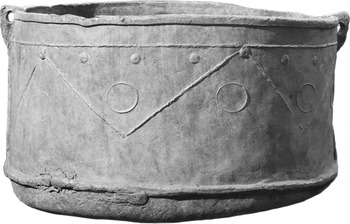
Romano-British lead tanks, also occasionally described as ‘cisterns’ or ‘containers’, are constructed from lead sheets and are usually circular in plan, ranging in size from approximately 0.5 m to 1 m in diameter, and 0.2 m to 0.6 m in height ( fig. 1).Footnote 1 They are decorated (to varying degrees) with simple geometric patterns, comprising most commonly horizontal and vertical banding, saltires, circles and zigzags, but in some cases there is also additional lettering and/or figural scenes. Several also incorporate the chi-rho monogram in their design: habitually interpreted as an early Christian emblem representing the name of Christ in Greek. Based on these shared characteristics a list of the 28 known tanks is given in Table 1 (Appendix).Footnote 2 This includes some vessels which have not been considered in previous analyses, for example, a square lead container from Caistor and fragments of a polygonal tank from Bishop Norton (both in Lincolnshire). These differ conspicuously in shape from the other tanks, but enough similarities exist regarding their size, manufacture, decoration and manner of disposal to suggest that they are simply variations on the more common circular model.
The Romano-British lead tank from Burwell, Cambs. (Photo reproduced with permission of the Museum of Archaeology and Anthropology, Cambridge)

Distribution of the tanks in Britain is almost exclusively to the south-east of a line between the Humber and the Severn estuaries, with particular concentrations in East Anglia and the East Midlands ( fig. 2). Only one outlier is known, from Ireby (Cumbria). With regard to their chronology, sixteen examples can be assigned a terminus post quem in the fourth century: ten on account of the incorporation of a chi-rho in their design, which is unlikely to appear so conspicuously in Britain before this period,Footnote 3 and six through associated dating evidence recovered during excavation (see Appendix, Table 1). Twelve of the tanks have no direct means of being dated having been discovered either by metal-detectorists, ploughing or river-dredging, but stylistic comparison with other datable tanks makes a Late Roman date reasonable. The tank from Enford (Wilts.) was found associated with a building of third-century date.Footnote 4 While the tank may post-date the building, this should alert us to the possibility that the manufacture of some of the examples pre-dated Constantine's conversion and the Edict of Milan in a.d. 313. It is also likely that some post-date the Honorian rescript of a.d. 410, which brought an end to Roman hegemony in Britain. Eleven tanks of extremely similar form have been discovered in Anglo-Saxon contexts (Appendix, Table 2). In shape, material and manufacture they are remarkably close to the Roman examples (though they differ in decoration) and their existence may imply a continued use for such items in later periods.
Distribution of lead tanks in Britain.

In addition to the British examples, four decorated lead tanks of extremely similar form have been found elsewhere within the Empire: three from Italy and one from Schleitheim, Switzerland.Footnote 5 These are probably earlier than most of the British examples, deriving from contexts dated from the first to the third centuries a.d., but have not yet been discussed in conjunction with the British collection. They will be addressed here in regard to how their design and find-spots can aid our understanding of the British tanks.
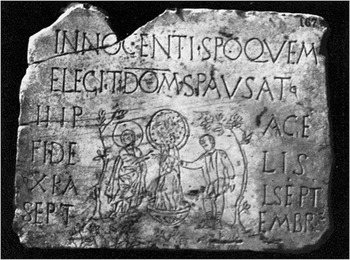
With regard to the current position of research on the tanks, they commonly feature in discussions on Romano-British art and religion, but few scholars have recognised that their design and potential use make them worthy of separate and more detailed consideration. An exception to this, and still the most influential, is Toynbee's Reference Toynbee1964 assessment of decorated lead work from Britain in which she explores the possibility that the tanks were used in early Christian baptism.Footnote 6 This was based largely on comparison between the form of the tanks and an image on a funerary relief from Aquileia, Italy, which she interpreted as showing a youth being baptised while standing in such a vessel ( fig. 3). This theory has come to dominate subsequent discussions, being accepted to varying degrees by most authors to the point where the tanks are included specifically within studies of Romano-British baptisteries.Footnote 7 Alternative interpretations have occasionally been put forward: ornamental water troughs used for diluting wine at the refrigium held by Christians in honour of the dead,Footnote 8 or vats for dying or brewing.Footnote 9 However, the viability of these theories has not been thoroughly examined and consequently the idea that the tanks were fonts continues to take precedence. Nonetheless, this theory has also lacked scrutiny and overlooks a substantial amount of contradictory evidence. It is the purpose of this article to draw attention to this, beginning with a reassessment of the tanks' design.
Fourth-/fifth-century funerary relief from Aquileia. (After Brusin Reference Brusin 1936 , 45, pl. 26)

DESIGN
The presence of the chi-rho on ten of the tanks demands that a religious perspective to their interpretation be considered. There is a tendency to explain the presence of the chi-rho in art as directly associated with Christian worship. However, the emblem was not exclusively used in religious spheres. It was adopted as an insignia by the Emperor Constantine prior to his battle against Maxentius at the Milvian Bridge in a.d. 312, the outcome of which saw him take sole control of the Empire. Henceforth it came to symbolise, on the one hand, the conversion of the emperor to Christianity and the power and legitimacy of the Christian God (whose patronage was credited as having secured Constantine's victory), and on the other, Constantine's own temporal authority and military prowess.Footnote 10 In Britain, where the monogram may not have been recognised as comprising actual Greek letters,Footnote 11 its use must initially stem from an association with this military victory and the adoption and dissemination of the symbol by Constantine and later emperors. Coinage was one channel via which the chi-rho would have entered Britain's iconographic vocabulary and in this context the monogram could be juxtaposed with images of secular victory and power such as a military standard on nummi of Constantine. Hence, in addition to being used and perceived as an icon of the Christian God, the chi-rho would have been recognised as a symbol of imperial authority independent from any explicit religious overtones. This ambivalence is reflected in how it was used in Britain. When combined with orantes (figures standing with arms raised in the position of prayer), for example, on the wall-paintings of the villa at Lullingstone (Kent), the chi-rho acts as an icon to convey Christian theological beliefs. Conversely, its presence among official stamps on a series of pewter ingots found in the Thames is best interpreted as an authenticating mark representing secular authority, unrelated to religious worship.Footnote 12 This complicates how the presence of the chi-rho in Romano-British art is interpreted. For example, the conspicuous display of the chi-rho in aristocratic villas, most notably at Frampton and Hinton-St-Mary, may be interpreted as either actual religious observance of the residents or a desire to express fidelity to the emperor combined with ambitions for imperial advancement.Footnote 13 Hence, a connection between the presence of the chi-rho and a religious function for its canvas is not automatic.
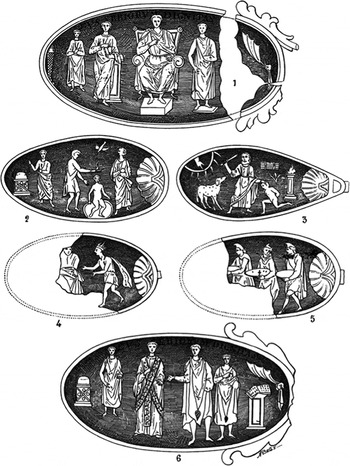
If the theory that the tanks were instruments of Christian worship is to gain credence, then the Christian elements of their designs must be seen to reflect genuine religious zeal. The tank from Flawborough (Notts.), which displays the chi-rho surrounded by four orantes, and an almost identical (though less well executed) composition on a tank from East Stoke (also from Notts.), eases any anxiety on this point by associating the monogram with signs of participation in religious worship. While this should be borne in mind, such decorative elements on these tanks are rare compared with the ubiquitous geometric motifs and should not disproportionately influence our interpretation of their iconography. There is a need to consider whether the more common geometric elements can be used to identify the tanks as religious, and specifically Christian, objects. Arguments have been made that these simplistic designs are metaphors for Christianity; the circles are seen to represent either the eternity of God or a wreath celebrating Christ's victory over evil and the saltire symbolises the cross of St Andrew.Footnote 14 While singular forms — such as circles and saltires — are too intangible and commonplace in contemporary imagery to communicate specific cultic allusions, more complex, composite images which are found on a number of tanks warrant closer attention. One example is the motif of a saltire surrounded by four circles, which appears on both a complete tank from Huntingdon (Cambs.) and a fragment of a tank from Ashton (Northants.). This motif is found elsewhere in conjunction with both Christian and pagan imagery and may have carried particular religious connotations. Outside of Britain, it appears on a set of silver spoons from Aquileia, four of which show biblical scenes ( fig. 4, Nos 2 and 6),Footnote 15 while within Britain its religious associations are more ambiguous. The motif is found combined with stylised pecten shells, a standard motif in pagan funerary art, on a lead coffin from ColchesterFootnote 16 and again on another lead coffin from Milton-next-Sittingbourne (Kent), though in this case the circles, far from representing the victory of Christ over evil, each contains the head of Medusa.Footnote 17 It may well be the case that this symbol, and others like it, were adopted by Christians from a pagan repertoire and adapted to convey a new meaning. In this capacity they indicate the closeness of early Christian symbolism to pagan antecedents and should be interpreted as representing a conflation of beliefs about the divine, rather than being seen to belong to one doctrine or another.
Set of fourth-century silver spoons from Aquileia. (After Cabrol and Leclercq Reference Cabrol and Leclercq 1907 , vol. 7.2, col. 2681–2682, fig. 877)

It might have been hoped that the inscriptions that appear on five of the tanks would be more explicit, but these too are somewhat ambiguous regarding any religious connotation. The tanks from Caistor, Bishop Norton and Bourton-on-the-Water carry the names of their makers followed by fecit, with no implication of religious significance. Two other tanks, from Flawborough and East Stoke, share the same (misspelt) phrase vtere (f)elix, translated loosely as ‘Good luck to the user’.Footnote 18 The juxtaposition of the phrase with orantes on both these tanks may lend a religious tone, but alone it is a fairly generic adage for the period that appears in both Christian and non-Christian contexts. Conversely, the phrase vivas, on the tank from Caistor, is found with a certain regularity on items with Christian associations, but nothing else in this tank's design implies such a connection.Footnote 19
Hence, while the combined use of the chi-rho and orantes figures on some tanks suggests a tangible link with Christian worship, other elements of their design are either indeterminate regarding religious sentiment or betray connections to pagan artistic traditions. The latter will be stressed further in regard to the figural decoration on the tank from Walesby (Lincs.). However, it is worth noting here that the amalgamation of pagan and Christian iconography is also witnessed on many other types of material remains from Roman Britain, which marry the two in an apparently unproblematic fashion. This places the tanks within a discourse on the conceptual boundary between early Christianity and traditional Romano-Celtic religions in Late Roman Britain.
BAPTISMAL FONTS?
The medley of potentially religious symbols and abstruse motifs with which the tanks are decorated cannot be used to confirm that they were owned and used exclusively by Christians, particularly since the majority of the tanks (18 in total) lack the chi-rho and consequently any overtly Christian elements to their designs. The argument that the tanks were used by a Christian community as baptismal fonts rests on two other pieces of evidence. The first is a comparison between the structure of the tanks and a carving on the fourth- or fifth-century funerary relief from Aquileia, mentioned above ( fig. 3). This relief has been seen as providing clear evidence that affusion (that is, the pouring of holy water over the head) was performed in the fourth century while the catechumen stood in a tank.Footnote 20 The second comes from a short figural scene on the tank from Walesby (Lincs.), which has been interpreted as depicting a baptism in progress; an idea initiated by Toynbee, but advanced by Thomas, and one that has gained wide acceptance.Footnote 21 The following discussion concerns the viability of the argument that the tanks were used as fonts, beginning with a brief overview of the evidence for baptism in fourth- and fifth-century Britain. This questions the prevalence of affusion in early Christian baptismal rites in Britain by addressing literary and archaeological sources, and places consideration of the Aquileia relief and the Walesby frieze within their broader cultural and theological context, as far as is possible.
EARLY BAPTISM IN BRITAIN
Both Thomas and Painter claim that in fourth-century Britain baptism was predominantly performed by affusion rather than by total immersion; a theory shared with regard to the wider Empire by both Yarnold and Davies.Footnote 22 Their evidence for this is drawn from the existence of baptismal fonts which were not large enough to allow the full immersion of an adult candidate. The immediate problem with arguing for the ubiquity of affusion using archaeological evidence is that the alternative — immersion in a natural stream or river — leaves no comparative material trace and it is, therefore, impossible to establish its prevalence without the aid of literary accounts. Of the literary sources which document or comment on the early Church in Britain — notably St Patrick's Confessio, Bede's Historia ecclesiastica gentis Anglorum, Constantius of Lyon's Vita sancti Germani, and the fragmentary epistles of Pelagius — none mention baptism in sufficient detail to give an impression of how it was performed. Texts from elsewhere in the Empire — from a wide range of periods and geographical areas — are more expansive on the particularities of baptismal ceremonies. Most influential of these was the Didache, also known as ‘The Teaching of the Twelve Apostles’, which can be traced to the first or second century in Syria and formed the basis for many subsequent liturgical texts from North Africa and the Near East. From Rome, the ‘Apostolic Tradition’, attributed to St Hippolytus and dated to c. a.d. 215, contains instructions on how baptisms were to be performed, as does Tertullian's De Baptismo from North Africa, of similar date. The writings of prominent Church leaders such as John Chrysostom's Baptismal Instructions and the De Sacramentis and De Mysteriis attributed to Ambrose — which are of greater contemporaneity with the tanks — also offer practical information on correct procedure.Footnote 23
There are manifold obstacles in using these texts as direct evidence for the rites and actions involved in baptismal ceremonies of fourth- and early fifth-century Britain.Footnote 24 Not only could the highly metaphorical and idealising tone of the practices described be an inexact reflection of reality, but research into the archaeological evidence for baptism has shown increased sensitivity to the variability of the rite between provinces, or even individual churches, making it unwise to use texts from Syria, Egypt and Rome to comment on the particular details of contemporary British customs.Footnote 25 Nonetheless, if anything of use can be extracted from these texts it could be their agreement on the superiority of immersion vis-à-vis affusion. While some describe baptisms taking place in fonts,Footnote 26 many claim that baptism by immersion was preferable to affusion: the Didache, for example, is particularly categorical in stating that affusion should only be performed as a last resort; that is, if the candidate was on their deathbed.Footnote 27 Likewise, both John Chrysostom and the author of the ‘Apostolic Tradition’ stipulate that naturally flowing water should be used.Footnote 28 Their consistency on this point may reflect a wider consensus of opinion among Christian communities. In a revealing aside, Ferguson observes that, ‘Those who approach the study of baptism … from the literary evidence see a greater likelihood of immersion, or submersion, being the normal practice’.Footnote 29
Turning to the archaeological record, it is clear that affusion was at times practised in Late Roman Britain, evidenced through surviving brick- or stone-built fonts. The most convincing examples of these have been excavated at Icklingham (Suffolk) and Richborough (Kent), and comprise sunken structures (with steps into it in the case of Icklingham), lined with plaster and located outside buildings with Christian associations.Footnote 30 Another possible font, from Witham (Essex), flanked what was originally a Romano-Celtic temple, but which may have been converted to Christian usage in the fourth century.Footnote 31 Yet, even including more dubious examples such as the plinth outside the church at Silchester and the octagonal pool at Chedworth, discoveries of permanent fonts in Britain are rare. Hence, if baptism by affusion was the ‘major Christian event’ which Thomas and others believe, how is this reconciled with the apparent dearth of provisions made for it?Footnote 32 Thomas has proposed that the lead ‘fonts’ were intended to be portable and could be transported around the province to areas lacking permanent facilities.Footnote 33 However, the calls for immersion in the literature should not so readily be dismissed; rivers and naturally flowing water were readily available in Britain and may have been used more commonly than has been appreciated. Writing in the fifth century, Constantius of Lyon recounts the mass baptism of an army of Britons around the year a.d. 429 and Bede's later account of the baptism of the Northumbrians by Paulinus in the rivers Glen and Swale implies that immersion was still being practised in Britain in the sixth and seventh centuries.Footnote 34 Such accounts are intended to emphasise the spectacle of converting whole populations or military units to Christianity rather than the peculiarity of baptism in a river, and there is no reason to assume that the method used was out of the ordinary.
To conclude, it appears from the above that baptism by affusion in the Late Roman period was infrequent, with no indication that freestanding fonts were used. However, the two specific sources of evidence that point to the existence of such freestanding fonts in Roman Britain need to be considered.
THE AQUILEIA RELIEF
The scene on the tombstone from Aquileia ( fig. 3) is composed of three figures. The central figure is smaller than the other two and stands in something resembling a bowl, while water is poured over their head from an orb above. Within this orb (interpreted by Ferguson as a representation of heaven), a dove flies downwards. A man crowned with a nimbus stands on the left and gestures as if speaking, while another figure wearing a short tunic stands on the right and touches the head of the central figure. The inscription on the relief reads:
INNOCENTI·SPOQVEM·ELEGIT·DOMSPAVSAT·INPACE·FIDELIS· XKALSEPT· SEPTEMBR
To a soul without blame, which the lord hath taken, rests in peace one of the faithful. 23 AugustFootnote 35
Toynbee interpreted this scene as showing the baptism of a young boy named Innocens (on whose grave the relief presumably stood) taking place within a freestanding vessel.Footnote 36 As an alternative, it is proposed here that the image is not of a standard fourth-century baptism, but actually a stylised rendering of the baptism of Christ. Such an interpretation has been dismissed by previous commentators: Gough has argued that the youthfulness of the central figure precludes him being Christ and Ferguson has claimed that the figure is actually a young girl based on the observation that ‘she’ is wearing a necklace.Footnote 37 On the first point, comparison between the relief and contemporary images of Christ's baptism — identified with some certainty by their juxtaposition with other biblical scenes — shows that Christ was often depicted as shorter and seemingly younger than other figures, as seen on a third-century sarcophagus at Santa Maria Antiqua, Rome.Footnote 38 With regard to the band around the figure's neck, this is indeed unusual, but to use it to identify the figure as female implies a degree of gender specificity for neck ornaments which cannot be affirmed for the period. A pressing argument for seeing the figure as male is the general absence of female nudity in early Christian art, except for images of Eve. Even Susanna, whose beauty while bathing is integral to the parable, is invariably shown dressed and in a rare scene of a female baptism on a glass sherd from Rome, the woman (named Alba) is clothed despite the ceremony being underway.Footnote 39 Other aspects of the Aquileia relief identify the figure specifically as Christ. The dove, shown here descending from heaven, is not a ubiquitous feature in images of baptism but is consistently present when Christ is depicted. Additionally, the distinctive, rustic clothes of the figure to the left suggest that this is John the Baptist. Another extremely similar composition to the Aquileia relief is seen on a silver spoon from the set mentioned above ( fig. 4, No. 2). On this spoon, the baptism taking place is unequivocally that of Christ on account of its juxtaposition with other recognisable biblical scenes on the accompanying spoons. Here, Christ is likewise portrayed as a nude young boy standing in a circular basin, making it probable that the two images are linked in meaning as well as style.
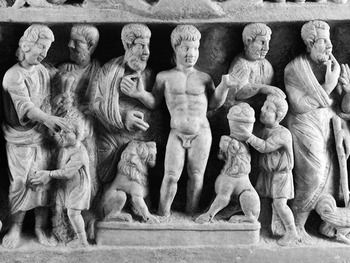
With regard to the vessels in which Christ is shown standing on both the relief and the spoon, it seems highly improbable that the artists would alter the story of the Holy baptism by exchanging the river Jordan for a portable tank in which the Son of God is baptised by affusion. It is more likely that the image of a shallow dish is being used metaphorically. A similar artistic device appears in early depictions of Daniel in the lions' den, which show him standing in a shallow bowl to represent the pit into which he had been thrown, as seen on the well-known ‘dogmatic sarcophagus’ ( fig. 5) and a relief carving, now in Cordoba.Footnote 40 Since both the tombstone and the spoons were discovered at Aquileia, their idiosyncratic portrayal of the baptism of Christ may reflect an iconographic formula peculiar to that region, which should signal caution in using it to comment on actual liturgical practices elsewhere. Hence, the image on the Aquileia relief appears to be highly figurative and should not be interpreted as a straightforward depiction of contemporary baptism in progress. Needless to say, the problems of using stylised depictions of Christ's baptism from Italy to explain functional objects from Britain are problematic and the image on this relief cannot be taken as evidence that lead tanks were used in this way.
Detail of the ‘Dogmatic Sarcophagus’ showing Daniel in the Lions' Den. (Photo reproduced with permission of the Vatican Museum)

THE WALESBY FRIEZE
The interpretation of the Walesby frieze takes us back to the iconography of the tanks themselves. The conclusion that the figural frieze on the tank from Walesby represents a baptism in progress was first proposed by Toynbee, who suggested that, hypothetically, such a subject would be appropriate for the decoration of a font.Footnote 41 Yet her tentative suggestion has been accepted so readily that it has on occasion been turned around; the presence of a scene of baptism on the Walesby tank is taken as evidence for a corresponding function of the tanks.Footnote 42
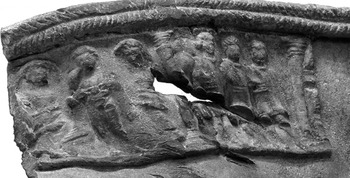
The frieze itself consists of two groups of three figures divided into panels by columns ( fig. 6). The far left-hand edge of the frieze has been intentionally cut away. In the right-hand panel stand three near-identical men dressed in short belted tunics with cloaks slung over the left half of their bodies. The composition of the left-hand panel is less clear. The figures here appear to be female; two are heavily veiled and drapedFootnote 43 and a nude figure stands between them. Toynbee proposed that this panel shows a female catechumen disrobing in preparation for baptism, flanked by her two female sponsors and that the three men represent another catechumen, with correspondingly male sponsors, awaiting his turn. Toynbee also suggested that another panel originally existed to the far left showing the actual ceremony taking place.Footnote 44 Thomas has since reworked the composition by transforming it into a three-dimensional stage in which the columns dividing the scenes denote physical supporting columns within a baptistery. The female figure stands at the far end with the font (not depicted) in front of her, while six male members of the ecclesia (three in the right-hand panel and three in a hypothetical, identical panel imagined to the left) look on from the wings.Footnote 45
Figural frieze on the Walesby tank (the damage sustained to the figures was made by a plough upon discovery). (Photo reproduced with permission of The Collection, Lincoln)

There are many problems with interpreting this scene as a baptism. As Denzey observes, ‘… early Christian art is extraordinarily visually consistent’.Footnote 46 Hence, if the tanks were used for baptism, what decorative schemes might we expect to find associated with Late Roman baptismal apparatus? Davies has addressed this question in an empire-wide study of baptisteries and fonts, and concludes that there existed an ‘iconographic system peculiar to baptisteries, so that the same subjects tended to be repeated on buildings widely separated both in space and time’.Footnote 47 The popular scenes were those connected with ideas of death and salvation, such as the Good Shepherd and the women at the tomb. Depictions of actual baptisms in baptisteries or on fonts are surprisingly rare, being more common on sepulchral art where they show either Christ himself or a male candidate.Footnote 48 Furthermore, when baptismal scenes occur they invariably omit the preparatory stages and concentrate on the inundation itself. Hence, interpreting the Walesby frieze as a baptism on a baptismal font depicting a nude female candidate before the main ceremony is to admit that this image deviates acutely from all other known representations of early liturgy and is completely unparalleled within early Christian art. It also requires that parallels found in the pagan iconography of Britain at this time are ignored.
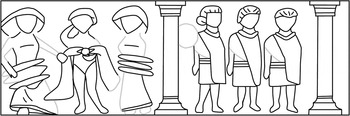
Bearing in mind the previous discussions, it is necessary to consider the scene independently from the notion that it decorated a baptismal font and to focus on what is actually depicted, rather than relying on conjectured embellishments. An illustration of the frieze is presented below ( fig. 7), with the objective of showing as accurately as possible what is visible in the scene and drawing attention to significant details not previously considered. As such, reconstruction of absent elements (indicated in grey) is kept to a minimum.
Schematic drawing of the Walesby frieze.

The division of the figures into groups of three distinguished by gender seems to be a crucial factor in interpreting the frieze. Triplicity has been described as ‘a basic phenomenon of Celtic religion’.Footnote 49 As regards the male panel, it is difficult to determine whether the figures are intended to be human or divine. The presence of three identical males instantly brings to mind images of the genii cucullati, enigmatic local spirits of Romano-Celtic religion usually depicted as indistinguishable from one another.Footnote 50 However, a defining feature of the genii cucullati is their heavy, hooded cloaks, which the Walesby men lack. Instead, their short tunics, belts and cloaks draped across one shoulder are reminiscent of military uniforms, though they lack additional military accoutrements.Footnote 51 It is worth noting that the human figures on the fragments of the Caistor tank may also be wearing short military-style tunics, though they are too poorly executed and preserved to be interpreted with any certainty.Footnote 52 Consequently, since none of the tanks have been found in association with any military sites or paraphernalia, and given the religious overtones of the other decorative elements discussed previously, the genii cucullati are probably a better, though imperfect, fit.
A satisfactory explanation for the female panel is similarly elusive. The Deae Matres, like the genii cucullati, typically appear as a trio. They are characterised as three matronly and heavily draped women carrying baskets of fruit, cornucopias, young children or other metaphors for fertility.Footnote 53 Furthermore, the juxtaposition of the Deae Matres with the genii cucullati is known elsewhere in Romano-British art and would not be surprising here.Footnote 54 Looking more closely at the two flanking figures, the right-hand female is badly damaged, but discernable folds in the dress of the woman on the left indicate that her knees are protruding and she may be seated, as the Deae Matres are frequently shown. Three linear shapes at waist height of each of these two women may represent stylised folds in cloaks which have been gathered in front of them; features paralleled on a relief of the Matres from Housesteads.Footnote 55 Alternatively, they may be elongated loaves, seen on images of the Deae Matres from Ancaster and Cirencester.Footnote 56 While it is apparent that the compositional repertoire for depictions of Deae Matres was not rigidly standardised and was often subject to modification — the peculiar sight of four mother goddesses from London is a case in pointFootnote 57 — the goddesses are invariably shown clothed. It seems, therefore, that the nudity of the central woman on the Walesby frieze requires further explanation.Footnote 58 Where is female nudity in Romano-British art typically found? The classical poise of the Walesby nude, with the left leg straight and the right slightly flexed, is best paralleled by statuettes of Venus or the numerous pseudo-venus figurines, which like the Deae Matres have been interpreted as images of fertility.Footnote 59 The left arm of the Walesby female is raised to her head — standard for images of Venus from Britain — and faint vertical lines to either side of her are probably the remnants of fabric draped loosely over her arms. There is a small orb in front of her stomach; perhaps an apple which she holds in her right hand or a knot in her drapery, both of which have parallels among images of Venus and fertility goddesses more generally.Footnote 60 Hence, though the scene evades comprehensive interpretation, similarities to images of Romano-Celtic fertility goddesses suggest that a similar sentiment may have inspired the composition of this panel of the Walesby frieze.
Many questions remain about the Walesby frieze. However, the above discussion has demonstrated that its imagery bears greater resemblance to established Romano-Celtic iconography than has previously been appreciated. This does not, however, exclude interpreting the scene as having Christian significance, reinforced by the juxtaposed chi-rho monogram. While decorative elements on the tanks from East Stoke and Flawborough support a connection between lead tanks and active Christian worship, a desire to understand this worship in terms of well-defined Christian rituals has had an excessive influence on how the Walesby frieze has been interpreted in the past. Rather than being a direct narrative of an early Christian ritual, the link between the pagan-inspired imagery of the frieze and the Christian emblem of the chi-rho must be more abstract and allegorical. It is possible that triplicity is pertinent in relation to the Holy Trinity, emphasised by the trio of crescents directly to the right of the figural frieze, which add to a recurring triadic theme for the decorative concept of the whole tank. Association of the chi-rho with images of pagan deities is common in Late Romano-British art, most famously among the artefacts of the Thetford treasure and the elaborate mosaics at Frampton and Hinton-St-Mary. Bearing this in mind, the real value of the Walesby tank is in its contribution to our understanding of Late Romano-British religious syncretism and iconographic adoption and exchange, and not the liturgical practices of early Christians.
DESTRUCTION AND DEPOSITION
The use of the tanks during their functional life constitutes only part of their biography. In order to gain the most complete understanding possible of the tanks' bearing on contemporary culture, the ramifications of their destruction and disposal must be considered. Petts has addressed this in some detail, but his conclusions are indelibly influenced by a belief that the tanks were used in Christian baptisms.Footnote 61 Therefore, despite the credibility of much of Petts' analysis it is worth revisiting the topic here, but removing the concept that the tanks were fonts from the equation and asking, not how the function of the tanks determined their disposal, but how the manner of their disposal can inform their function.
The methods by which the tanks were disposed are summarised in Table 1, and distinct patterns can be detected. All but one of the tanks with known find-spots (14 in total) were recovered from, or associated with, pits, wells or rivers. Additionally, at least half (14) had sustained deliberate pre-depositional damage. In some cases these tanks had been carefully cut into fragments (Brough, Walesby, East Stoke), in others, violently hacked at (Bishop Norton, Perry Oaks), and for several, only fragments of the tank have been found.
As a preliminary point, tanks which were decorated with the chi-rho monogram are found cut and buried in the same manner as those which were not and it seems that this had no bearing on how the tanks were disposed of. Furthermore, it is unlikely that the tanks were discarded as rubbish, since lead had many uses in Roman Britain, such as for water pipes, weights and the manufacture of pewter, and it seems improbable that it would have been casually removed from circulation.Footnote 62 It has previously been argued that these patterns of disposal correspond to the actions of pagan iconoclasts during a surge of hostility towards Christianity sometime in the fourth century.Footnote 63 This theory relies on there being sufficient antagonism between Christians and pagans in Roman Britain to erupt into acts of violence, but evidence for this is lacking. Sauer remarks, ‘the transition from paganism to Christianity in Britain was less of a cultural revolution. Even where statues were broken, we do not normally witness the same degree of destructive violence as in many other former parts of the Empire’, a sentiment with which many historians and archaeologists agree.Footnote 64 If broken religious imagery from Late Roman contexts is considered to be a sign of religious antagonism, then examples are few and involve the destruction of pagan images, not Christian. The most explicit hint of pagan indignation comes from an altar found in Bath, on which an inscription records that it was erected to re-sanctify the ‘holy spot’, which had been desecrated by ‘insolent hands’, possibly belonging to Christians though this is not explicitly stated.Footnote 65 Acts of pagan defiance appear to materialise in the resurrection of pagan monuments, rather than the destruction of Christian ones. Therefore, the idea that the tanks were victim of strong anti-Christian sentiments is inconsistent with contemporary evidence for religious interactions during this period.
How else might we understand their destruction and disposal? When intentionally broken statuary is discovered — most famously the fragments of pagan sculptures in wells at Lower Slaughter (Glos.) and Southwark Cathedral, and the buried cult statues at Uley and the Walbrook Mithraeum — they do not match the expected profile of debris from religious antagonism; for example, the targeted destruction of the face.Footnote 66 Croxford has noted that heads are the most common parts of incomplete statues to be found in Roman Britain, a phenomenon which he terms ‘positive selection’, suggesting that they are derived from the reverential fragmentation of sacred images by those who worshipped them, followed by the ceremonious burial of the most sacred parts.Footnote 67
Where fragmentation of the tanks has occurred, in no instance has the chi-rho been damaged and in some cases extra care has been taken to preserve decorative elements. In the example from East Stoke, the decorative panel of the orantes and lettering has been cut out of the main body of the tank and deposited on its own. The remainder of the tank was not found. Similarly, while the cut on the Walesby tank may have removed some of the figural scene, it was made carefully along the left-hand edge of one of the frames and did not damage the figures themselves, segmenting the design rather than destroying it. This was undoubtedly more than simply carving up scrap metal for reuse or wanton destruction. It appears that the breaking up of the tanks has more in common with the fragmentation of other religious imagery and was designed to ensure the preservation of prominent iconographic features.Footnote 68 It is not known what happened to the parts of the tanks that were not deposited; perhaps they were carved up and handed out to believers, while the most symbolically charged elements were reverently buried in a similar way to how Croxford imagines the fingers of statues might have been treated.Footnote 69 Alternatively, they may have been melted down to make good use of the lead, while part was buried in lieu of the whole tank. It is interesting to observe that the decorated sides of the tank from Rushden were buried, while the base was removed, perhaps because melting down the undecorated base would not desecrate any images.
Other evidence relating to the disposal of tanks also points towards ritual activity. Millett and Petts have advanced significantly our understanding of how and where the tanks were deposited by recognising correlations with contemporary hoards.Footnote 70 Like the tanks, Late Romano-British hoards of metalwork, ceramics or glassware were commonly deposited in wells, rivers or pits and several have been retrieved from the South and the East, particularly East Anglia and the East Midlands. Of course, commenting on the regional distribution of archaeological finds is hampered by modern factors, with distribution maps of artefacts presenting ‘the results of deposition, preservation and retrieval rather than a straightforward pattern of … usage’.Footnote 71 Johns also cautions that the publicity surrounding the discovery of several notable hoards in the east of Britain has disproportionately accelerated the hunt for more treasure in the surrounding area by attracting metal-detectorists to the region.Footnote 72 Bearing this in mind, it is not possible to maintain that the use of lead tanks was focused exclusively, or even predominantly, in the regions where they have been found. However, the concentration of their discovery in areas which have also produced several hoards of other material — either from the contemporary Late Roman period or earlier — demonstrates that there existed in these areas a tradition of hoarding which spanned centuries and determined how their inhabitants disposed of material. This also applies to the discovery of lead tanks in exclusively rural locations, which is likely to reflect a pattern of deposition and preservation rather than use. Hence, the reasons behind the deposition of the tanks depended less on what was appropriate for their function and more on the social conventions and the traditions of the individuals responsible for their disposal: they were treated in the same way as other votive offerings would have been.
Petts has already demonstrated that, although the history of ritual deposition was rooted in paganism, it also formed a part of early Christian worship.Footnote 73 To illustrate this, he notes the pewter hoards from Appleshaw (Hants.) and Heybridge (Essex), which contained vessels inscribed with the chi-rho, and also the sanctuary of Uley where a bronze sheet embossed with biblical scenes had been folded up and offered along with numerous pagan votives and curse tablets.Footnote 74 Once again, we are faced with the difficulty of interpreting the significance of the chi-rho in art, although the discovery of triangular plaques within the silver hoard from Water Newton (Cambs.) — items which are directly derived from pagan votive objects, but with the traditional image of a pagan deity replaced by the chi-rho monogram — confirms that votive worship was being employed by adherents of Christianity using specific objects embellished with Christian symbols.Footnote 75 Consequently, we cannot be sure whether those responsible for the breaking up of the tanks and their disposal would have identified themselves as Christians or pagans; the question itself may be redundant since, for much of the population, the line between the two would have been distinctly blurred. In Britain, indeed in the whole of north-western Europe, the practice of depositing valuables as gifts to the gods either in water or in pits stretched back at least as far as the Bronze Age.Footnote 76 It had been established over centuries of use as an effective method of communicating with the divine and the use of Christian artefacts in this way should not surprise us in the fourth century a.d.
Hence, the care taken in dismantling certain tanks and the non-retrievable disposal of large amounts of a useful raw material in wells or rivers is best accounted for by ritual activity.Footnote 77 While this may explain how some of the tanks entered the archaeological record, not all fit this pattern. Where care has not been taken in dismantling the tanks and disposal is in a place from which it can be recovered with ease, there is a possibility that burial of the tanks was for more prosaic reasons. In order for something to be worth hoarding for security, it must be of material value and hidden in a place from which it can be retrieved. The usefulness of lead — which may have qualified it as a financial reserve — has already been noted, and the pits in which some of the tanks were buried were shallow enough to make recovery feasible (e.g. Ludford and Wigginton). This pattern is paralleled by two sheets of lead found in a pit on the outskirts of the Roman cemetery at Butt Road, Colchester, which may have come from the roof of a nearby building. These sheets had been cut and folded prior to deposition, in a similar manner to some of the tanks. As the excavators suggest, sporadic stab marks on one of the sheets, which appear to indicate an air of frustration, may imply that this had not been an easy task. While ritual treatment cannot be totally ruled out, there is nothing in particular to suggest it in this case and it is probable that these sheets were buried for safekeeping.Footnote 78 The parallels between the dismantling and burial of these sheets and the tanks from Ludford and Bishop Norton suggest that some of the tanks may have been stored with the intention of recovery. Interestingly, these characteristics also define the final state of the tank from Flawborough, which, despite the orantes and chi-rho, has been subjected to a variety of punch marks, scratches and perforations before being flattened and buried in a small pit. Its prominent Christian iconography does not appear to have ensured it reverential treatment.
RITUAL DEPOSITION FOR RITUAL OBJECTS?
The various patterns of destruction and deposition show that the tanks entered the archaeological record for multiple reasons. In considering the question of function, it is necessary to examine whether the deposition of some tanks in a ritual manner meant that they had been used for ritual purposes. It appears not. In the case of the pewter hoards mentioned above, for example, Poulton and Scott believe that many of these vessels had never been used for any practical function and that the habit of hoarding pewter had developed to such an extent that vessels were being produced solely to be dedicated as votives.Footnote 79 Similarly, Manning has demonstrated that ritual patterns of deposition can be observed for hoards of ironwork, indicating that functional tools and even nails could make suitable offerings.Footnote 80 Add to this the abundant finds of coins, personal objects, weapons and vessels discovered in wells and structured deposits from Roman Britain and previous eras, and it becomes clear how temporal items could be endowed with symbolic gravitas through the act of ritual deposition itself. The status of the tanks as valuable and useful artefacts would have been enough to make them appropriate offerings and the fact that they were predominately hoarded in regions where hoarding was de rigueur, further precludes their deposition being the result of any specific aspect of their function. Hence, since their disposal appears to be dependent on regional customs and personal motives, it offers no evidence for prior function and cannot be used to support theories that the tanks were specifically liturgical.
TOWARDS AN ALTERNATIVE EXPLANATION
Unfortunately, a single alternative theory for the use of the tanks is not forthcoming, and indeed to suggest one here would simply serve to replace the idea that they were fonts with something equally as insubstantial. However, certain characteristics of the tanks have received, so far, little attention, but they have the potential to reveal new insights into how the tanks were used and viewed in Romano-British society.
While there was probably no call for portable fonts, the suggestion that the tanks were designed to be portable is intriguing. In cases where enough of the tank survives, eleven have integral lugs along the vertical joins of the sides, just below the rim, compared with four that do not. Iron rings had been attached through these lugs on the tanks from Kenilworth and Oxborough, and were probably also present on others, but have not survived. It seems more than likely that these were handles, and their existence on several of the tanks suggests that a concern for portability influenced their design. However, if the portability of an object was a priority, why make it out of lead? Of the complete tanks, the better preserved of the two from Bourton-on-the-Water weighs 112.3 kg (247.5 lbs). While this may be lifted with the aid of two or more persons, it is a phenomenal weight to be moving regularly, especially considering the impracticality of using the small handles attached at the weakest point of the tanks' construction. Their enormous weight contradicts any idea that they were consciously designed to be readily transportable and it can be concluded that their function required them to remain static.Footnote 81 Instead, the lugs bring to mind the holes pierced through Roman lead salt-pans from Cheshire, which were probably designed so that the pans could be temporarily lifted for cleaning or to repair the flues, but were too insubstantial to support the pans over any great time or distance.Footnote 82 A similar intention behind the lugs on the lead tanks seems likely.
That the function of the tanks involved practical use is implied by signs of wear and repair made in antiquity, such as the patching on the base of one tank from Bourton-on-the-Water, which perhaps implies that they were required to be watertight.Footnote 83 Two tanks (Wigginton and Enford) show evidence for in-situ burning and others (Caversham, Perry Oaks and Rushden) were also affected by heat in antiquity, which may imply that these tanks served an industrial purpose. It may be worthwhile to note that four of the Anglo-Saxon examples (Stridriggs, Westley Waterless and two from Flixborough) were found containing metal tools, which makes a connection between these tanks and industrial activity more explicit. Arguing for a direct link between these and the earlier Roman examples is problematic, given the intervening period of approximately 300 years and the lack of comparative imagery on the Anglo-Saxon tanks' external design. They do, however, imply that there was a role for lead tanks in industrial production of the first millennium a.d., which possibly originated in the Late Roman period.
There is other evidence to suggest that the tanks served a role in Roman baths, probably for the storage, heating or conduction of water. Three tanks have been found in association with bath-houses: one British tank from Rushden (Northants.), and two continental examples from the Roman baths at Juliomagus (modern Schleitheim, Switzerland) and a bath complex near Castel di Sangro (Abruzzo, Italy). It may also be significant that the Walesby tank and the example discovered in 1939 at Icklingham were deposited in the vicinity of villas; though whether these structures had associated bath-houses is unclear.Footnote 84 The tank from Schleitheim — at least 1.15 m high and 1.20 m in diameter (capacity 1,301 litres) — is significantly larger than the British examples, but that from Castel di Sangro — 0.5 m high and c. 0.61 m in diameter (capacity c. 146 litres) — is similar in size to the majority, which indicates that the British tanks could have been used in a comparable way (for dimensions of the British tanks see Table 1).
None of the tanks from outside of Britain are decorated with chi-rho monograms (probably owing to their earlier date), but they are embellished with other religious motifs, such as the palm branch, swastika and eight-pointed star, which were frequently used in both pagan and Christian art of the period.Footnote 85 It has been asserted that the presence of the chi-rho and religious imagery on the British tanks would make them unsuitable for a practical or industrial role. Is it possible, therefore, to reconcile their imagery with the evidence for utilitarian use? There is a possibility that the early Church in Britain was involved in local industry. This has been proposed for salt production in Cheshire, but the evidence is tenuous, consisting of a single, incomplete inscription on a salt-pan from Shavington which may imply that it belonged to a member of the clergy.Footnote 86 More probably, if their imagery reflects a tangible link with religious ceremonies, the tanks may have performed a utilitarian role within a religious venue, combining decoration appropriate for their surroundings with sturdy construction appropriate for their use. It is interesting to note that one of the three decorated lead tanks from Italy was excavated from the temple of the Vestals in the Roman Forum.Footnote 87 It is, of course, also possible that their designs simply reflect pleasing artistic schemes which suited the religious inclinations of their owners and were unrelated to any aspect of their function or location.
As a general point, if the tanks had been intended for use in religious activities (which remains a distinct possibility), then it must be remembered that this need not have been within the bounds of orthodox Church codes. The presence of the chi-rho on the votive plaques from Water Newton reminds us that, while these were used by Christians in ostensibly Christian rituals, these could be indistinguishable from pagan rites and unfamiliar to later commentators such as ourselves. Given the general lack of literary evidence for Romano-British religious customs, it is not unsurprising that we do not know the precise nature of these rituals.
Finally, other facets of the design and discovery of the tanks — for example more than one tank being found together (as at Ashton, Icklingham and Bourton-on-the-Water); metal fittings and broken pottery found inside some (Icklingham and Enford) and holes pierced around the rims of others (Bourton-on-the-Water) — are not discussed in detail here, since their significance is far from clear. It is unfortunate that the intentional deposition of the British tanks in pits, wells or rivers, away from areas of occupation, has removed them from the immediate context of their use. In the rare cases where this information is preserved they seem to have been connected with private habitation, possibly on a fairly grand scale, though the details are inconsistent: the Rushden tank, as mentioned before, was discovered near a bath-house, whereas the two tanks from Ashton were located within a building used for metalworking. This highlights the difficulty of finding a single theory which adequately accounts for the characteristics and the circumstances of discovery of all the tanks. Perhaps a less restrictive approach is needed. Given their rather rudimentary shape, it is easy to imagine a variety of uses for one or more of these large, sturdy, metal containers. Also it should be recognised that some features of the tanks, such as the signs of industrial use, are restricted to only a few examples, and it is possible that they resulted from ad hoc secondary usage once the tanks had ceased to be employed for the activity for which they had initially been designed.
CONCLUSION
When a theory has been accepted for so long, it tends to be treated as fact. Toynbee's original conclusion that the tanks may have functioned as fonts was based on knowledge of only eight tanks. Since then, the collection has very nearly quadrupled and yet the interpretation has not been reassessed in light of this new data. It is hoped that this study has highlighted the insubstantiality of the notion that the tanks were associated with baptism and, through this, advanced the discussion of their significance from a one-sided discourse on early liturgy towards a more balanced and expansive consideration of the evidence.
‘Baptismal lead fonts’ have to date been used unquestioningly to inform early Christian initiation rites, but scrutiny of the evidence shows that they should be removed from this debate. Instead, their contribution to our knowledge of Late Roman Britain lies in illuminating the grey area which existed between early Christianity and contemporary paganism and how the influence of pagan art and rituals characterised and defined Christian expression at the time. Furthermore, while the commonality of the tanks' design and style of pattern-work implies that they were produced with a single function in mind (whether ritual or utilitarian), these unifying characteristics only signal an homogeneity upon manufacture and may not reflect the purpose they served. Different ownerships, regional social conventions and historic periods would have impacted on how each tank was treated and the manner by which it was finally put out of service, resulting in the plethora of features recorded in Table 1: homogeneity on construction evolved into singularity on destruction.
For the time being, the tanks remain enigmatic and a convincing explanation for their original, intended use is elusive. Such ambiguity makes it all the more vital that any new tanks discovered should receive careful excavation and thorough academic consideration, rather than simply be labelled as ‘another possible font’.
ACKNOWLEDGEMENTS
I would like to thank Martin Millett and Caroline Vout for their encouragement and direction throughout the course of this project, as well as Gregory Tucker, Lacey Wallace and Leonie Pett for their comments and advice on earlier drafts. Thanks also to Georg Gerleigner, Jonathan Mannering and John Henderson for their help with translations, and to Martin Henig and Paul Booth for providing access to unpublished data and drawing my attention to additional parallels.
ROMANO-BRITISH LEAD TANKS

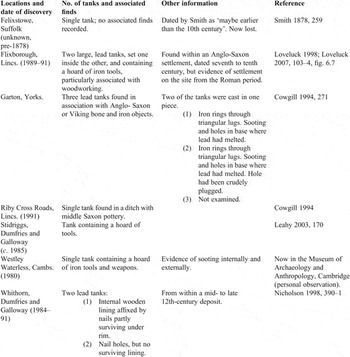
POST-ROMAN LEAD TANKS