The events of September 11, 2001 dramatically changed the political status of Muslims in the Western world. Muslim political activity suddenly became, and continues to be, a matter of great public interest and debate. On one side of the debate are alarmists, for whom every subsequent terrorist attack or uncovered plot is interpreted as evidence that Muslims represent an intrinsic threat to Western society and culture. While scholarship yields virtually no evidence of a systemic Islamic threat, research has documented the influence of this perspective in the mainstream media and public discourse (Cesari, Reference Cesari2010; Bail, Reference Bail2012). The most extreme alarmists warn that Islam is a politicizing religion, and that accommodating Muslims in Europe and North America will provide space for religious communities with evangelistic intent to transform the West into an Islamic society governed by Shari'a law. These claims persist, even though Muslims residing in the West report no such intention (Pew, 2011). More moderate alarmists are concerned about different cultural understandings of gender equality and sexual rights (Joppke, Reference Joppke2014), and religious arbitration (Korteweg, Reference Korteweg2008). Both the extreme and moderate alarmist perspectives argue that political participation by Muslims, and especially by devout Muslims, could allow them to work their influence within the system to transform Western society in ways that are incompatible with democratic values.
On the other side of the debate are integrationists, who wish for Muslims to be politically engaged in democratic society as active citizens of the communities they inhabit. However, some integrationists are also concerned about the relationship between Islamic faith and political participation. They are troubled by anecdotes that cursory interpretations of the Qu'ran or Hadith may deter Muslims from participating in Western politics and society, even though Muslim texts state that Muslim residence and engagement in non-Muslim societies is acceptable, as long as the society does not prohibit Islam (March, Reference March2006, Reference March2007). Research suggests that among Muslims, the belief that Muslims should not participate in Western politics is a minority viewpoint (Bullock and Nesbitt-Larking, Reference Bullock and Nesbitt-Larking2013; Parvez, Reference Parvez and Nielsem2013), that it is far more common for Muslim leaders to encourage participation (Bagby, Reference Bagby2012), and for Muslims to believe that, or at least behave as if, Islam and democracy are compatible (Bullock and Nesbitt-Larking, Reference Bullock and Nesbitt-Larking2013; Dana et al., Reference Dana, Wilcox-Archuleta and Barreto2017; Peucker, Reference Peucker2018).
Persistent tensions around Muslim religiosity and political participation primarily manifest in public discourse. Academic research on Muslims in Western contexts achieves clear consensus that generally speaking, Muslim identity, religion, and religiosity doesn't hurt, and could encourage, Muslim civic engagement, and that Muslim civic engagement supports democracy. This bourgeoning body of work demonstrates the complexity of the relationship between the many facets of being a Muslim and the myriad ways in which people are active within their local, national, and international communities. Many scholars focus on the relationship between Islamic beliefs or behaviors and political participation (Ayers and Hofstetter, Reference Ayers and Hofstetter2008; Doerschler and Irving Jackson, Reference Doerschler and Irving Jackson2011; McAndrew and Voas, Reference McAndrew and Voas2014; Read, Reference Read2015; Dana et al., Reference Dana, Wilcox-Archuleta and Barreto2017; Omelicheva and Ahmed, Reference Omelicheva and Ahmed2018; Jang et al., Reference Jang, Brown, Witvliet, Leman, Johnson and Bradshaw2023). Others examine the role of Islamic organizations and mosques in promoting participation (Jamal, Reference Jamal2005a; Ayers and Hofstetter, Reference Ayers and Hofstetter2008; Bagby, Reference Bagby2009; Dana et al., Reference Dana, Barreto and Oskooii2011; Fleischmann et al., Reference Fleischmann, Martinovic and Böhm2016; Oskooii and Dana, Reference Oskooii and Dana2017; Westfall, Reference Westfall2018), or document the mobilizing effect of Islamophobia (Munawar et al., Reference Munawar, Bhatti and Hamdani2005; O'Loughlin and Gillespie, Reference O'Loughlin and Gillespie2012; Martin, Reference Martin2017; Peucker, Reference Peucker, Esposito and Iner2019, Reference Peucker2021). Some scholars highlight the political activity of Muslim women, who have become symbols of the tension between Islamic and Western values, and discover that Muslim women are empowered and engaged as democratic citizens (Read, Reference Read2015; Easat-Daas, Reference Easat-Daas2017; Welborne et al., Reference Welborne, Westfall, Russell and Tobin2018). The comprehensive literature demonstrates the ways Muslims engage in their communities through electoral participation, associational involvement, protest, volunteerism, and by holding political attitudes that support participation, such as political trust, feelings of belonging, and national identity.
This paper focuses on one aspect of the Muslim-lived experience: Islamic religious behavior, which I define as actions that are religiously motivated (service attendance, prayer, meditation, studying scripture, tithing, missionary work, etc.). I examine whether a variety of Islamic religious behaviors, like mosque attendance, prayer, charitable giving, fasting, and dietary abstention, differently relate to civic engagement. I borrow Adler and Goggin's (Reference Adler and Goggin2005, 236) definition of civic engagement as “the way in which citizens participate in the life of a community in order to improve conditions for others or to help shape the community's future.” This definition includes formal activities, such as voting, as well as informal activities, such as volunteerism. It also includes modes of mainstream participation (voting, volunteering, donating, etc.) and protest activities (demonstrating, boycotting, signing petitions). Research on the role of religion in motivating or suppressing civic engagement clearly demonstrates that the relationship is not really about the religion or specific religious behaviors—it is about how those religious behaviors motivate, incentivize, frame, or provide opportunities for political participation (Omelicheva and Ahmed, Reference Omelicheva and Ahmed2018). I therefore theorize that different Islamic religious behaviors provide different incentives and opportunities for participation.
In what follows, I open with a discussion of the research on the relationship between Islamic religious behaviors and civic engagement. I frame the research by distinguishing between the theoretical political impact of public and private religiosity, and discuss why such a distinction sits uncomfortably on Islamic religiosity. The literature review is followed by an articulation of hypotheses and a detailed description of the data, variable construction, methodology, and results. I then discuss potential explanations for unexpected findings and opportunities for future research. I conclude by considering research implications, the limitations of the study, and recommendations for future survey research.
This paper demonstrates that Islamic religious behaviors do not encourage political or social withdrawal, and that many behaviors encourage engagement, but in diverse ways. In addition, the paper makes three empirical contributions to the literature. First, I consider the mobilizing role of less conventionally evaluated indicators of Islamic behaviors, such as dietary abstention and charitable giving. Second, I define civic engagement broadly to include mainstream practices of political participation, protest activities, informal community engagement, and associational membership. Finally, while the literature on Muslim civic inclusion and exclusion demonstrates that many experiences are mirrored on both sides of the Atlantic, there are few directly comparative studies, and very little trans-Atlantic work. I analyze original survey data from Muslim residents in five national contexts: Canada, France, Germany, the UK, and the United States. These data allow for unique comparative analysis of the links between religious behavior and civic engagement, and the discovery of international similarities or differences. Various cross-national relationships between Islamic religiosity and engagement demonstrate the importance of disaggregating both religious behaviors and modes of engagement in order to achieve a full understanding of the relationships between Islamic religious behaviors and politics.
Islamic religious behaviors and civic engagement
As a concept, religiosity describes the quality of an individual's religiousness. Researchers have used many different indicators to capture religiosity, such as strength of belief, the importance of religious guidance in daily life, positive feelings associated with God or religion, praying, attending religious services, religious study, etc. However, few studies fully capture the multidimensional concept. Dana et al. (Reference Dana, Wilcox-Archuleta and Barreto2017) justly criticize prior research on Muslim religiosity for its failure to consider the many dimensions of Islamic religious life. They borrow from Layman (Reference Layman1997) to summarize three dimensions of religiosity: belonging, believing, and behaving. Belonging refers to identification with a particular faith, belief captures the relevance of faith in day-to-day life and the interpretation of religious texts, and behavior relates to how the faith guides or motivates activity. I do not engage with the fullness of religiosity in this paper, but the conceptual delineation of belonging, believing, and behaving allows me to focus on behaving while still acknowledging the relevance and importance of belonging and belief in understanding how religion can influence civic engagement.
As already mentioned, mechanisms linking religious behaviors to civic engagement are not really about the behavior itself, but are about how the religious behaviors motivate, incentivize, frame, or provide opportunities for civic engagement. A persistent theme in research on religion and politics is a public–private distinction in religiosity, where public religiosity describes religious service attendance, group membership, and social activities, and private religiosity refers to prayer, meditation, or the quiet influence of faith in day-to-day life (Paxton et al., Reference Paxton, Reith and Glanville2014; Tausen and Funabashi, Reference Tausen and Funabashi2023). Read (Reference Read2007, Reference Read2015) makes a similar distinction between subjective and organizational dimensions of Muslim identity. The subjective dimension primarily captures private religiosity, and refers to the more internalized religious beliefs, and the organizational dimension captures involvement in the mosque, thereby relating to public religiosity. Those religious behaviors that occur publicly and in community are understood to provide more opportunities to develop human and social capital (Yeung, Reference Yeung2018), which then translates into civic engagement (Putnam, Reference Putnam2000). Private or subjective practices do not yield the same social and organizational resources, but could activate psychological resources that encourage political participation (Jang et al., Reference Jang, Brown, Witvliet, Leman, Johnson and Bradshaw2023). Read theorized that both dimensions could be positively or negatively associated with civic engagement, depending on interpretations of Islamic teaching.
Public religious behaviors
Public religiosity is developed through communal religious practices. Although this includes a range of potential behaviors, scholars have taken a marked interest in examining the effect of religious service attendance on political participation. Research on church attendance has long demonstrated that churches help congregants develop basic civic skills (Jones-Correa and Leal, Reference Jones-Correa and Leal2001; Schwadel, Reference Schwadel2002; Brown and Brown, Reference Brown and Brown2003), expand their social networks (Putnam, Reference Putnam2000; Schwadel, Reference Schwadel2005), access political information, and discuss public affairs (Brown and Brown, Reference Brown and Brown2003; Wald and Calhoun-Brown, Reference Wald and Calhoun-Brown2014). Logically, mosques should function in the same way. However, mosques play a slightly different role for Muslims than churches do for Christians, which could alter the way the institution informs political engagement. Mosques provide daily, ritualized prayer services, in addition to the weekly congregational prayer on Fridays. In most mosques, these activities are gender segregated. In general, Muslim men are more likely to attend prayer services (Read, Reference Read2015), while Christian women are more likely to attend church (Pew Research Center, 2016). Mosques also host events addressing the specific needs of the Muslim community or serving the community at large. Where the Muslim population is large enough, mosques may cater to specific ethnic or linguistic groups, but often they serve diverse constituencies, especially in North America. Jamal (Reference Jamal2005a) and Simmons (Reference Simmons2008) argue that congregational diversity provides an opportunity for the development of a pan-ethnic Muslim identity. Finally, while churches are generally well-regarded within their communities, the mosque is regarded with suspicion by the public and by governments in the West. They have been targets of vandalism, violence, and government surveillance (Qurashi, Reference Qurashi2018; Alimahomed-Wilson, Reference Alimahomed-Wilson2019). These unique attributes of the mosque beg the question of whether they play a different role in motivating the political activity of Muslims than churches do for Christians.
The largest body of work on the relationship between mosque attendance and civic engagement focuses on Muslims in the United States. Researchers have generally concluded that Islamic religious institutions motivate political inclusion and engagement with mainstream society. Many scholars use survey data to discover relationships between mosque attendance and political participation. In her landmark study of Arab Americans, Jamal demonstrates how mosque involvement mobilizes political activities through the development of group consciousness (Jamal, Reference Jamal2005b). Ayers and Hofstetter (Reference Ayers and Hofstetter2008) found a similar relationship using a 2004 survey that includes a larger and more diverse pool of respondents. They include mosque attendance within their conceptualization of religious resources, along with prayer and volunteerism, and found that religious resources are positively related to political participation. Read (Reference Read2015) used the same dataset to explore gender differences in civic engagement, and found positive effects between mosque involvement and civic engagement for men, but not for women. She attributes this finding to the gendered nature of mosque involvement. In data from the 2007 and 2008 Muslim American Public Opinion Survey, mosque attendance was associated with a greater likelihood of identifying as American and participating in politics (Dana et al., Reference Dana, Barreto and Oskooii2011, Reference Dana, Wilcox-Archuleta and Barreto2017). I found similar relationships in data from the Pew Research Center's 2011 Muslim American Survey, though I found that the relationship was limited to attendance that engaged congregants in activities other than prayer (Westfall, Reference Westfall2018). This result is reminiscent of research finding that Christian church attendance is not enough to motivate participation on its own, and that any effect is contingent on the social connections made within the church, often through church activities other than religious services (Djupe and Grant, Reference Djupe and Grant2001; Schwadel, Reference Schwadel2005). Bagby (Reference Bagby2012) suggests that Muslim civic engagement is supported by mosque leaders. In his survey of American mosques, he found that the vast majority of mosque leaders agree that Muslims should be involved in American institutions and politics. Considered together, the quantitative evidence from the United States suggests that the mechanisms linking church attendance to political engagement are also at work in mosques, with some conditions relating to the activities within the mosque and gendered participation.
Survey research from outside the United States yields similar results, suggesting that the mechanisms may work across different political contexts. In the UK, McAndrew and Voas (Reference McAndrew and Voas2014) find that communal religious practice is robust to generational decline among ethnic minority groups, and that among 1.5 and second-generation immigrants, religiosity (measured with an index that includes communal religious practice) is associated with higher levels of civic involvement. Oskooii and Dana (Reference Oskooii and Dana2017) use the same survey data to compare Muslims and Christians, and to demonstrate that mosques and churches are both associated with higher levels of electoral and non-electoral participation, and involvement in local organizations. Using survey data from the Netherlands, Fleischmann et al. (Reference Fleischmann, Martinovic and Böhm2016) found that religious service attendance relates positively to engagement in co-ethnic and mainstream organizations, and that participation in those organizations translates into a greater intention to vote among Turks, but not Moroccans. They speculate that the ethnic difference could be attributable to the nature of the associational life, as Turks appear to have more cohesive and interlinked associations that may mobilize more successfully than Moroccan organizations. Regardless of the reason for the ethnic differences, the work by Fleischmann et al. warns against treating Muslims in the West as a monolith. The relationships between public religiosity and civic engagement depend on particularities within each religious community—qualitative research is needed to fully understand these differences.
That said, qualitative work has already exposed some mechanisms that support the relationships discovered in the quantitative data. In their interviews with 30 civically active Muslims in Australia and Germany, Peucker and Ceylan (Reference Peucker and Ceylan2017) recount narratives of how mosques serve as a site of volunteerism, which provides a point of entry into a more diverse array of political activities. They also tell stories of people being recruited out of mosques, often to represent the mosque community in a meeting, which then triggered subsequent civic activity, such as running for election as a city counselor. They demonstrate that Muslim community work often naturally shifts into intercommunity engagement for individuals who are eager to have an impact beyond the faith community. Peucker (Reference Peucker, Esposito and Iner2019, Reference Peucker2021) further documents the prevalent desire among Muslim leaders to have a transformative impact on both Muslims and the wider community in Australia.
Some scholars examine the effect of Muslim community organizations on civic engagement. These organizations are not religious per se, but use religious identity to define their membership. Since being Muslim can act as a cultural and religious identity, participation in these organizations is not necessarily a religious behavior. However, Giugni et al. (Reference Giugni, Michel and Gianni2014) compare the political effects of involvement in cross-ethnic, ethnic, and religious associations in Switzerland, and find that involvement both cross-ethnic and religious associations have a positive impact on political participation. However, the inclusion of mosque attendance in the model causes the coefficient for religious organizational involvement to lose significance. The presumed correlation between religious organization and mosque attendance supports treating religious associational membership outside the mosque as a religious behavior. Peucker and Ceylan (Reference Peucker and Ceylan2017, 2405) argue that Muslim community organizations “rather than promoting social segregation, act as accessible entry point for Muslims’ civic participation, facilitate cross-community engagement and provide gateways to political involvement.” They find that the transition from intra-community activism to political work is more common in Australia than in Germany, which they attribute to the pluralistic nature of multicultural Australian civil society, which assumes that all individuals deserve equal opportunities to engage civically. Their findings illustrate the value of comparative research for identifying structural differences that shape Muslim engagement.
Research on Muslim public religiosity demonstrates the power of the Muslim community for motivating, providing resources for, and structuring intra- and inter-community engagement. The social networks Muslims form through their faith-based activity enrich their social capital, while the experiences they gain through mosque-led volunteerism and recruitment develop their human capital. These effects are particular to religious practice that happens in the company of others, and ideally, among people who represent a diversity of life conditions and experiences (Putnam, Reference Putnam2000).
Private religious behaviors
Compared to the research on public religiosity, scholarship less frequently focuses on the relationship between behaviors typically described as “private” (devotional activities like prayer, meditation, or reading a religious text) and civic engagement. However, private religiosity could motivate and frame civic engagement by making religious values more salient, or by activating psychological resources. Jang et al. (Reference Jang, Brown, Witvliet, Leman, Johnson and Bradshaw2023) speak on the importance of psychological resources when they demonstrate how “transcendent accountability” (seeing oneself as responsible to God or a higher power for one's impact on other people and the environment) and “religiopolitical awareness” (perceiving the influence of one's religion on one's political views and activities) mediated the positive relationships they find between religiosity and political participation.
Research on links between private religiosity and civic engagement among non-Muslim and mixed population produces inconsistent findings. Djupe and Neiheisel (Reference Djupe and Neiheisel2012) find that among Latino Americans, devotionalism predicts a higher probability of political participation. However, using a sample of Christians, Jews, and Muslims in Little Rock, AR, Glazier (Reference Glazier2020) found that “scripture reading and prayer” was not related to a composite measure of political participation. Loveland et al. (Reference Loveland, Sikkink, Myers and Radcliff2005) find that the effect of prayer on civic participation is conditioned by involvement in religious voluntary organizations, and that prayer promotes a cognitive connection to the needs of others that stimulates volunteerism, which then motivates greater secular civic engagement.
Research on the effects of specifically Muslim private religiosity on civic engagement in the West is limited. In their research on the religiosity of immigrant groups in the UK (including a substantial Muslim sample), McAndrew and Voas find that regular private religious practice, like prayer, declines in later generations of immigrants. Their composite index capturing religiosity is associated with higher levels of civic engagement and volunteering, but they do not disentangle the effect of private religious practice, because they measure religiosity in an index that includes religious affiliation, salience, service attendance, and prayer.
Dana et al. (Reference Dana, Wilcox-Archuleta and Barreto2017) provide a rare look at the independent effect of private Islamic religious practices on Muslim integration into the American democratic system and political process. In addition to assessing the impact of mosque attendance and Islamic knowledge on civic engagement, they also consider the degree to which the Qu'ran and Hadith influence daily life, and charitable giving. They found that those who give charitably are more likely to believe Islam is compatible with American democracy and are more likely to participate in politics. Those who are guided by religious texts are more likely to believe Islam is compatible with democratic principles, but less likely to participate in politics. They explain this discrepancy with reference to Islamic teachings, which do not compel participation: “Such Muslims may be described as having a very personal and devout relationship with Islam, in which their spirituality provides sustenance…political participation would not add to their individual practice of Hadith” (194). Relatedly, Read (Reference Read2015) found that, among Arab women in the United States, subjective religiosity was associated with a slightly lower rate of civic engagement, though it was unimportant for determining men's civic engagement. She suggests “this may reflect the fact that strict interpretations of all mono-theistic religions endorse a gendered division of labor, thus women may feel that it is more important to engage in the private, familial realm rather than the public one” (42).
Research on the political effects of private religiosity is inconclusive for Muslim and non-Muslim populations. Religious practice could trigger psychological processes that encourage engagement, or they may serve to reinforce faith identity, which could promote group consciousness, something Jamal (Reference Jamal2005b) and Dana et al. (Reference Dana, Wilcox-Archuleta and Barreto2017) discover promotes political participation. Alternatively, it is possible that the private practice of Islam is disassociated from public life. Indeed, many secularists suggest that religious practice should be entirely confined to the private sphere, with the assumption that private religiosity does not influence political culture.
Challenges with the public–private distinction for Islamic religious behaviors
The theorized public–private distinction provides justification for why one might expect diverse religious behaviors to promote civic engagement differently. However, many, perhaps even most, Islamic religious behaviors cannot be comfortably categorized as either public or private. Even prayer, which is generally considered to be a private activity, is often public or quasi-private in Muslim contexts. Praying in congregation is the primary religious activity in the mosque, and because daily prayers are called at specific times, families or proximate believers will pray together. Other activities that seem individual, like fasting or practices of dietary abstention, are also reinforced by the social context. Muslims will naturally find it more convenient to abstain and fast when in the company of other Muslims, and during Ramadan, breaking the fast at sundown with iftar is regularly done in community.
Charitable giving also straddles the public–private divide. Islam emphasizes and rewards giving charity in secret, and teaches that drawing attention to one's giving is highly undesirable. However, some Muslims argue that giving charity publicly—as long as one has the right intentions—sets an important example for other Muslims. Zakat.org makes a private–public distinction between obligatory charity (Zakat) and voluntary charity (Sadaqah), and argues that public charity is best for Zakat, in order to encourage others to fulfill their obligations, while Sadaqah is best done with pure charitable motive, and therefore privately (Zakat.org, 2023). There is evidence that public Zakat should work to motivate others—economists and psychologists have found social pressure to be an important determinant of giving (DellaVigna et al., Reference DellaVigna, List and Malmendier2012).
Clearly, the lines between public and private religious practice are blurred for most Muslims. Including a broader array of Islam-specific religious behaviors in research, and examining the independent effect of each behavior, opens the door to the discovery of unexpected relationships between religious behaviors and civic engagement.
Hypotheses
The literature cited above examines formal/electoral participation, informal/non-electoral participation, associational involvement, volunteerism, political identities, political attitudes, and trust. It is not uncommon for many empirical indicators of civic engagement to be merged into an index of participation (Jacobs et al., Reference Jacobs, Phalet and Swyngedouw2004; Jamal, Reference Jamal2005b; Ayers and Hofstetter, Reference Ayers and Hofstetter2008; Dana et al., Reference Dana, Barreto and Oskooii2011, Reference Dana, Wilcox-Archuleta and Barreto2017; Giugni et al., Reference Giugni, Michel and Gianni2014). However, the literature also hints at nuance in how religious behaviors relate to distinct methods of civic engagement. For example, while Oskooii and Dana found that mosque attendance mobilizes most forms of participation, including participating in a protest, it did not significantly predict signing a petition. Giugni et al. (Reference Giugni, Michel and Gianni2014) similarly found that participating in a religious organization predicted the breadth of participation in more mainstream political activities, like contacting politicians or donating money to a political organization, but the effect disappeared when the analysis was limited to protest activities, which includes things like boycotting, signing a petition, or wearing a badge. While a large body of work discovers that strong associational involvement encourages political participation, the work of Jacobs et al. (Reference Jacobs, Phalet and Swyngedouw2004) suggests that the same relationship may not hold for informal political involvement or for all Muslim groups. I therefore consider it likely that religious behaviors may differently relate to varied methods of civic engagement, based on how the religious behaviors motivate, incentivize, frame, or provide resources for particular types of political engagement. For example, the things that motivate campaigning may not motivate attending a demonstration.
Under the umbrella of civic engagement, I differentiate between mainstream participation, protest activities, community engagement, and secular associational membership. Mainstream participation includes uncontroversial political activities, like voting, contacting politicians, attending political meetings, etc. Protest activities are explicitly oppositional and reactive, and include things like signing a petition, participating in a protest, or boycotting. Community engagement is a measure of informal civic engagement, which includes things like helping your neighbor and volunteering. Secular associational membership includes membership in sports clubs, art clubs, labor unions, professional organizations, and the like. In what follows, I provide four hypotheses relating to the relationship between religious behaviors and civic engagement, along with descriptions of the hypothesized mechanisms.
H1: Mosque attendance will be associated with more mainstream political practices, community engagement, and associational memberships, but fewer protest activities.
As described in the review of Muslim public religiosity, quantitative research achieves a clear consensus that mosque attendance is associated with greater civic engagement across a range of indicators and in a variety of contexts. Qualitative research demonstrates that mosque communities are sites for political recruitment, that they are involved in cross-community and outreach activities, and that mosques are sites of volunteerism. Furthermore, national governments recognize the power of the mosque to mobilize congregants, and many European governments have deliberately forged links with mosques to collaboratively prevent disenfranchisement and encourage integration (Laurence, Reference Laurence2012). The organizational character of the mosque and the civic activity that takes place inside the mosque lead me to expect that those who regularly attend the mosque will be more likely to participate in mainstream politics and community engagement, and to be members of other associations. However, mosque leaders and congregants are aware that, despite the mosque community's involvement in the local community, the mosque is regarded with suspicion, and Muslims are highly motivated to change this perception through their political activity (Peucker, Reference Peucker2021). I therefore expect that those who are most active in the mosque will avoid more controversial and oppositional protest activities.
H2: Daily prayer will be positively associated with community engagement.
The literature on private religiosity is inconclusive in terms of whether and how prayer is related to civic engagement. Uncertainty about the relationship is compounded by the way Islamic prayer bridges the private–public divide. In the private sphere, Jang et al.'s (Reference Jang, Brown, Witvliet, Leman, Johnson and Bradshaw2023) psychological resources of “transcendent accountability” and “religiopolitical awareness” could link prayer to the full range of civic engagement, perhaps especially community engagement, since work in the local community has the most potential to do immediate good. Similarly, the practice of prayer could motivate engagement by strengthening one's commitment to Islamic religious values, which Easat-Daas (Reference Easat-Daas2017) suggests motivates activism through religious commitments to social justice.
The public nature of Islamic prayer introduces the possibility that Islamic prayer provides access to political resources associated with the wider Muslim community, which I would expect to motivate more mainstream political engagement, community engagement, and associational membership, but only if the person praying also engages with others in the community. I have previously demonstrated this conditionality by demonstrating that attending mosque to pray was not significantly related to mainstream political activities or community engagement, but that attending mosque for other purposes was (Westfall, Reference Westfall2018). Other research on the relationship between Muslim prayer and civic engagement is mixed, and consistently significant positive effects are only found when prayer is included in an index of religiosity. Furthermore, prayer strongly correlates with subjective religiosity (self-assessment of religious commitment), which has not been found to influence civic engagement (Read, Reference Read2015; Fleischmann et al., Reference Fleischmann, Martinovic and Böhm2016). The complexity of the practice of Islamic daily prayer, and the inconsistent results in the literature, make it difficult to hypothesize with confidence, but I hypothesize that the psychological resources linked to prayer should motivate community engagement, at the very least.
H3: Religiously motivated charitable giving will be positively associated with associational membership, community engagement, and protest.
I would expect faith-motivated charitable giving to activate the psychological resources described by Jang et al. (Reference Jang, Brown, Witvliet, Leman, Johnson and Bradshaw2023), and to connect strongly to Islamic values promoting social justice (Easat-Daas, Reference Easat-Daas2017), because charitable giving is deliberately redistributive. I would expect charitable giving to be associated with higher levels of community engagement, due to the easy extension from charitable gifts to volunteerism. I would also expect social awareness that comes with charitable giving to motivate membership in charitable or social justice-oriented organizations. The link to social justice could also promote protest activity on behalf of the disadvantaged targets of charity.
H4: Religious dietary abstention and fasting during Ramadan will be positively associated with community engagement and protest activities.
I have already discussed how dietary abstention and fasting are more convenient when one is around other Muslims. One can almost default into these practices in many Muslim-majority contexts, but abstaining can be a conspicuous behavior in Western contexts, which could result in othering or ostracization. The social incentive not to abstain is strong. Similarly, fasting during Ramadan is a challenge even in Muslim-majority contexts, where most restaurants are closed during the day and most people are fasting. In Western contexts where mainstream society is less aware or considerate, fasting becomes a different kind of challenge, and one that may not be respected by non-Muslims. Peucker (Reference Peucker2021, 34) finds that Muslims see religious organizations as a “safe space” where they don't have to “explain their religious duties and practices.” Therefore, those who have strong Muslim social networks may feel more empowered in their observance of Ramadan, in both fasting and feasting. I would expect those who strictly observe abstention and fasting to have more insular and religiously homogeneous social networks. This “bonding social capital” may not encourage mainstream political participation or secular associational memberships (Putnam, Reference Putnam2000).
However, those who are bonded to their religious community might engage in group advocacy. If members of the group experience unfair treatment or discrimination, those grievances are more likely to be shared. Peucker (Reference Peucker2021) finds that group empowerment and awareness of injustice motivates community volunteerism, but awareness of group injustice could also motivate protest activities, or civic activism with reference to Muslim-specific values and priorities (Mustafa, Reference Mustafa2016). I therefore expect abstention and feasting to correlate with protest activities, theoretically mediated by strong intra-faith connections.
The hypothesized direction of the relationships between religious behaviors and categories of civic engagement is summarized in Table 1.
Directions of hypothesized relationships

Data
I examine the relationship between Islamic religious behaviors and civic engagement with data from the Trans-Atlantic Muslim Opinion Survey, an original online survey of self-identified Muslims in Canada, France, Germany, the UK, and the United States. The survey data were collected in August of 2019 by Qualtrics® (https://www.qualtrics.com/), which employs a full probability design web-based survey technology. Qualtrics works with sample partners in each country, who drew samples from double-opt-in market panels where possible. Since Muslims are hard-to-reach, some participants were actively recruited based on their religious identity. The sample includes responses from 2,341 Muslims: 300 Muslims in Canada, 522 Muslims in France, 504 Muslims in Germany, 511 Muslims in the UK, and 504 Muslims in the United States. Surveys were available in English, French, Canadian French, and German.
I selected these five countries because they display fundamental differences in (1) collective recognition of Muslim communities, and (2) their histories of immigration. Western states recognize minority communities through multicultural policies, assimilation policies, or policies that may fall somewhere in between. Multicultural policies are those that recognize, and even encourage, cultural and religious particularism as bases for political belonging, while assimilation policies require cultural and religious minorities to shed distinctiveness to be absorbed into political culture of their host state. Immigration histories in the West are categorized by the traditions of former colonizers or settler states. Former colonial states continue to experience disproportionate flows of immigration from their colonies based on linguistic, legal, institutional, or cultural relationships between the colony and its former colonizers, relationships that theoretically facilitate immigrant integration. By contrast, settler states were once colonies of, and were permanently settled by, European powers. They generally have a tradition of large-scale permanent immigration from a variety of sending states. Figure 1 presents a typology with multicultural/assimilation policy on the x axis, and colonial/settler state tradition on the y axis.
Typology representing collective recognition of Muslim communities (multicultural vs. assimilation) and histories of immigration (settler state vs. colonial state).

English Canada fits squarely in type a, as it is an explicitly multicultural settler state, where state and society are expected to facilitate the expression of cultural identity within the Canadian cultural mosaic (Reitz, Reference Reitz2012). To my knowledge, there are no settler states with clear assimilative policies (type b). However, within federal Canada where there are constitutionally divided powers of immigration and integration, and provinces can take different approaches. Québec opts for an “interculturalist” approach that supports diversity “within limits” of democratic values and inter-community engagement (Gagnon and Iacovino, Reference Gagnon, Iacovino, R and Requejo2004; Bouchard, Reference Bouchard2015). Québec requires immigrants to actively participate in French language and culture, an expectation that reflects assimilative assumptions. There are not sufficient numbers of Muslims from Québec in the survey data to allow for separate empirical study, but the intra-state policy diversity within Canada is noteworthy.
As a former colonizer with multicultural policies, the UK exemplifies type c (Ashcroft and Bevir, Reference Ashcroft and Bevir2018). There is no central law promoting multiculturalism in the UK, but multiculturalism manifests in political rhetoric, institutional structures, scholarly analysis, and commercial marketing. The UK government also endorses cultural diversity, special treatment of cultural groups, and anti-discrimination (Mathieu, Reference Mathieu2018). France's republic model emphasizes cultural assimilation and the exclusion of religion from the public sphere (Hollifield, Reference Hollifield, Cornelius, Martin and Hollifield1994). This, combined with its colonial past, places it squarely in type d.
Germany and the United States bridge categories. Germany was not a colonizing or settler state. When it comes to recognizing minority communities, Germany has a more restrictive policy framework that is not truly assimilationist, but also isn't multicultural. Eckardt (Reference Eckardt2007) calls the approach “multiculturalism as pragmatism” because the state supports minority communities in practical ways, such as through providing strong support to migrants through its welfare system, but does not place emphasis on celebrating diversity. As such, Germany falls right on the neutral point of the typology. The United States is a settler state, and while the government and legal system is very tolerant and protective of religious expression and cultural diversity, it takes a rather hands-off approach to the formal incorporation of minority communities. At the same time, the U.S. policy and scholarship demonstrates a form of what I echo Eckardt in calling “assimilation as pragmatism,” where expectations of linguistic or socio-economic are endorsed (Brubaker, Reference Brubaker2001). The United States therefore bridges types a and b. The inclusion of these five country samples, which includes ideal-type and hybrid states allows for unique comparative analysis of the links between religious behavior and civic engagement, and the discovery of whether observed trends are generalizable beyond a single context, or across the dimensions on the axes displayed in Figure 1.
Measurement
Dependent variables: civic engagement
My dependent variables measure organizational membership, mainstream political participation, political protest, and community involvement. Organizational membership is both a dependent variable capturing engagement within the community, and an independent variable expected to promote other forms of engagement (cf. Fleischmann et al., Reference Fleischmann, Martinovic and Böhm2016). I measure organizational membership with an additive index capturing active membership (versus inactive or no membership) in the following: sport or recreational organizations; art, music, or educational organizations; labor unions; political parties; environmental organizations; professional organizations; humanitarian or charitable organizations; consumer organizations; self-help or mutual aid groups; ethnic or cultural organizations; other organizations.
Breadth of political participation is measured by asking whether the respondent participated in several political behaviors within the previous 12 months. I focus on two dimensions of participation: mainstream participation and protest activities. Mainstream participation includes contacting a politician, donating money to a political organization or candidate, voting in an election, volunteering for a political party or action group, volunteering for another political organization, wearing a political badge or sticker, and/or attending a meeting or rally.Footnote 1 Protest activities include signing a petition, participating in a lawful public demonstration, and boycotting a certain product. Two additive indices were created, and factor analysis affirms the construction of two variables capturing different types of political participation (see Appendix Table A1).Footnote 2
Informal community involvement is captured with an additive index measuring whether a respondent did any of the following within the past month: helped your neighbor in any way (e.g., mowing lawns, loaning tools, pet sitting, etc.); helped improve your local community on your own (e.g., supporting business, reporting crime, contacting local officials); helped improve your local community by working with your fellow citizens (e.g., neighborhood watch, residents' association, cleaning public spaces).
Independent variables
My primary independent variables measure religious behaviors. Mosque attendance is measured by how frequently survey respondents participate in social or religious activities (other than prayer) at the mosque. The survey included two questions asking about the frequency of attending mosque to pray, and the frequency of attending mosque for social or religious activities other than prayer. Responses to the two mosque questions are highly correlated (r = 0.71), which prohibits the inclusion of both variables in the models of civic engagement. Attending mosque for social and religious reasons other than prayer is a more powerful determinant of civic engagement in bivariate regression, so it is included in the model. Survey respondents also indicated whether they prayed daily, performed Zakat (charitable giving), fasted during Ramadan, abstained from pork, and/or abstained from alcohol. The measures of abstinence are highly correlated (r = 0.74), and were combined into an abstinence index. A correlation table of the religious behaviors is provided in Appendix Table B1.
Competing explanations
The model accounts for competing explanations for Muslim civic engagement with variables capturing public acceptance of Muslims, social and political trust, and demographic characteristics. Perceived community friendliness toward Muslims is included based on the assumption that more inclusive communities will promote higher levels of engagement. Those who trust others are more likely to cooperate with them to improve their communities, and someone who distrusts the central government might be less likely to participate in mainstream political behaviors that are sanctioned and encouraged by the state, though they might be more inclined to engage in protest activities (Fleischmann et al., Reference Fleischmann, Martinovic and Böhm2016). General interest in politics and political information are measured by time spent reading the news, which is expected to positively influence all types of civic engagement.
Social capital is a critical determinant of civic engagement. The number of a respondent's close friends (people with whom the respondent feels comfortable talking about private matters with or calling upon for help) indicates the richness of one's social networks, as does an indicator measuring the frequency with which one socializes with others. Putnam (Reference Putnam2000) posits that “bridging” social capital built between groups is more mobilizing than “bonding” social capital within groups. The diversity of the respondent's neighborhood captures potential for bridging social capital, and the proportion of a respondent's friend group that is Muslim measures bonding social capital.
Unemployment, gender, immigrant background, citizenship, and ethnicity are all included in the model as dichotomous control variables, along with ordinal measures of education and age, and dichotomous indicators of respondent country of residence (France is excluded as the category of reference because it is a strong representative of country type d in Figure 1). Definitions and descriptive statistics for all of the variables included in the model are provided in Appendix Table C1.
Results
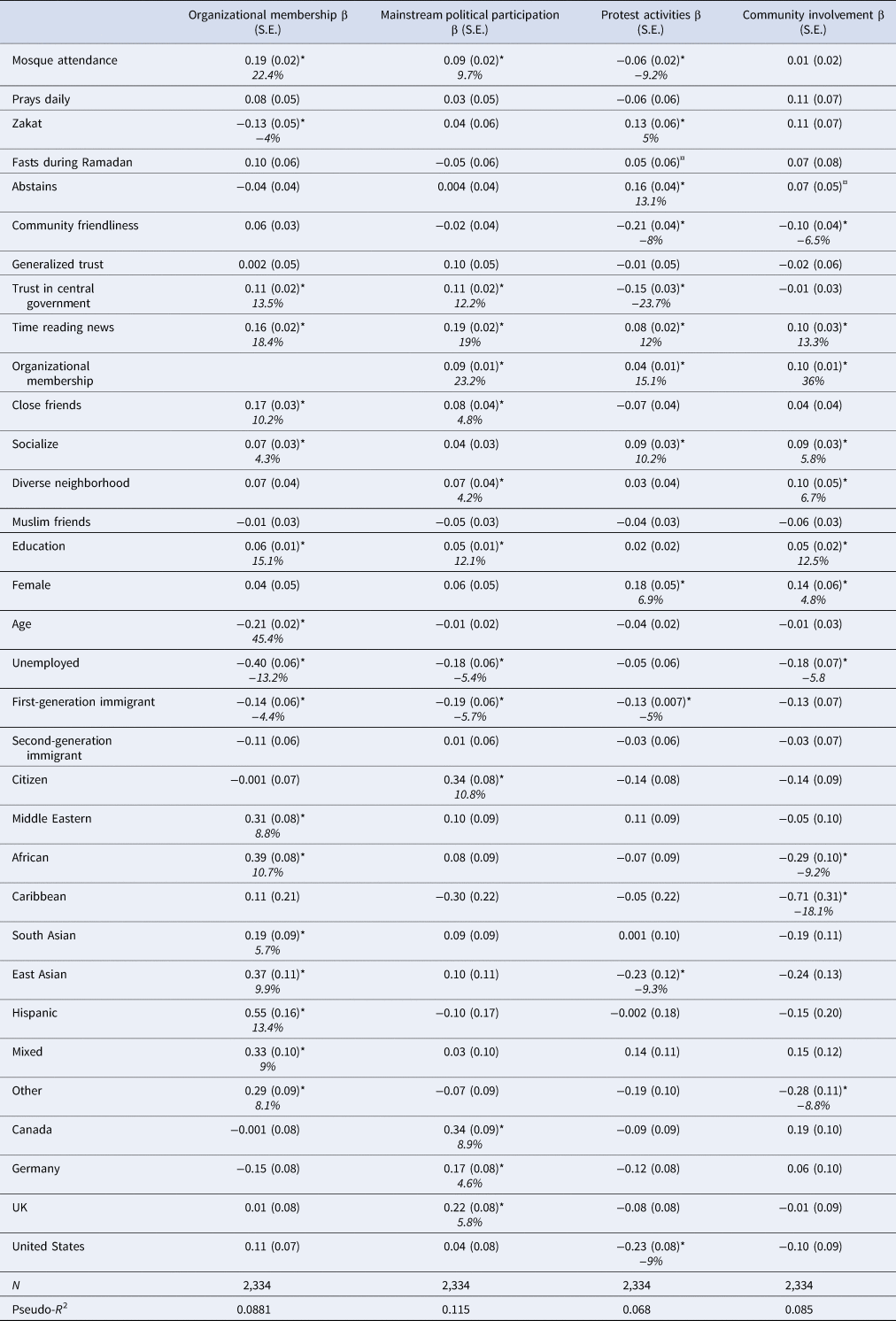
Because the dependent variables are ordinal, it is appropriate to fit generalized linear models (ordered probit models). The results of the statistical model are presented in Table 2, which reports coefficients, standard error, and whether the relationship meets the threshold for significance (p < 0.05). For statistically significant relationships, I include changes in the predicted probability that an individual will engage in at least one activity.
Ordered probit regression results and changes in predicted probabilities

*p < 0.05.
¤ p < 0.05 once multicollinearity is addressed by removing Zakat/abstain (see Appendix Tables D1 and E1).
Italics indicate the change in the probability of participation in at least one activity (min–max).
As anticipated by hypothesis 1, mosque attendance for reasons other than prayer is significantly associated with nearly all of the indicators of civic engagement, except community involvement. Relationships with associational memberships, and mainstream political participation are positive, while the relationship with protest activities is negative. Mosque attendance has the strongest impact on associational membership, increasing the probability of at least one active membership in an organization from 12.3 to 34.7% (22.4%). Attending mosque increases the probability of involvement in at least one mainstream political activity from 15.6 to 25.3% (9.7%). Meanwhile, mosque attendance decreases the probability that an individual will engage in a protest activity from 51.4 to 42.2% (−9.2%).
Results for the other indicators of private or private–public religiosity yield fewer significant results. Prayer is not significantly associated with any indicators of civic engagement, refuting hypothesis 2. Charitable giving (Zakat) is negatively associated with active organizational membership, decreasing the probability that someone will belong to an organization from 25.2 to 21.2% (−4%). Charitable giving is positively associated with protest activities, and increases the probability that someone will protest in at least one manner from 44 to 49% (5%). The positive relationship between charitable giving and protest supports hypothesis 3 in part, but the negative relationship with organizational membership was unexpected. I address some potential explanations for the unexpected relationship in the “Discussion” section.
Abstaining from alcohol and/or pork is significantly and positively associated with protest activities, increasing the probability that someone will engage in a protest activity from 42.2 to 55.3% (13.1%). Fasting during Ramadan does not share significant relationships with any indicators of civic engagement. These findings partially affirm hypothesis 4, which anticipated positive relationships between abstention/fasting and community engagement, and positive relationships with protest.
Appendix Table B1 demonstrates that dietary abstention is highly correlated with charitable giving and fasting. This multicollinearity is likely masking important relationships between any of these indicators and the measures of civic engagement. If the abstention index is removed from the model, both charitable giving and fasting during Ramadan positively predict protest, as predicted by hypotheses 3 and 4 (see Appendix Table D1). If charitable giving and fasting are removed from the model, abstention shares a positive relationship with community engagement as anticipated by hypothesis 4 (see Appendix Table E1). These results provide further evidence to support hypotheses 3 and 4.
Variables representing competing explanations for civic engagement share several interesting, and mostly expected, relationships with the indexes capturing civic engagement. Most importantly, secular organizational membership is significantly associated with all indicators of civic engagement. The changes in the predicted probabilities reveal that it is the most powerful determinant of mainstream participation and local community involvement. These significant relationships hint at potential indirect relationships between religious behavior and civic engagement, which I address further in the “Discussion” section.
Whether a respondent believes people in their country are friendly toward Muslims shares a significant and negative relationship with protest activities and community involvement. Trust in the central government is a significant positive determinant of mainstream political behaviors and active organizational membership, and is a negative determinant of protest activities, but it does not significantly impact the probability of community involvement. Time spent reading news significantly augments all forms of civic engagement.
Having a large number of close friends is positively associated with engaging in a greater number of orthodox political activities, active organizational memberships, and the frequency with which one socializes is positively associated with organizational memberships, protest activities, and local community involvement. These results demonstrate that strong social bonds have a mobilizing effect, but the frequency of socializing and the number of friends are associated with different types of engagement, which suggests social capital motivates differently depending on the type of activity. Living in a diverse neighborhood is significantly and positively associated with mainstream political participation and local community involvement.
Several demographic characteristics register as significant determinants of civic engagement. Education is significantly and positively associated with all forms of participation except protest activity. There are no gendered differences in organizational membership, trust in the central government, or orthodox political participation, but Muslim women are more likely to engage in a wider range of protest activities and to get involved in their local communities more than men. Age is a significant and strong determinant of organizational membership, but is not significant in any other models. Contrary to the conventional wisdom that predicts older people will be more likely to participate in politics and be engaged in their local and organizational communities, older Muslims in this sample are less likely to be involved in organizations than younger Muslims.
Unemployment suppresses all forms of civic engagement except protest activity. Being a first-generation immigrant is associated with lower levels of organizational membership and mainstream political participation, and the negative relationship with protest activity approaches significance (p = 0.051). Being a second-generation immigrant is not associated with any indicators of civic engagement, except for a negative relationship with organizational membership. Citizenship is positively associated with mainstream political participation, but not with any other forms of civic engagement.
Ethnicity is not a consistent determinant of civic engagement, but compared to Muslims who identify as white, those who identify as Middle Eastern, African, South Asian, East Asian, Hispanic, Mixed, and other ethnicities are more likely to be active members in more organizations, probably because of the lower tendency to join cultural or human rights organizations among those who identify as white. Those who identify as African or Caribbean are less likely to get involved in their local communities.
When it comes to organizational memberships, there are no statistically significant differences between Muslims residing in the UK, the United States, Canada, or Germany, compared to those in France. Canadian, German, and UK residents are more likely to participate in a wider range of conventional political activities and to be more involved in their local communities than Muslims in France. Muslims in the United States are less likely to participate in protest activities than Muslims in France. There is not a significant difference in local community involvement between the residents of France and those of the other four countries. These results reveal more national-level similarities than differences after controlling for individual-level factors, with the greatest degree of difference in mainstream political participation.
Discussion
Taking a bird's eye view of the model's results in Table 2 and Appendices Tables D1 and E1, no religious behaviors share a statistically significant negative relationship with mainstream political participation or community involvement. This result confirms previous scholarship finding that Islamic religious behaviors do not encourage political or social withdrawal. Rather, the results demonstrate that some behaviors encourage engagement, but in diverse ways. That said, some religious behaviors share negative relationships with protest and organizational membership, which I address below. Most of my hypotheses are confirmed in the statistical analysis, but there are a few unexpected, but explainable, results. The following describes the primary findings and discusses the most likely mechanisms behind the statistical relationships.
I find that mosques, as a representative of public religiosity, mostly function in the way I expected them to, thereby supporting hypothesis 1. Mosques remain strong sites of mobilization and incorporation, but participation in a mosque community may discourage protest. The negative relationship with protest activities resembles the weaker or absent relationships other scholars have found between religious attendance and protest activities (Giugni et al., Reference Giugni, Michel and Gianni2014; Omelicheva and Ahmed, Reference Omelicheva and Ahmed2018). That the mosque is the only religious behavior that encourages mainstream political participation signals something unique about mosque attendance as a religious behavior. These findings contradict arguments that mosques reinforce insular communities disengaged from mainstream society, and also refute assumptions that mosques are sites of political dissent. However, we should not automatically assume that the negative relationship between mosque attendance and protest signals a healthy relationship between mosque communities and larger society. Reduced protest among mosque attendees could reflect awareness of hostility toward the mosque, or intimidation. Peucker (Reference Peucker2021) hinted at this mechanism in his analysis of interviews with civically engaged Muslims, who reported the belief that their political activity is perceived negatively by the wider community. Fear of how their protest activities will be perceived may therefore disincentivize mosque communities from participating in or encouraging protest. Mosques are a critical site for the development of Muslim political consciousness, so the negative relationship between mosque attendance and protest should trigger some concern, especially since protest is an important method of accountability. The insignificant relationship between mosque attendance and community involvement was unexpected, especially since mosques are important sites of volunteerism. Perhaps the social resources available through mosque participation are more valuable for promoting formal participation in politics and organizations, and may substitute for other forms of informal participation.
I found that daily prayer was not significantly associated with any forms of civic engagement, which leads me to reject hypothesis 2. This is not an entirely unexpected result, as it confirms theory that private religious behavior provides psychological resources that may not be as mobilizing as the social resources provided by public religious behavior. It is still possible that indirect relationships link prayer and civic engagement, perhaps through developing or reinforcing affinity with one's co-religionists. The non-significant relationship should not deter a more thorough investigation of how prayer informs political identities or behaviors in future research.
The relationships between charitable giving and methods of civic engagement were somewhat unexpected. As stated in hypothesis 3, I expected giving to reinforce values of social justice, and for these to manifest in increased activity in secular organizations, more community involvement, and more protest activities. However, the relationship with protest was not significant in the full model. When I account for multicollinearity between charitable giving, fasting, and abstaining (see Appendix Tables D1 and E1), I find the expected positive relationships between charitable giving and community involvement and protest activities, though the effect sizes are small. Perhaps the weak relationships are attributable to the infrequency of Zakat, which is only required once per year. Future research could consider the power of both Zakat and Sadaqah, to explore whether relationships between charitable giving and civic engagement are strengthened with more frequent, non-compulsory faith-based contributions. I also expected charitable giving to share a positive relationship with organizational membership, but I found a negative, weak relationship. Perhaps giving produces a kind of replacement effect for volunteerism, where those who give feel less of a need to formally contribute in other ways. The substitution effect introduces supplemental considerations of the role of class, income, and employment in charitable giving, and therefore volunteerism, which could be teased out in future research. The target of charitable giving could also help clarify the relationship, and whether it is directed at the mainstream or Muslim community. Perhaps those who donate to general causes might belong to different organizations than those focused on causes specific to the Muslim community. Future work could examine these possibilities.
I expected fasting and abstention to be positively associated with community involvement and protest activities. Fasting was not significantly associated with any indicators of civic engagement until I accounted for multicollinearity (see Appendix Tables D1 and E1), at which point it positively predicted protest activities, as expected. The weakness of fasting in describing civic engagement could relate to its infrequency. Muslims generally only fast 1 month per year during the month of Ramadan. While fasting and breaking the fast may trigger resources that encourage civic engagement during that month, it may not have a long-term effect. Future research exploring the temporal effects of Ramadan on political psychology or activity would be welcome.
Abstention was positively associated with protest as expected, and then after accounting for multicollinearity, also positively correlated with community involvement. However, it unexpectedly shares a negative relationship with secular organizational membership (after accounting for multicollinearity). I had theorized that those who abstain may develop more insular social networks, which protects them from having to justify their religious beliefs and behaviors. The social insularity could explain the reduced likelihood of abstainers belonging to non-Muslim organizations, though the positive relationship with community involvement demonstrates that abstainers are still involved in their wider communities.
When secular organizational membership is included in the models as an independent variable, it is shown to be a very important determinant of mainstream political participation, protest activity, and community involvement. This suggests the potential for indirect relationships between those religious behaviors that are significantly correlated with organizational membership and the other indicators of civic engagement. For example, mosque attendance is not directly related to community involvement, but it strongly predicts organizational membership, which strongly predicts community engagement. Charitable giving and abstention seem to suppress organizational membership, which could compromise the path to participation through organizations for those who contribute and abstain. However, both giving and abstaining apparently positively impact civic engagement directly, presumably through other mechanisms. Future work could more formally explore the nature of these indirect relationships.
After controlling for individual-level factors, state fixed effects reveal more similarities than differences across national contexts that are generally considered to be divergent. Nevertheless, there are some empirical differences worth considering, even though nuanced consideration of national context is beyond the scope of this paper. That Muslims in Canada are more likely than Muslims in the United States to engage in mainstream political activities, and to be involved in their communities, could reflect explicitly inclusionary Canadian multiculturalism. Peucker and Ceylan (Reference Peucker and Ceylan2017) reach a similar conclusion in their comparison of Canadian and German Muslim community engagement. The finding that German Muslims are less likely than American Muslims to be active members of organizations also resemble their findings that Muslim community organizations in Germany were less effective promoting wider community engagement than organizations in Canada. French Muslims are more likely to engage in protest activities than American Muslims, a finding that could be attributable to French protest culture, but is also likely explained by Muslim resistance to their precarious and disadvantaged position within secular and assimilative France (Leiken, Reference Leiken2012).
Conclusion
This paper demonstrates that the conventional distinction between public and private religious behaviors does not graft perfectly on to Islamic religious behaviors, but the way Islamic religious behaviors straddle the public–private divide could explain the inconsistent direction and strength of relationships between varied religious behaviors and different types of civic engagement. The revealed differences demonstrate the importance of disaggregating both religious behaviors and modes of engagement in order to achieve a full understanding of the relationships between Muslims' religious behaviors and politics. Future research should build on these findings to explore nuanced relationships between religious behaviors, the full spectrum of religiosity, and myriad expressions of civic engagement.
A major contribution of this paper is its comparative approach with unique survey data of a hard-to-reach minority population in five countries. The cross-national individual-level data allow for a departure from the constraints of a national model approach, to draw attention to individual actors and shared experiences across borders. Generally, the data suggest similar dynamics at work among Muslim individuals in different national contexts.
These contributions are important, but it is necessary to acknowledge some limitations to the data. In each country, about 500 Muslims were sampled (300 in Canada), which does not allow for substantial representation of the diversity within a country's Muslim population. Research in Europe has discovered different patterns of engagement in ethnically distinct Muslim populations, demonstrating that Muslims should not be treated as homogenous groups. Future single case study research should focus on these contextual differences. Additionally, a survey that focuses only on Muslims does not allow for direct comparisons with non-Muslim groups, which would provide more information about the extent to which Muslim populations mirror mainstream and other minority groups in their religious behavior, civic engagement, and the mechanisms linking the two. Future work making these comparisons will be welcome.
Another limitation in this research is in the operationalization of civic engagement, through indices that represent counts of different methods of engaging in organizations, political activity, protest activity, and community engagement. This measurement is typical in survey research, and while it is suitable for representing breadth of engagement, it doesn't capture the intensity of engagement. By this metric, someone who participates in many different ways is deemed to be more civically engaged than someone who volunteers for a political organization every day. This is clearly not accurate. Future survey research should take care to include questions assessing the degree and frequency of engagement.
A more serious limitation is the presence of bias in the data. Younger people are overrepresented in the sample, as 59% of the Canadian sample, 70% of the French sample, 75% of the German sample, 64% of the British sample, and 57% of the American sample are 35 years of age or younger. By comparison, in a Pew sample of Muslim Americans, 48% are 39 or younger (Pew, 2011). In a cross-national survey of Muslims in seven countries, 51% of the British sample, 34% of the French sample, and 18% of the German sample were under 35 (Woodward, Reference Woodward2020). This age skew likely feeds into other disproportionalities, such as the high proportion of citizens represented in the sample. The bias toward younger Muslims is most likely the result of online survey distribution using the languages of the host state.
The age bias does not invalidate the results of this study, but it does require moderation of claims about the generalizability of these relationships across the whole Muslim population. Other research has already demonstrated generational differences in the civic engagement of Muslims in the West, suggesting that older Muslims are disaffected, and younger Muslims are more likely to take political action (O'Loughlin and Gillespie, Reference O'Loughlin and Gillespie2012; McAndrew and Voas, Reference McAndrew and Voas2014). While the relationships I discover between religious behaviors and civic engagement may work across generations, I am more confident that they exist among the younger generations, who are generally more involved members of the societies they inhabit.
Although this research comes with limitations, it does provide evidence for a more complex and varied relationship between Muslim faith and how that faith is enacted within community. Understanding the nuance of the relationship will help reveal where and how the Islamic faith can support Muslim civic engagement. Likewise, it can reveal where the connections between faith and engagement is fraught, and where state and society need to make a more concerned effort to accommodate and include Muslims in order to improve the health of democracy in varied national contexts.
Appendix A
Principal component factor analysis of political participation indicators (varimax rotation)

Appendix B
Correlations between indicators of religious practice

Appendix C
Definitions and descriptive statistics

Appendix D
Ordered probit regression results multicollinearity adjustment without abstain

Appendix E
Ordered probit regression results multicollinearity adjustment without Zakat and fast

Aubrey Westfall is an associate professor of political science at Wheaton College in Norton, MA. Her research explores the policies and sociopolitical practices regulating the political behavior of minoritized groups within Western democratic societies.