Implications
Our study reports new data on effects of supplementation of maize silage diets with extruded linseed, and natural and synthetic antioxidants on milk fatty acid (FA) composition in two cow breeds (Holstein v. Montbéliarde). In parallel, the effect of time of milking was studied. Our data allow to better know and understand the variability of dairy performances and milk FA composition induced by these different factors, in particular for trans FAs (C18:1 and both conjugated and non-conjugated C18:2).
Introduction
The fatty acid (FA) profile of dairy fat is important for the nutritional quality of dairy products. Different FA (short- and medium-chain saturated FA (SFA), mono- and polyunsaturated FA, cis and trans FA, conjugated linoleic acid (CLA), branched-chain FA) present in milk fat are potentially positive or negative factors for consumer health (Shingfield et al., Reference Shingfield, Chilliard, Toivonen, Kairenius and Givens2008). The milk FA composition is linked to many factors, both intrinsic (animal species, breed, genotype, lactation stage) and extrinsic (environmental) (Palmquist et al., Reference Palmquist, Beaulieu and Barbano1993). The effects linked to individual variations (Kelsey et al., Reference Kelsey, Corl, Collier and Bauman2003) or breed (Ferlay et al., Reference Ferlay, Martin, Pradel, Coulon and Chilliard2006) are significant but limited. However, little information is available on the interaction between breed and nutritional factors and on the comparison between Holstein and Montbéliarde cows (Soyeurt et al., Reference Soyeurt, Dardenne, Gillon, Croquet, Vanderick, Mayeres, Bertozzi and Gengler2006). Also, to our knowledge, no work has been published on the effect of time of milking on milk FA composition.
Milk FA profile varies widely according to diet. Supplementation of the diet with oilseeds rich in polyunsaturated FA (PUFA) has major effects by decreasing SFA and increasing c9-18:1, 18:2n-6 or 18:3n-3 (according to the nature of oilseeds), along with several trans isomers of 18:1, conjugated and non-conjugated 18:2, especially when added to maize silage or concentrate-rich diets (Chilliard et al., Reference Chilliard, Glasser, Ferlay, Bernard, Rouel and Doreau2007). Intensive research interest in vitamin E stems from its potential role as an antioxidant able to prevent the free radical-mediated tissue damage, and so to prevent or delay the development of certain degenerative and inflammatory diseases in dairy cows (Baldi, Reference Baldi2005). In addition, previous research has shown that dietary vitamin E can reduce the extent of diet-induced milk fat depression (MFD, Focant et al., Reference Focant, Mignolet, Marique, Clabots, Breyne, Dalemans and Larondelle1998). MFD is associated with a shift in rumen biohydrogenation, characterized by increased formation of t10,c12-CLA and t10-18:1 instead of c9,t11-CLA and t11-18:1 (Bauman and Griinari, Reference Bauman and Griinari2003; Roy et al., Reference Roy, Ferlay, Shingfield and Chilliard2006). It has been suggested that the alleviation of MFD by vitamin E is achieved by limiting the shift in rumen biohydrogenation from the t11-18:1 pathway towards pathways that produce t10-18:1. The antioxidant effect of vitamin E could be completed by natural antioxidants. Among them, plant polyphenols from fruits and vegetables are known to be effective in inhibiting oxidation (Jacob and Burri, Reference Jacob and Burri1996). The two types of antioxidants could induce complementary effects on rumen biohydrogenation of PUFA and then on milk FA profile, since studies in sheep (Gladine et al., Reference Gladine, Rock, Morand, Bauchart and Durand2007) showed synergistic effects of a mixture of plant extracts rich in polyphenols (PERP) and vitamin E in the prevention of lipoperoxidation in plasma.
The aim of this study was to evaluate the effects of (i) extruded linseed (EL) supplementation of maize silage-based diets, (ii) synthetic antioxidant (vitamin E) added to EL, (iii) natural antioxidants added to EL and vitamin E, (iv) cow breed (Holstein v. Montbéliarde), and (v) time of milking (morning v. evening) on dairy performance, milk fat percentage and FA composition.
Material and methods
Animals and diets
The 24 lactating cows (12 Holsteins body weight (BW) 648 ± 46 kg, days in milk (DIM) 61 ± 4 days and 12 Montbéliardes BW 646 ± 51 kg, DIM 76 ± 5 days) were used from the experimental herd of Marcenat (Cantal, France). During a 3-week pre-experimental period the dairy cows received a diet based on hay (6 kg dry matter (DM)/d) and maize silage offered ad libitum plus a concentrate mixture of cereals (4.6 kg/d) (70% barley and 30% maize) and soybean meal (2.8 kg/d). The diets were formulated in an attempt to cover 100% of the Institut National de la Recherche Agronomique (INRA) energy and protein requirements (INRA, 2007). At the end of the pre-experimental period, the 24 lactating cows were selected and divided up into four groups of six cows based on similarity in breed, parity, calving date, milk yield, fat percentage, protein percentage, and lactation stage to receive one of the four diets for the entire experimental period (5 weeks). Each group comprised three Holstein cows (one primiparous and two multiparous) and three Montbéliarde cows (one primiparous and two multiparous). The animals were gradually adapted to the experimental diets (3 day transition period). The first group received a daily control diet (diet C) based on maize silage offered ad libitum and grassland hay (1.7 kg DM) plus on average 3 kg DM (2.74 to 3.30 kg) of the cereal mixture used during the pre-experimental period and 2.7 kg DM of soybean meal. The second group received the same diet in which the cereal mixture and a part of soybean meal were replaced by 3.4 kg DM of EL (extruded mixture of linseed and wheat, 70% and 30%, INZO, Argentan, France) (diet EL) so that the EL provided a fat level of ca. 5% of dietary DM intake. By design, diets were isoenergetic. The third group received the EL diet plus 375 IU/kg diet DM of vitamin E (diet ELE) (dl-α-tocopherol acetate, INZO, Argentan, France). The choice of the dose of vitamin E (ca. 7500 IU/d) was based on the doses used in the literature (5500 to 12 000 IU/d per cow) (Weiss and Wyatt, Reference Weiss and Wyatt2003; Focant et al., Reference Focant, Mignolet, Marique, Clabots, Breyne, Dalemans and Larondelle1998; Pottier et al., Reference Pottier, Focant, Debier, De Buysser, Goffe, Mignolet, Froidmont and Larondelle2006). The fourth group received the ELE diet plus 10 g/kg diet DM of PERP (patent no. P170-B-23.495 FR between INRA and Phytosynthèse Company, Saint-Bonnet-de-Rochefort, France) (diet ELEP). The PERP was obtained from rosemary (Rosemarinus officinalis, whole plant), grape (Vinis vitifera, peel and seed, aqueous extraction), citrus (Citrus paradise, fruit, aqueous extraction), and marigold (Calendula officinalis, flower). Every day the animals received 200 g of mineral and vitamin premix containing 5 g/kg P, 20 g/kg Ca and 4.5 g/kg Mg, 2 g/kg Na, 1 g/kg S, 600 000 IU/kg vitamin A, 120 000 IU/kg vitamin D3, 1500 IU/kg vitamin E and 400 mg/kg vitamin B1, 1400 mg/kg Cu, 5000 mg/kg Zn, 4000 mg/kg Mn, 80 mg/kg I, 32 mg/kg Co and 22 mg/kg Se.
Maize silage, EL, vitamin E and PERP were offered at 0930 h and hay at 1300 h. The rest of the concentrate (barley + maize, and soybean meal) was prepared daily and offered automatically at equal amounts at 1100, 1430, 1830 and 2300 h. The diets were calculated so that individual energy and protein intake covered at least 110% of the INRA energy and protein requirements (INRA, 2007) in order to avoid both energetic undernutrition and mobilization of body fat reserves with resulting putative effects on milk FA profile.
Any refusals were collected and weighed daily (4 days each week) to calculate the net intake of each animal in each diet. Cows were housed in a tie-stall barn and were milked at 0600 h and 1600 h in a milking parlour. The experimental protocol was approved by the Institut National de la Recherche Agronomique Animal Care and Use Committee. All procedures were conducted in accordance with French Guidelines for the use of experimental animals compliant with animal welfare and good practice (Veissier, Reference Veissier1999).
Sampling, measurement and analyses
Samples of fresh maize silage, concentrates, grass hay and feed refusals were collected once per week during the last week of pre-experimental period, and once per week during the 3 last weeks of experimental period. The 3 samples obtained during experimental period were pooled to provide one sample per period and stored at −20°C. Feed DM concentration was determined after drying at 105°C for 24 h. Samples of maize silage, hay and concentrates were lyophilized, sieved through a 1 mm screen and analyzed for crude protein (CP), crude fibre, neutral detergent fibre (NDF), acid detergent fibre (ADF), starch, ether extract and organic matter (OM) using standard procedures (AOAC, 1997). Silage oven DM concentration was corrected for volatile losses according to INRA (2007).
The values of crude fibre, NDF, and ADF for maize silage were 231, 454 and 239 g/kg of DM, respectively. Maize silage contained low concentrations of maize grains and so its starch concentration (283 g/kg of DM) was lower than expected, based on nutritional values from feedstuffs (INRA, 2007). A digestibility study using sheep was designed to determine the digestibility of OM of maize silage (Coulon et al., Reference Coulon, D’Hour, Garel and Petit1994). The net energy value calculated using equations from INRA (2007) and OM digestibility was 6.11 (MJ/kg of DM). Cow BW and body condition score (BCS) were recorded at the end of the pre- and experimental periods.
Daily milk yield was recorded individually. Milk fat, protein and lactose percentages and somatic cell count were determined for individual cows from four consecutive milkings each week. One sub-sample (50 ml) was preserved in tubes with bronopol-B2 (Trillaud, Surgères, France) and stored at 4°C for analysis. Milk fat and protein percentages were assayed (CILAL, Theix, France) by standard procedures (NIRS, Milkoscan 4000; Foss Electric; Hillerod, Denmark, AOAC, 1997). Milk samples (3 mL) for FA analyses were taken from two consecutive milkings during the last week of the pre-experimental period and during the last week of the experimental period and stored at −20°C before lyophilization (Thermovac TM-20, Froilabo, Ozoir-La-Ferrière, France) for analysis of FA composition. For each animal, the milk FA composition was determined separately in samples from each milking (morning and evening).
Fatty acid composition was determined on ground lyophilized samples of forages, soybean meal, concentrate and EL, methylated as described by Sukhija and Palmquist (Reference Sukhija and Palmquist1988) with modifications (Loor et al., Reference Loor, Ueda, Ferlay, Chilliard and Doreau2004). Tricosanoate (Sigma Saint-Quentin Fallavier, France) was used as internal standard. Fatty acids in lyophilized milk were directly methylated according to Loor et al. (Reference Loor, Ferlay, Ollier, Doreau and Chilliard2005). Briefly, lipids in lyophilized milk samples were methylated directly using 2 ml 0·5 M sodium methanolate plus 1 ml hexane at 50°C for 5 min, followed after cooling by the addition of 75 μl 12 M HCl at room temperature for 10 min. The FA methyl esters were recovered in 3 ml hexane and washed with 3 ml water. Samples were injected by auto-sampler into a Trace-GC 2000 series gas chromatograph equipped with a flame ionisation detector (Thermo Finnigan, Les Ulis, France). Methyl esters from all the samples were separated on a 100 m × 0.25 mm i.d. fused-silica capillary column (CP-Sil 88, Chrompack, Middelburg, The Netherlands). The injector temperature was maintained at 250°C and the detector temperature at 255°C. The initial oven temperature was held at 70°C for 1 min, increased by 5°C/min to 100°C (held for 2 min), and then increased by 10°C/min to 175°C (held for 40 min), and 5°C/min to a final temperature of 225°C (held for 15 min). The carrier gas was hydrogen. Identification of trans isomers of 18:1, non-conjugated 18:2, and CLA isomers was as described in Loor et al. (Reference Loor, Ferlay, Ollier, Doreau and Chilliard2005). A reference standard butter (CRM 164, Commission of the European Communities, Community Bureau of Reference, Brussels, Belgium) was used to estimate correction factors for short-chain FA (C4:0 to C10:0).
Blood samples were taken on day 4 of the last week of the experimental period from each cow before the morning feeding from one coccygeal (tail) vessel in tubes containing ethylenediaminetetraacetic acid (2.1 mg/ml). Plasma was separated by centrifugation immediately after sampling at 3000 g for 15 min at 20°C. Plasma samples were frozen at −20°C until analysed for non-esterified fatty acids (NEFAs), glucose, acetate and β-hydroxybutyrate (β-OH). Plasma glucose, NEFA and acetate concentrations were determined spectrophotometrically by the glucose dehydrogenase method (Glucose RTU kit; BioMérieux, Lyon, France), the acyl-CoA synthetase method (Wako-Unipath NEFA-C kit; Oxoid, Dardilly, France), and l-malate dehydrogenase/citrate synthase/acyl-CoA synthetase method (Enzyplus, EZA811, Diffchamb, Lyon, France), respectively. The β-OH concentration was determined as indicated by Ferlay and Chilliard (Reference Ferlay and Chilliard1999).
Statistical analyses
For the pre-experimental period, data for nutrient intake, milk yield and composition were analysed by the general linear models procedure of SAS software (2000) with breed as main effect. Data for milk FA composition were analysed by the general linear models procedure of SAS software (2000) with breed, milking time, and breed × milking time as main effects.
For the experimental period, a covariate term was calculated as the deviation between each individual cow and mean of its respective breed except for DM and nutrient intake and plasma metabolites, using the data obtained from the last week of the pre-experimental period. The covariate term was not used for the analysis of DM and nutrient intakes because the distributed amounts were calculated according to the experimental design and so were imposed (except for maize silage intake). Data were analysed by the general linear models procedure of SAS software (2000), with covariate, diet, breed, milking time, breed × diet, breed × milking time, diet × milking time, and diet × breed × milking time as main effects. The breed × milking time, diet × milking time, and diet × breed × milking time interactions were not significant and so were removed from the model.
Differences between diets were analysed using orthogonal contrasts for testing: (i) effect of EL supplementation (C diet v. EL diets), (ii) effect of EL diet (C diet v. EL diet), (iii) effect of antioxidants (EL diet v. ELE and ELEP diets), (iv) effect of vitamin E (EL diet v. ELE diet), and (v) effect of PERP (ELEP diet v. ELE diet) (SAS, 2000). Significance was declared at P < 0.05. Interaction between diet and breed was considered significant at P < 0.10 to guard against type II error. This was deemed appropriate because of the low power of the experimental design to test for interactions rather than main effects combined with the a priori expectation for interactions.
Results
Intake, milk yield and composition
Effect of breed
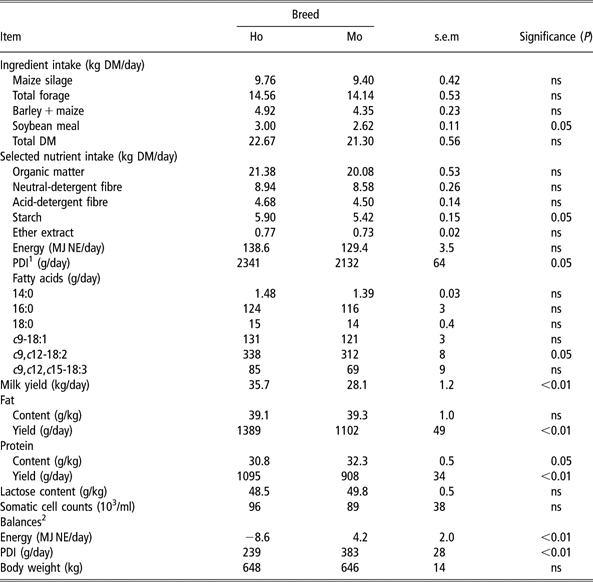
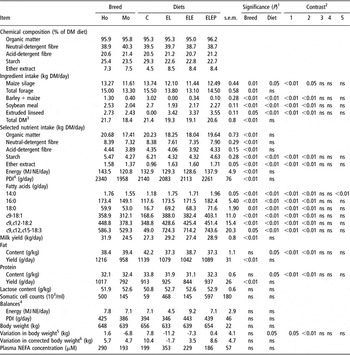
During the pre-experimental period the Holstein cows had higher starch (+9%), proteins digestible in the intestine (PDI, +10%), and c9c12-18:2 (+8%) intakes than the Montbéliarde cows (Table 1). During the experimental period the Holstein cows had higher maize silage intake (+14%) than the Montbéliarde cows (Table 2). According to the experimental design, the Holstein cows had higher total forage (+11%), DM (+18%), OM (+19%), NDF (+15%), ADF (+14%), starch (+28%), and ether extract (+15%), individual FA, net energy (+19%) and PDI (+20%) intakes than the Montbéliarde cows (Table 2).
Ingredient, energy and protein intakes, milk yield, fat, protein and lactose content and yield, energy and protein balances, and changes in BW from lactating Ho and Mo cows fed a maize silage-based diet during the pre-experimental period
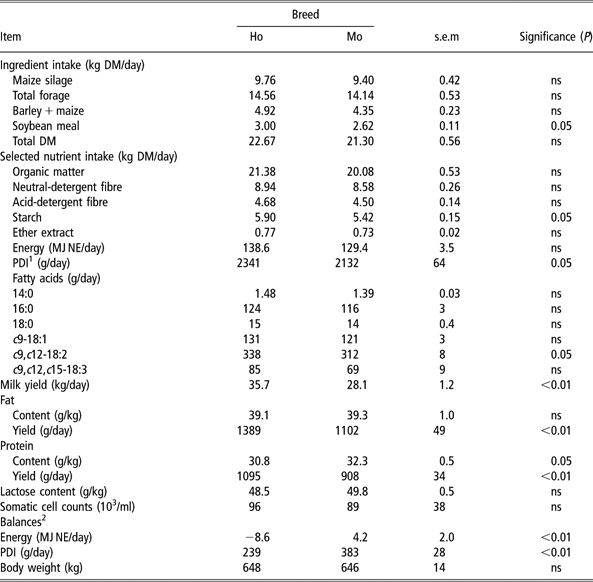
Ingredient, energy and protein intakes, milk yield, fat, protein and lactose content and yield, energy and protein balances, and changes in BW from lactating Ho and Mo cows fed maize silage-based diets without supplementation (C), and supplemented with EL, ELE, ELEP

Ho = Holstein; Mo = Montbéliarde; C = control diet; EL = extruded linseed diet; ELE = EL diet plus vitamin E; ELEP = ELE diet plus a PERP mixture; DM = dry matter; ns = not significant; PDI = protein digestible in the intestine; NE =net energy; NEFA = non-esterified fatty acid.
1The interaction between diet and breed is non-significant, except for barley + maize (P < 0.01), soybean meal and starch (P < 0.05), and PDI intakes (P < 0.10).
2Orthogonal contrasts were (1) effect of extruded linseed supplementation (C diet v. extruded linseed diets), (2) effect of C diet v. EL diet, (3) effect of antioxidant addition (EL diet v. ELE and ELEP diets), (4) effect of vitamin E (EL diet v. ELE diet), (5) effect of PERP (ELE diet v. ELEP diet).
3including mineral and vitamin premix.
4Balance = intake-maintenance and production requirements.
5Variation between the end of the pre-experimental and the end of the experimental period.
6Corrected BW (kg) = BW (kg) −4 × DM intake (kg/day) (Chilliard et al., Reference Chilliard, Rémond, Agabriel, Robelin and Vérité1987).
During both periods the Holstein cows had higher milk production (+27% and +30% for pre-and experimental periods, respectively, P < 0.01), milk fat (+26% and +27%, P < 0.01) and protein yields (+21% and +28%, P < 0.01) than the Montbéliarde cows. During the pre-experimental period the milk protein percentage was lower for Holstein than for Montbéliarde cows. During this period the energy balance was negative for Holstein cows, whereas it was positive for the Montbéliarde cows. During the pre-experimental period the PDI balance was lower for Holstein than for Montbéliarde cows, whereas during the experimental period, the energy and PDI balances were similar for the two breeds (Tables 1 and 2).
Effect of diet
Neither the total forage and total DM intakes, nor the energy and the PDI intake varied according to the diets (Table 2). By design, starch intake was higher for C than for the EL-supplemented diets (+29%, P < 0.01). By design, the ether extract and individual FA intakes were lower for C than for the EL-supplemented diets. Milk yield (28 kg/d), milk fat yield (905 g/d), milk protein yield (905 g/d), and lactose percentage (52 g/kg) did not vary significantly between the diets (Table 2). Milk fat percentage decreased with EL supplementation (−11%). The milk protein percentage was lower (−6%, P < 0.05) for EL diets than for the C diet. The energy and PDI balances of the animals were similar between the diets. The cows from the C diet gained 7.8 kg between the beginning and end of the experimental period, whereas the cows from EL and ELE diets lost 11.2 and 7.3 kg, respectively (P < 0.05). When the BW change was corrected for change in the digestive content the differences were not significant, although a non-significant numerical difference of 12.1 kg between the C and EL diets was still found probably because of the numerical lower energy balance for EL diet (despite the fact that calculated energy balance was positive for all groups, including EL diet).
Effect of milking time
During the pre- and experimental periods the time of milking had a significant effect on milk yield and composition (data not shown). For both periods the milk, fat and protein yields were higher (+32.6%, +12.3%, and +29.4% during the pre-experimental period, and +32.5%, +19.8%, and +30.2% during the experimental period, respectively) for morning than for evening milkings, whereas the fat percentage was lower (−14.5% and −8.6%, during the pre- and experimental periods, respectively). For these periods, milk protein (31.8 and 32.7 g/kg for pre- and experimental periods, respectively) and lactose (49.1 and 52.0 g/kg for pre- and experimental periods, respectively) percentages did not change with the time of milking.
Milk FA composition
Effect of breed
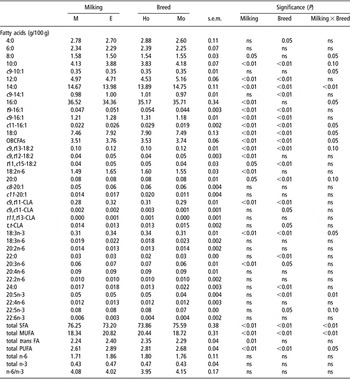
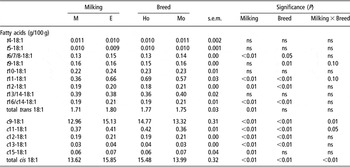
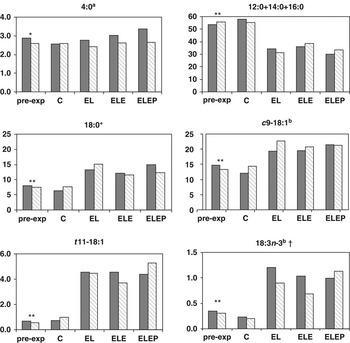
During the pre-experimental period the Holstein cows had lower percentages of total SFA and higher percentages of total monounsaturated FA (MUFA), total PUFA and total cis 18:1 than the Montbéliarde cows (Tables 3 and 4). The Holstein cows had higher percentages of 4:0, c9-14:1, t9-, c9-, c11-16:1, 18:0, t11-, c9-, c11- and c13-18:1, c9,t11- and c9,c11-CLAs, 18:3n-3, t11,c15-18:2, 20:3n-6, 20:5n-3, eicosapentaenoic acid (EPA), and 22:5n-3, and lower percentages of 10:0, 12:0, 14:0, odd or branched-chain FA (OBCFA), and t6/7/8-, t9-, t12-, c12- and t16/c14-18:1, c9t13- and tt-18:2, 20:0, 22:0, and 24:0 (Figure 1; Tables 3 and 4). The c9t11-CLA to t11-18:1 ratio was lower for Holstein than for Montbéliarde cows (0.433 v. 0.511, s.e.m. = 0.016, respectively), whereas the other desaturation ratios did not vary between the two breeds (data not shown).
Percentages of fatty acids in milk fat from lactating Ho and Mo cows fed a maize silage-based diet during the pre-experimental period

M = morning; E = evening; Ho = Holstein; Mo = Montbéliarde; ns = not significant; OBCFAs = odd or branched-chain FA; CLA = conjugated linoleic acid; SFA = saturated FA; MUFA = monounsaturated FA; FA = fatty acid; PUFA = polyunsaturated fatty acid.
Percentages of trans and cis isomers of 18:1 in milk fat from lactating Ho and Mo cows fed a maize silage-based diet during the pre-experimental period

M = morning; E = evening; Ho = Holstein; Mo = Montbéliarde; ns = not significant.
Percentages of selected fatty acids in milk fat from lactating Holstein (grey bars) and Montbéliarde (hatched bars) cows fed maize silage-based diets during pre-experimental period (pre-exp) and during experimental period supplemented or not (C), with extruded linseeds (EL) plus vitamin E (ELE), and plus plant extracts rich in polyphenols (ELEP). Breed effect was significant during pre-experimental, **P < 0.01; *P < 0.05, and experimental periods, aP < 0.01; bP < 0.05, respectively. Interaction between diet and breed was significant during experimental period: +P < 0.01, and †P < 0.10, respectively. (s.e.m. = 0.11, 0.61, 0.13, 0.31, 0.03, 0.01, and 0.12, 1.48, 0.60, 0.87, 0.44 and 0.08 g/100 g of total fatty acids for 4:0, 12:0 + 14:0 + 16:0, 18:0, c9-18:1, t11-18:1 and 18:3n-3 during the pre-experimental and experimental periods, respectively).

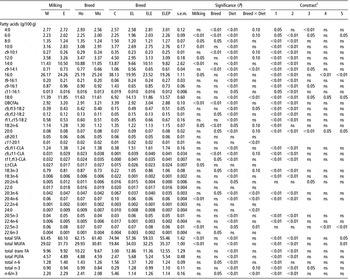
During the experimental period there were fewer differences between the two breeds (Tables 5 and 6). However, as in the pre-experimental period, the Holstein cows had higher percentages of 4:0, c9-14:1, 18:3n-3, 20:3n-6, and lower percentages of OBCFA. Nevertheless, contrary to the pre-experimental period, the Holstein cows had lower (−1.7 g/100 g) percentage of total cis 18:1, notably c9- and c11-18:1, and c9,c11-CLA, and higher percentages of 6:0, 8:0, c9-10:1, t12-, t16/c14- and, t13/14-18:1, c9,t12-18:2, 18:2n-6, t11,t13-CLA and 22:6n-3 than Montbéliarde cows. These differences between the two periods may be partly because of significant interactions between breed and diet for 6:0 (P < 0.10), c9-10:1 (P < 0.10), 12:0 (P < 0.10), 18:0 (P < 0.01), c11- (P < 0.01) and t16/c14-18:1 (P < 0.05), c9,t13-18:2 (P < 0.05), c9,c11-CLA (P < 0.10), 18:2n-6 (P < 0.10), 22:5n-3 (P < 0.01) and 24:0 (P < 0.01) (Figure 1; Tables 5 and 6).
Percentages of fatty acids in milk fat from lactating Ho and Mo cows fed maize silage-based diets without supplementation (C) and supplemented with EL, ELE, ELEP

M = morning; E = evening; Ho = Holstein; Mo = Montbéliarde; C = control diet; EL = extruded linseed diet; ELE = EL diet plus vitamin E; ELEP = ELE diet plus a PERP mixture; ns = not significant; OBCFAs = odd or branched-chain FA; CLA = conjugated linoleic acid; SFA = saturated FA; MUFA = monounsaturated FA; FA = fatty acid; PUFA = polyunsaturated fatty acid.
1Orthogonal contrasts were (1) effect of extruded linseed supplementation (C diet v. extruded linseed diets), (2) effect of C diet v. EL diet, (3) effect of antioxidant addition (EL diet v. ELE and ELEP diets), (4) effect of vitamin E (EL diet v. ELE diet), (5) effect of PERP (ELE diet v. ELEP diet).
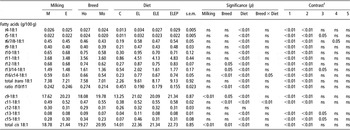
Percentages of trans and cis isomers of 18:1 in milk fat from lactating Ho and Mo cows fed maize silage-based diets without supplementation (C) and supplemented with EL, ELE, ELEP

M = morning; E = evening; Ho = Holstein; Mo = Montbéliarde; C = control diet; EL = extruded linseed diet; ELE = EL diet plus vitamin E; ELEP = ELE diet plus a PERP mixture; ns = not significant
1Orthogonal contrasts were (1) effect of extruded linseed supplementation (C diet v. extruded linseed diets), (2) effect of C diet v. EL diet, (3) effect of antioxidant addition (EL diet v. ELE and ELEP diets), (4) effect of vitamin E (EL diet v. ELE diet), (5) effect of PERP (ELE diet v. ELEP diet).
Effect of diet
Milk FA composition was strongly influenced by the supplementation with EL in the diet (Figure 1; Table 5). The EL supplementation decreased the total SFA percentage by 17.6 g/100 g with a concomitant increase in the MUFA and PUFA concentrations (+14.0 and +3.0 g/100 g, respectively). The percentages of total trans (+8.13 g/100 g) and cis 18:1 (+6.7 g/100 g) and total trans FA (+9.26 g/100 g) were increased by EL supplementation (P < 0.01).
Milk percentages of saturated short- and medium-chain FA decreased by 0.2, 0.3, 1.0, 1.4, 3.9, 17.2 g/100 g for 6:0, 8:0, 10:0, 12:0, 14:0 and 16:0, respectively, with diets containing EL compared with the C diet. Milk percentages of 18:0 and c9-18:1 increased with EL supplementation (+6.3 and 7.6 g/100 g, respectively). Individual percentages of trans isomers of 18:1 (from t4 to t16/c14) and cis isomers (except c12) increased between C diet and diets containing EL. The milk c9t11-CLA (+1.24 g/100 g), c9c11-CLA, t11,t13-CLA, c9,t13- and t11,c15-18:2, and 18:3n-3 percentages increased with EL supplementation. By contrast, the milk 18:2n-6 percentage decreased slightly with EL supplementation (−0.18 g/100 g). The long-chain n-6 FA (20:3n-6, 20:4n-6, 22:4n-6) percentage decreased with EL supplementation, whereas EPA percentage increased from C to diets containing EL.
The effects on milk FA composition of adding antioxidants to the diet were small in number and size. Addition of antioxidants increased 4:0, 6:0, c9-14:1 and c9-16:1 and decreased 18:0, t5-, t13/14-, c13- and c15-18:1, 20:0, 20:2n-6 and total n-3 FA. The ELE diet, compared with the EL diet, increased the milk percentages of 16:0 and 22:5n-3, and decreased 18:0, t6/7/8-18:1, and 20:0. The ELEP diet, compared with the ELE diet, slightly increased the milk percentages of 6:0, 18:0, 20:0 and total MUFA, and decreased 16:0, 22:5n-3 and total SFA.
Several significant interactions between diet and breed were observed (Tables 5 and 6; Figure 1). The percentages of 4:0 and 6:0 increased with EL supplementation for Holstein cows, but decreased for Montbéliarde cows (P < 0.10). The decreases in milk percentages of c9-10:1 and 12:0 (P < 0.10), c9-14:1 (P < 0.01), and 18:2n-6 (P < 0.10), 20:3n-6 and 20:4n-6 (P < 0.01) with EL supplementation were more marked for Holstein than for Montbéliarde cows. The increases in milk 18:0 (P < 0.01), t5-18:1 (P < 0.10), t16/c14-18:1 (P < 0.05), c9t13-18:2 (P < 0.05), and 18:3n-3 (P < 0.10) percentages with EL supplementation were more marked for Holstein than for Montbéliarde cows, whereas the increases in c11-18:1 (P < 0.01), c9c11-CLA (P < 0.10), and 22:5n-3 (P < 0.01) percentages were less marked (Figure 1).
Effect of milking time
The time of milking modified the milk FA composition more during the pre-experimental (Table 3) than during the experimental period (Table 5). For both periods the percentage of total SFA (and the percentages of 6:0, 8:0, 10:0, 12:0, 14:0, and 16:0) were higher for morning than for evening milkings, whereas those of MUFA, c9-18:1, total cis isomers of 18:1, OBCFA and 18:2n-6 were lower for morning than for evening milkings (Tables 3, 4, 5 and 6). For the pre-experimental period other FA percentages were lower for morning than for evening milkings: total trans isomers of 18:1 and some trans isomers of 18:1 (6/7/8, 11, and 12) and all cis isomers of 18:1 and t9-, c9-, and c11-16:1, c9t13-18:2, c9t12-18:2, t11,c15-18:2, c9t11-CLA, 18:3n-3, 20:3n-6. For the experimental period, the percentages of 20:4n-6 and 22:5n-3 were lower for morning than for evening milkings.
Plasma metabolites
During the experimental period the plasma β-OH concentration tended (P < 0.10) to be higher for Holstein than for Montbéliarde cows (586 v. 213 μM, s.e.m. = 206 μM, respectively). By contrast, breed effect was not significant for plasma NEFA (Table 2), acetate or glucose concentrations (242 μM, 265 μM and 650 mg/l, s.e.m. = 57 μM, 56 μM, and 25 mg/l, respectively). Effects of diet and breed × diet interaction were not significant for any of the metabolites.
Discussion
Effects of breed
Previous work (Palmquist et al., Reference Palmquist, Beaulieu and Barbano1993) indicated that breed had less effect than dietary factors on milk FA composition. This finding is confirmed by this study on Holstein and Montbéliarde breeds. In our study, the influence of breed on milk FA composition was different according to the period, with more marked effects during the pre-experimental period when all the animals received the same diet. This may be due to an effect (interaction) of the lactation stage, likely because Holstein cows mobilized more adipose tissue during the pre-experimental period because of a combined effect of milk potential and stage of lactation. Another explanation could be linked to the fact that milk FA composition during the experimental period was also influenced by feeding factors, notably lipid supplements, as demonstrated by significant breed × diet interactions for several FA (Figure 1). In particular, when animals received EL, milk fat from Holstein cows was richer in 4:0 and 18:3n-3 and poorer in 12:0 and 18:2n-6 than that from Montbéliarde cows. The higher 4:0 concentration in milk fat from Holstein than from Montbéliarde cows has also been reported by Lawless et al. (Reference Lawless, Stanton, L’Escop, Devery, Dillon and Murphy1999).
In the pre-experimental period milk fat from Holstein cows had slightly lower concentrations of 12:0 (−0.63 g/100 g) and 14:0 (−0.86 g/100 g) than that from Montbéliarde cows, in agreement with Lawless et al. (Reference Lawless, Stanton, L’Escop, Devery, Dillon and Murphy1999) and Soyeurt et al. (Reference Soyeurt, Dardenne, Gillon, Croquet, Vanderick, Mayeres, Bertozzi and Gengler2006). No difference in milk fat percentage of 16:0 was observed between the breeds during the two periods, in agreement with Soyeurt et al. (Reference Soyeurt, Dardenne, Gillon, Croquet, Vanderick, Mayeres, Bertozzi and Gengler2006) but at variance with Lawless et al. (Reference Lawless, Stanton, L’Escop, Devery, Dillon and Murphy1999).
In the pre-experimental period, the milk fat from Holstein cows had higher concentrations of 18:0 and several products of stearoyl-CoA desaturase (c9-14:1, c9-16:1, c9-18:1, c9t11-CLA and c9c11-CLA) than that from Montbéliarde cows. However, the higher milk concentration of 18:0 and c9-18:1 in Holstein cows (and to a lesser extent 16:1c9 and 18:1t11) may result from adipose tissue mobilization (Chilliard et al. Reference Chilliard, Ferlay, Mansbridge and Doreau2000), since the energy balance was negative for Holstein cows only. Furthermore, the higher concentration of c9t11-CLA in milk fat from Holstein cows during this period is in agreement with Nozière et al. (Reference Nozière, Grolier, Durand, Ferlay, Pradel and Martin2006), who reported higher concentrations of this FA in milk fat from cows fed a restricted diet.
Effects of EL supplementation
Feeding diets containing EL induced BW loss, as reported in dairy cows receiving animal or vegetable lipid supplementation (Chilliard, Reference Chilliard1993). This effect may be partly because of the changes in digestive content, since corrected BW did not vary significantly among diets (Table 2). However, the BW loss for EL diet was associated with a numerical increase in plasma NEFA concentration (P = 0.12 and Table 2) and a decrease in net energy balance. A greater FA mobilization from adipose tissue may result from a higher absorption of unsaturated FA (Chilliard, Reference Chilliard1993).
Milk protein percentage was lower for cows fed with diets containing EL than for those fed with the diet C, as generally observed with the lipid-supplemented diets (Chilliard and Ferlay, Reference Chilliard and Ferlay2004), including diets rich in EL (12.7% of DM diet, Gonthier et al., Reference Gonthier, Mustafa, Ouellet, Chouinard, Berthiaume and Petit2005; 16.8% of DM diet, Akraim et al., Reference Akraim, Nicot, Juaneda and Enjalbert2007).
Milk fat percentage was decreased by EL supplementation, in agreement with some studies (Akraim et al., Reference Akraim, Nicot, Juaneda and Enjalbert2007; Martin et al., Reference Martin, Rouel, Jouany, Doreau and Chilliard2008) but at variance with other (Gonthier et al., Reference Gonthier, Mustafa, Ouellet, Chouinard, Berthiaume and Petit2005). This decrease may be partly attributed to a dilution effect rather than to MFD, since we observed a numerical increase in milk yield and no change in milk fat yield. Previous work has emphasised the importance of a low forage fibre level and (or) a high starch concentration and the presence of unsaturated fat as dietary prerequisites for MFD to occur (Bauman and Griinari, Reference Bauman and Griinari2003). The high ratio of forage to concentrate (70/30) and the relatively low starch concentration (28% of diet DM) in our maize silage-based diets may also have averted MFD. Also, the absence of MFD may be due in part to the fact that concentrate (barley + maize and soybean meal) was offered four times daily; milk fat percentage was higher with a continuous feeding regimen of lipid-supplemented diets than with one feed per day (Banks et al., Reference Banks, Clapperton, Kelly, Wilson and Crawford1980).
Milk FA composition was strongly modified by EL supplementation, notably with high increases in 18:3n-3 and c9t11-CLA percentages, as already observed (Gonthier et al., Reference Gonthier, Mustafa, Ouellet, Chouinard, Berthiaume and Petit2005; Akraim et al., Reference Akraim, Nicot, Juaneda and Enjalbert2007; Chilliard et al., Reference Chilliard, Martin, Rouel and Doreau2009). The percentages of isomers of 18:1 ranked in decreasing order were: c9 > t11 > t13/14 > t10 > t12 > t16/c14 > c15 and t6/7/8. This descending order is in line with FA composition in milk fat from cows fed high-grass hay diets supplemented with linseed oil (Loor et al., Reference Loor, Ferlay, Ollier, Doreau and Chilliard2005; Roy et al., Reference Roy, Ferlay, Shingfield and Chilliard2006). Similar high increases in certain FA (t13/14 > t11 + t10 > t16/c14) were also reported in milk fat from cows given hay plus 5% of fat from ground linseed (Collomb et al., Reference Collomb, Sollberger, Bütikofer, Sieber, Stoll and Schaeren2004), or maize-silage-based diet with 5.7% oil from EL (Akraim et al., Reference Akraim, Nicot, Juaneda and Enjalbert2007). Our results confirm that t11c15 is the major trans isomer of 18:2 produced by hydrogenation of 18:3n-3 (Chilliard et al., Reference Chilliard, Glasser, Ferlay, Bernard, Rouel and Doreau2007). The EL supplementation strongly decreased the milk fat percentage of arachidonic acid, as reported by Pezzi et al. (Reference Pezzi, Giammarco, Vignola and Brogna2007), suggesting an inhibitory effect of 18:3n-3 or its metabolites on synthesis or milk secretion of this n-6 FA.
Effects of antioxidant addition
The vitamin E supplementation (ELE diet compared with EL diet) had no effect on milk fat percentage, conflicting with Focant et al. (Reference Focant, Mignolet, Marique, Clabots, Breyne, Dalemans and Larondelle1998, who used diets supplemented with extruded rapeseed and linseed) and Pottier et al. (Reference Pottier, Focant, Debier, De Buysser, Goffe, Mignolet, Froidmont and Larondelle2006, who used diets low in NDF concentration supplemented with EL plus linseed oil). In these studies, the vitamin E addition strongly increased the milk fat percentage (+5.0 and +6.0 g/kg, in Focant et al., Reference Focant, Mignolet, Marique, Clabots, Breyne, Dalemans and Larondelle1998 and Pottier et al., Reference Pottier, Focant, Debier, De Buysser, Goffe, Mignolet, Froidmont and Larondelle2006, respectively). The highest positive effects of vitamin E supplementation were obtained for diets inducing MFD, and an increase in milk t10-18:1 concentration at the expense of t11-18:1 concentration, which was prevented by vitamin E. The mechanism of action of vitamin E is not exactly known. It seems that vitamin E may counteract the shift in the biohydrogenation pathways that occurs with MFD diets by supporting the growth and function of t11-producing bacteria, as suggested by Pottier et al. (Reference Pottier, Focant, Debier, De Buysser, Goffe, Mignolet, Froidmont and Larondelle2006). The absence of changes in percentages of t10-, t11-18:1 or in the t10-18:1/t11-18:1 ratio with vitamin E supplementation in our study runs counter to the findings of Bell et al. (Reference Bell, Griinari and Kennelly2006) and Pottier et al. (Reference Pottier, Focant, Debier, De Buysser, Goffe, Mignolet, Froidmont and Larondelle2006), and is probably because of the fact that our dietary conditions did not induce MFD. Addition of PERP to vitamin E had no effect on dairy performances but tended to decrease the effects of vitamin E alone on milk FA concentrations, suggesting that PERP could alter rumen biohydrogenation pathway to some extent.
Effects of time of milking
A novel finding of this study is the effect of time of milking on milk FA composition. To our knowledge, no results have been reported comparing morning and evening milkings. The observed change in milk FA profile may be related to either the time feeds were offered or the intervals (10 h/14 h) between the milkings. The lower milk percentages of 18:0, c9-18:1, trans-18:1 and trans-18:2, 18:2n-6 and OBCFA observed for morning milking may be partly because of their dietary origin; the maize silage, rich in c9-18:1 and 18:2n-6 (Chilliard et al., Reference Chilliard, Glasser, Ferlay, Bernard, Rouel and Doreau2007), was offered after the morning milking once daily, which may explain the increase at evening in milk percentages of these two FA, in addition to 18:0 and trans FA as a result of rumen biohydrogenation. The forage ingestion after the morning milking may also induce a higher percentage of milk OBCFA at evening as their microbial synthesis is increased by forage-rich diets (Vlaeminck et al., Reference Vlaeminck, Fievez, Cabrita and Dewhurst2006).
The diurnal variation in milk percentages of short- and medium-chain FA (from 8:0 to 16:0) may be partly linked to the supply of precursors of their synthesis in the mammary gland. Three of the four concentrate meals were offered after 1400 h, which may have induced an increase in the availability of plasma precursors of de novo FA synthesis (acetate and β-hydroxybutyrate) after the evening milking, since it has been reported that the postprandial β-hydroxybutyrate peaks 3 to 4 hours after the feeding of concentrate (Miettinen and Huhtanen, Reference Miettinen and Huhtanen1989).
The milking intervals (10 and 14 h) are probably not involved in the variation of milk FA composition, since Delamaire and Guinard-Flament (Reference Delamaire and Guinard-Flament2006) found that the mammary uptake of precursors for de novo FA synthesis did not change until the milking interval reached at least 16 h. Also, no effect of once v. twice daily milking was observed on milk FA composition in well-fed cows (Chilliard et al., Reference Chilliard, Pomiès, Pradel and Rémond2006).
Conclusions
This study shows that the supplementation of a maize silage-based diet with EL decreases milk fat percentage without changes in milk fat yield, and induces wide variations in the milk FA profile, notably decreases in SFA and increases in cis and trans isomers of 18:1, and in conjugated and non-conjugated 18:2. Vitamin E supplementation had no effect on milk yield, milk fat or protein percentage and only moderate effects on milk percentages of FA (increase in 16:0, decreases in 18:0 and t6/7/8-18:1). These minor effects of vitamin E may be partly explained by the fact that no MFD occurred in the present trial. Adding PERP to vitamin E slightly modified milk FA composition, alleviating some of the effects of vitamin E, and decreased SFA and increased MUFA concentrations compared with ELE diet. Breed effect was much weaker than diet effect on milk FA composition, although several interactions were significant between breed and diet. During both periods the Holstein cows had higher milk percentages of 4:0 and 18:3n-3. With EL supplementation, the Holstein cows had lower percentages of total cis 18:1, and c9,c11-CLA, and higher percentages of 6:0, 8:0, t12-, t16/c14- and t13/14-18:1, and 18:2n-6 than Montbéliarde cows. Effect of time of milking on milk FA composition was significant and warrants further investigation to unravel its putative link to the frequency with which forages and concentrates were offered.
Acknowledgments
The authors thank C. Cirié, O. Troquet and the team of Domaine de la Borie, INRA Marcenat for feeding, milking, blood sampling and care of cows, and P Capitan and M Tourret for laboratory analyses. This research was supported in part by the European TRUEFOOD programme (Traditional United Europe Food), an integrated project financed by the European Commission under the 6th Framework Programme for RTD (Contract No. FOOD-CT-2006-016264), and by the national French PNRA Agilait programme (structures, oxidation stability, properties and bioaccessibility of the milk fat of dairy products enriched in unsaturated fatty acids) (Project No. ANR-06-PNRA-012). The authors also thank the Phytosynthèse Company (Riom, France) for supply of the mixture of plant extracts rich in polyphenols, and D. Durand and D. Bauchart for helpful discussions during the preparation of the trial.