1. Introduction
The Precambrian–Cambrian (Ediacaran–Cambrian) boundary was defined at the first appearance (FAD) of trace fossils called Phycodes pedum (Narbonne et al. Reference Narbonne, Myrow, Landing and Anderson1987; Brasier, Cowie & Taylor, Reference Brasier, Cowie and Taylor1994) or Trichophycus pedum (Geyer & Uchman, Reference Geyer and Uchman1995) at Fortune Head, southeastern Newfoundland, Canada. As this Global Stratotype Section and Point of the Ediacaran–Cambrian boundary was established mainly on the basis of trace fossils in siliciclastic strata, the wider correlation of shallow marine carbonate strata with this stratotype has been difficult in practice. Fortunately, carbon isotope stratigraphy has shown great potential to be a powerful complement to biostratigraphy for global correlation of Ediacaran–Cambrian successions (e.g. Kaufman & Knoll, Reference Kaufman and Knoll1995; Brasier et al. Reference Brasier, Shields, Kuleshov and Zhegallo1996). The Yangtze Platform in SW China crops out in well-preserved and carbonate-dominated sections across the Ediacaran–Cambrian boundary, which may provide good opportunity to elucidate C-isotope evolution over the Ediacaran–Cambrian boundary interval. The most continuous successions across the Ediacaran–Cambrian boundary on the Yangtze Platform are found in eastern Yunnan Province (Luo et al. Reference Luo, Jiang, Xu, Song and Xue1980; Qian et al. Reference Qian, Zhu, He and Jiang1996; Zhu et al. Reference Zhu, Li, Zhang, Steiner, Qian and Jiang2001, Reference Zhu, Zhang, Steiner, Yang, Li and Erdtmann2003). Studies on lithology, biostratigraphy and chemostratigraphy have been carried out for the famous Meishucun section (Qian, Reference Qian1977; Luo et al. Reference Luo, Jiang, Xu, Song and Xue1980, Reference Luo, Jiang, Wu, Song and Ouyang1982, Reference Luo, Jiang, Wu, Song, Ouyang, Xing, Liu, Zhang and Tao1984, Reference Luo, Jiang, Wu, Song and Ouyang1990; Brasier et al. Reference Brasier, Magaritz, Corfield, Luo, Wu, Ouyang, Jiang, Hamdi, He and Fraser1990). However, the level of the FAD of small shelly fossils there is controversial (Jiang, Reference Jiang1980; Luo et al. Reference Luo, Jiang, Wu, Song and Ouyang1982; Qian & Bengtson, Reference Qian and Bengtson1989; Qian et al. Reference Qian, Zhu, He and Jiang1996), and the expected negative C-isotope excursion near the supposed Ediacaran–Cambrian boundary seen in many other places in the world was not observed (Brasier et al. Reference Brasier, Magaritz, Corfield, Luo, Wu, Ouyang, Jiang, Hamdi, He and Fraser1990).
Recently, Shen & Schidlowski (Reference Shen and Schidlowski2000) observed a few negative and positive C-isotope excursions across the Ediacaran–Cambrian boundary at the potentially more complete Laolin section in NE Yunnan and placed the Ediacaran–Cambrian boundary at Marker A near the bottom of the ‘Xiaowaitoushan Member’. However, their stratigraphic framework, the placement of the Ediacaran–Cambrian boundary, and implied global correlations were doubted by Zhu, Li & Zhang (Reference Zhu, Li and Zhang2001). Zhu and his colleagues also suspected that the Dahai Member was not completely sampled by Shen & Schidlowski (Reference Shen and Schidlowski2000), as their δ13C values are all below zero, whereas peak δ13C values from the Dahai Member at the Meishucun section are above +1‰ (Brasier et al. Reference Brasier, Magaritz, Corfield, Luo, Wu, Ouyang, Jiang, Hamdi, He and Fraser1990). It was considered necessary to restudy the section for two main reasons: (1) the sedimentary units of the earliest Cambrian in the region east of the Dianchi Fault (including the Laolin section) are thicker and hence probably more continuous than those found west of the fault (where the Meishucun section is situated) (Qian et al. Reference Qian, Zhu, He and Jiang1996) (Fig. 1a; see below for details); (2) negative and positive C-isotope excursions have been reported from the Laolin section (Shen & Schidlowski, Reference Shen and Schidlowski2000), but both stratigraphic details and correlations are disputed (e.g. Zhu, Li & Zhang, Reference Zhu, Li and Zhang2001) and clearly need refinement. For the present study, we systematically sampled the Laolin section and analysed carbonate C-isotope compositions in order better to constrain C-isotope trends across the Ediacaran–Cambrian boundary and in so doing achieve better correlation with other regions of the world.
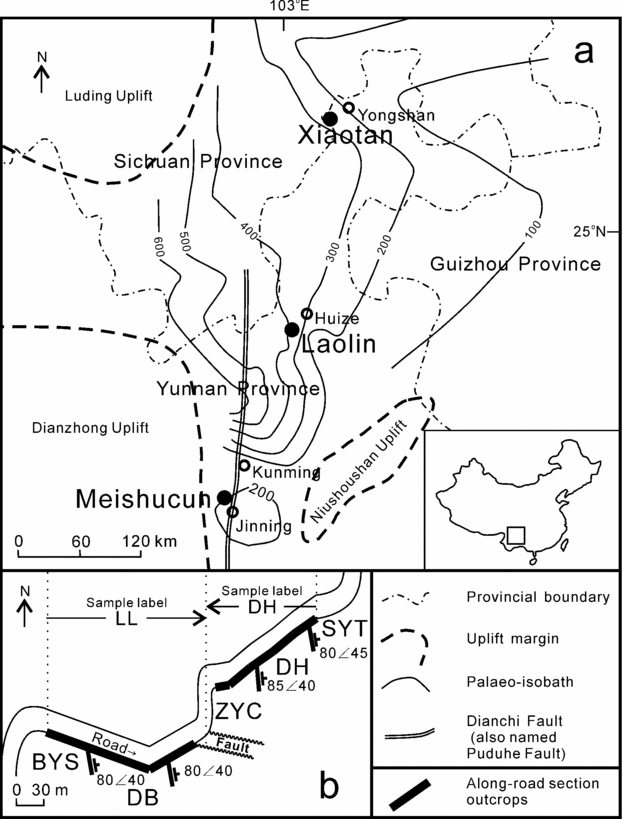
(a) Palaeogeographic and schematic geographic map showing localities of Laolin, Meishucun and Xiaotan sections in NE Yunnan, SW China; (b) schematic stretch of Laolin section, showing the sampled places along the road with geological member divisions, dip direction and dip angle. BYS – Baiyanshao Member; DB – Daibu Member; ZYC – Zhongyicun Member; DH – Dahai Member; SYT – Shiyantou Formation.

2. Stratigraphic features and previous work
2.a. Stratigraphic comparison with Meishucun section
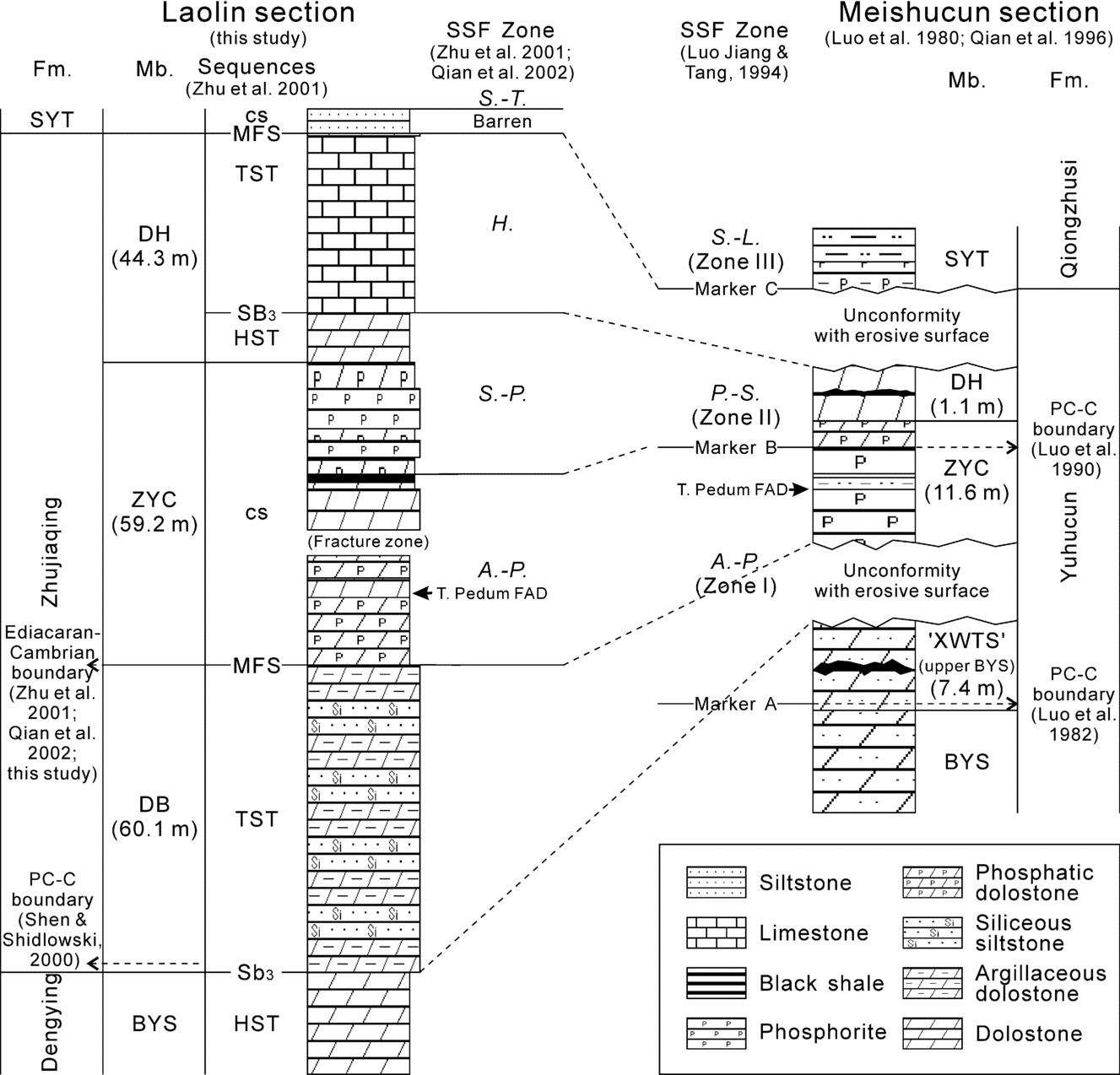
The sedimentary records from the terminal Neoproterozoic to early Cambrian in Huize County of NE Yunnan Province where the studied Laolin section (Luo, Wu & Ouyang, Reference Luo, Wu and Ouyang1991) is located, and in Kunming area where the well-known Meishucun section (e.g. Qian, Reference Qian1977; Luo et al. Reference Luo, Jiang, Xu, Song and Xue1980; Cowie, Reference Cowie1985; Qian & Bengtson, Reference Qian and Bengtson1989) is located, are similar, although differences have been revealed (Qian et al. Reference Qian, Zhu, He and Jiang1996; Zhu et al. Reference Zhu, Li, Zhang, Steiner, Qian and Jiang2001) which are stated below and illustrated in Figure 2.
Comparative stratigraphic columns between Laolin section and Meishucun section in Yunnan, SW China. Note the scale of the two sections is not equal. BYS – Baiyanshao Member; DB – Daibu Member; ZYC – Zhongyicun Member; DH – Dahai Member; SYT – Shiyantou Formation. HST – highstand systems tract; SB3 – third-order sequence boundary; TST – transgressive systems tract; MFS – maximum flooding surface; cs – condensed section. Small shelly fossil (SSF) zones of Laolin section: A.-P. – Anabarites trisulcatus–Protohertzina anabarica Assemblage; S.-P. – Siphogonuchites triangularis–Paragloborilus subglobosus Assemblage; H. – Heraultipegma yunnanensis Assemblage; S.-T. – Sinosachites flabelliformis–Tannuolina Zhangwentangi Assemblage. SSF zones of Meishucun section: A.-P. (Zone I) – Anabarites–Protohertzina Assemblage, P.-S. (Zone II) – Paragloborilus–Siphogonuchites Assemblage, S.-L. (Zone III) – Sinosachites–Lapworthella Assemblage.
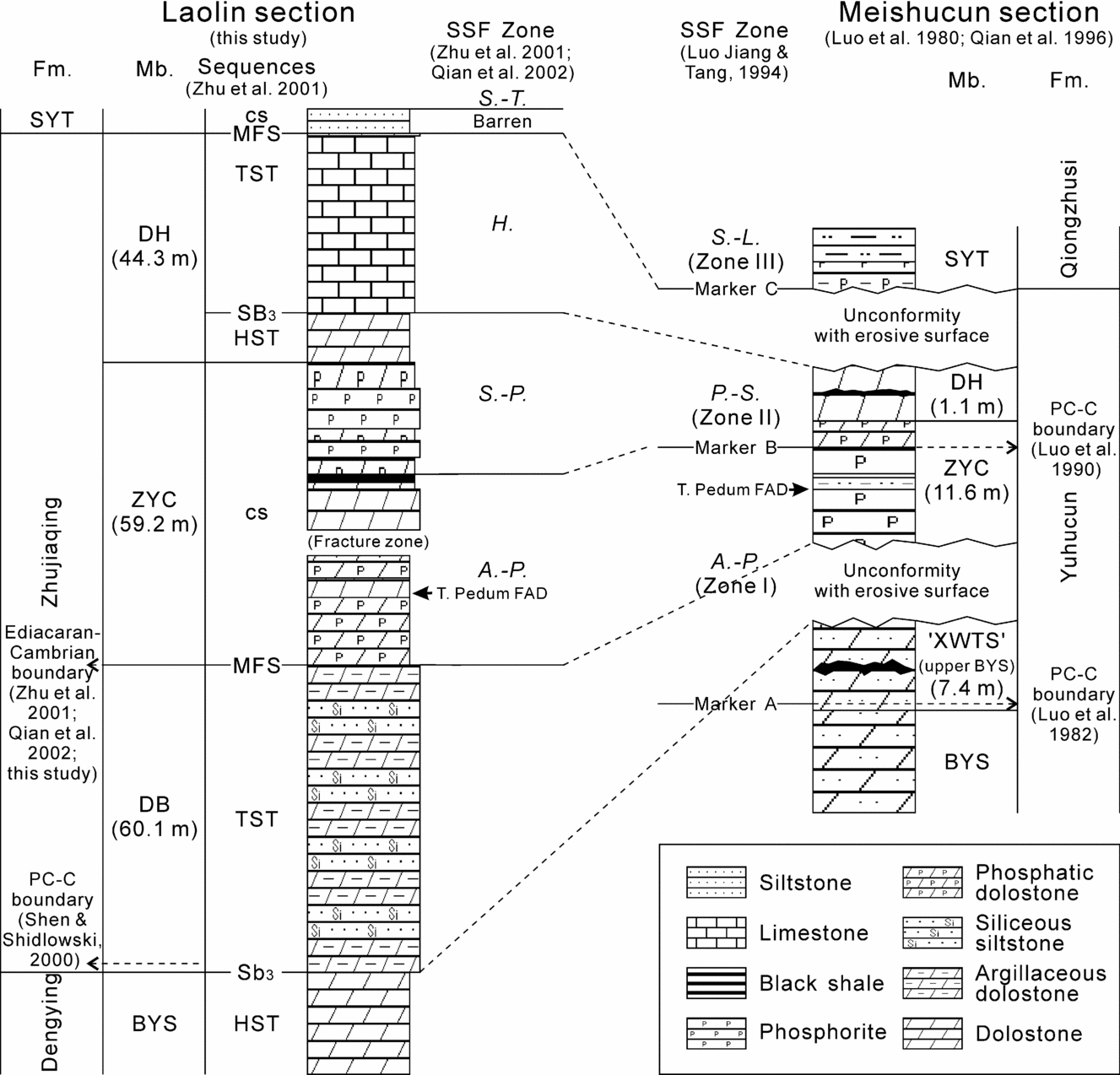
To compare the sections, we summarize the stratigraphic features of the Meishucun section first. According to Luo et al. (Reference Luo, Jiang, Xu, Song and Xue1980, Reference Luo, Jiang, Wu, Song and Ouyang1982, Reference Luo, Jiang, Wu, Song, Ouyang, Xing, Liu, Zhang and Tao1984, Reference Luo, Jiang, Wu, Song and Ouyang1990) and Luo, Wu & Ouyang (Reference Luo, Wu and Ouyang1991), the Meishucun section consists in upward succession of the ‘Xiaowaitoushan Member’, Zhongyicun Member, Dahai Member, Badaowan Member (later renamed as Shiyantou Member) (Figs 2, 3). The ‘Xiaowaitoushan Member’, having a thickness of 7.4 m, comprises intermediate (0.1–0.5 m) to thick (0.5–2 m) beds of light grey silty dolostone intercalated with some black chert plates or flat lenses, and in the uppermost part with some phosphorite beds (Luo et al. Reference Luo, Jiang, Xu, Song and Xue1980). The chert plates or lenses appear discontinuously in a horizontal direction (He, Reference He1989). Luo et al. (Reference Luo, Jiang, Xu, Song and Xue1980) claimed that this member contained small shelly fossils of Anabarites, Turcutheca, Circotheca, Hyolithellus, Cassidina and Artimycta, whose FAD was named Marker A. However, as the ‘Xiaowaitoushan Member’ and the underlying Baiyanshao Member are lithologically identical, Luo and his colleagues have been changing the placement of the base of the ‘Xiaowaitoushan Member’ in concordance with revisions of the position of the first occurrence of small shelly fossils, from 4.2 m to 7.4 m (Luo et al. Reference Luo, Jiang, Wu, Song and Ouyang1982) or 8.2 m (Xing et al. Reference Xing, Ding, Luo, He and Wang1984) below the base of the phosphorite of the overlying Zhongyicun Member. This clearly indicates that the ‘Xiaowaitoushan Member’ as originally defined was a biostratigraphic rather than a lithostratigraphic unit. From a lithostratigraphic viewpoint and from the observation that the FAD of small shelly fossils in the ‘Xiaowaitoushan Member’ could not be verified, the ‘Xiaowaitoushan Member’ was interpreted to be part of the Baiyanshao Member of the upper Dengying Formation (He, Shen & Yin, Reference He, Shen and Yin1988; He, Reference He1989; Qian & Bengtson, Reference Qian and Bengtson1989; Qian et al. Reference Qian, Zhu, He and Jiang1996; Qian, Reference Qian1999). Integrated evidence shows an erosion surface on top of the Xiaowaitoushan Member which is overlain by the Zhongyicun Member (Fig. 2). The lithology and sedimentary facies changed suddenly from the intertidal–supratidal silty dolostone of the ‘Xiaowaitoushan Member’ to subtidal algae bank phosphorite of the Zhongyicun Member (Qian et al. Reference Qian, Zhu, He and Jiang1996). Deposition of the ‘Xiaowaitoushan Member’ and the underlying Baiyanshao Member was within a single continuous marine facies of regressive systems tract, while deposition of the Zhongyicun Member switched abruptly to relatively high-energy environments (He, Reference He1989; Qian et al. Reference Qian, Zhu, He and Jiang1996). The vertical variation of the uneven karstic surface of the ‘Xiaowaitoushan Member’ reached up to 4 m, and phosphorite deposition of the Zhongyicun Member filled the karstic caves and some relatively more dissolved dolomitic beds wihtin the ‘Xiaowaitoushan Member’ (Qian et al. Reference Qian, Zhu, He and Jiang1996).
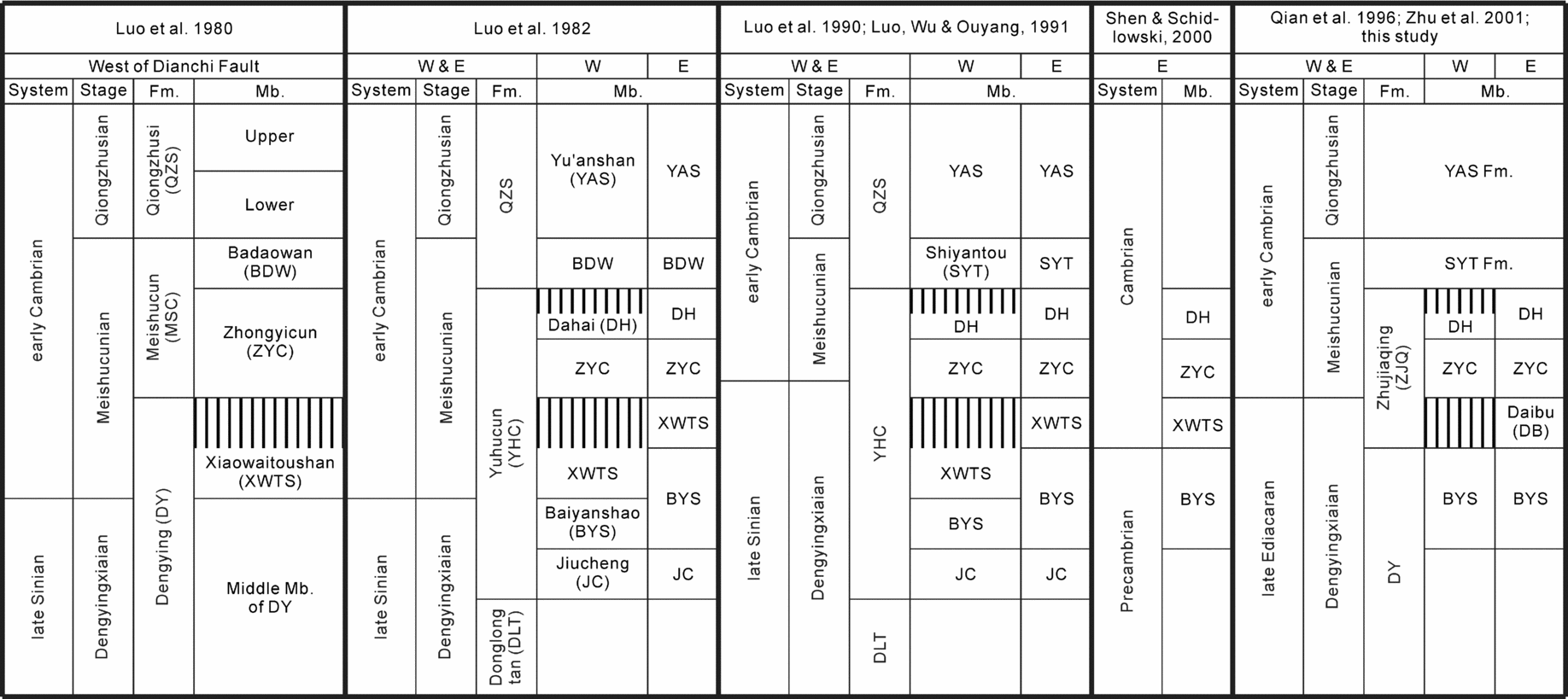
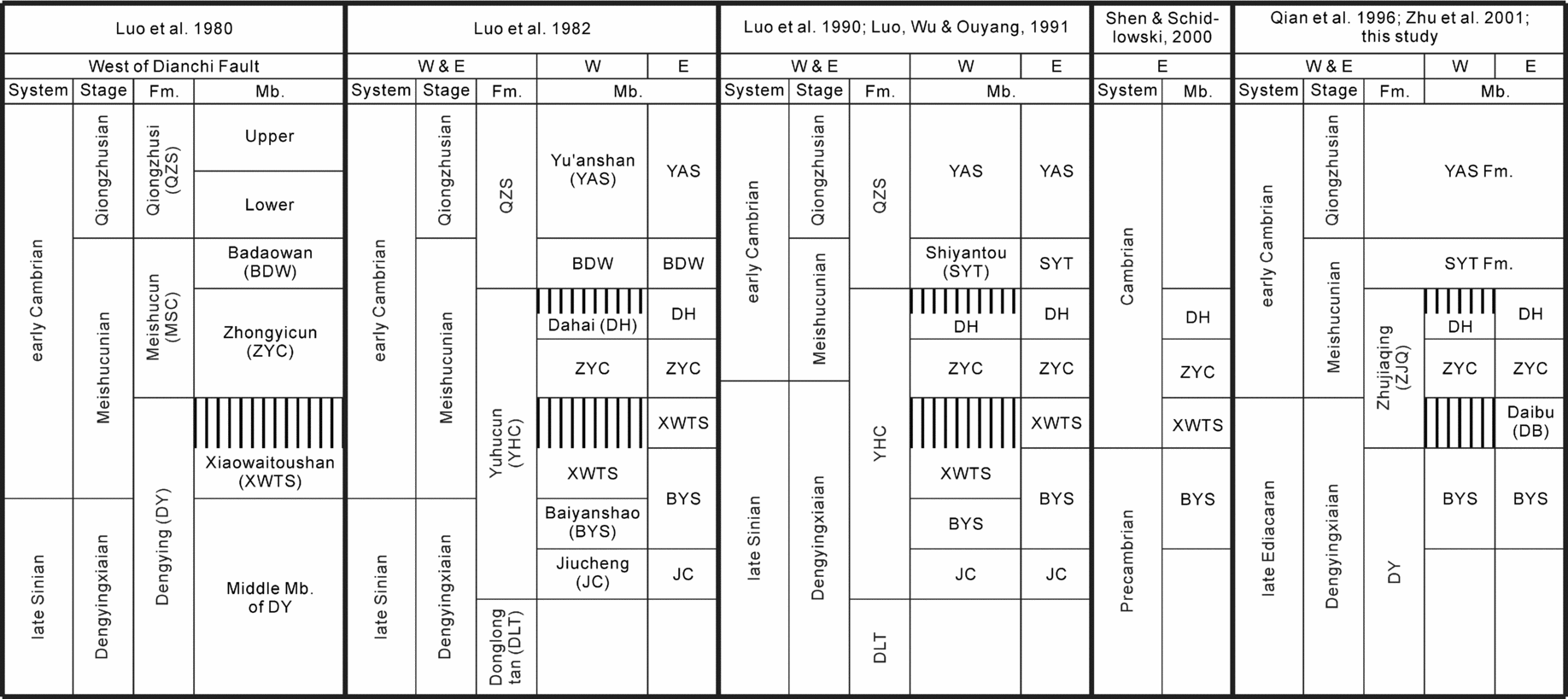
Stratigraphic classification for strata across the Ediacaran–Cambrian boundary in regions east and west of the Dianchi Fault in eastern Yunnan. Formation and member names are abbreviated after their earliest appearance in this table. Vertical hatching represents depositional break. E – region east to the Dianchi Fault; W – region west to the Dianchi Fault. In the left three panels depositional breaks are added according to Qian et al. Reference Qian, Zhu, He and Jiang1996 and Zhu et al. Reference Zhu, Li, Zhang, Steiner, Qian and Jiang2001.
The Zhongyicun Member (11.6 m) of the Meishucun section comprises thin (<0.1 m) to intermediate beds of phosphorite having oölitic microstructure and phosphatic dolostone with some intercalated chert beds in the uppermost part. According to Luo et al. (Reference Luo, Jiang, Xu, Song and Xue1980, Reference Luo, Jiang, Wu, Song and Ouyang1990) and Luo, Jiang & Tang (Reference Luo, Jiang and Tang1994), the lower Zhongyicun Member preserves rich small shelly fossils of the Anabarites–Protohertzina Assemblage (Zone I) and the upper Zhongyicun Member plus Dahai Member is rich in small shelly fossils of the Paragloborilus–Siphogonuchites Assemblage (Zone II). The Dahai Member (1.1 m) comprises grey thin–intermediate dolostone with some chert plates (Luo et al. Reference Luo, Jiang, Wu, Song and Ouyang1982) and is considered later to be disconformably overlain by the Shiyantou Member (He, Reference He1989; Qian et al. Reference Qian, Zhu, He and Jiang1996; Zhu et al. Reference Zhu, Li, Zhang, Steiner, Qian and Jiang2001; Fig. 2, see details below). The Shiyantou Member (54 m) begins with a more siliciclastic sedimentary unit and comprises black thin beds of phosphatic–argillaceous siltstone in the lower part and grey thin–intermediate beds of argillaceous siltstone and dolomitic siltstone with minor intercalated beds of phosphatic silt-bearing dolostone in the upper part. This member contains small shelly fossils of the Sinosachites–Lapworthella Assemblage (Zone III) which extends into the overlying basal Yu'anshan Member.
The Ediacaran–Cambrian boundary was initially placed at Marker A at the base of the ‘Xiaowaitoushan Member’ in which the FAD of small shelly fossils had been claimed (Luo et al. Reference Luo, Jiang, Xu, Song and Xue1980, Reference Luo, Jiang, Wu, Song and Ouyang1982) but was subsequently placed at Marker B (that is, at the boundary between the Anabarites–Protohertzina zone and the Paragloborilus–Siphogonuchites zone) in the upper Zhongyicun Member (Luo et al. Reference Luo, Jiang, Wu, Song and Ouyang1990). As for the C-isotope profile in the Meishucun section, no significant shift is indicated across Marker A at the basal ‘Xiaowaitoushan Member’, while a negatitive C-isotopic excursion was identified in the middle Zhongyicun Member (Brasier et al. Reference Brasier, Magaritz, Corfield, Luo, Wu, Ouyang, Jiang, Hamdi, He and Fraser1990; Fig. 6, see details below in Section 4.c).
The Laolin section is located in Laolin Village, Dahai Town, Huize County, about 200 km northeast of the Meishucun section (Fig. 1a). The lithology and fossils of the Laolin section were studied by Luo, Wu & Ouyang (Reference Luo, Wu and Ouyang1991), and those of the Zhujiaqing section located ~20 km north of the Laolin section were studied by Qian et al. (Reference Qian, Zhu, He and Jiang1996, Reference Qian, Zhu, Li, Jiang and Iten2002) and Zhu et al. (Reference Zhu, Li, Zhang, Steiner, Qian and Jiang2001). According to Luo, Wu & Ouyang (Reference Luo, Wu and Ouyang1991), the Laolin section consists of the Jiucheng, Baiyanshao, ‘Xiaowaitoushan’, Zhongyicun, Dahai, Shiyantou and Yu'anshan members, in upwards order. The Jiucheng Member comprises dark green dolomitic–argillaceous shale and black quartzose siltstone with minor intercalated beds of grey cryptocrystalline dolostone (Luo, Wu & Ouyang, Reference Luo, Wu and Ouyang1991). The Baiyanshao Member comprises grey to dark grey thickly bedded to massive dolostone (Luo, Wu & Ouyang, Reference Luo, Wu and Ouyang1991; this study). The lower part of the ‘Xiaowaitoushan Member’ comprises sandy–argillaceous dolostone (online Appendix Fig. A2a, http://www.journals.cambridge.org/geo) (Luo, Wu & Ouyang, Reference Luo, Wu and Ouyang1991), which is similar to the Baiyanshao Member in lithology, and according to Qian et al. (Reference Qian, Zhu, He and Jiang1996) and Zhu et al. (Reference Zhu, Li, Zhang, Steiner, Qian and Jiang2001) should belong to the Baiyanshao Member. The upper part of the ‘Xiaowaitoushan Member’ comprises interbedded thin–intermediate, dark, dolomitic cherts and yellowish siliceous dolostone (Luo, Wu & Ouyang, Reference Luo, Wu and Ouyang1991; this study, online Appendix Figs A1d, A2b), and was renamed the Daibu Member by He, Shen & Yin (Reference He, Shen and Yin1988), He (Reference He1989) and Qian et al. (Reference Qian, Zhu, He and Jiang1996). Zhu et al. (Reference Zhu, Li, Zhang, Steiner, Qian and Jiang2001) suggest that the name ‘Xiaowaitoushan Member’ be discarded, as it is not equivalent to the Daibu Member. The Daibu Member is a widespread lithostratigraphic unit representing a transgressive systems tract (TST) in NE Yunnan but is absent in the Meishucun area (Qian et al. Reference Qian, Zhu, He and Jiang1996; Zhu et al. Reference Zhu, Li, Zhang, Steiner, Qian and Jiang2001).
The lower part of the Zhongyicun Member at the Laolin section comprises grey thick beds of laminated phosphorite (online Appendix Fig. A2c) containing Meishucun Zone I-type small shelly fossils of Anabarites trisulcatus, Protohertzina anabarica, Conotheca subcurvata and Olivooides blandes (Luo, Wu & Ouyang, Reference Luo, Wu and Ouyang1991), which is essentially the same as the Anabarites trisulcatus–Protohertzina anabarica Assemblage in the Zhujiaqing section (Qian et al. Reference Qian, Zhu, Li, Jiang and Iten2002; Zhu et al. Reference Zhu, Li, Zhang, Steiner, Qian and Jiang2001). The middle part comprises interbedded black thinly bedded argillaceous dolostone and dolomitic oölitic phosphorite (online Appendix Figs A1c, A2d). The upper part comprises light grey to black, thinly to thickly bedded dolomitic phosphorite (online Appendix Fig. A2f) with minor intercalated very thin layers of shale (online Appendix Fig. A2e). The upper Zhongyicun part is rich in Meishucun Zone II-type small shelly fossils of the Paragloborilus–Siphogonuchites Assemblage (Luo, Wu & Ouyang Reference Luo, Wu and Ouyang1991), which was revised as the Siphogonuchites triangularis–Paragloborilus subglobosus Assemblage by Zhu et al. (Reference Zhu, Li, Zhang, Steiner, Qian and Jiang2001) and Qian et al. (Reference Qian, Zhu, Li, Jiang and Iten2002), based on investigations of the Zhujiaqing section. Marker B is placed at the FAD of Siphogonuchites–Paragloborilus Zone small shelly fossils within layer 16 in the upper part of the Zhongyicun Member (Luo, Wu & Ouyang, Reference Luo, Wu and Ouyang1991). The Zhongyicun Member contacts the Daibu Member below and the Dahai Member above, both with transitional boundaries. While chert content gradually decreases and phosphate content increases from the Daibu Member to the Zhongyicun Member, phosphate content decreases and dolomite content increases from the Zhongyicun Member to the Dahai Member. The phosphorite in the Zhongyicun Member represents a condensed section overlying a maximum flooding surface (Zhu et al. Reference Zhu, Li, Zhang, Steiner, Qian and Jiang2001). At the Laolin section, a fault fracture zone was observed in the upper Zhongyicun Member by this study (Figs 1b, 2).
Luo, Wu & Ouyang (Reference Luo, Wu and Ouyang1991) described the lithology of the Dahai Member as dolostone in its lower part and dolomitic limestone in its upper part, and observed Meishucun Zone II-type small shelly fossils of Paragloborilus, Siphogonuchites, Turcutheca, Hyolithellus, Palaeosulcachites, Sachites, Archaeoides, Cancelloria, Eiffella, Onychia in this member. According to Qian et al. (Reference Qian, Zhu, He and Jiang1996) and Zhu et al. (Reference Zhu, Li, Zhang, Steiner, Qian and Jiang2001) and confirmed by this study, the lower part of the Dahai Member in this region comprises whitish, thickly bedded dolostone and calcitic dolostone (online Appendix Fig. A2g), and the upper part comprises grey thickly bedded to massive argillaceous dolomitic limestone (online Appendix Figs A1b, A2h, i). This member is divided by a third-order sequence boundary into two parts, and the lower dolostone represents highstand systems tract (Zhu et al. Reference Zhu, Li, Zhang, Steiner, Qian and Jiang2001). In the upper part of the Dahai Member, a new small shelly fossil assemblage zone, the Heraultipegma yunnanensis Assemblage Zone, was established by Qian et al. (Reference Qian, Zhu, He and Jiang1996, Reference Qian, Zhu, Li, Jiang and Iten2002) and Zhu et al. (Reference Zhu, Li, Zhang, Steiner, Qian and Jiang2001), based on investigation of the Zhujiaqing section.
The Shiyantou Member comprises grey to dark grey, thickly to thinly bedded quartz siltstone (online Appendix Figs A1a, A2j) with excellent stratification (Luo, Wu & Ouyang, Reference Luo, Wu and Ouyang1991), which represents a condensed section, and contains a Sinosachites–Tannuolina fossil assemblage (Zhu et al. Reference Zhu, Li, Zhang, Steiner, Qian and Jiang2001; Qian et al. Reference Qian, Zhu, Li, Jiang and Iten2002) that extends to the basal Yu'anshan Member. Trilobites first occur at the base of the Yu'anshan Member (Qian et al. Reference Qian, Zhu, Li, Jiang and Iten2002), which overlies the Shiyantou Member.
As shown in Figure 3, originally, the Zhongyicun, Dahai and Badaowan members were placed into the Meishucun Formation (Luo et al. Reference Luo, Jiang, Xu, Song and Xue1980). However, the Badaowan Member (that is, Shiyantou Member) and Yu'anshan Member were subsequently placed into the Qiongzhusi Formation (Luo et al. Reference Luo, Jiang, Wu, Song and Ouyang1982), while the lower Meishucun Formation (Zhongyicun Member and Dahai Member only) and the upper Dengying Formation (including the Jiucheng, Baiyanshao and Xiaowaitoushan members) were combined to form the Yuhucun Formation (e.g. Luo et al. Reference Luo, Jiang, Wu, Song and Ouyang1982; Luo, Wu & Ouyang, Reference Luo, Wu and Ouyang1991; Luo, Jiang & Tang, Reference Luo, Jiang and Tang1994).
Based on their review of previous investigations and their own studies on sections in eastern Yunnan, Zhu et al. (Reference Zhu, Li, Zhang, Steiner, Qian and Jiang2001) suggested that the name of the Meishucun Formation be changed to Zhujiaqing Formation, which is redefined to include the Daibu, Zhongyicun and Dahai members. This renaming was conceived to avoid possible confusion with the biostratigraphic Meishucunian Stage. Zhu et al. (Reference Zhu, Li, Zhang, Steiner, Qian and Jiang2001) further suggested that the Qiongzhusi Formation be divided into the Shiyantou Formation and the Yu'anshan Formation, in order to avoid confusion with the biostratigraphic Qiongzhusian (Chiungchussuan) Stage. The names ‘Xiaowaitoushan Member’ and Yuhucun Formation were discarded; the reasons for the former were mentioned above, and the latter was rejected because it spanned too many strata, from the Precambrian to Cambrian.
As well as these nomenclatural changes, Zhu et al. (Reference Zhu, Li, Zhang, Steiner, Qian and Jiang2001) and Qian et al. (Reference Qian, Zhu, Li, Jiang and Iten2002) also revised the fossil assemblages (see above) and fossil zone positions. The base of Zone I has been moved from the ‘Xiaowaitoushan Member’ to the basal Zhongyicun Member; Zone II, which includes the upper Zhongyicun Member and the Dahai Member, is now divided into two zones: the Siphogonuchites triangularis–Paragloborilus subglobosus Zone in the upper Zhongyicun Member and lower Dahai Member and a newly established Heraultipegma yunnanensis Zone in the upper Dahai Member. We consider this revised stratigraphic framework and nomenclature (Zhu et al. Reference Zhu, Li, Zhang, Steiner, Qian and Jiang2001) to be more reasonable than that previously proposed and thus it is adopted in this paper. However, the name ‘Xiaowaitoushan Member’ with quotation marks is still used in the following text of this paper when reference to the published literature is made, in which case it refers to the Daibu Member in NE Yunnan (including the Laolin and Xiaotan section) and represents only the upper part of the Baiyanshao Member in Kunming area (including the Meishucun section).
The detailed differences between the Meishucun section and the sections in NE Yunnan were first revealed by Qian et al. (Reference Qian, Zhu, He and Jiang1996) and Zhu et al. (Reference Zhu, Li, Zhang, Steiner, Qian and Jiang2001). In the region west of the Dianchi Fault (Fig. 1), including the Kunming area, depositional breaks exist between the top Baiyanshao Member and the Zhongyicun Member, and between the Dahai Member and the Shiyantou Formation, while in the region east of the Dianchi Fault, which comprises NE Yunnan Province, sedimentary strata from the Ediacaran–Cambrian boundary interval are generally thicker and more continuous (Qian et al. Reference Qian, Zhu, He and Jiang1996). As a consequence, the Daibu Member and the upper Dahai limestone observed in NE Yunnan (He, Shen & Yin, Reference He, Shen and Yin1988; He, Reference He1989; Qian et al. Reference Qian, Zhu, He and Jiang1996), and also at the Laolin section (this study) are absent at the Meishucun section (Qian et al. Reference Qian, Zhu, He and Jiang1996). Likewise, the Heraultipegma yunnanensis small shelly fossil Assemblage Zone (Fig. 2) found in the upper Dahai Member in eastern Yunnan (Qian et al. Reference Qian, Zhu, Li, Jiang and Iten2002) is absent in the Kunming region (Luo et al. Reference Luo, Jiang, Wu, Song and Ouyang1990). Based on extensive field work, Qian et al. (Reference Qian, Zhu, He and Jiang1996) concluded that the best sections with more continuous deposition and fossils are located near Dahai Town and Yulu Town in Huize County (Fig. 1). While small shelly fossils have not been reported from the Daibu Member at the Laolin and Zhujiaqing sections (Luo, Wu & Ouyang, Reference Luo, Wu and Ouyang1991; Qian et al. Reference Qian, Zhu, Li, Jiang and Iten2002; this study), small shelly fossils were claimed to be found within the ‘Xiaowaitoushan Member’ at the Meishucun section (Luo et al. Reference Luo, Jiang, Xu, Song and Xue1980). This, however, has not been verified and may represent karstic infillings of the Zhongyicun Member deposition (Qian et al. Reference Qian, Zhu, He and Jiang1996).
2.b. The root of debates about the Laolin section
According to Luo, Wu & Ouyang (Reference Luo, Wu and Ouyang1991), no small shelly fossils were found within the ‘Xiaowaitoushan Member’ at Laolin, yet they placed Marker A at the base of the ‘Xiaowaitoushan Member’ in their figure 1 without further explanation. They did so possibly by lithological correlation with the Meishucun section where Marker A had been placed at the base of the ‘Xiaowaitoushan Member’ within which small shelly fossils had been claimed (Luo et al. Reference Luo, Jiang, Xu, Song and Xue1980). However, as pointed out above, the small shelly fossils in the ‘Xiaowaitoushan Member’ at the Meishucun section were not subsequently verified (Qian et al. Reference Qian, Zhu, He and Jiang1996). This discrepancy led subsequently to the debate between Shen & Schidlowski (Reference Shen and Schidlowski2000, Reference Shen and Schidlowski2001) and Zhu, Li & Zhang (Reference Zhu, Li and Zhang2001) over the stratigraphic framework and corresponding δ13C curve at the Laolin section. Shen & Schidlowski (Reference Shen and Schidlowski2000) cited the placement of Marker A in figure 1 of Luo, Wu & Ouyang (Reference Luo, Wu and Ouyang1991). Zhu, Li & Zhang (Reference Zhu, Li and Zhang2001) argued that Marker A should be placed within the Zhongyicun Member because it was in this member that small shelly fossils first appeared (see text of Luo, Wu & Ouyang, Reference Luo, Wu and Ouyang1991). We thoroughly examined the whole paper of Luo, Wu & Ouyang (Reference Luo, Wu and Ouyang1991) and found neither mention of small shelly fossils in the ‘Xiaowaitoushan Member’ nor any discussion about the placement of Marker A in their figure 1 as representing the FAD of small shelly fossils at Laolin. During our field study and thin-section observations, we did not find any small shelly fossil within the interval from the upper Baiyanshao Member to the Daibu Member. For the Laolin section, small shelly fossils of Anabarites, Protohertzina, Conotheca and Olivooides characteristic for the Anabarites–Protohertzina Zone have been found in the lower part of the Zhongyicun Member (Luo, Wu & Ouyang, Reference Luo, Wu and Ouyang1991), but no small shelly fossils have been found in the ‘Xiaowaitoushan Member’ (Luo, Wu & Ouyang, Reference Luo, Wu and Ouyang1991) or in the Daibu Member (this study). Therefore, we agree with the view of Zhu, Li & Zhang (Reference Zhu, Li and Zhang2001) that Marker A, which is palaeontologically defined as the base of small shelly fossil Zone I, should be placed at the base of the Zhongyicun Member (Fig. 2). Such placement is consistent with the study of the Meishucun section (Qian et al. Reference Qian, Zhu, He and Jiang1996) at which the real FAD of small shelly fossils is not in the ‘Xiaowaitoushan Member’ but in the basal Zhongyicun Member.
In addition, as pointed out by Zhu et al. (Reference Zhu, Li, Zhang, Steiner, Qian and Jiang2001), Shen & Schidlowski (Reference Shen and Schidlowski2000) did not mention the limestone unit which is the upper part of the Dahai Member in the Laolin section, and may have not sampled it.
3. Analytical methods
Samples were collected from the upper Baiyanshao Member through to the Daibu, Zhongyicun and Dahai members at Laolin section. Sample lithologies included dolostone of the Baiyanshao Member, dolomitic chert of the Daibu Member, phosphatic dolostone, dolomitic phosphorite and cherty dolostone of the Zhongyicun Member, dolostone, limestone of the Dahai Member, and siltstone of the Shiyantou Formation (Table 1). Thin-sections of the rock samples were scrutinized under a polarizing microscope in order to avoid visible alterations such as micro-vein of calcite and recrystallized calcite in samples destined for element and isotope analyses. Samples of thin-section counterparts without visible alteration were powdered and reacted with orthophosphoric acid at 70°C for 1 hour to extract CO2 following the principles first determined by McCrea (Reference McCrea1950) and Craig (Reference Craig1953). C- and O-isotope compositions of the liberated CO2 were measured using a Finnigan MAT-252 mass spectrometer. Chinese GBW00405 carbonate standards (TTB-1 and TTB-2) were placed after every ten samples for checking for memory effects and isotopic calibration. The phosphoric acid-dolomite fractionation factor of 1.01066 (Rosenbaum & Sheppard, Reference Rosenbaum and Sheppard1986) was used for δ18O calculation. Isotopic data were presented relative to the V-PDB standard. C- and O-isotope compositions of a second sample batch were determined using an online analysis system, Finnigan Gasbench II + Delta Plus XP. The deviations of C- and O-isotope results of repeated measurements on standards are both within 0.15‰. The results of duplicate samples agree well within error (Table 1).
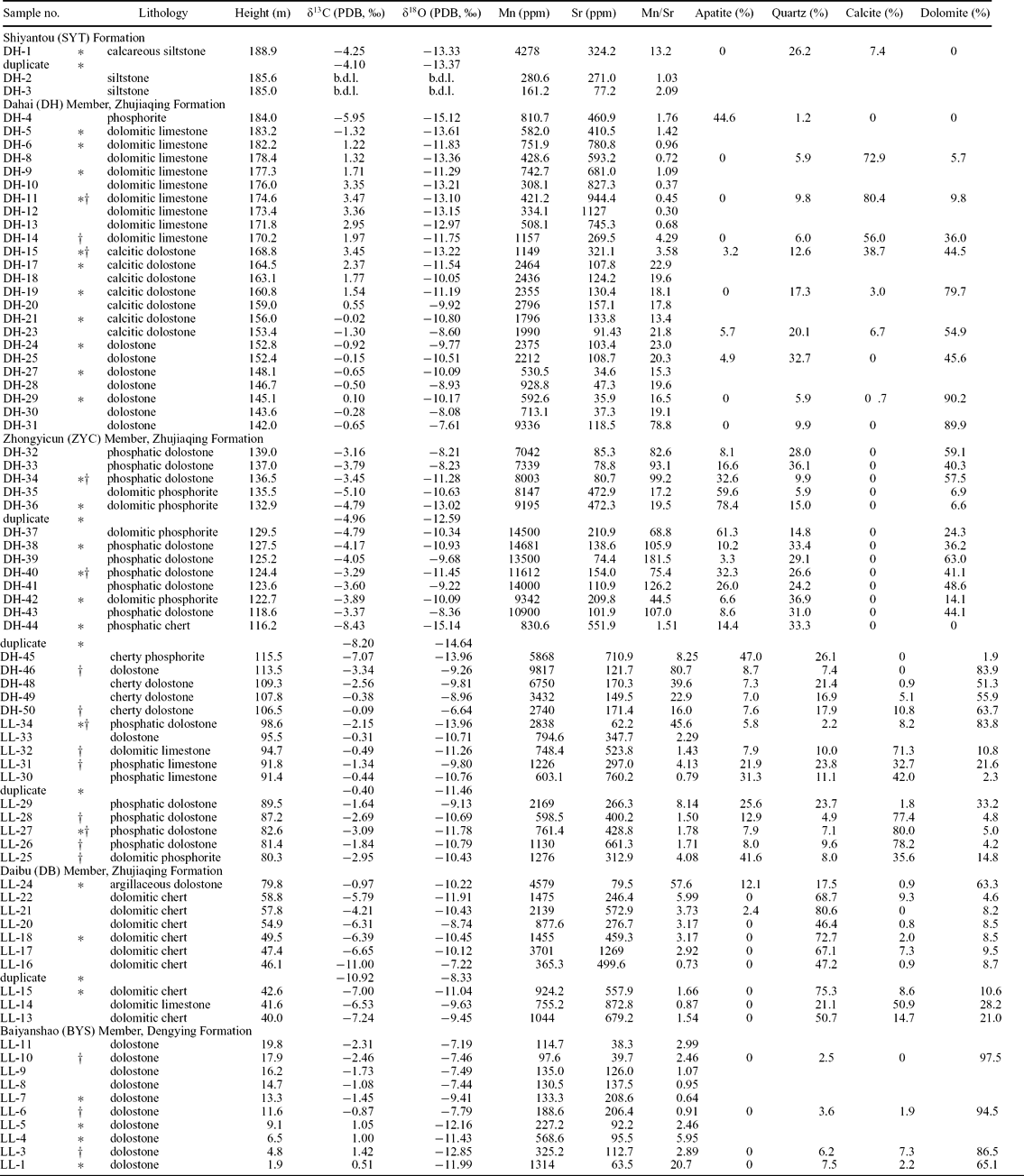
Analytical results for carbonate carbon and oxygen isotope compositions and leachable Mn and Sr concentrations of samples from the Laolin section
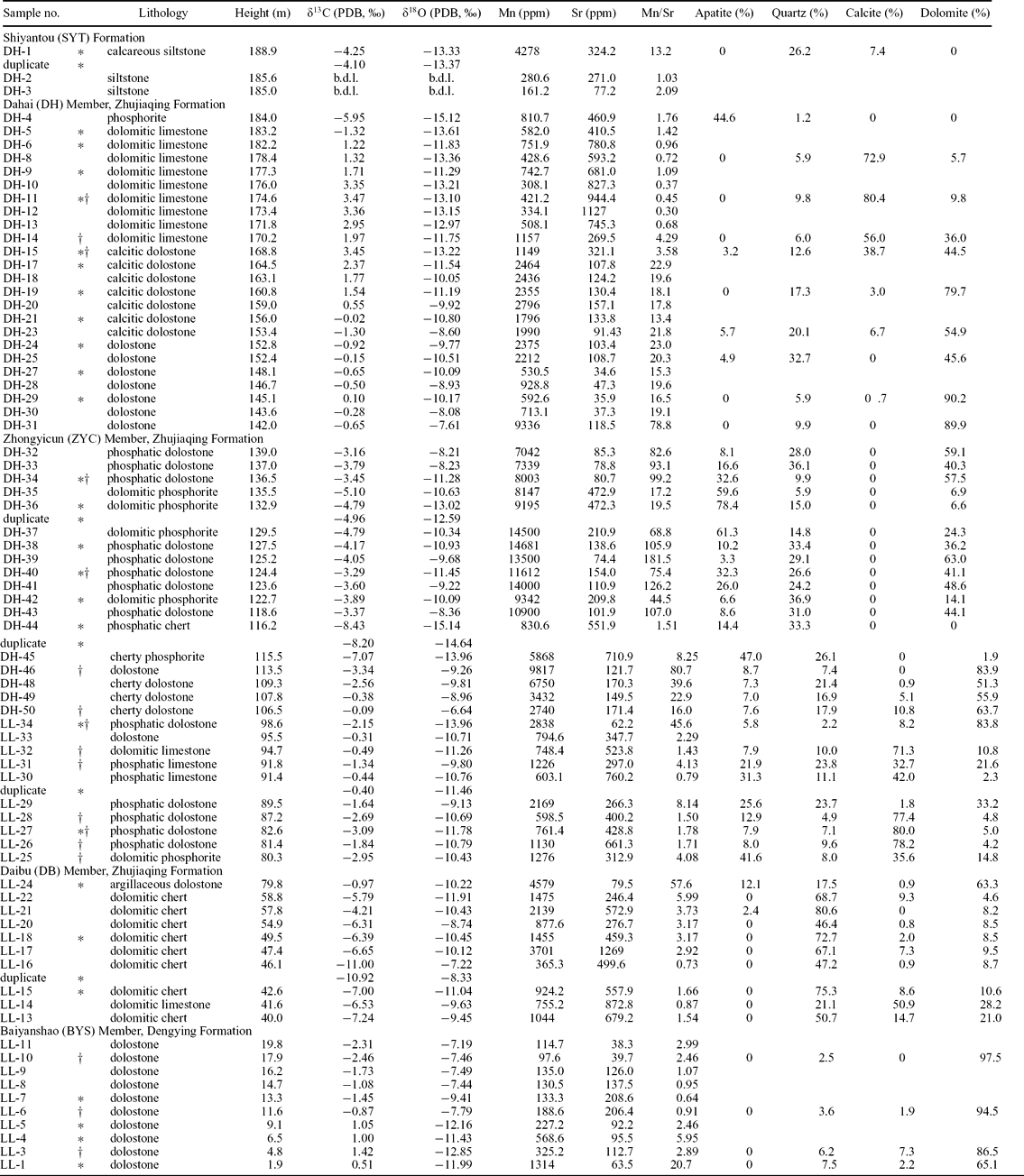
* δ13C and δ18O were analysed with an online Finnigan Gas-Bench + DeltaPlus XP system. δ13C and δ18O of the other samples were analysed with a Finngan MAT-252 after offline extraction of CO2. b.d.l. – below detectable limit.
† The sums of mineral contents calculated from XRD results are greater than 100%, which occurs when the calculated corundum contents are less than the actual contents of corundum added to the samples, and have been normalized to one hundred percent.
A portion of the individual samples was leached by 1M acetic acid at 50°C for at least 12 hours with several sessions of ultrasonic stirring. The leachate was converted to nitric acid solution by evaporation and redissolution and Rh was added for instrument calibration. Trace element concentrations were determined using a Finnigan Element II ICP-MS. The precisions are generally better than 5% for the analysed elements based on long-term uncertainty of the lab measurement on standard carbonate.
XRD measurements were carried out using a Rigaku D/max IIIa diffractometer equipped with a Cu-target tube and a curved graphite monochromator, and operating at 37.5 kV, 20 mA. The slit system was 1° (DS/SS), 0.3 mm RS. Samples were step-scanned with a step size of 0.02° (2q) from 18° to 100° and speed of 2s/step. The quantitative mineral phase analysis was achieved by means of Whole Pattern Fitting with a General Structural Analysis System (Larson & Von Dreele, Reference Larson and Von Dreele2004).
All the above analyses were done at the State Key Laboratory for Mineral Deposits Research, Nanjing University.
4. Results and discussion
4.a. Evaluation of diagenesis
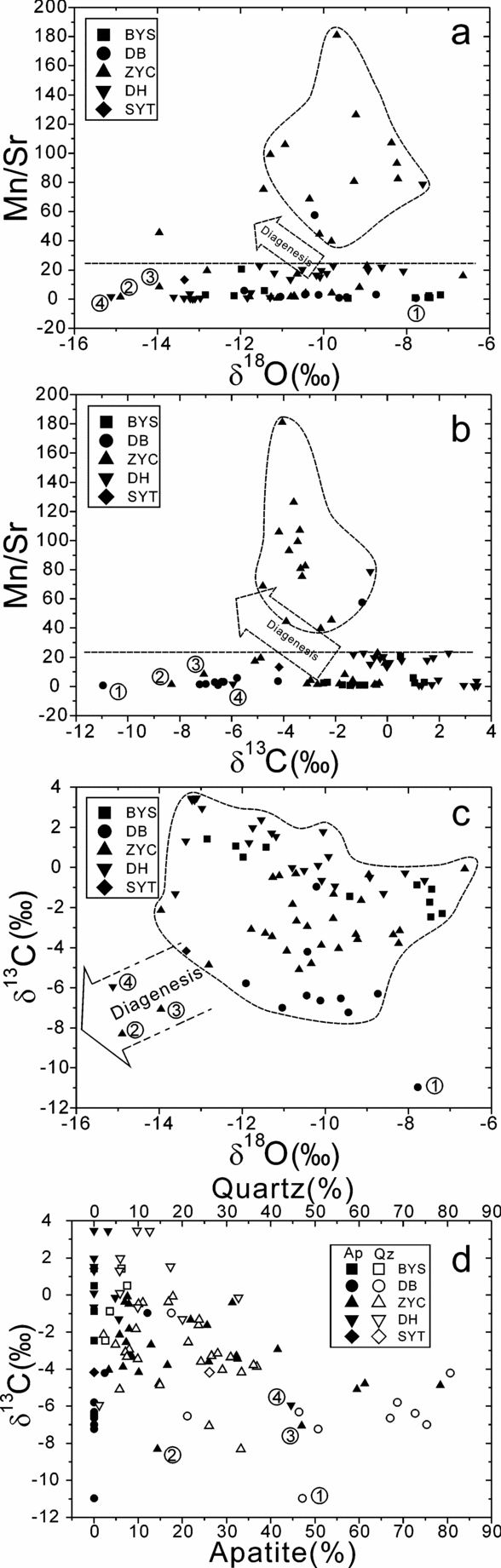
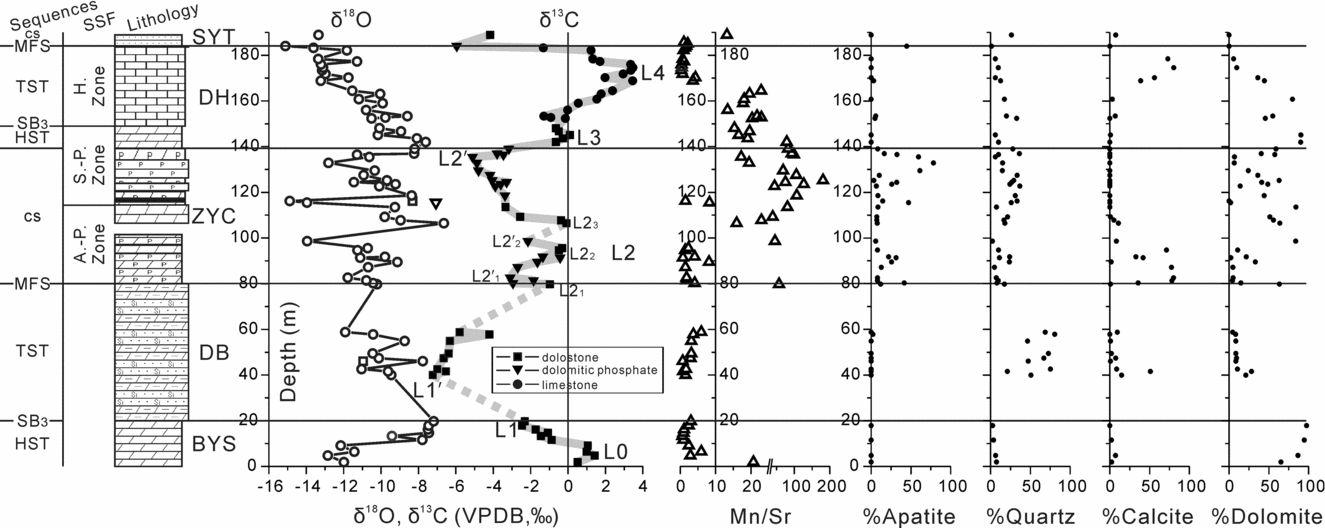
Table 1, Figure 4 and Figure 5 show the results for δ13C, δ18O, Mn/Sr and mineral contents of the Baiyanshao Member to basal Shiyantou Formation at the Laolin section. The Mn/Sr ratios of samples from the Baiyanshao Member (except one sample, LL-1), the Daibu Member (except one sample, LL-24), the lower part of Zhongyicun Member and the upper part of the Dahai Member are all below 10. Samples from the upper Zhongyicun Member and the lower Dahai Member have Mn/Sr ratios greater than 10, which may indicate the influence of diagenesis in these units. If diagenesis influenced Mn/Sr, δ13C and δ18O equally but affected different samples to different degrees, then negative correlations between Mn/Sr and δ18O, and between Mn/Sr and δ13C, would be expected. However, cross-plots of Mn/Sr–δ13C and Mn/Sr–δ18O do not show any correlations (Fig. 4a, b). For the samples with Mn/Sr<25, their δ13C and δ18O vary within a large range without any correlation with Mn/Sr. For the samples with a high and large range of Mn/Sr (30–180), their δ13C and δ18O values are intermediate in the whole range of all samples from the section and only vary within a limited range (Fig. 4a, b). Taken individually, no member of the Laolin section shows any such negative correlation either, which suggests that the Mn/Sr ratio may not be a good tracer of diagenetic alteration in this area.
Cross-plots of δ18O–Mn/Sr (a), δ13C–Mn/Sr (b), δ18O–δ13C (c) and δ13C–phosphate and quartz (d) for Laolin section in northeastern Yunnan, southwestern China. BYS – Baiyanshao Member; DB – Daibu Member; ZYC – Zhongyicun Member; DH – Dahai Member; SYT – Shiyantou Formation. Circled numbers: 1 – Sample LL-16; 2 – DH-44; 3 – DH-45; 4 – DH-4.

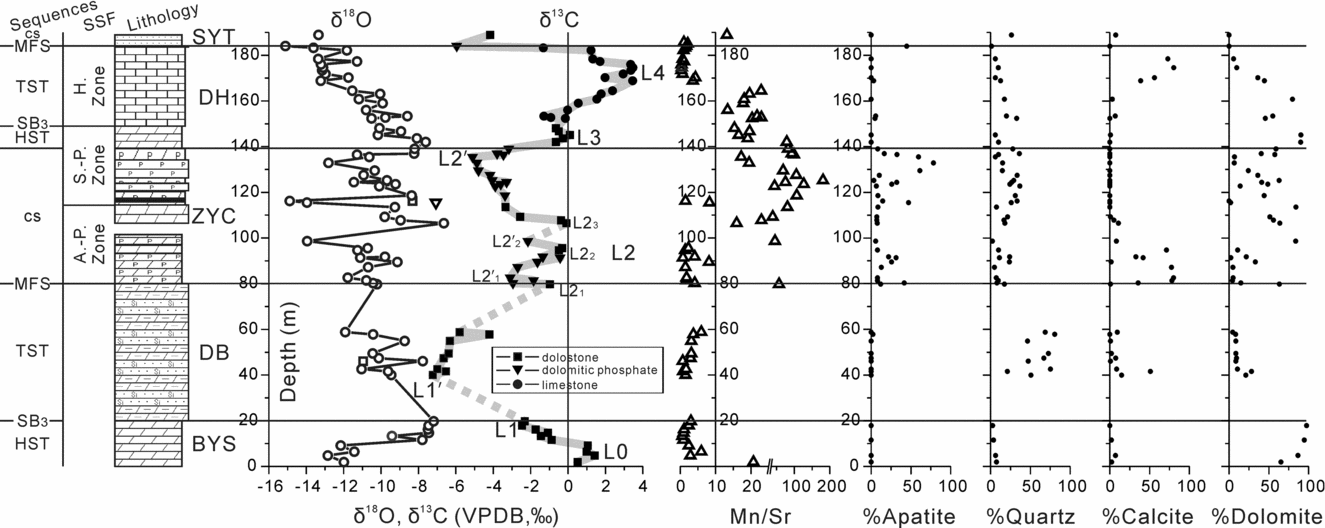
Profiles of δ13C, δ18O, Mn/Sr and XRD data for Laolin section in Yunnan, southwestern China. Small shelly fossils (SSF) zones: A.-P. Zone – Anabarites trisulcatus–Protohertzina anabarica Assemblage Zone; S.-P. Zone – Siphogonuchites triangularis–Paragloborilus subglobosus Assemblage Zone; H. Zone – Heraultipegma yunnanensis Assemblage Zone. HST – highstand systems tract; SB3 – third-order sequence boundary; TST – transgressive systems tract; MFS – maximum flooding surface; cs – condensed section. BYS – Baiyanshao Member; DB – Daibu Member; ZYC – Zhongyicun Member; DH – Dahai Member; SYT – Shiyantou Formation. In a couple of sectors indicated by dashed lines, samples are not available due to intensive weathering (from L21 and from L1′ to the underlying points) or fault fragmentation (from L2′2 to L23). For lithological legends see Figure 2.
Diagenesis usually causes δ13C and δ18O depletion, so positive correlation between δ13C and δ18O has often been interpreted as indicating diagenetic resetting (e.g. Bathurst, Reference Bathurst1975). Consequently, the δ13C values of samples with δ18O <–10‰ were often thought of as having been affected by diagenesis. Nearly half of our δ18O values are below −10‰. However, except for the upper part of the Zhongyicun Member, samples of the Laolin section show no positive correlation between δ18O and δ13C (Fig. 4c). The Dahai Member, except for one sample, even shows a clear negative correlation, while the Daibu and Baiyanshao members also show broad negative correlations. Such negative correlations are difficult to reconcile with most diagenetic processes and suggest instead a primary signature. Theoretically, potential reasons for negative correlation could include spatial and/or depth heterogeneity of δ13C in the water column, although this could not be proven in this study. The strongly negative δ13C composition (−11.0‰) with high δ18O value (−7.22‰) of a sample from the Daibu Member (LL-16, Fig. 4c) is particularly difficult to explain given the mantle input value (Kump, Reference Kump1991), and would require an additional source of 12C if it were representative of seawater. The oxidation of organic matter might provide the additional 12C, which implies diagenetic alteration. Thus this sample is not included in the evolutionary curve (Fig. 5).
The δ18O and δ13C values of two samples from upper part of the Zhongyicun Member (DH-44, DH-45, Fig. 4c) together with one sample of the top Dahai Member (DH-4, Fig. 4c) plot towards the lower left part in the trend arrow in Figure 4c and may have been modified most significantly by diagenesis. In thin-sections of sample DH-44, which is from the sole 1.6 m thick black shale layer in the Zhongyicun Member, carbonate can hardly be seen except in the form of a micro-vein (online Appendix Fig. A2e; also see XRD data in Table 1). Therefore, the measured C-isotope values may have come from diagenetic carbonate. Thin-section observations show that sample DH-45 is unique in our sample set from the Zhongyicun Member for its almost pure granular phosphorite without visible carbonate but with some chert and micro-cavities (online Appendix Fig. A2d; also see XRD data in Table 1); these micro-cavities might have been carbonate once that has been dissolved by meteoric water. Consequently, the δ13C value of this sample may reflect minor carbonate remnants whose C-isotope composition was affected by meteoric water. For these reasons, in the δ13C evolutionary diagram (Fig. 5), we abandoned these two upper Zhongyicun Member samples (DH-44, DH-45). Previous study suggests phosphate formation-associated diagenesis could lead to δ13C depletion (e.g. Brasier et al. Reference Brasier, Magaritz, Corfield, Luo, Wu, Ouyang, Jiang, Hamdi, He and Fraser1990). The XRD results of the bulk samples from the Laolin section (Table 1), however, show no correlation between δ13C and apatite contents (Fig. 4d). This suggests that either diagenetic effect on the δ13C values was not related to the apatite contents, or the δ13C values of the studied samples were not significantly affected by diagenesis and thus reflected an approximation to the primary record. Other indications mentioned above supported the latter scenario. The δ13C values of the studied samples were not correlated with the silicic content either. This also suggests that the chert-rich dolostone intervals (mainly the Daibu Member) recorded approximately primary δ13C values (Fig. 4d).
4.b. New δ13C trend and comparison with previous work
After abandoning some samples whose δ13C values may have been significantly affected by diagenesis, the δ13C curve of the Laolin section (this study, Figs 5, 6; hereafter Curve II) should represent at least an approximation to the primary δ13C trend for the Ediacaran–Cambrian boundary interval. The δ13C trend displayed by this curve can now be compared with the δ13C curve of Shen & Schidlowski (Reference Shen and Schidlowski2000) for the Laolin section (hereafter Curve I; Fig. 6). For Curve II, the δ13C values of the upper Baiyanshao dolostone show a continuous decline in an upward direction from 1.4‰ (L0) to −2.5‰ (L1), which is similar to the trend from S0 to S1 of Curve I, although the δ13C value (L1) of the upper Baiyanshao Member in Curve II is less negative than that of Curve I in the upper Baiyanshao Member (S1). A part of the section between the upper Baiyanshao Member and the lower Daibu Member was covered by talus material during our sampling, and so no samples from this part (which might be expected to have more negative δ13C values) have been collected. The low δ13C values of Curve II in the lower–middle Daibu Member (−6.5 to −7.2‰, L1′), which is similar to the correlative δ13C values of Curve I (S1′), are possibly a consequence of the continuation of this general decline from the upper Baiyanshao Member. However, Curve II does not record the abrupt rise at the top of the Baiyanshao Member shown in Curve I. From the middle to the top of the Daibu Member, δ13C values of Curve II show a rise from the nadir of the curve (L1′) to −1.2‰ (L21), which is also similar to the rise from S1′ to S2 in Curve I.
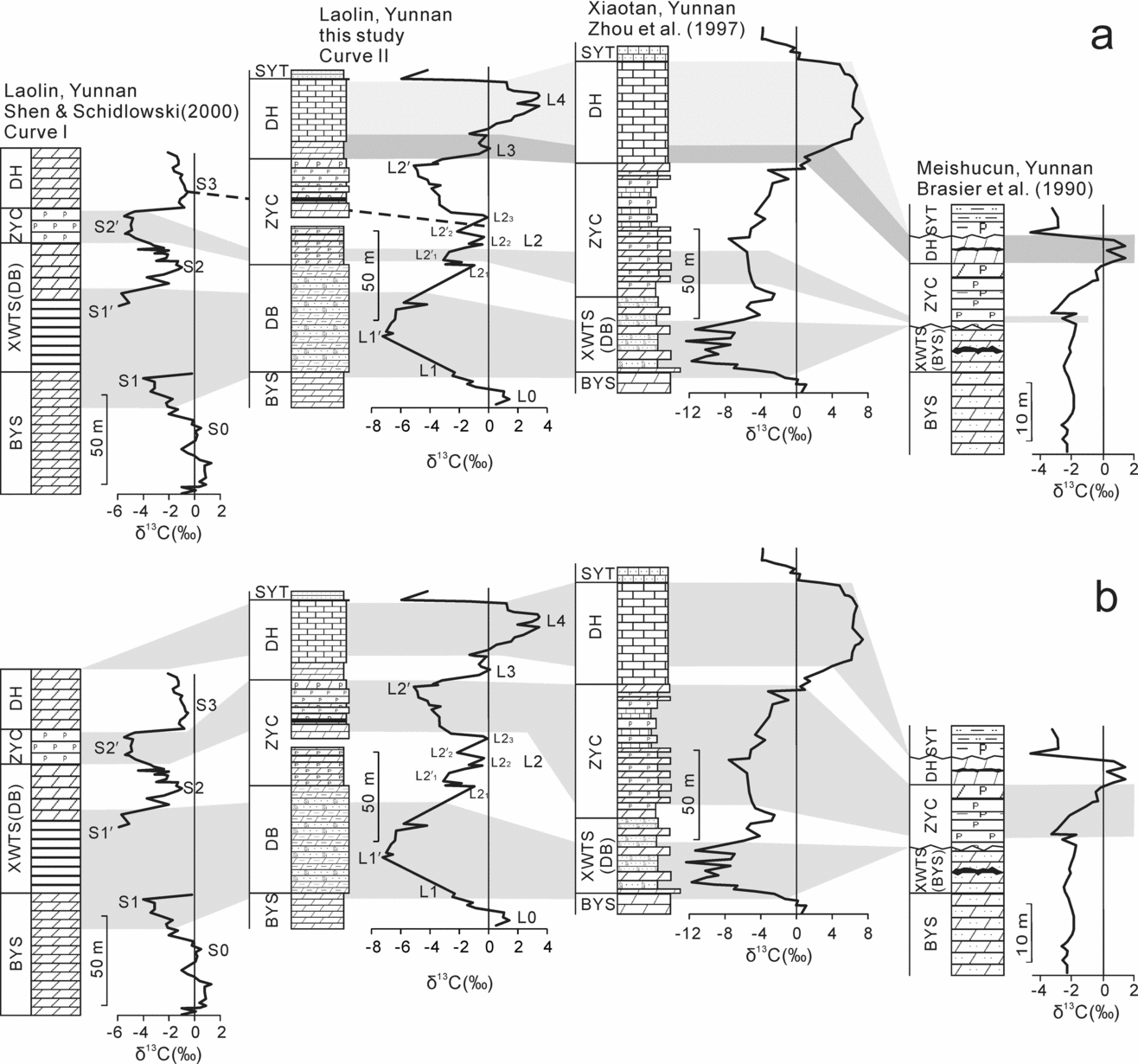
C-isotope stratigraphic correlation scheme between sections on Yangtze Platform. Panels (a) and (b) present two possible ways of correlation; for details see text. Curve I and its labels S1, S2 and S3 are from Shen & Schidlowski (Reference Shen and Schidlowski2000). Labels S0, S1′ and S2′ of Curve I are added by this study. Note the scale for the much thinner Meishucun section is not equal to that for the others, and the thicknesses are not proportional to time. BYS – Baiyanshao Member; DB – Daibu Member; ZYC – Zhongyicun Member; DH – Dahai Member; SYT – Shiyantou Formation.
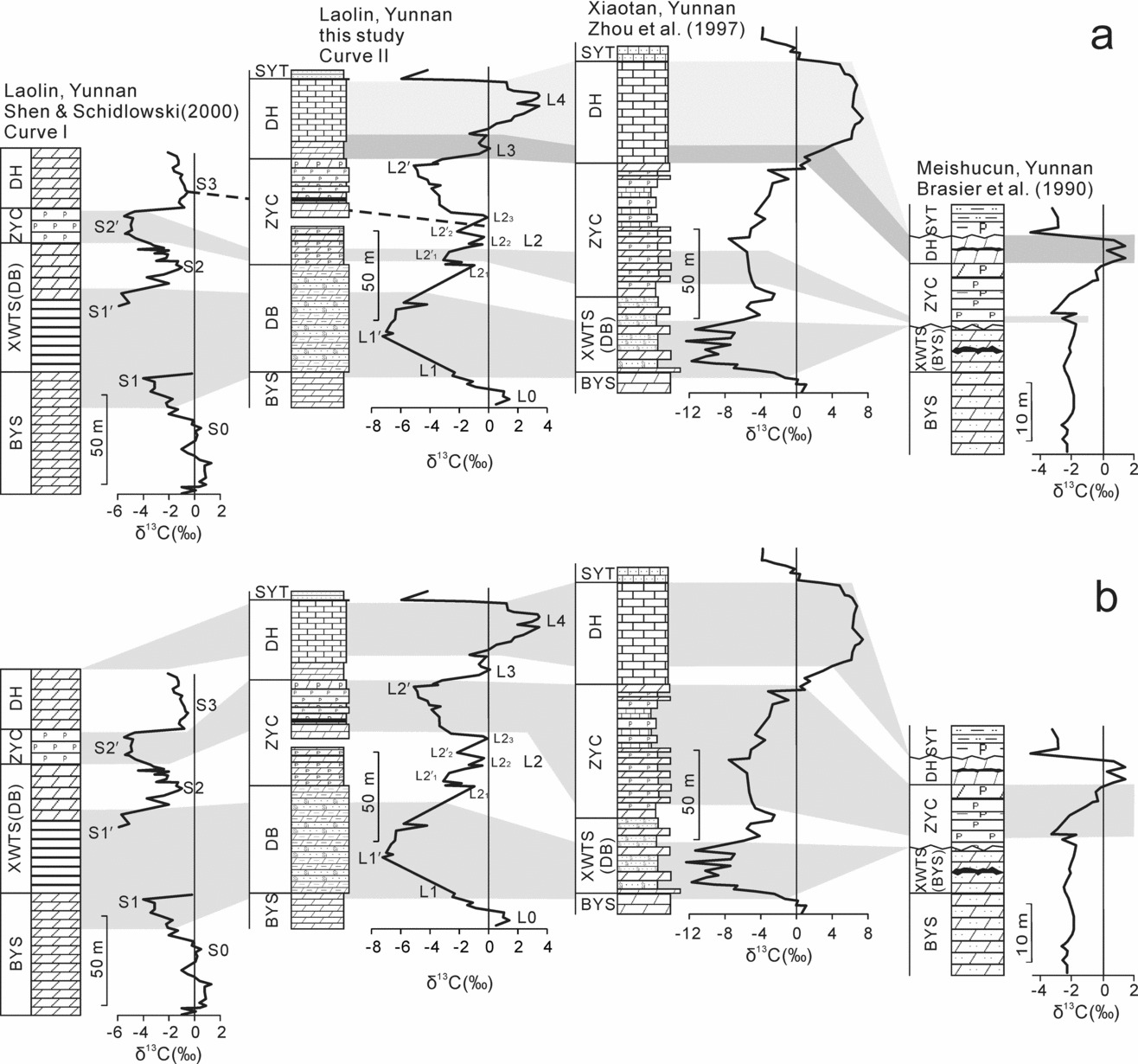
From S2 and L2 upward, the two curves diverge. For Curve II, in the lower and middle parts of the Zhongyicun phosphorite and phosphatic dolostone, δ13C values vary in a relatively small range (between −3.2 and 0‰) which may include some modest cycles from L21 to L23. After this, larger changes occur again. The δ13C values decline evidently from −0.1‰ (L23) in the middle–upper Zhongyicun Member to −5.1‰ (L2′) in the upper Zhongyicun Member. Toward the top of the Zhongyicun Member, δ13C values rise slightly to −3.2‰. The succeeding Dahai dolostone and limestone continue this increasing trend, reaching up to about +3.5‰ at the top (L4) of the succession in the upper Dahai Member. In the middle of this approximately 9‰ rise there is a small negative shift from +0.1 (L3) to −1.3‰. After the apex at +3.5‰ (L4), the curve begins to decline toward the top of the Dahai Member and appears to plummet to a very low value of −5.7‰ (DH-4) at the Dahai–Shiyantou boundary, although diagenetic alteration of this sample cannot be fully ruled out as pointed out above.
In Curve I (Fig. 6), there are two sectors which distinctly differ from Curve II. (1) In Curve I all δ13C values of the Zhongyicun Member are below −4.4‰ (S2), whereas in Curve II only the upper Zhongyicun Member has comparable negative δ13C values (L2′) and all of the middle and lower Zhongyicun Member has δ13C values between −3.2‰ and −0.1‰ (L2). (2) In Curve I all the δ13C values of the Dahai Member are below 0‰ (S3) whereas in Curve II the δ13C values of the Dahai Member rise up to a peak at +3.5‰ (L4) in the upper part of the member.
The Zhongyicun Member δ13C values of Curve I (S2′) seem only to correspond to either the lower Zhongyicun Member (Fig. 6a) or the upper Zhongyicun Member (Fig. 6b) of Curve II. In either case, a part of the Zhongyicun Member seems to be missing or was taken as part of a neighbouring member for Curve I. It cannot be that we have mistaken the Zhongyicun Member in our study because the Zhongyicun Member contains phosphorite or phosphatic dolostone beds throughout its thickness and these are not hard to recognize in the field. Our thin-section work and XRD results verify that almost all samples of the Zhongyicun Member contain phosphate, whereas the underlying Daibu Member and the overlying Dahai Member contain little or no phosphate. Under the assumption that the placement of the boundary between the ‘Xiaowaitoushan Member’ and the Zhongyicun Member of Curve I is correct, then the Zhongyicun Member of Curve I (S2′) may correspond to the lower Zhongyicun Member (L2′1, Fig. 6a) rather than to the upper Zhongyicun Member (L2′) of Curve II; the alternative possibility of correlating S2′ to L2′ (Fig. 6b) would imply that the lower–middle part of the Zhongyicun Member has been missed during sampling, which would not have happened easily. If S2′ corresponds to L2′1, then S3 may correspond to L22 and L23 (Fig. 6a), in which case the real Dahai Member of the section has not been sampled and the ‘Dahai Member’ of Curve I might in reality be the middle–upper part of the Zhongyicun Member. Such a scenario is not impossible because there is a fault fracture zone in the middle–upper part of the Zhongyicun Member (Fig. 1b). At this locality, the rocks look like siltstone and could be taken as rock of the Shiyantou Formation.
However, the δ13C values of the Zhongyicun Member of Curve I (<−4.5‰, S2) are more comparable to the upper part of the Zhongyicun Member of Curve II (L2′) (Fig. 6b). Figure 6b shows a more likely correspondence between Curve I and Curve II and a more consistent correlation of the two curves of the Laolin section with other sections in eastern Yunnan. If such correspondence between Curve I and Curve II is correct, then the upper part of the ‘Xiaowaitoushan Member’ of Curve I should correspond to the lower part of the Zhongyicun Member, while the upper part of the Dahai Member was not sampled for Curve I; this was also suspected by Zhu, Li & Zhang (Reference Zhu, Li and Zhang2001). For these reasons, we consider that the situation shown in Figure 6b is more likely than the situation shown in Figure 6a.
In summary, the new Laolin δ13C profile shows two pronounced negative excursions (L1′ and L2′) and one pronounced positive δ13C excursion (L4) with three less pronounced positive δ13C excursions (L0, L2 and L3). Although in a couple of sectors, samples are not available due to fracturing and weathering, the new C-isotope profile is more detailed than the previously published one (Shen & Schidlowski, Reference Shen and Schidlowski2000) in which the upper Dahai limestone may have been missed and the lower Zhongyicun Member may have been taken as the upper ‘Xiaowaitoushan Member’.
4.c. Comparison with C-isotope curves of Xiaotan section and Meishucun section in eastern Yunnan
The C-isotope curve of the Laolin section is very similar to that of the Xiaotan section at Yongshan (Zhou et al. Reference Zhou, Zhang, Li and Yu1997) (Fig. 6), ~200 km north of the Laolin section (Fig. 1). The most prominent common features of the two δ13C profiles are a large negative shift (over 8‰) starting at the top of the Baiyanshao Member and ending at the Daibu Member, and a large positive shift (over 8‰) starting at the top of the Zhongyicun Member and ending at the Dahai Member, followed by a similarly large negative shift extending to the overlying Shiyantou Formation. The similarity between the δ13C profiles of the two sections indicates that these units represent chronostratigraphic entities with similar depositional environments, and provides confidence that these curves may provide some correlation potential further afield. The similarities between Curve II of the Laolin section and the C-isotope curve of the Xiaotan section also highlight a probable inaccuracy in Curve I.
Comparison of the C-isotope curves between the sections east of the Dianchi Fault (including the Laolin section from this study and the Xiaotan section) with the Meishucun section west of the fault, shows some similarities and dissimilarities. The similarities include the prominent rise from negative values in the Zhongyicun Member to positive values in the Dahai Member followed by a large fall to the overlying Shiyantou Formation. Luo, Wu & Ouyang (Reference Luo, Wu and Ouyang1991) believed the ‘Xiaowaitoushan Member’ to be equivalent to the Daibu Member, but the most prominent dissimilarity is the lack of a pronounced negative shift in the ‘Xiaowaitoushan Member’ at the Meishucun section, which supports the above-mentioned view that there is a depositional break between the so-called ‘Xiaowaitoushan Member’ and the Zhongyicun Member at Meishucun (He, Shen & Yin, Reference He, Shen and Yin1988; He, Reference He1989; Qian & Bengtson, Reference Qian and Bengtson1989; Qian et al. Reference Qian, Zhu, He and Jiang1996). According to these papers, at the Meishucun section the ‘Xiaowaitoushan Member’ is similar to and belongs in the underlying upper Baiyanshao Member which was followed by a depositional hiatus during which time the Daibu Member was deposited in the region east of the Dianchi Fault with a pronounced negative C-isotope shift. A less evident dissimilarity is that the Dahai δ13C peak at the Meishucun section (<2‰) is not as high as the one at the Laolin section (3.5‰), which may also support the above-mentioned claim of another depositional hiatus between the Dahai Member and Shiyantou Formation at the Meishicun section (He, Reference He1989; Qian et al. Reference Qian, Zhu, He and Jiang1996; Zhu et al. Reference Zhu, Li, Zhang, Steiner, Qian and Jiang2001). It is conceivable that the upper Dahai limestone in the Dahai area was deposited during this interval (Qian et al. Reference Qian, Zhu, He and Jiang1996), although depositional depth differences within the basin could also result in δ13C variation.
4.d. Global correlations
4.d.1. Ediacaran–Cambrian boundary associated negative δ13C excursion
As pointed out in Section 1, because the Global Stratotype Section and Point of the Ediacaran–Cambrian boundary at Fortune Head, southeastern Newfoundland, Canada, was established mainly on the basis of trace fossils in siliciclastic strata (Narbonne et al. Reference Narbonne, Myrow, Landing and Anderson1987; Landing, Reference Landing1994), correlation of shallow marine carbonate strata with this stratotype has been difficult. Sections spanning the Ediacaran–Cambrian boundary in south China have not only small shelly fossil zones (e.g. Luo et al. Reference Luo, Jiang, Xu, Song and Xue1980; Luo, Wu & Ouyang, Reference Luo, Wu and Ouyang1991; Qian et al. Reference Qian, Zhu, Li, Jiang and Iten2002) for correlation with world-wide carbonate-dominated regions, but also well-established trace fossil zones (Yin, Li & He, Reference Yin, Li and He1993) for correlation with siliciclastic regions, thus providing maximum potential for correlation. Over the past decade it has become increasingly clear that a distinctly large δ13C negative excursion is closely associated with Ediacaran–Cambrian boundary strata worldwide, such that the negative excursion itself is increasingly regarded as a surrogate for the boundary (Strauss et al. Reference Strauss, De Marais, Hayes, Summons, Schopf and Klein1992, pp. 117–27; Grotzinger et al. Reference Grotzinger, Bowring, Saylor and Kaufman1995; Knoll & Carroll, Reference Knoll and Carroll1999; Kimura & Watanabe, Reference Kimura and Watanabe2001). An attempt at global correlation of the C-isotope curve we obtained for the Laolin section, calibrated with biotratigraphic markers, is made below.
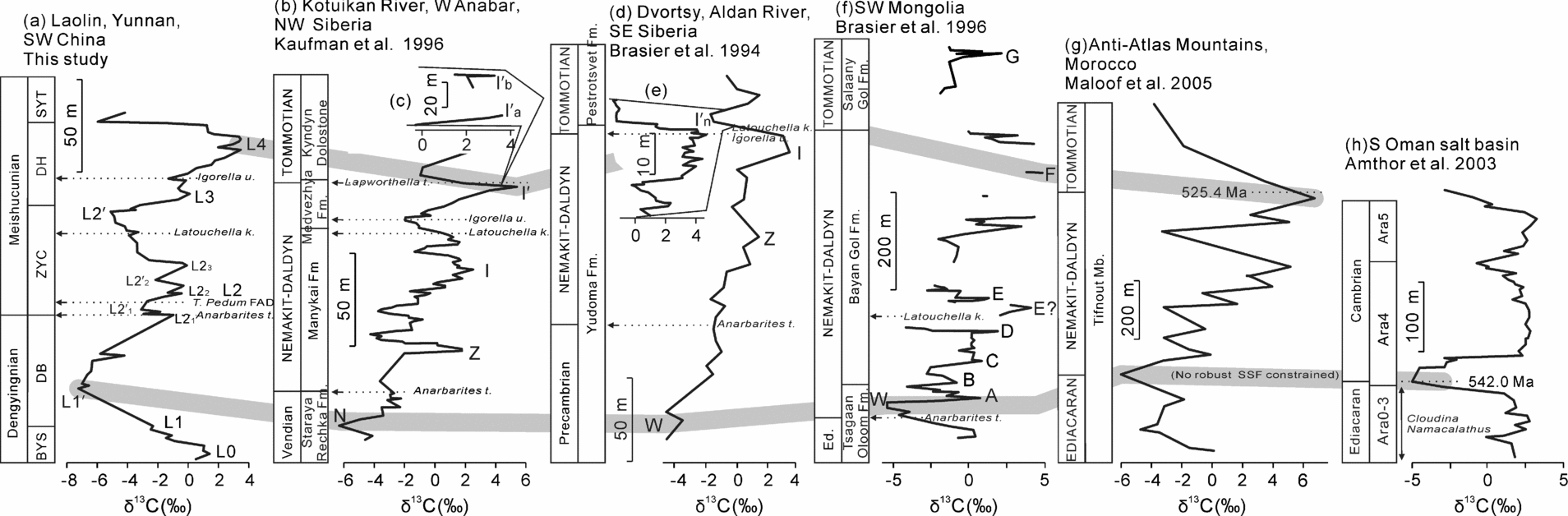
Figure 7 shows our profile together with C-isotope stratigraphic profiles from the Anabar uplift of NW Siberia (Kaufman et al. Reference Kaufman, Knoll, Semikhatov, Grotzinger, Jacobsen and Adams1996; Kouchinsky et al. Reference Kouchinsky, Bengtson, Missarzhevsky, Pelechaty, Tossander and Val'kov2001), SE Siberia (Brasier et al. Reference Brasier, Rozanov, Zhuravlev, Corfield and Derry1994; Kouchinsky et al. Reference Kouchinsky, Bengtson, Pavlov, Runnegar, Val'kov and Young2005), SW Mongolia (Brasier et al. Reference Brasier, Shields, Kuleshov and Zhegallo1996), Morocco (Maloof et al. Reference Maloof, Schrag, Crowley and Bowring2005) and southern Oman (Amthor et al. Reference Amthor, Grotzinger, Schröder, Bowring, Ramezani, Martin and Matter2003).
Global C-isotope stratigraphic correlation scheme. Negative δ13C excursions around the Ediacaran–Cambrian boundary are correlated between L1′ in section (a), N in section (b), W in section (d) and (f), and other two in section (g) and (h). Positive excursions near the base of Tommotian are correlated between L4 in section (a), I′ in section (b), F in section (f) and the one in section (g). Sources of data for each section are indicated. Data of δ13C curve sector (c) are from Bol'shaya Kuonamka section of E Anabar uplift, NW Siberia (Kouchinsky et al. Reference Kouchinsky, Bengtson, Missarzhevsky, Pelechaty, Tossander and Val'kov2001), and δ13C curve sector (e) from Selinde section, SE Siberia (Kouchinsky et al. Reference Kouchinsky, Bengtson, Pavlov, Runnegar, Val'kov and Young2005). Strata from top Manykai to Medvezhya Formation containing I′ deposited at W Anabar uplift, NW Siberia did not deposit in Aldan River section, SE Siberia (Kaufman et al. Reference Kaufman, Knoll, Semikhatov, Grotzinger, Jacobsen and Adams1996). I′a, I′b are correlated with I′n, and are suggested by the authors to be above I′ in Koutuikan River section, NW Siberia. See text for details. Note only the left three sections have equal scale bars. BYS – Baiyanshao Member; DB – Daibu Member; ZYC – Zhongyicun Member; DH – Dahai Member; SYT – Shiyantou Formation.
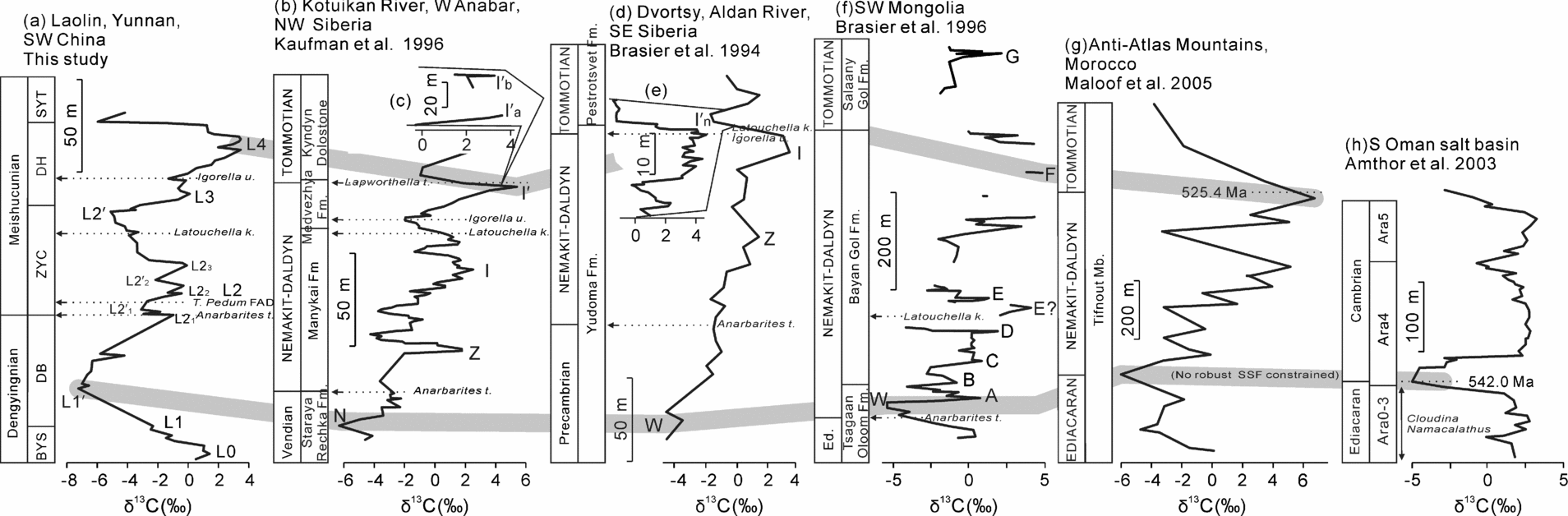
Cross-correlation between the Mongolian and Siberian profiles is anchored by the negative excursion ‘W’, Sr isotope stratigraphy, and FAD of skeletal fossils (Brasier et al. Reference Brasier, Shields, Kuleshov and Zhegallo1996; Shields, Reference Shields1999). On the Siberian Platform, the negative δ13C boundary excursion is situated not far below the FAD of Anabarites trisulcatus small shelly fossils at Aldan River (Magaritz, Holser & Kirschvink, Reference Magaritz, Holser and Kirschvink1986; Magaritz et al. Reference Magaritz, Kirschvink, Latham, Zhuravlev and Rozanov1991; Brasier et al. Reference Brasier, Rozanov, Zhuravlev, Corfield and Derry1994), Kotuikan River (Pokrovsky & Missarzhevsky, Reference Pokrovsky and Missarzhevsky1993; Knoll et al. Reference Knoll, Kaufman, Semikhatov, Grotzinger and Adams1995b; Kaufman et al. Reference Kaufman, Knoll, Semikhatov, Grotzinger, Jacobsen and Adams1996) and Sukharikha River (Kouchinsky et al. Reference Kouchinsky, Bengtson, Pavlov, Runnegar, Torssander, Young and Ziegler2007). The first negative δ13C excursion on the Siberia Platform (W in Fig. 7d, −4.5‰) was observed by Magaritz, Holser & Kirschvink (Reference Magaritz, Holser and Kirschvink1986) in predominantly dolostones of the Yudoma Formation at the Dvortsy section, along the Aldan River, SW Siberia, where the former Precambrian–Cambrian stratotype candidate was proposed (Cowie, Reference Cowie1985). The negative excursion at the Kotuikan River section, Anabar uplift, NW Siberia (N in Fig. 7b, −6.2‰) was recorded in massive dololutite in the middle part of the Staraya Rechka Formation, which represented a range of shallow, restricted subtidal to intertidal depositional environments devoid of strong currents (Kaufman et al. Reference Kaufman, Knoll, Semikhatov, Grotzinger, Jacobsen and Adams1996). The negative excursion (labelled ‘1n’, −8.6‰), at the Sukharikha River section on the NW Siberia platform, occurred in the basal Sukharikha Formation consisting of mostly dolostones and subordinate limestones deposited from the proximal carbonate-ramp environment (Kouchinsky et al. Reference Kouchinsky, Bengtson, Pavlov, Runnegar, Torssander, Young and Ziegler2007). A comparable negative excursion (−7‰) was observed in the middle part of the Lower Shale Member of the Soltanieh Formation at the Valiabad section, Elburze Mountains, N Iran and was also below the early skeletal fossils, such as Protohertzina anabarica, occurring near the top of this member. This negative excursion was recorded in the rhythmically interbedded carbonate-shale layers (<1 m) in shale successions deposited in an open marine subtidal environment (Brasier et al. Reference Brasier, Magaritz, Corfield, Luo, Wu, Ouyang, Jiang, Hamdi, He and Fraser1990; Kimura et al. Reference Kimura, Matsumoto, Kakuwa, Hamdi and Zibaseresht1997). A more negative excursion (−9.3‰), situated in the thin beds of lime mudstone sporadically occurring at the base of the Ingta Formation, which consists predominantly of fine siliciclastic rocks on shallow shelf, is directly below the FAD of both body fossils (P. anabarica) in the top Ingta Formation and trace fossils (P. pedum) in the middle Ingta Formation of the Mackenzie Mountains, NW Canada (Narbonne, Kaufman & Knoll, Reference Narbonne, Kaufman and Knoll1994). The Laolin δ13C Curve II shows a very similar situation, with a −7.2‰ negative excursion (L1′) in the Daibu Member that lies just below the FAD of Anabarites–Protohertzina and T. Pedum within the basal Zhongyicun Member.
A similar negative δ13C excursion in the upper Tsagan Oloom Formation, Zavkhan basin, SW Mongolia (feature W, −5.3‰), however, lies slightly above the level of the FAD of the Anabarites trisulcatus Zone and the earliest assemblage of hexactinellid sponge spicules (Brasier et al. Reference Brasier, Shields, Kuleshov and Zhegallo1996). This excursion appears in light- and dark-grey limestone with black siliceous concretions deposited in shelf and peritidal environments. At the Kuorbusuonka River section, Olenek uplift, NE Siberia, a less negative δ13C excursion (−2.6‰) in shallow ramp dolostone of the uppermost Turkut Formation, lies above the lowermost shelly fossil Cambrotubulus sp. (Knoll et al. Reference Knoll, Grotzinger, Kaufman and Kolosov1995a; Khomentovsky & Karlova, Reference Khomentovsky and Karlova1993). A similar negative shift nearby is reported from the upper Turkut Formation at the Olenek River section (−3.5‰) (Pelechaty et al. Reference Pelechaty, Grotzinger, Kashirtsev and Zhernovsky1996; Plechaty, Kaufman & Grotzinger, Reference Pelechaty, Kaufman and Grotzinger1996). These latter two excursions are less negative than the typical negative excursions (<−4‰) spanning the Ediacaran–Cambrian boundary around the world.
Although the FADs of small shelly fossils are very likely diachronous (Brasier et al. Reference Brasier, Shields, Kuleshov and Zhegallo1996), this almost ubiquitous and large negative δ13C excursion could be used as a chronostratigraphic anchor for the Ediacaran–Cambrian boundary. Trace fossil data from eastern Yunnan provide further support for this. Yin, Li & He (Reference Yin, Li and He1993) studied 27 sections distributed over an area of 30000 km2 from Huize to Kunming and observed Phycodes pedum limited in phosphorites of lower Zhongyicun Member (just above negative δ13C excursion L1), which could be correlated with Trichophycus pedum from the Global Stratotype Section at Fortune Head, SE Newfoundland, Canada.
Supportive data for using this excursion as a global marker also come from other successions in the world without the Anabarites trisulcatus Zone. For instance, at the Turukhansk uplift on the northwestern margin of the Siberia Platform, a negative δ13C excursion (−7.5‰) has also been found in subtidal shelf silty dolostone at the lower part of the Platonovskaya Formation, whose trace and body fossils can only broadly constrain the depositional age being around the Ediacaran–Cambrian boundary (Bartley et al. Reference Bartley, Pope, Knoll, Semikhatov and Petrov1998). At the Nokhtuisk section on the southern margin of the Siberia Platform, a large and prolonged negative δ13C excursion interval N1 (−9‰) with some superposed high frequency shifts (<5‰), occurring in micritic clasts of carbonate conglomerates spreading over a thick interval (200 m) in the middle and upper Tinnaya Formation deposited on distally steepened ramp in deep water, is just below the red beds of the Nokhtuisk Formation; these do not contain guide fossils but are suggested as being early Cambrian based on regional lithostratigraphic considerations (Pelechaty, Reference Pelechaty1998). A pronounced negative excursion (−6‰) occurring in peritidal dolostones of the lower Tifnout Member in the Ediacaran–Cambrian boundary successions of the Anti-Atlas mountains in Morocco is also inferred to have recorded the same biogeochemical event (Magaritz et al. Reference Magaritz, Kirschvink, Latham, Zhuravlev and Rozanov1991; Maloof et al. Reference Maloof, Schrag, Crowley and Bowring2005) (Fig. 7g), although biostratigraphic data only constrain the excursion as post-dating Ediacaran faunas and pre-dating Atdabanian fossil assemblages of the later early Cambrian (Tucker, Reference Tucker1986; Latham & Riding, Reference Latham and Riding1990).
Recently, precise U–Pb dating on zircons from volcanic ash beds within a stratum coincident with the negative C-isotope excursion (−5‰) at the basal A4 carbonate formed during highstands in an unrestricted sea in the southern Oman Salt Basin yielded an age of 542.0±0.3 Ma (Amthor et al. Reference Amthor, Grotzinger, Schröder, Bowring, Ramezani, Martin and Matter2003; Fig. 7h). This age constraint agrees well with previous constraints for the negative C-isotope excursions around the Ediacaran–Cambrian boundary at Khorbusuonka River, NE Siberia (slightly below the ash bed with a zircon age of 543.9±0.2 Ma: Bowring et al. Reference Bowring, Grotzinger, Isachsen, Knoll, Pelechaty and Kolosov1993) and S Namibia (between two ash beds with zircon ages of 543.3±1 Ma and 539.4±1 Ma: Grotzinger et al. Reference Grotzinger, Bowring, Saylor and Kaufman1995), and provides further support for the global validity of the Ediacaran–Cambrian boundary excursion. The extinction of Cloudina and Namacalathus occurred close to the Ediacaran–Cambrian boundary in Oman and globally (Amthor et al. Reference Amthor, Grotzinger, Schröder, Bowring, Ramezani, Martin and Matter2003; Brasier, Reference Brasier and Donovan1989, pp. 73–88; Seilacher, Reference Seilacher, Holland and Trendall1984, pp. 159–68) and appears to have been coincident with the global biogeochemical event marked by the negative C-isotope excursion (Knoll & Carroll, Reference Knoll and Carroll1999). Therefore, this global biogeochemical event pre-dated the Cambrian bioradiation and may have coincided with mass extinction and faunal turnover at the Ediacaran–Cambrian boundary.
Exceptional cases where no clear negative excursion appears around the supposed Ediacaran–Cambrian boundary have been observed occasionally. Biostratigraphic and chemostratigraphic data for the terminal Neoproterozoic mixed deltaic to shallow marine siliciclastic carbonate successions in Namibia support a latest Vendian age for the top of the Spitskopf Member, but in the overlying strata no negative excursion is observed near the Ediacaran–Cambrian boundary as in other regions, suggesting the youngest Vendian strata were probably removed by erosion or never deposited in the basin (Grotzinger et al. Reference Grotzinger, Bowring, Saylor and Kaufman1995). Similarly, in the Meishucun section, a clear negative excursion is also absent below the reported FAD of Anabarites–Protohertzina (basal Zhongyicun Member). The negative excursion in the Zhongyicun Member at the Meishucun section should correlate with L2′ in the Zhongyicun Member but not with excursion L1′ in the Daibu Member of the Laolin section. Thus, regardless of whether the Anabarites–Protohertzina fossils from the ‘Xiaowaitoushan Member’ are of primary (Luo et al. Reference Luo, Jiang, Xu, Song and Xue1980) or secondary (Qian et al. Reference Qian, Zhu, He and Jiang1996) origin, the negative excursion near the Ediacaran–Cambrian boundary observed in other regions is absent in the Meishucun section. This observation is consistent with and supportive of the conclusion made from field observations and stratigraphic analyses by Qian et al. (Reference Qian, Zhu, He and Jiang1996) that there was a depositional break between the ‘Xiaowaitoushan Member’ and the Zhongyicun Member in the region west of the Dianchi Fault in eastern Yunnan.
4.d.2. Pre-Tommotian positive δ13C excursions
According to Brasier et al. (Reference Brasier, Shields, Kuleshov and Zhegallo1996), the C-isotopic features D (2.0‰) and E (1.8‰) occurring in limestone of the lower Bayan Gol Formation in Mongolia compare reasonably well in position and magnitude to peak I (3.4‰) occurring in dolostone of the uppermost Yudoma Formation in the Aldan River area, SE Siberia, which is also supported by 87Sr/86Sr values and cross-plots of small shelly fossils. However, there is no matchable C-isotopic excursion in the Aldan River area, E Siberia, to the more positive excursion F (5.1‰) above E in the upper Bayan Gol Formation in Mongolia which contains the supposed Tommotian fauna.
A large positive δ13C excursion (5.4‰) occurring in shallow-marine limestone of the Medvezhya Formation close to the Nemakit–Daldynian/Tommotian boundary at the western Anabar uplift, NW Siberia, was first discovered by Pokrovsky & Missarzhevsky (Reference Pokrovsky and Missarzhevsky1993). Knoll et al. (Reference Knoll, Kaufman, Semikhatov, Grotzinger and Adams1995b) and Kaufman et al. (Reference Kaufman, Knoll, Semikhatov, Grotzinger, Jacobsen and Adams1996) named this large excursion peak I′ (Fig. 7b) and argued that during the depositional interval of peaks I and I′ at the Anabar uplift of NW Siberia, only peak I appeared in the Aldan River area of SE Siberia due to a depositional hiatus between the Yudoma Formation and the overlying Pestrotsvet Formation with an apparent karstic surface in between. Consequently, radiation of small shelly fossils of the N. sunnaginicus Zone occurred gradually in the stratum interval between a point slightly above C-isotope peak I and a point slightly above peak I′ in NW Siberia, whereas in SE Siberia these fossils occurred together suddenly in the stratum above peak I. Kaufman et al. (Reference Kaufman, Knoll, Semikhatov, Grotzinger, Jacobsen and Adams1996) and Kouchinsky et al. (Reference Kouchinsky, Bengtson, Missarzhevsky, Pelechaty, Tossander and Val'kov2001) suggested that the hiatus between the upper Yudoma Formation (Nemakit–Daldynian ± early Tommotian) and lower Pestrotsvet Formation (Tommotian) in the Aldan area lasted too long (several million years) to be considered intrazonal, and thus could be more reasonably regarded as a pre-Tommotian interval.
Recently, at the Bol'shaya Kuonamka section in the eastern Anabar uplift, which belong to an open-marine facies, three distinct positive excursions (I′, I′a, I′b in upward sequence) were discovered in lower beds of the Emyaksin Formation (argillaceous carbonates), and were believed to succeed peak I in SE Siberia (Kouchinsky et al. Reference Kouchinsky, Bengtson, Missarzhevsky, Pelechaty, Tossander and Val'kov2001). Of these three, I′ (~5‰) was correlated litho- and biostratigraphically with I′ (5.4‰) at the western Anabar uplift, leaving the other two (I′a, I′b, both ~3.5‰) no counterpart at the western Anabar uplift, probably because the eastern Anabar region was in a more offshore depositional environment than the west during the period when the early Cambrian transgression began from the north (Kouchinsky et al. Reference Kouchinsky, Bengtson, Missarzhevsky, Pelechaty, Tossander and Val'kov2001). Similarly, at the Selinde section, SE Siberia, which is near to but represents more offshore facies than transitional facies at the Dvortsy section in the Aldan River area, positive δ13C oscillations (I′n, frequent oscillations from 3 to 4.5‰) have been observed within limestones of the basal Pestrotsvet Formation, which is the uppermost level of the Nemakit–Daldynian stage. This oscillatory positive shift indicates a protracted period of minor positive values after I′ and probably embraces I′a, I′b of the Bol'shaya Kuonamka section at the eastern Anabar uplift (Kouchinsky et al. Reference Kouchinsky, Bengtson, Pavlov, Runnegar, Val'kov and Young2005). A similar positive I′-type excursion (4‰) has been reported from the upper Kessyusa Formation of the Olenek uplift (Knoll et al. Reference Knoll, Grotzinger, Kaufman and Kolosov1995a), and a large I′-type peak (peak 6p, >6‰) with a minor I′n-type peak above (peak 7p, ~1.5‰) has also been reported from shelf carbonates of the uppermost Sukharikha Formation at Sukharikha River, western margin of Siberia (Kouchinsky et al. Reference Kouchinsky, Bengtson, Pavlov, Runnegar, Torssander, Young and Ziegler2007).
Brasier et al. (Reference Brasier, Magaritz, Corfield, Luo, Wu, Ouyang, Jiang, Hamdi, He and Fraser1990) studied the Meishucun section and suggested correlations between the Anabarites trisulcatus–Protohertzina anabarica Zone (Zone I) in E Yunnan and the Anabarites trisulcatus Zone in E Siberia, and between the Paragloborilus–Siphogonuchites (Zone II) in E Yunnan and the Purella antiqua Zone in E Siberia. As both zones in Siberia belong to the Nemakit–Daldynian Stage, such correlations imply that Zone II in the upper Zhongyicun and Dahai Member of the Meishucun section are considered to be slightly older than the classic Tommotian fossil assemblages. At the Laolin section and the nearby Zhujiaqing section, a Heraultipegma yunnanensis Zone was observed by Qian et al. (Reference Qian, Zhu, He and Jiang1996, Reference Qian, Zhu, Li, Jiang and Iten2002) and Zhu et al. (Reference Zhu, Li, Zhang, Steiner, Qian and Jiang2001) in the upper Dahai limestone, which was not deposited in the region west of the Dianchi Fault. There are many common fossils between the Siphogonuchites–Paragloborilus Zone to Heraultipegma Zone (the upper Zhongyicun to Dahai Member) in eastern Yunnan and the N. sunnaginicus Zone (top Manykai to Medvezhya Formation) in NW Siberia, such as Halkieria sp., Latouchella maidipingensis, Latouchella korobkovi, Rostroconus sp., Igorella ungulata, Ovalitheca sp., Turcutheca sp., Bemella sp. (Qian, Reference Qian1999; Qian et al. Reference Qian, Zhu, Li, Jiang and Iten2002; Kaufman et al. Reference Kaufman, Knoll, Semikhatov, Grotzinger, Jacobsen and Adams1996). Therefore, positive excursion L4 (3.5‰) which occurs in the upper Dahai Member (Heraultipegma yunnanensis Zone) should correlate with I′ in the top Medvezhya Formation in NW Siberia, and peaks L21 to L3 possibly correlate with peaks Z to I in NW Siberia (Knoll et al. Reference Knoll, Kaufman, Semikhatov, Grotzinger and Adams1995b; Kaufman et al. Reference Kaufman, Knoll, Semikhatov, Grotzinger, Jacobsen and Adams1996) and with features A to E in Mongolia (Brasier et al. Reference Brasier, Shields, Kuleshov and Zhegallo1996). As mentioned above, the interval from the top Manykai Formation to the Medvezhya Formation in NW Siberia, which contains I′, is regarded as a pre-Tommotian interval, thus the upper Dahai Member which contains L4 should belong to the Pre-Tommotian Stage of the Cambrian. This further supports the correlation of the positive excursion L4 (3.5‰) at the Dahai Member below the Tommotian-type Sinosachites–Tannuolina Zone of the Shiyantou Formation with the Mongolian Feature F, which has a similar δ13C magnitude (5.1‰) and position immediately below the Tommotian-type Tiksitheca licis Zone (Brasier et al. Reference Brasier, Shields, Kuleshov and Zhegallo1996) and also with the δ13C peak (~4.5‰) occurring in phosphate-rich carbonate beds which contain maximum abundance of small shelly fossils of the basal Upper Shale Member overlain by shales having Tommotian-type fossils at the Valiabad section in northern Iran (Brasier et al. Reference Brasier, Magaritz, Corfield, Luo, Wu, Ouyang, Jiang, Hamdi, He and Fraser1990; Kimura et al. Reference Kimura, Matsumoto, Kakuwa, Hamdi and Zibaseresht1997).
The large positive excursion (7.3‰) within the Dahai Member of the Xiaotan section in northeastern Yunnan (Zhou et al. Reference Zhou, Zhang, Li and Yu1997) (Fig. 6) is strikingly similar in stratigraphic position and magnitude to the positive peak (7‰) (Fig. 7g) in peritidal dolostones of the upper Tifnout Member belonging to the uppermost Nemakit–Daldynian parts of sections from the Anti-Atlas mountains, Morocco, where the early Cambrian strata are more expanded but lack fossils (Maloof et al. Reference Maloof, Schrag, Crowley and Bowring2005). Correlation of the Dahai Member positive δ13C excursion at the Laolin section (L4) and Xiaotan section with the Moroccan section δ13C peak dated at 525.4±0.5 Ma appears straightforward, which indirectly lends an age constraint for the Dahai Member.
5. Summary and concluding remarks
(1) The large negative δ13C excursion observed in both this study (L1′, −7.2‰) and Shen & Schidlowski (Reference Shen and Schidlowski2000) in the Daibu Member of the Laolin section is immediately below the FAD of small shelly fossils in the basal Zhongyicun Member of this section. The same distribution relationship between the FAD of small shelly fossils and a negative excursion of <−4‰ has also been observed from the Aldan River of SE Siberia (Magaritz, Holser & Kirschvink, Reference Magaritz, Holser and Kirschvink1986; Magaritz et al. Reference Magaritz, Kirschvink, Latham, Zhuravlev and Rozanov1991; Brasier et al. Reference Brasier, Rozanov, Zhuravlev, Corfield and Derry1994) and western Anabar in NW Siberia (Pokrovsky & Missarzhevsky, Reference Pokrovsky and Missarzhevsky1993; Knoll et al. Reference Knoll, Kaufman, Semikhatov, Grotzinger and Adams1995b; Kaufman et al. Reference Kaufman, Knoll, Semikhatov, Grotzinger, Jacobsen and Adams1996), Sukharikha River on northwestern margin of Siberia (Kouchinsky et al. Reference Kouchinsky, Bengtson, Pavlov, Runnegar, Torssander, Young and Ziegler2007), Elburze Mountains in N Iran (Brasier et al. Reference Brasier, Magaritz, Corfield, Luo, Wu, Ouyang, Jiang, Hamdi, He and Fraser1990; Kimura et al. Reference Kimura, Matsumoto, Kakuwa, Hamdi and Zibaseresht1997) and Mackenzie Mountains in NW Canada (Narbonne, Kaufman & Knoll, Reference Narbonne, Kaufman and Knoll1994). In some other regions, the FAD of small shelly fossils was found at a stratigraphic level beneath the negative excursion in Mongolia (Brasier et al. Reference Brasier, Shields, Kuleshov and Zhegallo1996) and at the Olenek uplift of NE Siberia (Khomentovsky & Karlova, Reference Khomentovsky and Karlova1993; Knoll et al. Reference Knoll, Grotzinger, Kaufman and Kolosov1995a; Pelechaty et al. Reference Pelechaty, Grotzinger, Kashirtsev and Zhernovsky1996; Pelechaty, Kaufman & Grotzinger, Reference Pelechaty, Kaufman and Grotzinger1996). As the FADs of small shelly fossils are very likely diachronous (Brasier et al. Reference Brasier, Shields, Kuleshov and Zhegallo1996), and the large negative excursion may document a major biogeochemical event involving the world ocean, our data further support that the Ediacaran–Cambrian boundary is closely associated with this negative excursion. This C-isotope stratigraphic marker is particularly useful for successions where the negative C-isotope excursion occurs together with fossils having only approximate biostratigraphic significance, such as in the Turukhansk uplift on the northwestern margin of Siberia (Bartley et al. Reference Bartley, Pope, Knoll, Semikhatov and Petrov1998), Nokhtuisk on the southern margin of Siberia (Pelechaty, Reference Pelechaty1998), Anti-Atlas mountains in Morocco (Magaritz et al. Reference Magaritz, Kirschvink, Latham, Zhuravlev and Rozanov1991; Maloof et al. Reference Maloof, Schrag, Crowley and Bowring2005) and S Oman (Amthor et al. Reference Amthor, Grotzinger, Schröder, Bowring, Ramezani, Martin and Matter2003).
(2) In contrast to the large negative excursion (L1′) in the Daibu Member beneath the Zhongyicun Member at the Laolin section, there is no clear negative excursion from the top Baiyanshao Member through the ‘Xiaowaitoushan Member’ to the basal Zhongyicun Member at the Meishucun section (Brasier et al. Reference Brasier, Magaritz, Corfield, Luo, Wu, Ouyang, Jiang, Hamdi, He and Fraser1990), which lends support to the view that in the region west of the Dianchi Fault, including the Meishucun section, a depositional hiatus once occurred between the ‘Xiaowaitoushan Member’ (belonging to the Baiyanshao Member) and the Zhongyicun Member (Qian et al. Reference Qian, Zhu, He and Jiang1996).
(3) The large positive excursion (L4, +3.5‰) found by this study in the upper Dahai Member of the Laolin section is comparable in magnitude and position not only to the succession in Xiaotan located east of the Dianchi Fault but also to the peak I′ at both eastern and western of the Anabar uplift in NW Siberia (Kaufman et al. Reference Kaufman, Knoll, Semikhatov, Grotzinger, Jacobsen and Adams1996; Kouchinsky et al. Reference Kouchinsky, Bengtson, Missarzhevsky, Pelechaty, Tossander and Val'kov2001) and feature D in Mongolia (Brasier et al. Reference Brasier, Shields, Kuleshov and Zhegallo1996). All these correlative peaks are located at the biostratigraphic level of the latest Nemakit–Daldynian stage. It requires further study to determine whether there are correlated C-isotope excursions in the strata above the Dahai Member in NE Yunnan to peaks I′a & I′b at the eastern Anabar uplift in NW Siberia (Kouchinsky et al. Reference Kouchinsky, Bengtson, Missarzhevsky, Pelechaty, Tossander and Val'kov2001), peak I′n at the Selinda section in E Siberia (Kouchinsky et al. Reference Kouchinsky, Bengtson, Pavlov, Runnegar, Val'kov and Young2005) and peak 7p at Sukharikha River, western margin of Siberia (Kouchinsky et al. Reference Kouchinsky, Bengtson, Pavlov, Runnegar, Torssander, Young and Ziegler2007), which are suggested being above peak I′.
(4) The positive excursion (S3) assigned to the Dahai Member of the previously published C-isotope curve for the Laolin section has δ13C values lower than 0 (Shen & Schidlowski, Reference Shen and Schidlowski2000), which cannot be reconciled with excursion L4 (+3.5‰) in Dahai Member observed in this study. The most likely explanation for this discrepancy is that this previously published C-isotope curve was incomplete and missed at least the upper Dahai limestone, as this unit was not mentioned in the lithological description given for the section by Shen & Schidlowski (Reference Shen and Schidlowski2000).
In summary, this study supports the notion that the Ediacaran–Cambrian boundary is associated with a large negative δ13C excursion, and that the Laolin section and the Xiaotan section in northeastern Yunnan are the best candidates for a supplementary carbonate-dominated Global Stratotype Section and Point for the Ediacaran–Cambrian boundary on the Yangtze Platform.
Acknowledgements
We thank Mao-Yan Zhu for discussion and assistance in fieldwork, and Graham Shields for his comments and English polishing. Martin Brasier and an anonymous reviewer are thanked for their constructive criticism. We also thank Ming-Yuan Lai and Tao Yang for their assistance in measuring carbon and oxygen isotope compositions, and Yu-Guan Pan for XRD analysis. This research was supported by NSFC grants 40572017, 40872025, 40232020 and 40172041 and a Doctoral Station Grant of the Education Ministry of China.