Introduction
Kinship care as a form of protective care has grown considerably over the past decade (Australian Institute of Health and Welfare, 2004, 2014b). Currently, one-sixth of Victorian children in out-of-home care are Indigenous, a rate 16 times that of non-Indigenous children (Australian Institute of Health and Welfare, 2014b). While child protection identifies kinship care as a form of out-of-home care, families tend to understand such care as simply family looking after their own children in their own homes (Burgess, Rossvoll, Wallace, & Daniel, Reference Burgess, Rossvoll, Wallace and Daniel2010; Kiraly & Humphreys, Reference Kiraly and Humphreys2013). This approach to protective care is particularly important to Indigenous families, given the history of the Stolen Generations.
Community awareness of the impact of family and cultural disconnection on the Stolen Generations led to the Indigenous Child Placement Principle being agreed by all Australian states in the 1980s; this is now enshrined in legislation (Children, Youth and Families Act 2005, State of Victoria, 2005, s. 13). The Principle requires that consideration must first be given to placement of an Indigenous child within their family network, with placements ensuring contact with Indigenous family, community and culture (Human Rights and Equal Opportunity Commission, 1997). The Secretariat of National Aboriginal and Islander Child Care (SNAICC) (2005) identified contact with family and community as central to Indigenous children's best interests, and suggested that the stability of care placements may be, in large part, dependent upon this. Child protection policy in Victoria now aims to promote contact with family and culture for separated Indigenous children (State of Victoria DHS, 2005; Victorian Aboriginal Child Care Association, 2005). Cultural support planning for children under Guardianship Orders is required by Victorian legislation (Children, Youth and Families Act 2005, State of Victoria, 2005). The aim of cultural support planning is to provide Indigenous children in care with information about their family, community, culture and traditional land in order to ensure their connection with their family and their involvement with community activities (State of Victoria DHS, 2005).
The Family Links: Kinship Care and Family Contact research project at the University of Melbourne set out to explore the nature of family contact in kinship care in Victoria and arrangements needed to support children's wellbeing. The project comprised a survey of kinship carers, interviews with young people and parents, and focus groups with carers and kinship care support workers. The perspectives of children and parents, respectively, have been reported previously (Kiraly & Humphreys, Reference Kiraly and Humphreys2012, Reference Kiraly and Humphreys2013). Given the singular importance of family and cultural contact for Indigenous children and their families, a nested study focusing on Indigenous kinship care was included in this project. A more detailed research report is available from the authors (Kiraly & Humphreys, Reference Kiraly and Humphreys2011).
Research with Indigenous People
Research with Indigenous people can be a sensitive issue. Despite extensive research with Aboriginal people, many Aboriginal people feel that it has not benefited their communities (Onemda, 2008). A SNAICC report (2004b) described a history of non-Indigenous researchers making negative and racially prejudiced judgements about Indigenous families, cultures and child-rearing practices. Indigenous people do, however, have an interest in research that stands to benefit their communities, including those where sufficient information is provided to participants about the purpose of research projects, respect and confidentiality is accorded to participants, and outcomes are fed back to communities (Onemda, 2008). The comprehensive National Health and Medical Research Council Guidelines for Ethical Conduct in Aboriginal and Torres Strait Islander Health Research (NHMRC, 2003) have been followed in this research; they include the requirement that participating communities should be satisfied that any proposed research links to the needs articulated by Indigenous people. SNAICC (2004b) identified priority areas of research in relation to Indigenous children as including the impact of strong cultural identity in Indigenous children on their development; the impact of policy and practice that is not culturally relevant, including the placement of children in non-Indigenous care; and the experiences and difficulties of Indigenous kinship carers.
Research on Indigenous Kinship Care
To date, there has been little research into Indigenous kinship care. In a brief overview of Indigenous kinship care, McHugh (Reference McHugh2003) identified a low level of compliance with the Indigenous Child Placement Principle, and little support to Indigenous kinship carers. The following year, Cashmore and Ainsworth (Reference Cashmore and Ainsworth2004) noted that there had been no Australian research investigating the outcomes for Indigenous children in kinship care as compared with other forms of care. A small study of Indigenous foster and kinship care identified a need for more practical support for carers, and greater attention to casework for children (Elarde & Tilbury, Reference Elarde and Tilbury2007). In reviewing kinship care literature in the same year, Bromfield and Osborn (Reference Bromfield and Osborn2007) found little published research about Indigenous children in kinship care. They commented:
Given the formal recognition of the Aboriginal Child Placement Principle, which preferences kinship care for Indigenous children, there is an urgent need for research that examines Aboriginal and Torres Strait Islander children's and carers’ experiences of kinship care. (p. 4)
Context of the Research Project
At the time this research was conducted (2010), the first support services for kinship care families in Victoria were just being established. In developing a model of kinship care support with limited funds, the most vulnerable placements were to be targeted. The model was designed to provide short-term support, with the intention that as many families as possible would progress to permanent care arrangements and require only the usual supports available to families. Services for informal kinship care arrangements were limited to information and advice. Indigenous specific services were developed in 2011. The intention has been to augment both mainstream and Indigenous specific support services over time; however continuing funding constraints have not allowed for this to date.
Methodology
Setting up the Project
Ethics approval was obtained from the University of Melbourne Human Research Ethics Committee. We sought to assure Indigenous approval and control of the study from the outset. The Research Project Reference Group included representation from the Victorian Aboriginal Child Care Agency (VACCA), and confirmed the importance of specific focus on the issues for Indigenous children. The primary research worker was a non-Indigenous woman who took cross-cultural awareness training in 2007 (Koorie Heritage Trust, 2013). This article has been approved by each participating organisation.
All research participants were offered the option of follow-up debriefing.
Research Design
In the Indigenous study we set out to explore the following questions:
1. To what extent are Indigenous children in kinship care able to maintain family relationships and connection to their culture?
2. What helps to support family relationships and connection to culture for Indigenous children in kinship care?
3. What are the barriers to family and cultural connection for Indigenous children in kinship care?
We wanted to generate a body of information about these issues, as well as to gain a more in-depth perspective as far as possible. A mixed methods research design was therefore selected (Creswell & Plano-Clark, Reference Creswell and Plano-Clark2011); this involved a survey and three focus groups. The survey allowed us to explore arrangements for family and cultural contact for children, and caregivers’ views about these. We looked to the focus groups for greater insight into key issues through their more in-depth descriptions. These independent data sources also provided a means of triangulation or bias reduction (Curtin & Fossey, Reference Curtin and Fossey2007).
The Survey
Survey questions asked for demographic data and information about arrangements for children's family and cultural contact. Most survey questions required fixed-choice responses, but there was also room for respondents to write comments. Five specific questions were addressed to Indigenous respondents (Figure 1). A research officer from an Indigenous organisation reviewed these questions for appropriateness in relation to Indigenous respondents, along with the whole survey questionnaire.
Specific survey questions for Indigenous caregivers.

Questionnaires were sent to all kinship carers who were receiving caregiver payments from the Victorian Department of Human Services (DHS). Microsoft Excel was used to identify the cohort of carers of Indigenous children and for data analysis.
The Focus Groups
Focus groups were undertaken with kinship carers and kinship care support workers in three Aboriginal organisations, two rural and one metropolitan. Participation was solicited via the DHS Aboriginal Out of Home Care Reference Group as well as via direct approach to services. The possibility of an Aboriginal co-facilitator was canvassed; however, the participating services decided that this was not necessary given that children and parents were not involved. A semi-structured questioning route was used; all sessions were recorded and transcripts made. Transcripts were coded and analysed using the NVivo software program (QSR International, 2010). A coding tree was established to explore particular aspects of contact arrangements; additional codes were added as new themes emerged. Analysis was reviewed by the senior author. Names of participants have been changed to ensure anonymity.
Limitations
This is a small study with some limitations. Unless mandated, survey samples are subject to biases in relation to who chooses to respond; thus survey results cannot be generalised to a whole population. In the qualitative component of the study, the unavailability of Indigenous children, mothers and fathers for research limited the development of a more rounded picture of the issues in question. The findings of this study are specific to Victoria; other states and territories have Indigenous populations with different characteristics and cultures. In particular, issues of family and cultural contact and service responses may differ in Australia's remote communities. Child protection and service sector arrangements also vary across the country.
In reporting results, we use the term ‘Aboriginal’ when referring to focus group discussions in Aboriginal services, rather than the more inclusive term ‘Indigenous’. ‘Indigenous’ is used when referring to the survey respondents, who included a small number of caregivers and children of Torres Strait Islander identity.
Results – Survey
Demographic Data
In the wider research project of which this study constitutes a component, we received 430 survey responses, representing 694 children. This constituted 27 percent of caregivers being paid caregiver allowances at that time, which is considered a good number of returns for a study of this type (Van Bennekom, Reference Van Bennekom2007). The percentage of children represented who were Indigenous (16%) was comparable to the percentage of children in kinship care in Victoria in June 2010 who were Indigenous (19%) (Australian Institute of Health and Welfare, 2011a).
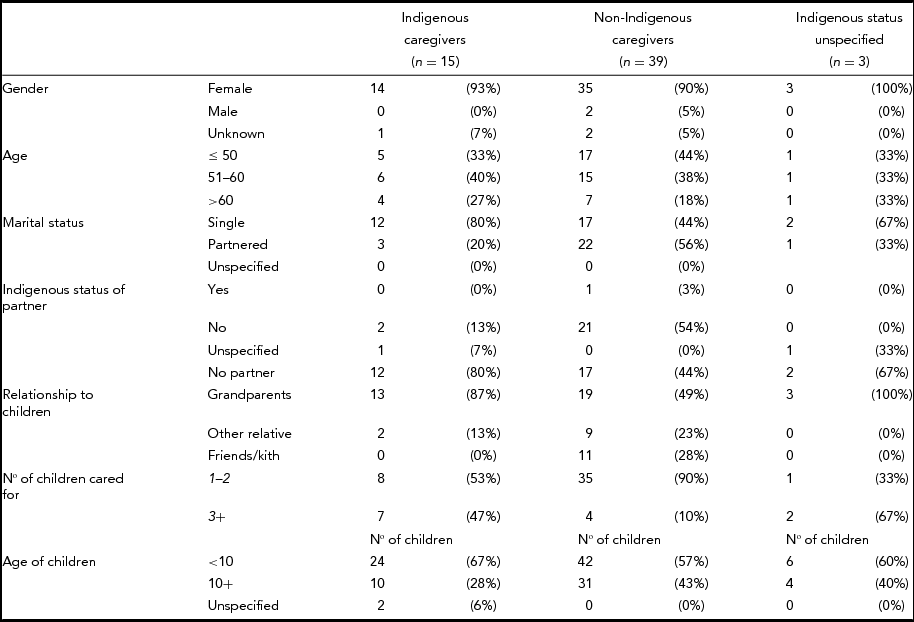
Fifty-seven caregivers reported that they were looking after Indigenous children, a total of 109 children. Table 1 provides details of these carers. One-quarter (15) of these carers were Indigenous, two-thirds (39) were non-Indigenous and three were unspecified. At least two-thirds of the Indigenous children were in non-Indigenous care, which is a little higher than the population figures for children in kinship care at that time (51%) (Australian Institute of Health and Welfare, 2011a). Six children had Torres Strait Islander identity, three of whom were both Aboriginal and Torres Strait Islanders. One carer was a Torres Strait Islander.
Kinship carers of Indigenous children.
Almost all (96%) of the carers were female. All the Indigenous carers were family members; most (13 of 15) were grandmothers. Of the non-Indigenous carers, only half were grandparents. Over one-quarter (11 of 39) of the non-Indigenous carers were unrelated, that is, ‘friends’ or ‘kith’ carers. Compared with the non-Indigenous caregivers of Indigenous children, the Indigenous caregivers were older, and more often single. They were more often caring for larger numbers of children, and for a greater proportion of younger children.
Cultural Support Planning
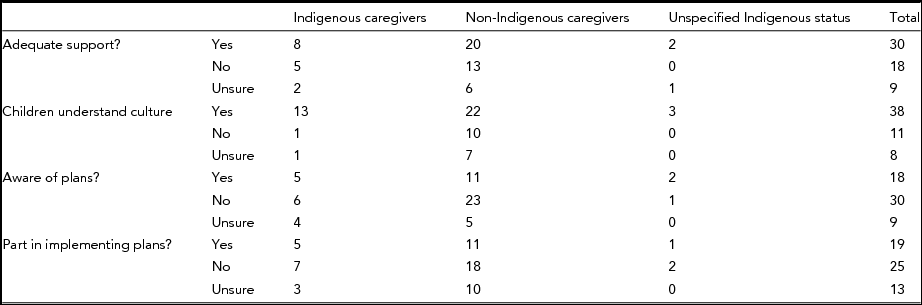
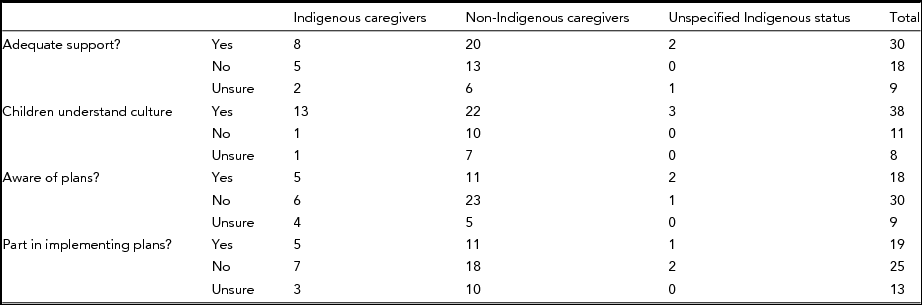
There was a marked difference between the experiences of Indigenous and non-Indigenous respondents in terms of children's understanding of their culture (Table 2). Most (13 of 15) of the Indigenous carers saw children in their care as understanding their culture. However, only half (22 of 39) of the non-Indigenous carers of Indigenous children saw the children in their care as having an active understanding of their Indigenous culture. Only around half of both the Indigenous caregivers (8 of 15) and non-Indigenous caregivers (20 of 39) reported that they were receiving adequate support for the children's contact with their family and culture. Only one-third (18 of 57) of all the caregivers reported that they were aware of the cultural support plans for children in their care, and only one-third (19 of 57) reported having a part in implementing such plans.
Survey responses: support for Indigenous children's culture.
A number of comments were made by carers about their commitment to the children and issues of keeping children in contact with their family members.
“Family needs family. And if their mother can't be there, well then, I’m there. I will not let strangers bring up my grandchildren.” (Indigenous carer)
“They know where they come from and are encouraged in cultural perspectives.” (Indigenous carer)
“Would love for the children to learn and know of their culture as they do mine! A little each day.” (Non-Indigenous carer)
Unmet Support Needs
Permeating comments on questionnaires were wider issues about the burden of care and unmet support needs. Housing and financial constraints were mentioned; however, the greatest number of comments was about unmet needs for social support. A number of carers mentioned behavioural problems that required intervention such as child counselling and carer training. They also articulated the need for practical help with daily living and respite care. It was widely seen that support was not forthcoming.
“We are nine, living in a three-bedroom house – I sleep in the garage with two children. That's the thanks we get!” (Non-Indigenous carer)
“It has be the most stressful undertaking of my life. The children required intensive counselling, health care and had behavioural issues, when placed with us.” (Non-Indigenous carer)
“We have our right to be grandparents taken from us and we become parents again. And it puts a bit on husband and wife relationships. I know several families where the marital relationship has broken down.” (Indigenous carer)
Results – Focus Groups
Of the thirteen participants, 11 were Aboriginal and the other two had Aboriginal family. Eleven were case managers or support workers, and at least five were current or past caregivers.
Themes of discussion included the imperative of family contact, despite difficulties; the challenges of providing support for contact arrangements; broader casework issues; and carers’ support needs. In reporting these issues, extensive quotes are used to promote the voice of the participants.
Culture and Family
The overwhelming theme in participants’ comments was the importance of family, community and culture to children's wellbeing. Kinship care was seen as fitting naturally into the Indigenous world view.
“Well, the strength [of kinship care] is that children remain within their extended family, which supports our philosophy around self-determination, self-management . . . The family best knows the family circumstances.” (Jenny, worker)
The inclusive definition of family was stressed by many participants, with terms like ‘sister’, ‘uncle’ and ‘cousin’ describing a range of biological and non-biological family relationships. A lack of distinction between kinship care and foster care was evident in discussions. A number of participants spoke of the imperative of family obligations. Several participants had grown up in families that had taken on the care of many children with the long stayers becoming brothers and sisters.
“Our family is everybody. It's not just the immediate family, Mum and Dad and siblings. You had the whole works and jerks of a Koori family . . . baby, newborn, toddler, youth, middle aged, right up to the elder, that's our kinship from that child . . . that's the way we’ve been brought up.” (Rose, worker and carer)
“Even though they’re not blood related, like in a white man's sense, they are my brother and sisters and I have to take care of them.” (Nicole, worker and carer)
The legacy of the Stolen Generations was mentioned in each group as having a powerful influence on the lives of Aboriginal families. Mental health issues, substance abuse, violence, poor parenting, perpetuation of the cycle of child removal and a mistrust of authority were described as the result of these experiences. Some families were seen to be providing care to additional children despite their own issues with trauma past or present. Preventing further removal of children from their families and communities was described as a major priority.
“As long as that kid doesn't lose their identity and way, they’re fine, no matter whose care they’re in. Because at the end of the day they’re going to come looking for their mob . . . But at least you know they’ve got reconnection and know people loved them and they weren't given away. That's what I truly believe, that our kids need to be connected to family and community.” (Rose, worker and carer)
“My parents are foster carers. They’ve had about 50 kids on [service] books, but off the books they’ve had about a hundred or so . . . Mum said you know, your [kin] brother can't take care of his daughter and he's thinking of putting her in the home in town. Me and my brother looked at each other and we vowed that none of our [kin] brother's or sister's kids would end up in a home. Because me and my brother did a stint in there . . . On and off, my mother and father would fall off the wagon – you know, I don't blame them, they were just young parents . . . So for me and my younger brother it was like, ‘No’ . . . Having the foster kids in care has opened our eyes that it's a community responsibility, it's a family responsibility.” (Nicole, worker and carer)
The diversity of Indigenous cultures was mentioned by several participants who felt that this is frequently overlooked by non-Indigenous workers. Differences were between clan groups; between traditional and contemporary culture; between urban and rural communities; and between the remote communities of northern Australia and Victorian communities. Cultural awareness training for non-Indigenous workers was thus seen as critical.
“I think one of the big things at the moment is you have to emphasise understanding how community and culture impacts on families. Because that's massive.” (Sue, worker)
“But I think too, they need to do some cultural awareness training, so they get a bit of a sense of our sense of humour as well.” (Jenny, worker)
Family Contact
Parental contact for children in kinship care was generally seen as essential, but often very challenging. Due to cultural imperatives, contact between children and their parents was seen by a number of participants as likely to occur regardless of legal orders and parents’ difficulties. The children's safety was of utmost importance, so caseworkers saw their role as keeping contact arrangements safe and imposing restrictions on an ad hoc basis as necessary, such as when a parent was substance-affected. An example was given where an arrangement between child protection and an Aboriginal service had been made for a young woman's contact visit with her child to be supervised in the service's playgroup setting. This provided the mother with a comfortable environment in which to relate to her child, which included peer and professional support.
“A lot of the family will just let [contact] happen anyway. Like, if they’re living in the same community, they’re not going to stop Mum and Dad coming to the door if their own child's inside. So it's around more putting strategies in place to protect the child and the carer if need be, rather than stop the parent from coming.” (Sue, worker)
“We’ve got a couple that aren't safe [to have contact such as] where an older child is incarcerated for murder or for whatever. There's one probably we’ll be actively not supporting, when the older brother comes out, because it's not going to be good for the younger one. But we’ll do that in consultation with the family and with DHS.” (Sue, worker)
Considerable discussion took place about the children's links to their wider family, including aunts and uncles. Geographical and financial constraints sometimes prevented adequate contact, especially in country areas and when family members did not own cars. Searching for lost relatives also featured in discussions, with some participants mentioning Facebook as a way in which some people searched for lost family members.
“It shouldn't just be about Mum and Dad, it's about the whole family – bet you that child, they need that connection.” (Marjorie, worker and carer)
“With this technology Facebook and that, well my eldest daughter was online talking to some woman up in Mount Isa, to find out it was their brother's aunty who's been looking for them for years they said . . . Two different mobs, they don't know our ways. Now . . . he [stepson] rings them every day and talks to them by Facebook or phone . . . We’ve just been waiting for him to turn up.” (Rose, worker and carer)
Also mentioned was the importance of recognising children's key relationships when making decisions about the most appropriate placement. This included both Aboriginal and non-Aboriginal relationships for children with a mixed heritage family. However, for those children who were living with non-Aboriginal families, caregivers’ negative attitudes were sometimes observed to be a barrier to children's contact with their Aboriginal family and culture. Staff saw a role for engagement with non-Aboriginal family to break down prejudice and find ways to facilitate these connections.
“The grandmother is non-Indigenous . . . She was very negative towards the community . . . [but] it's a different perspective now on the grandmother's part because we sat down and explained it all . . . And we’re going to introduce the community . . . and now she's a very happy Grandma. In the first place it was, ‘You’re not taking my bloody grandkids’.” (Gary, worker)
Participants described difficulties of cultural support planning. These included limited understanding of the requirements of the process and who is responsible for it; limited capacity within Aboriginal services to lead the process; and the expectation that Aboriginal services will be the keepers of cultural knowledge relevant to all clans and nations. These limitations were seen as sometimes leading to ‘cultural tourism’ such as a child going ‘out bush’ with an Elder or attending cultural festivities, without meaningful contact with their Indigenous family. Participants said the plan review process should include detailed discussion with children and families about their wishes.
“Real cultural experiences that provide a sense of connection to the child's immediate family and community could be as simple as connecting children with their sibling or extended family in ways in which the child is able to reflect on its relevance.” (Sally, worker)
Caregiver Assessment
Standards of caregiver assessment were discussed at some length. Children's safety was considered to be paramount; however, the interpretation of caregivers’ circumstances was seen as raising issues of cultural differences between Aboriginal communities and wider Australian society. A lack of collaborative casework between child protection and Aboriginal services was seen as affecting assessment processes at times, and as compromising care outcomes. It was also suggested that Aboriginal services staff were sometimes reluctant to threaten a child's stability by challenging care arrangements that they saw as unsatisfactory.
Assessment errors included both inappropriately excluded and included caregiving families. It was suggested that the quality of relationships needed to be balanced against common physical limitations, such as crowded housing. A concern was the inadequate assessment of all the family members regularly living in one household. Several participants mentioned that the cultural imperative to care for children was a particular challenge, in that families were unlikely to self-assess their capacity to provide care, and to decline when appropriate.
“It's all very well keeping our kids in our community, but what level of care is being provided? If you’re putting [children] in care into a kinship place where the kids aren't safe, that's borderline – I think don't put them in at all – that would be my view.” (Gary, worker)
“So even if a Grandma didn't feel she was fit enough or strong enough to take on care, she would never say ‘No’. So [it’s] cultural. Culture is a huge, huge issue. Or in terms of family . . . there usually is another half a dozen people living in the house . . . they’re not going to tell their family that they’re not welcome there.” (Sue, worker)
“We’ve got one carer who is living in accommodation that's just very small. But at the end of the day a decision was made to place these children with this carer and I think ultimately it was the right decision, despite the accommodation. Because we as Aboriginal people don't all have our own bedrooms and our own space.” (Jenny, worker)
A cultural practice of parents using harsh language and threats of physical punishment was seen as raising particularly challenging issues for appropriate assessment.
“Our tradition is oral and our discipline's in the form of oral rather than physical and flog . . . our discipline is with our words – ‘Keep going mister . . . I’ll flog you, I’ll flog you.’ You can hear that 50,000 times a year . . . Where someone else will just go up and slap, slap their children straight away . . . Well it's the different levels of voice you use to give that discipline to get control.” (Sally, worker)
“‘I’ll threaten them’ – that's how they talk, the families. That came [up in a] kinship assessment and nearly knocked it on the head. [It’s] the Aboriginal person that you’re talking to. [But] that doesn't come up good – because you’re not supposed to talk like that to a child . . . I think that the workers doing the assessments need cultural training.” (Gary, worker)
A number of workers raised the use of police records checks in assessment as presenting unintended consequences. When used to approve carers in the absence of in-depth assessment, police checks were seen as potentially exposing children to unseen risks. On the other hand, they were also seen to sometimes exclude suitable caregivers where past offences were wrongly interpreted as posing a risk to children, or where a potentially suitable caregiver was unwilling to undergo a police check because of a fear of authority.
“A lot of our community . . . had either a drunk and disorderly or something else. Now . . . they’re frightened of going, because they think it’ll come up in the police check. So a lot of our community are not applying for that because of a ‘previous’.” (Gary, worker)
“We don't have a lot of Aboriginal carers. When that new rule came in a few years ago about the police checks and Working With Children checks . . . look, a lot of our mob are pretty alright, [but they] don't like police nosing around . . . So what if they’ve had a little fight and that, you can overcome those sorts of things. That could have happened years ago . . . I don't know how we’re going to do it; maybe away from [our service] at a hall or something with a feed, to give them just a police check.” (Rose, worker and carer)
It was also suggested that sometimes the non-Aboriginal side of a family was less scrutinised during care assessments than the Aboriginal side, leading to a bias towards non-Aboriginal care. In the face of the complexity of family assessment, Aboriginal input into all assessments was seen as critical.
Caregiver and Casework Skills
A feature of the discussions was the level of empathy and understanding demonstrated by caseworkers and caregivers in efforts to keep families connected. Non-judgemental approaches that took personal and collective history into account were evident in the way family problems were understood and interventions made. Parents and children were typically referred to by epithets such as ‘the young bloke’ and ‘that little one’. In seeking to help, participants did not differentiate their roles as workers, carers and members of family and community.
“Look . . . our mob is very loud. They’re only loud when they’re stressed . . . Let them express their feelings and don't take it personally – but make sure their safety is in place. I mean they had no house and they’ve got kids and just had a baby, their children have been removed; they’ve got a crisis, they’ve got a death in the family, they’re at wits’ end. They just want a voice – sit down and let them be, they calm down . . . they’re frustrated, who else do they go to? Don't judge them I suppose . . . I think we just need to make sure that they’ve been heard and make sure that our kids are reconnected to all their family and community.” (Sue, worker)
“It's a family responsibility . . . Mum and Dad will explain who [the children] are and what's gone on with that kid. We had one little girl that was sexually assaulted and she was very scared of girls, women, because it was her mother that done it. So me and my niece had to keep our distance from her, until she had gotten used to us and felt that she was protected . . . we sit down and discuss what the best action is for that child to make sure they feel comfortable. So my Dad will ring us and one by one we’ll come home . . . and have tea, and sit down and just yarn with the little person.” (Nicole, worker and carer)
Other issues mentioned were the challenge of establishing trust among people suspicious of welfare intervention and the importance of working directly with children and listening to their views.
“There's some very sensitive people there . . . and I suppose it's getting to know them before you start on the work. Even with the Koori workers, we were still very sensitive . . . But as far as non-Indigenous working – [you] need to stress that point . . . Trust is a very big thing. They don't trust anybody, so get that trust first then they’ll work with you.” (John, worker)
“Talk to the actual kids, they’ll be very honest about their placement . . . they don't hide nothing . . . get new workers to build trust with them kids and they will just spill their guts really.” (Sally, worker)
Support to Children and their Families
There was much discussion of contextual issues affecting family and cultural contact. Participants described the straitened circumstances of many Aboriginal families, and the need for practical and emotional support to enable children to remain in contact with family and community.
“It's very hard when you’ve got six or seven kids and you’re supposed to [attend] care team meetings for those six kids once a month and do face-to-face contact, things like that.” (Rose, worker and carer)
“I’ve actually dealt with one . . . where we’ve now seen the children being placed [away] in Melbourne . . . Had we been able to put services in to provide that support to the carers who felt that they had no respite care or anything like that . . . Those carers now can't look after those kids. And it's hard enough to get kinship carers, but particularly when the children have got a real disability, how do you do it? (Gary, worker)
Both carers and staff were seen to need training to understand issues of grief, loss and trauma; and staff needed training in mediation when family dynamics were difficult.
“The [staff] would have [to develop] those skills in being able to mediate. A kinship worker may have to go out there and actually be a bit of a buffer. I mean, it's a grandmother who's looking after her grandkid, then having Mum rock up. You know, that's going to be really tricky and I’m sure [these skills] wouldn't just happen with our community.” (Sally, worker)
“Kinship carers need support in understanding how and why we should be working therapeutically with children to address these issues . . . the language and terminology needs to be made more attractive for carers and young Aboriginal people who want to be a part of therapeutic work, and the expectations of families need to be upfront with regards to response . . . [otherwise] we will continue to see the gap between families become wider in terms of any potential for reunification.” (Sally, worker)
Discussion
This research study, one of the first about Australian Indigenous kinship care, highlights a number of issues for policy and practice. It supports the view that properly assessed and supported kinship care can assure the wellbeing of Indigenous children and support their family and cultural connections. However, issues of safety need to be addressed in a sophisticated manner – in their determination to maintain family contact, parents and other family members may sabotage efforts to simply restrict contact with their children.
The study also provided early evidence of some difficulties in the area of cultural support planning, in particular indications that some children in non-Indigenous kinship care in Victoria may be growing up without an active connection to their Indigenous family and culture. An active partnership between child protection and Indigenous services is needed if plans are to be accurate and effective in keeping children connected with family and culture. A plan needs to be developed and reviewed regularly for every Indigenous child in care, not just those on Guardianship Orders.
Our consultations also highlighted difficulties in Indigenous kinship care assessment and support which are of particular concern given the vulnerability of many Indigenous kinship families. Much research has provided evidence that kinship carers in general are older, poorer, in poorer health and have lower levels of education than foster carers (Boetto, Reference Boetto2010) and this pattern of disadvantage is understood to apply in even greater measure to Indigenous carers. Households are also known to be larger and more crowded, and offending histories are more common. The culture of parenting in an Indigenous family may differ from that of non-Indigenous families (SNAICC, 2004a); this is supported by the results of this study. The older age of the Indigenous carers in our survey population may be of particular concern given that there is still a gap of nearly 10 years in life expectancy between Indigenous and non-Indigenous Australian females (Australian Institute of Health and Welfare, 2014a), and when last measured, mortality rates for Indigenous Australians aged 50–74 years were more than double non-Indigenous rates (Australian Institute of Health and Welfare, 2011b). Assessment of a whole kinship household needs to be thorough and nuanced to weigh up the benefits to a child of love, commitment and the security of being in one's own family or community network with any identified concerns. As carers age and young children turn into adolescents, providing substantial support is critical, both with managing contact with children's parents and other family members, and with the many other challenges they face.
Effective assessment and support of kinship families caring for Indigenous children requires collaboration with Indigenous services. Interventions need to be built on an understanding of the impact of the Stolen Generations on the functioning of families and communities today. Trust of welfare workers, both Indigenous and non-Indigenous, is often lacking; it may be slow to be established and easily destroyed. More focus is needed on relationship-building between workers, carers and parents from the outset of care, both to improve contact experiences and stabilise care arrangements, and to maximise the chance for reunification where possible. Indigenous services are limited by the huge demands on their time and a still-developing skill base, so they need to be well-resourced for this very challenging work. Their staff and carers need continuing access to training, including therapeutic, trauma-informed responses to children; staff also need training about the challenges of working within their own communities. Cultural awareness training for non-Indigenous workers is critical to combating misunderstandings and misguided attitudes that can impede the assessment and support of kinship families.
In addition to children in statutory kinship care, large numbers of Indigenous children may be in informal care arrangements. These families need to be brought into the service fold to obviate the need for more statutory care in situations of carers who are struggling.
Given the number of non-familial kinship care arrangements found in this study, it may also be desirable to explore further to what extent non-familial kinship care is being used for Indigenous children in Victoria, and how these are determined. Recent evidence suggests that such kinship care arrangements are more vulnerable to breakdown than familial kinship care (Perry, Daly, & Kotler, Reference Perry, Daly and Kotler2012; Sallnas, Vinnerljung, & Westermark, Reference Sallnas, Vinnerljung and Westermark2004). The dimension of different culture may be an additional vulnerability, and non-familial kinship carers may need particular support with keeping children connected to their families.
The approach to kinship care support described by the Aboriginal service workers in this study was characterised by empathy, persistence and creativity, suggesting that these workers may be particularly attuned to the needs of troubled parents, and well-positioned to help when relationships between carers and parents become fraught. There may be much to learn from Indigenous services that would be considered applicable to generalist services that support both Indigenous and non-Indigenous families.
Conclusions
This study has provided evidence of considerable resilience, skill and commitment to care within Indigenous families, services and communities in relation to supporting the connection of Aboriginal children with their family members and culture. However, limitations in cultural support planning, assessment and support of kinship families are of concern, as is the damage caused by limited cultural awareness. Indigenous children in ‘protective’ kinship care may remain at risk until all assessments are thorough and culturally aware, and robust support is available to caregiving families.
The final word comes from a survey respondent:
“We love caring for all the children and see them develop and gain confidence. It is not an easy path at times but it is not dull! Kinship care seems to be the ‘Cinderella’ of the care system, so I hope your research project might help these people.” (Non-Indigenous carer of Indigenous child)
We hope so too.
Acknowledgements
We thank all the caregivers of Indigenous children who completed the survey. We also thank the Victorian Aboriginal Child Care Agency (VACCA), Rumbalara Family Services and Gippsland and East Gippsland Aboriginal Cooperative (GEGAC) for their participation and assistance. The contribution of Emeritus Professor Bruce Lagay with survey data processing is acknowledged with appreciation.
The project was supported financially by the Victorian Department of Human Services, the Victorian Office of the Child Safety Commissioner (now the Commission for Children and Young People, Victoria), the Federal Department of Families, Housing, Community Services and Indigenous Affairs (now the Australian Government Department of Social Services) and the R E Ross Trust. None of these bodies were involved in decision-making in the research or publication process.