I. INTRODUCTION
One of the most important properties of a high-energy laser (HEL) exit aperture (windows) is the absorption coefficient at the laser wavelength of interest. Absorption causes a cascade effect that negatively impacts the emitted laser power. When a high-energy beam transmits through a window material, a part of the laser energy is absorbed (usually by impurity elements that form absorption centers) and causes the window to heat. Heating, in turn, causes changes in the refractive index (n) of the window as a function of the material's thermo-optic coefficient (dn/dT). These changes result in beam distortion and loss of output power as measured by the optical path distortion (OPD) and have a severe impact on system performance.Reference Bayya, Chin, Sanghera and Aggarwal1
In addition to low absorption, the window should also be strong and environmentally rugged. Higher strength enables thinner windows which reduces the absorption loss, improves OPD, and decreases the window weight. Environmental ruggedness prevents reactions with pollutants and sea spray. As with all systems, window material selection is a compromise. Currently, HEL systems operating in the short wavelength infrared (SWIR, 1–2 μm) region use fused silica and oxyfluoride glasses (OFG).Reference Klein2 Although these materials have very low absorption, they are fairly weak. New options for HEL windows include transparent ceramic materials such as sapphire, ALON, and magnesium aluminate spinel, usually referred to as simply ‘spinel’. These materials are considerably stronger than glass but have higher absorption and higher dn/dT.3–Reference Moynihan and Loehr8
Spinel ceramic windows are typically fabricated from commercial powder by various densification methods such as vacuum sintering and hot pressing, with the addition of LiF sintering aid in the case of hot pressing.Reference Villalobos, Sanghera and Aggarwal9–Reference Roy and Hastert13 However, as has been noted by many other researchers, the absorption of spinel is generally above 21,000 ppm/cm (21,000 × 10−6/cm) in the 1–2 µm range.Reference Klein2,Reference Harris, Johnson, Seaver, Lewis, Turri, Bass, Zelmon and Haynes14 While a 20,000 ppm/cm absorption is generally acceptable for sensor windows and for armor applications, it is too high for high power laser applications due to beam distortion effects that are directly attributable to absorption of the laser beam energy.Reference Tropf, Thomas and Palik15–Reference Koechner17 The high absorption is not an inherent function of the spinel matrix, but is a result of impurity elements in the spinel that are not removed before or during densification.Reference Kim, Baker, Villalobos, Frantz, Shaw, Lutz, Sadowski, Kung, Hunt, Sanghera and Aggarwal18–Reference Reimanis, Rozenburg, Kleebe, Cook and Tustison20
We have investigated and developed techniques to lower the concentration of impurity elements that absorb in the 1–2 μm range in commercially available spinel powders. In this paper we will discuss those techniques and compare commercial and low loss spinel with sapphire and ALON that we measured concurrently with our spinel samples.
II. EXPERIMENTAL
The starting material was commercially available spinel powder (Baikowski grade S30CR). The powders were processed by either washing in HNO3, improving the distribution of LiF sintering aid by coating the powder particles,Reference Villalobos, Sanghera, Bayya and Aggarwal21 and/or by hot pressing in excess LiF sintering aid.
Acid washing was accomplished in 1500-mL glass breakers using Teflon-coated magnetic stirrers. Twenty grams of spinel powder were suspended in 50 mL of HNO3 and the suspension stirred for 1/2 h. The suspension was centrifuged, decanted, and washed with deionized (DI) water four times to remove traces of acid and the acid soluble impurities. The powder was dried overnight at 80 °C and baked in air at 600 °C for 6 h.
Standard sintering aid additions simply involve manual mixing of the spinel and the LiF sintering aid. Improved distribution of the sintering aid was accomplished by a sedimentation coating technique where LiF was dissolved in DI water and the spinel powder added while stirring on a hot plate with a magnetic stirrer. Stirring was continued while heating to slowly evaporate the DI water. Eventually the LiF solution saturates and comes out of solution. When the material becomes a paste, it was placed in a drying oven at 80 °C. The dried powder was heat treated at 600 °C for 6 h and hot pressed.
Densification of the powder was performed by vacuum hot pressing in 25-mm-diameter (i.d.) graphite dies that were lined with graphite-foil (Graftech grade GTA, Cleveland, OH). Hot pressing includes a 2 h hold at 1300 °C to remove the LiF sintering aid and a final hold at 1600 °C for 2 h at 50 MPa to densify the samples. An initial pressure of 5 MPa was maintained until the end of the 1300 °C hold and then ramped to the final 50 MPa. Samples were then hot isostatically pressed (HIP) at 1700 °C at 200 MPa for 4 h and optically polished.
The purity of the powder and ceramic was characterized using glow discharge mass spectrometry (GDMS) (EAG Lab). The median and mean particle size and distribution of the powder were measured by laser diffraction/scattering using a Horiba LA-950 system (Horiba, Kyoto, Japan). Before laser diffraction/scattering was performed, the samples were sonicated until the point where the particle size distributions do not change with further sonication. The laser diffraction/scattering was then performed immediately. Powder surface area was measured using microporosimetry (BET method, Micromeritics, Norcross, GA).
Absorption loss measurements were performed on polished ceramic samples using the photothermal common-path interferometry (PCI) method (Stanford Photo-Thermal Solutions, Pahoa, HI). Absorption loss measurements were performed on laser window grade sapphire (Meller Optics, Inc., Providence, RI) and ALON (Raytheon Co., MA) samples at the same time as the procedures were performed in the spinel samples. The PCI method uses a 2 laser system. The pump laser is at the wavelength of interest (1.06 µm was used in this study) and is focused in the sample. The probe laser is a HeNe that interrogates the area affected by the pump laser. Distortions caused by the pump laser in the material cause interference in the probe laser that is directly proportional to the material absorption.Reference Alexandrovski, Fejer, Markosian and Route22Figure 1 shows a schematic of the PCI setup from Stanford Photo-Thermal Solutions (STPS). Due to the size of the distorted area and the effect of the surface of the samples, more exact measurements are obtained with thicker samples.
Schematic of the PCI method, from STPS.

III. RESULTS AND DISCUSSION
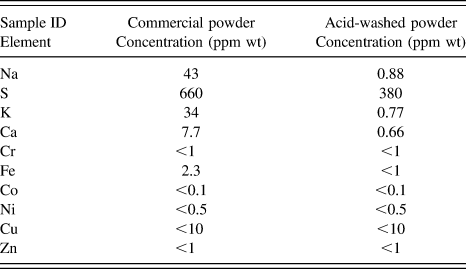
Scanning electron microscopy of the commercial powder shows it to be made up of 50 nm grains agglomerated into highly porous 10–100 µm particles. The large particles are soft agglomerates that readily break up into a bimodal distribution centered on 200 nm and 8 µm as determined by laser scattering particle size analysis. The BET surface area is 30 m2/g. GDMS analysis of the commercial powder shows that it is relatively pure, other than the sulfur from the precursor materials, and that acid washing results in a decrease of the impurity content (Table I). The decrease in impurity content by simply acid washing the powder suggests that most of the impurities are on the surface and are not inside the powder grain structure. Surface impurities could be a result of insufficient rinsing of the powder during synthesis which allowed the impurities to settle on the particle surface during drying, and/or the high energy surface of the particles attracts impurities while still in suspension during the synthesis process. Sintering of the spinel powder without cleaning the surface traps the impurities in the matrix and leads to the increased absorption usually reported for spinel. The only impurity not effectively removed by acid washing is sulfur. However, sulfur is removed by the LiF sintering aid. Our experience shows that 0.5% by weight LiF reduces the sulfur to below GDMS detection limits in the hot-pressed samples.
GDMS analysis of commercial spinel powder before and after acid washing.
Once it is hypothesized that surface impurities affect the absorption of spinel, there are two methods that can be used to achieve low absorption: pretreat the spinel surface to remove impurities before the densification process and/or remove the impurities during hot pressing. In our case, acid washing achieves the former, while the use of sintering aids that react and form volatile species with the impurity elements takes care of the latter.
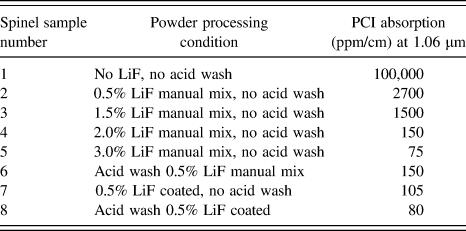
Lithium fluoride is the standard sintering aid used to produce transparent spinel by hot pressing and is generally removed by inserting holds in the 1200–1300 °C range during the hot press schedule.Reference Villalobos, Sanghera and Aggarwal9–Reference Roy and Hastert13 In the case of pressureless sintering or by hot pressing with vitreous carbon insertsReference Villalobos, Bayya, Kim, Sanghera, Sadowski, Miklos, Florea, Aggarwal, Swab, Halbig and Mathur23 it is possible to eliminate the use of LiF. Elimination of LiF is thought to be desirable because it is considered to be a detriment to mechanical properties of densified spinel,Reference Kim, Baker, Villalobos, Frantz, Shaw, Lutz, Sadowski, Kung, Hunt, Sanghera and Aggarwal18–Reference Reimanis, Rozenburg, Kleebe, Cook and Tustison20 so there is a concerted effort to reduce the amount of LiF that is used during hot pressing.Reference Villalobos, Sanghera and Aggarwal9,Reference Reimanis, Rozenburg, Kleebe, Cook and Tustison20,Reference Villalobos, Bayya, Kim, Sanghera, Sadowski, Miklos, Florea, Aggarwal, Swab, Halbig and Mathur23 Nevertheless, our absorption measurements in Table II show that increasing the amount of LiF (by weight) greatly decreases the absorption at 1–2 µm wavelength range. It should be noted that it was necessary to increase our hold times at 1300 °C from 0.5 to 2 h to remove the extra LiF and produce clear samples.
Effect of processing variables on hot pressed spinel absorption loss.
Table II shows the sample number, powder processing method(s), and the absorption of densified spinel disks. The first 5 samples are separated from top to bottom by the amount of LiF used during densification. Except for sample 1 which had no LiF, samples 2–5 were manually mixed; meaning that the LiF was added to the spinel powder and mixed with a plastic spatula for 5 min before placing the powder in the hot press die. From our previous experiences it was determined that this mixing method produced less contamination than ball milling techniques. As the amount of manually mixed LiF is increased from 0 to 3% by weight, the absorption is dramatically reduced from 100,000 to 75 ppm/cm. It should be noted that our standard addition of LiF sintering aid is around 0.5% so a more realistic comparison of absorption results would be a decrease from 2700 to 75 ppm/cm (samples 2–5). The decrease in absorption as a function of LiF addition appears to be exponential. As will be explained below, the reduction in absorption is related to the amount of LiF coverage of the particle surface which is a squared term. The 21,000 ppm/cm absorption value found in the literature suggests that other researchers tend to use less LiF sintering aid than we do.
Further study of Table II shows that acid washing the spinel powder before manually mixing LiF also has a dramatic improvement in absorption. Sample 2, as described above, has 0.5% LiF that was manually mixed, while in sample 6 the spinel powder was acid washed before manually mixing with 0.5% LiF. The absorption drops from 2700 to150 ppm/cm. This improvement is not as good as adding 3% LiF, but it does have the advantage that less LiF can be used during hot pressing, and perhaps a better or a combination of solvents may further improve the effect of prewashing the powders.
Table II also compares the effect of coating the spinel particles with LiF prior to hot pressing. In this method, the LiF is dissolved in DI water and allowed to precipitate on the spinel powder suspended in the LiF solution as the water is evaporated. Sample 7 was coated with the standard 0.5% LiF and shows much less absorption than sample 2 which was manually mixed with the same 0.5% LiF. The absorption drops from 2700 ppm/cm in the manual mixed sample to 105 ppm/cm in the coated sample. The absorption value of the coated sample is as if it had been manually mixed with 2–3% LiF. Combining acid washing with coating (sample 8) results in an absorption value of 80 ppm/cm which is within the measurement error of the 3% LiF manually mixed sample. The combination of acid washing and coating also alleviates any misgivings about using excessive amounts of LiF during the densification of spinel.
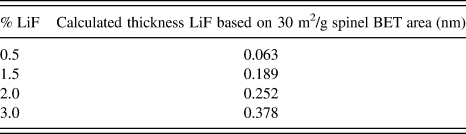
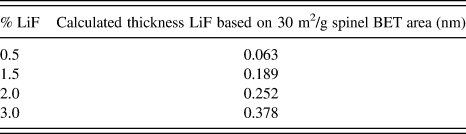
During the initial stages of the hot-pressing process, LiF melts at 850 °C and flows to form a thin layer on spinel particles. Table III lists the thickness that an LiF layer would have to be if it were to cover the entire 30 m2/g BET surface area of the spinel powder, assuming uniform distribution of LiF. The thickness value was calculated as a function of the weight percent LiF used in hot pressing and its density of 2.64 g/cm3.Reference Aigueperse, Mollard, Devilliers, Chemla, Faron, Romano and Cuer24 Since the ionic radii of Li and F are respectively 0.090 nm and 0.119 nm,Reference Shannon25 it is doubtful that full coverage is attained at <2% LiF where the calculated coating thickness is over twice the ionic radius of fluorine. Referring Table II, the value of 2% LiF coincides with a drop in absorption from 1500 to 150 ppm/cm. There is a further drop at 3% LiF to 75 ppm/cm, but the rate of decrease is slow and we shall see in future experiments if further increase in the percent LiF results in the absorption approaching an asymptote. The remaining absorption is presumably due to impurity elements within the as-received powder particles that are inaccessible from the surface.
Calculated thickness of LiF spread over the 30 m2/g BET surface area of spinel powder as a function of the weight percent of the LiF added and the powders.
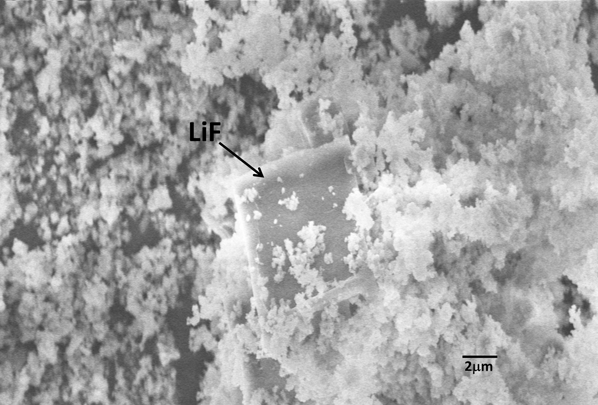
It is interesting to note that the coated samples exhibit lower absorption than the manually mixed sample of equal LiF content. There are two possible effects that can account for this. (i) Li+ and F− dissolved in the coating solution react with the impurity elements on the spinel surface during the stirring/evaporation process. This effect would be similar to the mechanism in the acid washing process. (ii) Better distribution of LiF in the spinel during hot pressing allows for shorter diffusion distances and higher probability of reaction with impurity elements. Figure 2 shows the size difference between the large LiF square in the center of the micrograph and the spinel particles in a manual mixed sample. The size difference illustrates the consequent LiF distribution inhomogeneity that can be expected. Presumably at the higher LiF contents it is easier to fully cover all the exposed spinel surfaces.
SEM micrograph of manually mixed 0.5% by weight LiF crystal surrounded by spinel powder.
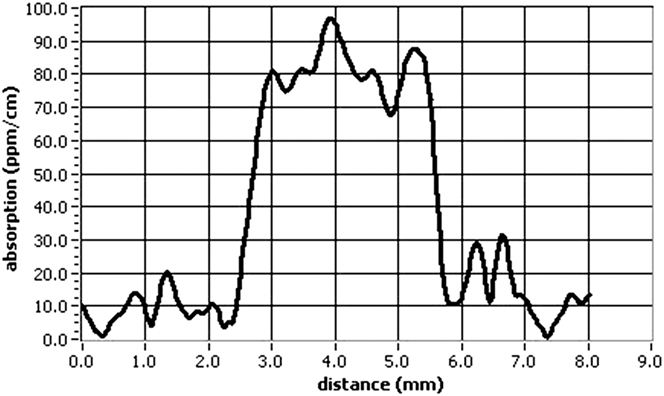
Care must be taken in interpreting the PCI absorption patterns. The polish, surface contaminants, and thickness of the sample can skew the absorption measurements. Figure 3 shows the absorption pattern of sample 5 (3% LiF manually mixed). The x axis is the position along the thickness of the sample and the y axis is the absorption value as a function of position. The pattern shows an optically polished sample of sufficient thickness to obtain a good average absorption measurement, in this case about 75 ppm/cm. The front sample surface is at around 2.5 mm and the back surface is around 5.5 mm making the sample about 3 mm thick. The peak at 3 mm shows the effect of the impurities and roughness of the front surface. Impurities in this case can also include residual polishing compound, solvents used in cleaning, finger prints and in some cases impurity elements segregated to the surface. The same effects can be present on the back surface. The bulk absorption at a distance of 3.2–5.0 mm shows some inhomogeneity, but not an excessive amount considering the resolution of the y axis.
Absorption pattern of sample 5, spinel powder with 3.0% LiF manual mixed, hot pressed, HIP and optically polished.
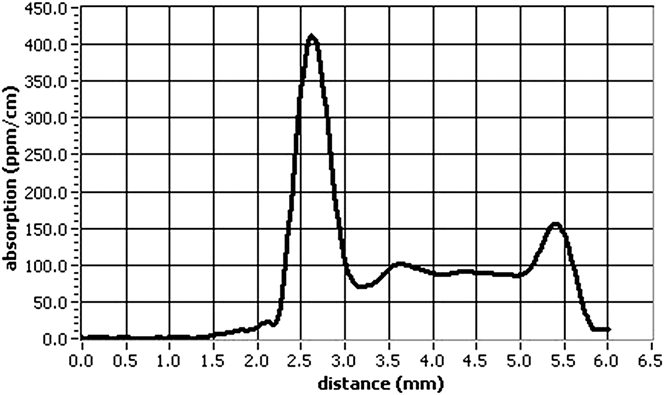
Figure 4 shows the pattern of sample 7, powder coated with 0.5% LiF. This sample was only inspection polished as can be seen from the very large absorption bands for the front and back surfaces. The bulk absorption is around 105 ppm/cm and shows that coating the powder results in more homogeneous bulk absorption due to the more even distribution of the LiF sintering aid.
Absorption pattern of sample 7, spinel powder coated with 0.5% LiF, hot pressed, HIP and inspection polished.
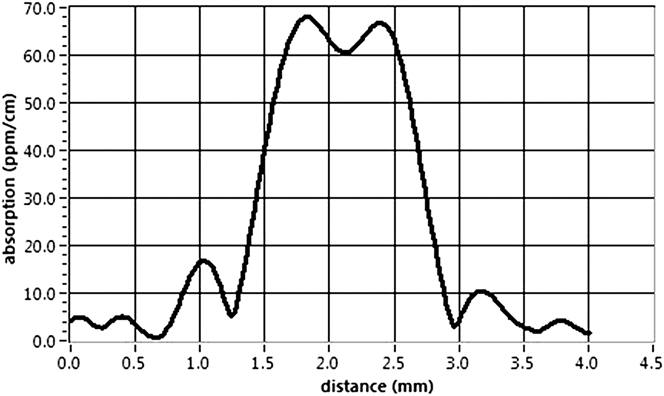
There is no exact metric as to what constitutes a sample that is too thin to measure. What is necessary to obtain a measure of the bulk absorption is a relatively flat area in the pattern between the surface absorption peaks, as is the case in the two previous patterns. Figure 5 shows an example of a pattern from a sample that is too thin to measure and not reported in the table above. The peaks from the front and back surfaces overlap preventing examination of the bulk absorption.
Absorption pattern of coated sample with inspection polish showing detrimental effect of surface polish and lack of sample thickness.
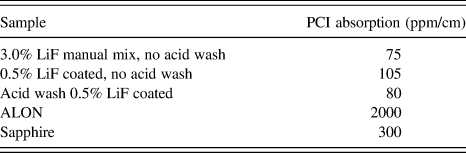
Due to the variability in performing absorption measurements it is useful to perform comparison tests of different materials at the same time. This reduces errors from day to day variations in laser and detector configuration. The materials should be ground to the same size and thickness, and polished to the same standards. For comparison we purchased “laser window” grade sapphire and ALON and measured them side by side with our spinel samples. The results are listed in Table IV along with the results from the best pre- and post-processing conditions used in spinel. The absorption values for sapphire and ALON agree with the values found in the literature.Reference Harris7,Reference Harris, Johnson, Seaver, Lewis, Turri, Bass, Zelmon and Haynes14
Absorption data for spinel, ALON, and sapphire taken under the same conditions at the same time.
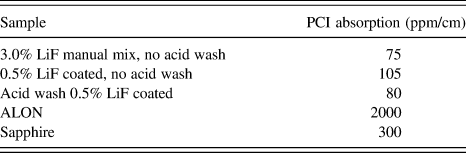
It is interesting to note that our standard (0.5% LiF manually mixed) spinel and commercially available ALON both have absorptions in the 2000–3000 ppm/cm range. Since ALON and spinel are both polycrystalline materials densified from powder, it is assumed that similar powder pre-processing or appropriate choices in densification additives should reduce the absorption in ALON. Sapphire is made by growth from the melt techniques because it has a hexagonal crystal structure and must be used in single crystal form to avoid birefringence. Judging from the absorption of sapphire, it appears that either the starting powder used in the sapphire melt is of higher purity than the starting spinel and ALON powders, that the melt serves to remove impurities, or that the growth process is self-purifying. Figure 6 shows the 3% manually mixed no acid wash spinel sample, the ALON sample, and the sapphire sample. All of the samples are 4 mm thick. Visibly, all three samples show excellent transparency and would make very good sensor windows. However, in a high energy laser system, an increase in absorption can result in thermal heating of the window which in turn reduces the laser beam quality.
Picture of (left to right) the 3% manually mixed no acid wash spinel sample, the ALON sample, and the sapphire sample all showing excellent transparency. All three samples are 4 mm thick.
IV. CONCLUSION
We have developed and demonstrated three techniques that can be used to reduce the absorption loss in densified spinel. We have shown that the key to reducing absorption loss involves the removal of impurity elements that are on the surface of the spinel powder particles. The impurity elements can be removed prior to densification by washing the spinel powder in HNO3, or during densification by increasing the exposure of the surface impurities to the LiF sintering aid. The increased exposure to LiF can be accomplished through improved distribution of the LiF by simply adding excess LiF or by evenly distributing the LiF by a precipitation coating technique. GDMS and experimental evidence show that the impurity elements are concentrated on the surface of the as-received spinel powder as evidenced by a decrease of absorption loss from 100,000 ppm/cm to <75 ppm/cm by treating the surface of the powder. This makes spinel ceramic a much more attractive candidate window material for HEL systems operating in harsh environmental conditions.