The optimal surgical management of neonates and infants with tetralogy of Fallot remains controversial. Evidence suggests that early repair of congenital cardiac disease minimizes the secondary damage to the heart and other organs.Reference Pigula, Khalil, Mayer, del Nido and Jonas1–Reference Castaneda, Mayer, Jonas, Lock, Wessel and Hickey5 The policy of early corrective repair of tetralogy of Fallot, irrespective of age, versus staged repair with construction of a systemic-to-pulmonary shunt, continues to be unresolved. The aim of our study was to analyze the midterm outcome of primary early correction of tetralogy of Fallot, regardless of weight, age, and preoperative state.
Materials and methods
Population
Between January, 1996, and December, 2005, 61 consecutive patients, of whom 45 were boys, all less than 6 months of age, underwent primary early correction of tetralogy of Fallot. In no patient during that period of time did we construct a systemic-to-pulmonary arterial shunt. All the operations were performed by one surgeon working in two institutions, the Slovak Pediatric Heart Centre in Bratislava, Slovakia, and the University Hospital Hamburg-Eppendorf, Germany. Patients with pulmonary atresia, absent pulmonary valve syndrome, and atrioventricular septal defect with common atrioventricular valve were excluded from this study. The median age at surgery was 3.3 months, with a range from 10 days to 6 months. Of the patients, 27 patients (44%) were younger than 3 months of age, including 12 (20%) newborns. The median weight was 4.6 kilograms, with a range from 2.3 to10 kilograms (Table 1).
Demographic data.

Data are displayed as median and range.
In 4 patients, we encountered relevant associated lesions. In 2, there was anomalous origin of the left anterior interventricular coronary artery from the right coronary artery, while the other 2 patients had discontinuity of the left pulmonary artery. The patients were divided into two groups according to age, those younger than 3 months of age, and those aged from 3 to 6 months. All patients younger than 3 months were referred for surgery on an urgent or semi-urgent basis due to spells of sustained cyanosis. Those aged from 3 to 6 months underwent surgery on an elective basis.
At the beginning of our experience, particularly in the patients younger than 3 months of age, the repair was performed under deep hypothermic circulatory arrest. Since 1999, the operation has been performed on cardiopulmonary bypass using mild to moderate hypothermia at temperatures of 32 to 28 degrees Celsius. Repair was predominantly performed through a transatrial approach, with a limited ventriculotomy. The anatomy determined the extent and type of reconstruction of the right ventricular outflow tract. Apart from the closure of the ventricular septal defect, and resection of any obstructive lesions in the right ventricular outflow tract, the surgical repair included a transjunctional patch, augmentation of the pulmonary trunk, reconstruction of the left pulmonary artery, and in one patient, placement of a homograft from the right ventricle to the pulmonary arteries. The rate of transjunctional patching was significantly higher in patients younger than 3 months of age (Table 2).
Operative data.

Data are displayed as median and range.
Data
The study was retrospective, data being obtained from cardiac databases and the review of medical records. Preoperative and postoperative evaluation routinely included a standard 12-lead electrocardiogram, a chest X-ray and a transthoracic echocardiogram with Doppler examination of the heart and the great vessels. Follow-up data was obtained from the inpatient medical records, direct family contact, and correspondence with the referring cardiologists. Median follow-up was 4.5 years, with a range from 0.1 to 12 years.
Statistical analysis
Data was analyzed with a statistical program (JMP Statistical Analysis, Cary, NC). The data is presented as median and range. A p value of less that 0.05 was considered significant. Comparison was made using the chi-squire test and Student’s t-test Actuarial survival, and freedom from reintervention, were determined by the Kaplan-Meier method. Subgroups were compared by the log-rank test.
Results
Early outcome
There was one early death (1.6%). A newborn with the left anterior descending coronary artery crossing the right ventricular outflow tract underwent complete correction with insertion of a pulmonary homograft. After six hours in intensive care, he arrested, and extracorporeal membrane oxygenation was started as a part of resuscitation. On the third day, extensive intracranial hemorrhage was noted and support was stopped on the 4th day. The function of the heart had never recovered. An autopsy was not obtained.
Extracorporeal membrane oxygenation support was also needed in another patient who deteriorated on the first postoperative day due to progressive postoperative right ventricle dysfunction and tricuspid regurgitation. The patient was brought to the operating room, where the entrapment of one of the cordal attachments of the tricuspid valve by a pledget was discovered and corrected. After 5 days of support, the patient was successfully weaned from extracorporeal oxygenation.
There was no difference in survival and the lengths of ventilation or time of hospitalization between the groups. Infective complications were few, but one patient required surgical revision due to infection of a deep sternal wound. The mean length of stay in hospital was 11 days (Table 3).
Post-operative data.

Data are displayed as median and range.
Follow-up
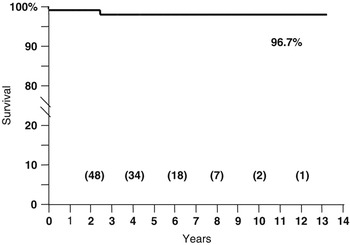
Follow-up data were available for 58 patients (95%), 3 patients having been lost to follow-up. The median follow-up was 4.5 years, with a range from 0.1 to 12 years. There was one sudden late death of unknown cause. Actuarial survival rates were 98.4%, 96.7%, and 96.7% at 1, 5, and 10 years, respectively (Fig. 1). There was no difference in long term survival between the groups (p equals 0.129). None of the tested variables, namely length of cardiopulmonary bypass, aortic cross clamp time, or need for a transjunctional patch, were predictive of mortality.
Actuarial survival at 10 years including operative mortality. The numbers of patients in the follow-up are shown in parenthesis.

A total of 6 patients required reoperations. In 2 patients with discontinuous left pulmonary arteries, corrected initially below the age of 3 months, we had to reconstruct the stenosed left pulmonary artery. In another 4 patients, older than 3 months, further operations were needed because of failure of a homograft, left pulmonary arterial stenosis, and recurrent obstruction of the right ventricular outflow tract in 2 patients. Freedom from reoperation was 98.2%, 92.2%, and 83% at 1, 5, and 10 years respectively, with no difference between the groups (p = 0.679).
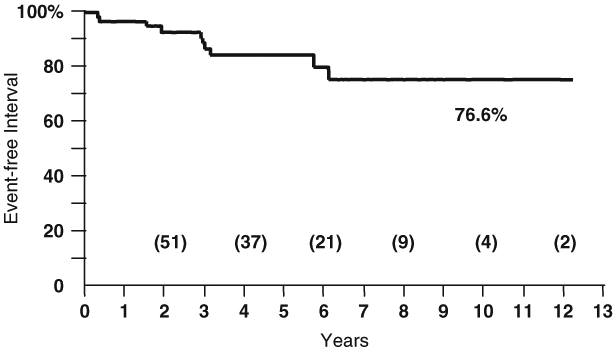
Catheter reintervention was required in 3 further patients. The cumulative event-free interval was 96.7%, 85.6%, and 76.6% at 1, 5, and 10 years respectively (Fig. 2), with no significant difference between the groups (p = 0.435).
Cumulative event-free interval at 10 years. The numbers of patients in the follow-up are shown in parenthesis.

On most recent follow-up by echocardiogram, tiny residual ventricular septal defects were seen in 2 patients, and mild tricuspid regurgitation in 1 patient. All patients are in sinus rhythm. Anti-arrhythmic therapy for supraventricular tachycardia is needed in 2 patients. Another 24 patients (40%) still require medication with digoxin and/or diuretics according to the wishes of the referring cardiologists. All patients showed a normal neurological development, except for one who had seizures, and another one with an attention deficit hyperactivity disorder. The remaining patients are doing well and are thriving adequately.
Discussion
Currently, primary corrective surgery of tetralogy of Fallot is electively performed in asymptomatic patients in the majority of centers between 3 and 6 months of age. Controversy persists, nonetheless, concerning the optimal strategy for management of symptomatic infants younger than 3 months of age.
Primary early correction minimizes the damage to organs due to chronic hypoxia, promotes pulmonary arterial growth, and alleviates the stimulus for continuing right ventricular hypertrophy, thus preserving the mechanical and electrical stability of the heart.Reference Seliem, Wu and Glenwright6–Reference Touati, Vouhe and Amodeo8 Seliem et al.Reference Seliem, Wu and Glenwright6 examined the effect of early relief of obstruction of the right ventricular outflow tract on right ventricular morphology in relation to the age at the time of operation. Among the patients who underwent repair before 6 months of age, the right ventricular mural thickness, and the ratio of mural thickness to transverse dimensions, decreased significantly after repair. In contrast, patients who underwent correction at a later stage showed no significant change in these parameters. Early resolution of right ventricular hypertrophy and fibrosis are considered important in minimizing the incidence of late right ventricular dysfunction and ventricular arrhythmias.Reference Touati, Vouhe and Amodeo8
On the other hand, the staged approach, with delayed intracardiac correction, exposes the heart to long-lasting pressure overload of the right ventricle and persistent cyanosis. Long-term preoperative hypoxaemia contributes to cardiomyocytic degeneration and interstitial fibrosis, which may account for myocardial dysfunction and ventricular arrhythmias.Reference Chowdhury, Sathia, Ray, Singh, Pradeep and Venugopal9 On top of that, the risk of thrombosis of the shunt, or pulmonary arterial distortion, and subsequent pulmonary arterial underdevelopment, are considerable.Reference Walsh, Rockenmacher, Keane, Hougen, Lock and Castaneda7, Reference Touati, Vouhe and Amodeo8 The rate of mortality of the staged approach using selective construction of shunts and preservation of the pulmonary valve, nonetheless, approaches zero.Reference Karl, Sano, Pornvilliwan and Mee10, Reference Steward, Backer, Young and Mavroudis11 The salvage rate of the pulmonary valve is up to 80%, with 60% freedom from severe pulmonary regurgitation.Reference Steward, Backer, Young and Mavroudis11 On the other hand, a very high rate of reoperation in these series is a matter of concern. By definition, all patients undergoing construction of a palliative shunt require reoperation for the definitive repair, excluding the need for other operations or re-interventions after correction.
The results of repair of tetralogy of Fallot in neonates and young infants have improved markedly during the recent years. Reddy et al.Reference Reddy, Liddicoat, McElhinney, Brook, Stanger and Hanley12 and Hirsch et al.Reference Hirsch, Mosca and Bove2 reported mortality rates of 3% for repair in infants and neonates. Similarly, Groh et al.Reference Groh, Meliones and Bove13 reported a 4-year survival rate of 94% and an 88% freedom from reoperation at 4 years. Ooi et al.Reference Ooi, Moorjani and Baliulis14 showed that the age at surgery did not affect the haemodynamic outcome of primary corrections, and that early repair can be accomplished with very low mortality and acceptable morbidity. All these findings are consistent with our strategy of primary early correction, regardless of age, with a 10 year survival rate of 96.7%. Surgery in infants less than 3 months of age did not increase morbidity, including the length of stay in hospital, when compared to our patients corrected between the ages of 3 and 6 months.
In our study, we used a transjunctional patch along with a limited ventriculotomy more often in patients younger than 3 months of age, but this was not associated with increased mortality or morbidity. The need for a transjunctional patch reflects the severity of obstruction of the right ventricular outflow tract at the level of the pulmonary valve, and is not eliminated by construction of a systemic-to-pulmonary arterial shunt. Repair incorporating a transjunctional patch at an early age is safe, and confers excellent long-term survival and freedom from reintervention and re-operation.Reference Bacha, Scheule and Zurakowski15
Our data are comparable to previously reported long-term survival of patients with repairs sparing the ventriculo-pulmonary arterial junction, and for patients corrected by using a transjunctional patch.Reference Bacha, Scheule and Zurakowski15 The main concern when using a transjunctional patch is the deleterious effect of chronic pulmonary regurgitation on right ventricular function and exercise performance.Reference Redington16 Many technical factors in addition to the transjunctional patch might influence late performance of the right ventricle. It is extremely important to preserve the architecture of the right ventricle as much as possible by minimizing the length of the ventriculotomy, avoiding division of the coronary arteries, and by preserving the moderator band. Particular attention should be paid during patch closure of the ventricular septal defect not to interfere with the function of the tricuspid valve. Our 76.6% event-free interval at 10 years reflects the higher incidence of reintervention for recurrent obstruction within the right ventricular outflow tract, especially recurrent stenosis of the left pulmonary artery. On the other hand, we applied a low threshold for reintervention. It was our policy to eliminate increased right ventricular afterload early and at any level, especially in the presence of pulmonary regurgitation, in order to preserve the long-term right ventricular function.16 Similar results with regard to the reintervention rate for recurrent obstruction and/or left pulmonary arterial stenosis have been reported by others.Reference Hirsch, Mosca and Bove2, Reference Bacha, Scheule and Zurakowski15
The obvious limitations of our study are its retrospective design, a relatively short follow-up time, and lack of standardized exercise testing of patients.
In conclusion, we opt to delay elective primary repair of tetralogy of Fallot in asymptomatic patients beyond the age of 3 months. In symptomatic patients, nonetheless, primary repair is undertaken irrespective of age, weight, and preoperative state. This approach is safe, and provides excellent outcomes over the medium midterm, with acceptable morbidity and rates of reintervention. The long-term benefits of this approach must be established by careful follow-up, with particular emphasis on arrhythmias, right ventricular function, and exercise performance.