Outpatient parenteral antimicrobial therapy (OPAT) is the administration of antimicrobial infusion therapy in ambulatory settings. With appropriate antimicrobial selection and monitoring, OPAT is safe, efficacious, and cost-saving.Reference Tice, Rehm and Dalovisio 1 The Infectious Diseases Society of America developed guidelines highlighting key elements to successful OPAT including a multidisciplinary OPAT team.Reference Tice, Rehm and Dalovisio 1 Despite these recommendations, many patients are referred for OPAT without infectious disease (ID) or stewardship consultation and without adequate follow-up to monitor for antimicrobial toxicities or opportunities to modify therapy.Reference Lane, Marschall and Beekmann 2 This may contribute to overuse of OPAT and avoidable complications including hospital readmission.Reference Gomez, Maraqa, Alvarez and Rathore 3 , Reference Allison, Muldoon and Kent 4 Oversight by antimicrobial stewardship programs (ASPs) can reduce OPAT overuse and costs and can improve patient safety and outcomes.Reference Gordon, Shrestha and Rehm 5 – Reference Madigan and Banerjee 7
The Veterans Health Administration is the largest integrated healthcare system in the United States, serving 8.3 million veterans annually. OPAT complications were found in 24% of patients discharged from one Veterans Affairs (VA) Medical Center, although the appropriateness of OPAT use was not reviewed.Reference Lai, Tran, Nguyen, Fleischmann, Beenhouwer and Graber 8 Our objective was to characterize OPAT use at a VA Medical Center and identify opportunities for stewardship intervention, including a comparison between patients with and without ID consultation. Given the scope of the VA Health Care System, reducing OPAT overuse could have significant economic and safety implications for a large population.
METHODS
We conducted a retrospective review of OPAT courses from January 1 to December 31, 2012, within the Salt Lake City VA Medical Center, a 122-bed hospital with 5,000 discharges per year serving veterans throughout the Intermountain West. The ID service is staffed by faculty and residents associated with the University of Utah. All patients receiving OPAT were identified from those referred for home infusion therapy during the study period. Patients were excluded if they received less than 1 day of OPAT.
Data abstracted by medical chart review included antimicrobial(s) used, indication, duration of therapy, culture results, and whether ID consultation was obtained. Two ID physicians (B.K. and E.S.S.) reviewed all OPAT courses for potential modification using categories adapted from a previous study,Reference Knackstedt, Stockmann, Davis, Thorell, Pavia and Hersh 9 including (1) stop therapy, (2) intravenous (IV) to oral (PO) conversion, (3) change duration, (4) change drug, (5) reduce number of drugs, and (6) change dose. Reviewers did not review cases in which they had been involved in the management. Each reviewer determined whether the modification would have definitely, possibly, or not been recommended.
Descriptive statistics were used to compare courses with and without ID consultation. The χ2 or Fisher exact test was used to compare differences in proportions. The University of Utah Institutional Review Board and the Salt Lake City VA’s Office of Research and Development approved this study.
RESULTS
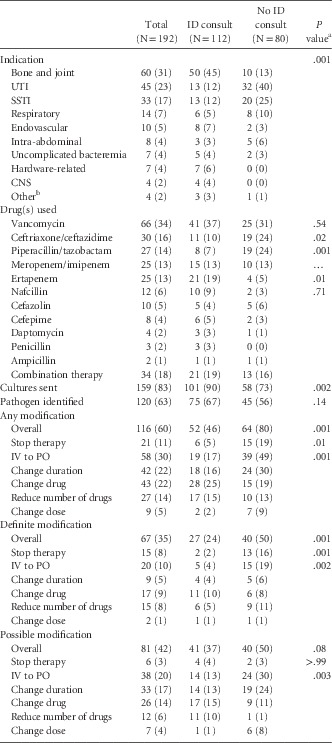
We identified 192 OPAT courses in 148 patients. A total of 131 courses (68%) followed hospital discharge, representing 2% of discharges during the study period. ID was consulted with 112 courses (58%). The most common indications were bone and joint infections (31%), urinary tract infections (UTIs) (23%), and skin and soft-tissue infections (SSTIs) (17%) (Table 1). The most frequently prescribed antimicrobials were vancomycin (34%), carbapenems (26%), third-generation cephalosporins (16%), and anti-pseudomonal penicillins (14%). A pathogen was identified in 120 of 192 courses. Of the 72 courses without pathogens identified, 39 had negative culture results and 33 had no cultures performed. The median (interquartile range) duration of therapy was 15 (14–35) days. The median duration of therapy varied by indication, ranging from 14 days for UTIs (interquartile range, 14–14 days) and SSTIs (10–14 days) to 49 days (42–59 days) for central nervous system infections.
Characteristics of Outpatient Parenteral Antimicrobial Therapy Courses With and Without Infectious Diseases (ID) Consultation

NOTE. Data are no. (%) of courses. CNS, central nervous system; IV, intravenous; PO, by mouth; SSTI, skin and soft-tissue infection; UTI, urinary tract infection.
a χ2 or Fisher exact test used to compare differences in proportions between patients with an ID consult and those without an ID consult.
b Includes neutropenic fungal prophylaxis (n=1), varicella zoster virus keratitis (n=1), herpes simplex virus encephalitis (n=1), and herpes zoster (n=1).
ID was involved in 50 (83%) of 60 OPAT courses for bone and joint infections (Table 1). In contrast, ID consultation was sought for 13 (29%) of 45 courses for UTIs. Third-generation cephalosporins and piperacillin/tazobactam were more commonly used in courses without ID consultation (24% vs 10%, P=.02, and 24% vs 7%, P=.001, respectively), whereas ertapenem was more commonly prescribed by ID (19% vs 5%, P=.01).
Upon review, a modification was recommended in 116 (60%) of 192 courses (Table 1). The most common modifications were IV to PO conversion (30%), change in duration (22%), and change in drug (22%). Forty-one percent of courses were potentially avoidable (11% stop therapy, 30% IV to PO). The frequency with which any modification was recommended was lower for OPAT courses with ID consultation compared with those without (46% vs 80%, P<.001), including potentially avoidable courses (stop therapy, 5% vs 19%, P=.01; IV to PO, 17% vs 49%, P<.001).
CONCLUSIONS
In this evaluation of OPAT use at a VA Medical Center, OPAT was prescribed in 2% of all discharges, yet more than half of courses were potentially modifiable, including more than 40% where OPAT may have been avoided. Although the frequency of recommended modifications was lower for courses with ID consultation, OPAT was potentially avoidable in up to 22%. These findings highlight the opportunity for stewardship interventions to improve OPAT use in the VA system.
Broad-spectrum agents including third-generation cephalosporins, anti-pseudomonal penicillins, and carbapenems were prescribed in more than half (56%) of courses, yet nearly 40% of patients had negative culture results or no cultures performed. Moreover, IV to PO conversion or de-escalation was recommended in more than half of OPAT courses. Lack of supporting culture data and frequent recommendations to de-escalate therapy suggest much of the observed broad-spectrum agent use could have been avoided through ASP evaluation.
UTIs and SSTIs were common indications for OPAT, with median durations of therapy of 14 days. Recent study and guidelines suggest many of these courses are unnecessarily prolonged. A recent evaluation of outpatient male UTIs in the VA system found no difference in early or late recurrence with 7 days of therapy compared with longer durations.Reference Drekonja 10 Guidelines for diagnosis and treatment of catheter-associated UTIs recommend 5–7 days of therapy, often oral, with the rare patient needing 10–14 days.Reference Hooton, Bradley and Cardenas 11 Similar recommendations exist for most patients with SSTIs.Reference Stevens, Bisno and Chambers 12 UTIs and SSTIs therefore provide an excellent target for ASP intervention to avoid unnecessary OPAT and minimize prolonged durations of therapy.
Our unique aspect is that we reviewed courses in which ID was involved; OPAT was potentially avoidable in 22%. The most frequent (25%) recommendation for courses involving ID was a change in drug, often to a narrower-spectrum agent. Ertapenem was prescribed in nearly 20% of OPAT courses involving ID. Although likely driven by convenience or lack of cultures, common use of this broad-spectrum agent warrants further investigation. Our results underscore variation in ID practice and suggest that OPAT use can be optimized by review, even when ID physicians are involved.
Our study has several limitations. We performed a retrospective, single-center evaluation over 1 year. Although patterns of use at our facility may not reflect use elsewhere, previous studies suggest OPAT use is growing and frequently misused.Reference Gordon, Shrestha and Rehm 5 Each course was reviewed by only 1 ID physician; therefore, recommendations may have differed between reviewers. However, given the results of this investigation, our ASP is planning an intervention involving compulsory review of all OPAT courses.
In summary, a significant proportion of OPAT use at our institution is likely modifiable or avoidable, even when ID physicians are involved. An ASP intervention has the potential to reduce OPAT overuse while lowering costs and improving patient safety. Expansion of such an intervention could have a significant impact on the VA Health Care System.
Acknowledgments
Financial support. None reported.
Potential conflicts of interest. All authors report no conflicts of interest relevant to this article.