A small proportion of patients with atrial septal defects develop pulmonary vascular obstructive disease and present in adult life with pulmonary arterial hypertension and elevated pulmonary vascular resistance.Reference Robert, Craig and Arthur1–Reference Joerg, Sabine and Benita3 Clinical examination including the chest X-ray and electrocardiogram suggests the presence of pulmonary hypertension. Echocardiography further refines this assessment by providing an estimate of pulmonary artery systolic pressures. These data are at best semi-quantitative and do not allow accurate stratification of patients into operable and inoperable. Cardiac catheterisation to estimate the pulmonary vascular resistance index at baseline and after administration of pulmonary vasodilators such as inhaled nitric oxide is often undertaken for the purpose of this stratification. However, this is invasive and with important limitations. The results of cardiac catheterisation are validated systematically through long-term follow-up after closure of the defects; as a result, cut-offs separating operable from inoperable patients are not clearly defined.Reference Vishwanathan and Kumar4, Reference Ullrich, Christian, Michael, Walter and John5
During strenuous rhythmic exercise, several cardiovascular compensations take place, which results in 5–6-fold increased cardiac output. Both systemic vascular resistance and pulmonary vascular resistance decline with exercise.Reference Thomas6 As the resting pulmonary vascular resistance is very low in normal individuals, further decline in pulmonary vascular resistance on exercise is relatively marginal when compared to the decline in systemic vascular resistance. This is especially true in a patient with a large atrial septal defect and normal pulmonary artery pressure in whom the pulmonary vascular bed capacitance is high. In a patient with a large atrial septal defect and pulmonary vascular obstructive disease, pulmonary vascular resistance is elevated and not reversible by neurohumoral mechanisms during exercise. During exercise, left ventricular output increases, which results in excessive systemic venous return. Since the pulmonary vascular resistance is elevated, right ventricular output is relatively fixed. This results in increased right atrial filling pressure that may promote right to left shunt across the defect.Reference Xing, James, Ronald and Karlman7 We hypothesised that a decline in systemic arterial partial pressure of oxygen on exercise can be used as an indicator of development of pulmonary vascular obstructive disease with relatively fixed elevation of pulmonary vascular resistance.
We sought to prospectively test this hypothesis in a group of patients with atrial septal defect with pulmonary hypertension. The purpose of this study was to examine the utility of decline in arterial partial pressure of oxygen after exercise as a marker of pulmonary vascular obstructive disease in patients with atrial septal defect with pulmonary hypertension.
Methods
Study design and setting
This was a prospective study undertaken in a tertiary referral hospital. Prior approval from the institutional ethics committee was obtained.
Informed consent
This was obtained from healthy volunteers and patients with atrial septal defect but normal pulmonary artery pressure, who acted as controls and study patients with atrial septal defect and pulmonary hypertension. For patients under 18 years of age, consent was obtained from one of the parents and assent was obtained from the patient.
Patient selection
The inclusion criteria for the study patients with atrial septal defect with pulmonary hypertension were as follows:
• Resting saturation of more than 90% measured by pulse oximetry (Nellcor, Oximax™, N 65, CO., United States of America).
• Predicted pulmonary artery systolic pressure more than 50 millimetres of mercury by Doppler echocardiography.
• Patients in functional class I or II (New York Heart Association).
The following patients were excluded from the study:
• All patients with resting oxygen saturation of less than 90%.
• Patients with any other potential disease that can result in arterial desaturation (for example, lung disease, thoracic cage deformities, Down's syndrome).
• Patients who were unable to perform an exercise treadmill test for any reason.
Exercise test
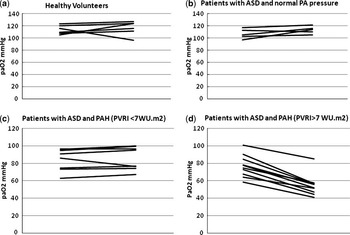
A symptom-limited treadmill exercise was performed on all the patients. Bruce protocol was followed. A radial artery was cannulated under local anaesthesia with a 22- or a 24-gauge cannula and it was used for blood gas sampling. Arterial blood gas samples were drawn before and as soon as the test was terminated (peak exercise). A decline in arterial partial pressure of oxygen of more than 10 millimetres of mercury was considered as “significant” arterial desaturation. This conclusion was made after we performed a similar exercise test in 11 patients with normal pulmonary artery pressure who acted as controls. Of them, six were healthy volunteers with no cardiac disease and five were patients with large atrial septal defect and normal pulmonary artery pressure. Only 1 out of the 11 had a decline in arterial partial pressure of oxygen of 9 millimetres of mercury, whereas the rest of them had either no change or a marginal increase in the arterial partial pressure of oxygen after exercise (Fig 1).
Observed partial pressure of oxygen before and after exercise in six healthy volunteers (a), patients with atrial septal defect and normal pulmonary artery pressure (b), and in patients with atrial septal defect and pulmonary hypertension but with a pulmonary vascular resistance index of less than 7 Wood units per square metre (c) shows that there was either an increase or no significant decrease in arterial partial pressure of oxygen after exercise. In patients with an atrial septal defect, pulmonary hypertension, and a pulmonary vascular resistance index of more than 7 Wood units per square metre (d), there was a universal and significant drop in arterial partial pressure of oxygen after exercise.

Cardiac catheterisation
All the study patients with atrial septal defect and pulmonary hypertension underwent cardiac catheterisation. In the control group, cardiac catheterisation was performed only on patients with atrial septal defect and normal pulmonary artery pressure. No sedation was administered during the procedure. Fick's principle was used to quantify the pulmonary systemic blood flow and the calculation of pulmonary vascular resistance index and systemic vascular resistance index. Oxygen consumption was assumed and derived from standard tables for age, sex, and heart rate.Reference LaFarge and Miettinen8 Oximetry data were obtained from the superior caval vein (as a representation of mixed venous blood), pulmonary artery, one of the four pulmonary veins, and the descending thoracic aorta. Similarly, pressure data were obtained from the right atrium, pulmonary vein, pulmonary artery, and descending thoracic aorta. Pressure and oximetry data were obtained while patients were on room air, 100% oxygen inhalation, and a mixture of oxygen and 30–40 parts per minute of inhaled nitric oxide. Oxygen was delivered by a tightly fitting anatomical facemask connected to an oxygen reservoir. Flow rate was maintained at 12–15 litres per minute. The desired concentration of inhaled nitric oxide was achieved by administration of nitric oxide flow calculated by the formula:

Nitric oxide was delivered by a constant flow of oxygen at 5 litres per minute through a tight fitting oxygen mask. 100% oxygen and inhaled nitric oxide were administered for 10 minutes each with a 10-minute washout period between the two. A single arterial blood gas analyzer was used to measure oxygen saturation and dissolved oxygen content.
Data analysis
On the basis of exercise test and arterial blood gas results, study patients with atrial septal defect and pulmonary hypertension were further sub-divided into two groups: those who had a decline in arterial partial pressure of oxygen more than 10 millimetres of mercury and those who had a decline of less than 10 millimetres of mercury after exercise. Only these two subgroups were considered for statistical analysis with cardiac catheterisation data. The variables that were analysed were
• pulmonary artery mean pressure on room air, oxygen inhalation, and inhaled nitric oxide;
• pulmonary vascular resistance indexed to the body surface area on room air, 100% oxygen inhalation, and inhaled nitric oxide;
• pulmonary to systemic blood flow ratio on room air, 100% oxygen inhalation, and inhaled nitric oxide.
Fisher's exact test was applied to test the null hypothesis of categorical variables. Levine's t-test was used to test the continuous variables. All statistical analysis was performed using the SPSS software (SPSS, California, United States of America).
Results
Control group
The demographic and baseline characteristics of the six healthy volunteers, five patients with atrial septal defect and normal pulmonary artery pressure, and 18 patients with atrial septal defect and pulmonary hypertension are summarised in Table 1. Exercise duration and performance were better among the six healthy volunteers when compared to the five patients with atrial septal defect and normal pulmonary artery pressure. No complications were encountered during the study. Change in arterial partial pressure of oxygen after exercise is shown in Figure 1. The mean pulmonary artery pressure and the pulmonary vascular resistance were within normal limits for the group of patients with atrial septal defect and normal pulmonary artery pressure. They all had a significant pulmonary to systemic blood flow ratio (Table 1). Pulmonary vasodilator testing was not performed among them.
Demographic and baseline characteristics of the study group and controls.

ASD = atrial septal defect; f = female; m = male; METS = metabolic equivalents; OS = ostium secundum ASD; PA = pulmonary artery; PAH = pulmonary arterial hypertension; PaO2 = partial pressure of oxygen; PVRi = pulmonary vascular resistance indexed to body surface area; Qp/Qs = pulmonary to systemic blood flow ratio; RVSP = right ventricular systolic pressure estimated by peak tricuspid regurgitation jet velocity and estimated right atrial pressure; SV = sinus venous defect
Study patients
The study included 18 consecutive patients with atrial septal defect and pulmonary hypertension who satisfied the criteria. Right ventricular systolic pressure calculated by tricuspid regurgitation jet velocity was 70.56 plus or minus 13.5 millimetres of mercury by Doppler echocardiography. Their basal characters are summarised in Table 1. Exercise capacity in terms of exercise duration and metabolic equivalents achieved was significantly lower when compared with either healthy volunteers or patients with atrial septal defect and normal pulmonary artery pressures, both p less than 0.001. When compared to the controls, they had higher mean pulmonary artery pressure, p less than 0.003, higher pulmonary vascular resistance index, p less than 0.001, and lower basal arterial partial pressure of oxygen, p equals 0.001.
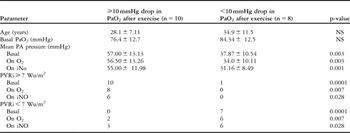
There were 18 patients with atrial septal defect and pulmonary hypertension who were subjected to exercise testing and arterial blood gas analysis. Both the subgroups had comparable basal arterial partial pressure of oxygen (Table 2; p non-significant). After exercise, 10 patients had a decline in arterial partial pressure of oxygen more than or equal to 10 millimetres of mercury after exercise and eight patients did not have a significant drop in arterial partial pressure of oxygen. Only these two subgroups would be considered further for data analysis. Their data are shown and compared in Table 2 and Figure 1.
Comparison of haemodynamic parameters in the two groups of study subjects with ASD and PAH.

ASD = atrial septal defect; iNO = inhaled nitric oxide; NS = non-significant; O2 = oxygen; PA = pulmonary artery; PAH = pulmonary arterial hypertension; PaO2 = partial pressure of oxygen; PVRi = pulmonary vascular resistance index. Due to technical reasons, data could not be obtained on oxygen in two patients and with inhaled nitric oxide in three patients.
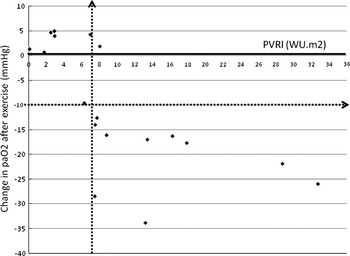
Cardiac catheterisation was performed on room air on all the 18 patients with atrial septal defect and pulmonary hypertension. When compared with the 10 patients with atrial septal defect and pulmonary hypertension who had a significant drop in their arterial partial pressure of oxygen after exercise, the eight patients with atrial septal defect and pulmonary hypertension who did not significantly drop their arterial partial pressure of oxygen after exercise had lower mean pulmonary artery pressure, p equals 0.003. All the 10 patients with atrial septal defect and pulmonary hypertension who had a significant drop in arterial partial pressure of oxygen had a basal pulmonary vascular resistance index of more than or equal to 7 Wood units per square metre. Out of eight patients with atrial septal defect and pulmonary hypertension but who did not have a significant drop in arterial partial pressure of oxygen, seven had a basal pulmonary vascular resistance index of less than 7 Wood units per square metre, p equals 0.0001. The remaining one patient also was noted to have a pulmonary vascular resistance index of less than 7 Wood units per square metre after oxygen and inhaled nitric oxide. The difference in the arterial partial pressure of oxygen after exercise was plotted against the basal pulmonary vascular resistance index (Fig 2). No linear correlation could be demonstrated between the change in arterial partial pressure of oxygen after exercise and pulmonary vascular resistance index. A decline in arterial partial pressure of oxygen of more than or equal to 10 millimetres of mercury predicted a basal pulmonary vascular resistance index of more than or equal to 7 Wood units per square metre with a specificity of 100% and a sensitivity of 90%.
The difference in the arterial partial pressure of oxygen after exercise (y axis) among all the 18 patients with atrial septal defect and pulmonary hypertension is plotted against the pulmonary vascular resistance index obtained by cardiac catheterisation (x axis). A dotted vertical line parallel to the y axis is marked to show a pulmonary vascular resistance index of 7 Wood units per square metre. A dotted horizontal line is marked to show a drop in arterial partial pressure of oxygen of 10 millimetres of mercury after exercise.

Satisfactory haemodynamic data with oxygen could not be obtained in two patients and with inhaled nitric oxide in three patients due to technical reasons. The haemodynamic data after oxygen inhalation and inhaled nitric oxide for the patients with atrial septal defect and pulmonary hypertension are shown in Table 2. In patients with atrial septal defect and pulmonary hypertension who did not have a significant drop in arterial partial pressure of oxygen after exercise, there was a further reduction in the mean pulmonary artery pressure after administration of oxygen when compared with those patients with atrial septal defect and pulmonary hypertension who had a significant drop in arterial partial pressure of oxygen after exercise, p equals 0.01. No further reduction was seen with the pulmonary vascular resistance index on oxygen, mean pulmonary artery pressure on inhaled nitric oxide, and pulmonary vascular resistance index on inhaled nitric oxide. There was no association between the decline in arterial partial pressure of oxygen after exercise in patients with atrial septal defect and pulmonary hypertension and their pulmonary to systemic blood flow ratio on cardiac catheterisation under any condition.
Discussion
It is not clear why some patients with atrial septal defect develop pulmonary hypertension while others do not. Those who are destined to develop pulmonary hypertension typically do so before the third decade of life. Cardiac catheterisation is considered necessary to obtain precise measurements of pulmonary artery pressures, and to calculate shunt ratios and pulmonary vascular resistance in most patients with atrial septal defect and pulmonary hypertension. This is quite unlike most children with post-tricuspid shunts and pulmonary hypertension where a large shunt ratio is often clinically obvious. Cardiac catheterisation also allows the opportunity to test the effect of pulmonary vasodilators such as inhaled nitric oxide. Decisions on operability are, however, often not based on precise cut-offs of haemodynamic data either in the basal state or after vasodilators. This is because of a paucity of studies in which haemodynamic data are tested against late outcomes after defect closure. The gold standard here would perhaps be a pulmonary vascular resistance index measured at least a year after defect closure. Owing to the absence of unambiguous cut-offs, decisions on operability in most settings often involve a “holistic approach” that incorporates clinical, X-ray, non-invasive, and haemodynamic data.
Exercise physiology-induced cardiopulmonary compensations provide an additional tool to evaluate the haemodynamics of pulmonary and systemic blood flow in patients with shunt lesions. Exercise is shown to increase systemic blood flow with a corresponding increase in pulmonary blood flow without alteration in pulmonary vascular resistance in patients with moderate-sized ventricular septal defect and normal pulmonary artery pressure.Reference Newman, Stephens, Shafter and Bliss9 In this study, we sought to systematically examine the effect of exercise on arterial partial pressure of oxygen in atrial septal defect with pulmonary hypertension. We sought to test the hypothesis on whether a decline in arterial partial pressure of oxygen can be used as an indicator of development of pulmonary vascular disease in a carefully selected group of patients with atrial septal defect who were thought to have borderline operability status based on clinical and non-invasive evaluation. We chose arterial partial pressure of oxygen and not oxygen saturation because we expected the former to be more sensitive to shunt reversal across the atrial septal defect. There were six healthy volunteers and five patients with atrial septal defect and normal pulmonary artery pressure who served as controls. Patients with advanced pulmonary hypertension with oxygen saturations less than 90% were deliberately avoided because of the potential risks of performing a symptom-limited exercise test. Further, cardiac catheterisation could not be justified for medical reasons because they were clearly thought to be inoperable. A reduced exercise tolerance in patients with atrial septal defect and pulmonary hypertension was seen in our study and this is demonstrated in another recent study.Reference Gerhard, Konstantinos and Darlington10
When the exercise test was performed among the six healthy volunteers and the five patients with atrial septal defect and normal pulmonary artery pressure, there was a decline in arterial partial pressure of oxygen of 9 millimetres of mercury in one healthy volunteer. In all others, the arterial partial pressure of oxygen either increased or remained unchanged. On the basis of these results, we chose a cut-off of 10 millimetres of mercury as a “significant” decline.
Among the study patients with atrial septal defect and pulmonary hypertension, this significant decline appeared to accurately predict a basal pulmonary vascular resistance index more than or equal to 7 Wood units per square metre with a specificity of 100% and a sensitivity of 90%. However, there was no linear correlation with the pulmonary vascular resistance index and a decline in the arterial partial pressure of oxygen.
The test is safe, easy to perform, and simulates a common physiologic state. The gold standard used here was haemodynamic data obtained through cardiac catheterisation. The question of whether this test can be used to assess operability can only be addressed through the prospective follow-up of a cohort of patients with atrial septal defect and pulmonary hypertension after closure of the defect. Our results suggest that determining the decline in arterial partial pressure of oxygen following exercise can be an important addition to the available diagnostic armamentarium in this group of patients in whom decision-making is particularly difficult.
Study limitations
The relatively small numbers included in the study are perhaps because our inclusion criteria were limited to patients presumed to have borderline operability status in whom cardiac catheterisation was indicated for planning further management. However, the association between the decline in arterial partial pressure of oxygen of 10 millimetres of mercury or more and pulmonary vascular resistance is strong and consistent. Oxygen consumption was assumed and not measured and this could contribute to errors in flow and resistance calculations.Reference Achim, Oliver and Walter11 Only 6 patients from our 18 patients with atrial septal defect and pulmonary hypertension have undergone closure of the defect. The question on the value of this test in determination of operability in patients with atrial septal defect and pulmonary hypertension cannot therefore be addressed. The youngest patient in the study was 10 years old and the rest of the patients were adults. Intuitively, the results obtained in this study may be extrapolated to the paediatric population, which can perform an exercise stress test, though this specific question is not answered.
Conclusion
A decline in arterial partial pressure of oxygen of 10 millimetres of mercury or more following exercise appears to consistently predict a high pulmonary vascular resistance (basal, post-oxygen, and inhaled nitric oxide) in patients with atrial septal defects and pulmonary hypertension. Once validated in a larger group of patients, these data would be more physiological and might potentially obviate the need for cardiac catheterisation to determine operability. Measurement of arterial partial pressure of oxygen before and after exercise should be considered in the panel of investigations usually performed for patients with shunts and elevated pulmonary artery pressures.
Acknowledgement
No financial support was obtained and there are no disclosures to make.