There is growing interest in how conflict affects community- and individual-level norms and preferences. An emerging literature points to counterintuitively co-operative, pro-social responses to violence.Footnote 1 Yet other research finds that violence has more detrimental effects on norms and preferences.Footnote 2 Why do some studies of conflict exposure reveal positive outcomes from violence, while others find long-term damaging effects?
One possibility is that the effects of violence are mediated by in-group/out-group cues and boundaries, in which violence may heighten pro-social behavior toward in-groups but undermine pro-social norms in the treatment of out-groups. We draw insights into divergent in-group/out-group norms from our experimental work in post-war Kosovo. Using variations in behavioral measures of norms and preferences from experimental economics (dictator, public goods, ultimatum and trust games), we find that people in a post-conflict environment with well-defined in-group/out-group identities (in this case Albanians and Serbs) reflect those divisions behaviorally. There is a strong tendency to favor in-groups over out-groups in our experiments when those cues are made readily apparent in our treatments. We also find that increasing exposure to violence amplifies in-group/out-group divides and parochial communal norms. Balancing and matching on covariates helps reduce concerns that victimization selection effects are driving our results.
The remainder of the discussion proceeds as follows. First we highlight important contributions in the literature on the effects of conflict on pro-sociality. Next we introduce our hypothesis on the effects of in-group/out-group divisions on norms and preferences. Then we explain our research design and present our experimental results. Finally, we discuss the implications of our findings and suggest new directions for research.
LITERATURE
While there is a long tradition of cross-national macro-level scholarship on the origins and outcomes of interstate and civil war, as well as macro-level case studies of the consequences of violence for institution building, research is only beginning to address possible causal effects and mechanisms at the micro level.Footnote 3 To this end, researchers are increasingly examining the impact of violence on micro-level norms and preferences. There is a vast theoretical literature on the importance of pro-social norms and preferences to institution building, market development and civil society.Footnote 4 To evaluate social norms, more researchers are turning to lab and lab-in-the-field experiments to complement traditional observational methods.Footnote 5 For example, there is a growing empirical literature on the use of experiments to measure altruism, public good contribution, bargaining preferences and trust.Footnote 6 Researchers are also increasingly applying experiments to understand the effects of violence in different cases and historical contexts, and among diverse populations including former combatants, non-combatants, children and adults, victims and perpetrators. However, the findings are a mix of positive and negative effects.Footnote 7
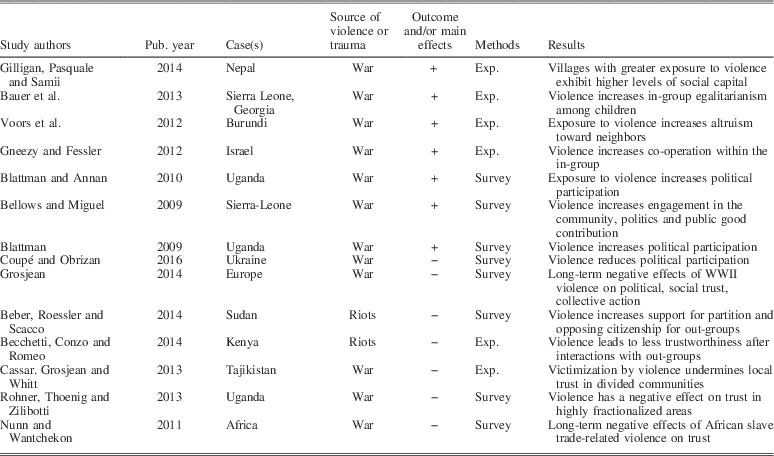
In Table 1, we highlight some recent examples of findings from experimental and survey research on war-related trauma and victimization. Some studies report significant pro-social responses to violence within communities of combatants, non-combatants or victims of traumatic events across a range of post-conflict environments. In Uganda, exposure to violence is shown to stimulate voting and local-level political engagement. In Israel, people were more likely to co-operate in lab experiments conducted during the 2006 Israeli-Hezbollah war in Lebanon than either before or after the war. In Sierra Leone, victimization by violence enhances localized collective action. In Burundi, exposure to violence increases local altruism, enhances risk seeking and raises discount rates. Communities affected by violence in Nepal’s civil war demonstrate higher levels of altruism, public good contribution and trust. Children who were exposed to violence in Sierra Leone and the Republic of Georgia are more egalitarian in the treatment of others.
Heterogeneous Effects of Violence Reported in Recent Micro-level Studies

Other studies, however, report negative effects of conflict exposure. Recent violence in eastern Ukraine appears to be driving down political participation. Political violence in Kenya had negative effects on trustworthiness. In Sudan, exposure to violence is undermining support for a multi-ethnic state, fueling the movement for partition. In Uganda and Tajikistan, exposure to violence has a negative effect on trust and social cohesion in highly fractionalized areas of the country, but no adverse effects in low fractionalization regions. Some studies also point to long-term legacies of violence. Across Europe, negative effects of violence on contemporary social and political trust and collective action have been linked to the Second World War. Across Africa, similar detrimental effects of violence on contemporary interpersonal and institutional trust have been traced to the slave trade.
While micro-foundations are important to informing macro-level outcomes of violence, more work needs to be done to clarify sources of seemingly heterogeneous findings in the literature. Why might violence seemingly undermine pro-social norms and behavior under some circumstances, but enhance group bonding norms and co-operation in others?
THEORY AND HYPOTHESIS
We argue that the effects of violence may depend on the nature of in-group/out-group cues and boundaries. We hypothesize that exposure to violence increases pro-social behavior toward in-groups relative to out-groups. The implications from our hypothesis are that studies that show positive pro-social effects of violence could be capturing a dimension of in-group bonding, while studies that reveal negative effects may be tapping into out-group aversions.
Our hypothesis is grounded in social identity and group conflict theory. Social identity theory emphasizes how individuals are motivated to seek out and form in-group bonds with others.Footnote 8 However, the desire to bond with in-groups may also intensify aversion toward out-groups.Footnote 9 Group conflict theory underscores how well-defined in-groups can come into conflict with one another.Footnote 10 Though intergroup violence is rare, once it begins, it can feed off and intensify the development of parochial bonds.Footnote 11 Numerous behavioral studies have found evidence of in-group parochialism in the lab and in the field, though the mechanisms underlying parochialism are still not entirely well understood.Footnote 12
Why might violence encourage parochialism? One possibility is that victims of violence turn to in-group bonding as a coping mechanism. Research has identified post-traumatic accelerated cohesion, in which victims of violence form intense bonds among others who have shared traumatic experiences; individuals with strong social support networks appear better able to cope with the potentially traumatic effects of violence than those who remain isolated.Footnote 13 While it could be rational for victims of violence to seek in-group protection in a threatening environment,Footnote 14 violence may also intensify fears, hatreds and/or resentments that cause people to turn inward and away from other groups.Footnote 15 Our research design attempts to illustrate how different in-group/out-group cues could affect behavioral responses to violence. We anticipate that individuals will express stronger bonds toward in-groups relative to out-groups when such cues are made available to them.
RESEARCH DESIGN
To evaluate our hypothesis, we employ a behavioral strategy to identify whether the effects of violence are conditioned upon in-group/out-group cues. We examine pro-social norms using behavioral experiments with two types of in-group/out-group treatments: those based on ethnicity and those based on local community bonds.Footnote 16 Numerous studies of violence have focused on the effects of violence on interethnic norms as well as norms within and outside local environments; we consider both types of in-group/out-group treatments.Footnote 17 We conduct our experiments in Kosovo, an environment of recent ethnic tension between ethnic Serbs and Albanians and where ethnic distinctions are readily apparent based on language, religion and other cues.Footnote 18 In Kosovo, we anticipate that people will generally behave more pro-socially toward their ethnic and communal in-groups relative to out-groups. This is not necessarily an effect of conflict. Indeed, observational data indicate strong in-group/out-group polarization in Kosovo even before the 1998–99 war began.Footnote 19 However, we hypothesize that those who have increasing levels of exposure to violence are more pro-social toward in-groups relative to out-groups than the general population. We measure exposure to violence by increasing degrees of victimization through personal injury and the loss of family and friends.Footnote 20
Finally, we provide evidence to show that selection effects related to exposure to violence are unlikely to be driving our results. We find that victims and non-victims are well balanced demographically, and our results are robust to matching on covariates such as gender, age, education, and across urban and rural environments. This helps alleviate concerns that certain people were systematically targeted for victimization based on pre-existing characteristics such as in-group ties and out-group aversions. In an environment of widespread ethnic cleansing such as Kosovo, victimization was highly indiscriminate: everyone was a potential target.Footnote 21 We conclude by discussing possible implications of our findings on the interpretation of positive and negative effects of violence being reported in the case literature. Next, we present our experimental protocols in more detail.
EXPERIMENTAL PROTOCOLS
We employ a number of different experiments using a combination of within-subject and between-subject designs with different treatments and randomized treatment order. We worry that exposure to violence might have heterogeneous effects depending on the types of norms and preferences measured, so we include different experiments to assess a range of norms related to altruism, altruistic expectations, public good contribution, bargaining and trust. We briefly summarize the design of each experiment as follows.
To assess in-group/out-group effects based on ethnicity, we run three experiments – a dictator game, an expectations game and a public goods game. Each experiment utilizes ethnicity as an explicit treatment. First, we employ the dictator game to measure the effects of ethnicity on norms of altruism and fairness. Norms of altruistic self-sacrifice have been identified as an important component of group cohesion in evolutionary contexts, and studies have shown that altruism is an important indicator of pro-social behavior where in-group/out-group distinctions are apparent.Footnote 22 In our version, subjects must decide how to allocate money between themselves and another person of random ethnicity (Albanian or Serb). The subject and the other person each begin with 5 euros. The subject then chooses whether to give money to the other person, to take money from the other person or to do nothing, in which case the status quo remains in effect: the subject gets 5 euros and the other person gets 5 euros. They make their decision by circling the word ‘give’, ‘take’ or ‘neither give/nor take’ and an amount of money from 0 to 5 in 0.5-euro increments on a form.
In addition, to evaluate whether subject behavior corresponds to expectations from others, we introduce a reverse-dictator game. After completing the dictator game, subjects receive a sealed envelope that contains an amount of money (written on a form) from another participant of random ethnicity. Without opening the envelope, they are asked whether they think the other person sent money to them, took money or did neither. They then circle the amount of money they think was sent/taken on a form.Footnote 23 We repeat both experiments using in-group and out-group ethnic treatments in random order for a within-subject design.
Finally, we measure the effects of ethnicity on public goods contribution. Public goods are considered vital to the functioning of many political and social institutions, and significant in-group/out-group effects have been identified in prior studies of public goods provision absent conflict.Footnote 24 In our version, subjects each begin with 5 euros in a public goods account with nine other people (50 euros total). In the in-group treatment, every subject is in a group in which they are one of seven in-group members and three out-group members. In the out-group treatment, each subject is in a group in which they are one of three in-group members along with seven out-group members. The order of the treatment is again randomized.
For each treatment, we give every subject an additional 2.5 euros. They must decide whether to put more money into a common pot, take money out of the common pot (up to 5 euros) or do nothing. Whatever subjects put into the pot is doubled in value, and whatever they withdraw from the pot is halved in value. After the subject makes his/her decision, whatever remains in the pot is equally divided among all recipients, regardless of whether they contribute more or less to the public good or cash out entirely. Subjects may also decide not to contribute more or take out money, in which case they receive their initial 2.5 euros plus an equal division of what remains in the common pot.Footnote 25 Once all the experiments are completed, subjects are given a self-administered survey asking additional questions related to conflict exposure and victimization by violence.
To assess in-group/out-group effects based on our local community treatment, we utilize data from a second set of experiments. Here, we use a between-subject design in which subjects decide how to allocate money with someone either from their local community or from somewhere else in Kosovo. Because local communities in Kosovo are almost universally segregated by ethnicity, the ‘local’ treatment is an implicit ethnic in-group treatment. In the ‘not-local’ treatment, however, there is greater uncertainty regarding the ethnic identity of the recipient.Footnote 26 The local/not-local treatment enables us to examine how exposure to violence affects norms both within and outside the local community. In this second set of experiments, we use a new sample of Albanians and Serbs with no prior exposure to the ethnic treatments.
All subjects take part in a dictator, ultimatum and trust game in that order. In the dictator and ultimatum games, subjects must decide how to allocate 10 euros between themselves and someone else, either from their local community or elsewhere in Kosovo, determined randomly. Subjects indicate how much to send by circling an amount on a form (0–10 euros). In the ultimatum game, the subject only receives money if the allocation is accepted by the recipient. We randomly match subjects with recipients, and offers are either accepted or rejected using the strategy method. The subject plays the ultimatum game as both the proposer and the recipient, and their offers/rejections are also randomly matched with others.
For the trust game, we use a variation on the classic protocol.Footnote 27 Subjects are given 4 euros and decide how much to keep for themselves and how much to give to another person (either from their local community or somewhere else in Kosovo). Whatever is sent to the other person is multiplied by three, and then the other person decides how much (if any) to return to the subject. We inform subjects that we will randomly pair them with another person. We use the strategy method to determine how much to return when matching the subject and recipient. Hence, we ask subjects to decide how much money they would return to another person by selecting options on a form. We tell subjects that their decisions will affect how much another person receives in the future, just as someone else’s decisions will affect how much they receive today. Once subjects complete the experiments, they are given a self-administered survey with questions about conflict exposure and victimization by violence.
DATA COLLECTION
For the experiments that evaluate explicit ethnic treatments, fieldwork was conducted between from 6–17 March 2011 using representative samples of Albanians and Serbs from Kosovo. In total, 308 Albanians and 158 ethnic Serbs completed experiments with ethnic treatments. For the second group of experiments with local/not-local treatments, data were collected from 7 May to 20 July 2011. A total of 220 subjects completed experiments with the local/not-local treatments. Local survey enumerators carried out the recruitment of subjects under supervision by one of the authors and a local project administrator.
In both samples, subjects were recruited using a stratified random sampling method based on ethnicity and municipality, where municipalities are selected based on probability proportion to size. The principle urban environment of that municipality is sampled along with a random village from the same municipality.Footnote 28 In both urban and rural environments, subjects were sampled using a random route method based on an initial random selection of starting points, interviewing every fifth household with skip intervals and most-recent birthday as the final selection key. No more than five subjects were recruited per random route. Serb subjects were recruited by a team of local Serbs, and Albanian subjects were recruited by local Albanians.Footnote 29
Subjects were given an invitation letter to participate in the study by a local recruiter and were told the time, date and location where the study would take place. Urban and rural experimental sessions were run in separate locations for convenience to the participants. Most sessions took place in groups of twenty in local schoolrooms, hotel or restaurant conference rooms, or community social halls. All Serb and Albanian experimental sessions were administered by a local ethnic Serb or Albanian who read from a standard script under supervision by one of the authors, who remained out of sight in an adjacent room. Subjects completed the experiments first, followed by the self-administered survey. Once the survey was completed, subjects were randomly paid for one of the experimental tasks.Footnote 30
EMPIRICAL STRATEGY
To test our hypothesis on the effects of violence, we turn to multivariate regression models. For ethnic treatments, our dependent variable of interest is a discrete variable (Yij) denoting whether individual (i) in experiment (j) displays a behavioral bias in favor of in-group over out-group members. For our local/non-local experiments, the dependent variable is the amount sent by individual (i) in experiment (j) under different local vs. non-local treatments.
 $${\rm Y} _{{{\rm ij}}} =\beta _{0} {\plus}\beta _{{\rm 1}} {\rm V}_{{{\rm ij}}} {\plus}\beta _{{\rm 2}} {\rm X}_{{{\rm ij}}} {\plus}{\varepsilon}_{{{\rm ij}}} $$
Our key independent variables are indices of individual victimization (Vij) based on a range of responses to questions about exposure to violence, injury, and loss of friends and family during the war, while Xij is a vector of extended controls for covariates such as ethnicity, age and education. Regression coefficients are estimated by logit for our ethnic treatments and tobit for our local/non-local treatments with robust standard errors. The results presented below are robust to alternate specifications of standard errors, the inclusion of fixed effects and covariate matching (see Appendix).
RESULTS
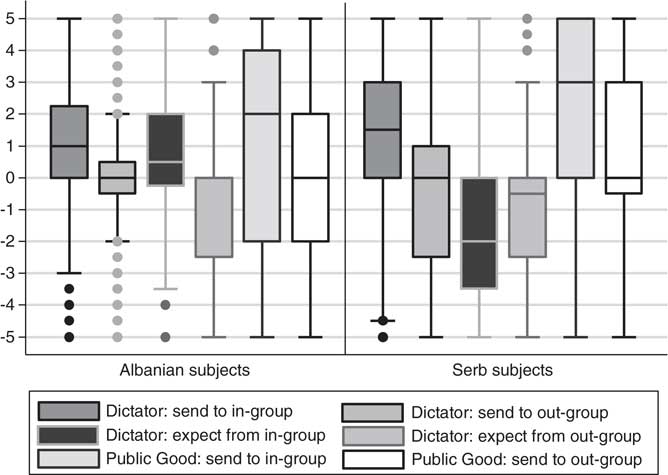
We begin with an overview of experimental decision-making using explicit in-group/out-group ethnic treatments with dictator and public goods experiments. Figure 1 indicates box-whisker plots and Appendix Table 1 provides summary statistics of the amount sent to (and the amount expected from) in-group/out-group recipients in the dictator game and the amount contributed in the public goods experiments. Box-whisker plots in Figure 1 show that dictator giving is more favorable to in-group recipients than out-group recipients.
Dictator giving, expectations and public good contributions by ethnicity Note: amounts>0 indicate that the subject sent money to a recipient or contributed more money to the public good; 0=subject did not send or take money from recipient or contribute more or take from the public good. Amounts<0 indicate that subjects took money from recipient or withdrew money from the public good. For expectations, amounts>0 indicate that the subject expects more money from another person; 0=subjects do not expect other person will send or take money. Amounts<0 indicate that subjects expect other person to take money from them.

Comparing means using t-tests in Appendix Table 1 shows that Albanian subjects give more, on average, to other Albanians than they do to Serbs (p<0.001), and that Serb subjects give more to other Serb recipients than to Albanians (p<0.001). In terms of dictator expectations, Albanians also expect to receive more from other Albanians than they do from Serbs (p<0.001). In contrast, Serbs expect to receive less from each other than they do from Albanians (p<0.020), which is an interesting, counterintuitive observation about community norms of altruistic giving within the Kosovo Serbian community. Serbs give more to other Serbs, but on average do not expect indirect reciprocity.Footnote 31 Finally, Albanians contribute more to a public good when they are in a group of majority Albanians than when they are in a group of majority Serbs (p<0.001). Serbs also contribute more, on average, when they are in a group with a Serb majority (p<0.001).
Simple t-tests indicate that subjects are responding to in-group/out-group treatments. When given clear cues about the ethnic identity of a recipient, subjects in a post-conflict environment tend to behave more altruistically toward in-groups than out-groups, and to contribute more money to public goods if the in-group is the majority. Expectations of altruism vary by ethnicity, and may reflect cultural or environmental differences between Serb and Albanian norms inside Kosovo. Overall, we observe strong evidence that in-group norms are more pro-social than norms applied toward out-groups. On average, subjects gave 60 per cent of the total allotment (6 out of 10 euros) in the dictator game to a co-ethnic, but gave 46 per cent (4.6 out of 10 euros) to an out-group. Subjects in the public goods game contribute nearly 27 per cent of their allotment to an in-group majority but less than 2 per cent to an out-group majority.
While everyone who lives during a period of intense violence has some baseline level of conflict exposure, we now examine whether increasing levels of victimization by violence augment the basic in-group/out-group distinctions we observe in the general sample. To measure victimization, we rely on self-reported victimization in our survey on a range of indicators including personal injury, family members injured, family members killed, friends injured and friends killed to build a composite score of victimization by violence (Cronbach’s alpha=0.73). We discuss concerns about victimization selection effects in more detail after presenting an overview of all experimental results.
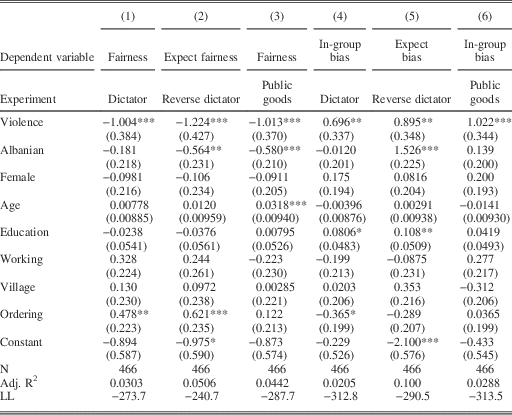
Table 2 indicates the results of a logit regression in which victimization by violence (Violence) is the key independent variable of interest. In Table 2 we examine dictator game behavior and expectations and public goods contribution. We use alternate specifications of the dependent variable. First, we create a dependent variable called Fairness, which is coded 1 if subjects make the same decision for both in-group and out-group ethnic treatments and 0 if subjects change their behavior depending on the treatment. We then create a second dependent variable called In-group Bias, which is coded 1 if subjects send more money to the in-group than to the out-group. In support of our hypothesis, we find that victimization by violence undermines fairness norms and enhances in-group bias in dictator giving, dictator expectations and public goods contribution.Footnote 32 Our results are robust to the inclusion of controls for ethnicity, gender, age, education, employment (a proxy for income), location (urban vs. rural) and treatment order.Footnote 33
Victimization by Violence using Ethnic In-group/Out-group Treatments

Note: logit regression. Robust standard errors in parentheses. ***p<0.01, **p<0.05, *p<0.1
In summary, our experiments appear to capture an important effect of victimization on behavior. When ethnic cues are readily apparent, subjects apply different norms to in-groups and out-groups, and victimization by violence is strongly correlated with increasing parochialism. Exposure to violence amplifies in-group pro-sociality, which is consistent with the emerging literature on the pro-social effects of violence, but also undermines norms applied to out-groups – which is also consistent with another emerging parallel literature on the detrimental effects of violence. When in-group/out-group divisions are present in a post-conflict setting, victimization by violence heightens those divisions, and the results raise concerns about the long-term negative effects of exposure to violence on pro-social norms and preferences.
Next we consider the effects of violence on local communal norms. We begin by examining basic local/not-local treatment effects on dictator giving, ultimatum bargaining and trust. Appendix Table 1 includes the means and standard deviations of dictator giving, ultimatum offers and trust offers for the local/not-local treatment groups. In this case, t-tests do not indicate significant treatment effects between members of one’s own community and those outside the community in dictator giving (p<0.134), ultimatum offers (p<0.414) or trust offers (p<0.254) in a between-subject comparison. On average, dictator giving and ultimatum/trust offers are quite high in both local and non-local treatments. Subjects give between 43 and 47 per cent of their endowment to the other person in the local and non-local dictator games, respectively. Subjects offer 47 to 48 per cent of their endowment to the other person in the ultimatum game, and between 65 and 63 per cent of their initial endowment in the trust game to local and non-local recipients, respectively.
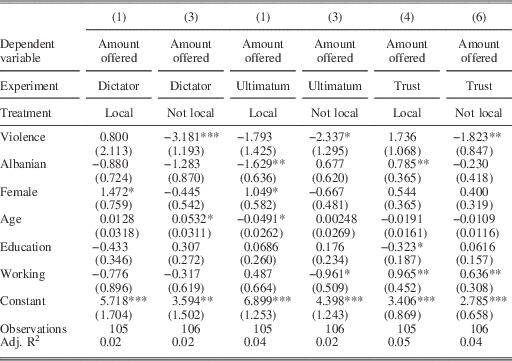
At first glance, it would seem that, in the absence of clear ethnic cues, people in Kosovo are generally very pro-social to outsiders relative to those in their own community. However, when we examine victimization by violence using an index based on personal injury, or having family members injured or killed (Cronbach’s alpha=0.70), we observe hidden effects of victimization within our sample. Table 3 reports the results of tobit regression on dictator giving, ultimatum and trust offers, comparing subjects who received local and not-local treatments. The coefficient on victimization (Violence) is not significant for the local treatment group, but is negative and significant for the not-local treatment group in all three experiments. The results are robust to the use of extended controls for ethnicity, gender, age, education and employment (a proxy for income). Details on coding are provided in Appendix Table 3.
Victimization by Violence using Local/Not Local Treatments

Note: tobit regression. Robust standard errors in parentheses. ***p<0.01, **p<0.05, *p<0.1
The local treatment experiment provides important insights into pro-social behavior and the effects of violence when ethnic cues are not readily available. Ethnic divisions in Kosovo appear highly salient under ethnic treatments, but not under local/outsider treatments. Despite the high probability that outsiders are ethnically Albanian (90 per cent of the population), controls for ethnicity do not indicate that Serbs are consistently less pro-social than Albanians to outsiders. At the same time, victimization appears to have consistent negative effects. Under ethnic treatments, victims are more in-group parochial than non-victims. In the local/non-local treatment, victims are less pro-social outside their immediate community. The difference between victim and non-victim behavior in these experiments may help explain how violence can undermine norms of co-operation, pro-sociality and interpersonal trust in uncertain and potentially hostile environments. Victims are less trusting of strangers and outsiders, even when they are most likely co-ethnics.
DISCUSSION
We are naturally concerned that the selection effects of victimization may be driving our results. To what extent do victims of violence differ from non-victims? Were some people more likely to be targeted for attack than others? Violence in Kosovo has been characterized by the indiscriminate ethnic cleansing of whole areas of Albanians (1998–99) followed by reprisal attacks by Albanians against Serbs (1999–2004).Footnote 34 To deal with potential endogeneity and selection concerns about victimization in our sample, we consider covariates of victimization on a range of observables. In the Appendix we report results of Kolmogorov-Smirnov balance tests for observable differences between victims and non-victims, and regressions on victimization by ethnicity, gender, age, education and urban/rural location. We find that our results regarding the effects of victimization on experimental behavior are robust when matching on covariates using coarsened exact matching and propensity score matching techniques.Footnote 35
Among these covariates, we observe only a weak correlation that females were less likely to be targeted for violence than males, which supports our argument that victimization is highly indiscriminate in ethnic cleansing campaigns. Because many villages and communities were already self-segregated before the onset of violence, it also alleviates the problem of neighbors selectively targeting out-group members of their community.Footnote 36 If most perpetrators of violence were not local (that is, they were outsiders), they would be unlikely to possess specific information about which Albanians or Serbs to target and which to spare. The Appendix includes maps indicating levels of victimization by violence, property destruction and displacement, which provides additional evidence that conflict exposure and victimization were widely inflicted on the general population and in our sample.
We also consider the possibility that people were targeted for victimization based on pre-existing hostility toward out-groups or in-group solidarity. To address selective targeting, we examine whether people who were internally displaced during the violence (movers) are distinguishable from non-movers. Additional regression tables provided in the Appendix indicate that movers do not differ significantly from non-movers in terms of in-group ethnic ties, in-group/out-group social distance, in-group/out-group trust, or when controlling for gender, age, education and village locations. Instead, we observe that victimization by violence and destruction of property are the strongest predictors of whether one has moved, which we have argued is largely indiscriminate in a campaign of ethnic cleansing. Hence, our results do not suggest that victims were targeted based on more pronounced in-group loyalties or out-group aversions.
Another possibility is that victims were not targeted at the individual level, but instead at the community level. However, observational data from before and immediately after the war indicate that in-group loyalty and out-group aversions are not heterogeneous to communities but generally widespread across the Albanian and Serbian populations. Conflict data from the 1998–99 war and the 2004 riots also do not suggest selective targeting at the community level.Footnote 37 The geography of violence in Kosovo points to indiscriminate violence and property destruction.
CONCLUSION
Our research offers a possible in-group/out-group account of why some studies might find positive, pro-social effects of exposure to violence, while others uncover more detrimental results. We find that pro-sociality in lab-in-the-field experiments depends on the nature of in-group/out-group cues in the experimental treatment.Footnote 38 In the general population, one set of treatments (ethnicity) captures a negative legacy of violence on parochialism, while another (local/non-local) shows strong evidence of pro-sociality and norm recovery. Under ethnic treatments, we observe that subjects are more altruistic toward ethnically defined in-groups than out-groups, and are more willing to contribute to in-group public goods than to out-group public goods. Victimization by violence appears to intensify this type of parochial behavior. However, when in-group/out-group boundaries are ambiguous, as in our second set of local/non-local treatments, group identification becomes problematic outside the local community. On the surface, most subjects treat outsiders no differently than locals, which is a good sign of pro-sociality after violence. However, victims of violence are less altruistic or trusting of people outside their communities. In an uncertain environment, the experiment shows how violence could make people turn inward. We hope others will consider our findings when evaluating legacies of violence in populations where in-group/out-group boundaries are salient by varying degrees.Footnote 39 The results from our experiments appear sensitive to how such cues are expressed or embedded in our treatments.