1. Introduction
In a 2003 paper in the American Economic Review, economists Tayfun Sönmez and Atila Abdulkadiroğlu framed the thorny problem of assigning K-12 students to public schools in game theoretic terms (Abdulkadiroğlu and Sönmez Reference Abdulkadiroğlu and Sönmez2003). In addition to formulating school assignment as a problem from the branch of microeconomic theory known as mechanism design, they analysed existing school choice allocation systems in Boston, Columbus, Minneapolis and Seattle. The economists demonstrated through proofs and propositions that the existing systems have ‘serious shortcomings’ and that adopting a different mechanism could ‘provide a practical solution to some of these critical school choice issues’ (Abdulkadiroğlu and Sönmez Reference Abdulkadiroğlu and Sönmez2003: 742). A reporter from the Boston Globe summarized the broad policy implications of the economists’ work:
For more than two decades, policymakers have devoted enormous amounts of attention to various ways to assign students to schools, sparking philosophical debates, charges of racial and economic discrimination, and tangled court battles – all of which have played out with particular drama in Boston. But the authors say their work…is the first rigorous examination of how best to do the matching. (Cook Reference Cook2003)
Shortly after their landmark paper appeared, the Strategic Planning Manager of Boston Public Schools (BPS) invited Abdulkadiroğlu and Sönmez along with economist Al Roth and doctoral student Parag Pathak to an October 2003 meeting to hear about problems with the current system of allocation (Abdulkadiroğlu et al. Reference Abdulkadiroğlu, Pathak, Roth and Sönmez2005b). In 2005, BPS implemented a new system of assigning students to schools based on the economists’ recommendations.Footnote 1
What changes did the economic theorists recommend, and how did their proposal relate to the issues that had tormented Boston’s public school system for decades? In this paper, I investigate the peculiarities that arise when mechanism design is deployed in contexts in which issues of social, racial and distributive justice are particularly salient. Using the 2005 redesign of the BPS student assignment algorithm as a case study, I argue that mechanism design does not simply enact economic efficiency, but can also enact ideal theories of distributive justice. It is in this enactment that it is possible to identify mechanism design’s limitations. When an ideal theory of justice is enacted through mechanism design, a normative gap emerges between the normative goals of the policymakers and the normative theory underlying economists’ designs. As a result, mechanism design may obstruct stakeholders’ avenues for normative criticism of public policies, and may serve as a technology of depoliticization.
This paper contributes to an emerging literature commenting on recent advances and applications in theoretical and experimental mechanism design. These advances lie at the intersection of economics, computer science and operations research and are often united under the headings of ‘design economics’ or ‘market design’.Footnote 2 A range of historians, philosophers and sociologists of science have brought their critical perspectives to bear on the introduction of mechanism design – supplemented with experiments and computing techniques – into policymaking. For example, a handful of works explore the so-called ‘performativity thesis’ in economic sociology (Callon Reference Callon1998b) in relation to market designers’ activities through studies of the electromagnetic spectrum auctions (Mirowski et al. Reference Mirowski, Nik-Khah and MacKenzie2007) and the design of utilities markets (Breslau Reference Breslau, Camic, Gross and Lamont2012, Reference Breslau2013). These works suggest that the rules and procedures drawn up in economic theory create a performative frame, formatting actors and institutions in a way that makes them more closely resemble economists’ theoretical constructs. Others have argued that the distinctive combination of theoretical models and experimental techniques in market design demand a novel understanding of the limitations and applicability of rational choice and economic theory (Guala Reference Guala2001; Alexandrova Reference Alexandrova2008). In addition, several recent papers discuss how market designers respond to settings in which ethical, political and economic issues are intertwined (Roth Reference Roth2007; Li Reference Li2017; Hitzig et al. Reference Hitzig, Hu and Viljoen2019).
This article represents a substantial departure from previous literature in two main ways. First, I focus on applications of design economics in which social justice issues are particularly salient. Second, this paper draws a novel connection between ideal theories of justice in political philosophy and the performativity literature in economic sociology. By laying out an analogy between mechanism design and ideal theories of justice, I show that the performance of economic theory may also be a performance of political theory. The performativity thesis thus has stakes beyond those articulated in previous works.
The article proceeds as follows. I begin in section 2 with an overview of the historical and political issues at play in the Boston school system, and I introduce a few central concepts from design economics. Then, in section 3, I demonstrate that mechanism design can be understood as instantiating an ideal theory of distributive justice. As such, a normative gap emerges between the goals of the designers and the policymakers. Then, section 4 demonstrates the stakes of the normative gap by drawing on criticisms of ideal theory and the concept of performativity. I conclude with a brief discussion of practical implications of the normative gap, and directions for future work.
2. Background
In this section, I discuss the historical and political context of Boston public schooling, which serves as a prologue to the 2005 BPS redesign. I also introduce the concepts from mechanism design required to understand the case at hand.
2.1. Prologue
Legally speaking, segregation in public schools in the United States ended with the landmark Supreme Court ruling Brown v. Board of Education in 1954 (Brown v. Board of Education of Topeka 1954). But the years following that case were marked with struggles over integration. Boston is especially infamous for its handling of desegregation in the school system in the decades after Brown, and indeed became a symbol of ‘white backlash’ to civil rights era reforms.Footnote 3 In 1972, the Boston chapter of the National Association for the Advancement of Colored People (NAACP) filed a class action lawsuit against the Boston School Committee, charging the group with maintaining racial segregation in their schools in violation of the Thirteenth and Fourteenth amendments (Morgan v. Hennigan 1974). Judge Wendell Garrity Jr. eventually ruled, in 1974, that the defendants had indeed contributed to racial segregation in public schools.
After the ruling, which mandated that all schools be racially balanced, Judge Garrity put forward a controversial plan: to desegregate public schools through compulsory busing. Between 1974 and 1988, students from predominantly black neighbourhoods were bused to schools in predominantly white neighbourhoods and vice versa in order to achieve racial balance in public schools. Throughout the busing period, the policy earned fierce criticism from all sides and was blamed for inciting riots, protests and other violent incidents (Formisano Reference Formisano2004).Footnote 4 Judge Garrity’s active role in the busing controversy was vehemently criticized. Over a decade after busing ended, a report out of the Hoover Institute summarized Garrity’s role and subsequent effects on the system, ‘A federal judge’s experiment in social engineering has unraveled neighbourhoods and frustrated black achievement’ (Richer Reference Richer1998: 1).
Boston began to petition Garrity to adopt a controlled choice procedure starting in 1984 (Boston School Committee, Office of the Secretary 1984). Under a controlled choice plan parents have explicit choice over the schools their children might attend in or outside their residential neighbourhoods. No student is guaranteed a spot at any particular school – rather, with parent preferences in hand, the district officials assign students in a way that compromises among three objectives: (i) to give families some choice over which school their children would attend; (ii) to administer a fair procedure; and (iii) to ensure a balanced distribution of students in terms of various demographic characteristics (Alves and Willie Reference Alves and Willie1987). In 1988, Boston implemented a controlled choice procedure with limited busing. Boston’s controlled choice plan was in effect until 1999 when, freed from the necessity to balance school enrollment across demographic characteristics, an immediate acceptance mechanism was adopted.Footnote 5 Under the new system, the 60,000 students in Boston’s Public Schools in kindergarten through 12th grade submitted a ranked list of no more than five schools in the spring before kindergarten, 1st, 6th and 9th grades (Abdulkadiroğlu et al. Reference Abdulkadiroğlu, Pathak, Roth and Sönmez2005b). Under the immediate acceptance mechanism, BPS assigned students to their first choice school whenever possible.
For over-demanded spots, allocation occurred via a system of priorities. First priority went to students who already had a sibling at that school. Next, students who lived in that school’s ‘walk-zone’ – areas which would allow students to walk to school – got priority. Then, the final seats were allocated by random lottery. The first stage ended when either no seats remained or no student remained who listed that school as their first choice. At the second stage of the process, after each school considered all the students who had listed that school as their first choice, all of the schools with remaining spots considered all of the students who listed them as their second choice, and allocated the seats in priority order. The process continued (third stage, fourth stage, etc.) until every submitted choice had been considered. When the process terminated, any students who were not assigned to any of their choices were assigned to the closest school with available spots.Footnote 6
Though the immediate acceptance mechanism did not stir the level of controversy of the busing system, it nonetheless had its flaws. For the unlucky students who did not get their first choice school, their second choice school was likely to already be filled with students who listed it as their first choice. So, there was a chance that a student would fail to get a spot at her second choice school that would have been available to her if she had listed her second choice school as her first choice. And by the time she considered her third choice school, her third choice would already be already filled with students who listed it as their first or second choice…and so on. Thus, there was an incentive for families to ‘game’ the system by writing down a ‘strategic’ ranking of schools that might not reflect their true preferences.
Indeed some parents strategized. Others did not. The result was that parents who did not strategize were less likely to receive their top choices. For example, Abdulkadiroğlu et al. (Reference Abdulkadiroğlu, Pathak, Roth and Sönmez2006) show that in 2003, 20% of parents listed two over-demanded schools as their top two choices. Ranking two over-demanded schools as top choices is an example of a particularly naive strategy. Of those 20% who filled out the form in this way about 27% ended up unassigned. Further, Abdulkadiroğlu et al. (Reference Abdulkadiroğlu, Pathak, Roth and Sönmez2006) also show that the 20% of parents who filled out the form in this way tended to come from lower income brackets and less wealthy neighbourhoods.
In technical terms, the fact that some can ‘game’ the immediate acceptance mechanism shows that it is not strategy-proof. In this context, ‘gaming the system’ has a highly specific meaning, which I will dwell on in section 3. Abdulkadiroğlu and Sönmez (Reference Abdulkadiroğlu and Sönmez2003) note that the immediate acceptance algorithm is not strategy-proof. In talks with BPS, they (together with Roth and Pathak) made an empirical case to BPS that strategizing occurred (Abdulkadiroğlu et al. Reference Abdulkadiroğlu, Pathak, Roth and Sönmez2006). When they proposed redesigns of the mechanism for assignment, they considered only strategy-proof mechanisms. Reflecting on their design decision, they write, ‘As far as we know, it is the first time that ‘strategy-proofness’…has been adopted as a public policy concern related to transparency, fairness, and equal access to public facilities’ (Abdulkadiroğlu et al. Reference Abdulkadiroğlu, Pathak, Roth and Sönmez2006: 2). While other applications of mechanism design had taken strategy-proofness into account as an incentive constraint, in the Boston case, strategy-proofness was the primary goal: ‘it came to be seen as a criterion of equal access for families with different degrees of sophistication about the system’ (Abdulkadiroğlu et al. Reference Abdulkadiroğlu, Pathak and Roth2009: 1956).
What exactly did the economists change about the mechanism in Boston? In order to explain the policy change, I present a brief overview of concepts from mechanism design pertinent to the school choice case.
2.2. School choice as a mechanism design problem
The founding paper of school choice – and arguably of market design – is David Gale and Lloyd Shapley’s 1962 paper ‘College Admissions and the Stability of Marriage’ (Gale and Shapley Reference Gale and Shapley1962). Gale and Shapley present a two-sided matching model in which there are two sets of agents – students and schools – and each agent has preferences over agents in the other set. The canonical school choice problem as presented in Abdulkadiroğlu and Sönmez (Reference Abdulkadiroğlu and Sönmez2003) adapts several key mathematical results from the literature initiated by Gale and Shapley to analogues in assigning K-12 students to public schools.Footnote 7
The solution to a school choice problem is a matching that assigns each student i to a school, say s. The matching is thus referred to as a function µ:I→S, where µ(i) thus refers to the school assignment for student i. There are two concepts that apply to matchings that are relevant for our purposes – stability and efficiency.Footnote 8 A matching is stable if no unmatched student-school pair (i,s) exists such that student i prefers school s to her assignment and she has higher priority than some other student who is assigned a seat at school s.Footnote 9 The concept of efficiency as applied to matchings is the familiar definition of Pareto efficiency. A matching is efficient when no student could be matched to a more preferred school without causing a change in the allocation such that another student is matched to a less preferred school.
While the concepts of stability and efficiency apply to matchings, strategy-proofness is a concept that applies to the matching mechanism. A mechanism is a systematic procedure that selects a matching for any school choice problem. In other words, the mechanism takes as input any arbitrary school choice problem – that is, some set of student preferences and a set of school priorities – and constructs a matching. Thus, a mechanism ϕ is a function from an arbitrary school choice problem to a matching. It takes as input a set of schools and a set of students, along with the priorities and preferences of those schools and students, and outputs an allocation of students to schools. Under a strategy-proof mechanism, a student’s best assignment will be the one attained by submitting truthful preferences.
Thus, mechanisms can have various desirable properties. They can reliably construct stable matchings when such matchings exist, they can reliably construct efficient matchings when such matchings exist, and they can be strategy-proof. Note that since the school choice problem is a two-sided matching problem, the concepts of stability, efficiency and strategy-proofness can apply to students, schools or both. In the case of Boston’s school choice mechanism, schools are not strategic players – priorities are defined by local laws rather than by individual school administrators. So the main concepts of interest are stability, efficiency and strategy-proofness for students. Much of the theoretical literature on school choice revolves around existence and impossibility theorems about which mechanisms can and cannot achieve these and other desiderata for one or other or both side(s) of the market.
The most important example of a strategy-proof mechanism for our purposes is the deferred acceptance algorithm defined by Gale and Shapley and proven to be strategy-proof in Dubins and Freedman (Reference Dubins and Freedman1981) and Roth (Reference Roth1982a). The deferred acceptance algorithm, applied to the school choice problem, works as follows. At the first stage, each student ‘proposes’ to her first choice school. The schools that have received proposals consider the proposals according to priority order and tentatively hold as many students as possible under their capacity. The remaining students are rejected. Then, at the second stage (and for all following stages k) all of the students rejected at stage 1 (or k−1) propose to their second choice school. The key feature of the deferred acceptance algorithm is that it initially assigns students tentatively, so that students with higher priority can be considered over students who ranked that school first in later stages of the assignment. The procedure ends at the stage when no student proposal is rejected. The tentative assignments then become final assignments.
When Abdulkadiroğlu et al. were brought in to help BPS redesign their allocation method, the economists suggested two alternative procedures and settled on the one based on the famous deferred acceptance algorithm.Footnote 10
3. Engineers or philosopher-kings?
How are we to understand BPS’s choice to implement a deferred acceptance algorithm in the context of Boston’s historically fraught school system?Footnote 11 Roth’s (Reference Roth2002) self-description suggests that economic theory allows economists to ‘engineer’ institutions for policymakers. He gestures to the relationship between physics and engineering:
Consider the design of suspension bridges. The simple theoretical model in which the only force is gravity, and beams are perfectly rigid, is elegant and general. But bridge design also concerns metallurgy and soil mechanics, and the sideways forces of water and wind. Many questions concerning these complications can’t be answered analytically. (Roth Reference Roth2002: 1342)
I suggest that in the Boston case, many of these ‘complications [that] can’t be answered analytically’ are principally normative in nature.Footnote 12 Thus, I seek to understand how the normative ‘complications’ in this setting are handled by economists who think of themselves as engineers.Footnote 13
After giving a brief summary of standard concerns, I argue that the BPS case highlights two further issues with the engineering analogy. Then I show, through an inference to best explanation, that the economic theory used in the Boston case can be understood as enacting a version of an equal opportunity for welfare principle of distributive justice. On this understanding, the economists do not resemble engineers as much as they resemble political philosophers given the opportunity to make a thought experiment real.
3.1. Two problems with the engineering analogy
What is implied by the engineer analogy? Engineers combine scientific theory with practical know-how to offer designs that bring about a certain outcome in the real world – e.g. a structurally sound suspension bridge. Engineering a solution proceeds through the following stylized process. First, engineers translate salient aspects of a practical problem into their theoretical analogues. Then, engineers solve the theoretical problem, and find the best real-world approximation to the theoretical solution by taking into account real-world constraints such as the materials available, budget constraints and the objectives of the design. Engineers’ technical solutions to practical problems are thus widely understood to be value-free in an important sense.Footnote 14 When engineers do make value judgements, they do so in order to fill in an instrumental gap between theory and practice. Their value judgements are directly related to their technical expertise: they do not require recourse to considerations outside the engineer’s domain of expertise, domains such as ethics and politics. Engineers choose means to a clearly defined end – when they make value judgements, they do not play any role in interpreting or defining the ends themselves.
Standard criticisms of the engineering analogy in economic policy draw attention to the instrumental gap. These criticisms suggest that the engineering analogy understates the scope of economists’ instrumental reasoning. Notably, a broad family of well-worn objections to the involvement of economists in policy-making centres on economists’ near-ubiquitous reliance on the concept of efficiency to make statements about welfare.Footnote 15 Armed with neutral principles such as Pareto efficiency – and related metrics such as Kaldor-Hicks efficiency and Bergson-Samuelson social welfare functions – economists think of themselves as engineers in the realm of policy. They apply their narrow concepts of welfare and efficiency to the evaluation of optimal policy, much the way a physicist applies Newtonian physics to the design of suspension bridges. They provide the means to help policymakers achieve their ends, while remaining silent on the ends themselves.
But, the standard objection goes, policy goals are much more normatively complex and multidimensional than the goal of suspension bridge design, so economists necessarily must engage in some reductive interpretation of social goals to apply their tools. The standard objections take issue with the way in which economists fill in the instrumental gap between theory and practice. Understanding how to factor in various normative ‘complications’ that arise in evaluating policies is not, as Roth suggests above, like factoring in ‘metallurgy and soil mechanics, and the sideways forces of water and wind’. Economists must interpret the incomplete description of policymakers’ ends in order to come up with a means to those ends using their concepts of preference, welfare and efficiency. In doing so, the instrumental reduction to the concept of efficiency traffics in the economists’ own ideas about what should be. Such arguments are too numerous to cite here, but Daniel Hausman and Michael McPherson concisely capture a common thrust: ‘Economists are not only social engineers contributing to policy in the way that civil engineers contribute to policies concerning dams’ (Hausman and McPherson Reference Hausman and McPherson2006: 306). Rather, they continue, ‘normative economics attempts to appraise policies, even if usually from a limited point of view, and evaluative thinking is in practice unavoidable in order to formulate well-defined questions for positive inquiry’ (306). These issues highlight ways in which economists’ domain of expertise is narrower than their diagnoses of and solutions to policy problems suggest.
There are two further features of the school choice case that suggest the engineer metaphor is misleading. These features, taken together, demonstrate the possible emergence of a normative gap in market design that is not present in, say, civil engineering. The first feature (F1), which I introduce briefly here and return to in section 4, is that the economic theory is enacted. The stakeholders in the school choice redesign are formatted as individuals with well-ordered preferences, and thus ‘perform’ the desirable properties of the mechanism.Footnote 16 This enactment is unlike the simplifying assumptions made in engineering, which typically do not re-format agents to conform to stylized assumptions.
Features of school choice as ‘engineering’
(F1) Theory is enacted by participating agents.
(F2) Theory is grounded in a more elaborate normative theory than maximization of efficiency.
The second unusual feature of this case (F2), which I will discuss for the remainder of this section, is that the mechanism design used relies on more complex normative concepts than simple efficiency. Economists do not simply fill in an instrumental gap when they propose policy solutions – instead, they introduce a normative gap. In contrast to the instrumental gap, which arises when economic theory is normatively limited, the normative gap emerges because economic theory is normatively capacious. The various desirable properties that solutions to mechanism design can have are often referred to as ‘normative properties’ of different mechanisms. This plurality of normative properties indicates that market designers’ normative work does not define the best mechanism as the ‘efficient’ mechanism. Choosing between mechanisms with different normative properties requires a normative judgement. It is illustrative that a retrospective paper by two of the economists involved in the redesign of Boston’s mechanism was titled ‘Leveling the Playing Field: Sincere and Sophisticated Players in the Boston Mechanism’ (Pathak and Sönmez Reference Pathak and Sönmez2008). This paper concludes:
Boston Public Schools…identified a fairness rationale for a strategy-proof system. In this paper, we examined this intuitive notion and showed that the Boston mechanism favors sophisticated parents at Pareto-dominant Nash equilibrium, providing formal support for BPS’s position. (Pathak and Sönmez Reference Pathak and Sönmez2008: 1646)
In what sense does economic theory provide formal support for BPS’s fairness rationale? If economic theory can ‘level the playing field’, it must do more than collapse a multidimensional social goal into the language of efficiency. In fact, economic theory seems to map the multidimensional social goals into an egalitarian theory of justice.
3.2. Inference to best explanation: equal opportunity for welfare
I have suggested that the engineer metaphor is misleading in the BPS case because of an unusual feature of mechanism design. There are many desirable normative properties under consideration, and selecting among them can require elaborate normative theories (F2). What distinguishes the BPS case and related uses of mechanism design from other instances of economists’ involvement in public policy is that there is a normative gap between the language of theory and policy in addition to the usual instrumental gap. Economists do not just develop the means to an end but also define that end in their own terms and come up with the means to achieve it.
So what exactly is the end in the BPS case? In order to go about understanding the normative theory implicit in the BPS policy change, I make an inference to best explanation. This explanation is one possible interpretation of how the economists and policymakers might have been implicitly thinking about justice. In order to best explain the trade-offs that economists and policymakers made in recommending and implementing a new algorithm, I take the solution adopted to implicitly endorse a view related to Richard Arneson’s equal opportunity for welfare account of distributive justice (Arneson Reference Arneson1989, Reference Arneson1991, Reference Arneson1999). I do not claim that they were influenced by Arneson’s theory directly, nor that they were consciously thinking about their philosophical position. I do suggest, however, that understanding the economic theory as endorsing a particular implicit normative theory helps us understand the peculiar normative role that mechanism design introduced in the Boston school choice case, and further, points to more general conclusions about the use of mechanism design in the construction of justice-oriented institutions.
Game theoretic thinking has played a starring role in theorizing about justice in the contractarian tradition.Footnote 17 It is useful to contextualize the activity of mechanism design within this tradition. In the context of constructing justice-oriented institutions, mechanism design begins with a distributive theory and then works backward to find the institutions which, given some theory of rational agency, yields the desired outcome. Before beginning to examine what kinds of institutions yield the desired outcome, theorists shape their agents into a particular kind of rational agent with certain kinds of knowledge and information and not others. On the face of it, it may seem that since game theory is so readily employed in theorizing about justice, then mechanism design is well-suited to the practice of justice. Mechanism design begins with a distributive principle and locates the institutions which, under rational choice and a given informational environment, will enact it.
With this intellectual history in mind, the Boston school choice case begins to resemble a thought experiment from political theory. On my inference to best explanation, some distributive principle was chosen, and then a mechanism was designed to enact that principle given some assumptions about the rationality of participants. I will return to a broader comparison between political philosophy and market design in section 4.1. For now I focus on the distributive principle chosen. As Abdulkadiroğlu et al. report in their 2005 paper, after the economists had proposed several possible mechanisms with different normative outcomes, BPS spent some time ‘thinking through their philosophical position on the trade-off between stability and efficiency’ (Abdulkadiroğlu et al. Reference Abdulkadiroğlu, Pathak, Roth and Sönmez2005b: 371). Eventually, they chose a version of the deferred acceptance algorithm for its normative properties of stability and strategy-proofness.
What exactly is the distributive principle settled on by BPS, which led to their choice? While general theories of justice aim to characterize principles of justice to guide the design of all social institutions, the case at hand requires a local version of such distributive principles. Theories of justice aim to answer the question
How can a group organize the basic structure of society according to principles that could be justified to all?
and introduce various sorts of theoretical constructs to do so. In the BPS case, the distributive question is a local version applied to a single institution:
How can BPS assign students to public schools according to principles that could be justified to all?
The central planner in the BPS case, namely the school committee, is in direct control of only one distributive outcome. Of course that direct control feeds into indirect control because education is an input to many other outcomes that obtain over the course of one’s life. While these ramifications are considered in choosing a distributive principle for the school system, the distributive principle itself only applies to outcomes over which the school committee has direct control, i.e. the allocation of students to schools.
Given this narrowed scope of social justice, I argue through an inference to best explanation that the distributive principle implicit in BPS’s policy change is closest to equal opportunity for welfare, as advanced by Arneson. Arneson writes, ‘people share equal opportunity for welfare just in case there is some time at which their opportunities are equal and if any inequalities in their opportunities at later times are due to their voluntary choice or differentially negligent behavior for which they are rightly deemed personally responsible’ (Arneson Reference Arneson1989: 86). The theory relies on a definition of welfare as preference-satisfaction and of ideally considered preferences.Footnote 18 I now demonstrate how BPS enacts a variant of equal opportunity for welfare by walking through the procedure for assigning students to schools in normative terms using a minimal example.Footnote 19
Consider a school choice problem in which there exist only three students i 1, i 2 and i 3 and three schools s 1, s 2 and s 3. The set of preferences P of students over schools is as follows.
 $$\matrix{ {{\rm{Student}}} &{1{\rm{st}}} & {2{\rm{nd}}} & {3{\rm{rd}}} \cr{{i_1}:\ } & {{s_2}} & {{s_1}} & {{s_3}} \cr{{i_2}:} & {{s_1}} & {{s_2}} & {{s_3}} \cr {{i_3}:} & {{s_1}} & {{s_2}} & {{s_3}} \cr } $$
The set of priorities for schools over students are defined by law. As described in section 2, in 2005 these priorities took into account ‘walk-zones’ and sibling attendance.
 $$\matrix{ {{\rm{School}}} &{1{\rm{st}}} & {2{\rm{nd}}} & {3{\rm{rd}}} \cr {{s_1}:} &{{i_1}} & {{i_3}} & {{i_2}} \cr {{s_2}:} & {{i_2}} & {{i_1}} & {{i_3}} \cr {{s_3}:} & {{i_3}} & {{i_1}} & {{i_2}} \cr } $$
BPS elicits all preferences of students over schools P and computes all school priorities of schools over students, π. Then the centralized mechanism ϕ creates a matching µ between students and schools. The one that BPS chose, the deferred acceptance algorithm, results in the matching that I shall refer to as µ DA. For comparison, consider the matching that results from the immediate acceptance algorithm (used in Boston from 1999 to 2004) which I call µ LA.
 $${\mu _{DA}} = \left[ {\matrix{ {{i_1}} & {{\rm{goes\ to}}} & {{s_1}} \cr {{i_2}} & {{\rm{goes\ to}}} & {{s_2}} \cr {{i_3}} & {{\rm{goes\ to}}} & {{s_3}} \cr } } \right]{\mu _{IA}} = \left[ {\matrix{ {{i_1}} & {{\rm{goes\ to}}} & {{s_2}} \cr {{i_2}} & {{\rm{goes\ to}}} & {{s_3}} \cr {{i_3}} & {{\rm{goes\ to}}} & {{s_1}} \cr } } \right]$$
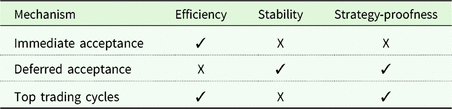
I now illustrate how different mechanisms can have different desirable properties. Notice that µ LA is not stable, because i 2 would prefer to be matched with s 2 and i 2 has higher priority at s 2.Footnote 20 The immediate acceptance algorithm is also not strategy-proof because if student i 2 had submitted a ranking that put s 2 as her top choice, she would have received s 2 instead of s 3, which she preferred less. Though it is neither stable nor strategy-proof, µ LAis Pareto efficient because no individual could be made better off without someone else becoming worse off. Conversely, the deferred acceptance algorithm, which is strategy-proof, produces µ DA which is a stable but not Pareto efficient matching. The matching µ DA is not Pareto efficient because if i 1 and i 2 swapped schools, they would both be better off. However, it is still stable because there is no school-student pair that would rather be matched to each other than to their assignment under µ DA. The top trading cycles mechanism, also considered by BPS and mentioned briefly in section 2.3 is strategy-proof and efficient, but not stable.Footnote 21
The three mechanisms considered by BPS and discussed here – deferred acceptance, immediate acceptance, and top trading cycles – each have some desirable properties that mechanisms can exhibit (see Table 1 for summary). Thus BPS must make a normative trade-off when choosing which mechanism to implement. When BPS considered its ‘philosophical position’ concerning various trade-offs between different mechanisms, we can understand them as considering the desirable properties of each mechanism and their philosophical analogues.
Three mechanisms and their normative properties

Now, I demonstrate how the implicit normative political theory underlying BPS’s choice of the deferred acceptance algorithm over the others can be best explained as a version of Arneson’s equal opportunity for welfare principle of distributive justice. Arneson distinguishes two dimensions along which interpretations of the egalitarian ideal differ. Along one axis, interpretations are after straight equality or equality of opportunity. On the other axis are bases for measuring distributive shares, with resources on one end and welfare at the other (Arneson Reference Arneson1989). Equal opportunity for welfare, then, can be understood in contrast to other possible combinations. An opportunity is defined as a prospect for acquiring something if one seeks it.Footnote 22 In the school choice example, an opportunity is a chance to attend a certain school. In order for equal opportunity for welfare to obtain among students seeking positions at schools, every student must have equal opportunity to satisfy her preferences over schools she would like to attend.
Arneson’s view also takes into account the ability of various people to ‘negotiate’ the options presented to them, which in the BPS case translates into a concern about ‘strategizing’. Arneson writes that people might face the same array of options and ‘yet differ in their awareness of these options [and] their ability to choose reasonably among them’ (Arneson Reference Arneson1989: 85). He argues that people must face an effectively equivalent array of options, which could obtain in three different ways. First, options can be effectively equivalent if the options are equivalent and the individuals are identical in their ability to negotiate options. Second, if options are not equivalent but they exactly counteract inequalities in ability to negotiate, then options are effectively equivalent. A third way in which options can be effectively equal is for the options to be equivalent and for inequalities in negotiating abilities to be the result of decisions for which individuals are personally responsible. In the case of school choice, the fact that some played strategically and some do not under the immediate acceptance algorithm was seen as unfair. Under Arneson’s framework, the different abilities to strategize suggested that none of the three possible ways for options to be effectively equivalent obtained. Thus, BPS chose an algorithm under which all individuals have the same options and the same ability to negotiate the options. In other words, the need to satisfy one of the ways of creating effectively equivalent options can be understood as BPS’s rationale for adopting a strategy-proof mechanism.
Thus I have demonstrated that the school choice algorithm selected by BPS was selected on normative grounds that extend far beyond economists’ usual common denominator of ‘efficiency’. Through an inference to best explanation, I suggested that the choice of the deferred acceptance algorithm over other possibilities can be understood as instantiating an implicit normative political theory about what constitutes a just allocation of students to public schools. On this view, a just allocation process provides each participant an equal opportunity for welfare, where welfare is defined as preference-satisfaction.
I do not mean to suggest that equal opportunity for welfare à la Arneson is the only possible normative theory underlying the decision to adopt the deferred acceptance procedure. I simply offer an inference to best explanation, focusing on the prominence of strategy-proofness as a normative criterion.Footnote 23 By focusing on the stability of the chosen algorithm, one could offer a different underlying normative theory. I offer a sketch of an alternative here. Stability is closely related to envy-freeness, which is a distributive ideal in many theories of justice or fairness (see e.g. Varian Reference Varian1975; Dworkin Reference Dworkin1981a,b). Stability, in Pathak’s words, ‘embodies a notion of fairness: a student should not envy another school over her assignment and have a higher claim to that school’ (Pathak Reference Pathak2011). Since the mechanism ensures a stable outcome – an outcome in which there is no ‘justified’ envy, i.e. no student would prefer to be matched to a different school at which they also had higher priority – the allocation of students is envy-free.Footnote 24 For the purposes of my argument, it is more important to see that some underlying normative theory exists than to precisely pinpoint the content of the normative theory.
4. The normative gap
I now turn a critical eye on the use of mechanism design in constructing BPS’s student allocation algorithm. In section 3, I introduced two unusual features of the BPS redesign: that the economic theory is enacted in the school system (F1) and that it draws on an elaborate, but unarticulated, normative framework (F2). Putting (F1) and (F2) together suggests that mechanism design enacts a theory of justice. There is a normative gap between the implicit normative theory of the mechanism and the actual demands of justice. In this section I further describe the normative gap, and discuss what is at stake when it emerges. In order to do so, I draw on the distinction in political philosophy between ideal and non-ideal theories of justice, and on the concept of performativity from economic sociology.
4.1. Ideal theory, enacted
What role can or should ideals play in arranging actual institutions? This question is at the crux of the disagreements in political philosophy around ideal theory and non-ideal theory. While the term ideal theory has been used in a number of ways, I use the original definition in A Theory of Justice (Rawls Reference Rawls1971). Rawls takes ideal theory to be an account of the principles that ought to guide the design of the basic structure of society. Ideal theory operates according to two assumptions absent in non-ideal theory (Rawls Reference Rawls1971, Reference Rawls2001): strict compliance and favourable circumstances.Footnote 25 Non-ideal theory, on the other hand, aims to formulate principles that take into account obstacles due to non-compliance and due to unfavourable circumstances. Rawls writes that non-ideal theory ‘studies the principles that govern how we are to deal with injustice’ (Rawls Reference Rawls1971: 8). While critics of ideal theory form a motley group, many dispute Rawls’ particular formulation of the proper relationship between ideal theory and non-ideal theory (Mills Reference Mills1997; Anderson Reference Anderson2010; Simmons Reference Simmons2010; Sen Reference Sen2011, for example).
What does the disagreement about ideal theory and non-ideal theory have to do with the BPS case? Following my inference to best explanation of the principles underlying the Boston school case, I argue that the mechanism design enacts an ideal theory even though it takes place in the non-ideal world. First, the mechanism makes the two idealizing assumptions made in ideal theorizing. It assumes strict compliance – it assumes that students will actually participate in and comply with the allocation procedure. It also assumes favourable circumstances – that students will not be prevented for social, economic or otherwise historically contingent reasons from obtaining information about schools and from rank-ordering the top five schools across the entire district that they would like to attend. Then, with these assumptions in hand, there is an abstract question: How do we allocate students in a way that can be justified to all? In order to answer that question in this realm of abstraction, just as Rawls introduces the veil of ignorance and the original position, mechanism design introduces a formal construct.
In the BPS case, which aims to answer a much more local question about justice, the construct is a strategy-proof mechanism which ‘‘levels the playing field’ by diminishing the harm done to parents who do not strategize or do not strategize well’ (Boston Public Schools 2005). The strategy-proofness of the mechanism ensures that participants list their ‘true preferences’ rather than trying to ‘game the system’. The strategy-proof requirement thus constrains the way in which participants interact. Participants in the Boston school choice mechanism, as under the veil of ignorance, are ab initio – all that matters for acquiring the just distribution is their ‘true preferences’ which are highly idealized.
One might have expected that the mechanism design used in the BPS case, insofar as it is grounded in a distributive principle like equal opportunity for welfare, would belong to the realm of non-ideal theory. After all, non-ideal theory concerns itself with finding distributive principles that handle injustice in the actual world. Boston’s public school allocation system had been repeatedly charged with allegations of injustice as discussed in section 2. But, the underlying theory is highly idealized and abstract. The economic theory brought in to ‘solve’ Boston’s problems thus enacts a hypothetical construct like those drawn up by theorists of justice like Rawls (and others such as Gauthier and Harsanyi). The mechanism, understood in this way, does not select the just allocation of students to schools in non-ideal circumstances. Rather, it is an artifact of ideal theory. I now turn to a discussion of criticisms of ideal theory and how they come to bear on this enactment.
4.2. Criticisms from non-ideal theory
Do criticisms of ideal theory have bite in this real-world enactment of ideal theory? Or does the enactment, by taking place in the non-ideal world, thus dodge the criticisms of ideal theory? In order to answer this question, I turn to two prominent objections to ideal theorizing from Amartya Sen and Charles Mills, and investigate how each comes to bear on the enactment of ideal theory at hand.Footnote 26 I take these criticisms from non-ideal theory to demonstrate the existence of a gap between the ideal of justice enacted by mechanism design and the actual demands of justice. In this section I use ‘actual demands of justice’ as a placeholder, and describe in more depth what these actual demands of justice entail in the next section.
Sen’s critique of Rawls centres on a distinction between the comparative nature of non-ideal theory and the transcendental approach of ideal theory (Sen Reference Sen2011). Non-ideal theory is comparative in that it allows for comparison of the relative justice of various alternatives. His argument raises issues with two aspects of transcendental theories. First, he argues that the indeterminacy of impartial bargaining devices poses a real problem for locating transcendental theories. The plurality of bargaining solutions indicates the impossibility of finding a ‘transcendental’ theory. Second, and more practically, he argues that abstract ideals of justice are neither necessary nor sufficient for judging the justice or injustice of actual institutions (Sen Reference Sen2011: 102).Footnote 27
Both of Sen’s criticisms of ideal theory relate to the BPS case in insightful ways. Consider the first criticism, and recall that any given mechanism design solution to a school choice problem might have a range of desirable properties. In the BPS case, economists and policymakers specifically focused on the trade-offs between stability, efficiency and strategy-proofness. Sen’s criticism in this context calls attention to the fact that other combinations of these desirable features might also serve as distributive principles which, under suitably idealized circumstances, could be justified to all.
Sen’s second criticism also instructively applies to the BPS case. It suggests that having a distributive principle for school allocation that can be justified to all in the realm of ideal theory is neither necessary nor sufficient for ensuring justice. Sen argues that the transcendental approach and the comparative approach give fundamentally different answers to the question of what justice demands (Sen Reference Sen2006: 218). The comparative approach looks for ‘ways and means of advancing justice…in the world by remedying inequities’ while the transcendental approach looks for ‘the simultaneous fulfillment of the entire cluster of perfectly just societal arrangements’ (Sen Reference Sen2006: 218). The deferred acceptance algorithm enacts an arbitrarily chosen transcendental theory. Sen’s criticism, applied to our case, suggests it would be misguided to assume that this enactment advances justice.
At times Sen suggests that the pursuit of ideal theory may even be counter-productive – far from playing a necessary role in addressing urgent questions of justice, it may serve to distract from those very questions.Footnote 28 A stronger version of this argument has been put forward by Mills with an eye toward racial injustice. Mills has argued that ideal theory obscures the history of racial domination, and thus prescriptions based on contractarian frameworks are necessarily flawed in certain societies (Mills Reference Mills1997, Reference Mills2003, Reference Mills2005). He writes that ideal theory ‘is really an ideology, a distortional complex of ideas, values, norms, and beliefs that reflect the nonrepresentative interests and experiences of a small minority of the national population’ (Mills Reference Mills2005: 172). Further, he claims that ideal theory ‘was constructed to evade these [racial] problems’ (Pateman and Mills Reference Pateman and Mills2007: 107). In order to draw up principles of justice, one must attend carefully to the realities of racial domination, as in non-ideal theory.
Mills’ criticisms are useful for understanding the unusual case at hand. In the BPS case, ideal theory is acted out in the real world. As such, it displaces non-ideal theorizing. It abstracts away from racial (and other demographic) realities in order to institute a mechanism that is justifiable to all on its own terms, in a very limited sense. While Mills’ assertions about how ideal theory represents ‘ideology’, and how ideal theory was ‘constructed to evade’ racial realities may strike some as extreme,Footnote 29 his provocative criticism provides at the very least a grave warning about the possible dangers of ideal theorizing in the absence of non-ideal theorizing, specifically in the context of racial injustice. Even if ideal theory was not ‘constructed to evade’ racial realities in the causal sense that Mills claims, when ideal theory is enacted as in the BPS case, it might facilitate the evasion of a proper discussion of the real injustice particular to a given situation.
4.3. Performativity and technologies of depoliticization
What exactly are the ‘actual demands of justice’ to which the school allocation system must respond? How does mechanism design wedge a ‘normative gap’ between these demands and the normative properties of the proposed algorithm? In order to articulate how the normative gap emerges, I draw on the performativity thesis from economic sociology.
The concept of performativity, which has its roots in speech act theory (Austin 1962), ethnomethodology (Garfinkel 1956) and actor-network theory,Footnote 30 has taken on a variety of meanings when applied to scientific expertise. I focus on the concept of performativity that has been used to describe economists in general,Footnote 31 and market designers in particular (Mirowski et al. Reference Mirowski, Nik-Khah and MacKenzie2007; Breslau Reference Breslau, Camic, Gross and Lamont2012, Reference Breslau2013). To call economics performative is to suggest that economic knowledge does not describe existing phenomena, but rather consists of a set of tools that constructs actors and institutions. In other words, economics provides a performative framing that moulds reality in its own image – reality thereby comes to resemble economists’ abstractions.Footnote 32
In the BPS case, mechanism design provides a performative framing for the problem of assigning students to public schools. This framing moves the allocation of seats in schools into the realm of ideal theory. Participants are shaped into a certain kind of agent. ‘Strategy-proofness’ becomes the central policy concern related to ‘transparency, fairness, and equal access to public facilities’. The performativity of the economic theory has a blinding effect, as if participants in the mechanism are gradually made into rational agents behind a veil of ignorance, whose knowledge of their actual position in the broader structure of social life is erased.
The framing of households in school choice as agents with well-ordered preferences gives rise to considerations that must be dealt with in the realm of non-ideal theory. These considerations are ‘the actual demands of justice’ relevant to the situation at hand. The public schools in Boston are varied in their resources and opportunities for students, and students at different schools have vastly different outcomes. The choice of the deferred acceptance algorithm changes the overall distribution of students to schools. Are better-off students still landing in the best-resourced public schools? Are there racial disparities that result? These considerations have to do with the collective demands of a school system. The deferred acceptance algorithm serves particular notions of ‘transparency, fairness and equal access to public facilities’ – but these notions can only be achieved within the performative framing. Deferred acceptance is ‘transparent’ only to the extent that all participants understand the process. It is ‘fair’ to the extent that prevents a particular form of strategizing. It ensures ‘equal access to public facilities’ if access is understood as opportunity for welfare, i.e. the satisfaction of stated preferences. The performative framing shuts down other notions of transparency, fairness and equal access to public facilities, which may arise out of attentiveness to local particulars, the historical injustice of the school system, and the privileging of collective demands for equity.
The performative framing thus entraps participants in a thought experiment that exists only ab initio. Inside this thought experiment, it is difficult for households to assess their actual interests, preferences and welfare, and how they are or are not represented in the policy change. Participants’ concerns about historical injustice, local inequities and collective demands do not disappear in the BPS case, rather, they are displaced by the performative framing of mechanism design.Footnote 33 The normative gap emerges between the framing of student assignment in the language of mechanism design, akin to an ideal theory of justice, and the politics of the allocation of students to public schools. To genuinely address the political stakes requires recourse to non-ideal theory which in turn requires democratic input. The normative gap is hard to close through democratic deliberation because the stakeholders themselves lack the technical understanding that could reframe the interaction.
Why does the so-called normative gap matter? I have not suggested that the economists and policymakers involved in redesigning Boston’s student allocation systems were making explicit claims about the suitability of their ideal theory. I have merely provided an inference to best explanation of how their work might be explained as an enactment of ideal theory. So, one might object that my criticism cannot tell us much about the role of economic theory in redesigning the allocation system. In the spirit of the criticisms from non-ideal theory – why not just pay attention to what actually happened in Boston and assess whether the use of mechanism design improved the fairness of the public school allocation system? A hypothetical interlocutor might gesture to two facts to indicate the success of the market designers’ work, and thus the irrelevance of the criticism from non-ideal theory. First, recall the civil unrest and the racially motivated violence that plagued the school system in the latter half of the 20th century. Though BPS still face criticism over the system of allocation, people are not so incensed as to take to the streets. Second, the City of Boston has confirmed the economists’ success by continuing to enlist them in refining their system of school allocation in the years since the 2005 redesign.Footnote 34
The mechanism design ‘succeeds’ in these limited ways not because it meaningfully addresses the inequities relevant to the just allocation of resources but rather because it appears to furnish a set of impartial rules and procedures. Mechanism design thus serves as a technology of depoliticization. Because an ideal theory is enacted by the mechanism, opportunities for normative criticism of the rules and procedures are closed off to the stakeholders.
In the wake of desegregation, a select group of experts undermined the public’s trust in the school system. That select group of experts might have involved at various points the Boston School Committee, together with Judge Garrity and various consultants. Decision-making procedures are especially appealing when expert judgement has undermined public trust. As Theodore Porter argues in his landmark book Trust in Numbers, ‘a decision made by the numbers (or by explicit rules of some other sort) has at least the appearance of being fair and impersonal’ (Porter Reference Porter1995: 8). Recall some of the charges against Judge Garrity that came out in retrospect: ‘[he] had a paternalistic mentality that all goodness and all knowledge flows from the federal court’ (Richer Reference Richer1998: 5). The criticism that, through busing, a federal judge had taken up ‘an experiment in social engineering’ is indicative of the undermining of public trust.
Gradually, after Garrity, the allocation process became more mechanical and rule-based. The Boston School Committee had historically faced a political, social and economic quandary assigning students to public schools, and their expert judgements had undermined the public’s trust in their ability to make decisions. The ‘controlled choice’ plan initiated in 1988 allowed parents to begin to place their ‘trust’ in a mechanism rather than a group of experts. That mechanism became even more rule-based in 1999 when race was dropped as a distributive category. Then, when economic theorists turned their attention to BPS in 2005, they offered an entire mechanical language for evaluating the virtues of different allocation algorithms.
The mere fact that school choice had been cast as a problem in mechanism design by Abdulkadiroğlu and Sönmez (Reference Abdulkadiroğlu and Sönmez2003) made it an attractive alternative to other ways of deciding how to allocate students to schools, simply by virtue of being highly mechanical. The school choice procedures appeared to become more objective in two ways. First, procedures replaced the expert judgements of the school committee – when the ‘controlled choice’ mechanism was put into place in 1988, a procedure replaced individual decision-makers. Second, mechanism design offered a consistent language for evaluating the increasingly algorithmic procedures. In 2003, what Abdulkadiroğlu and Sönmez’s paper offered was a language for evaluating allocation procedures that offered a veneer of objectivity. This veneer of objectivity makes it easier to justify the procedure to a vested public. Some policy might be chosen not because it actually addresses the issues best but because it appears to offer accountability both in the procedure itself and the evaluation of those procedures.
Consequently, the gap between the normative theory implicit in BPS’s use of mechanism design and the justice-based concerns of stakeholders can be understood partially as the result of a bi-level drive toward more seemingly objective rules and procedures. The ideal theory implicit in the mechanism design supplants local ideas about what constitutes justice.Footnote 35 Additionally, it is not the normatively best solution – any objective-seeming method would have accomplished the task.
Sen’s two part criticism of ideal theory also helps us here. First, recall that there are many ways of reaching an ‘impartial ideal’ – by imposing different constraints on rational agents. The same is true in the school choice case. There are many candidates for a distributive ideal that can be performatively framed through concepts such as ‘efficiency’, ‘stability’ and ‘strategy-proofness’. So in the face of this indeterminacy one must choose a particular distributive ideal. But the process of choosing an ideal cannot be impartial or objective – it is not aiming for some transcendental truth but rather a fair solution to an actual problem. One would hope, in fact, that the process of choosing among ideals would be highly democratic or collectively deliberative, and therefore closely tailored to the needs of Boston’s public. However, the technical evaluation of procedures can easily come to take the place of such democratic deliberation.
One might still respond to the critical framing above by suggesting that the current algorithms designed by a small group of experts are clearly an improvement over leaving it up to the judgements handed down by a few experts. I have not argued otherwise. However, I have argued that the veneer of objectivity is worrisome in conjunction with mechanized procedures that ‘perform’ reality. Mechanism design, used in this way, is a technology of depoliticization, which may obstruct normative criticism in a manner similar to how Mills sees ideal theory as evading unjust realities. Without proper attention to the gap between the normative theory enacted by the mechanism and the actual demands of justice, the gap will persist.
4.4. Epilogue
To further demonstrate how the critical perspectives presented above come together to illustrate the emergence and persistence of the normative gap, I present an epilogue to the story presented in section 2.
I have already called attention to how the priority system – defined by local laws before the mechanism is enacted (subsection 3.2.) – must be decided with the utmost care if the mechanism is to genuinely give students in all neighbourhoods an equal opportunity for welfare. When BPS considered different proposals for changing the mechanism in 2003, they were also presented with six different ways of drawing walk-zones, suggested through a community engagement process (Landsmark and Dajer Reference Landsmark and Dajer2004; Abdulkadiroğlu et al. Reference Abdulkadiroğlu, Pathak, Roth and Sönmez2005b; Dur et al. Reference Dur, Kominers, Pathak and Sönmez2018). The redrawing of walk zones would change the demographic distribution of priorities at different schools. However, the only change made by BPS was to change the algorithm for assignment. An attentiveness to collective demands of the school system relies on how the neighbourhoods are drawn, but since the mechanism offered a straightforward way of discussing a different kind of fairness, the easiest change to make was a mechanical one – to change the algorithm. The elaborate normative language of the mechanism displaced other sorts of normative questions. The performative framing obstructed deeper questioning of how well the mechanism met collective demands. In the ensuing years, stakeholders began to express concern that the system of walk-zone priority continued to provide an unfair advantage to those who lived in wealthier neighbourhoods (Dur et al. Reference Dur, Kominers, Pathak and Sönmez2018). Stakeholders attempted to renew discussions about redrawing neighbourhood lines in 2006, the year after the new algorithm was instated, and again in 2009. But the system remained largely unchangedFootnote 36 – the normative gap persisted.
In 2012, Boston Mayor Thomas Menino heeded the concerns about walk-zones and pledged a major overhaul of the BPS allocation system. While the concerns about walk-zones were addressed, the normative gap persisted because the economists involved this time around simply offered up a new mechanism – a new performative framing corresponding to a new ideal theory. This mechanism solved a new set of concerns about walk-zones, while the 2005 mechanism change responded principally to concerns about ‘gaming the system’. The mayor commissioned Pathak, one of the original consultants in 2003 who was by 2012 a professor of economics at MIT, to evaluate proposals for overhauling the system. One of Pathak’s doctoral students in operations research, Peng Shi, played a key role in evaluating alternative mechanisms for the advisory committee, using computer simulations to analyse the impact of various proposals (Seelye Reference Seelye2013b).
Shi eventually put forward a proposal of his own which scrapped walk-zone priority altogether and would also do away with the final remnants of busing students to faraway neighbourhoods as initiated by Garrity in 1974 (Seelye Reference Seelye2013b). Shi writes of his proposal: ‘I formulated the reform as an optimization problem of finding school-choice menus and priorities that induce the best combination of equity of access, proximity to home, predictability, and community cohesion’ (Shi Reference Shi2015: 1). Under his proposal an algorithm produces a ‘menu’ of at least six schools for every parent to choose from, at least four of which must be of high or medium quality, where quality is determined by test scores. On 13 March 2013 the advisory committee voted to instate Shi’s proposal in Boston’s Public Schools.
So, with Shi’s proposal the final vestiges of busing in Boston disappeared, and the deferred acceptance algorithm was replaced by a restricted choice menu. How does the critical discussion presented in this paper help to understand these developments?
BPS was pushed into adopting a different mechanism that performs a different normative theory that still fails to offer a democratic forum through which stakeholders might assess whether the algorithm meets the collective demands of the school system.Footnote 37 One could run through an inference to best explanation, as presented in subsection 3.2., to locate an ideal theory of justice that corresponds to Shi’s algorithm. It would yield a different result – an ideal theory more focused on the tricky problem of walk-zones than the tricky problem of strategizing – but still an elaborate account of what constitutes distributive justice.Footnote 38 It is difficult for a stakeholder unhappy with the new system to criticize it on normative grounds, because the ideal theory is enacted. The performative framing of the allocation procedure blocks off normative criticism from participants in the optimization problem. The normative gap persists.
Consider the following quotation from a New York Times article about Shi’s proposal:
That it took a dispassionate outsider with coding skills but no political agenda to formulate the model is a measure of the complexities facing urban school districts today. Many such districts, like Boston’s, are plagued by inequities…Overcoming that legacy here has been so emotionally charged that previous attempts to redraw the zones have failed, though in 2005 the district did change the algorithm it uses to assign students. (Seelye Reference Seelye2013b)
It is remarkable indeed that the busing system, criticized as ‘a federal judge’s experiment in social engineering’, was ultimately axed by a solution drawn up by an MIT graduate student ‘with coding skills but no political agenda’. But I do not take this fact to offer a ‘measure of the complexities facing urban school districts’. Rather, given the critical perspectives I have presented in this section, we can see that it is instead a measure of the gap between an ideal theory enacted through mechanism design and the actual demands of justice. Precisely what Shi and his models did in 2012, and what Abdulkadiroğlu et al. did in 2003, is provide a seemingly objective procedure to ‘overcome’ Boston’s legacy of injustice by offering a technology of depoliticization. In this case, to overcome the legacy has been to ignore it by enacting a theory ab initio that solves whichever problem happened to have initiated the current policy discussions but not the problems that came before. Millsian criticisms thus arise: How can the mechanism genuinely mete out justice if it fails to explicitly consider certain kinds of actual, present and past injustices in the school system? The normative gap is hard to close through democratic deliberation since each new mechanically objective ideal theory, through the mechanism, is performed. Participants, policymakers and economists alike are trapped in the realm of ideal theorizing.
I do not aim to place blame or responsibility on the economists who have consulted on school choice redesigns. This paper is not directly concerned with the responsibilities of experts in public policy. But this paper does suggest that economists’ self-conception as ‘engineers’ is misleading at best and dangerous at worst. Economists do not see themselves as responsible for worrying about ‘justice’ in any deeper way than presenting a mechanism. Their mechanisms have different normative properties that need to be weighed by the policymakers. In some cases the economists clearly express the normative limitations of their designs: ‘Under the assumptions of the model…the ‘leveling the playing field’ idea only indicates that sophisticated students lose their strategic rents under the new mechanism’ (Pathak Reference Pathak2011: 531). But the economists’ technical language on its own is normative in elaborate ways – its machinery operates in the realm of ideal theory. Economists’ technology can thus depoliticize sites of democratic contestation, thereby distracting attention from the most important questions at hand.
In this section I have drawn on the concept of performativity to demonstrate what is at stake when ideal theory is enacted through mechanism design. Sen and Mills’ criticisms from non-ideal theory demonstrate that there exists a gap between the ideal theory enacted through the mechanism and the collective demands of the school system. The veneer of objectivity offered by the language of mechanism design helps to explain how the normative gap appeared in the first place. It appeared because the trust of experts had been undermined, and rules and procedures seem to offer an impartial alternative mode of decision-making. BPS took the economists’ advice to implement a strategy-proof algorithm not because it addressed the actual issues at hand but because it was a procedure that could be justified to all in a highly abstract realm. The enactment of ideal theory is problematic for the very same reasons that ideal theorizing is problematic to Sen and even Mills. The enactment of ideal theory succeeds because it offers a performative frame, thereby obstructing stakeholders’ avenues for normative criticism of the mechanism.
5. Conclusion
In the decades that followed Brown vs. Board of Education, Boston’s school system was subjected to national scrutiny and controversy. Sparking high profile incidents of racially motivated violence and city-wide protests against court-ordered busing, the allocation of students to Boston’s public schools became a lightning rod for profound questions about the nation’s approach to racial, social and distributive justice. Three decades after court-ordered busing began in Boston, the mechanism design approach to school choice introduced a novel technical language that would come to mediate Boston’s (and other cities’) policy discussions in 2005 and beyond. To what extent did this novel technical framing enable policymakers to address inequities in Boston’s school system? What is the role of mechanism design theory when used to intervene in policy arenas of enduring social complexity?
In this article, I offered a critical discussion of the normative forces peculiar to design economics through a close study of several economists’ involvement in BPS’s policy discussions. I began in section 2 with the social and political background of school choice in Boston. I explained the canonical school choice model from mechanism design (Abdulkadiroğlu and Sönmez Reference Abdulkadiroğlu and Sönmez2003), and how BPS came to adopt, in 2005, a version of the famous deferred acceptance algorithm. In the following section, I went through an inference to best explanation, suggesting that the adoption of a strategy-proof mechanism instantiated an elaborate normative theory that resembles an equal opportunity for welfare principle of justice. In section 4, I argued that the mechanism design thus enacts an ideal theory. By considering criticisms of ideal theory (Mills Reference Mills2003, Reference Mills2005; Sen Reference Sen2011), I argued that this enactment of ideal theory inserts a normative gap between the abstract ideals of the institution and the collective demands of stakeholders. I drew on the performativity thesis to demonstrate how mechanism design thus serves as a technology of depoliticization.
What does this argument suggest about the future of design economics in policy arenas where issues of social and distributive justice coincide with technological complexities to be overcome? It suggests that the mechanism design approach to school choice will always be flawed and incomplete when instantiated in a particular setting. It reduces families and individuals to calculating individual actors, and flattens complex collective commitments to equality into unarticulated ideal theories of justice. This process closes off democratic debate, as stakeholders are left without the proper technical knowledge and language to voice their opinions about how well the school system is meeting collective demands. Thus, in order for mechanism design to overcome the challenges highlighted in this paper, it must serve as a social technology that invites democratic participation.Footnote 39
Precisely how mechanism design might serve as an inclusive social technology is a pressing topic for future work. Finding a path forward is important for designing school choice procedures in Boston and elsewhere,Footnote 40 but also for the design of other justice-oriented institutions. Mechanism design is ripe for application in constructing institutions in wide-reaching realms – from healthcare and town-planning to international trading schemes for carbon and water. If mechanism design can serve as an inclusive, participative and democratic social technology, it holds the promise of offering tractable solutions to local, national and global problems in which issues of great theoretical complexity intersect explicitly with the real demands of justice, as well as ideals. Economists participating in the market design literature are poised to solve extraordinarily complex problems with many constraints, and a browse through the leading economics journals reveals that market designers are eager to find ways to get their theory to line up with a variety of social goals.Footnote 41 But no matter how intricate the mechanism design solutions become, they will necessarily be incomplete as technical solutions to sociotechnical problems. Mechanism designers must strive to develop social technologies that conscientiously enable – rather than accidentally preclude – democratic participation.
Acknowledgements
I am grateful to my supervisor Stephen John for his guidance. I thank Jerry Green, Os Keyes, Scott Kominers, Bobby Pakzad-Hurson, Al Roth, Amartya Sen, Glen Weyl and three anonymous referees for comments and conversations that improved the paper substantially. David Adler, Julian Gewirtz and Indiana Seresin offered valuable responses to earlier drafts. The Frank Knox Memorial Fellowship from Harvard generously supported the writing of this work.
Zoë Hitzig is a PhD candidate in economics at Harvard and a Graduate Fellow at the Edmond J. Safra Center for Ethics. URL: https://scholar.harvard.edu/hitzig.