The career of William Babell (1688–1723), an English composer of German birth, has recently been reassessed by me following identification of a manuscript source in Bergamo, which appears to be a collection of his harpsichord music.Footnote 1 The manuscript shows he was an important keyboard composer active in Britain immediately prior to the publication of Handel's Suites de Pieces pour le Clavecin (1720), and it has provided insights into his working methods. The major items – eleven substantial toccatas mostly in prelude–fugue form together with two suites – are replete with the cadenza-like passagework familiar from his arrangements of arias from operas produced at the Haymarket Theatre between 1706 and 1714, which were published in three collections in his lifetime (in 1709, 1711 and 1717).Footnote 2 They also reveal the range of influences on his keyboard style, illustrating how he adapted material from music by French, Italian, German and English composers. Though the source is not an autograph, it was copied towards the end of Babell's life by an individual close to him, to judge from the large number of pencil corrections that appear to be the composer's own. The manuscript therefore has biographical implications, suggesting that there was a composer-supervised project to bring together his keyboard music, perhaps in order to prepare some of it for publication, which never saw completion.
The existence of a collection of keyboard pieces accords with how Babell's career and surviving music have previously been understood. The composer's biography draws on the late eighteenth-century account of John Hawkins, but can also be pieced together from court records, the sources of his music (including two autograph keyboard manuscripts and posthumous publications of his chamber and orchestral music), Johann Mattheson's Der vollkommene Capellmeister (1739), newspaper reports (such as the announcement of his appointment as organist of All Hallows Bread Street in 1718) and an obituary.Footnote 3 Babell emerges from these sources as a leading musician whose reputation rested heavily on his status as a harpsichordist, as is apparent from the obituary (echoed later by Mattheson), which declared, ‘Scarce ever was any Man, as we are inform'd, more famous for the Harpsicord than himself’.Footnote 4 This view doubtless stemmed from Babell's keyboard dexterity, evident from the aria arrangements and toccatas. His growing reputation before his early death is also reflected in a diverse output in other genres. This included concerto-like pieces for his main instrument (an example of which survives), at least thirty sonatas and concertos for other instruments that were published posthumously – probably considered suitable for his own performances (as a continuo player) in conjunction with colleagues in public concerts – and a St Cecilia's Day ode (lost), which was performed at the Lincoln's Inn Theatre in 1718.Footnote 5
A radically different view of Babell has been developed in recent years by Graham Pont, which discounts or ignores most of the available musical and biographical information and is instead focused on two theories: that keyboard music by Babell was copied from lost Handel autograph manuscripts, and that Babell acted as the principal copyist of Handel's music between c1711 and his death in 1723. These ideas are founded on criticisms of how scholars have used stylistic evidence as well as of their understandings of the working methods of eighteenth-century music copyists. In this essay I will revisit the evidence relating to Babell's activities as a harpsichord composer and as a music copyist, arguing that Babell should take his place as an important contributor to the repertory of early eighteenth-century English harpsichord music – a position put into doubt recently by a recording of the toccatas marketing them as works of Handel, as well as from claims in Pont's own writings. However, I also consider some of the broader issues that Pont's criticisms have touched upon, including how stylistic evidence is used and how the handwriting of copyists may be distinguished.
BABELL AS A PERFORMER–COMPOSER
Suits of the Most Celebrated Lessons Collected and Fitted to the Harpsicord or Spinnet by Mr: William Babell with Variety of Passages by the Author, a collection published by John Walsh in 1717, is devoted mainly to solo keyboard versions of arias from operas performed at the Haymarket Theatre in London between 1711 and 1714. The ‘Variety of Passages by the Author’ consists of division-like and cadenza-like passagework, which in the aria arrangements has been added to the sections originally for solo voice and continuo, often further elaborated in written-out repeats of ‘A’ sections; they have long fascinated writers on Handel's music and eighteenth-century performance practice.Footnote 6 Writing in the 1890s about the collection's extrovert concluding piece, the arrangement of ‘Vo’ far guerra’ from Rinaldo (1711), Friedrich Chrysander proposed:
we can make out [from William Babell's version] what Handel's famous improvisation of Cembalo Solos in this Rinaldo air really consisted of. Babell's brilliant gift of imitating upon the harpsichord what he listened to during opera performances deserves to be acknowledged. The great independency and mastery with which he treats Handel's themes is admirable. In this arrangement of the air ‘Vo’ far guerra’ we possess the greatest specimen of bravura music for harpsichord written until the year 1713. This alone has assured it a lasting historic importance.Footnote 7
Chrysander's opinion concerning the ‘great independency and mastery with which [Babell] treats Handel's themes’ is not widely shared today, though his suggestion that Babell's arrangement was influenced by Handel's obbligato harpsichord performances in the 1711 production has been endorsed by later writers. Gerald Gifford and Terence Best, for instance, have argued that Babell's ‘keyboard style was undoubtedly influenced by his close acquaintance with Handel's playing’, which he would have encountered as a member of the Haymarket opera orchestra.Footnote 8 The point was taken further, however, by Pont in 1995 and 2011, who claimed that Babell's arrangement did not simply reflect Handel's influence, but in fact conveyed what Handel had written in a lost autograph manuscript, thereby implying that Handel was the composer of the version published under Babell's name.Footnote 9
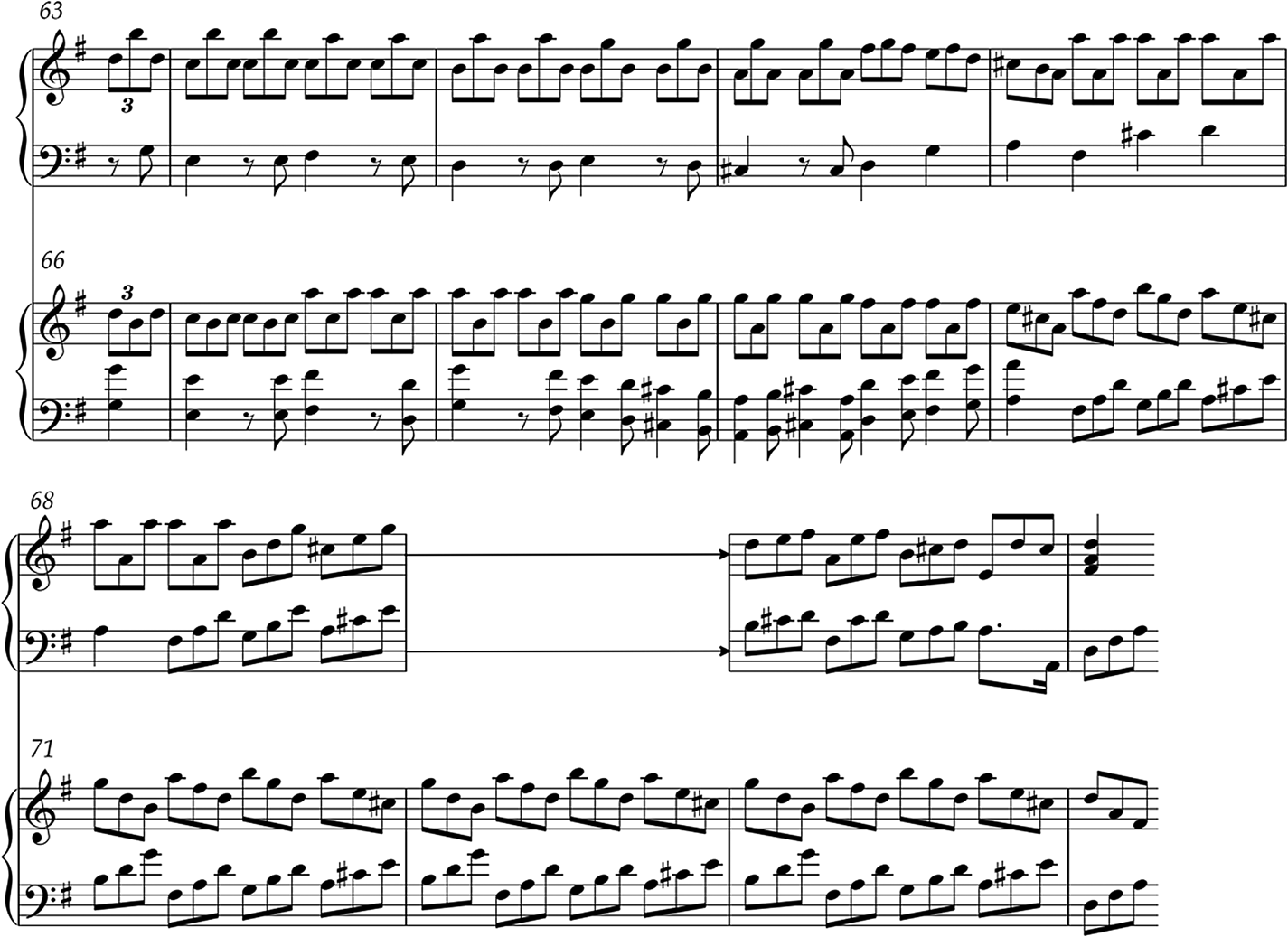
An important source of information about Handel's harpsichord playing in the aria is Walsh's short score The Songs in Rinaldo (1711), which shows that ‘Vo’ far guerra’ included two passages of harpsichord obbligato, one before the entrance of the singer, the other before the final ritornello that concludes the aria's ‘A’ section.Footnote 10 At first ‘Vo’ far guerra’ was published without the obbligato part, perhaps because it had not yet been written down or was not ready for publication – the word ‘Cembalo’ appears on portions of empty staves where the cadenzas were played – but it appears in the second and subsequent editions, as ‘the Harpsicord Peice [sic] Perform'd by Mr. Hendel’.Footnote 11 The cadenza-like interpolations attributed to Handel in these editions are modest compared with Babell's, though Babell's are placed in the same locations as Handel's, which suggests there is a link between his arrangement and ‘the Harpsicord Peice’. Furthermore, the second cadenzas in both versions are related, following a similar harmonic trajectory at the beginning featuring two-note tremolo-like figuration in triplets in the right-hand part accompanied by a bass moving in descending thirds and ascending seconds (Example 1). These similarities suggest that Babell was influenced by Handel's performances. However, even if a copy of Handel's cadenzas was available, it is unlikely that Babell recycled them in a literal manner. None of Handel's original cadenza material has been quoted literally; instead Babell appears to have taken Handel's rhythmic and technical devices as a starting-point for cadenzas that must be assumed to be his own.Footnote 12
‘the Harpsicord Peice [sic] Perform'd by Mr. Hendel’ from ‘Vo’ far guerra’, Rinaldo, hwv7a, bars 63–70 (Hallische Händel-Ausgabe, series 2, volume 4/1, ed. David R. B. Kimbell (Kassel: Bärenreiter, 1993), 139) (used by permission) (above); Handel, arr. Babell, ‘Vo’ far guerra’, bars 66–74 (Suits of the Most Celebrated Lessons Collected and Fitted to the Harpsicord or Spinnet by Mr: William Babell with Variety of Passages by the Author (London: Walsh, 1717), 64) (below)

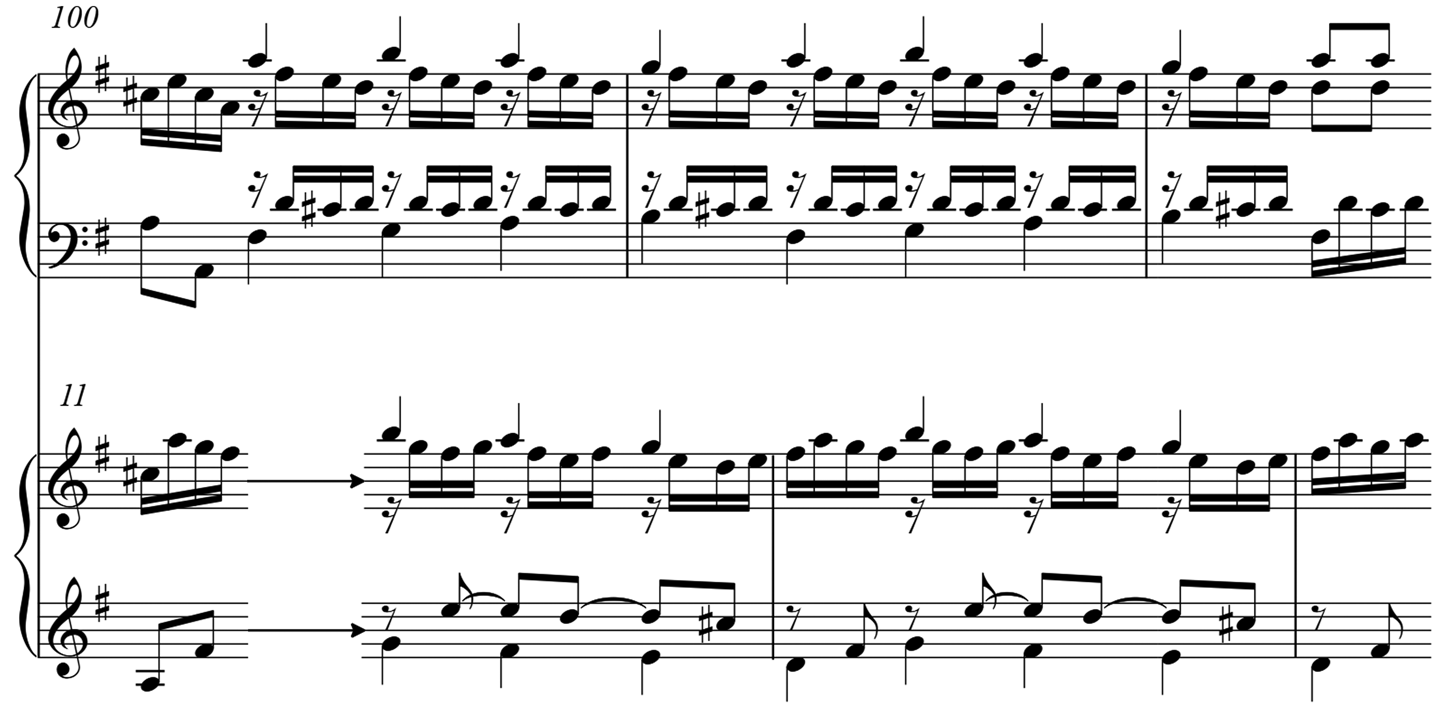
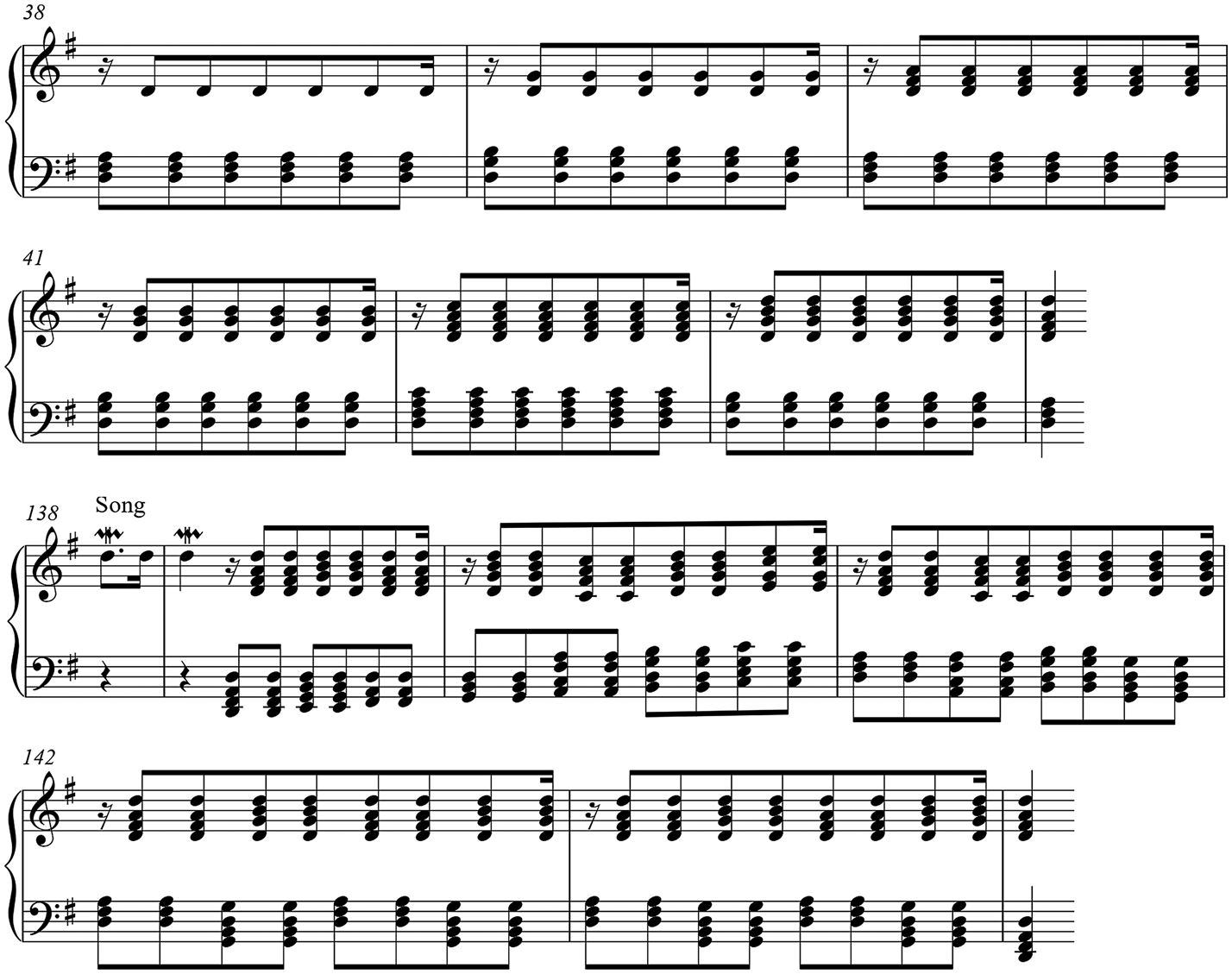
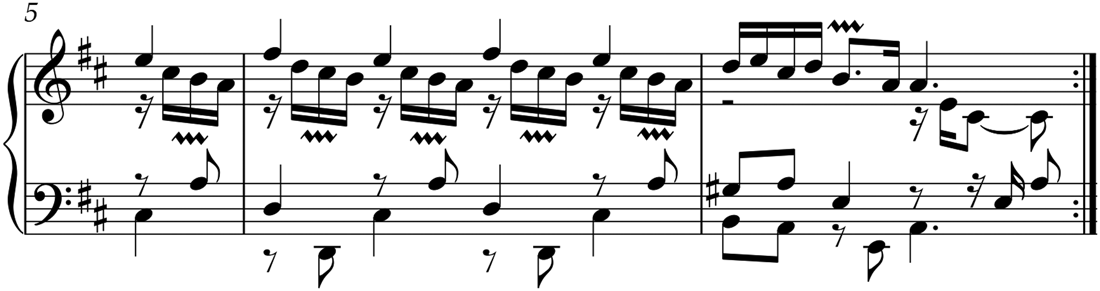
The Italian-style lingua franca of the early eighteenth century meant that composers drew upon a vocabulary of stock figuration, a factor that causes difficulties for attributions that rely on stylistic evidence.Footnote 13 Self-borrowings can, none the less, sometimes be identified in cases where the figuration appears in a similar harmonic context, especially if the new composition and the borrowed work belong to the same genre. On this basis two self-borrowings may be identified in Babell's preludes and cadenzas for ‘Vo far guerra’: Example 2a shows variants of a cadential progression elaborated by a repeating pattern in semiquavers, while Example 2b shows two versions of a sequence of displaced chords distributed between hands over a pedal D (in ‘Vo’ far guerra’ the pedal appears in the middle of the texture – on d1 – while in the Prelude it appears in the bass). These paired passages share a key, harmonic structures and textural elements such as the division of the four-part writing between the two hands in Example 2a and the thick sonorities in Example 2b. However, most comparisons of this kind are inconclusive, as illustrated by comparing Example 2a to a passage from an Almand by John Baptist Loeillet of London (Example 3). Loeillet's Almand uses a similar semiquaver figure in four-part texture that repeats in a cadential context, as well as stepwise movement in tenths between the treble and bass, but little importance can be attached to this resemblance because the figure belongs to the vocabulary of stock devices – it is a cadential pattern elaborated in a conventional manner – and no other connections between Loeillet's Almand and Babell's cadenza can be identified. Loeillet's and Babell's isolated uses of this device therefore do not indicate that a direct connection between their pieces existed.
Handel, arr. Babell, ‘Vo’ far guerra’, bars 100–102 (Suits of the Most Celebrated Lessons, 66) (above); Babell, Prelude, bars 11–13 (Suits of the Most Celebrated Lessons, 46) (below)

Babell, Prelude, bars 38–44 (GB-Lbl, Add. MS 71209, fols 29v–30) (above); Handel, arr. Babell, ‘Vo’ far guerra’, bars 138–143 (Suits of the Most Celebrated Lessons, 68) (below)

John Baptist Loeillet, Almand (from Lessons for the Harpsichord or Spinet (London: Daniel Wright, 1732), Lesson 2), bars 5–7

The need for caution when using stylistic evidence of this kind comes to the fore in Pont's criticisms of how scholars have addressed matters of authenticity in Handel's keyboard music, developed most extensively in a 2016 study entitled ‘Handel's Keyboard Sonatas’.Footnote 14 The study draws attention to several keyboard manuscripts whose contents Pont partially or entirely attributes to Handel, which were either not considered previously as works of Handel or whose authenticity has been questioned or dismissed by other scholars. Pont draws on his theory about Babell's handwriting and has attributed to Babell the copying of several of these sources (see below). However, he also argues for Handel's authorship by comparing figures or passagework, notably in discussions of a manuscript copied by the Chichester organist William Walond the younger (GB-Lfom, Coke 1275) in the 1770s and the Bergamo manuscript. Largely on the basis of the comparisons, the latter is heralded as ‘the most important collection of Handel's pre-London keyboard music to come to light, since the publication of the pieces from the Aylesford Collection in 1928’, a belief that influenced harpsichordist Fernando de Luca, whose commercial recording of the toccatas and preludes (Urania Records LDV 14032, 2018) has been marketed on websites under the title Händel: Complete Preludes & Toccatas from the Bergamo Manuscript (though the cover of the disc is headed ‘Georg Friedrich Händel – William Babell / Bergamo Manuscript’).Footnote 15
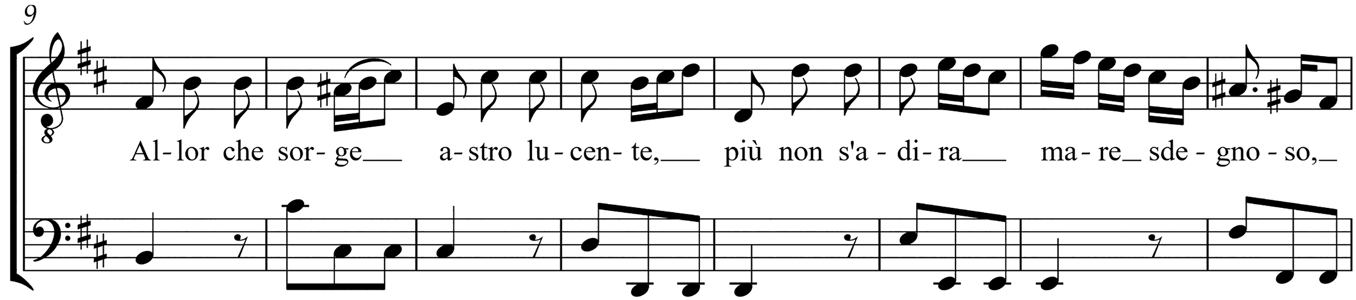
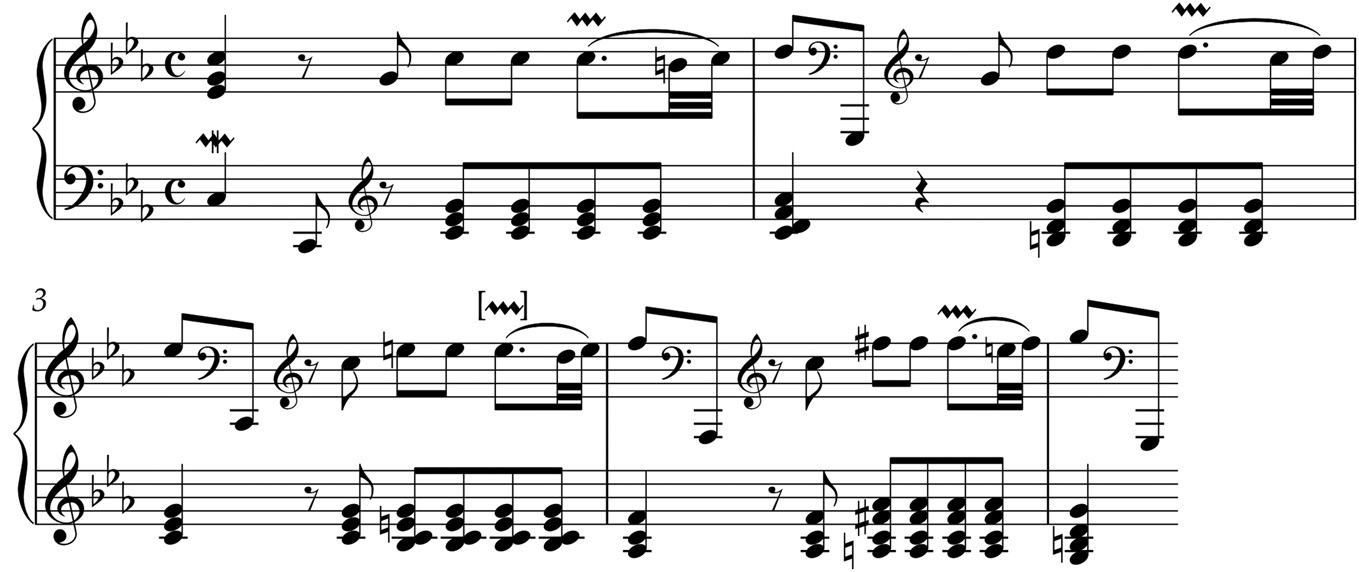
Many of the similarities are deemed to be significant as a consequence of Pont's problematic idea that improvisatory figuration in music by Babell would have been copied from lost Handel autographs. He points to similarities between the first movement of Bergamo Toccata 1 and an unascribed Sonata in two movements in the Walond manuscript, which he describes as ‘very Handelian’.Footnote 16 Yet both pieces have all the hallmarks of notated improvisations: the first movement of the piece in the Walond manuscript consists mostly of scales in demisemiquavers, while the second is nothing more than a collection of sequential patterns, which concludes with a cadence involving a repeated trill-and-turn figure also found at the end of the first movement of Bergamo Toccata 1. Similarly, scale figures in the second, third and tenth toccatas, said to resemble those in Babell's arrangement of ‘Vo’ far guerra’, or the passage in the second fugue of Toccata 10 where a fragment of the subject has been pitched against ‘brilliant semiquaver figuration in the manner . . . much favoured by Handel’, consist mostly of rudimentary sequential patterns; both likewise are uninformative. Pont does draw attention to one piece not consisting of stock figuration, the aria ‘Allor che sorge’, originally from Rodrigo (1707), whose opening he compares with the opening of Toccata 8. However, the figures are insufficiently similar by themselves to prove a connection (Examples 4a and 4b): the third repeated note of the figure in the aria, which is in triple time, is a restruck suspension (bars 10, 12 and 14), while in the toccata, in common time, this note helps articulate the end of a phrase unit. The figure is also harmonized differently: whereas Handel opts for a rising stepwise bass through his opening gambit, the toccata begins with tonic and dominant harmonies before a descending tetrachord is heard (bars 3–5).
Handel, ‘Allor che sorge’, Rodrigo (Vincer se stesso è la maggior vittoria), hwv5, bars 9–16 (Hallische Händel-Ausgabe, series 2, volume 2, ed. Rainer Heyink (Kassel: Bärenreiter, 2007), 159). Used by permission

Babell, Toccata 8, first movement, bars 1–5 (I-BGi, Ms. xiv 8751 h.1, fol. 20r)

The case for Babell's authorship of the Bergamo toccatas draws on a variety of types of evidence.Footnote 17 There are concordances with known works by Babell: a variant of the first movement of Toccata 1 is found in the autograph Babell portion of GB-Lbl, Add. MS 71209, while the first movement of the second and the entirety of the eleventh were published in Babell's Suits of the Most Celebrated Lessons. In addition, the stylistic argument in favour of Babell is focused on musical structure, not on comparing figures. Standing in contrast to the fluency of Handel's fugal writing, the fugues in the Bergamo manuscript reveal their composer's occasional difficulties handling extended, non-binary forms; there is a tendency for the fugal material to be underdeveloped (as in Toccata 9) or, more frequently, there is excessive reliance on repetitive sequential patterns (as in Toccata 6 or Toccata 10). The second movement of Toccata 5 also relates closely to the aria arrangements, since it is an expanded reworking of the second movement of the Sonata with Air and Variations in B flat major, hwv434, incorporating cadenza-like passagework in a manner recalling the ‘Vo’ far guerra’ arrangement. A connection to Babell can also be demonstrated for the two suites in the Bergamo manuscript. Both include gavottes modelled on pieces by the French organist Jean-François Dandrieu, a composer whose music also found its way into Babell's Suits of the Most Celebrated Lessons in expanded versions.
BABELL AS A MUSIC COPYIST
Babell's musical handwriting was first identified in the article of 1995 by Pont and is known from two keyboard manuscripts: GB-Lbl, Add. MS 71209, an oblong manuscript in four hands containing a large portion copied by Babell c1713, and GB-Lfom, Coke 1257, copied entirely by Babell c1714 and apparently originating from the library of the Duke of Leeds. Coke 1257 is organized along the lines of the Suits of the Most Celebrated Lessons, since it concentrates on pairs of aria arrangements coupled with a prelude, while Babell's contribution to Add. MS 71209, which involved less pre-planning, begins with two prelude–aria pairs and is notable for arrangements of several violin-sonata movements by Corelli and Dandrieu.Footnote 18
Add. MS 71209 seems to have been copied to begin with as an integrated volume, though it includes an interpolated gathering with a paper type different from the rest (leaves 13–16), which suggests that the contemporary reverse-calf binding was supplied at an intermediate stage, perhaps when the manuscript came into Babell's hands; he pencilled on the rear pastedown a series of tallies (possibly for calculating the costs of music lessons) and the inscription ‘For Babel att M.r Scotts In Deens Cour / Deen Street near S.t Ann's Church / near soho square’.Footnote 19 The manner in which it was copied can be quite easily deduced: it is mainly the work of Hand A (fols 1v–2r, 3v–12v, 17r–21r, 80v–79r) and Babell (fols 21v–73v); the third (Hand B) and fourth occupy, respectively, the pages that were left unused by Hand A and Babell (fols 2v–3r, 74r–78v) and the interpolated gathering. The original purposes of these manuscripts may explain their contrasting codicology: Coke 1257, which has a gilt-tooled red-morocco binding and a frontispiece featuring a drawing by the French draughtsman François Boitard, appears to be a lavish presentation volume, while Add. MS 71209 could have been compiled by Hand A and Babell working as successive teachers of Elizabeth Griffith, whose name has been written on the end leaf.
The identification of Babell's hand in Add. MS 71209 and Coke 1257 can be made with confidence. The surviving examples of Babell signature are similar to how his name has been written into Add. MS 71209.Footnote 20 Both manuscripts also concentrate on arrangements found in similar versions in Babell's printed keyboard volumes.Footnote 21 Especially convincing, however, is the remarkably close resemblance of Babell's hand to that of his father Charles Babel (died 1716), a French wind player and prolific music copyist active in England c1698–1716. Babel senior's extensive output of manuscripts certainly suggests that music copying formed an important part of his livelihood, so it is reasonable to assume that his skills were passed on to his son, including the ability to produce copies neat and consistent in appearance – hallmarks of Babel senior's work.Footnote 22
The hands of the two Babells are very similar, and if none of the above evidence existed – if the identity of Charles Babel as a copyist was not known, the music remained unidentified or undated, or other examples of William's handwriting were unavailable – careful examination would be required to confirm the existence of two copyists. Commenting on the similarities in 1995, Pont observed that ‘the father was a fine calligrapher, [whereas] his son was merely a competent one, whose writing was often slapdash’.Footnote 23 An important difference between them does seem to be in the speed of copying; the younger man's work often appears to have been executed in a hastier manner. However, William's hand potentially remains indistinguishable from Charles's in cases where he might have taken more care. The large anthology of harpsichord music that Charles copied for his son dated 1702 (GB-Lbl, Add. MS 39569) contains several pages towards the end (pages 236–241 and 250–286) featuring clef formations usually associated with William's hand that were conceivably copied by the younger man.Footnote 24 The treble clefs have wide upper loops and begin on the bottom line of the stave or above in William's manner, unlike Charles's, which tend to begin from a lower point and have a narrow upper loop. Similarly, the bass clefs in which the pair of dots are preceded by two vertical strokes are typical of William and not Charles, who normally omits these strokes.
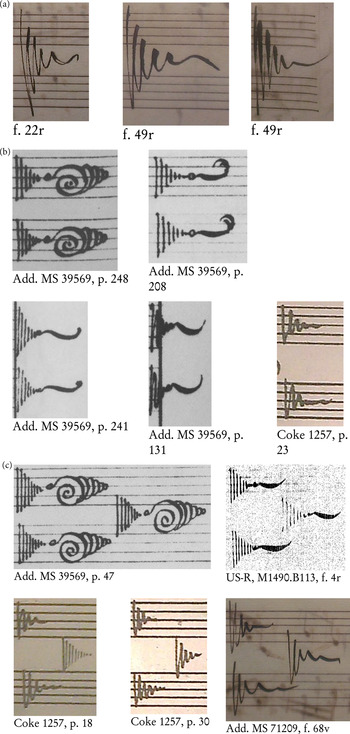
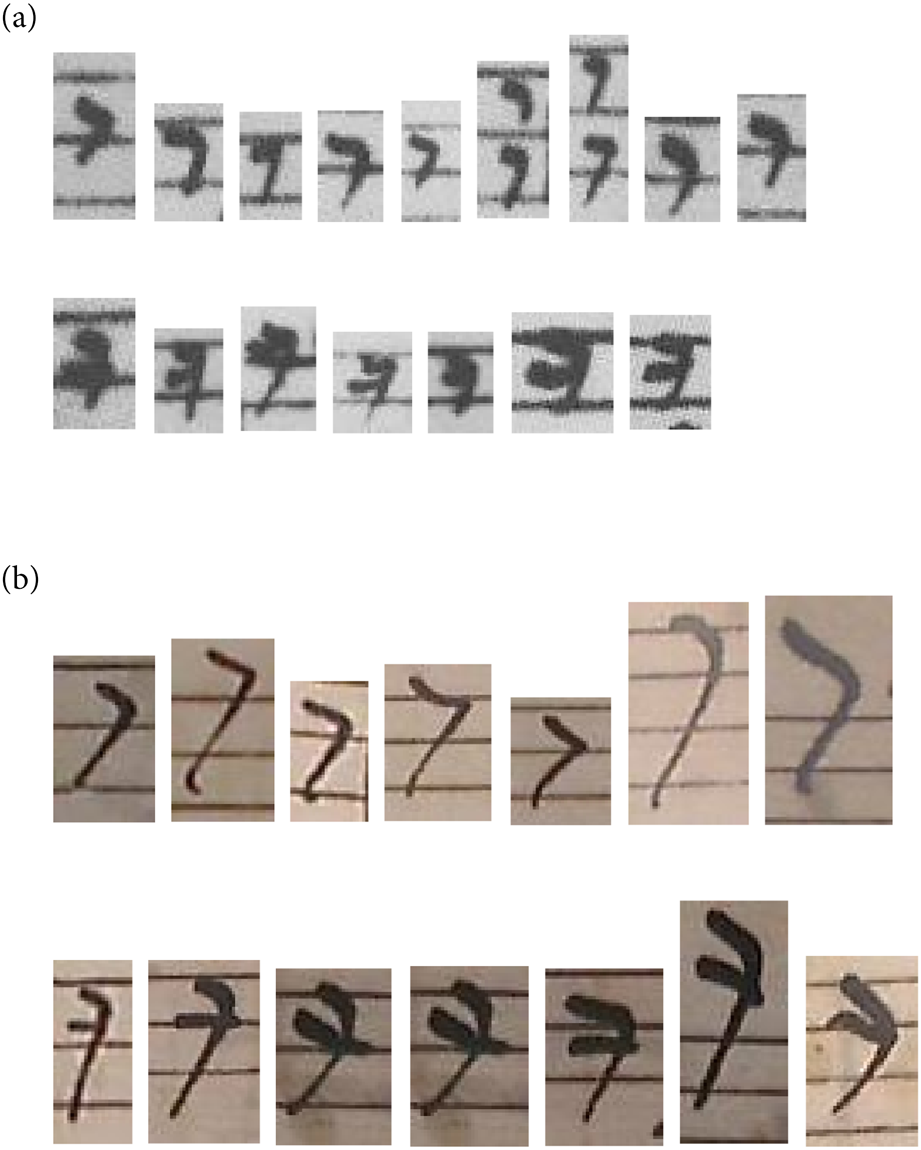
The clefs notwithstanding, a closer examination shows that Charles Babel was responsible for the copying of Add. MS 39569 in its entirety (except for some nineteenth-century additions). It should be noted that the treble-clef style preferred by William is also found in the latter portion of a pair of treble–bass partbooks of instrumental music copied c1702 by Charles.Footnote 25 Furthermore, several features of the copying on pages 236–241 and 250–286 are characteristic of Charles, not of William, including: (a) terminal flourishes that always consist of series of carefully drawn, closely aligned vertical strokes; (b) quaver and semiquaver rests that tend to be small and upright; and (c) the use of the French language. William could have been imitating the work of his father more closely than usual and was probably capable of writing in French. However, the terminal flourishes of the two men can usually be differentiated (Figure 1). William tends to adopt either a single flourish covering both systems or writes three in which the vertical lines are joined together as a single stroke, only occasionally writing a series of separate lines (as on page 18 of Coke 1257); in only a few very exceptional cases are the lines joined in Charles's work (as on page 131 of Add. MS 39569). Also significant is the lack of William's right-slanting, often large quaver and semiquaver rests. Charles's obey an opposite tendency, since they are rarely higher than the width of one space, while William's frequently extend to three, often as a consequence of the slanting (Figure 2).
(a) Single terminal flourishes in the portion of GB-Lbl, Add. MS 71209 copied by William Babell (b) Double flourishes in manuscripts copied by Charles and William Babell (c) Triple flourishes in manuscripts copied by Charles and William Babell

(a) Quaver and semiquaver rests from GB-Lbl, Add. MS 39569, pages 236–241 and 250–251 (b) Quaver and semiquaver rests from GB-Lbl, Add. MS 71209, fols 21v–22r, 29r, 30r, 49r

The theory Pont has developed about William Babell's handwriting makes two principal claims: (a) that a large number of manuscripts of Handel's operas previously attributed by other scholars to several scribes were copied by the same individual; and (b) that this person was Babell.Footnote 26 The second claim can be discounted immediately: no attempt has been made to show how the hand resembles that of the two previously identified autographs, and none of the manuscripts concerned have a connection to Babell. Pont states that the copyist called ‘H2’ in previous literature on the copyists of Handel's music has been identified there as Babell. However, this claim stems from a misreading of the critical commentary to the keyboard volumes of the Halle Handel Edition, which assigns the siglum ‘H2’ to Babell's autograph Coke 1257.Footnote 27 The siglum refers solely to Coke 1257 without having any implications for the copyist's identity, and Pont has mistakenly taken the manuscript identifier in the commentary as a label for a copyist. The only other evidence offered to support the idea that the manuscripts are connected to Babell concerns the binding of Coke 1257. It is suggested that the similarity of the elaborately gilt-tooled leather bindings of several copyists’ scores of Handel's music, of Coke 1257 and of Add. MS 39569, indicates that they ‘undoubtedly came from the same collection’.Footnote 28 However, while the similarities may suggest that the designs were made by the same craftsman, they do not necessarily imply that they came from the same collection.Footnote 29 In addition, as noted above, Coke 1257 is likely to have been a presentation volume and, if so, would not have been owned by Babell.
The first claim is partly dependent on the second, since it follows from Pont's idea that Babell's hand was ‘extremely capricious and variable’.Footnote 30 Add. MS 71209 and Coke 1257 in no way suggest this was so, and it is all the more unlikely considering the training Babell evidently received from his accomplished father. The amount of variation Pont envisages would also be unprecedented for an eighteenth-century professional musician, and the only evidence cited in support is faulty: the earliest layer of GB-Lbl, Add. MS 17853, containing tunes for recorder or violin signed ‘W:B’., which are copied in a hand very different from Babell's, is proposed as a Babell autograph; yet it is signed ‘William / Blakiston’ and ‘blakeston / booke 1694’ and was copied when Babell was only five years old or younger.Footnote 31 The remaining manuscripts Pont considers are the work of the Handel copyists identified by previous scholars for the period c1711–c1725, which he argues are copies by a single individual. These manuscripts are beyond the scope of the present essay (they are unconnected to Babell), though in his study of Handel's keyboard sonatas Pont considers this individual to be the copyist of two keyboard manuscripts mentioned above. While their principal copyists cannot possibly be Babell, it is worth clarifying here who the scribes are likely to have been.
The main portion of a manuscript signed and dated 1778 by William Walond the younger (GB-Lfom, Coke 1275) is a source of genuine pieces by Handel alongside pieces it ascribes to Handel that are probably by other composers.Footnote 32 Walond (1751–1836) was undoubtedly the copyist, since the hand is the same as the one that appears in other manuscripts known to have been copied by him.Footnote 33 Pont suggests it was copied by Babell on the basis of its inclusion of pieces by Handel found in other sources dating between c1717 and 1721. However, this possibility can be discounted since the portion copied by Walond includes pieces copied directly or indirectly from Pier Giuseppe Sandoni's Cantate da Camera e Sonate per il Cembalo (?1727), John Loeillet's Lessons for the Harpsichord or Spinet (1732), Henry Symonds's Six Sets of Lessons for the Harpsicord (1734) and Sandoni's Six Setts of Lessons for the Harpsichord (?1745). A two-part ‘Minuetto’, which appears to be a reduction of an orchestral or wind-band piece, was also composed after Babell's death; it is annotated ‘This part is also repeated with the Bassoon’ and ‘Clarinetts’ and belongs stylistically to the mid- or late eighteenth century.Footnote 34
The Bergamo manuscript does not seem to be a Babell autograph, though it may contain pencilled corrections in his hand. Pont considers Babell the principal copyist on the basis of a notational feature (the use of a mordent with two parallel vertical strokes), the C clefs, which apparently conform to the style found in some of the Handel manuscripts unconnected to Babell, and a cut-common-time signature in which the vertical stroke going through the middle of the signature is capped by a hook, also used by Charles Babel. There are a number of further similarities that are distinctive, including piece titles in a large-size calligraphy. However, clefs and terminal flourishes are formed differently, so it is more likely that the principal copyist was imitating the hands of William or Charles, and may have been another member of the Babell family or a student. This is also suggested by the pencil corrections, which include compositional revisions such as alterations to accidentals and changes to the voicing of chords, but also corrections of simple copying errors that are likely to have been the result of inexperience. In Toccata 1 (G major), for example, the final note was originally A1, while in the first movement of Toccata 2, missing left-hand notes and a rest had to be supplied for the first half of bar 25. The principal copyist also writes successive stepwise notes a third too high or too low after miscalculating the width of a leap, a sign of incomplete awareness of the musical sense (for example, Toccata 10, second movement, bar 11).
As a prominent harpsichordist and composer in London in the second decade of the eighteenth century, William Babell may have conceived his aria arrangements and toccatas for his own use in public concerts and perhaps in connection with his teaching and employment as a church organist. The reputation he enjoyed in his lifetime seems to be reflected in the flamboyant and often exciting qualities of his keyboard music, which shows that he had a strong command of harpsichord textures and devices appropriate to the instrument. He adopted a vocabulary of improvisatory figuration similar to that used by Handel, presumably as a consequence of their shared working environment, and he borrowed from or paraphrased a range of pieces by Handel and other composers. His paraphrases seem to have been something of a speciality, though it is important to recognize that the techniques were by no means out of the ordinary. The instances of borrowing – those where he has taken a theme from another composer and developed it differently (as in the fugue of Toccata 6, which adopts a subject from Corelli) or has paraphrased, as in his arrangement of ‘Vo’ far guerra’ or the second movement of Toccata 5 (based on the second movement of hwv434) – show that the source material was a starting-point for his own elaboration. His reuse of material by other composers therefore relates to early eighteenth-century borrowing practice at large, which was usually a transformative process.Footnote 35
Babell's documented activities as a compiler of music manuscripts can also be explained in the context of his career. The two autographs, largely devoted to his own arrangements, were probably prepared for patrons who employed him as a teacher or supported his performing and composing in other ways; there is no evidence suggesting that he produced manuscripts on a large scale beyond occasional copies of his own music. Such activity would in any case have been incompatible with his career profile, since the preparation of opera or other institutional scores tended to be undertaken by ‘rank-and-file’ orchestral musicians such as viola players.Footnote 36 The similarity of Babell's hand to that of his father nevertheless offers a remarkably clear illustration of how teachers or mentors influenced musical hands. Resemblances of a similar kind can not only be traced in the work of the anonymous principal scribe of the Bergamo manuscript, but also of copyists in the scriptoria associated with Handel and in the manuscripts of musicians who were taught in institutions. Winton Dean suggested that John Christopher Smith the elder learned the copyist's trade from D. Linike (first name not known), a leading scribe of the Haymarket Theatre and important copyist of Handel's music c1712–c1725, whose handwriting was confused with Smith's by earlier scholars.Footnote 37 Similarly, Rebecca Herissone has identified a ‘Chapel Royal style’ in English music manuscripts of the late seventeenth and early eighteenth centuries on the basis of handwriting characteristics shared between identified copyists.Footnote 38 Babell's case therefore helps to reinforce the idea that learning to write music in professional circles was a carefully controlled process. It seems to have depended on familial or master–student relationships and involved the close imitation of models in order to arrive at the stylistically consistent results that can be readily seen in their surviving work today.