A patient-reported outcome (PRO) is defined by the U.S. Food and Drug Administration as “any report of the status of a patient's health condition that comes directly from the patient, without interpretation of the patient's response by a clinician or anyone else” (1). Among other uses, such as engaging patients on experience and satisfaction, PROs have been used to ascertain the outcomes of clinical interventions. Patient Web portals (PWP) have gained popularity with technological advances as a means to collect PRO data. Compared with paper-based PROs, studies done using PWPs show fewer data entry errors, reduction of missing information, and increased patient willingness to report sensitive information (Reference Coons, Gwaltney and Hays2). PWPs allow patients to report symptoms and communicate with providers online and have been found to improve outcomes in cancer (Reference Basch, Deal and Kris3;Reference Berry, Blumenstein and Halpenny4), asthma (Reference Fiks, Mayne and Karavite5), hypertension (Reference Bernocchi, Scalvini, Bertacchini, Rivadossi and Muiesan6–Reference McKinstry, Hanley and Wild8), and diabetes (Reference Lau, Campbell, Tang, Thompson and Elliott9;Reference Osborn, Mayberry, Mulvaney and Hess10), among other diseases.
Type 2 diabetes mellitus, benign essential hypertension, and asthma, commonly managed in primary care settings, account for three of the top twenty reasons for office visits according to the United States Centers for Disease Control and Prevention (CDC) in 2012 (11). According to this report, the number of ambulatory office visits with a primary diagnosis of diabetes mellitus, essential hypertension, and asthma was 23.6, 34, and 10.5 million, respectively (11).
In addition to long-term follow-up, optimal outcomes for patients with these chronic diseases rest on being able to identify subtle changes or new symptoms in a timely manner. Such information is key in initiating appropriate interventions, but may be underreported or unreported at routine clinic visits.
The success of any new intervention involving patient care depends on the existing patient–provider relationship as it forms the crux in the management of chronic medical conditions. The trust associated with a strong relationship has been shown to promote patient compliance (Reference Thom, Kravitz, Bell, Krupac and Azari12). Although PWPs have been used in a primary care setting, how the implementation of this technology might affect the patient–provider relationship that is so instrumental in providing quality long-term care for chronic conditions has not been assessed.
STUDY QUESTION
We reviewed the potential effects of PWPs on the patient–provider dynamic by examining the benefits (in terms of communication, disease management, and compliance) and drawbacks (both patient- and provider-specific) of implementing this technology in a primary care setting.
METHODS
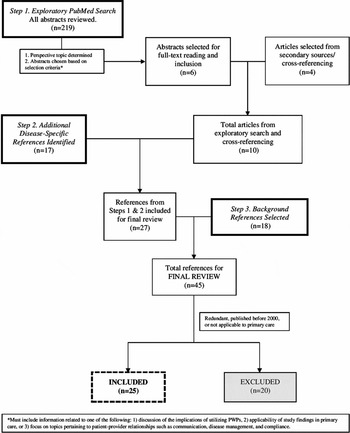
An overview of the methods used for reference selection is provided in Figure 1.
Reference selection criteria flow diagram.

Step 1. The authors conducted an exploratory literature search on PubMed from inception through December 2015 to gain an overall perspective on the use of patient Web portals. This was completed by using controlled Medical Subject Headings (MeSH) and text-word searches. The following search terms were used in various combinations based on the size of the retrieval sets: MeSH: Outcomes Assessment (Health Care), Surveys and Questionnaires, Self Report, Internet, Cell Phones. Text-Word: “patient reported outcomes”, “patient report*”, PROMIS OR PROM OR PRO, “electronic diary” OR “electronic diaries”, “social media”, computer OR computers, laptop*, touchscreen*, app OR apps, tablet OR tablets, mobile, electronic.
The first author (H.C.) and senior author (K.M.) individually screened the titles and abstracts yielded by this original search. The review of the abstracts indicated that these studies were mainly conducted in the sub-specialty areas of medicine, such as oncology and neurology, compared with primary care. This initial exploratory search led us to focus on PWP use in the area of primary care, specifically on chronic medical conditions such as diabetes mellitus, hypertension, and asthma. Abstracts were read by both H.C. and K.M., with the authors initially synthesizing data individually and then discussing themes as a team. Articles were selected for full-text reading based on their relevance and focus. Salient selection criteria included features such as: (i) discussion of the implications of using PWPs, (ii) applicability of study findings in primary care, or (iii) focus on topics pertaining to patient–provider relationships such as communication, disease management, and compliance. We did not consider articles without an English abstract or without data relevant to any of the above selection criteria. Articles selected for full-text review were read in full by H.C. and K.M., and decisions to include in the manuscript were made as a team.
The reference lists of these initial articles were hand-searched for additional citations that pertained to the study question. When articles were chosen from the new set, the subsequent reference lists were also reviewed to potentially include any additional literature to support the study objective.
Step 2. In addition to the sources we obtained from the initial exploratory search and cross-referencing, we ran a disease-specific search in March 2016 focused on diabetes, hypertension, and asthma. This was done through an unstructured PubMed search, using combinations of the following terms to find relevant articles: diabetes, hypertension, asthma, portal, ePRO, eDiary/Diaries, telemedicine, electronic survey/questionnaire. Articles were selected using the same selection criteria detailed for the first search and reference lists were again hand-searched for relevant titles.
Step 3. Following this initial synthesis of the literature, we noted the need for additional information regarding certain key factors that could affect both PWP use and patient–provider relationships, such as an understanding of chronic disease prevalence, Internet use, and clinic visit duration. We retrieved relevant records for this purpose.
RESULTS
Literature Search
Steps 1 and 2. From our two PubMed searches, we selected a total of twenty-seven articles for full-text reading and inclusion in the original manuscript: ten selected from the initial search and cross-referencing, and seventeen selected from the disease-specific search and additional cross-referencing.
Articles relating to the use of PWPs in managing certain chronic diseases in a primary care setting were selected when pertinent to the study question: eleven related to the management of diabetes, seven to hypertension, and two to asthma. The remaining seven articles selected provided additional background on PWPs that helped address the study objective.
We focused our review on eliciting data on PWPs regarding certain key benefits of their effects on patient–provider relationships, including communication, compliance, and disease management. We then highlighted the potential drawbacks of PWPs separately from a patient and provider standpoint.
Step 3. We supplemented our original twenty-seven articles with eighteen additional references from sources such as PubMed, meeting abstracts, the CDC, and the International Telecommunication Union. These sources provided context and further supported this perspective through relevant statistics and background.
Finally, authors reviewed each of these forty-five references individually and reduced the final list to a total of twenty-five by excluding sources that were redundant, published before 2000, or not directly applicable to primary care. After this reduction, fourteen articles from Steps 1 and 2, the exploratory and disease-specific searches, and eleven additional references from Step 3, the background search, were retained.
The final twenty-five references included seven reports, six randomized studies, three observational studies, two systematic reviews, two prospective pilot studies, two case-control studies, one case report, one survival analysis, and one patient survey.
Based on the literature collected, we synthesized the data into a perspective on PWP usage and reflected on their potential applicability in primary care settings and their effect on patient–provider relationships.
BENEFITS
Communication
Between Clinic Visits
Studies have shown that PWPs allow patients to report information regarding their symptoms, medication use, adverse effects, and quality of life directly to their providers online (Reference Basch, Deal and Kris3;Reference Berry, Blumenstein and Halpenny4;Reference Bernocchi, Scalvini, Bertacchini, Rivadossi and Muiesan6;Reference Green, Cook and Ralston7;Reference Lau, Campbell, Tang, Thompson and Elliott9;Reference Osborn, Mayberry, Mulvaney and Hess10;Reference Das, Faxvaag and Svanæs13). This finding suggests that PWPs could potentially fill a role in improving the effectiveness of patient–doctor communication and in permitting real-time monitoring of patients’ health. Their use in clinical practice could facilitate expeditious responses by clinicians. For example, following bariatric surgery, PWPs were found to be an effective mode of communication for patients and providers that allowed for identification of issues and prevention of health deterioration (Reference Das, Faxvaag and Svanæs13). Similarly, PWPs designed in a primary care setting could provide appropriate notifications directly to providers when patients report, for example, acute changes in blood sugar, blood pressure (BP), or peak expiratory flow rates, and facilitate management responses, thereby improving patient–provider communication.
During Clinic Visits
Reporting on a PWP carries practical implications for communication during visits. In an analysis of 392 videotaped primary care office visits, physicians were found to discuss a median of six topics with 15.7 minutes per visit (Reference Tai-Seale, McGuire and Zhang14). This translated to a median of 5 minutes spent on the major topic of the visit (Reference Tai-Seale, McGuire and Zhang14). In one study working with cancer patients, it was found that providers with access to patient reports spent more time addressing symptoms and quality of life issues, without increasing visit duration (Reference Berry, Blumenstein and Halpenny4). This could be applicable in primary care settings as well. Data from PWPs could help streamline office visits, allowing clinicians to address the concerns and needs of the patients optimally. Akram et al. examined the self-reporting of hypoglycemic episodes and demonstrated that recall of mild hypoglycemia may be unreliable after 1 week, leading to underreporting if patients are not seen within this timeframe (Reference Akram, Pedersen-Bjergaard, Borch-Johnsen and Thorsteinsson15). PWPs could serve as the forum through which providers receive critical health information, allowing for better management at the time of the visit.
Disease Management
A positive patient–provider dynamic promotes effective disease management, which could serve to improve trust and the overall relationship. The study by Thom et al., found that greater levels of trust for their providers correlated with patients’ intentions to follow their advice. This translated to greater symptom improvement 2 weeks post-visit as well (Reference Thom, Kravitz, Bell, Krupac and Azari12). The implementation of PWPs has been associated with improvements in glycemic control for patients with type 2 diabetes mellitus (Reference Lau, Campbell, Tang, Thompson and Elliott9). For patients with hypertension, home monitoring of BP through a PWP could lead to improved control and higher patient satisfaction (Reference McKinstry, Hanley and Wild8). PWPs were found to be feasible in the management of asthma and were associated with clinically significant improvements mainly in the pediatric population (Reference Fiks, Mayne and Karavite5).
Acute exacerbations of chronic illnesses account for a large amount of emergency room (ER) visits: Asthma-related issues account for an estimated 1.8 million ER visits annually, while diabetes accounts for an additional 11.7 million (16). Regular PWP use by both patients and providers could serve as an effective platform for making timely medication dose adjustments, recognizing new symptoms early, and promoting necessary lifestyle changes. This practice pattern could eventually impact rates of ER visits through improved communication. As a corollary to this, PWPs with built-in disease-specific questions for common chronic diseases may capture symptoms otherwise typically underreported, thereby helping facilitate management and address areas for improvement.
Compliance
Chronic diseases usually entail the need for long-term medications. However, medication adherence for chronic conditions such as hypertension and type 2 diabetes mellitus appears to range from 50 percent to 70 percent (Reference Vietri, Wlodarczyk, Lorenzo and Rajpathak17). If a patient reports poor medication compliance, timely responses from their healthcare team could yield improvements in their adherence to the medications and their overall disease control (Reference Bernocchi, Scalvini, Bertacchini, Rivadossi and Muiesan6). We propose that receiving such prompt responses to the entries into a PWP by their providers can help patients develop a sense of empowerment to take a more active role in their own care.
Home BP monitoring is an important adjunct to overall management of hypertension as providers would be able to track changes and advocate judiciously (Reference Agarwal, Bills, Hecht and Light18). For asthma, regular reporting of peak flow rates could reduce inappropriate medication use and help clinicians identify patients requiring assistance with their regimen and potentially avert exacerbations or relapses (Reference Bheekie, Syce and Weinberg19). Treatment compliance could improve in patients if they are able to report any changes in their symptoms and receive prompt, appropriate responses from their providers. Patients who recognize that their reports are directly relevant to their care and have trust in their providers may be more willing to engage and adhere to their treatment plans (Reference Thom, Kravitz, Bell, Krupac and Azari12).
DRAWBACKS
While PWPs may help various facets of patient care, we need to recognize some drawbacks or limitations that mainly stem from the need to use and incorporate modern technology into patient care and the creation of a virtual encounter compared with the traditional face-to-face discussion.
Patient Specific
Report Reliability
While daily reporting could promote compliance and communication, it is possible that patients may not report all information accurately and modify their reports according to the social desirability bias (Reference Stirratt, Dunbar-Jacob and Crane20). The biased information could be detrimental to their care in the long-term, if providers are unaware of potential noncompliance. Similarly, data entry omissions could lead providers to assume inaccurately that the conditions are under adequate control and could cause delays to appropriate treatment modifications.
Barriers to Use
Reporting on a PWP requires patients to have a basic knowledge of computers and use of the Internet. While 88.5 percent of the U.S. population uses the Internet, implementing PWPs in clinical practice requires awareness of the patient populations that do not have access to the Web or a home computer (21). Therefore, this may not be applicable to everyone due to inadequate experience using computers or an inability to access Internet or enter information. However, over two-thirds of American adults own a smart phone, and implementing mobile apps could help make PWPs accessible to the 15 percent of smart phone users who report difficulties going online without their phones (22).
Despite the obvious benefits to communication that PWPs provide, we need to recognize some of the issues they may cause as well. Relying excessively on technology could pose a problem if there were any technological failings. Clinicians have reported organizational and personal constraints that partially impeded effective communication by means of the online forum (Reference Das, Faxvaag and Svanæs13). For example, information may not reach providers despite data entry by patients, leading to diminished trust in the system. We suggest that addressing issues regarding the timing of data review and responses to PWP entries by providers could be handled by developing a set of expectations communicated to patients ahead of time. In addition, patients need to be informed and be aware that they may continue to use conventional communication methods in addition to PWPs during urgent or emergent situations.
Provider Specific
Work-related
The review of PWP reports will compose an additional task that will need to be incorporated into the already busy schedules of providers. Barriers to successful PWP implementation include workflow modifications that may prove to be a constraint on time and effort (Reference Harle, Listhaus and Covarrubias23). Clinicians may believe an increase in workload as a response to the implementation of the PWP, perhaps due to lack of integration into the electronic health record (Reference McKinstry, Hanley and Wild8). The widespread use of PWPs in primary care settings would require them to be easily accessible by busy practitioners to reduce attrition. It would be vital to streamline the transfer of data to providers for review without affecting their workflow significantly. Potentially, this could be achieved by aggregation of critical and noncritical data separately so that clinicians can access and respond to patient data in batches based on acuity.
CONCLUSIONS
As healthcare embraces technological advancements, the embedding of PWPs into clinical practice can help gather important health information, empower patients to be active participants in promoting their health, and positively affect patient–provider relationships. The incorporation of wireless technology for this purpose has been proposed through devices such as metered dose inhalers with electronic compliance monitoring and glucometers with wireless data transfer (Reference Foster, Smith, Usherwood, Sawyer, Rand and Reddel24;Reference Årsand, Frøisland and Skrøvseth25). Such devices, in conjunction with PWPs, could provide additional support for effective patient management between office visits. Future PWP platforms could avail of such cutting edge devices for data accrual and delivery to primary care physicians.
This review of the use of PWPs in patient care suggests that appropriately integrated healthcare PWPs could supplement certain important facets of healthcare delivery such as communication, disease management, and compliance effectively. The effect of PWPs on patient–provider dynamics requires continued reassessment to ensure and support smooth integration.
CONFLICTS OF INTEREST
The authors have no conflicts or disclosures to report.