When ‘Chief’ Albert Luthuli arrived in Norway to receive the 1960 Nobel Peace Prize, world leaders celebrated his advocacy of civil disobedience. Cheered by Oslo crowds in December 1961, he intended to enjoy ‘ten days of [f]reedom’ with his wife Nokukhanya (see Fig. 1). Over the previous eight years, the apartheid regime had prevented Albert Luthuli from attending gatherings and confined him to his district of Stanger in Natal province. Monitoring his every movement, policemen prohibited his functions as president-general of the African National Congress (ANC).Footnote 1 While the international press marveled at how these restrictions failed to poison Luthuli's ‘courteous’ demeanor, his harder-edged activism went largely unreported.
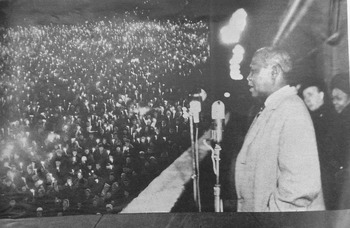
Luthuli speaking at Oslo City Hall, with his wife Nokukhanya at far right. Photographer unknown. Image courtesy of Historical Papers, William Cullen Library, University of the Witwatersrand, Johannesburg.

Using recently available evidence and better-known sources, this article sets out to reconsider Luthuli's involvement in the ANC's turn to violence. To this end, we challenge a prevailing historiographical claim that he was a staunch peacekeeper regardless of relentless crackdowns and his distrust of authorities who nearly beat him to death and massacred protesting women, children, and men. Documents in the special collections of Michigan State University and the Schomburg Research Center describe the president-general's secret rendezvous in early January 1962 with an old colleague from the United States. Standing with his visitor in a Groutville field near his home, Luthuli said he could not ‘blame’ the radical youths who came to him vowing to pursue a confrontational ‘track’ against the state. Only weeks earlier a new guerrilla wing named Umkhonto weSizwe (‘Spear of the Nation’), or MK, had sent its ANC members to bomb government targets in cities, including Durban.Footnote 2 Uncovering Luthuli's evolving views of justifiable violence not only expands knowledge of a fateful moment, but also alters how we understand his aim to emancipate South Africa from apartheid, a system of white supremacy that he likened to ‘slavery’.Footnote 3
With confidants Luthuli was more explicit about his ideas of self-defense, confessing approval of saboteurs fighting for human rights. When Luthuli stood at the Oslo podium adorned in Zulu warrior's regalia he had already participated in clandestine discussions contemplating ‘some kind of violence’ to implode the status quo at home (see Fig. 4).Footnote 4 Since Pretoria had banned his organization and its rival Pan-Africanist Congress (PAC) in 1960, Luthuli's tactic of passive resistance had become harder to practice. On the heels of his Nobel acceptance, MK triggered explosives on 16 December 1961. These salvos raised doubts then and now. Was Luthuli a political contortionist, climbing the pedestal of peace while stooping, a week later, to war? Was he complicit in MK's incendiary debut? If so, was his nonviolent advocacy more pragmatic than principled, more situational than unshakeable? Or did Luthuli's trip to Norway enable ANC renegades to sideline him? How did he react to the appeals of MK co-founder and future Nobel recipient Nelson Mandela, who desired Luthuli's consent before engaging in acts of sabotage? These questions spark intense interest and debate.Footnote 5
A path-breaking article published by History and Theory in 2000 helped lay the foundation for new scholarship on the armed struggle. In this essay, co-authors Jabulani Sithole and Sibongiseni Mkhize scrutinize the apartheid propaganda that manipulated Luthuli's image. Their analysis concentrates on what transpired immediately after the president-general's death in July 1967. Sithole and Mkhize show that law enforcement officials informed the media of Luthuli's resolute renunciation of violence, a contention that the widowed Nokukhanya refuted. Building on the scholarship of Sithole and Mkhize, Stephen Ellis's External Mission investigates a related line of inquiry, tracking how ANC radicals and their foreign extras veered from civil disobedience. In Ellis's book the dramatis personae are Mandela, Walter Sisulu, Oliver Tambo, and enthusiasts of the South African Communist Party (SACP); infiltrating Soviet and Chinese agents make up the supporting cast.Footnote 6 For his part, Paul Landau convincingly locates the origins of armed struggle in the allure of 1950s communism, which intensified the intimacy between Sisulu, Mandela, secretary-general Duma Nokwe, and the SACP during the Treason Trial (1956–61) (see Fig. 2). MK soldiers were the offspring of this ideological liaison, consummated soon after Sharpeville police slaughtered African protesters in March 1960.Footnote 7
Luthuli is circled in this portrait of ‘The Accused’ in the Treason Trial. Photographer Keystone-France. Image courtesy of Gamma-Keystone Collection, Getty images.Footnote 74

Raymond Suttner stands out among academics who argue that Luthuli prepared the ground for armed struggle. An activist imprisoned for years on Robben Island, Suttner deploys intimate knowledge of ANC strategies to reveal Luthuli's eventual espousal of ‘just’ conflict.Footnote 8 Scott Couper disagrees with Suttner, asserting that faith ‘bound’ the 1960 Nobel winner to repudiate violence ‘before, during and after the decision to form MK’, despite the state's brutality. Silenced by rebel cadres, the Christian president-general could only watch Mandela and his irreverent cohort careen on a ‘new course’ that ran over passive resistance (see Fig. 3). Couper characterizes Luthuli as being clairvoyantly aware of the treacherous pitfalls of freedom fighting. Yet by claiming Luthuli had a fixed belief in nonviolence and by highlighting as evidence of this principle his public pronouncements, Couper overlooks Luthuli's personal views of self-defense. These private insights emerged in the course of secret meetings between 1960 and 1962, which were held near Groutville so the banned Luthuli could convene with colleagues eager to debate military options. Their recollections point to Luthuli's influence in compromises endorsing sabotage, including his recognition that Pretoria's ready recourse to lethal violence made it virtually impossible for civil disobedience to work.Footnote 9
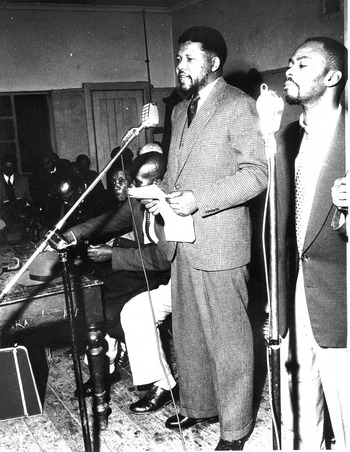
Nelson Mandela (with paper) addressing the 1961 All-In Conference in Pietermaritzburg, Natal. Photograph by BAHA Drum photographer. Image courtesy of Bailey's African Historical Archive, Johannesburg.

Even so, Couper's interpretation is now an important reference point in scholarly debates pioneered earlier by Martin Legassick, whose appraisal of ANC ‘patriotic history’ reflected other ideological concerns. Unlike Couper's religious analysis of Luthuli's principle of nonviolence, Legassick considers broadly how revolutionaries in the liberation movement shaped and imperiled the prospects of equality in a new democracy.Footnote 10 In 2003 Legassick stirred controversy by urging academics and ‘masses’ alike to face a squalid truth. The armed struggle was a charade, he declared, much ‘talked and written about but not seriously implemented’. Drawing on the benefit of hindsight, Legassick rated thirty years of guerrilla warfare on a continuum of doomed skirmishes, low morale, and toothless propaganda. There were no battles won and territories gained, and no credible ANC message that its liberators could defeat the enemy. So exiled ‘leaders had to fall back on’ a collaborative ‘settlement’ fostered in the 1980s by ‘South African businessmen’ and Mandela's ‘overtures’ from jail.Footnote 11 In one sweeping remark, Legassick dubbed MK a fiasco, against which he and other activists had warned before being discarded as reactionaries. Truly ‘seizing power’ and securing ‘socialism’ – here he spoke as a Trotskyite of the lapsed ‘Marxist Workers’ Tendency (MWT)’ – demanded working-class action that ‘should in its early stages have mainly the character of organized self-defence … of strikes, demonstrations and squatter camps, and so on’.Footnote 12
Legassick hardened his stance in a 2008 broadside delineating the exploits of a late-apartheid ‘revival of the workers’ movement’ in South Africa. This study was almost withdrawn from a South African Democracy Education Trust (SADET) ‘history of resistance’. In prose bristling with indignation, Legassick blamed this project for warping his co-authored commissioned chapter on multiracial syndicalism to fit the myth of ‘nation-building’ – an ideal exaggerating the import of external armed struggle while downplaying the success of internal labor organization.Footnote 13 Certain SADET researchers such as Jabulani Sithole were accused of ‘falsif[ying] information’ about past ‘unionism’. On this issue Legassick felt betrayed. As a special issue editor, he recalled agreeably shepherding Sithole into History and Theory, a journal featuring articles in 2000 on deceits ‘of the struggle’ that included a skilful distillation of ‘Truth or Lies?’ in the ‘representations’ of Luthuli. In objecting to the ‘unrealistic’ claim that MK combatants weakened white supremacy, Legassick attributed such ‘fabrications’ to SADET's director Bernard Magubane and his patron President Thabo Mbeki.Footnote 14 With reference to a colluding head of state, Legassick may have hoped to expose another pretense of armed struggle – for Mbeki had never applied his Soviet military training – and the hagiographic promise of the president and Magubane to ‘tell the story of united … leaders and masses, … [on] the field of battle’.Footnote 15
Sithole crafted a trenchant refutation querying whether Legassick wanted to further ‘[c]ontestations over knowledge’ or engage in ‘ideological bullying’. Addressing the allegation that he discounted evidence, Sithole cited his critic's choice ‘to ignore’ the archived Simons papers, which they had read separately. This set of documents contained proof contradicting Legassick's ‘rigidly held’ political opinion that ‘the workers’ movement’ was the dynamic center of anti-apartheid struggles in South Africa. Sithole highlighted letters between Ray (Alexander) Simons and other labor organizers such as Moses Mabhida in which union leaders ‘were quick to acknowledge that their initial efforts’ to mobilize radical forces ‘within the country’ during the 1970s ‘yielded disappointing results’.Footnote 16
In a 2015 article considering ‘alternatives in the wake of’ 1960 bloodshed, Saul Dubow constructively shifts debates on the armed struggle. He pinpoints ‘verities’ of that fateful year: the ‘killings of innocent protesters at Sharpeville and Langa’ (the Cape Town township), which ‘made armed resistance unavoidable’; and the rise of Prime Minister Verwoerd, a target of assassination shortly after Sharpeville, who ‘went on to impose “grand” apartheid and republican independence’. Exploring what might have happened ‘had Verwoerd been killed or incapacitated, and had the ANC not chosen to interpret Sharpeville as a casus belli’, Dubow extends the limits of historical methodology.Footnote 17 Through conjectural analysis, he identifies signs of ‘noncompliance’ in unions and churches that endured ‘harsher conditions’ after 1960. This ‘political opposition’, Dubow maintains, might have eased national tensions and facilitated earlier negotiations had not war nationalism pervaded the apartheid regime and liberation movements. He hypothesizes that ‘Luthuli might also have been able to forestall’ violence ‘had he not been’ confined by ‘banning orders to Groutville, Natal’, and had MK not been thrust on him. This counterfactual exercise enhances the incisive treatment of what occurred in Luthuli's ‘alliance’ when Mandela's ‘hardliners’ weaponized the ANC. While valuing Dubow's innovative approach and retrospective conclusion that armed struggle ‘may not have been the wisest decision’, we argue that even Luthuli at his most astute could not have predicted the future.
Indeed, Luthuli felt obliged to focus on recent history and violence. Rarely consulted sources describe how Luthuli reviewed successive events, namely his Nobel Prize and the imposition of martial law following Sharpeville, both of which compelled him to attend clandestine debates determining the ANC shift to sabotage. With armed struggle topping his movement's agenda, Luthuli was drawn into key decisions establishing protocols for MK. He chaired two secret meetings, which are reconstructed below in unprecedented detail. The telling evidence emerges in personal papers of the Schomburg Research Center for African American History and Culture, a division of the New York Public Library, and special collections in Yale and Michigan State University. These sources chart Luthuli's evolving definition of resistance, which blurred the line between conciliation and confrontation, and convey his perceptions of how mass protests, starting with the 1952 Defiance Campaign, as well as government oppression created irrepressible conflict in South Africa. Anticipating ‘[w]hen I am attacked’, he purportedly told aspiring saboteurs he would not ‘just be like Christ and turn the other cheek. I will fight back.’Footnote 18 In other words, life experience necessitated Luthuli's interest in forging a consensus with ANC men committed to overthrowing their ‘slave’ tyranny. ‘I understand these fellows fully’, he said of these would-be insurgents in 1962.Footnote 19 While agreeing reluctantly to the development of MK, Luthuli never publicly disowned its founders or soldiers.
CHRISTIANITY, VIOLENCE, AND POLITICS IN LUTHULI'S FORMATIVE YEARS
Several studies examining Luthuli's activism spotlight his religious aversion to violent unrest.Footnote 20 While his distinguished writings back this perspective, there is evidence that the community shaping his core values adopted a strain of revivalism whose viability depended on injurious social outcomes. Born in 1898, Albert John Mvumbi Luthuli grew up fatherless. He was raised by isiZulu-speaking amakholwa (‘believers’) of the Mvoti Mission Reserve.Footnote 21 His childhood was shaped by fourth-generation proselytizers of the American Board of Commissioners for Foreign Missions (ABM), whose forerunners had left Boston harbor in the 1830s aiming to save ‘refugees’ of Shaka's kingdom.Footnote 22 Young Albert's paternal stand-in, his uncle Martin Luthuli, was a lay preacher seeking ‘a well ordered … manner of life’ imbued with the bible and formal education.Footnote 23 Martin Luthuli inveighed against the spirituality of ancestor-worshipping Africans known as amabhinca.Footnote 24 His evangelism ruptured ‘heathen’ Zulu families, particularly after converted children left their elders for ABM schools. This documented abandonment of traditional guardians and customs caused suffering in Mvoti homesteads.Footnote 25 Grateful for the spread of Christianity, Albert trained as an instructor of amakholwa pupils in the ABM Adams College.Footnote 26 His most significant partner in life then (and throughout his life) was Nokukhanya Bhengu, whom he met at Adams; they would marry and have seven children. Beyond the College, Albert shared bible fellowship with young and old, a calling that enhanced his political acumen. He followed his uncle's line of succession in 1935 as the elected chief of Mvoti Mission Reserve, attending ceremonies at which regent Cyprian Bhekuzulu praised Shaka's martial power. And by many accounts, Luthuli amiably governed his followers through a council of men and women.Footnote 27
Chief Luthuli nurtured community to mitigate the deleterious effects of segregation. In 1944 he joined the ANC during a decade of mounting immiseration in a ‘“black belt” of informal settlements’ around Durban, where ‘thousands of first-generation urban dwellers’ settled after leaving the ‘countryside in the wake of evictions’.Footnote 28 By 1946, Luthuli was serving on the Native Representation Council (NRC), a white-led advisory body that he would regard as a ‘toy telephone’ requiring him to ‘shout a little louder’ to no one in government. He disrupted polite council procedures to denounce what crushed his people. One enraged NRC chairman tried to muffle Luthuli, who retorted that ‘the reactionary character of the Union Native Policy’ exposed ‘a policy of fascism which is the antithesis of the letter and the spirit of the Atlantic Charter’.Footnote 29 Luthuli's encounters with homegrown fascism demonstrated the limits of praying for change. During one fact-finding NRC tour of ‘[t]ribal’ Natal, he noted the ‘misapplication of Christian trust’ in destitute chiefdoms. ‘[B]orn with their shackles’, he observed, they wait for what ‘God may do in the future, while the present slips by’ into ‘hollow promises’ that democracy will be bestowed ‘when He is ready’.Footnote 30 Luthuli's predecessor Dr James Moroka echoed these sentiments in the 1951 ANC annual conference: ‘We are eternally being led to the light [but we] never seem to walk to the light.’ After Luthuli's American Board-sponsored visit to the US from the middle of 1948 to early 1949, he endorsed the Programme of Action, signaling his commitment to strikes and boycotts.Footnote 31 In 1950, he became the branch president of the Natal ANC and overtly embraced Gandhi's satyagraha philosophy, a spiritual standard of passive resistance that came of age in South Africa at the turn of the twentieth century.Footnote 32
In October 1952 Luthuli championed satyagraha through the Defiance Campaign. Pretoria moved to strip him of his chieftaincy. Undeterred, Luthuli said that nullifying his customary authority could never diminish ‘passive-resistance’. But he cautioned: ‘The non-violent policy I am advocating … taxes our physical courage.’Footnote 33 He was mindful of the ‘white supremacists’ with ‘guns and the other techniques of intimidation’ readying to ‘present themselves as restorers of order’.Footnote 34 Meanwhile, the ANC protested ‘the Pass Laws, Group Areas Act, the Separate Voters’ Representation Act, the Suppression of Communism Act and the Bantu Authorities Act’.Footnote 35 When the state formally started to oust Luthuli, he responded with a 9 November sermon, ‘Christian Life: A Constant Venture’, that would form the basis of his illustrious anti-apartheid statement, ‘The Road to Freedom is Via the Cross’.Footnote 36 He originally offered these thoughts on the day East London authorities indiscriminately shot Defiance Campaigners in the township of Duncan Village, where black protesters countered by killing two white people and burning government facilities. The police retaliated, killing more than 200 Africans, according to estimates.Footnote 37 The carnage stunned Luthuli's organization. Mandela, Sisulu, and A. P. Mda broached revolt but settled on nonviolence.Footnote 38 The deposing of Luthuli would make him a prime candidate to head the ANC. The ‘Natal Chief’ who displayed ‘defiance of the government’ awed Sisulu.Footnote 39 By contrast, Dr Moroka, the president-general charged with sedition, retained his own lawyer and disavowed Congress policies in court.
‘SHOOT DOWN THE BLACK MASSES’
During the December 1952 ANC annual conference, Luthuli won the delegate count. As the new president-general, he grabbed the reins of a lurching movement pummeled by a state that exacerbated tensions between Africanists and non-racialists and eroded popular support for civil disobedience.Footnote 40 The next year white parliamentarians passed a series of draconian decrees such as the Criminal Laws Amendment and Public Safety Act, which suspended due process. ANC firebrands started to look beyond Luthuli, drafting the Mandela Plan (M-Plan), a template for underground operations to take up the fight if the organization was banned.Footnote 41 By June, Mandela was vowing to ‘overthrow a white minority regime bent on … power at any cost’.Footnote 42 At the time authorities were evicting residents from Sophiatown, a Johannesburg community of black property-holders. Mandela's comrade Sisulu told Luthuli of other ‘revolutionary’ stirrings. The president-general admitted that ‘non-Whites’ appeared ready ‘at any time to change the non-violent aspect of our movement, to violence’.Footnote 43 By year's end, Mandela had encouraged Sisulu to leave the country without Luthuli's knowledge and travel to Romania, the Soviet Union and China. Recently convicted of sanctioning ‘objects of communism’, Sisulu had been sentenced to nine months with hard labor, suspended for three years on condition that he did not give further offence under the Suppression of Communism Act.Footnote 44 While this risky journey extended ideological vistas, the prosecution of Defiance Campaigners under the Suppression of Communism Act revealed the crossroads before Luthuli. Attorneys appraised the confrontational conduct of Congress branches, exhibiting testimony of demonstrators who reputedly threatened police and derided the ‘white Satan’.Footnote 45 Luthuli chose the treason trial proceedings to affirm that the ANC ‘would be sympathetic to Russia as we would be sympathetic to any other Nation that showed sympathy with oppressed people’.Footnote 46
But he also reassured white South Africa, foes and friends alike, and ‘the world that we do not mean to use violence in … our cause’.Footnote 47 An American pacifist visiting South Africa in 1953, Douglas Steere, worried about the president-general's ‘position in the Congress … surrounded by men … [who] do not share his convictions and principles … Whether Luthuli can hold this group together and mold them … is to be seen.’ Steere recognized the power of ‘more bitter direct-action people’ to ‘carry off the Congress’.Footnote 48 Luthuli also wanted to push the ANC into a grand coalition with the Congress of Democrats (COD) and its former SACP members, Federation of South African Women (FEDSAW), Indian Congress, Colored People's Congress (CPC), and South African Congress of Trade Unions (SACTU).Footnote 49 Emerging in 1955, this Congress Alliance was augmented by the inclusion of women. For Luthuli the success of civil disobedience hinged on oppressed mothers, daughters, fathers, and sons standing as one, whatever might come, with their representatives in the Congress of the People.
Luthuli never attended this Congress of the People in Kliptown on 26 June 1955. Catastrophes intervened. He had a stroke and a heart attack; the government freshly banned him to Groutville. From his sickbed Luthuli posted messages outlining a Freedom Charter, which specified the right to have full access to voting, schools, property ownership, job opportunities, and freedom of speech and assembly. There were stipulations, as well, to redistribute territory seized by the Land Acts, and to nationalize industry and banking.Footnote 50 Women would be instrumental in achieving this new dispensation, Luthuli stated. Defiance Campaigner and future MK recruit Dorothy Nyembe recalled: ‘Our mentor was Chief Albert Luthuli. He taught us that men and women were equal, and that it all depends on one's dedication.’ For her part, Nokukhanya Luthuli became a national delegate of the Women's League, vetted her husband's speeches, and earned household income, making it possible for him to fulfill his unpaid ANC responsibilities.Footnote 51
The government interpreted the Freedom Charter as a subversive document. On 5 December 1956, Luthuli and 155 anti-apartheid leaders were arrested. Charged with treason, they were locked in Johannesburg Prison, stripped and humiliated (see Fig. 2). The Natal ANC and Indian Congress, petitioning for their release, commented that ‘these arrests … follow the familiar fascist pattern set by Hitlerite Germany’.Footnote 52 The jail holding suspects in what came to be known as the treason trial brought far-flung activists together. Deepening his friendship with ANC communists, Luthuli joined Moses Kotane to foster political fellowship and cultural theater. When M. B. Yengwa uncorked praises (izibongo) honoring King Shaka, Luthuli rejoiced in the performance with Zulu and non-Zulu defendants, declaring Ngu Shaka lowo! (That is Shaka!). The curtain had risen on a nationalist drama.Footnote 53
Released in 1957, Luthuli barnstormed cities, appealing to the conscience of voters. In advance of the first all-white national ballot he implored citizens to see their juridical order as ‘the most’ menacing ‘tyrannical slave laws’ to ‘besmirch the statute book of our country’.Footnote 54 His entreaty fell on deaf ears. The electorate handed the National Party another conquest. Apartheid rulers triumphed with over 50 per cent of the white vote, an outcome that had eluded them in 1948. Luthuli persevered, requesting audiences with politicians and rousing multiracial crowds. He found solace in the thousands who welcomed his speeches with roars of ‘Mayibuye Afrika!’ (Come Back Africa!) and ‘Somlandela Luthuli!’ (We will follow Luthuli wherever he goes!).Footnote 55 While engulfed in a sea of black faces, Luthuli also confronted white men shouting, ‘We will not allow a kaffir to address this meeting!’ These ‘Nazi-like thugs’ stormed his platform and bloodied him.Footnote 56 In the middle of 1959 he was again banned. The Minister of Justice accused Luthuli of stoking ‘hostility between whites and non-whites’.Footnote 57 Luthuli's rejoinder appeared in Durban's Daily News: ‘I will defy the Government's ban on me – even if it means that they put me in jail.’Footnote 58 It was the end of a tumultuous decade not only for Luthuli, but also for his followers, who became less confident of negotiation.
In 1960, popular revolts erupted in Pondoland, Sekhukhuneland, Zeerust, and Natal. With African women participating, insurgents smashed dipping tanks, razed commercial crops, burned passes, and intimidated ‘collaborators’. Only repeated police and army incursions quashed these disturbances.Footnote 59 Rebels implored the ANC to supply guns.Footnote 60 Mandela yearned to harness this aggression. Luthuli, however, insisted that ‘violence was … inimical to our liberation struggle’. Few leaders in his movement were swayed; more saw no advantage in containing the fury.Footnote 61
In March 1960, police killed 69 unarmed African pass protestors at a Pan-Africanist Congress (PAC) rally in Sharpeville. Headlines captured world outrage over this bloodbath, which brought pariah status and martial law to South Africa.Footnote 62 A State of Emergency gave the government sweeping discretion to detain over twenty-five thousand people and outlaw the ANC and other liberation organizations – among them, in Luthuli's words, the ‘rabid’ PAC. The state seized Robert Sobukwe, the PAC leader, and sentenced him to prison. Prime Minister Hendrik Verwoerd commended the Sharpeville commander Lt. Col. Pienaar who exonerated his officers for rebuking ‘the native mentality [which] does not allow them to gather for a peaceful demonstration’.Footnote 63 Justice Minister Francois Erasmus railed against Africans for trying to ‘bring to its knees any White Government’. He encouraged his soldiers, then reinforced by white vigilantes, ‘to shoot down the black masses’.Footnote 64
The regime's intent was clear. It would menace Africans with genocidal rhetoric, banish activists, and obliterate dissent. Facing this onslaught, ANC leaders felt increasingly uncertain about civil disobedience. Luthuli continued to support nonviolence, organizing pass-burning demonstrations and announcing a ‘Day of Mourning and Protest’. The government reacted by incarcerating him for five months. Guards beat Luthuli, who was suffering from a coronary thrombosis and high blood pressure. He spent much of his sentence in a prison hospital. With the president-general out of commission, Mandela gained influence in the ANC.Footnote 65 During the State of Emergency from March to August 1960, Mandela, Sisulu, Nokwe, Joe Slovo, and Rusty Bernstein became hunted outlaws. They and communists Yusuf Dadoo, Moses Kotane, Michael Harmel, and Ben Turok in the Congress Alliance went into hiding. Turok reflected on this period of peril and concealment: ‘We were the ANC. Moses was the ANC. It comes down to that, we all participated, there was no distinction, the Alliance was complete.’Footnote 66 Luthuli was not privy to the thinking of this vanguard. In July 1960, SACP members and South African exiles Yusuf Dadoo and Vella Pillay, and later from South Africa, ANC-SACP member Joe Matthews and SACP member Michael Harmel, met Russian handlers in Moscow with the aim of advancing insurrection in South Africa.Footnote 67 In late October and early November, Dadoo and Pillay were in China for weapons and logistics training. During the December 1960 SACP national conference, Mandela, Sisulu, Govan Mbeki, Kotane, and Raymond Mhlaba mapped a course to revolution. In External Mission Ellis contends that the SACP was a Soviet puppet directing the ANC to armed struggle. Landau persuasively suggests otherwise, positing that, while Mandela and his comrades appreciated Eastern Bloc attention, they orchestrated their own self-defense plan.Footnote 68
Mandela knew the military option was not an easy sell, ‘particularly to Luthuli’.Footnote 69 The president-general was keen to avoid warfare by proposing a new constitution and mass demonstrations against what would soon be declared the Republic of South Africa. The forum for discussing these initiatives was an All-In African Conference in Pietermaritzburg. When the event commenced on 25 March 1961, Luthuli was upstaged by Mandela's return from the underground and his appearance before the All-In audience (see Fig. 3). Historian Saul Dubow encapsulates this moment when ‘an adjournment in the Treason Trial proceedings, combined with a lapse in … banning orders’, facilitated Mandela's ‘star billing’.Footnote 70 The option of nonviolent change seemed less likely when, in April 1961, the UN Security Council refused to ratify the General Assembly Resolution proclaiming apartheid ‘a flagrant violation of … the Universal Declaration of Human Rights’. Pretoria, for its part, spurned pressure from Commonwealth nations to reform by duly becoming an independent Republic on 31 May 1961. This was a victory for Prime Minister Verwoerd. His flinty ascendancy undergirded the birth of a new nation that immediately withstood two severe tests. Following Sharpeville, Verwoerd had managed to stabilize an economy reeling from massive capital outflows, and then survived a bullet fired point blank at his face by a white assassin.Footnote 71
In response to the All-In initiative the regime arrested ten thousand Africans, stationed troops in the townships, and disrupted a strike denouncing the South African Republic. Mandela warned the state that unleashing ‘naked force [on] our non-violent struggle’ would end ‘a chapter … of a non-violent policy’. He ruffled the NEC, which never authorized his fiery caveat.Footnote 72 Mandela and his faction were disciplined for flouting protocol. Interestingly, Tambo, charged with establishing the ANC external mission, declared in London that if the government crushed the opposition ‘it would be the last time the ANC would talk of peace’.Footnote 73 With Pondoland insurgents seeking weapons from the ANC to combat Bantu Authorities, women and youth in townships like Cato Manor attacking apartheid structures, and the SACP, PAC, National Liberation Movement Committee, and the Yu Chi Chan Club contemplating war, nonviolence in South Africa seemed to have run its course. Mandela believed it was time for the ANC to command an armed struggle.
1961 BIRTH OF UMKHONTO WESIZWE: ‘[A]DMIRER OF SHAKA AND … NOT OPPOSED TO VIOLENCE’
Between 1961 and 1962 an ‘internal security’ panic gripped South Africa. The PAC threatened civil war. Police and army units acted in concert, reinforcing repression. Luthuli doubted ‘whether anything but indiscriminate … violence will make any impression … [and] if the whites continue as at present, nobody will give the signal for mass violence. Nobody will need to.’Footnote 75 At the dawn of African decolonization, Luthuli stated that Pretoria was bent on ‘concentration camps, terrorism, and legalized murder’.Footnote 76 Was it useful to espouse civil disobedience, he wondered, in the face of unceasing detentions and treason trials? Could he rely on the West to see through Pretoria's Cold War propaganda demonizing the ANC as godless communists?Footnote 77 Could he expect Christian allies in the United States and Great Britain to stop ‘deadly’ Afrikaner nationalism? Luthuli had compared ‘concentration camp’ apartheid to a force bent on its own Final Solution. Could he continue to pray for divine peace to save his people from racist hell?Footnote 78 These questions examined the limits of turning the other cheek.
During a session of the NEC Working Group in June 1961, Mandela urged the ANC to adopt a self-defense platform. Unnerved, Kotane rejected this option because it exposed ‘innocent people to massacres by the enemy’.Footnote 79 Mandela appealed to Kotane with a SeSotho axiom, Sebatana ha se bokwe ka diatla, meaning ‘attacks of the wild beast cannot be averted with only bare hands’.Footnote 80 The proverb communicated a critique of passive resistance. Mandela implied that black South Africa could not wait for Leninist conditions (favored by the communist Kotane) to arise as they did in 1917 Bolshevik Russia. Rather, the MK pioneer pointed to a more relevant revolution in Cuba, a plantation island populated by landless people with enslaved ancestors. There, the oppressed flocked to Fidel Castro and Che Guevara, drilled as bush guerrillas, and toppled Batista's dictatorship. This contemporary example should inspire the liberation movement, Mandela said, particularly because apartheid rulers had banned the ANC and nonviolent protest. A skeptical Kotane nevertheless allowed Mandela to present his proposal, ultimately authorizing the idea of self-defense to be tabled at a NEC meeting scheduled for the following month outside Durban.Footnote 81 In advance of these deliberations, Mandela and Kotane huddled separately with Luthuli. Mandela coveted the president-general's ‘blessing’, but Luthuli ‘could not publicly support an armed struggle’, adding crucially that he ‘would not oppose it’.Footnote 82 The Cape Town-based activist Amy Rietstein chronicled these developments. She visited Wolfie Kodesh's flat in Johannesburg, where Mandela was hiding from police. During her stay, Rietstein typed Mandela's NEC report making the case for self-defense, which he presented to Luthuli. Unable to restrain Mandela, the president-general solicited Kotane's opinion.Footnote 83
As Luthuli's influence over his movement waned, his posture toward violence evolved. Charles Hooper, who introduced the 1962 edition of Let My People Go, registered this modifying attitude. Between 1957 and 1960, Hooper interviewed the ‘Chief’ more than a dozen times. During their exchanges, Luthuli emphasized the appropriateness of ‘morally defensible’ aggression – for instance, when ‘a madman [is] attacking one's family’. Hooper described Luthuli's ‘condemnation of violence … [as] conditional and qualified’ in the face of ‘pass arrests, night raids, 180 days [detention], and the starvation of minds and bodies’. If the ANC acquired weapons, Luthuli exhorted, its arsenal should be ‘employed massively with a real chance of success; or with restraint as the final means of trying to warn of trouble ahead, and then against installations, not people’. In these scenarios, he imagined ‘that no violent course’, if mapped, was ‘either predictable or controllable’.Footnote 84 Asked in 1961 by his secretary and biographer, Mary Benson, whether anti-colonial war such as the ‘Angola situation could arise in South Africa’, Luthuli claimed ‘the leadership stand by the non-violent method’. Nevertheless, he considered whether ‘these white men tak[ing] advantage of our seeming docility’ would propel ‘some, particularly young people, … to question the efficacy of non-violence when they face so aggressive a Government’. He opined that ‘[i]f the oppressed people here ever came to indulge in violent ways … [h]owever much you may disagree with them, you cannot blame them.’Footnote 85
When the NEC session convened in July 1961 on the Stanger farm of Walter Singh, Luthuli, Yengwa and roughly sixty others were in attendance. Before giving an account of this event, it is important to acknowledge the confusion over whether Luthuli attended this and other 1961 meetings. There is a persistent misunderstanding that ANC and Joint Congress debates about militarizing resistance, which included the president-general, were the same deliberations resulting in MK's inaugural attacks. Kotane and Slovo stated that Luthuli ‘was not present at any of the meetings that endorsed armed struggle, and that it was only after armed operations began that Kotane was dispatched by the ANC to explain the decision’. It is probable that Kotane and Slovo were referring to later discussions about MK's launch that led to the December 1961 bombings.Footnote 86 At Walter Singh's farm in July of that year the subject of counter-violence came to the fore, including concerns that other combatants were racing ahead of the ANC in the Trotskyite Yu Chi Chan Club and PAC-affiliated POQO. Advocates of passive resistance in the Natal Indian Congress announced their critique of Mandela's proposal. SACP cadres had no intention of revealing their position – they had already formed covert sabotage units.Footnote 87 Early on in the NEC meeting, Luthuli stated his opposition to armed struggle and Mandela's announcement in May promising an end to nonviolence. Mandela acknowledged the censure before putting forward his case for legitimately constituted, tightly-regulated military action. Luthuli objected, predicting the ANC would be casting aside its moral mantle. On a more practical level, Luthuli knew his members could not win a war when they lacked both modern firearms and any experience of a modern battlefield. Indeed, Mandela himself had never even fired a gun. Finally, Luthuli worried that a sudden shift in strategy would betray the rank and file, which adhered to foundational rules requiring a national conference to transform ANC policy.
Mandela recalled that ‘we worked on’ Luthuli ‘the whole night and I think that in his heart he realized we were right. He ultimately agreed that a military campaign was inevitable.’Footnote 88 Still unconvinced of counter-violence, Yengwa contributed to the ‘searching debate’. His view of the Stanger proceedings illuminates the shared acceptance of armed struggle and Luthuli's reluctant accord with Mandela's ‘logic’.Footnote 89 Other participants in ‘these discussions’ such as Curnick Ndlovu thought Luthuli went along with the consensus because ‘[t]he ANC had stood the test of time … [with] collective leadership.’ Joe Matthews too noted how the president-general's insistence on nonviolence gave way to compromise.Footnote 90 For his part, Kader Asmal claimed knowledge of ‘plans for an armed struggle, under the auspices of a new military formation, were submitted to Chief Luthuli for his approval'. Bob Hepple remembers that the ANC’s continued stance on non-violence also reflected a desire to protect not only ANC members, but also still-legal Congress Alliance partners.Footnote 91 According to Mandela, Luthuli accepted a compromise that involved maintaining the ANC's stance on peaceful protest while permitting the creation of a distinct sabotage unit that hit hard targets.Footnote 92 At this stage, the creation of MK aimed to cripple the national economy without collateral bloodshed, raise wider awareness of apartheid intransigence and force a shaken government to the negotiating table.
The following night Luthuli chaired an ANC-led gathering of the Joint Congress Alliance in a beach house near Stanger. Members of the South African Indian Congress (SAIC), the South African Congress of Trade Unions (SACTU), the Federation of South African Women (FEDSAW), the Colored Peoples Congress (CPC), and Congress of Democrats (COD) filled the venue. The president-general opened the assembly by recognizing MK and calling this entity into question because it originated without a unanimous vote of the Congress. Demonstrating his democratic, inclusive leadership style, he stipulated that MK discussions begin anew with Congress Allies present. The armed struggle debate was rekindled, to the dismay of Mandela. Ismail Meer chronicled the contentious back-and-forth, which ‘contemplated … violence as an easy way out of the hard task of mobilizing the people in the face of repression’ and promoted ‘violent means’ to harness ‘rising militancy’.Footnote 93 Luthuli mediated different proposals such as a nationwide strike; this motion prompted a complaint from the floor that the ANC was shying from a physical fight. Apparently, the president-general retorted, ‘if anybody thinks I'm a pacifist, let him go and take my chickens, he will know how wrong he is!’Footnote 94 Sisulu recalled that the Zulu ‘Chief [who] … was a great admirer of Shaka and … not opposed to violence in principle’ was proffering an ‘argument … that all forms of struggle were not exhausted’.Footnote 95 SAIC chairperson Dr Monty Naicker backed this line, with J. N. Singh clarifying that ‘non-violence ha[d] not failed us, we have failed non-violence’. Mandela chimed in, proclaiming that passive resistance had not halted apartheid repression.Footnote 96
The stalemate ground on until Kotane broke the impasse by asking for the authorization of a self-defense option. He informed MK ‘not [to] involve us’ as ‘the policy of non-violence … can only be changed by the National Executive’, instructing Mandela to ‘co-ordinate with others that are in the field … [and to] keep on reporting’.Footnote 97 In the light of dawn Alliance members agreed to these stipulations and certified the prior decision taken at Singh's farm.Footnote 98 The communist lawyer Rowley Arenstein who advised Luthuli later complained in a memoir that ‘the Johannesburg SACP clique’ had ‘hijacked’ the debate and driven the ANC to armed struggle.Footnote 99 Arenstein's accusation all but ignored his client's leadership during the July 1961 NEC and Joint Congress Alliance meetings, held near Groutville expressly so that Luthuli could preside. Indeed, Luthuli, Kotane and Naicker were instrumental in devising the dual resolution to uphold nonviolence while sanctioning the establishment of an affiliated sabotage wing. An eyewitness remembered the sentiment expressed by the trio: ‘You go and start that organization. We will not discipline you because we understand why you have taken this line. But … we are going to continue with non-violence.’Footnote 100 Luthuli acknowledged the double bind in which circumstances had placed the ANC. Only a majority of the organization's delegates polled at a national conference could formalize armed struggle, but since the movement was banned this conference was all but impossible.
There is no extant evidence of Luthuli ever repudiating the formation of MK. On the contrary, his avowal ‘not to countenance … loss of life’ was affirmed through Mandela's explanation of what could be carried out: ‘forays against military installations, power plants, … and transportation links’.Footnote 101 While Luthuli remained troubled by the prospect of armed struggle escalating the existential threat of a racial Armageddon, pacifism was not his answer either.Footnote 102 After being kept abreast of MK developments (by SACP stalwart Kotane and Curnick Ndlovu), Luthuli was said to have remarked: ‘Look, I am not a communist … but that doesn't mean that when I am attacked, I will just be like Christ and turn the other cheek. I will fight back. MK is a way of fighting back … [but what] I would like you not to do is to say that MK is officially an ANC body.’Footnote 103
MIDNIGHT MEN: ‘I UNDERSTAND THESE FELLOWS FULLY’
To Pretoria's consternation, on 23 October 1961 Luthuli became the first African-born recipient of the Nobel Peace Prize. The tribute propelled him from ‘backwater’ obscurity to worldwide celebrity. Congratulatory letters poured in, including telexes from American President John F. Kennedy and heads of 25 different countries.Footnote 104 Descending on Groutville, journalists lined up to interview the new laureate; their dispatches referred to his belief that the award belonged, above all, to the ANC and its anti-apartheid crusade. Luthuli immediately sensed that he had a global podium from which to address ‘our suffering and humiliation’. Through the press he enjoined the United Nations (UN) and South Africa's top trading partners to impose embargoes on Verwoerd's regime.Footnote 105 Luthuli also stressed the urgency of the moment; ‘events are moving fast’, he intoned ominously, with ‘[t]he time … a few minutes to 12.’Footnote 106
For Mandela, Sisulu and other exponents of armed struggle, Luthuli's honor came at the wrong time. If the president-general's watch showed ‘a few minutes to twelve’, by their reckoning it was already three minutes past midnight. Adulatory English-language coverage of the Nobel announcement clouded Luthuli's status, as well; militants outside the ANC pointed to the ‘peace prize’ headlines when deriding his organization as a liberal front hailed by European paternalists. Such an indictment soon flowed from the PAC and from Neville Alexander, commander of the Yu Chi Chan Club, who scorned Luthuli as a ‘patsy of the white man’.Footnote 107
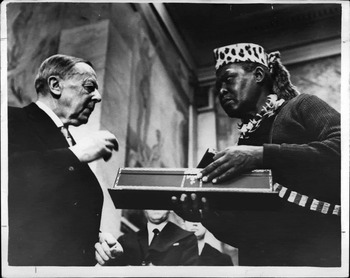
When the president-general and his wife Nokukhanya landed overseas, reporters shouted questions about rumors of imminent racial war in South Africa. After reiterating the ANC policy of nonviolence, Luthuli responded with rhetoric ostensibly aimed at MK: ‘What do you get out of violence, except that you increase the chances of bitterness, and are you more likely to effect violence to reach an end? I say no.’Footnote 108 He confided a different sentiment to his friend Mary Louise Hooper in Norway. ‘There can be no real peace’, Luthuli postulated, ‘as long as people are oppressed’.Footnote 109 Moreover, in conversation with one dignitary during the Nobel festivities Luthuli was said to have admitted that he ‘felt bound at a meeting with the ANC's leaders some months earlier to accept a decision to embark on sabotage’.Footnote 110 Wearing the iziqu necklace of Zulu warriors ‘who had killed in battle’, Luthuli entered Oslo City Hall where a convocation awaited the conferral of his medal on 10 December 1961 (see Fig. 4).Footnote 111 Shortly thereafter Luthuli presented a lecture saluting ‘disciplined resistance’ in South Africa.Footnote 112 A member of the Congress of Democrats Rusty Bernstein helped to draft this oration; one line conveyed the irony that the laureate's honor coincided with the end of fifty years of ANC nonviolence. Luthuli had deleted this reference, occasioning Bernstein's response (registered in his memoir): ‘Non-violence had always been a hard course to steer in a violent country … Yesterday's non-violent ANC had spawned today's armed liberation force.’Footnote 113
Luthuli collecting the Nobel medal while wearing the iziqu, a necklace earned by Zulu warriors who endured mortal combat. Photographer K09/Zuma. Image courtesy of Zuma Press, Inc.

With the president-general in Oslo, Mandela accelerated MK plans. At this juncture he was more excited by Algerian attacks on French colonists than by Luthuli's moment.Footnote 114 Moreover, MK was raring to eclipse rivals in the South African field. The first ANC saboteurs knew POQO was advancing the PAC pledge to win freedom through violence.Footnote 115 On the evening of 15 December, Luthuli and his wife Nokukhanya returned to Durban, Natal, as MK began operations in that city.Footnote 116 If irony hovers over this near-synchronicity, no one has indicated the timing was purposeful. In the early morning of 16 December MK bombed Johannesburg and Port Elizabeth. Echoing Luthuli's words to Kotane, Sisulu called his saboteurs a ‘fighting arm’ of liberation. The devices were planted outside vacant government offices and around remote state assets (for example, transmission lines). Most assessments of this maiden mission conclude that it had more failures than successes. Some explosives were duds; one operative was accidentally blown up. Still, six blasts shook cities, with each detonation announcing MK's declaration: ‘the government policy of force, suppression, and violence will no longer be met with non-violent resistance only’.Footnote 117 The 16 December offensive disrupted a national holiday, when Afrikaners commemorated their defeat of ‘savage’ Zulu regiments at ‘Blood River’ in 1838, while Africans lamented the loss of King Dingane's army in a battle to repulse Boer invaders.Footnote 118 The Zulu-language broadsheet, Ilanga Lase Natal, portrayed the dueling histories of this anniversary: ‘Dingane alone has a large body of … literature written round his episode with the Trekkers … [which the] country has come to believe in … as told from … one point of view. But Africans have their own version of the great epic of Zulu kings [who] … were not the brutes’ but rather ‘sane men fighting … [for] their way of life’.Footnote 119
Approached days later by the press, Luthuli expressed ‘regret’ and denied knowing who was responsible for the explosions.Footnote 120 He also sought information from his organization. The isiZulu-speaking Curnick Ndlovu was dispatched from MK's Johannesburg-area ‘Rivonia’ base to see Luthuli. They discussed the distribution of flyers broadcasting reasons for the bombings. Luthuli said ‘he was not aware that the [MK] leaflet was coming’ but ‘was not opposed to it … [nor] the feeling’.Footnote 121 He then asked Kotane for recommendations. In one of their exchanges Luthuli used an allegory to illustrate a crisis between the patriarchal ANC guardian and his assertive children: ‘When my son decides to sleep with a girl, he does not ask for my permission, but just does it. It is only afterwards, when the girl is pregnant and the parents make a case, that he brings his troubles home.’Footnote 122 Yet this rift, Yengwa recalled, did not shake Luthuli's ‘outspoken’ affirmation of ‘the young men … Mandela and the other leaders … driven to commit acts of sabotage, because of the government oppressing the … liberation movement’.Footnote 123
Luthuli's Nebraska-born confidant John Reuling, a former teacher at Adams College who was invited to the Nobel ceremonies, recorded similar sentiments. Eluding police in January 1962, Reuling visited Groutville, where he and the laureate walked into a sugar field to whisper behind a screen of cane. The American guest noted Luthuli's compassion for ‘the young fellows [who] come to me and say, “You have been non-violent for these many years, and this law has passed, and there are these many more people in prison, these many more people in detention, and this trial and that trial and we simply can't see the way out except by … fighting.”’ Luthuli added: ‘Five or ten years ago I would have told them they are going down the wrong track – now I just don't know … . I understand these fellows fully, and I simply cannot blame them.’Footnote 124 Jordan Ngubane plumbed this dilemma of ‘nonviolence … in South Africa’, where there was no ‘freedom to assemble or to travel, [or mobilize] a large army of disciplined volunteers’, as ‘the police can trace the movements of a person virtually from day to day’. Since ‘Sharpeville showed so clearly that mass nonviolence leads to shootings’, he detected no ‘enthusiasm among the Africans for’ entering the arena of civil disobedience only to ‘lose’.Footnote 125 Ngubane thus alluded to Luthuli's motivation to link ‘battles … of Tshaka … [and] Gandhi’ to the sacrifices of ‘martyrs who fell at’ Sharpeville, Pondoland, and Sekhukuneland.Footnote 126 So while Luthuli publicly extolled Christian conciliation as a way forward, for example in his column for the Golden City Post newspaper, he pondered defensive tactics within a continuum marked by the poles of nonviolence and violence.
On 3 January 1962 Luthuli met with colleagues to review Minister of Justice John Vorster's sabotage bill, which carried the death penalty. Luthuli disapproved of the bombers’ handbills declaring nonviolence ‘dead’ and MK's association with the ANC.Footnote 127 The group heard him out and opted to grant saboteurs autonomy under joint purview of Luthuli's organization and the SACP. Although dismayed by the timing of MK's debut, Luthuli never resigned from his movement, as he threatened to do years earlier when accused of consorting with white liberals.Footnote 128 Instead, he strengthened cooperation between national branches and ANC offices elsewhere on the continent, and approved NEC orders for Mandela to engage with the Pan-African Freedom Movement for East Central Africa (PAFMECA) in Ethiopia, which offered ‘military training’.Footnote 129 On 8 January 1962, Mandela convened with Luthuli in Groutville, where the latter protested MK's launch but did not oppose its formation; they talked, as well, about gaining allies during Mandela's upcoming Africa tour, an expedition that he embarked upon without a passport.Footnote 130 Months later, perhaps in May or June 1962, Luthuli gathered close to home with Kotane, Sisulu, Ndlovu, Ronnie Kasrils, and Billy Nair. The tightening dragnet of the security state, Mandela's reconnaissance and Tambo's pursuits topped the agenda. That winter the General Law Amendment Act (No. 76) was passed. It broadened sabotage to encompass labor strikes and political graffiti, and reversed the burden of proof for those accused of deliberately damaging governing property: if found guilty, they could be executed. ANC members regarded the legislation as an act of war. After his return to South Africa in early August 1962 and clad in fatigues, MK's commander-in-chief, Mandela, quietly entered Groutville to brief the president-general during the day. At night the traveler reveled with friends at a nearby party; word leaked that he was in Luthuli's vicinity. On 5 August policemen blocked a Natal road near the town of Howick, where they arrested Mandela; his capture hinged on a tip from the US Central Intelligence Agency, which spied on liberation movements in Southern Africa.Footnote 131 Mandela would be charged with not having secured a permit to leave the country.
The ANC now confronted ‘a very dangerous situation’, Joe Matthews recalled, as even former ANC Secretary-General James Calata, referring to MK, asked Z. K. Matthews, ‘Intoni le High Command? [What is this High Command?]’. Other members wondered, ‘which political organization established the military body?’. During October 1962, the ANC leaders Govan Mbeki, Sisulu, Tambo, Kotane, Yengwa – but not the banned Luthuli who could not attend – were part of an ANC consultative conference in Lobatse, Bechuanaland Protectorate that formally linked the ANC and MK and transferred effective power to ANC Vice-President Tambo, head of the ANC external mission.Footnote 132 By June 1963, MK had conducted over two hundred operations. Another watershed of armed struggle occurred in July 1963. With Mandela starting to serve his five-year prison term, police raided a farm in Rivonia, a suburb of Johannesburg; the property known as Lilliesleaf concealed MK principals mulling over Operation Mayibuye, a blueprint for guerilla warfare.Footnote 133 Seven suspects were taken into custody with weapons and materials implicating Mandela. He would stand trial again, this time for sedition alongside the Rivonia defendants. The prospect that a conviction would send these ANC men to the gallows agitated and ‘depressed’ Luthuli.Footnote 134 On 29 August 1963 the Durban-based British Consul-General Anthony Eden interviewed the Chief. They conversed the day after Verwoerd delivered a bellicose speech in Natal glorying in ‘white unity’. Such racist triumphalism, according to Eden's transcript, provoked Luthuli to say that ‘he would use violence in the last resort, and this time has probably come’.Footnote 135
In this bleak milieu Luthuli coordinated anti-apartheid protests with the American Committee on Africa (ACOA) and a UN Special Committee on Apartheid, steered by Enuga Reddy, which fostered boycotts of South Africa.Footnote 136 By September 1962, an admirer of the president-general, Reverend Martin Luther King Jr, had kicked off the US Appeal For Action Against Apartheid. Boosted by this solidarity, Luthuli beseeched the world to recognize that the ANC had ‘been forced to abandon all hope of reaching a just solution by consultation and negotiation’.Footnote 137 Calling for weapon embargoes and trade boycotts, Luthuli communicated with external ANC leaders Tambo and Robert Resha.Footnote 138 With the death penalty looming for the Lilliesleaf accused, Luthuli implored British diplomats and the UN Secretary-General to ‘save the lives of’ his friends.Footnote 139 ‘With them will be interred this country's hopes’, he lamented. Luthuli took comfort in their ‘spirit of militancy’, which embodied ‘the highest in morality and ethics’. It was not easy, he professed, for his organization to pursue ‘justice by the use of violent methods’, but the ‘uncompromising white refusal to’ ensure ‘freedom’ for ‘the African and other oppressed’ pushed the ANC in this direction.Footnote 140 His advocacy was part of an effort by the Afro-Asian bloc to pass UN Security Council Resolution 182, demanding the release of imprisoned anti-apartheid activists. In June 1964 the trial judge, Quartus de Wet, imposed life sentences on the convicted men.Footnote 141
Several months before the Rivonia trial commenced, Pretoria maneuvered to exploit Luthuli's status as a global icon of peace. Authorities fabricated a letter dated May 1963. Allegedly written by the president-general, it was posted to Dag Hammarskjöld's successor, Secretary General U Thant. The forgery offered to ‘guide’ the UN diplomat's Cold War-era ‘deliberations’ and affirm the principle of nonviolence ‘touch[ing] the hearts of the South African government’. The counterfeit further condemned the extremism of exiled ANC socialists, disparaging them as ‘puppet politicians’ who brainwash their underlings, ‘cause the Government to arm themselves to the teeth’, and delay a negotiated solution.Footnote 142 Alerted to the fraud, Luthuli vehemently replied: ‘I would sooner see myself dead than be an author of such a letter.’Footnote 143 When he succumbed to injuries after being hit mysteriously by a train in August 1967, Luthuli was widely mourned. The police General Hendrik van den Bergh, an official with prior Nazi associations, interrupted the bereavement period to reissue government shibboleths underpinning the fake letter to U Thant. Van den Bergh claimed the ANC was a communist front that silenced Luthuli's conciliatory vow to see the natives trusting in the regime's ‘honesty of purpose’.Footnote 144 Two years later, Van den Bergh created the Bureau of State Security (BOSS), an intelligence agency notorious for misinformation campaigns as well as for torturing and assassinating activists in South Africa.Footnote 145
CONCLUSION
Contrary to the founder of BOSS, Luthuli was neither a victim of ANC fanatics bent on guerrilla warfare nor an unyielding opponent of military struggle. He considered other options in the aftermath of Sharpeville, showing that he had more interest in confrontation than pacifism. In fact, he was skeptical of the latter after the state wantonly killed unarmed protesters. Luthuli made his feelings about pacifism known when a comrade openly questioned whether he had the determination to repulse attackers. At the end of the 1950s, no concessions from the regime and its increasingly supportive electorate were forthcoming. Thus, by 1961 Luthuli had come to endorse certain measures of self-defense. The secret July meetings were crucial moments as he and fellow strategists debated the life and death consequences of nonviolence, and then joined together in the MK compromise, which was sealed, according to Luthuli confidants, by Mandela's argument in favor of armed struggle and the president-general's paternal advice to the new commander-in-chief: ‘You go and start that organization. We will not discipline you because we understand why you have taken this line.’
To be sure, Luthuli still hoped the ANC would maintain its foundational policies while MK fulfilled its mandate to destroy government property and avoid any bloodshed. As an astute leader who already faced the hydra-headed vengeance of the state, he aimed to guide and consult an omnibus movement, comprised of radicalizing resisters and a few bomb makers who knew well their vicious enemy; monitoring saboteurs ‘in the field’ was one function of Luthuli's organizational role, along with receiving reports from MK via Kotane. That is why Luthuli, having touched down in Durban with Nobel in hand, expressed consternation that he was not informed of the 16 December inaugural offensive. By this point, Luthuli was reviewing the ‘5 or 10 years’ that had passed since the mass civil disobedience campaigns; their futility informed his realization that ‘fighting back’ was ‘the way out’ for those ‘fellows’ he understood ‘fully’.
As scholarship focused on the immediate post-Sharpeville moment suggests, there may have been diplomatic alternatives for the National Party and its opponents.Footnote 146 Perhaps Luthuli, more than most men of political authority, could have divined a negotiating advantage in his situation. Yet records of the president-general and similar activists indicate that they could not see such future alternatives as possibilities of dialogue and peace starkly receded. Indeed, by 1964 and the Rivonia verdict, Luthuli had recognized that the moral exigency of combating apartheid ‘slavery’ required more than faith in nonviolence. After fifty years of ‘turning the other cheek’, Luthuli acknowledged the language and intent that white supremacists were more likely to heed: violent sabotage.