1. Introduction
The aim of this illustrative paper is to show how words and expressions are coined or changed in Cameroonian speech in English and French in order to insult or stereotype other groups of people. Taken along official language lines, ethnic boundaries and social divides, these lexical elements reproduce some aspect of the addressee's history, social stance, academic achievement, professional background, linguistic and political belonging, and even gender. The expressions are from four major sources: French, English, Pidgin English and various indigenous languages. Some of them capture common social phenomena in the society. For example, Pidgin English supplies a descriptive name for a woman who moves in with a man to whom she is not married, i.e. come-we-stay. This appellation focuses more on the woman and the relationship rather than on the man. Such coinages are also common elsewhere in Africa. For instance, Nigerian Pidgin English supplies the appellation face-me-I-face-you for cramped up residential apartments in which rooms face each other on the corridor. Lexical strategies for naming and derogation are common in these two societies where groups compete with each other for their voices to be heard and respected.
The constant struggle between the anglophones and francophones in Cameroon since independence in 1960 and 1961 from France and Britain respectively has escalated into innumerable instances of what Anchimbe (Reference Anchimbe and Anchimbe2007) calls ‘linguistic victimisation’ or what Atanga (forthcoming) terms ‘linguistic bias’. Each group uses creative lexical strategies to demean, humiliate, and insult the other in a bid to improve their own social esteem. As Giles & Coupland (Reference Giles and Coupland1991: 105) explain, ‘the process of achieving positive distinctiveness enables individuals to achieve a satisfactory social identity and thereby enhance their own positive self-esteem’. Doing this often involves denigrating the social esteem of opponents because one's group's positive public image is measured in terms of the opponent's positive public image. The various groups in Cameroon, including ethnic and social groups, are involved in this phenomenon of linguistic victimisation for positive self-esteem. Although several naming strategies are used for naming and referring to opponents, this paper focuses only on those that are used to insult or victimise interlocutors.
The data used here were collected mostly through observation of casual daily speech and interaction. A few examples are from online interactive forums. However, some of the expressions analysed below were first used in formal situations, e.g. come-no-go was first used in 1996 for migrant workers who stay on indefinitely by the former governor of the South West Region, Oben Peter Ashu, on the Buea regional radio station. Two of the examples provided below – (1) and (5) – are from interviews I conducted in Yaoundé in September 2009 for a broader study on attitudes towards linguistic groups and languages in Cameroon.
2. Speech as a form of linguistic victimisation
The notion of linguistic victimisation previously presented in Anchimbe (Reference Anchimbe and Anchimbe2007) holds that a person could become a victim of exclusion, insult, and even torture simply because of the language s/he speaks. In the case of Cameroon, the groups involved in, and affected by, linguistic victimisation are ethnic, e.g. insults regarding ethnic social habits (les nkwa for the Beti) and history (seven cata for the Bafut); linguistic, e.g. insults towards speakers (anglofool for the anglophones, and francofool for the francophones) derived from their use of English and French respectively; regional, e.g. les Nordistes for mostly Muslims from the three northern regions (Adamawa, North, and Far North) of Cameroon; and social, e.g. come-we-stay explained above. These negative stereotypes are explained below.
Even strong adopted identity allegiances (e.g. political identity) can be shattered by stereotyping directed at ethnic and linguistic roots. A politician will normally break his political affiliation to support his roots as an anglophone if it is subjected to insults. People easily develop counter-strategies to victimisation by protesting or by passing the insult on. In the following excerpt from The Post newspaper in Cameroon, anglophone members of parliament from opposing political parties come together to protest when an anglophone opposition MP is called a Nigerian by a francophone MP simply because he spoke in English:
A plenary session of the just-ended parliamentary session…slipped into the sidelines of a row when one MP called Paulinus Jua a Nigerian…Anglophone CPDM MPs equally protested that somebody referred to a fellow Cameroonian as a Nigerian simply because he spoke in English. (The Post, December 20, 2004)
Similar incidents abound in daily interaction between Cameroonians from different social, ethnic, political, linguistic and regional backgrounds. Attention here is not on these incidents (see Mbangwana, Reference Mbangwana1991, Anchimbe, Reference Anchimbe2004, Mulo Farenkia, Reference Mulo Farenkia, Anchimbe and Janney2011, etc.) but rather on the lexical and semantic resources Cameroonians use to insult others. Some of the words and expressions used are presented in complete sentences from real life interaction.
3. Linguistic and social structure of Cameroon
Several especially insulting lexical resources used in linguistic victimisation are derived from the pluralistic linguistic and social set-up of Cameroon. With over 200 ethnic groups and at least 250 ethnic languages, cordial communal co-existence and collaboration has failed on many occasions, for instance, in politics, religion, and trade. Because of this, mutual suspicion has developed between members of the different groups in the country. Since ethnic and linguistic groups have not learned to trust each other, they have constructed in-group barriers that protect them from out-groups they consider opponents. In order to ridicule opposing groups, each group has devised names and references that belittle, humiliate and insult the other(s). Similar strategies have also been used on individuals, not as members of groups, but in relation to their social habits (especially prostitutes and concubines).
However, insults are very common at the level of groups. The insults directed at individuals often make clear reference to the group they are identified with, e.g. ‘You anglofools will never change’ said to one person (an anglophone). During the years of political turmoil in the 1990s in Cameroon, the anglophones were referred to as the enemies in the house (‘les ennemis dans la maison’) because they pioneered opposition to the predominantly francophone government. The highly Muslim north of the country has also been opposed to the south on various occasions and are hence grouped together as les nordistes (the northerners) and pejoratively as les moutons du nord (‘the sheep of the north’; see Mulo Farenkia, Reference Mulo Farenkia, Anchimbe and Janney2011). These two examples show how Cameroonians exploit various features to insult and victimise those they are opposed to. A closer look at the convenience groupings (Anchimbe, Reference Anchimbe, Heidemann and de Toro2006) constructed for different reasons and exploited for linguistic victimisation will facilitate the understanding of the expressions analysed below.
3.1 Administrative regions
Cameroon is made up of ten administrative units called regions. These were called provinces before November 2008. There is no clear logic as to why the country was thus divided, but two of these regions (North West and South West) are ex-British colonies while the rest are ex-French. Although some regions have some peculiar features, convenience groupings have often stretched beyond one region. As far as insulting is concerned, most regions were attributed certain negative peculiarities only a few decades ago. For instance, the North West became identified as the stronghold of the opposition only after the launching of the Social Democratic Front (SDF) party and the post-presidential election violence in the 1990s. However, the following groupings have received specific stereotypes which are used to insult or to victimise their members.
3.2 Linguistic and historical features
The most extensive arena for inter-group victimisation is between the anglophones and the francophones. Having been colonially governed by two countries after WWI, these groups have several differences, the most salient being linguistic – French for the francophones and English for the anglophones. The two groups represent starkly different proportions of the population and the geographical landscape. The francophones occupy about four-fifths of the land and constitute about 80% of the population.
Several subtle sociolinguistic battles have been reported between the anglophones and francophones. These include francophones referring to anglophones as Biafrans or Biafrains (in French), i.e. from Biafra in Nigeria. Anglophones in turn refer to francophones as frogs (possibly, for being boisterous or more likely as a retention of British stereotypes about the French, i.e. as those who eat frogs). The following extract from Jua and Konings (Reference Jua and Konings2004: 11) captures the way the francophones construct the anglophones.
We recently heard the story that when told by a visitor that he hailed from Kumba, the economic capital of the South West Province in Anglophone Cameroon, the Cameroonian Ambassador to Belgium, Isabelle Bassong, exclaimed: ‘Oh, Kumba, donc vous êtes moitié Nigérien et moitié Camerounais’ [Oh, Kumba, so you are half Nigerian and half Cameroonian].
As the expressions analysed below illustrate, these sociolinguistic battles are played out in the way the two linguistic and historical groups refer to each other. The terms anglophone and francophone have been renovated in various ways and used as insults.
3.3 Geographical, cultural, and religious demarcations
The geography, culture and dominant religions of certain groups and regions have been used as targets for insults, stereotyping and other forms of victimisation. Common examples are references to vegetation, e.g. the grassfields – graffi/grafi/glafi, often extended to cultures as in the ‘grassfield cultures’ (North West and West Regions), the grand north (e.g. les nordistes), and the grand south. The grand north is united in religion since Islam is the dominant religion there, the grafi/glafi zones are covered by low grass and they also share common cultures, and the grand south is generally Christian in religion. These demarcations are often used pejoratively.
3.4 Political belonging
References in politics are generally eponyms that bear the name of the person at the centre of the political institution captured in the insult. For instance, the expression les Fru Ndis does not only include members of the SDF party but also by extension all anglophones, since the SDF has been treated as an anglophone party. Some of these expressions endure longer than others while others simply expand their meanings and are used for similar people in other domains, not necessarily politics. For example, the expression come-no-go is no longer limited to North Westerners working in industrial plantations in the South West but to anyone who remains in a place for a very long time. The prominence of politics in linguistic stereotyping indicates to what extent the multiparty political system of the country has added a new layer of identity to its already many ethnic, regional, religious and linguistic identities.
4. Naming as insult: victimisation through the spoken word
The negative categories of insult and stereotype make sense only when placed within the fabric of the society and how its members interact with each other and construct one other, and build and defend in-group boundaries. In this section I focus on more detailed examples corresponding to the categories identified above.
4.1 References to anglophones
Since the 1990s the anglophones have protested against marginalisation. The francophones have in turn become combative, calling the anglophones the opposers and linking them to the opposition SDF party. Significantly, they have modified the word anglophone in different insulting ways. The word is clipped to anglo implying being naïve, stupid, and old-fashioned. This has spread also to the way anglophones dress, as the francophones claim, in shouting colours that do not match and with outrageous make-up that is not en vogue.
The term anglo presents anglophones as social misfits. An excerpt from an interview with an 18-year-old francophone girl (of the Bamileke tribe) who attends an English-medium school in Yaound in 2009 is given below. Our discussion turned to things that make francophones think anglophones ‘do the right thing at the wrong moment’ in ways that are said to be stupid and backward.
Example 1
Question: Could you give me one or two examples of the things anglophones do at the wrong time?
Answer: [smile] hmmn
Question: The things that make them ‘gauche’ [left].
Answer: Let us take for example dressing. Anglophones are very poor in dressing…I mean all what they are doing is always left, left.
Question: What is bad about the dressing?
Answer: They don't know how to, [switches abruptly to French] ils ne connaissent pas comment marier les habits, comment, quelle chaussure porter avec quel habit, comment se maquiller même, tout. [They don't know how to match clothes, how, which shoes to put on with which dress, even how to make-up, everything.]
Question: Le maquillage aussi? [Make-up as well?]
Answer: Le maquillage aussi, c'est mauvais. Là-bas alors c'est grave. Je ne sais pas. Je me dis souvent que peut-être qu'ils veulent imiter les francophones, mais, parce que les francophones ont le don pour ça. [Make-up as well, it's bad. That of all is terrible. I don't know. I tell myself, perhaps, they want to imitate the francophones, but, because the francophones are gifted in it (make-up).]
The exchange in example 1 above shows how deeply rooted the divide between the anglophones and the francophones is, given that the girl is only 18 but already has entrenched and denigratory judgements about everything anglophone.
The reference anglo above is intensified by the addition of two words to the clipped base form anglo. These are fou from French which means ‘insane, mad, stupid or foolish’ and fool from English: anglofou and anglofool. Such pejorative judgements have been extended to young anglophone women who are regarded as naïve and malleable. For this the francophones have derived a feminine variant of anglo to refer to young anglophone women, which is anglose, which also carries the additional connotation of not being able to understand or speak French. This has been captured in the joke cracked by francophone boys:
Example 2
Francophone boy: Anglose, tu m'aime? [‘Anglose, do you love me?’]
Anglophone girl: Oui, je m'aime. [‘Yes, I love me’.]
Two more terms used against the anglophones are the geographical terms Bamenda and Biafra or Biafran (in French les Biafrains). Bamenda is a major town in anglophone Cameroon and Biafra refers to the southern (mostly Igbo) area that attempted to secede from the Federal Republic of Nigeria in the 1960s. Calling someone un Bamenda attributes to him or her all the negative qualities identified with an anglo. Interestingly, this term has expanded its scope and is also used for francophones who are naïve or less smart as in example 3, easily heard among francophones:
Example 3
Tu me prends pour ton Bamenda, n'est-ce pas? [‘You take me for your Bamenda, don't you?’]
Je suis devenu ton Bamenda ici. [‘I have become your Bamenda here’]
There is a dual connotation to the use of the word Biafra. It could refer to the common colonial history anglophone Cameroon has with Nigeria – explaining why anglophones are insulted and victimised as Nigerians, or it could refer to the Southern Cameroons National Council's attempt to secede from the Republic of Cameroon, just as the Biafrans in Nigeria tried in the 1960s. The following excerpt from an interview in the Bafut Observer indicates how much anglophones detest being identified with Nigeria.
For me only one name drives me crazy and you better be careful when you call me that name especially if you are Francophone. I know that it inconveniences me to be carrying a spear all the time, but I do it to make sure that anybody who calls me ‘Biafran’, I will immediately pierce it through his stomach. (Bafut Observer, 2000: 8)
4.2 References to francophones
In return, anglophones aim to out-denigrate the francophones. The first term is frog, as discussed above. Two other terms used are francofou and francofool in direct retaliation to anglofou and anglofool. An extreme and exaggerated term also used on the francophones is francofrog. The excerpts in example 4 taken from readers' comments in the interactive section of The Post newspaper online illustrate the use of the terms francofool and francofrog as insults.
Example 4
Since these athletes made a significant performance in the previous ‘Mount Cameroon Race of Hope' there was no way out to fabricate the list of successful candidates as is usually done by our Francofool ‘brothers' who always manipulate the list of public exams.
www.postnewsline.com/2007/04/cameroon_athlet.html?cid=65861182
The francofrogs under puppet Biya have not had enough. Commonwealth scholarships all go to francophone students who can't even construct good sentences in English.
4.3 References to historical events
Ethnic groups or people from different administrative regions sometimes use historical events to insult each other. The Bafut people of the North West are called seven cata because during colonialism they allegedly tried to carry an Englishman's car on their heads. A cata is the Pidgin English word for the cloth or grass one folds and uses as a softener or stabiliser for head loads. Each person folded seven catas which they placed on their heads to soften contact with the load. When this event is evoked the Bafut are cast as primitive and backward. Similarly, the anglophones, commonly treated on a par with ethnic groups, are called, as discussed earlier, Biafra according to the colonial historical link to Nigeria. The British colonial administration ruled its parts of Cameroon from its offices in Nigeria.
The more recent expression come-no-go is used to describe North Westerners resident in the South West and working for the Cameroon Development Cooperation. It was first used by the former government of the South West Region in 1996 to explain why the ruling party had performed poorly in municipal elections. A government spokesman declared on Cameroon Radio and Television (CRTV) Buea station that the come-no-gos were responsible because they had all voted for the SDF.
The French term maquisard, a negative reference to the Basaa, also has a historical implication, i.e. the role of the Basaas in the rebellion against the French colonial administration in French Cameroun before independence in 1960.
4.4 References to social life: love and cheating
Social relationships involving love and sex, especially illicit relationships, form a subset in themselves. A woman involved in an extra-marital relationship with a married man is referred to as deuxième bureau (‘second office’). The idea of ‘office’ refers to errant husbands telling their wives they were in the office, when explaining delays in arriving home. However, a woman who moves in with a man when they are not (yet) married or do not have the intention of getting married is referred to as a come-we-stay. The relationship itself is also called come-we-stay. It conveys the idea of a cheap liaison, like telling the woman, ‘Just come and live with me, there is nothing attached, no marriage.’
Young boys also have names for girls they have casual sex with. They are called clear-coast and are visited only when the main girlfriend is absent – i.e. the coast is clear. Conversely, older women with whom younger boys have sexual relationships are called rémé ngas (‘mother-girls’ – see example 5). The word rémé is the youths' distortion of the French word mère (‘mother’) and nga is a Pidgin English slang for ‘girl’. By extension, a girl may be called rémé nga if she looks ugly and old-fashioned, and if she supplies the boy with as much money as a real rémé nga would. Example 5, which illustrates the use of rémé nga by the youth, is taken from the monthly youth magazine sold in major Cameroonian towns. The term mboma (example 5) is the opposite of rémé nga, i.e. old rich men who go after young innocent girls by offering them money.
Example 5
In order not to fall prey to ‘mbomas’ and ‘rémé ngas’, who could give us illnesses, we should be contented with what our parents give us. (100% Jeune Magazine, September 2006: 5)
Other people who have negative qualities may be likened to mbomas and rémé ngas. A last appellation, show-show, refers to young, beautiful, dainty girls who are also generally pugnacious, self-confident or even proud and arrogant, without sexual connotations, however.
4.5 Ethnic or tribal names
Ethnic groups and tribes in Cameroon may be subject to stereotyping, which makes others treat them with caution, suspicion, distrust or disdain. These are sometimes evoked by the very names of the tribes, which may undergo special morphological modification. Clipping is the most common pattern used. In Table 1, the clipped forms of the names of the ethnic groups (Nyangi, Bami and Anglo-Bami) are disparaging to similar degrees as Wadjo (from Fulfulde) used for the Muslim northerners and les nkwa used for the Beti. The word nkwa is borrowed from the Bamileke language. It normally refers to anyone foreign to Bamileke land or cultures, but it progressively adopted a new and more prominent meaning, i.e. ethnic groups that are lazy, irresponsible and spendthrifts. The Beti are presented as best fitting this description (see Onomo, Reference Onomo2005).
Expressions about ethnic or tribal groups

An interesting term from Pidgin English used in reference to the Beti or les nkwa is les chop-broke-pot, i.e. those who eat and break the pot from which they ate. It casts them as careless, irresponsible and as living from day to day. This expression, like some of the others above, has transcended this original meaning and now refers also to anyone in the political system or state administration who is interested only in self-enrichment.
The word gadamayo is used mostly in the three northern regions. It is from Fulfulde and refers to all those from the grand south living in the grand north. The word means ‘those who have crossed the Mayo or the Benoue River’. An anglophone teacher of English in Garoua, interviewed in September 2009, had the following to say about who a gadamayo is:
Example 6
Gadamayo…at this time does not only mean those who are speaking English or their indigenous languages…but those who have come from the other side of the…Mayo, those who have crossed the River Benoue and have gone to the other side; they call them gadamayos… that is, all the people from the south.
The term ‘Anglo-Bami’ first emerged in the 1990s designating the anglophones and Bamilekes considered most critical of the government. Today, it has expanded to those Bamilekes who are born in anglophone zones and who grow up speaking English rather than French as first official language. This latter meaning is not as negative as the former.
A pejorative term, ninety-nine point nine sense (99.9 sense) is used for the Banwa people of the Lebialem Division, South West Region. This means that the Banwas behave as if their intelligence quota is 99.9% high. They are always calculating and venture into any deal only when they are sure of gaining something. Although the expression confirms the view that the Banwas are supposedly very intelligent, it also carries a negative undertone in that they are projected as crafty, sly, and cunning. It therefore follows that every Banwa person would be treated with distrust even if s/he does not show any signs of slyness or stinginess – s/he may then be a victim of these categorisations.
4.6 References to geographical peculiarity
Geographical characteristics of different regions may be used to group divergent groups together and to insult or praise them. As Anchimbe (Reference Anchimbe, Heidemann and de Toro2006: 250) notes, ‘Geophysical similarities are used to bridge the more glaring differences of languages, ethnicity, religions and cultural practices.’ The effects may be positive or negative: positive when used by the people themselves to show to what extent they form a unified convenience group and negative when used by others to discriminate against them.
The term graffi, grafi or glafi, i.e. grassfield, is used as a blanket reference to the North West and West Regions. These two regions have similar vegetation cover and also similar cultures, often referred to as the grassland cultures and members of those cultures as the grasslanders. When pronounced graffi or glafi, it is the negative meaning that is invoked. To counter this, the graffis have come up with a mocking counterpart especially for people from the South West Region, i.e. foresfi from ‘forest field’ since most parts of the South West have dense forests.
Another term motivated by geographical location is les Nordistes. It refers to the three northern regions, which are mostly Muslim. As Mulo Farenkia (Reference Mulo Farenkia, Anchimbe and Janney2011) shows, a further insulting expression is used for the Muslims from these regions: les moutons du nord (‘the sheep of the north’). It suggests that they are illiterate and follow orders (especially from spiritual leaders) without second thought. So, if you are mistaken for a nordiste these attributes will immediately be conferred on you and you are likely to be a victim of certain discriminations.
4.7 References to profession: law enforcement forces
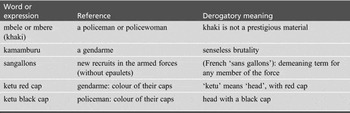
The police attract derogatory names world-wide: in the US they are called pigs and in Germany Bullen (‘bulls’) or, even more pejoratively, Bullenschweine (‘bull-pigs’). Cameroonians have different ways to refer, by way of insult, to the different law enforcement forces in the country. Some of these names bear semantic undertones that represent the society's conception of the profession. For example, kamamburu is used for the gendarmes and indicates that they are senselessly brutal when dealing with people (not necessarily criminals). The police are generally identified as mbele or mbere (‘khaki’), referring to their khaki uniforms. Due to the brutality evoked by the term kamamburu, a policeman will feel more insulted if called a kamamburu than a mbere khaki.
References to law enforcement forces

The last two examples are formed with the Lamnso head-word ketu which means ‘head’. In a personal communication with Bonaventure Sala, I was told the word ‘head’ has similar variants in Bamenda languages: e.g. ketu in Lamnso, Kom, and Oku; and kitu, tuo, and ntu in Ngemba dialects. Law enforcement forces are, therefore, identified by the colour of the caps they wear on their heads. Like most other terms, these expressions emerged in the early 1990s during the state of emergency in Bamenda where policemen, gendarmes, soldiers, anti-riot police and soldiers were deployed. The people used the colour of their caps to identify them. The brutality they meted out to the people is reflected in the negative connotations attached to these expressions.
4.8 Political eponyms
The use of the names of political figures to refer to their followers, members of their political parties and others is common in Cameroon. It is similar to grouping people of common background together for purposes of stereotyping. However, some eponyms are more inclusive than others. For instance, les Fru Ndis refers to supporters of the SDF chairman, members of the party, and anglophones. This reflects francophones' impression of the SDF as an anglophone party and the anglophones as an ethnic group. The Ben Munas is a narrower term, referring only to his followers in the SDF breakaway faction and members of the Alliance of Progressive Forces party, which he (Muna) formed after the breakaway. As far as les Biyas, and its phonological modification les Mbiyas, is concerned, reference is made to the long-standing president, his supporters, the administration, and to a large extent the chop-broke-pots around him who are allegedly only interested in power and riches.
5. Conclusion
The multilingual and multicultural nature of Cameroon makes tribes and linguistic groups distrust one another and therefore build barriers around themselves. The use of demeaning lexical strategies to name other groups is a means of giving to one's own group a better public image. The phenomenon is very creative given that people borrow extensively and wittingly from several sources, among them history, social behaviour, language use, religion, geographical landscape and political belonging, as well as from several languages, especially French, English, Pidgin English and vernacular languages.
The stereotypes go beyond the mere verbal insult. Anybody who is identified as un Bamenda, i.e. a foolish yes-person, ends up being treated and spoken to thus: without respect and with impunity. Similarly, anyone identified as 99.9 sense is treated with suspicion. This vicious circle of suspicion and counter-suspicion, naming and counter-naming has reduced inter-tribal, inter-group collaboration in politics, trade, and to some extent social life. It is unimaginable how deep-rooted some of these divisions are and how they are passed on to younger generations. Multilingualism and multi-ethnicity thus make us less optimistic about the multicultural dream of other societies.■
 ERIC A. ANCHIMBE, PhD, is a lecturer in English Linguistics at the University of Bayreuth, Germany. He has published on World Englishes and postcolonial identity construction. His current research is on the pragmatics of postcolonial Englishes from the postcolonial pragmatics framework. Among his other recent publications are Postcolonial Linguistic Voices (edited with S. A. Mforteh, Mouton de Gruyter, 2011), Postcolonial Pragmatics, special issue Journal of Pragmatics 43(6) (2011), Linguistic Identity in Postcolonial Multilingual Spaces (CSP, 2007), and Cameroon English: Authenticity, Ecology and Evolution (Lang, 2006). Email: eric.anchimbe@uni-bayreuth.de