INTRODUCTION
Octocorals (Octocorallia: Alcyonacea) are vital components of shallow water and reef environments throughout the tropics including the seas of the Indian sub-continent (Fabricius & Alderslade, Reference Fabricius and Alderslade2001). India, despite its vast coastline extending over 8129 km and subtropical climatic conditions, has very few coral reef areas (Rajasuriya et al., Reference Rajasuriya, Zahir, Muley, Subramanian, Venkataraman, Wafar, Munjurul Hannan Khan, Whittingham and Wilkinson2000; Ayyappan & Krishnan, Reference Ayyappan and Krishnan2004). The Indian coast has two widely separated areas containing reefs: the Gulf of Kutch in the north-west and Palk Bay and Gulf of Mannar with numerous fringing reefs around small islands in the south-east (Kelleher et al., Reference Kelleher, Bleakley and Wells1995; Muley et al., Reference Muley, Alfred, Venkatraman and Wafar2000). The west coast of India between Mumbai (formerly Bombay) and Goa is reported to have submerged banks with isolated coral formations (Nair & Qasim, Reference Nair and Qasim1978). Offshore of Goa and Karnataka States several islands have high coral cover (Sluka & Lazarus, Reference Sluka and Lazarus2009). Important offshore island groups of India with extensive reef growth include the Andaman and Nicobar Islands in the Bay of Bengal and the Lakshadweep Islands in the Arabian Sea (Rajasuriya et al., Reference Rajasuriya, Zahir, Muley, Subramanian, Venkataraman, Wafar, Munjurul Hannan Khan, Whittingham and Wilkinson2000).
The absence of reef along the continental coastline in the Bay of Bengal is attributed to the immense quantity of freshwater and silt brought by the rivers (Seawell, Reference Seawell1932; Islam, Reference Islam2003). Other disincentives to reef growth include heavy monsoonal rains and high human inhabitation on the coastline. The threats to octocoral health and damage to near shore reefs include sedimentation, dredging, coral mining and use of explosives and bottom-set nets for fishing (Rajasuriya et al., Reference Rajasuriya, Zahir, Muley, Subramanian, Venkataraman, Wafar, Munjurul Hannan Khan, Whittingham and Wilkinson2000; authors' personal observations).
In the last decade, knowledge of the taxonomy and ecology of soft corals, especially from shallow tropical reefs in the Indo-Pacific region has increased (Chanmethakul et al., Reference Chanmethakul, Hansa and Supareok2010). Gorgonian octocorals in spite of their cosmopolitan distribution have not been studied extensively in the Indo-West Pacific region (Goh & Chou, Reference Goh and Chou1996). The octocoral fauna of the Indian Ocean at present is known from stray reports: Lakshadweep (Hickson, Reference Hickson and Gardiner1903, Reference Hickson and Gardiner1905; Pratt Reference Pratt and Gardiner1903, Reference Pratt, Herdman and Honell1905; Ofwegen & Vennam, Reference Ofwegen van and Vennam1991); Maldives and Mascarene Archipelago (Hickson, Reference Hickson and Gardiner1903, Reference Hickson and Gardiner1905, Reference Hickson1930; Pratt, Reference Pratt and Gardiner1903; Faure, Reference Faure1977); Seychelles (Verseveldt, Reference Verseveldt1976); Madagascar (Tixier-Durivault, Reference Tixier-Durivault1966; Verseveldt, Reference Verseveldt1968, Reference Verseveldt1970, Reference Verseveldt1971); Tanzania (Ofwegen & Benayahu, Reference Ofwegen van and Benayahu1992); and the material collected by the ‘Investigator’ (Thomson & Henderson, Reference Thomson and Henderson1906; Thomson & Simpson, Reference Thomson and Simpson1909), mostly from Andamans, Ceylon, Ganjam coast, Arakan coast, Coramandel coast, Persian Gulf and Indian coast (Thomas & Rani, Reference Thomas and Rani1986, Reference Thomas and Rani1987; Mary Reference Mary1998; Mary et al., Reference Mary, Lazarus and Vincent1998; Mary & Lazarus, Reference Mary and Lazarus2004). Identification of Indian octocorals collected by the ‘Investigator’ (Thomson & Henderson, Reference Thomson and Henderson1906; Thomson & Simpson, Reference Thomson and Simpson1909) is greatly hampered by the inaccessibility of the material in the Calcutta Museum. Octocorals of Mauritius and Andaman and Nicobar Islands were reported by Vennam & Parulekar (Reference Vennam and Parulekar1994) and Vennam et al. (Reference Vennam, Bhat and Parulekar1996).
A comprehensive list of other less extensive taxonomic papers describing species found in the western Indian region can be found in Bayer (Reference Bayer1961). Ofwegen (Reference Ofwegen van1987) described species of the family Melithaeidae from the Indian Ocean and the Malay Archipelago, and reviewed Wrightella coccinea from the Maldives (Ofwegen, Reference Ofwegen van1989). In addition to Thomson & Simpson's (1909) collection of four species of Gorgonacea (Anthozoa: Melithaeidae) from Laccadives, three species of Gorgonacea and 19 species of Alcyonacea were described by Ofwegen & Vennam (Reference Ofwegen van and Vennam1991) and 17 by Alderslade & Shirwaiker (Reference Alderslade and Shirwaiker1991) from the same region. From the Indian Ocean, five new species of Dendronephthya (Verseveldt & Ofwegen, Reference Verseveldt and Ofwegen van1991) and a new genus, Pseudothelogorgia, were reported (Ofwegen, Reference Ofwegen van1994). Additionally, a new species of Pseudopterogorgia was described by Williams & Vennam (Reference Williams and Vennam2001). Octocorals of the south-west Indian Ocean (South Africa–Mozambique) were studied by Benayahu & Schleyer (Reference Benayahu and Schleyer1995, Reference Benayahu and Schleyer1996) and Ofwegen & Schleyer (Reference Ofwegen van and Schleyer1997).
Taxonomic knowledge of octocorals is far from adequate in the Indian seas and confusion in the literature still exists because of meagre knowledge involving variability. Additionally, many authors have described separate taxa for intraspecific variants (Williams, Reference Williams1997).
The inshore areas of the present study between Kanyakumari in Tamil Nadu State and Vizhinjam in Kerala State have many rocky outcrops which provide substratum for a variety of benthic organisms including soft corals, gorgonids, hard corals, sponges, mussels and algae (Mary, Reference Mary1998; Mary & Lazarus, Reference Mary and Lazarus2004; Sluka & Lazarus, Reference Sluka and Lazarus2009). Previous studies from the south-east coast were conducted of exported (Thomas & Rani, Reference Thomas and Rani1986, Reference Thomas and Rani1987), entangled in fishing nets (Mary & Lazarus, Reference Mary and Lazarus2004) and stranded materials on beaches (Mary, Reference Mary1998). This study reports for the first time on in situ collected specimens from the south-west Indian coast. The present study reports the total octocoral diversity, percentage coverage and diversity by site.
MATERIALS AND METHODS
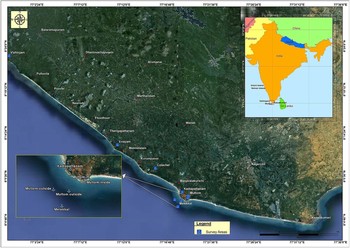
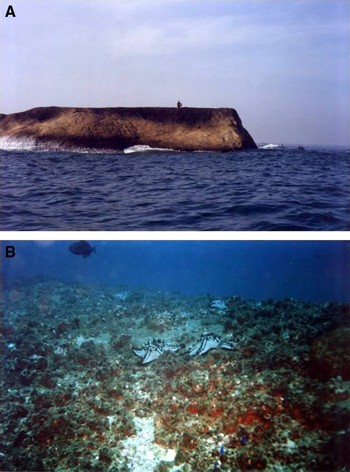
Collections were made during January to March, 2002 from 5 stations in Tamil Nadu (Muttom (MUT), Kadiapattanam (KAD), Colachel (COL) and Enayam (ENY)) and Kerala regions (Vizhinjam (VIH)) of the south-west coast of India (Figure 1). All survey locations were shallow, rocky and near-shore (Figure 2A, B). The specimens were collected using SCUBA at a depth-range of 3–27 m. Specific depth-ranges for the species collected have been given along with photographs taken in situ and ex situ to differentiate morphologically similar species and to show the variety of colour morphs. Descriptive notes on colony morphology, colour and sclerite structures (sufficient to differentiate species found here) are provided for indeterminate species.
Study sites along the south-west Indian coast.

(A) Ex situ dive site of Muttom, south-west Indian coast; (B) in situ dive site of Muttom, south-west Indian coast.

The collected specimens are preserved in 70% ethanol, except Acabaria which is air-dried. Specimens were identified using morphological characteristics of the colonies and sclerites following Bayer (Reference Bayer1981) and Bayer et al. (Reference Bayer, Grasshoff and Verseveldt1983). Sclerites were obtained by dissolving the organic tissues with 10% hypochlorite and were then examined under a compound microscope. The classification and terminology of the taxa were based on Fabricius & Alderslade (Reference Fabricius and Alderslade2001). Major taxonomic revisions are necessary for many families found on the south-west and south-east coasts of India, and accordingly many specimens could not be identified to the species level. All specimens reported are deposited at the Northern Territory Museum (NTM) of Arts and Science, Darwin, Australia and still under examination for a detailed systematic study.
Line intercept transects were used to calculate the percentage cover of both living and non-living benthos. At each site between four and nine 25 m transects were laid in representative areas of the substrate. One observer (R.D.S.) examined the bottom underneath points at 25 cm intervals along the transect, giving a total of 100 possible points per transect. Some transects contained less than 100 points due to diving related problems or the exclusion of points occupied by mobile invertebrates (mainly crinoids). Percentage cover was calculated as the total number of points for each benthic category divided by the total number of points for that transect (range 85–100 points, mean points per transect = 99).
RESULTS
Fifty-six samples were collected, yielding 14 species from ten genera and six families of which ten are new records to India; two are new to the shallow (11–12 m) Indian waters and one appears to be a new record to the south-west Indian coast.
The present study in the entire south-west regions of Tamil Nadu and Kerala shows that all specimens collected except Junceella juncea proved to be new records for the survey locations. Octocoral coverage at all sites was less than 1%. Muttom was the most diverse site with 12 species followed by Colachel 9, Vizhinjam and Enayam 7 each and Kadiapattanam 6 species. Abundance showed Muttom again dominating with 19 specimens followed by Colachel 11, Enayam 10, Vizhinjam 9 and Kadiapattanam with 7 to its record.
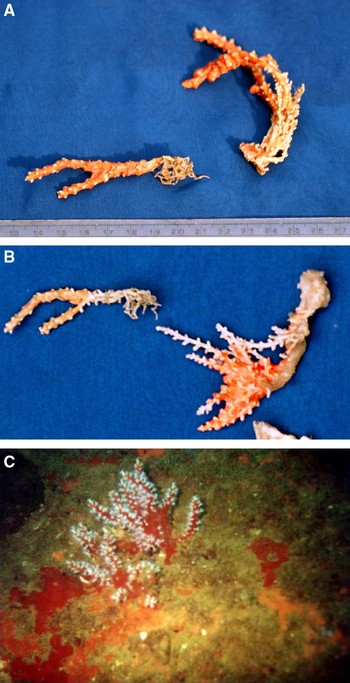
(A) Carijoa sp.; (B) Carijoa sp. half dried; (C) Carijoa sp. in situ.

MATERIALS EXAMINED
NTM C14990 (Muttom); 10 specimens (4 MUT, 1 KAD, 2 COL and 1 VIH); depth 10–16 m.
DESCRIPTION
The largest specimen is 13.5 cm long with a width of 2.5 cm. The polyps when expanded are 0.2–0.5 cm long. Colonies are slimy when alive with colours of orange, blue and brown with white or cream polyps. Specimens become completely white when air-dried. Sclerites are slender and rod-like, with small thorns.
HABITAT
Found predominantly in turbid coastal waters along with mussels. Some are found on flat sandy bed.
REMARKS
This genus is a new record to India.
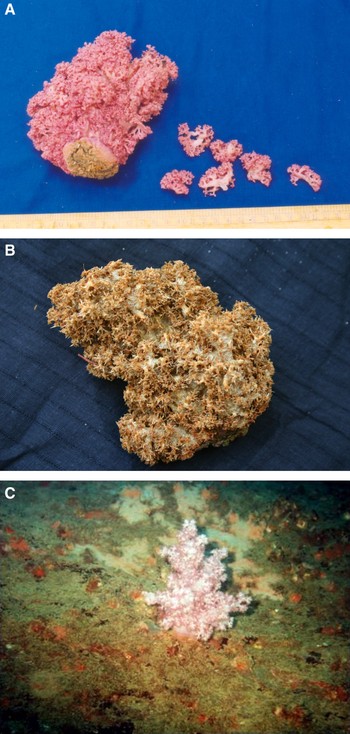
(A) Dendronephthya sp.; (B) Dendronephthya sp. dried; (C) Dendronephthya sp. in situ.

MATERIALS EXAMINED
NTM C14991 (Enayam); five specimens (2 MUT, 1 COL and 2 ENY); depth 12 m.
DESCRIPTION
Colonies are highly branched and bushy with umbellate branching. The largest specimen is 13.5 cm long and 11.3 cm wide with soft and swollen stalk. When expanded, surface is prickly with sharp spines. Colour of the colonies when alive ranges from dark red to pink and cream with the stalk pale white or cream coloured; polyps white. Sclerites include tuberculate and thorny spindles, needles, many irregularly shaped sclerites and antlers in the internal canal walls.
HABITAT
It is less abundant in the wave-exposed areas of the Indian coast.
REMARKS
This is a new record from the shallow (12 m) Indian coast whereas the previous records are from a depth of 60–70 m from Andaman and Nicobar Islands. (Thomson & Henderson, Reference Thomson and Henderson1906; Thomson & Simpson, Reference Thomson and Simpson1909; Verseveldt & Ofwegen, Reference Verseveldt and Ofwegen van1991). Mostly found as solitary colonies on hard bottom.
Acabaria variabilis.

MATERIALS EXAMINED
NTM C14992 (Muttom); three specimens (2 MUT and 1 KAD); depth 11 m.
DESCRIPTION
Colony dichotomously branched in one plane. Internodes and polyps are cream or white in colour while the swollen nodes are pink/red when alive and retain the same colour when air-dried. Sclerites are colourless with mostly leafy clubs in calyx walls; nodes with pink rods and spindles. The specimen is 6 cm tall and 6.5 cm wide.
HABITAT
Found in the crevices of rocks and hangs from below the rocks; rare in wave exposed areas.
REMARKS
This is a new record to the shallow Indian coast while previously recorded at a depth of 55–60 m from Maldives and Lakshadweep Islands (Ofwegen, Reference Ofwegen van1987). Acabaria variabilis remains a very variable species based on the colour of the colony (Ofwegen, Reference Ofwegen van1987) while coloured nodes are characteristic for some Acabaria (Fabricius & Alderslade, Reference Fabricius and Alderslade2001).
Acabaria sp.

MATERIAL EXAMINED
NTM C14993 (Colachel); three specimens (2 COL and 1 VIH); depth 14 and 18 m.
DESCRIPTION
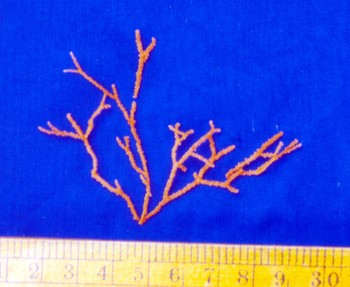
It is dichotomously branched in one plane and the colony is orange in colour that retains after air-drying. Swollen nodes are sparingly distributed. Nodes and internodes show colourless and yellow sclerites; mostly rods in nodes, spindles in polyps and leafy clubs in the calyx walls; size of the colonies ranges from 4.0–4.4 cm length and 2.3–2.5 cm width.
HABITAT
Tiny colonies overhanging below rock cliffs.
REMARKS
This is a new record to India. This species differs from A. variabilis in the presence of yellow sclerites both in the nodes and internodes and with its distinct orange coloured colony. The specific pink/red nodes which are typical of A. variabilis were absent in this species (Ofwegen, Reference Ofwegen van1987).
Echinomuricea sp.

MATERIALS EXAMINED
NTM C14994 (Muttom); four specimens and bits (2 MUT, 1 COL and 1 ENY); depth 4–12 m.
DESCRIPTION
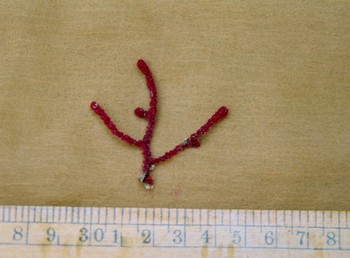
Colony is 4.2 cm high and 4.6 cm wide. Colour dark red with slender whip-like branches, growing in one plane. Branches are thick and intersect at right angles. Polyps are monomorphic and retractile. Sclerites are thorny scales, spindles and thorny stars.
HABITAT
Occurs in both turbid and clear water; commonly found associated with different sponge species; survives well in high sediment water along the south-west Indian coast (Mary & Lazarus, Reference Mary and Lazarus2004).
REMARKS
A potential new record to the Indian coast as the radiates and crosses of E. indica (Mary, Reference Mary1998; Mary & Lazarus, Reference Mary and Lazarus2004) recorded from Kanyakumari (40–65 km from the present study areas) are absent in this species. It is a common genus found in Lakshadweep Islands (Ofwegen & Vennam, Reference Ofwegen van and Vennam1991), Andaman and Nicobar Islands (Vennam et al., Reference Vennam, Bhat and Parulekar1996) and Gulf of Mannar, east coast of India (Thomas & Rani, Reference Thomas and Rani1986, Reference Thomas and Rani1987).
Echinogorgia sp. A.

MATERIALS EXAMINED
NTM C 14995 (Vizhinjam); five specimens (1 MUT, 1 KAD and 3 VIH); depth 26 m.
DESCRIPTION
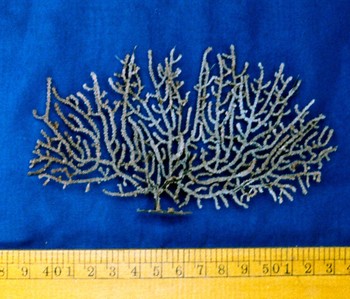
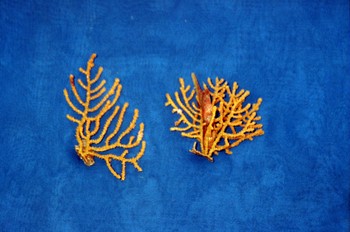
Colonies grow in one plane with short side branches forming net-like fans. Size ranges from 8.1–14.1 cm in width and 6.9–13 cm in height. Colour of the colony when alive is yellow; when dried, the yellow coloured colonies turn to light brownish shade. Sclerites mostly spindles and thornscales; colour of sclerites dark red or burgundy.
HABITAT
It is common in turbid waters and found as individual colonies on hard bottom.

MATERIALS EXAMINED
NTM C14996 (Enayam); three specimens (2 ENY and 1 VIH); depth 14 m.
DESCRIPTION
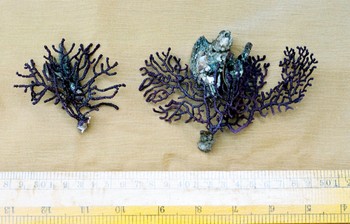
Purple coloured colonies grow in one plane with short side branches forming net-like fans. Stalk robust; width ranges from 8.1–13.5 cm and height 7.9–8.3 cm; sclerites are spindles and thick colourless thornscales that form a complex root structure in the calyx and capstans in axial sheath around axis.
HABITAT
Tolerant to turbid waters and found associated with sponges and mussels.
REMARKS
This is a new record to India as it differs from Echinogorgia sp. A in the presence of colourless thornscales and capstans.
(A) Menella sp. A; (B) Menella sp. A in situ.

MATERIALS EXAMINED
NTM C14997 (Colachel); four specimens (1 each from MUT, KAD, COL and ENY); depth 8 m.
DESCRIPTION
It has thick whip-like branches from which side branches arise at right angles and curve upwards. Size ranges from 11–32 cm height and 5.4–6.5 cm in width. Colour brownish yellow. Sclerites are rooted-leaves and collaret are spindles.
HABITAT
It can survive in fast flowing turbid waters and is found associated with mussels (Figure 10B). Few frondose algae could be seen attached with the species.
REMARKS
This genus is a new record for India.
(A) Menella sp. B; (B) Menella sp. B in situ.

MATERIALS EXAMINED
NTM C15000 (Muttom); two specimens (1 each from MUT and COL); depth 9 m.
DESCRIPTION
Colonies are of whip like branches; height 13.1–18.2 cm and width 4.8–7.2 cm; diameter of branches 0.5 cm; polyps are cream coloured while branches are of burgundy colour; sclerites are mostly rooted leaves, small spindles and capstans.
HABITAT
Found on mussel beds (Figure 11B) and occurs in fast flowing turbid waters.
REMARKS
This is a new record to India. This species differs from Menella sp. A in the presence of small spindles and capstans.
Paraplexaura sp. A.

MATERIALS EXAMINED
NTM C14998 (Colachel); three specimens (1 COL and 2 VIH); depth 16–20 m.
DESCRIPTION
It is richly branched with relatively thick stalk and side branches that curve upwards at right angles. Colour of the colony yellow when both alive and preserved; size ranging from 3.5–6.4 cm height and 3.3–7.6 cm width. Surface of branches contain spindles with tubercles, capstans, and thornscales which are of red colour.
HABITAT
Found in murky waters associated with sponges and mussels.

MATERIALS EXAMINED
NTM C14999 (Vizhinjam); two specimens (1 MUT and 1 VIH); depth 18–24 m.
DESCRIPTION
Colour of the colony yellow when both alive and preserved; size ranges from 4.2–5.8 cm height and 2.4–6.8 cm width. Thickly branched with thick stalk and side branches at right angles; sclerites are thick thornscales, capstans and spindles with tubercles; polyp sclerites are smooth; sclerites are colourless.
HABITAT
Found in murky waters associated with sponges and mussels.
REMARKS
This is a new record to India as it differs from Paraplexaura sp. A in the presence of colourless sclerites.
Pseudopterogorgia sp.

MATERIALS EXAMINED
NTMC15001 (Muttom); three colonies and some fragments (2 MUT, 1 ENY and fragments KAD); depth 27 m, rocky substratum.
DESCRIPTION
Colonies are red in colour when alive and preserved; colonies uniformly distributed with pinnate branches and small polyps. Polyp sclerites smooth and tuberculate coenenchymal spindles are colourless. Colony size ranges from 13.6 cm height and 6 cm width.
HABITAT
Found on hard substratum in turbid waters and few associated with sponges. Seems to tolerate high sedimentation rate and is rare in clear waters (Fabricius & Alderslade, Reference Fabricius and Alderslade2001).
REMARKS
This is a new record to India and needs further study to compare with the previously recorded Pseudopterogorgia fredericki (Williams & Vennam, Reference Williams and Vennam2001).
(A) Junceella juncea; (B) Junceella juncea dried.

MATERIALS EXAMINED
NTM C15002 (Kadiapattanam); five specimens (1 each from MUT, COL, VIH and 2 KAD; fragments from ENY); depth 19 m.
DESCRIPTION
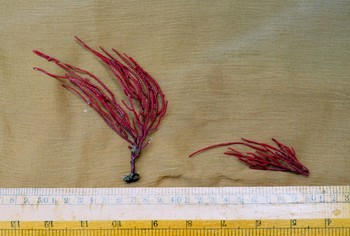
Specimens unbranched and whip-like; height of the specimen collected was up to 159 cm; diameter of the colonies varies from 3.5–7 mm; calyces papillate and directed towards the growing tips; polyps are small with characteristic clubs in the surface of the coenenchyme, and capstans (0.05–0.1 mm) in the subsurface of the cortex. Colour red when alive with black/cream coloured axis.
HABITAT
Common in turbid water; large specimens observed in Colachel in water depth <5 m; mostly associated with mussels and sponges.
REMARKS
It was reported earlier from the Gulf of Mannar (Thomas & Rani, Reference Thomas and Rani1986, Reference Thomas and Rani1987) and south-west Indian coast (Mary, Reference Mary1998; Mary & Lazarus, Reference Mary and Lazarus2004).
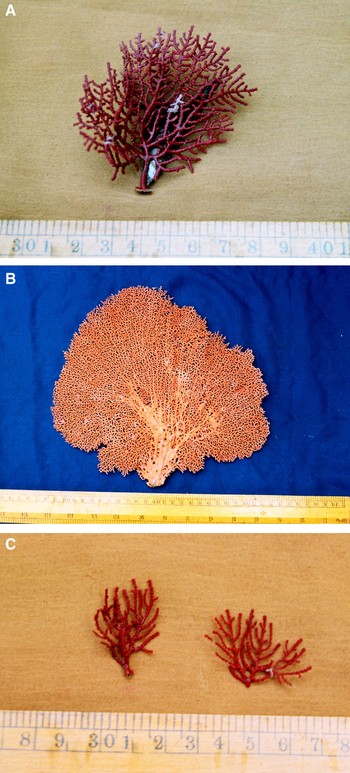
(A) Verrucella sp.; (B) Verrucella sp.; (C) Verrucella sp.

MATERIALS EXAMINED
NTM C15003 (Muttom), NTM C15004 (Colachel), NTM C15005 (Kadiapattanam); six specimens (2 MUT, 1 each from KAD, COL, ENY and VIH); depth 9–20 m.
DESCRIPTION
Colonies were richly branched forming different network patterns (Figure 16A, B, C); colour of the colonies were orange, red and yellow when alive and retains colour on preservation; height extends from 15–23.2 cm and width from 21.5–24.5 cm. Sclerites are mostly of double heads with sharp waists and short spindles.
HABITAT
In the current observation, Verrucella sp. has been found as individual colonies on both sandy and rocky beds; well associated with hard corals, sponges and mussels.
REMARKS
This genus is a new record to India.
DISCUSSION
The overall objective of the present survey was to investigate the diversity and distribution of octocoral fauna of the south-west Indian coast. Our study reports 14 species of octocorals from six families and 10 genera. Ten species were found to be new records to India with two new to the shallow Indian coast and one seems to be a potential new record. Carijoa, Menella, Paraplexaura and Verucella sp. are entirely new genera to India. The distinct orange coloured Acabaria sp. A is found to be a new taxon because of its different undescribed/coloured (and colourless) sclerites with leafy clubs and spindles with tubercles in both nodes and internodes. Acabaria variabilis and Dendronephthya are new to the shallow Indian coast (11 and 12 m depth) as the previous records (Thomson & Henderson, Reference Thomson and Henderson1906; Thomson & Simpson, Reference Thomson and Simpson1909; Verseveldt & Ofwegen, Reference Verseveldt and Ofwegen van1991) were from 60–70 m depth. Echinomuricea sp. is found to be a potential new record as the earlier records reported from the south-east and south-west coasts of India (Thomas & Rani, Reference Thomas and Rani1986; Mary, Reference Mary1998; Mary & Lazarus, Reference Mary and Lazarus2004) show variations of sclerites in different forms from the present colonies which need further study. Echinogorgia spp. A and B are new records to India and the previous records of E. complexa, E. flora and E. reticulata (Thomas & Rani, Reference Thomas and Rani1987; Mary, Reference Mary1998; Mary & Lazarus, Reference Mary and Lazarus2004) need further revision on its various multiradiate sclerites. Pseudopterogorgia sp. is found to be a new record to India which again needs further study to compare with the previously recorded Pseudopterogorgia fredericki (Williams & Vennam, Reference Williams and Vennam2001). Junceella juncea is a common species previously recorded from the south-east and south-west Indian coasts (Thomas & Rani Reference Thomas and Rani1987; Mary, Reference Mary1998; Mary & Lazarus, Reference Mary and Lazarus2004). The present collection was identified only to the genus level except for Acabaria variabilis and Junceella juncea as the sclerites on other specimens lead to confusion and need detailed revision of the respective taxa.
The overall octocoral coverage at study sites was less than 1%. Area-wise distribution shows that diversity was high in Muttom with 12 species followed by Colachel 9, Vizhinjam and Enayam 7 each and Kadiapattanam 6 species. Abundance showed Muttom dominating with 19 specimens followed by Colachel 11, Enayam 10, Vizhinjam 9 and Kadiapattanam 7 to its record. It is also noted that the family Ellisellidae is distributed throughout the entire surveyed sites compared to the other families recorded.
Along the Gulf of Mannar (south-east Indian coast), fleshy octcorals are abundant (Pillai, Reference Pillai1971) and recorded with 27 species (Vennam & Parulekar, Reference Vennam and Parulekar1997). Also Vennam et al. (Reference Vennam, Bhat and Parulekar1996) recorded 26 species of alcyonaceans from Andaman and Nicobar Islands. Compared to the south-east coast, the south-west Indian coast shows less abundance and diversification in the octocoral population possibly due to the south-west monsoon that hit the Western Ghats which brings much precipitation in the coastal areas and resultant sedimentation. The one site (Melekkal, Muttom) which had a significant alcyonacean population was a deeper (25+ m) site which in addition to receiving less wave energy and the resultant sedimentation, had a significant area of hard bottom for colonization.
CONCLUSION
Much work remains to bring into order octocorallian taxonomy and ecology on the Indian subcontinent. Octocorals are a small proportion of the rocky reef fauna of south-western India. The present survey makes a small contribution towards resolving issues surrounding the distribution and taxonomy of this little known fauna.
ACKNOWLEDGEMENTS
This project was funded by the Committee for Research and Exploration, National Geographic Society (grant No. 7094–01). We acknowledge Phil Alderslade and Leen Ofwegen with gratitude for the confirmation of species identification and their valuable comments on numerous aspects of this manuscript. Thanks are also due to the two anonymous referees for their helpful comments on earlier versions of this paper. The first author thanks M. Aneel Kumar, Sini Sony and Marwa Al-Adhali, GIS Experts, RTS, Oman for working on the latest Google map.