Introduction
This study seeks to understand the relationship between public attitudes concerning the EU and the speed of directive transposition in EU member states. A significant number of European policies take the form of directives, however, directives must be transposed into the legal system of the different member states to carry the weight of law. Since many EU policies are directives, and directives do not carry the force of law without transposition, it is clear that ‘transposition is … a critical precondition for the effective implementation of European policy’ (Steunenberg and Rhinard, Reference Steunenberg and Kaeding2010). Essentially, European policy integration is dependent on timely transposition of directives (see Dimitrova and Rhinard, Reference Dimitrova and Rhinard2005). Thus, developing a clearer understanding of the determinants of transposition speed, and in particular the relationship between public attitudes toward the EU and transposition delay, has important implications for the study of European policy implementation and integration.
Understanding the relationship between public attitudes concerning the EU and transposition delays also has implications beyond the study of policy implementation and integration. It addresses issues surrounding policy responsiveness, and political representation in Europe. Democracy is predicated on the assumption that the provisions of public policy are related to the wishes of the citizens, and policy changes are linked to the changing preferences of citizens (Pitkin, Reference Pitkin1967; Dahl, Reference Dahl1971; Powell, Reference Powell2000). Although most directives are eventually transposed by member states, if the speed at which directives are transposed by member states is influenced by public attitudes concerning the European Union, this indicates that member state governments are responding to the public on issues concerning the EU and integration, even if only in the short term. Importantly, this finding would also imply that policy responsiveness on issues of European policy and integration occurs during the implementation of policy, whereas one normally expects to see political representation and responsiveness in the policy-making stage.
A fair amount of research has shown that member state directive transposition is often delayed (e.g. Knill and Lenschow, Reference Knill and Lenschow1998; Kaeding, Reference Kaeding2008; König and Luetgert, Reference König and Luetgert2009), and in recent years research concerning the determinants of transposition delay and non-compliance has rapidly increased (see Mbaye, Reference Mbaye2001; Börzel and Risse, Reference Börzel and Risse2003; Mastenbroeck, Reference Mastenbroek2003; Thomson, Reference Thomson2007, Reference Thomson2009; Thomson et al., Reference Thomson, Torenvlied and Arregui2007; Toshkov, Reference Toshkov2007, Reference Toshkov2008; König and Luetgert, Reference König and Luetgert2009; Steunenberg and Kaeding, Reference Steunenberg and Rhinard2009; Steunenberg and Rhinard, Reference Steunenberg and Kaeding2010, etc.) Some of the factors that have been shown to affect the timeliness of transposition are a directive’s policy sector (Lampinen and Uusikylä, Reference Lampinen and Uusikylä1998; Berglund et al., Reference Berglund2006), a directive’s status as an amendment (Mastenbroek, Reference Mastenbroek2003; Borghetto et al., Reference Borghetto, Franchino and Giannetti2006; Kaeding, Reference Kaeding2006), the institutional body adopting the directive (Mastenbroek, Reference Mastenbroek2003; Kaeding, Reference Kaeding2006; Steunenberg and Rhinard, Reference Steunenberg and Kaeding2010), the length of time provided by the EU for transposition (Borghetto et al., Reference Borghetto, Franchino and Giannetti2006; Steunenberg and Rhinard, Reference Steunenberg and Kaeding2010), and the member state government’s level of support for the EU (Toshkov, Reference Toshkov2007, Reference Toshkov2008), among others.
Most importantly for the present study is the literature that has examined the relationship between public attitudes regarding the EU and transposition (see Lampinen and Uusikylä, Reference Lampinen and Uusikylä1998; Mbaye, Reference Mbaye2001; Kaeding, Reference Kaeding2006; Steunenberg and Rhinard, Reference Steunenberg and Kaeding2010). These works have examined the effect of public support for the EU on transposition speed/delay; each expecting that greater public support for the EU will translate into faster/timelier transposition of directives.
These studies found, generally, that public support for the EU is unrelated to the transposition process. Specifically, Mbaye (Reference Mbaye2001) found higher EU approval among the public of a member state to be correlated with more instances of directive non-compliance (the opposite of what was expected), although she concludes that this is a spurious relationship. Neither Lampinen and Uusikylä (Reference Lampinen and Uusikylä1998), nor Kaeding (Reference Kaeding2006) found a relationship between positive public opinion concerning the EU and transposition timeliness (i.e. transposition before the deadline). Steunenberg and Rhinard (Reference Steunenberg and Kaeding2010) also found no effect of public support for the EU on the speed of transposition (i.e. the amount of time member states use to transpose a directive).
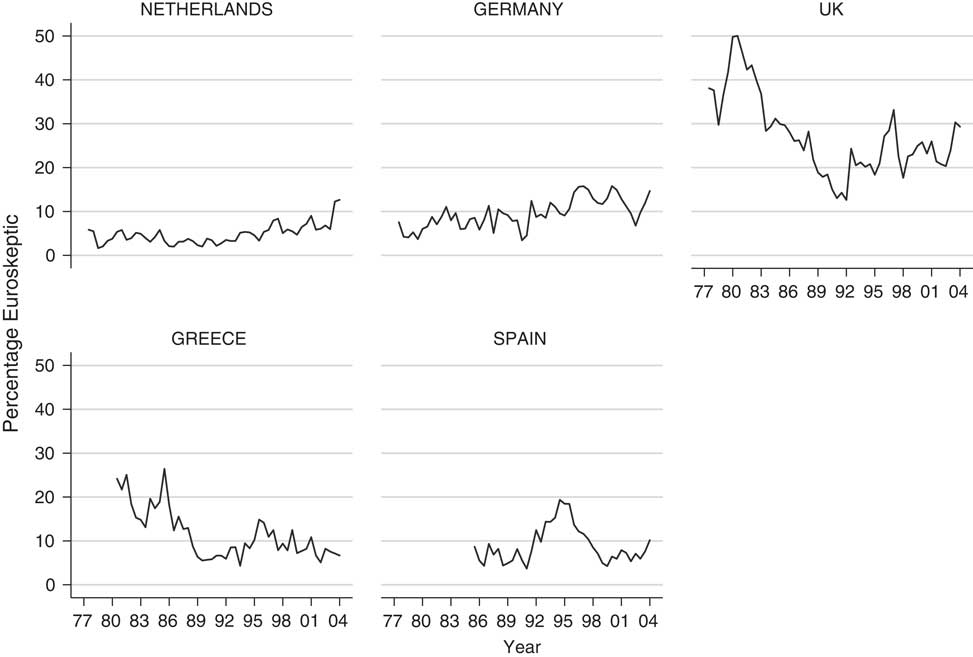
Although these findings appear to indicate that public opinion concerning the European Union is unrelated to transposition, these works do not account for the time-varying nature of public opinion. In each of these previous studies, public attitudes toward the EU were measured at one point in time, usually at the adoption of a directive by the EU. However, public attitudes toward the EU change with time. That is, public support for the EU and/or public opposition to the EU may be at one level at time t, but may be higher or lower at time t+1, and may again change at time t+2, and so on. In fact, the level of public opposition to the EU does vary over time, as can be seen in Figure 1, which graphs aggregate public opposition to the EU in five member states (the Netherlands, Germany, the United Kingdom, Greece, and Spain) from 1977 through 2004.
Aggregate Public Euroskepticism. Figure 1 graphs the percentage of respondents to each Eurobarometer study who believe that their country’s membership of the EU is a ‘bad thing’.

As transposition of a directive can last for years, measuring public attitudes toward the EU at a single point in time does not account for this dynamic nature, likely leading to misestimation of the effect of public attitudes on transposition. The question thus remains, what is the relationship between public attitudes toward European integration and the transposition of European directives?
Building upon the theoretical constructs of this previous literature and drawing on existing theories of policy responsiveness (e.g. Stimson et al., Reference Stimson, MacKuen and Erikson1995; Wlezien, Reference Wlezien1995, Reference Wlezien2004, etc.), this article tests the relationship between aggregate public attitudes toward the EU and the speed of transposition. By utilizing a methodological approach that accounts for the time-varying nature of public opinion, this study yields results that suggest that public opinion does influence member state transposition of directives. Specifically, higher levels of aggregate public opposition to the EU (Euroskepticism) in a member state are found to correlate with slower transposition.
Transposition, public opinion, and responsiveness
Myriad studies have examined policy responsiveness to public opinion (e.g. Miller and Stokes, Reference Miller and Stokes1963; Page and Shapiro, Reference Page and Shapiro1983; Stimson et al., Reference Stimson, MacKuen and Erikson1995; Wlezien, Reference Wlezien1995, Reference Wlezien2004; Erikson et al., Reference Erikson, Wright and McIver2002; Soroka and Wlezien, Reference Soroka and Wlezien2004; Bartle et al., Reference Bartle, Dellepiane-Avellaneda and Stimson2011; Bevan and Jennings, Reference Bevan and Jennings2014; Bølstad, Reference Bølstad2015, etc.), finding that governments, in general, tend to provide the public with their preferred policy (see e.g. Stimson et al., Reference Stimson, MacKuen and Erikson1995; Wlezien, Reference Wlezien1995, Reference Wlezien2004; Soroka and Wlezien, Reference Soroka and Wlezien2005, Reference Soroka and Wlezien2010). The general theoretical theme within this literature rests upon the idea that the public controls governments and parties through the threat of electoral retribution and/or the promise of electoral victory (see Ferejohn, Reference Ferejohn1986; Erikson et al., Reference Erikson, MacKuen and Stimson1993; Stimson et al., Reference Stimson, MacKuen and Erikson1995; Manza and Cook, Reference Manza and Cook2002; Hobolt and Klemmensen, Reference Hobolt and Klemmensen2008). In essence, governments wish to be reelected, and fear being turned out of office, therefore they provide the public with policies they prefer in the hope of gaining public support in the next election.
This basic theoretical framework can be applied to understanding the relationship between aggregate public attitudes toward the EU and the process of transposition. While it has been argued that policy-makers (i.e. governments and political parties) at the national level in Europe have confronted a tension between a need to represent and a need to be responsible, leading to a situation in which they have found it increasingly difficult to respond to public preferences (Mair, Reference Mair2009; also see Mair and Thomasson, Reference Mair and Thomasson2010), there is significant literature suggesting that policy-makers at the national level in Europe do represent and respond to the public (see e.g. Hakhverdian, Reference Hobolt and Klemmensen2012; Wlezien and Soroka, Reference Wlezien and Soroka2012; Williams, Reference Williams and Spoon2016). This is the crux of the idea of the postfunctionalist theory of integration, which argues that a constraining dissensus regarding the issue of European integration has arisen in the EU and its member states (Hooghe and Marks, Reference Hooghe and Marks2009; also see de Wilde, Reference de Wilde2012; Hutter and Grande, Reference Hutter and Grande2014).
The work regarding the idea of a constraining dissensus has suggested that between the 1950s and 1980s the public was largely uninvolved in the process of integration, allowing elites to progress integration without concern for public input (a permissive consensus). Public attention to the issue of European integration, however, began to grow in the 1990s, leading to the politicization of this issue. The need to represent the newly politicized public attitudes regarding European integration have constrained the ability of elites to push forward integration unimpeded (Hooghe and Marks, Reference Hooghe and Marks2009).
In line with this theoretical understanding, it follows that one may expect that public attitudes toward the European Union may influence the process of integration as policy-makers attempt to curry favor with the public. It has been suggested that higher aggregate public Euroskepticism in an EU member state indicates that the public of that state prefers less integration (Toshkov, Reference Toshkov2011). Thus, in a desire to win more votes, and ultimately secure reelection, governments in EU member states should respond to public attitudes concerning the EU. Generally speaking, responsiveness takes the form of government provision of preferred policies, in this case the provision of policies leading to either more or less integration (whichever is the public’s preferred policy). Policy-makers in the EU member state have multiple paths for influencing the process of integration. For example, governments can take Euroskeptic or Europhilic positions in the Council of Ministers and/or the European Council, or they can use tools provided by the European Union, such as the ‘Early Warning System’, to resist certain EU policies.Footnote 1 In fact, previous research has supported this understanding, suggesting that governmental policy-makers do respond to both Euroskepticism among other parties (Meijers, Reference Meijers2015; van de Wardt Reference Van de Wardt2015), as well as aggregate public attitudes toward the EU (Toshkov, Reference Toshkov2011; Bølstad, Reference Bølstad2015; Williams and Spoon, Reference Williams2015; Williams, Reference Williams and Spoon2016). Beyond the above modes of policy responsiveness, it is also possible that EU member state policy-makers attempt to respond to public preferences regarding the EU by influencing the process of transposition.
Transposition may be affected by public attitudes toward the EU as member state governments likely view it as an additional tool which allows them to respond to public integration preferences in the short term and appeal to the public in order to bolster reelection chances.Footnote 2 Recent research has found that policy-makers are responsive to public attitudes regarding the European Union, however, the public does not always recognize this responsiveness (Toshkov, Reference Toshkov2011).Footnote 3 In essence, whether the public is aware of government actions regarding transposition is less important than whether governments understand their actions concerning transposition as providing the public with its preferred policy. Previous studies have both theorized that governments view the implementation of new EU rules via transposition as an important aspect of integration, and have found that more Euroskeptic governments tend to delay transposition, while more Europhilic governments tend to transpose on time (Toshkov, Reference Toshkov2007, Reference Toshkov2008). Thus, it is reasonable to assume that member state governments understand transposition as essential to European integration, and therefore, will also use transposition as a tool to influence policy regarding integration in order to appeal to the public’s preferences, increasing the likelihood of reelection.
It should be noted that most directives are eventually transposed and implemented by governments. However, this long-term trend does not preclude the application of theories of policy responsiveness to the process of transposition. The causal mechanism of most theories of policy responsiveness, including those being applied in this study, is electoral incentive (see Ferejohn, Reference Ferejohn1986; Erikson et al., Reference Erikson, MacKuen and Stimson1993; Stimson et al., Reference Stimson, MacKuen and Erikson1995; Manza and Cook, Reference Manza and Cook2002; Wlezien, Reference Wlezien2004; Hobolt and Klemmensen, Reference Hobolt and Klemmensen2008). Short-term policy responses to public attitudes in order to bolster the likelihood of being returned to office in the next election, such as delaying the transposition of a directive when aggregate public Euroskepticism is greater, fit well with the expectations derived from these theories. In fact, the general long-term trend of directive transposition, with short-term delays is precisely what theories of policy responsiveness predict.
Theories of policy responsiveness argue that governments will provide the public with their preferred policy, and as public policy preferences change, the government will also alter policies (see Stimson et al., Reference Stimson, MacKuen and Erikson1995; Wlezien, Reference Wlezien1995, Reference Wlezien2004; Soroka and Wlezien, Reference Soroka and Wlezien2005, Reference Soroka and Wlezien2010; among others). As public policy preferences can change regularly (see Figure 1), theories of policy responsiveness imply short-term responsiveness. That is, a specific policy may be avoided by the government when it is unpopular with the public, however, that same policy may be enacted at a later time, without violating theoretical understandings of policy responsiveness, if public support for that specific policy becomes higher.
In the case of directive implementation, one would expect short-term delays in transposition when aggregate public Euroskepticism is greater, as governments respond to public attitudes by providing them with their preferred policy at that particular time. However, one would also expect member states to transpose in the long term, as public attitudes toward the EU are dynamic, and member states have an incentive to transpose directives when the public is less opposed to the EU.
Thus, from this understanding, it can be expected that higher levels of public opposition to the EU will result in governments slowing transposition.
Hypothesis Higher levels of aggregate public Euroskepticism in a member state result in slower transposition of EU directives in that state.
Research design
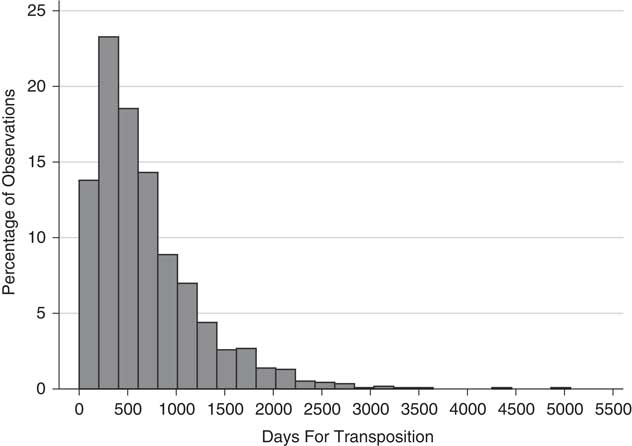
The dependent variable in this study is the time between the issuance of a directive and its transposition by each member state. The unit of analysis is the directive-state dyad. This variable is measured as the number of days that have elapsed between a directive’s publication in the EU’s official journal, and the publication of the first directive implementing measure in each member state’s official journal (for other research using a similar operationalization, see Berglund et al., Reference Berglund2006; Berglund, Reference Berglund, Gange and van Waarden2009; Steunenberg and Rhinard, Reference Steunenberg and Kaeding2010).Footnote 4 The most number of days to elapse between the issuance of a directive and its transposition is 5063 for Council Directive 89/105/EEC in Germany. The fewest number of days to elapse between the issuance of a directive and its subsequent transposition is 0 for Commission Directive 81/432/EEC also in Germany. The mean number of days for the transposition of a directive is 688.50, with a std. dev. of 558.73. The median is 875.Footnote 5 The distribution of this variable is displayed in Figure 2.
Distribution of dependent variable prior to expansion by Eurobarometer Surveys.

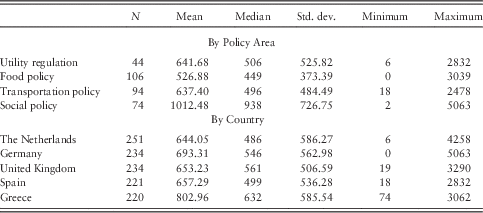
The data used to derive this measure are the same raw data used by Steunenberg and Rhinard (Reference Steunenberg and Kaeding2010). These data concern directives adopted by the EU in the policy areas of food legislation, social policy, transport policy, and utility regulation between 1 January 1978 and 1 January 2003. This end date is used in order to avoid cases in which member states may still be attempting to transpose directives (see Steunenberg and Rhinard, Reference Steunenberg and Kaeding2010). In total, there are 318 distinct directives in these data. Of the 318 directives, 44 concerned utility regulation, 106 focused on food policy, 94 addressed transportation policy, and 74 concerned social policy. For descriptive statistics concerning the dependent variable, including the mean, median, standard deviation, and minimum and maximum values by policy area see Table 1.
Descriptive statistics concerning transposition speed by policy area and country

These policy areas were chosen as they, ‘differ sufficiently in terms of the time at which they were developed at the European level, allowing for differences in policy characteristics and national transposition experiences’ (Steunenberg and Rhinard, Reference Steunenberg and Kaeding2010: 505). Additionally, these policy areas differ significantly in terms of policy substance and governmental function. For example, directives in the area of food legislation tend to be focused on ensuring a healthy food supply, such as Council Directive 78/664/EEC, which provides criteria for the level of purity necessary for antioxidants used in foodstuffs. On the other hand, directives in the area of transport policy tend to focus on the practices of transportation used in commerce and industry, like Council Directive 97/70/EC, which set up safety standards for fishing vessels >24 m in length. The differences in governmental function across these policy areas allows for more generalizable conclusions to be drawn from the findings of this study. Although, it should be noted, that without sampling from all policy areas, it is impossible to derive completely generalizable results.
The data further focuses on transposition by the governments of the Netherlands, Germany, the United Kingdom, Spain, and Greece. This set of countries was chosen as it:
… includes some of the founding member states of the Union as well as more recent members (UK in 1973, Greece in 1981, and Spain in 1986). Moreover, these countries display substantial variation on transposition performance, as indicated by the Commission’s transposition ‘scoreboards’ over the last couple of years, covering most of the variation that can be found between EU member states (Steunenberg and Rhinard, Reference Steunenberg and Kaeding2010: 505).
In essence, while the five countries used in this study do not provide a perfect representation of EU member states, they do provide a large degree of variation in many key aspects of transposition. However, it should be emphasized that these data do not include countries that joined the EU after 1995, and that the below results may, indeed, differ for these newer EU member states, particularly for EU member states in Eastern Europe.
In total, there are 1160 directive-state dyads in this data set. Of this full sample, 251 of the dyads concern the Netherlands, 234 of the dyads concern Germany, 234 of the dyads concern the United Kingdom, 221 of the dyads concern Spain, and the final 220 dyads concern Greece. For descriptive statistics concerning the dependent variable, including the mean, median, standard deviation, and minimum and maximum values by policy area see Table 1.
The structure of the original data used by Steunenberg and Rhinard was transformed to account for the time-varying nature of the independent variable (aggregate public Euroskepticism). As will be explained below, aggregate public Euroskepticism in each country changes with each new Eurobarometer survey. Therefore, each observation in the original data set is expanded by the number of Eurobarometer surveys that have been concluded between the publication of a directive at the EU level, and the subsequent transposition date of that directive in each member state.Footnote 6 This results in a total of 5386 observations.
Independent variable
The main independent variable of this study, aggregate public Euroskepticism is operationalized in two ways. These two measures are derived from Eurobarometer data from 1977 through 2004.Footnote 7 The first of these measures attempts to capture what Taggart and Szczerbiak (Reference Taggart and Szczerbiak2004) call ‘hard Euroskepticism’, or principled opposition to the European Union. This operationalization is the percentage of respondents to a survey who believe their country’s membership of the EU is ‘a bad thing’. The second of these operationalizations attempts to capture all Euroskepticism, including what Taggart and Szczerbiak (Reference Taggart and Szczerbiak2004) call ‘soft Euroskepticism’, or qualified opposition to one or more policies of the European Union. This measure is operationalized as the percentage of respondents to a survey who believe their country’s membership of the EU is either a ‘bad thing’, or ‘neither good nor bad’ (see van Elsas and van der Brug, Reference van Elsas and van der Brug2015 for a similar operationalization).Footnote 8 It must be noted that each Eurobarometer survey provides new values of aggregate public Euroskepticism, and new Eurobarometer surveys are concluded approximately every 6 months.Footnote 9 Thus, the measures of aggregate public Euroskepticism change biannually.
Additionally, as research suggests that time series public opinion data concerning Euroskepticism tend to be fractionally integrated (see Bølstad, Reference Bølstad2015), the above operationalizations of Euroskepticism were tested for stationarity. The null could not be rejected for either measure of aggregate public Euroskepticism in any member state, suggesting non-stationarity.Footnote 10 To address the non-stationarity of these measures, a Hodrick–Prescott filter, specifying a smoothing parameter of 400, was applied.Footnote 11 The values for the cyclical components derived by applying this filter to each of the measures of Euroskepticism in each EU member state were used as the measures of the main independent variable.
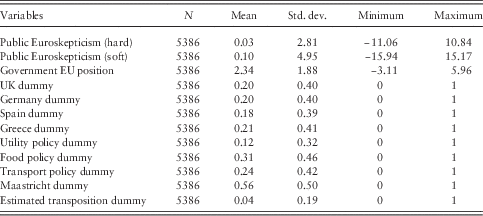
The range of the unfiltered aggregate public Euroskepticism variable measured as the percentage of respondents to a survey who believe their country’s membership of the EU to be a ‘bad thing’, or ‘hard Euroskepticism’, is 1.64 (Fall 1978 in the Netherlands) to 50.04 (Fall 1980 in the United Kingdom). The mean of this variable is 11.99 and the std. dev. is 8.39. The range for this measure after filtering is −11.06 (Fall 1978 in the United Kingdom) to 10.84 (Fall 1985 in Greece), with a mean of 0.03 and a std. dev. of 2.81.
The range of the unfiltered aggregate public Euroskepticism variable measured as the percentage of respondents to a survey who believe their country’s membership of the EU to be either a ‘bad thing’, or ‘neither good nor bad’, what can be understood to be ‘soft Euroskepticism’, is 9.37 (Spring 1991 in the Netherlands) to 76.11 (Spring 1981 in the United Kingdom), with a mean of 37.56 and a std. dev. of 14.78. The range for this measure after filtering is −15.94 (Fall 1990 in Germany) to 15.17 (Spring 1981 in Germany) with a mean of 0.11 and a std. dev. of 4.94 (descriptive statistics for all independent and control variables used in this study can be found in Table 2).
Descriptive statistics of independent and control variables

The public Euroskepticism figures represent this variable after filtering.
Control variables
Research has suggested numerous other variables beyond public attitudes toward the EU, that influence transposition delay and speed. These include, but are not limited to, factors such as, the length of time member states are granted to transpose a directive, the complexity of a directive, a directive’s status as either new or an amendment to a previous directive, whether a directive was issued solely by the European Commission through delegated powers, the intensity of European Commission monitoring of member states, member state experience with transposition, and the number of veto players involved in the transposition process (see Börzel, Reference Börzel2001; Tallberg, Reference Tallberg2002; Mastenbroek, Reference Mastenbroek2003; Borghetto et al., Reference Borghetto, Franchino and Giannetti2006; Kaeding, Reference Kaeding2006; Steunenberg and Kaeding, Reference Steunenberg and Rhinard2009; Steunenberg and Rhinard, Reference Steunenberg and Kaeding2010). While these variables are clearly important for explaining transposition as a process, it is unnecessary to include all known variables that could influence transposition delay/speed. Rather, only those variables that may confound the relationship between public attitudes and transposition speed need be included in the below analysis.
Therefore, for the purposes of this study, a number of control variables were included. First, a dummy variable for each country, using the Netherlands as the baseline category, was also included in the analysis. This controls for any unobservable factors that may influence both the speed of transposition as well as the level of aggregate public Euroskepticism in an EU member country (for additional studies including country dummy variables, see Steunenberg and Rhinard, Reference Steunenberg and Kaeding2010). Moreover, as differences exist in transposition delay across policy areas (Berglund et al., Reference Berglund2006), dummy variables for the different directive policy sectors (food legislation, social policy, transport, and utilities regulation) are included in this study, with social policy as the baseline policy domain. To control for the possibility that changes in institutional design of the EU across time affect transposition speed and public attitudes toward the EU, a dummy variable indicating whether an observation occurs in the Maastricht Treaty period is included.Footnote 12
Finally, the level of government support for the EU is included in two of the four main models of this study. Governmental support for the EU influences the timeliness of directive transposition as more Euroskeptic governments see delaying transposition as a tool for resisting integration, and less Euroskeptic governments see the timely transposition of directives as deepening integration (Toshkov, Reference Toshkov2007, Reference Toshkov2008). At the same time, government support for the EU likely has some influence on aggregate public Euroskepticism as research has suggested that the actions of policy-makers drive, to some degree, public policy preferences (see Wlezien, Reference Wlezien1995, Reference Wlezien2004 among others). The measure of government support for the EU was developed using data derived from the Comparative Manifestos Project (CMP; Volkens et al., Reference Volkens, Lehmann, Matthiess, Merz, Regel and Werner2015).Footnote 13
Analytical strategy
The dependent variable of this study necessitates the use of a duration model. Therefore, a Cox proportional hazard model is used in the below analysis. The Cox model is ideal as it is ‘particularly well suited to include [time-varying covariates]’ (Box-Steffensmeier and Jones, Reference Box-Steffensmeier and Jones2004: 103), and this extension of the Cox model can easily be calculated in Stata 13. Additionally, it is possible that the findings could be influenced by systematic effects at the directive level, thus, standard errors were clustered on the directive.Footnote 14
Analysis
The main hypothesis of this study suggests that higher levels of aggregate public Euroskepticism in a member state are related to slower directive transposition in that state, Following this hypothesis, one expects to see a statistically significant hazard ratio below 1.00 for each operationalization of this variable.
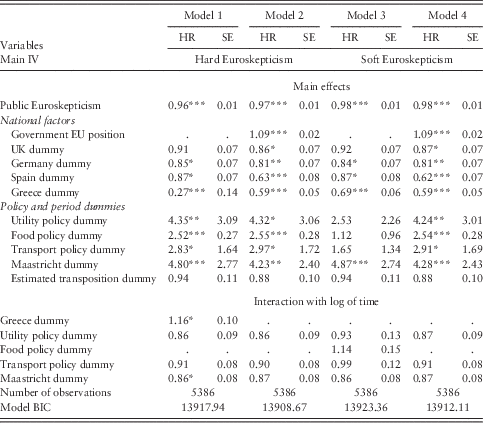
Model 1 (see Table 3 for models 1 through 4) is a test of this hypothesis using the operationalization of aggregate public Euroskepticism as ‘hard Euroskepticism’ (the percentage of respondents to a survey who believe their country’s membership of the EU is a ‘bad thing’), and does not include a measure of the government’s support for the EU.Footnote 15 The hazard ratio for aggregate public Euroskepticism in model 1 is 0.96 and is statistically significant at conventional levels.
Effect of public opinion on transposition

BIC=Bayesian information criterion; HR=Hazard ratio.
The main effects of each variable on the dependent variable are reported as a hazard ratio. The effects of the interaction of those variables that violate the proportional hazard assumption with the log of time are reported as a hazard ratio. The dependent variable is the time in days to transposition. The independent variable in models 1 and 2 is ‘hard Euroskepticism’ (i.e. percentage of respondents to a survey who believe their country’s membership of the EU is a ‘bad thing’). The independent variable in models 3 and 4 is ‘soft Euroskepticism’ (i.e. percentage of respondents to a survey who believe their country’s membership of the EU is either a ‘bad thing’, or ‘neither good nor bad’).
***P⩽0.01; **P⩽0.05; *P⩽0.10 in a two-tailed test.
Model 2 reports the results of a test of the above hypothesis, again using the operationalization of aggregate public Euroskepticism as ‘hard Euroskepticism’, however, this model includes a measure of the government’s support for the EU. In this model, aggregate public Euroskepticism again has a hazard ratio of <1.00 (0.97), and is statistically significant at the P⩽0.01 level. These findings lend support to the main hypothesis of this study, suggesting that high levels of aggregate public Euroskepticism, measured as only ‘hard Euroskepticism’, do lead to slower transposition of directives.
In models 3 and 4 the operationalization of aggregate public Euroskepticism used in models 1 and 2 is replaced with the operationalization of aggregate public Euroskepticism as ‘soft Euroskepticism’ (the percentage of respondents to a survey who believe their country’s membership of the EU is either a ‘bad thing’ or ‘neither good nor bad’). In model 3, which does not include a measure of the government’s support for the EU, the hazard ratio for the measure of aggregate public Euroskepticism is 0.98 and is statistically significant at the P⩽0.01 level.
Model 4 introduces the measure of government position regarding the EU as a control variable. As can be seen, the hazard ratio for aggregate public Euroskepticism is, again, below 1.00 and is statistically significant at the P<0.01 level. Similar to the results found in models 1 and 2, the findings of models 3 and 4 lend support for the above hypothesis, indicating that high levels of aggregate public Euroskepticism, measured as ‘soft Euroskepticism’, do lead to slower transposition of directives.
Taken together, models 1 through 4 all indicate that the level of aggregate public Euroskepticism, whether operationalized as ‘hard Euroskepticism’ or ‘soft Euroskepticism’, does, in fact, influence the speed at which European Union directives are transposed by EU member states. Further, relying on multiple operationalizations of the aggregate public Euroskepticism variable indicates a robustness to this finding.
Turning to substantive results, Bayesian information criterion suggest that model 2 fits best in explaining the effect of aggregate public Euroskepticism measured as ‘hard Euroskepticism’, and model 4 fits best in explaining the effect of aggregate public Euroskepticism measured as ‘soft Euroskepticism’. The hazard ratio of 0.97 in model 2 means that for every increase of 1 in aggregate public Euroskepticism (i.e. ‘hard Euroskepticism’) the likelihood of a directive being transposed at any given time decreases by 3%. The hazard ratio of 0.98 in model 4 suggests that for every increase of 1 in aggregate public Euroskepticism (i.e. ‘soft Euroskepticism’) the likelihood of a directive being transposed at any given time decreases by 2%. Although these substantive effects may appear small on the surface, one must keep in mind that this variable theoretically ranges from 0 to 100. Thus, the substantive effect of aggregate public Euroskepticism is actually quite sizable.
Regarding the control variables, one finds several to be related to transposition speed. In all four models, the hazard ratio for the Maastricht Treaty dummy variable is statistically significant and >1.00. This indicates that transposition has occurred more quickly since the Maastricht Treaty has come into force. Additionally, the policy dummy variables were all statistically significant and positive in models 1, 2, and 4. This suggests that directives in the areas of utility regulation, food policy, and transport policy are transposed more quickly than are social policy directives. It should be noted, however, that in model 3, none of the policy dummy variables are statistically significant, indicating that the findings of models 1, 2, and 4 may not be robust.
Moreover, many of the country dummy variables were statistically significant. Specifically, the dummy variables for Germany, Spain, and Greece were statistically significant with hazard ratios of <1.00 in all four models. This suggests that Germany, Spain, and Greece all transpose directives more slowly than does the Netherlands. Moreover, the United Kingdom dummy variable is found to be statistically significant in models 2 and 4. The hazard ratios for this variable in models 2 and 4 are below 1.00, indicating that the United Kingdom transposes directives more slowly than does the Netherlands, but the statistically insignificant finding in models 1 and 3 suggest that this finding may not be particularly robust.
Additionally, the hazard ratio of the variable denoting government support for the EU is positive and significant in all models in which it is included. This suggests, following the findings of Toshkov (Reference Toshkov2007, Reference Toshkov2008), that governments that are more positive toward the European Union transpose directives more quickly.
Finally, two variables, both in model 1, show statistical significance when interacted with the log of time. The interaction of the Greece dummy variable with the log of time is positive, indicating that the relationship between the Greece dummy variable and the speed of transposition grows stronger as time passes. The interaction of the Maastricht Treaty dummy variable with the log of time has a hazard ratio of 0.86, indicating that as time passes, the effect of the Maastricht Treaty on the speed of transposition decays. These findings, however, lack robustness.
Conclusion
This study sought to more thoroughly test the relationship between public attitudes concerning the European Union and the process of transposition. Previous research (Lampinen and Uusikylä, Reference Lampinen and Uusikylä1998; Kaeding, Reference Kaeding2006; Steunenberg and Rhinard, Reference Steunenberg and Kaeding2010) had examined this relationship, and found aggregate public support for the EU to be unrelated to the process of transposition. Extending this previous research through the use of extended Cox proportional hazard modeling and accounting for the time-varying nature of public attitudes toward the EU, the results of this study indicate that public attitudes toward the EU do influence the process of transposition.
Specifically, it was found above that higher levels of aggregate public Euroskepticism, measured as ‘hard Euroskepticism’ or ‘soft Euroskepticism’, in an EU member state are related to slower transposition of directives in that state. This supports the main hypothesis of this study, and provides corroboration of Hooghe and Marks’ (Reference Hooghe and Marks2009) theoretical assertion that the process of European integration is constrained by public attitudes regarding the European Union and European integration.
This finding has important implications for our understandings of both policy implementation and political responsiveness in Europe. First, this research informs our knowledge of the transposition process. Building on the ample literature concerning transposition delay (Lampinen and Uusikylä, Reference Lampinen and Uusikylä1998; Mbaye, Reference Mbaye2001; Mastenbroeck, Reference Mastenbroek2003; Kaeding, Reference Kaeding2006; Thomson, Reference Thomson2007, Reference Thomson2009; König and Luetgert, Reference König and Luetgert2009; Steunenberg and Rhinard, Reference Steunenberg and Kaeding2010) this work offers evidence that public opinion does influence transposition speed, and therefore that implementation of European public policy by member state governments is affected by the public. This suggests that transposition is not simply a bureaucratic process, but that it is also a political process.
Second, this study adds to a growing literature (see Franklin and Wlezien, Reference Franklin and Wlezien1997; Adams et al., Reference Adams, Haupt and Stoll2004, Reference Adams, Clark, Ezrow and Glasgow2006, Reference Adams, Clark, Ezrow and Glasgow2009; Hobolt and Klemmensen, Reference Hobolt and Klemmensen2008; Toshkov, Reference Toshkov2011; Bevan and Jennings, Reference Bevan and Jennings2014; Spoon and Klüver, Reference Spoon and Klüver2014; Bølstad, Reference Bølstad2015; Williams and Spoon, Reference Williams2015; Williams, Reference Williams and Spoon2016, etc.) concerning political responsiveness in the European Union and its member states. While most directives are eventually transposed, the above results indicate that member state governments respond to public attitudes concerning the issue of integration in the short term in the hopes of bolstering reelection bids, and they attempt to resist integration when the public is more negative toward the EU.
Interestingly, these findings also indicate that policy responsiveness is occurring in the policy implementation phase in EU member states. Although responsiveness is normally thought to exist in the policy-making phase, these results strongly suggest that governments are very adept at finding tools to respond to and appeal to public preferences.
It should be noted, this study is only one step in developing an understanding of how public opinion and transposition of European directives relate. The data used in this study covers four policy areas in five EU member states from 1978 to 2003. While the policy areas, countries, and years included in this study do provide a fairly representative sample in many regards, the findings above may not be entirely generalizable to other policy areas, countries, and time periods. Therefore, future research should increase the number of policy areas, countries, and years covered as data becomes available. This will aid in identifying any differences in the relationship between public opinion and transposition across different contexts. Specifically, expanding the number of countries in these data set will allow for an examination of the possibility that public opinion concerning the EU affects transposition differently in newer member states (i.e. Eastern European member states).
Additionally, it may prove interesting to move beyond the overall level of public attitudes toward the European Union, and examine how changes in aggregate public Euroskepticism are related to delays in transposition. Studying this relationship may give a fuller picture of how public opinion influences the process of transposition, and would serve as an additional test of the above theoretical assertions.
It may also be beneficial to examine how certain factors condition the effect of public attitudes concerning the EU on transposition speed. Research has found that greater issue salience increases the likelihood that political leaders respond to the public (Jacobs, Reference Jacobs1993; Jones, Reference Jones1994; Hobolt and Klemmensen, Reference Hakhverdian2005, Reference Hobolt and Klemmensen2008). Moreover, there is literature suggesting that policy-makers are more responsive to public demands as elections near (Canes-Wrone et al., Reference Canes-Wrone and Shotts2001; Canes-Wrone and Shotts, Reference Canes-Wrone, Herron and Shotts2004). Thus, directive salience and temporal proximity to elections may be important factors conditioning the relationship between public attitudes toward the EU and transposition, and these possible conditioning effects should be addressed in future research.
Finally, future research should go beyond the question of how public attitudes toward the EU affect transposition, and examine how public preferences in specific policy domains are related to the transposition of directives in those same domains. For example, if the public of a member state prefers more environmental regulation, and a directive reduces the level of environmental protection in Europe, will the member states delay its transposition?
Acknowledgments
The author would like to thank Jae-Jae Spoon, John Ishiyama, John Booth, T. David Mason, Tetsuya Matsubayashi, and those (too numerous to name) who provided feedback on this paper as it went through multiple iterations for all of their helpful comments, critiques, and insights.